Clash of the Titans: Noam Chomsky & Michel Foucault Debate Human Nature & Power on Dutch TV, 1971
Today, we’re revisiting the clash of two intellectual titans, Noam Chomsky and Michel Foucault. In 1971, at the height of the Vietnam War, the American linguist and the French theorist/historian of ideas appeared on Dutch TV to debate a fundamental question: Is there such a thing as innate human nature? Or are we shaped by experiences and the power of cultural and social institutions around us? The thinkers answered these questions rather differently, giving viewers a fairly succinct introduction to their basic theories of language, knowledge, power and beyond.
42 years later, you can watch the debate on YouTube in parts or in its entirety. Above you will find two excerpts that show you the highlights, complete with subtitles. Below you can watch the entire debate online, from start to finish. Subtitles should be provided, but if you have any problems, you can read a full transcript of the debate online (it’s entirely in English), or purchase a copy in book format.
Looking for free, professionally-read audio books from Audible.com? Here’s a great, no-strings-attached deal. If you start a 30 day free trial with Audible.com, you can download two free audio books of your choice. Get more details on the offer here.
If you would like to support the mission of Open Culture, consider making a donation to our site. It’s hard to rely 100% on ads, and your contributions will help us continue providing the best free cultural and educational materials to learners everywhere. You can contribute through PayPal, Patreon, and Venmo (@openculture). Thanks!
Related Content:
Michel Foucault: Free Lectures on Truth, Discourse & The Self (UC Berkeley, 1980–1983)
An Animated Introduction to Michel Foucault, “Philosopher of Power”
Noam Chomsky Spells Out the Purpose of Education
Jacques Lacan Speaks; Zizek Provides Free Cliffs Notes
Read More...Donald Barthelme’s Syllabus Highlights 81 Books Essential for a Literary Education
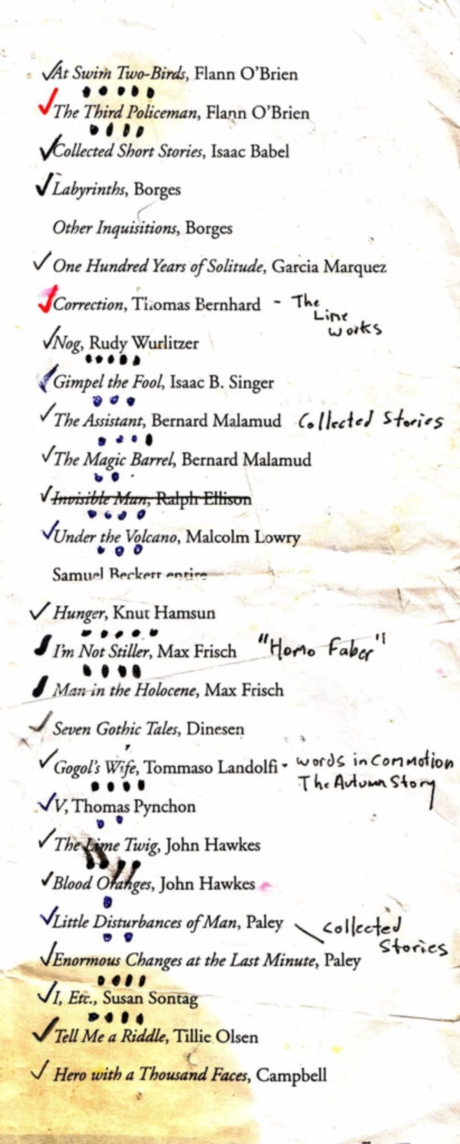
We’ve had a lot of fun—and some debate—lately with reading lists from people like Carl Sagan, Neil DeGrasse Tyson, and even Marilyn Monroe (via her library). And we’ve featured undergraduate syllabi from the teaching days of David Foster Wallace and W.H. Auden. Now for something more-or-less formal than those. This one comes via a 2003 piece by Kevin Moffett in McSweeney’s spin-off The Believer (10 years old this month—I know, right?). The list (first page above and full list below) has a somewhat illustrious heritage. Compiled by postmodernist writer Donald Barthelme for his students at the University of Houston, it then made its way to Barthelme’s student, Southern writer Padgett Powell. The list then came to Moffett when he was a student of Powell’s at the University of Florida.
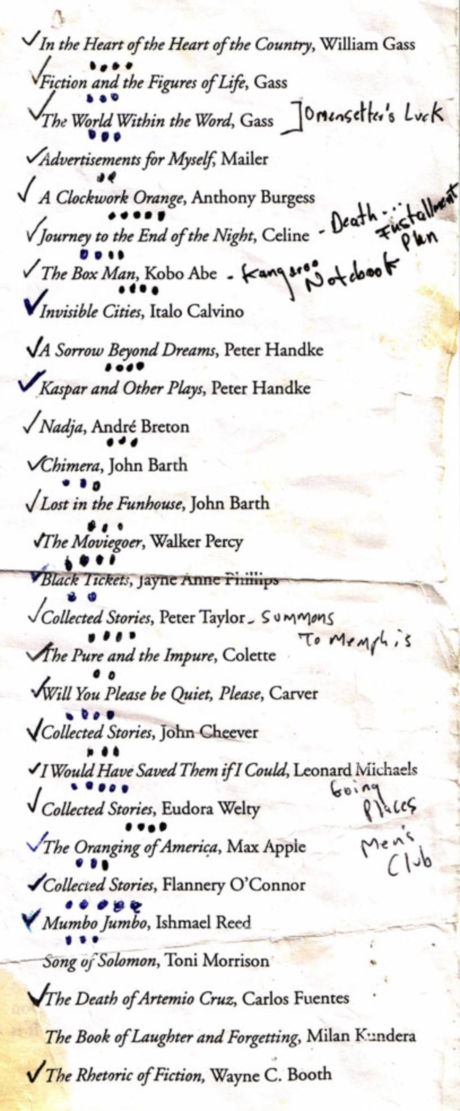
Consisting of 81 books, mostly novels and short story collections (and the work of Samuel Beckett—“entire”), and mostly twentieth-century modernist fiction, the list came to Powell with Barthelme’s instruction to attack the books, “in no particular order, just read them.”
This Moffett did, and his story of how he sought the books—in the used bookshops, warehouse sales, and libraries of north Florida—lends to his experience the air of a suburban knight’s quest tale, with Moffett as underdog hero. The list spans a range of difficulty, from the academic obscurantism of Roland Barthes to the general accessibility of Updike (Barthelme modestly exempts himself). But the text that turns Moffett from diffident to avid reader, Flannery O’Connor’s “A Late Encounter With the Enemy,” also turns his “resolution into a vow.” It’s almost as though his engagement with Barthelme’s list initiates him into a mystical order of language.
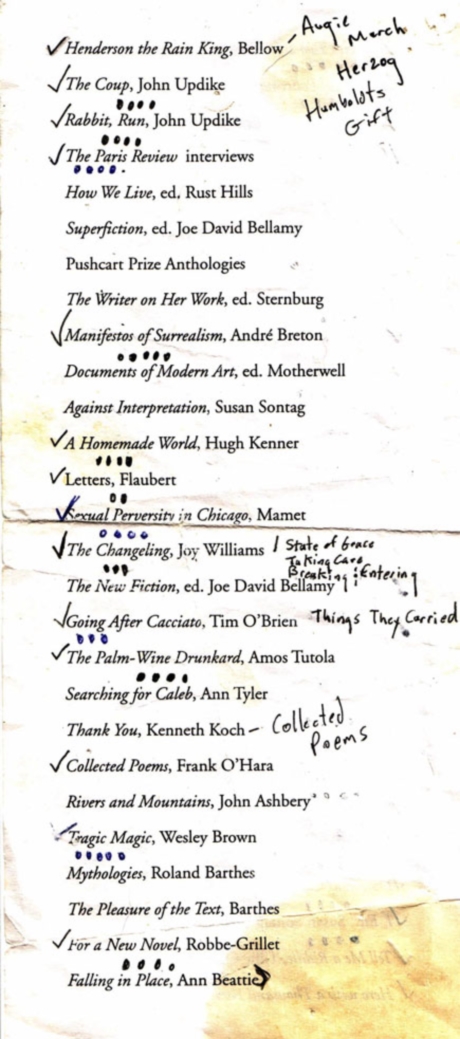
The list itself, as you can see from the scans, shows the wear of several pairs of hands—hands holding late-night coffees in college-town cafes and felt-tip pens with which to make tiny checkmarks of accomplishment. We do not know from Moffett’s piece whose hands did the coffee-spilling, checkmarking, and annotating, whether Powell’s, Moffett’s, or some student or private reader unmentioned. Some of the books left unchecked are those with which I have had readerly epiphanies: Borges’ Other Inquisitions, Barthes’ Mythologies, Beckett (“entire”), Toni Morrison’s Song of Solomon. And what strikes me, as with all such lists, are the number of books I haven’t read but have wished to, meant to, promised that I would. Perhaps it’s not too late to turn a resolution to a vow and hit the stacks.
Here is the complete list:
- Flann O’Brien, At Swim Two-Birds
- Flann O’Brien, The Third Policeman

- Isaac Babel, Collected Short Stories
- Borges, Labyrinths
- Borges, Other Inquisitions
- Garcia Marquez, One Hundred Years of Solitude
- Thomas Bernhard, Correction
- Rudy Wurlitzer, Nog
- Isaac B Singer, Gimpel the Fool
- Bernard Malamud, The Assistant
- Bernard Malamud, The Magic Barrel
- Ralph Ellison, Invisible Man
- Malcolm Lowry, Under the Volcano
- Samuel Beckett entire
- Knut Hamsun, Hunger
- Max Frisch, I’m Not Stiller
- Max Frisch, Man in the Holocene
- Dinesen, Seven Gothic Tales
- Tommaso Landolfi, Gogol’s Wife
- Thomas Pynchon, V
- John Hawkes, The Lime Twig
- John Hawkes, Blood Oranges
- Paley, Little Disturbances
- Paley, Enormous Changes at the Last Minute
- Susan Sontag, I, Etc.
- Tillie Olsen, Tell Me a Riddle
- Campbell, Hero with a Thousand Faces
- Bellow, Henderson the Rain King
- John Updike, The Coup
- John Updike, Rabbit, Run
- The Paris Review interviews
- Rust Hills (ed.), How We Live
- Joe David Bellamy (ed.), Superfiction
- Puschart Prize Anthologies
- Sternburg (ed.), The Writer on Her Work
- André Breton, Manifestos of Surrealism
- Motherwell (ed.), Documents of Modern Art
- Susan Sontag, Against Interpretation
- Hugh Kenner, A Homemade World
- Flaubert, Letters
- Mamet, Sexual Perversity in Chicago
- Joy Williams, The Changeling
- Joe David Bellamy (ed.), The New Fiction
- Tim O’Brien, Going After Cacciato
- Amos Tutola, The Palm-Wine Drunkard
- Ann Tyler, Searching for Caleb
- Kenneth Koch, Thank You
- Frank O’Hara, Collected Poems
- John Ashbery, Rivers and Mountains
- Wesley Brown, Tragic Magic
- Roland Barthes, Mythologies
- Barthes, The Pleasure of the Text
- Robbe-Grillet, For a New Novel
- Ann Beattie, Falling in Place
- William Gass, In the Heart of the Heart of the Country
- Gass, Fiction and the Figures of Life
- Gass, The World Within the Word
- Mailer, Advertisements for Myself
- Anthony Burgess, A Clockwork Orange
- Celine, Journey to the End of the Night
- Kobo Abe, The Box Man
- Italo Calvino, Invisible Cities
- Peter Handke, A Sorrow Beyond Dreams
- Peter Handke, Kaspar and Other Plays
- André Breton, Nadja
- John Barth, Chimera
- Walker Percy, The Moviegoer
- Jayne Anne Phillips, Black Tickets
- Peter Taylor, Collected Stories
- Colette, The Pure and the Impure
- Carver, Will You Please be Quiet, Please
- John Cheever, Collected Stories
- Leonard Michaels, I Would Have Saved Them if I Could
- Eudora Welty, Collected Stories
- Max Apple, The Oranging of America
- Flannery O’Connor, Collected Stories
- Ishmael Reed, Mumbo Jumbo
- Toni Morrison, Song of Solomon
- Carlos Fuentes, The Death of Artemio Cruz
- Milan Kundera, The Book of Laughter and Forgetting
- Wayne C Booth, The Rhetoric of Fiction


Related Content:
Neil deGrasse Tyson Lists 8 (Free) Books Every Intelligent Person Should Read
Carl Sagan’s Undergrad Reading List: From Plato and Shakespeare, to Huxley and Gide
Josh Jones is a writer, editor, and musician based in Washington, DC. Follow him @jdmagness
Read More...Rare Live Footage Documents The Clash From Their Raw Debut to the Career-Defining London Calling (1977–1980)
For all their leftist political fervor, musical richness, and fiercely uncompromised delivery, The Clash still suffered accusations that they sold out when they signed what looked like a relatively lucrative deal with CBS records in 1977. Those charges came from grassroots fans and critics like Mark Perry, who wrote in his seminal British punk fanzine Sniffin’ Glue that “Punk died the day The Clash signed to CBS.” A a couple years later, they were grandiosely billed as “the only band that matters,” a quote then CBS employee and NYC-based guitarist Gary Lucas takes credit for. While they would come to regret the CBS deal, even after their breakup in 1986, it’s also undoubtedly true that their uncomfortable tenure with the corporate giant helped their early, career-defining work reach a much wider public—and, as one writer argues, may even have broken barriers for the rise of independent punk labels.
But enough about commerce—I’ll let the music speak. In video above, the band performs at Sussex University Brighton on May 25, 1977. This show, part of the White Riot Tour, marks the beginning of their time with CBS, shortly after the release of debut album, The Clash. In very washed-out, grainy black and white, watch them play “Capital Radio,” “Protex Blue,” “Cheat,” and “Remote Control.” Joe Strummer begins the set with a nod to the band’s own sense of how much they “mattered,” mumbling “Okay, ‘Capital Radio’… with words that mean something” before they tear into the track.
In the second part of this footage (above) the band bangs out “White Riot” and “Police and Thieves.” It’s hardly a quality editing job, here, and the audio is mostly boomy reverb (despite the major label deal), but it’s still some pretty amazing archival footage. One thing to note is that this 1977 film documents the band after a crucial lineup change. While drummer Terry Chimes played on recorded versions of these songs (credited as “Tory Crimes” on record), he left the band soon after, to be replaced by the excellent “Topper” Headon (Chimes returned in 1982 when Headon was overcome by his heroin addiction). Their headlining White Riot Tour included supporting bands The Jam, The Buzzcocks, and The Slits.
If debut album The Clash was mostly raw, gritty punk rock with sprinklings of reggae, and the follow-up Give ‘Em Enough Rope a little too polished for some fans (at CBS’s insistence), the double album London Calling surely marks the band’s writing and recording apex. It tops so many critics’ “top” lists that I hardly need say more about it to introduce the high-quality film above of a February 27, 1980 Paris show. The contrast between the White Riot tour footage and this is stark: we get full-color, well-lit video and fairly decent live sound, and the band is much tighter, having worked a full three years at this point with drummer Headon. The above set includes London Calling classics like the title track, “Wrong ‘Em Boyo,” “Jimmy Jazz,” and “Train in Vain.” Part of what the contrast between these two sets of footage signifies is the increasing confidence and polish of The Clash as they made their way from their first gig at the Black Swan opening for the Sex Pistols in ’76 to the worldwide punk phenomenon they became by 1980. If it’s true The Clash sold out, they mostly did it with more style and integrity than pretty much anyone before or since.
Related Content:
The Clash Live in Tokyo, 1982: Watch the Complete Concert
The Clash: Westway to the World
Mick Jones Plays Three Favorite Songs by The Clash at the Library
Josh Jones is a writer, editor, and musician based in Washington, DC. Follow him @jdmagness
Read More...Inside the Making of Dr. Strangelove: Documentary Reveals How a Cold War Story Became a Kubrick Classic
Stanley Kubrick directed Dr. Strangelove: Or, How I Learned to Stop Worrying and Love the Bomb, but viewers only familiar with his more overtly lavish films—The Shining, A Clockwork Orange, 2001: A Space Odyssey—might not realize it at first. (Unless, of course, they paid attention to its distinctive Pablo Ferro-designed opening credits.) Kubrick’s fifth feature, released in 1964 and set in that same era, did not require the director and his collaborators to build an entire space station, nor to write dialogue in the specialized slang of the hooligans of London’s apocalyptic future, nor to release crashing waves of blood from elevator doors. A few rough-and-ready flying and shooting sequences aside, the physical production of Dr. Strangelove required only the accoutrements of the United States military—mostly real, some imagined.
Yet more than a few of Kubrick’s fans now hold up Dr. Strangelove as the director’s most intricate work. By my own highly personal measure of the sheer frequency with which I can watch the movie (I attend nearly every theatrical screening, no matter what), it certainly ranks as his richest.
This owes in large part to Kubrick’s signature perfectionism, which forged Dr. Strangelove as much as it did the films that followed. Watch Inside: Dr. Strangelove (part one, part two, part three, part four, part five), and you can learn just what went into filming this story of a crazed general, a gung-ho bomber, a frustrated RAF captain, a German nuclear scientist in mortal combat with his own right hand, and the looming prospect of mutually assured destruction. Interviews with cast members, critics, editors, producers and others associated with the picture reveal how this Cold War worst-case-scenario developed into something so very… Kubrickian. And into a Kubrickian comedy, at that.
Related Content:
Rare 1960s Audio: Stanley Kubrick’s Big Interview with The New Yorker
Stanley Kubrick’s Very First Films: Three Short Documentaries
Peter Sellers Gives a Quick Demonstration of British Accents
Colin Marshall hosts and produces Notebook on Cities and Culture and writes essays on literature, film, cities, Asia, and aesthetics. He’s at work on a book about Los Angeles, A Los Angeles Primer. Follow him on Twitter at @colinmarshall.
Read More...The Math in Good Will Hunting is Easy: How Do You Like Them Apples?
Perhaps you remember the scene (above) in Gus Van Sant’s 1997 film, Good Will Hunting. MIT professor Gerald Lambeau, winner of the coveted Fields Medal, challenges his graduate students to solve a math problem that he, himself, spent two years trying to crack. That set the bar pretty high. So, imagine everyone’s surprise when Will Hunting, a janitor at MIT played by Matt Damon, wrestles the problem to the ground without breaking a mental sweat.
?t=13s
Well, not quite everyone was surprised, especially not the mathematicians behind the Numberphile video series. Right above James Grime, who resides at the Department of Mathematics and Theoretical Physics at Cambridge University, breaks down the famous “Homeomorphically Irreducible Trees of Degree Ten” problem. And, it turns out, it’s a problem mere mortals can solve fairly easily at home.
Numberphile also offers a quick bonus video that tries to answer another tough question: Who was the real Will Hunting? Who was the character modeled after? There are a few prime candidates.…
If you would like to support the mission of Open Culture, consider making a donation to our site. It’s hard to rely 100% on ads, and your contributions will help us continue providing the best free cultural and educational materials to learners everywhere. You can contribute through PayPal, Patreon, and Venmo (@openculture). Thanks!
Related Content:
Mathematics in Movies: Harvard Prof Curates 150+ Scenes
Calculus Lifesaver: A Free Online Course from Princeton
Read More...The Mirroring Mind: An Espresso-Fueled Interpretation of Douglas Hofstadter’s Groundbreaking Ideas
Today, Jason Silva serves up another philosophical espresso shot with The Mirroring Mind, a two-minute video inspired by the ideas explored in Douglas Hofstadter’s influential book, Gödel, Escher, Bach: An Eternal Golden Braid. The film — which you may need to watch twice, ideally after you’ve had your own stiff cup of coffee — offers Silva’s “interpretation of Strange Loops of Self Reference, recursion, and the emergence of consciousness and self-awareness.” Once you’ve got a handle on things, you can watch Silva’s previous films on The Immersive Power of Cinema, The Biological Advantage of Being Awestruck, and The Gospel of Radical Openness.
Follow us on Facebook, Twitter and now Google Plus and share intelligent media with your friends! They’ll thank you for it.
Read More...The “Amen Break”: The Most Famous 6‑Second Drum Loop & How It Spawned a Sampling Revolution
So much of what enters the popular lexicon depends upon small happy accidents: chance encounters, misreadings, gaffes, extemporaneous bursts of inspiration. Artists attuned to the strange in the mundane pick up on odd moments of beauty and weirdness and redeploy them in new works. And in the dawn of the digital age, that redeployment accelerates to such a degree that one such moment can spawn whole movements in months.
This is sort of what happened with the so-called “Amen Break,” perhaps the most sampled six seconds of music in digital history. As the brief 2004 video above—from artist and writer Nate Harrison—explains, the Amen break “has been used as the rhythmic backdrop in everything from late 80s gangster rap to corporate America’s recycling hip-hop forms to sell things like Jeeps and blue jeans to suburban America.”
The Amen Break originated in humble circumstances, as the drum break on a B‑side recording from DC-based soul group the Winstons. Having run out of material, the Winstons decided to record an instrumental of gospel standard “Amen, Brother” on the obverse of their now-mostly-forgotten, but once Grammy-winning 1969 R&B hit “Color Him Father.” It’s possible you’ll recognize the tune of “Amen, Brother” (above), but I guarantee you’ll know the “Amen Break” (below, in three speeds), performed by Winstons’ drummer G.C. Coleman. It’s everywhere.
Long before the Amen Break’s crude use in advertising, it was a keystone in such diverse cultural moments as black nationalist group Public Enemy’s “Bring the Noise”—from their ferocious 1988 groundbreaker It Takes a Nation of Millions to Hold Us Back—to N.W.A.’s “Straight Outta Compton,” to the theme song of Matt Groening’s Futurama. And as this Economist article explains, the Amen break also underlay the 90s British rave-culture phenomena known as jungle and drum & bass. (BBC radio even produced an hour-long segment on the Amen Break, interviewing pioneers and mainstays of the rave scene). The re-use of the Amen Break began in the 1980s with the sampler, which gave DJs and bedroom producers the ability to create new soundscapes from old records, usually as backing tracks for rappers (such as New York producer Mantronix’s “King of the Beats”).
As the Amen Break became more popular, and hip hop DJs more organized and in-demand, it worked its way onto the first official release of a compilation specifically for rap DJs called Ultimate Breaks and Beats, a series that collected classic rhythm tracks of rock, funk, and pop songs stripped of their vocals. And as its use evolved in a British context, says Nate Harrison in his history at the top, “Amen tracks” reached levels of “highbrow posturing” in which the speed and lack of syncopation lead to undanceable “absurdities.” No doubt jungle purists would sneer at Harrison’s contention, but take a listen to the track he references, UK artist Squarepusher’s 1997 “Vic Acid” (below) and decide for yourself. (Other Amen jungle tracks, like Shy FX’s “Original Nuttah” crash along at even more jackhammer speeds).
However, while the Amen Break was clipped and re-sequenced into greater levels of abstraction by IDM experimentalists like Squarepusher, one particularly fascinating effect of its meme-ification is its passage from original live drum break, to ubiquitous sample, then back to a part played again by live drummers, such as YouTube “Hi-Hat Master” Ydna Murd below.
It may be the case that almost every drummer who came of age in the late eighties and nineties plays some version of the Amen Break. But just what constitutes the endless appeal of this snippet of sound, and how did the looping of a few bars of drumming help lay the foundation for several new genres of music in the late 2oth century? The author of The Economist piece on the Amen break speculates it’s drummer G.C. Coleman’s individual style as well as certain qualities of the recording:
Amen also has certain sonic qualities that set it aside from its rivals. Rather than keeping time with a hi-hat, Coleman uses the loose sound of the ride cymbal, filling out the aural space. And the recording has a “crunch” to it, says Tom Skinner, a London-based session drummer: “That quality is appealing to beatmakers.” The pitched tone of the snare drum is particularly distinctive; as any junglist will tell you, a snare can be as evocative as a smell.
Author Michael S. Schneider, however, has a more rarified answer: he speculates that the Amen break has the properties of the geometric golden mean, that ancient Greek proportion that supposedly describes the shape of truth and beauty.
Is this likely? Was Winstons’ drummer Coleman channeling Apollonian ratios from the collective unconscious, or was he just doing his thing, playing his heart out? If Coleman himself had some insight into why the Amen Break exploded, we will never know; he died in 1996. And for all of the creative recycling of the Amen Break, neither Coleman nor Winstons’ bandleader Richard L. Spencer ever received a dime in royalties, a fact that has left Spencer—who calls the use of the break plagiarism—somewhat bitter. But British music journalist Simon Reynolds puts it this way: “It’s a bit like the man who goes to the sperm bank and unknowingly sires hundreds of children.” Hundreds of children, he might have added, beloved by millions of music fans across the globe.
a big h/t goes to @kirstinbutler
Related Content:
All Hail the Beat: How the 1980 Roland TR-808 Drum Machine Changed Pop Music
The History of Music Told in Seven Rapidly Illustrated Minutes
Josh Jones is a writer, editor, and musician based in Washington, DC. Follow him @jdmagness
Read More...Eric Clapton in the 60s: Film Revisits the Young Guitarist When He Took the Rock World by Storm
In recent decades, Eric Clapton has settled into a kind of commercially comfortable respectability. His songs, like “Tears From Heaven” and “My Father’s Eyes,” are easy on the ears but hard to get enthused about. So it might be difficult for those of younger generations to understand how Clapton’s guitar playing once inspired fanatics to spray-paint “Clapton is God” across walls all over London.
This two-hour documentary takes us back to those exciting times: to when Clapton joined the Yardbirds at the age of 18, only to leave a year and a half later because he was unhappy with the band’s commercialism; to his legendary blossoming as an electric blues guitar virtuoso with John Mayall & the Bluesbreakers; to his emergence as a superstar with Cream and his brief experiment with Blind Faith. The film explores the early development of Clapton’s playing through interviews with fellow musicians Mayall, Chris Dreja, Ben Palmer, Neil Innes and others, along with Cream producr Bill Halverson and a group of veteran music journalists.
Eric Clapton–The 1960’s Review is not the film to watch for extended musical performances by Clapton, but it’s a great way to learn more about what made him, if not God, certainly one of the greatest blues and rock guitarists of all time.
Related content:
A Young Eric Clapton Demonstrates the Elements of his Guitar Sound
Read More...Watch Powers of Ten and Let Designers Charles & Ray Eames Take You on a Brilliant Tour of the Universe
All our childhood homes contained books we couldn’t quite explain. I remember feeling particularly mystified, though not displeasingly so, by a slim volume called Cosmic View, originally published in 1957. The book seemed to me unimaginably old, strikingly lavish, and faintly alien, like a visual time capsule from a forgotten era in a parallel reality.
The outlandish name of the author, Kees Boeke—surely not a name at all—only strengthened these imaginative impressions. Every few months, I would flip through and wonder at Cosmic View’s full-page images. A girl with a cat? Planetary orbits? The galaxy itself? A bug? A cell?
I suppose I could have read a bit of the text and understood the context for all of this, but I preferred at the time to leave the strange little volume’s rhyme or reason obscure. Today I understand Boeke’s aim: to view our universe at every possible scale, cosmic and otherwise, zooming all the way in and then all the way out from our everyday perspective.
The 1977 short film Powers of Ten would do the same, but in motion. Taking Cosmic View as a starting point, Charles and Ray Eames’ iconic little film (first above) starts with a fixed point in Chicago, then moves out into the universe by factors of ten. And, before too long, you find yourself 100 million light years away. It’s eight minutes of brilliant work. But they didn’t come easily. Almost a decade before releasing Powers of Ten, the Eames produced a less widely seen prototype. 1968’s A Rough Sketch for a Proposed Film Dealing with the Powers of Ten and the Relative Size of Things in the Universe reveals some of the thinking and process the American designers undertook to envision a cinematic Cosmic View. They ultimately succeeded, having fleshed out this basic but still impressive concept over the following decade. In 1982, the project would come full circle by returning to print with Powers of Ten: A Book About the Relative Size of Things in the Universe and the Effect of Adding Another Zero.
Related Content:
Powers of Ten: 1977 Short Film by Designers Ray & Charles Eames Gives Brilliant Tour of Universe
Charles and Ray Eames’ Powers of Ten: The Classic Film Re-Imagined By 40 Artists
Magnifying the Universe: Move From Atoms to Galaxies in HD
Colin Marshall hosts and produces Notebook on Cities and Culture and writes essays on literature, film, cities, Asia, and aesthetics. He’s at work on a book about Los Angeles, A Los Angeles Primer. Follow him on Twitter at @colinmarshall.
Read More...FOUND: A New Collection of Rare Photos from the National Geographic Archives
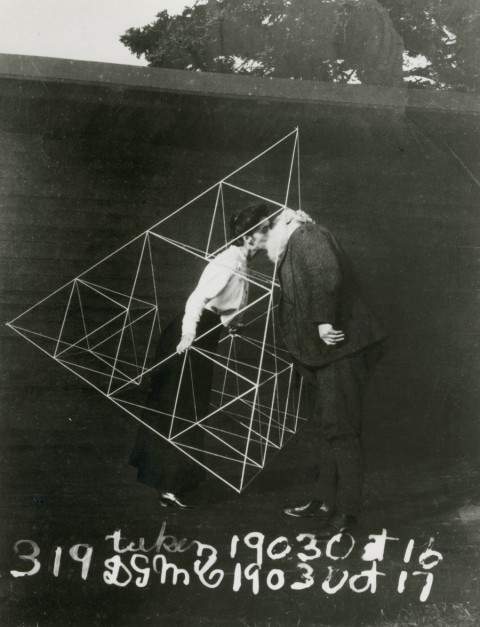
Ladies and gentlemen, we present FOUND, a new site that features a curated collection of photography from the National Geographic archives. Launched as part of NatGeo’s 125th anniversary celebration (hopefully we’re around in another 119 years too!), FOUND showcases “photographs that reveal cultures and moments of the past.” Many of these rare photos have never been published. We picked an immediate favorite from the collection: Alexander Graham Bell and his wife Mabel kissing within a tetrahedral kite, one of his many inventions, in October 1903. You can start perusing the photo archive here.
via Kottke
Follow us on Facebook, Twitter and Google Plus and we’ll make it easy to share intelligent media with your friends!
Read More...Support Us
We're hoping to rely on loyal readers, rather than erratic ads. Please click the Donate button and support Open Culture. You can use Paypal, Venmo, Patreon, even Crypto! We thank you!

About Us

Open Culture scours the web for the best educational media. We find the free courses and audio books you need, the language lessons & educational videos you want, and plenty of enlightenment in between.
Advertise With Us

FREE UPDATES!
GET OUR DAILY EMAIL
Get the best cultural and educational resources on the web curated for you in a daily email. We never spam. Unsubscribe at any time.
FOLLOW ON SOCIAL MEDIA

Open Culture editor Dan Colman scours the web for the best educational media. He finds the free courses and audio books you need, the language lessons & movies you want, and plenty of enlightenment in between.
Advertise With Us

