Dial-a-Poem: The Groundbreaking Phone Service That Let People Hear Poems Read by Patti Smith, William S. Burroughs, Allen Ginsberg & More (1968)
Thanks for allowing me to be a poet. A noble effort, doomed, but the only choice. —John Giorno, Thanx for Nothing
Dialing a poem today, I’m connected to Joe Brainard, who died of AIDS-related pneumonia in 1994, reading an excerpt of “I Remember.” He stumbles over some words. It’s exciting. There’s a feeling of immediacy. When the reading ends in an old-fashioned dial tone, I immediately think of a half-dozen friends I’d like to call (assuming they respond to something that’s not a tag or text).
“Take down this number,” I’d say. “641–793-8122. Don’t ask questions. Just call it. You’ll love it.”
And they probably would, though they wouldn’t hear the same recording I did.
As Dial-A-Poem’s founder, the late John Giorno, remarked in a 2012 interview:
A person asked me the other day: “What happens if I listen to a poem and I want to tell a friend to listen to it?” I told him: “Well, she can’t.” [laughs] That’s the point. What happens is, when things are really successful, you create desire that is unfulfillable. That’s what makes something work.
Giorno established Dial-A-Poem in 1968, placing ten landlines connected to reel-to-reel answering machines in a room in New York City’s Architectural League:
I sort of stumbled on [the concept] by chance… I was talking to someone on the telephone one morning, and it was so boring. I probably had a hangover and was probably crashing, and I got irritable and said to myself at that moment, “Why can’t this be a poem?” That’s how the idea came to me. And we got a quarter of a page in The New York Times with the telephone number you could dial.
In its first four-and-a-half months of operation, Dial-A-Poem logged 1,112,237 incoming calls, including some from listeners overseas. (The original phone number was 212–628-0400.) The hours of heaviest traffic suggested that a lot of bored office workers were sneaking a little poetry into their 9‑to‑5 day.
Dial-A-Poem reconceived of the telephone as a new media device:
Before Dial-A-Poem, the telephone was used one-to-one. Dial-A-Poem’s success gave rise to a Dial-A-Something industry: from Dial-A-Joke, Dial-A-Horoscope, Dial-A-Stock Quotation, Dial Sports, to the 900 number paying for a call, to phone sex, and ever more extraordinary technology. Dial-A-Poem, by chance, ushered in a new era in telecommunications.
Featured poets included such heavy hitters as William S. Burroughs, Patti Smith, Allen Ginsberg, Ted Berrigan, Robert Creeley, Sylvia Plath, Charles Bukowski, and Frank O’Hara (who “only liked you if you wrote like him”).
The content was risqué, political, a direct response to the Vietnam War, the political climate, and social conservatism. No one bothered with rhymes, and inspiration was not necessarily the goal.
Unlike Andy Warhol, Jasper Johns, and other career-minded artists who he hung out with (and bedded), Giorno never made a secret of his homosexuality. Sexually explicit and queer content had a home at Dial-a-Poem.
Meanwhile, Dial-a-Poem was featured in Junior Scholastic Magazine, and dialing in became a homework assignment for many New York City Public School students.
Two twelve-year-old boys nearly scuppered the project when one of their mothers caught them giggling over the Jim Carroll poem, above, and raised a ruckus with the Board of Ed, who in turn put pressure on the telephone company to discontinue service. The New York State Council on the Arts’ lawyers intervened, a win for horny middle schoolers… and poetry!
For anyone interested, an album called You’re A Hook: The 15 Year Anniversary Of Dial-A-Poem (1968–1983) was released in 1983. Vinyl copies are still floating around.
If you dial 641.793.8122, you can still access recordings from an archive of poetry, notes SFMoMA.
via Messy Nessy
Related Content:
Stream Classic Poetry Readings from Harvard’s Rich Audio Archive: From W.H. Auden to Dylan Thomas
Cartoonist Lynda Barry Reveals the Best Way to Memorize Poetry
Ayun Halliday is an author, illustrator, theater maker and Chief Primatologist of the East Village Inky zine. She most recently appeared as a French Canadian bear who travels to New York City in search of food and meaning in Greg Kotis’ short film, L’Ourse. Follow her @AyunHalliday
Read More...Revisit Kate Bush’s Peculiar Christmas Special, Featuring Peter Gabriel (1979)
It’s been hard out there for Kate Bush fans. Since the genius “Queen of British Pop” retired from touring in 1979, public appearances have been few and far-between. She found the machinery of pop-stardom a hindrance to her process, and she’s been busy with other things, she says. “Every time I finish an album, I go into visual projects…. So I started to veer away from the thing of being a live performing artist, to one of being a recording artist with attached visuals.”
Fans are not entitled to her presence, but Kate Bush was sorely missed in the 35 years between her first tour and her 2014 “Before the Dawn” residency at London’’s Hammersmith Apollo. Before returning to the stage, she kept herself in the public eye with elaborately costumed music videos, a format perfectly suited to her theatrical and cinematic ambitions. (Asked by an interviewer in 1980 what she wanted to do next, she answered, “Everything.”)
But then there’s the Kate Bush Christmas Special, “titled simply Kate on-screen,” writes Christine Pallon. The program, which “aired on the BBC on December 28th, 1979,” followed on the heels of the Tour of Life, the whirlwind debut concert series that promised, but did not deliver, so many more. “The Christmas special’s choreography borrows heavily from that tour. But where she sang live on the Tour of Life, she lip-syncs to pre-recorded tracks here and incorporates pre-recorded video segments. As a result, the Christmas special plays out more like a crazy, longform music video than a traditional stage show.”
Does Kate Bush sing Christmas songs? Does she sit on Santa’s lap? Does she mime, arms akimbo, before the yule log?
Does she lounge on a piano next to a Golden Age crooner?
C’mon…
Okay, she sings one Christmas song, “December Will Be Magic Again,” an original released as a UK single that year. The song pays earnest homage to traditional Christmas figures like Bing Crosby, Saint Nick, and Oscar Wilde before Kate turns into some kind of strange Santa-like being who drops down on “the white city” in a parachute to “cover the lovers.”
Otherwise, the Christmas Special draws on Bush’s first three albums. In addition to her entourage of dancers and backup lip-syncers, she also invites a special guest—Peter Gabriel, of course (who might just as well be called the male Kate Bush)—to sing his “Here Comes the Flood” and duet with her on the extremely downbeat “Another Day.”
Christmas spirit? Who needs it? This is Kate, answering the age-old question, Pallon writes, “what would happen if the BBC gave a Christmas special to an incredibly ambitious 21-year-old art rocker who also smokes a ton of weed?” See the full tracklist, with timestamps, just below. Enjoy, and Happy Kate Bush Christmas Special Day!
Kate Bush — Christmas Special Tracklist:
(Intro) 00:00
Violin 00:29
(Gymnopédie No.1 — composed by Erik Satie) 03:44
Symphony In Blue 04:44
Them Heavy People 08:20
(Intro for Peter Gabriel) 12:52
Here Comes The Flood (Peter Gabriel) 13:22
Ran Tan Waltz 17:02
December Will Be Magic Again 19:43
The Wedding List 23:35
Another Day (with Peter Gabriel) 28:05
Egypt 31:41
The Man With The Child In His Eyes 36:21
Don’t Push Your Foot On The Heartbreak 39:24
Related Content:
300 Kate Bush Impersonators Pay Tribute to Kate Bush’s Iconic “Wuthering Heights” Video
2009 Kate Bush Documentary Dubs Her “Queen of British Pop”
Josh Jones is a writer and musician based in Durham, NC. Follow him at @jdmagness
Read More...Tune Into Tree.fm: An Online Radio Station That Streams the Soothing Sounds of Forests from Around the World

Image by Snežana Trifunović, via Wikimedia Commons
Walk into a forest. Stand perfectly still. Close your eyes. What do you hear? The sounds of birds, the rustling leaves, yes, yes…. But what’s that? And that? The forest is full of sounds you can’t identify! Curious sounds, far-away sounds, soothing sounds, sounds that are not the churning anxious wheels inside your head when you try to relax….
Experiencing ourselves around trees has several demonstrable benefits, as the science of forest bathing has taught us. Many of these have to do with visual, olfactory, and tactile pleasures. But we must not neglect the natural acoustic system all around us: an immersive experience in full 360-degree sound. Trees’ “vibratory energies reveal humanity’s many connections with forests,” writes David George Haskell at Scientific American.
Forests “are full of song.”
That’s all very well for people who can go outside. But if you’re locked down in a major city, say, or the office, or an ill-advised holiday gathering, and you feel cortisol levels rising, we’ve got you covered. Back in September, we featured Sounds of the Forest, a crowdsourced audio archive gathering sounds from forests all over the world. Now, these clips are streaming at Tree.fm, an online radio station for tree songs in stereo.
Streams rill, frogs hoot, birds caw and squawk in chorus. And then there are the trees, each species possessed of its own voice, Haskell writes:
Gusts of wind sonify plant diversity. Oak’s voice is coarse-grained, throaty; maple’s is sandy and light. These differences have their origins in plant evolution and adaptation. Drought-resistant oak leaves are thicker, tougher than the water-hungry maple. The different sounds of trees on a dry mountain ridge and in a moist forested hollow speak to the particularities of the ecology of each place. Ponderosa pine sings sweetly in the winds of California, its long needles were, John Muir wrote, “finest music” and a “free, wing-like hum”. But in Colorado, pines have evolved shorter, stiffer needles to cope with heavy loads of snow and ice. There, the trees wail as their wiry needles harrow the wind.
Tree.fm “is a tool that gives you instant access to the sounds of the world’s forests,” Beth Skwarecki writes at Lifehacker. Many of those sounds, like the forests that produced them, are endangered, not only from the usual suspects but also the noise pollution of highways and housing developments. Listen to forest songs on repeat or hit “listen to a random forest” and be “transported to Madagascar to listen to some lemurs, or to Ghana to hear some peacefully rushing water, or to Russia, where a bird I’ve never heard of puts on a vocal performance.” This is good medicine. Discover the forest songs that best soothe your nervous system or delight ears at Tree.fm.
Related Content:
Sounds of the Forest: A Free Audio Archive Gathers the Sounds of Forests from All Over the World
Free: Download the Sublime Sights & Sounds of Yellowstone National Park
How to Find Silence in a Noisy World
Josh Jones is a writer and musician based in Durham, NC. Follow him at @jdmagness
Read More...Get Inside the Head of a New York City Christmas Tree: A Gonzo Short Film from Artist Nina Katchadourian
For every year this Christmas tree
Brings to us such joy and glee
O Christmas tree, O Christmas tree
Such pleasure do you bring me…
All over New York City, tree stands are springing up like mushrooms.
Unlike the fanciful windows lining 5th avenue, the Union Square holiday market, or Rockefeller Center’s tree and skating rink, this seasonal pleasure requires no special trip, no threat of crowds.
You could battle traffic, and lose half a day, dragging the kids to a cut-your-own farm on Long Island or in New Jersey, but why, when the sidewalk stands are so festive, so convenient, so quintessentially New York?
The vendors hail from as far away as Vermont and Canada, shivering in lawn chairs and mobile homes 24–7.
What befalls the unsold trees on Christmas Eve?
No one knows. They vanish along with the vendors by Christmas morning.
The spontaneous cooperation of two such vendors was critical to artist Nina Katchadourian’s “Tree Shove,” above.
Katchadourian, who may look familiar to you from Lavatory Self-Portraits in the Flemish Style, recalls:
My friend Andrew had been hearing me say for years that I wanted to be shoved through one of those things and he found two friendly Canadians selling Christmas trees in a Brooklyn supermarket parking lot and worked it out with them.
The result is highly accessible, gonzo performance art from an artist who always lets the public in on the joke.
Add it to your annual holiday special playlist.
Related Content:
Artist Nina Katchadourian Creates Flemish Style Self-Portraits in Airplane Lavatory
Watch The Insects’ Christmas from 1913: A Stop Motion Film Starring a Cast of Dead Bugs
When Salvador Dalí Created Christmas Cards That Were Too Avant Garde for Hallmark (1960)
Ayun Halliday is an author, illustrator, theater maker and Chief Primatologist of the East Village Inky zine. Follow her @AyunHalliday.
Read More...Dave Grohl & Greg Kurstin Cover 8 Songs by Famous Jewish Artists for Hanukkah: Bob Dylan, Beastie Boys, Velvet Underground & More
Whatever you say to people this holiday season, whether it involves a “happy” or a “merry” or a nothing at all, maybe we can agree: winter holidays can brighten up a dark time of the year, even if they’re also fraught with family tension and other stresses. Maybe not everyone’s great at decorating or singing holiday songs, but we can all appreciate a job well done. Holiday lights shine like beacons on dark, cold winter nights… we swoon to the sounds of the Beastie Boys’ “Sabotage,” Mountain’s “Mississippi Queen,” and Peaches’ “Fuck the Pain Away”.…
Well, I don’t know what your holidays are like, but those all work for me.
There are plenty of great Christmas songs—many written and recorded by Jewish songwriters, Andrew Frisicano points out at Time Out—and many a great Hanukkah song, some written by gentiles.
But when Dave Grohl and Foo Fighters producer Greg Kurstin decided to celebrate the Festival of Lights and chase away the darkness of a particularly dark winter, they went with standards you won’t find in any songbook. Their latest Hanukkah cover, Bob Dylan’s “Rainy Day Women #12 & 35,” maybe comes closest to that other big holiday.
After his conversion to Christianity, Dylan went wild for Christmas, hosting a “Yuletide extravaganza” on his Theme Time Radio Hour. In their celebrations this year, Grohl and Kurstin decided “instead of doing a Christmas song,” as the Foo Fighters’ singer said in their announcement video at the top, they would “celebrate Hanukkah by recording eight songs by eight famous Jewish artists and releasing one song each night of Hanukkah.” In addition to those named above, they’ve also covered Drake’s “Hotline Bling,” a favorite of Jewish grandparents everywhere over the holidays.
Grohl himself is not Jewish, but Kurstin is. In any case, they’ve both thrown themselves wholeheartedly into the endeavor. What would you like to see next up on the setlist? I don’t think they’re taking requests, but a little “Heaven’s on Fire” might be nice, or a nice long cover of “Sister Ray”? Just throwing that out there.
The dynamic Hanukkah duo have given us a way to reimagine holiday music, and with “all the mishegas of 2020,” as they write in their Twitter announcement for the Hanukkah Sessions, I think we might as well say why not and seize the moment. See the full playlist of Grohl and Kurstin’s Hanukkah Sessions here.
Related Content:
Bob Dylan Reads “‘Twas the Night Before Christmas” On His Holiday Radio Show (2006)
David Byrne Creates a Playlist of Eclectic Music for the Holidays: Stream It Free Online
Hear Paul McCartney’s Experimental Christmas Mixtape: A Rare & Forgotten Recording from 1965
Josh Jones is a writer and musician based in Durham, NC. Follow him at @jdmagness
Read More...When Italian Futurists Declared War on Pasta (1930)
We must fight against puddles of sauce, disordered heaps of food, and above all, against flabby, anti-virile pastasciutta. —poet Filippo Tommaso Marinetti
Odds are Filippo Tommaso Marinetti, the father of Futurism and a dedicated provocateur, would be crestfallen to discover how closely his most incendiary gastronomical pronouncement aligns with the views of today’s low-carb crusaders.
In denouncing pasta, “that absurd Italian gastronomic religion,” his intention was to shock and criticize the bourgeoisie, not reduce bloat and inflammation.
He did, however, share the popular 21st-century view that heavy pasta meals leave diners feeling equally heavy and lethargic.
As he declared in 1930 in The Futurist Cookbook:
Futurist cooking will be free of the old obsessions with volume and weight and will have as one of its principles the abolition of pastasciutta. Pastasciutta, however agreeable to the palate, is a passéist food because it makes people heavy, brutish, deludes them into thinking it is nutritious, makes them skeptical, slow, pessimistic… Any pastascuittist who honestly examines his conscience at the moment he ingurgitates his biquotidian pyramid of pasta will find within the gloomy satisfaction of stopping up a black hole. This voracious hole is an incurable sadness of his. He may delude himself, but nothing can fill it. Only a Futurist meal can lift his spirits. And pasta is anti-virile because a heavy, bloated stomach does not encourage physical enthusiasm for a woman, nor favour the possibility of possessing her at any time.
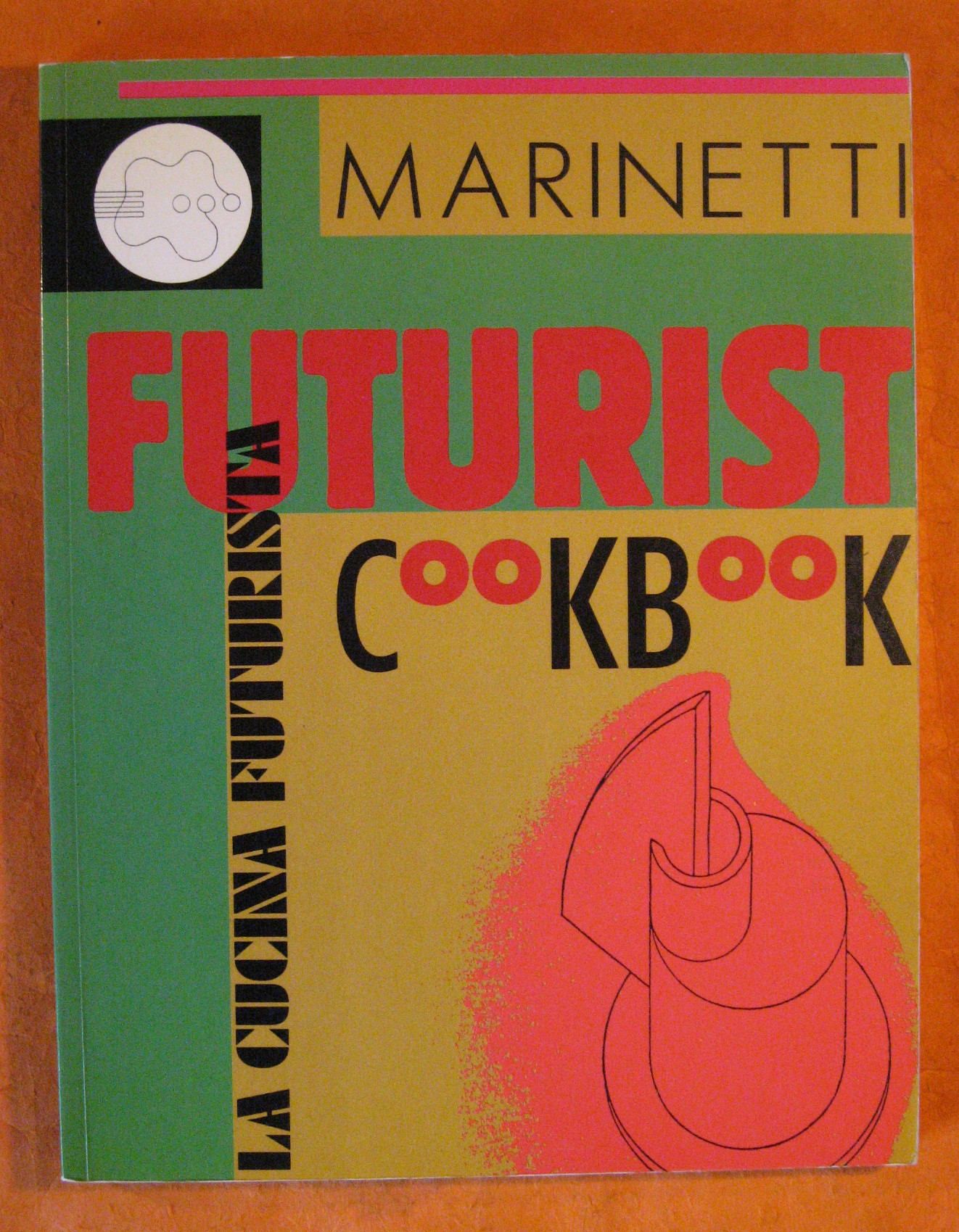
Bombast came naturally to him. While he truly believed in the tenets of Futurism—speed, industry, technology, and the cleansing effects of war, at the expense of tradition and the past—he gloried in hyperbole, absurdity, and showy pranks.
The Futurist Cookbook reflects this, although it does contain actual recipes, with very specific instructions as to how each dish should be served. A sample:
RAW MEAT TORN BY TRUMPET BLASTS: cut a perfect cube of beef. Pass an electric current through it, then marinate it for twenty-four hours in a mixture of rum, cognac and white vermouth. Remove it from the mixture and serve on a bed of red pepper, black pepper and snow. Each mouthful is to be chewed carefully for one minute, and each mouthful is divided from the next by vehement blasts on the trumpet blown by the eater himself.
Intrepid host Trevor Dunseith documents his attempt to stage a faithful Futurist dinner party in the above video.
Guests eat salad with their hands for maximum “pre-labial tactile pleasure” before balancing oranges stuffed with antipasto on their heads to randomize the selection of each mouthful. While not all of the flavors were a hit, the party agreed that the experience was—as intended—totally novel (and 100% pasta free).
Marinetti’s anti-pasta campaign chimed with Prime Minister Benito Mussolini’s goal of eliminating Italy’s economic dependence on foreign markets—the Battle for Grain. Northern farmers could produce ample supplies of rice, but nowhere near the amount of wheat needed to support the populace’s pasta consumption. If Italians couldn’t grow more wheat, Mussolini wanted them to shift from pasta to rice.
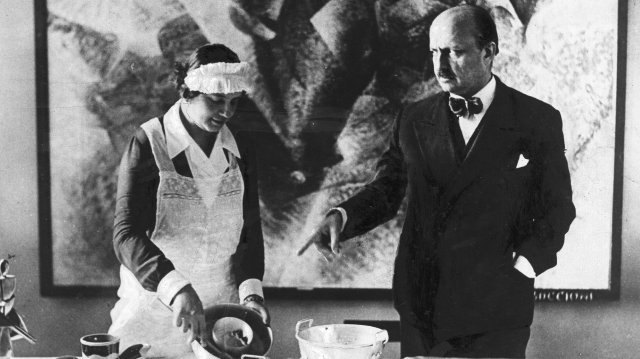
F.T. Marinetti by W. Seldow, 1934
Marinetti agreed that rice would be the “patriotic” choice, but his desired ends were rooted in his own avant-garde art movement:
… it is not just a question of replacing pasta with rice, or of preferring one dish to another, but of inventing new foods. So many mechanical and scientific changes have come into effect in the practical life of mankind that it is also possible to achieve culinary perfection and to organize various tastes, smells and functions, something which until yesterday would have seemed absurd because the general conditions of existence were also different. We must, by continually varying types of food and their combinations, kill off the old, deeply rooted habits of the palate, and prepare men for future chemical foodstuffs. We may even prepare mankind for the not-too-distant possibility of broadcasting nourishing waves over the radio.
Futurism’s ties to fascism are not a thing to brush off lightly, but it’s also important to remember that Marinetti believed it was the artist’s duty to put forward a bold public personae. He lived to ruffle feathers.
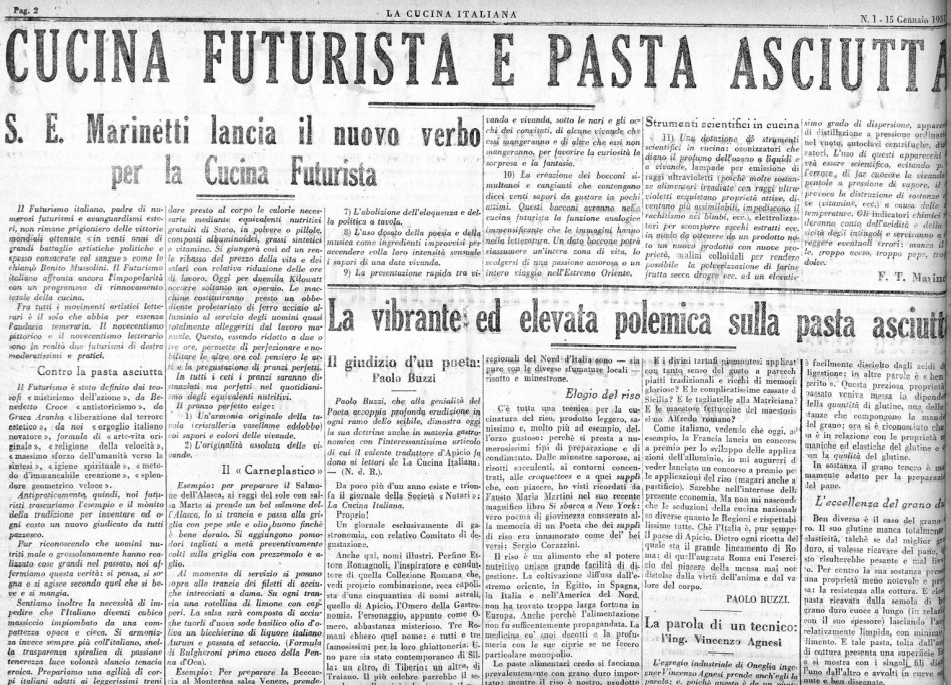
Mission accomplished. His anti-pasta pronouncements resulted in a tumult of public indignation, both locally and in the States.
The Duke of Bovino, mayor of Naples, reacted to Marinetti’s statement that pasta is “completely hostile to the vivacious spirit and passionate, generous, intuitive soul of the Neapolitans” by saying, “The angels in Heaven eat nothing but vermicelli al pomodoro.” Proof, Marinetti sniped back, of “the unappetizing monotony of Paradise and of the life of the Angels.”
He agitated for a futuristic world in which kitchens would be stocked with ”atmospheric and vacuum stills, centrifugal autoclaves (and) dialyzers.”
His recipes, as Trevor Dunseith discovered, function better as one-time performance art than go-to dishes to add to one’s culinary repertoire.
There is a reason why Julia Child’s Coq a Vin and Tarte Tatin endure while Marinetti’s Excited Pig and Black Shirt Snack have fallen into disuse.
Uh… progress?
As Daniel A. Gross writes in the Science History Institute’s Distillations:
Marinetti supported Fascism to the extent that it too advocated progress, but his allegiance eventually wavered. To Marinetti, Roman ruins and Renaissance paintings were not only boring but also antithetical to progress. To Mussolini, by contrast, they were politically useful. The dictator drew on Italian history in his quest to build a new, powerful nation—which also led to a national campaign in food self-sufficiency, encouraging the growing and consumption of such traditional foods as wheat, rice, and grapes. The government even funded research into the nutritional benefits of wheat, with one scientist claiming whole-wheat bread boosted fertility. In short, the prewar dream of futurist food was tabled yet again.
Get your own copy of Filippo Tommaso Marinetti’s The Futurist Cookbook here.
via Mental Floss
Related Content:
Salvador Dalí’s 1973 Cookbook Gets Reissued: Surrealist Art Meets Haute Cuisine
Recipes from the Kitchen of Georgia O’Keeffe
Ayun Halliday is an author, illustrator, theater maker and Chief Primatologist of the East Village Inky zine. See her as a French Canadian bear who travels to New York City in search of food and meaning in Greg Kotis’ short film, L’Ourse. Follow her @AyunHalliday.
Read More...Watch “Jackson Pollock 51,” a Historic Short Film That Captures Pollock Creating Abstract Expressionist Art on a Sheet of Glass
Jackson Pollock was described as an “action painter,” a label that surely wouldn’t have stuck if the public never had the chance to see him in action. In that sense, only the era of photography could have produced an artist like him: not just because that technology pushed painting toward abstraction, but because it could disseminate images of the artist himself far and wide. One photographer did more for this cause than any other: the German-born Hans Namuth, who despite a lack of initial interest in Pollock’s work nevertheless took up the challenge of capturing his creative process — and thereby doing much to craft the artist’s image of raw, intuitive and individualistic physicality. Namuth accomplished this even more memorably with a motion picture: the short “Jackson Pollock 51,” which you can watch above.
After attempting some shooting at the artist’s East Hampton, Long Island home,“Namuth was unhappy about having to choose between focusing on the painting or on Pollock,” as the New York Times’ Sarah Boxer puts it. “He wanted to catch painter and paint at once.” Namuth eventually hit upon a solution: “The painting would have to be on glass, and I would film from underneath.”
The film first shows Pollock painting more or less as usual (albeit outdoors, to obviate the need for lighting), and in laconic voiceover the artist describes his development and process. “I can control the flow of the paint,” he says. “There is no accident, just as there is no beginning and no end. Sometimes, I lose a painting.” Indeed, he admits, “I lost contact with my first painting on glass, and I started another one.”
This hints at the rigorous standards — and standards entirely his own — to which Pollock held his work. But he also left his second glass painting to ruin, having by some accounts entered personal and professional freefall immediately after he and Namuth wrapped this shoot. The two got into a shouting match that night, accusing one another of phoniness; at its height, Pollock action-painted the dining-room floor by overturning the laden dinner table in anger. “According to Pollock lore, his relationship with the camera was a Faustian bargain,” writes Boxer. “After that night [with Namuth], Pollock never stopped drinking.… Six years later, bloated, depressed and drunk, he drove his car into a tree, killing himself and a friend.” “The implication is that Namuth killed Pollock, that the photographs stole the artist’s ‘savage’ spirit. In doing things for the camera that he once did more spontaneously, Pollock came to feel he was indeed a phony.” But it’s also thanks to Namuth, too-active a director of the action though he may have been, that we can look at a Pollock canvas today and so vividly imagine its creation.
Related Content:
Watch Portrait of an Artist: Jackson Pollock, the 1987 Documentary Narrated by Melvyn Bragg
The MoMA Teaches You How to Paint Like Pollock, Rothko, de Kooning & Other Abstract Painters
Dripped: An Animated Tribute to Jackson Pollock’s Signature Painting Technique
Vintage Footage of Picasso and Jackson Pollock Painting… Through Glass
How the CIA Secretly Funded Abstract Expressionism During the Cold War
Based in Seoul, Colin Marshall writes and broadcasts on cities, language, and culture. His projects include the Substack newsletter Books on Cities, the book The Stateless City: a Walk through 21st-Century Los Angeles and the video series The City in Cinema. Follow him on Twitter at @colinmarshall, on Facebook, or on Instagram.
Read More...The Biblical Sci-Fi of “Raised by Wolves”–Pretty Much Pop: A Culture Podcast #68

What happens when a male android loves a female android VERY much, and they nurse human embryos together on a distant planet after fleeing from war-torn Earth? Why the female android flies and makes a bunch of people explode with her eyes, that’s what happens! …In the first episode of this bonkers HBO Max series by Aaron Guzikowski (with notable assistance from Ridley Scott of Alien and Blade Runner fame).
Your hosts Brian Hirt, Erica Spyres, and Mark Linsenmayer reflect on how much we’re supposed to understand, what if any character we’re supposed to identify with, whether the imagery is just TOO heavy-handed, and how this show compares with related sci-fi like Westworld or post-apocalyptic shows like The Walking Dead. Beware: Spoilers abound in this one, so you might want to watch the show, or just let us reveal its weirdness to you.
Here are some articles to feast on:
- “‘Raised by Wolves’ Finale Explained by Showrunner: WTF Was That?” by Adam Chitwood
- “‘Raised by Wolves’ Showrunner Aaron Guzikowski on Crafting an Ambitious Science Fiction World” by Jack Giroux
- “‘Raised by Wolves’: Ridley Scott Explains That Monstrous Finale” by Jennifer Vineyard
- “‘Raised by Wolves’ Season 2 Theories That May (or May Not) Happen” by Meghan O’Keefe
- “5 (Spoiler-Free) Themes Underlying Season 1 of the Sci-Fi Series, ‘Raised by Wolves’” by Frumentarious at Sandboxx
- “The Aspirational Android Parenting of ‘Raised by Wolves’ ” by Lydia Kiesling
Learn more at prettymuchpop.com. This episode includes bonus discussion that you can only hear by supporting the podcast at patreon.com/prettymuchpop. This podcast is part of the Partially Examined Life podcast network.
Pretty Much Pop: A Culture Podcast is the first podcast curated by Open Culture. Browse all Pretty Much Pop posts.
Read More...Hear a Rare First Recording of Janis Joplin’s Hit “Me and Bobby McGee,” Written by Kris Kristofferson
“You can’t think of that song without thinking of Janis,” says Kris Kristofferson of Janis Joplin’s raw, bittersweet, posthumously released “Me and Bobby McGee.” Kristofferson, who wrote the song, only heard Joplin’s version after her death, when he returned to California after playing the Isle of Wight in 1970. He met the producer of Joplin’s last album, Pearl, in L.A., who told him to come to the studio “to play me her recording of ‘Bobby McGee.’ And it just blew me away. Just blew me away.” Above, you can hear a rare recording, possibly the first take, and possibly one of the early versions Kristofferson heard in the studio.
Many people have assumed Kristofferson wrote the song for Joplin, but that’s not the case: he didn’t know she was recording it at all. It was written, in 1969, about a woman, Barbara “Bobby” McKee, who worked as a secretary in songwriter Fred Foster’s building. Foster gave Kristofferson the title “Me and Bobby McKee,” Kristofferson misheard the last name, assumed it was a man, and wrote the famous lyrics, inspired not by Barbara but by Federico Fellini’s La Strada, in which Anthony Quinn and Giulietta Masina travel together on a motorcycle as a performing duo. (The Louisiana references come in because Kristofferson was working as a helicopter pilot in the Gulf at the time.)
In La Strada, Quinn “got to the point where he couldn’t put up with [Masina] anymore and left her by the side of the road while she was sleeping,” says Kristofferson. Later, when he finds out she has died, he “goes to a bar and gets in a fight. He’s drunk and ends up howling at the stars on the beach.” In a parallel to this mournful scene, Tom Breihan at Stereogum describes how Kristofferson, after hearing Joplin’s version of the song, “spent the rest of the day walking around Los Angeles, crying. He probably wasn’t alone. A lot of people probably cried when they heard Joplin singing ‘Me and Bobby McGee.’” A lot of people still do.
A long list of famous singers has covered the song, originally recorded by Roger Miller—just about anyone you might name in folk and country. But Joplin “made it her own,” Kristofferson says, and it’s no empty cliché. Written as a country song, Joplin doesn’t quite sing it that way, and she “doesn’t really sing it as blues or psychedelic rock either,” writes Breihan. “Instead, she just lets it rip, her phrasing immediate and instinctive,” howling at the stars like Anthony Quinn. “Joplin might’ve never hitchhiked across the country with anyone named Bobby McGee,” but she “did what great interpreters do.” She made the song “about Janis Joplin, because that’s what Janis Joplin made it.”
Related Content:
Watch Janis Joplin’s Final Interview Get Reborn as an Animated Cartoon
Janis Joplin’s Last TV Performance & Interview: The Dick Cavett Show (1970)
Janis Joplin & Tom Jones Bring the House Down in an Unlikely Duet of “Raise Your Hand” (1969)
Josh Jones is a writer and musician based in Washington, DC. Follow him @jdmagness
Read More...Watch Link Wray Play a Downright Dirty Version of “Rumble,” the Only Instrumental to Be Banned on Radio (1974)
It takes a lot of swagger and confidence to play a couple of barre chords on a guitar, look like the coolest cat doing so, and revolutionize rock music while doing so. That’s Link Wray we’re talking about, and the song is the 1958 instrumental hit “Rumble.” It still sounds fresh today for the same reasons it was controversial at the time. It sounds sleazy, grungy, dirty. This is a song for a pool hall, or a biker bar, and just reeks of cigarettes and liquor. And from Pulp Fiction onwards, the song has popped up in many movies and TV shows, giving a scene a bit of cool danger.
The above video is from a one-hour gig that Wray and his band performed at the Winterland Ballroom in San Francisco, 1974, the former ice skating rink that promoter Bill Graham turned into one of the primo music venues of its day. And Link Wray playing was like one of the gods of rock descending to anoint the crowd. Presley–though Wray defended him during his act–had dropped out of mainstream culture. The original rock and rollers, Wray’s peers, were either dead or nostalgia acts. So this appearance is magical, rock spirit made flesh, looking dangerous and sexual in all his swagger.
That swagger was well earned. Fred Lincoln Wray was born in North Carolina to a Shawnee mother, as a Cherokee and White father had returned from WWI with PTSD. In the mostly Black neighborhood where he grew up, he would hide underneath the bed when the Ku Klux Klan would come through on a terror campaign. “Elvis, he grew up — I don’t want to sound racist when I say this — he grew up white man poor,” Wray said in an interview. “I was growing up Shawnee poor.”
He suffered weak eyesight and bad hearing from childhood measles, and later when he served time in the army, he’d contract tuberculosis, lose one lung, and was told he wouldn’t have a singing career.
But he did have his guitar skills, which he’d learned as a child from a traveling Black guitarist called Hambone. Back from the army he formed a group with his brothers Vernon and Doug, and was going by the name Lucky. They gigged around Virginia and Washington, DC, and were asked by a local promoter to come up with a song similar to The Diamonds’ “The Stroll.” What they came up with was an instrumental called “Oddball.” It was a hit played live but when they went into a studio to record a demo, it just didn’t have “that sound”. Wray started punching holes in his speakers with a pencil and in one stroke created the fuzztone guitar sound.
The big labels wouldn’t bite, but Cadence Records’ Milt Grant said yes. Or rather, his teenage stepdaughter and her friends said yes, and Milt put aside his own distaste. Juvenile delinquents were at once both a “problem” and a way to sell product, especially with the hit musical and movie West Side Story. “Rumble” was a much better name than “Oddball,” and, on March 31, 1958, it was released.
Some DJs refused to play the single in cities where teenage gang violence was a problem. When Wray and his band played American Bandstand, Dick Clark didn’t mention the title. It didn’t stop the single from being a hit.
And it was influential. Wray pretty much invented power-chord riffing, and influenced Jimi Hendrix, Jeff Beck, Neil Young, Jimmy Page, Pete Townshend, and countless others. Curmudgeon-genius Mark E. Smith of the Fall named him as one of the only two musicians he respected (the other was Iggy Pop).
Link Wray’s Cherokee and Shawnee heritage was not well known among the general public, but the recent documentary Rumble: The Indians Who Rocked the World brought the influence of Native American musicians out into the open for celebration, connecting Link Wray with Robbie Robertson, Charlie Patton, Mildred Bailey, and Stevie Salas.
Related Content:
Two Guitar Effects That Revolutionized Rock: The Invention of the Wah-Wah & Fuzz Pedals
The Story of “Wipe Out,” the Classic Surf Rock Instrumental
Quentin Tarantino Explains The Art of the Music in His Films
Ted Mills is a freelance writer on the arts who currently hosts the Notes from the Shed podcast and is the producer of KCRW’s Curious Coast. You can also follow him on Twitter at @tedmills, and/or watch his films here.
Read More...Support Us
We're hoping to rely on loyal readers, rather than erratic ads. Please click the Donate button and support Open Culture. You can use Paypal, Venmo, Patreon, even Crypto! We thank you!

About Us

Open Culture scours the web for the best educational media. We find the free courses and audio books you need, the language lessons & educational videos you want, and plenty of enlightenment in between.
Advertise With Us

FREE UPDATES!
GET OUR DAILY EMAIL
Get the best cultural and educational resources on the web curated for you in a daily email. We never spam. Unsubscribe at any time.
FOLLOW ON SOCIAL MEDIA

Open Culture editor Dan Colman scours the web for the best educational media. He finds the free courses and audio books you need, the language lessons & movies you want, and plenty of enlightenment in between.
Advertise With Us


