The Famous Break Up of Sigmund Freud & Carl Jung Explained in a New Animated Video
Making friends with similar interests can be a challenge for anyone. But imagine you are the founder of an entirely new discipline, with its own peculiar jargon, set of practices, and conceptual categories. Imagine, for example, that you are Sigmund Freud, who in 1896 made his break with medicine to pursue the work of psychoanalysis. Drawing on clinical experience with patients, his own self-analysis, cocaine-induced reveries, and an idiosyncratic reading of Greek mythology, Freud invented his strange psychosexual theories within the confidence of a very small circle of acquaintances and admirers.
One of his close relationships during those productive and turbulent years, with eccentric ear, nose, and throat doctor Wilhelm Fliess—a collaborator, influence, “confessor and moral supporter”—ended badly in 1906. It was in that same year that Freud met the much-younger Carl Jung. At their first meeting, the two “talked nonstop for 13 hours,” the Aeon video above, animated by Andrew Khosravani, tells us. Thus began the intense and now-legendary six-year friendship between the psychiatrists, a “passionate and surpassingly weird relationship, which, given the people involved, perhaps shouldn’t come as a surprise.” Freud settled upon Jung as his protege and successor, the “Joshua to my Moses,” overjoyed to have found a friend who seemed to understand his ideas intimately.
They traveled to the US to give joint lectures and analyzed each other’s dreams. Freud wrote to propose that Jung should think of their relationship as between “father and son,” an odd proposal in any friendship, but especially when the “father” invented the Oedipal complex; “this did not go unnoticed by Freud, and he freaked out a little.” The unsettling dynamic already presented a shaky basis for a long term bond, but it was their wildly divergent ideas that ultimately drove them apart. Jung took issue with Freud’s obsession with libido as the primary driver of human behavior. Freud cast a withering eye on Jung’s keen interest in religion, mysticism, and the paranormal as expressions of a collective unconscious.
As he had divorced himself from Wilhelm Fleiss in 1906, Freud similarly, abruptly, broke off his friendship with Jung in 1913, sending a rather nasty break-up letter to sever their “emotional tie.” Jung, he wrote, “while behaving abnormally keeps shouting that he is normal,” giving rise to “the suspicion that he lacks insight into his illness. Accordingly, I propose that we abandon our personal relations entirely.” The video ends by declaring Freud the winner of this “feud,” such as it was, though the personal conflict seems rather one-sided. As Jung would later relate, he “soon discovered that when [Freud] had thought something, then it was settled.” After Freud broke it off, Jung wrote in his diary, “the rest is silence.”
As for the legacies of both men, these seem settled as well. They both had significant influence on writers and artists of all kinds, on literary theorists, new age mystics, and philosophers. But Jung is hardly taken seriously in the mainstream of psychiatry, and Freud’s ideas have largely been abandoned, save for one: as millions who still reveal themselves weekly on therapists’ couches can attest, the talking cure of psychoanalysis is alive and well.
Related Content:
Animated Video Tells the Story of Jean-Paul Sartre & Albert Camus’ Famous Falling Out (1952)
The Famous Letter Where Freud Breaks His Relationship with Jung (1913)
Carl Jung Explains Why His Famous Friendship with Sigmund Freud Fell Apart in Rare 1959 Audio
How a Young Sigmund Freud Researched & Got Addicted to Cocaine, the New “Miracle Drug,” in 1894
Josh Jones is a writer and musician based in Durham, NC. Follow him at @jdmagness
Read More...How the Uptight Today Show Introduced the Sex Pistols & British Punk to American TV Viewers (1978)
It’s depressingly easy to rile up millions of people these days with the click of a mouse. Billion-dollar industries and political campaigns are built on such technology. But before the empires of social media, there was television, a one-way medium and, prior to cable, an extremely limited one. In those bygone days, you really had to put your back into it if you wanted widespread attention. The Sex Pistols—including their manager and promoter, visionary huckster Malcolm McLaren—worked hard to cultivate infamy, using television as a primary means of generating shock value.
Although the band members, at least, never made any money, they were highly paid in notoriety on both sides of the Atlantic. Their image as violent junkies who couldn’t play their instruments owed mainly to Sid Vicious, who replaced competent bassist and songwriter Glen Matlock in 1977, a move that boosted the band’s ability to freak people out while simultaneously setting them on a course for certain demise within the year.
The spectacular self-destruction occurred, as every fan knows well, on a tour of the US South that McLaren booked with the wickedest of intentions, springing the band on cowboy bars in Texas, for example, for the sake of sheer provocation. Their final show at San Francisco’s Winterland Ballroom was caught on film, complete with the last song they ever played together, a cover of the Stooges “No Fun.” After the one-song encore, Johnny Rotten sneered “ever get the feeling you’ve been cheated?” and dropped the mic, disgusted with the whole “ridiculous farce,” he later wrote.
Before embarking on their comically disastrous US tour, the Pistols got a heavy dose of free publicity from an American news media as eager then as ever to chase after a sensation. In the vintage Today Show clip above, see how US viewers were introduced to British punk. “Whether naturally or calculatedly so,” says NBC’s Jack Perkins after reporting on Vicious and drummer Paul Cook’s refusal to grant an interview unless they were each paid $10, “the four young men are outrageous. They’re also vile and profane.”
Perkins then walks viewers through the hardly shocking details of rudeness to hotel staff and bit of a mess left in their room, shaking his head sadly. No band could hope to top Led Zeppelin when it came to this most cliched of rock and roll stunts. But Perkins pretends it’s the first time anything like it had ever happened. McLaren could not have scripted better finger-wagging outrage to inspire American gawkers (some of whom give brief post-concert interviews) to come out and see the Pistols flame out on their final tour.
Then there are the record execs Perkins gets on camera, including A&M’s Kip Cohen, who sized up the situation astutely: “There’s a case of an act and management and intelligence behind an act, brilliantly utilizing the media, cashing in and creating a whole hype for itself.” Cohen, a seasoned industry man who had previously managed the Fillmore East, predicts great things for the Sex Pistols. But he expresses some skepticism about whether their savvy media manipulation was a new phenomenon, citing the Beatles and the Stones as having already broken such ground.
One could go back even further to Chuck Berry and Elvis, who pushed many of the same outrage buttons for what constituted “clicks” in olden times. But as Perkins points out—shaking his head in disapproval, before cutting back to a snickering Jane Pauley and very serious Tom Brokaw—the Pistols pulled it off by looking like they couldn’t possibly have cared any less about being good at what they did, which took an entirely different kind of talent.
Related Content:
Watch the Sex Pistols’ Very Last Concert (San Francisco, 1978)
The Sex Pistols Play in Dallas’ Longhorn Ballroom; Next Show Is Merle Haggard (1978)
Malcolm McLaren: The Quest for Authentic Creativity
Josh Jones is a writer and musician based in Durham, NC. Follow him at @jdmagness
Read More...Hear Meryl Streep Read Sylvia Plath’s “Morning Song,” a Poem Written After the Birth of Her Daughter

Image via Wikimedia Commons
Pregnancy and parenting are “extreme experiences that stretch our understanding,” writes Lily Gurton-Wachter at the Los Angeles Review of Books. They “push us beyond comfort or even comprehension.” Women risk their own lives to give life to a stranger, a tiny human whose future is entirely uncertain. Parents live with constant dread of all that could befall their children, an anxious state, but also a vulnerability that can make us deeply sensitive to the fragility of human life. Gurton-Wachter compares motherhood to going to war, “a profound, frightening, exhilarating, transformative experience at the boundary of life, an experience from which one comes back a different person.”
It’s a comparison Sylvia Plath would likely appreciate. With her ability to compress personal experience in collections of surprising, often violent, images, Plath expressed deep ambivalence about motherhood, undercutting a tradition of sentimental idealization, giving voice to fear, discomfort, bewilderment, and mystery.
In “Metaphors,” from 1960’s Colossus, she begins with a playful description of pregnancy as “a riddle in nine syllables.” Within a few lines she feels effaced and starts to “see herself merely as a ‘means,’” notes Shenandoah, “almost an incubator… This culminates with the last line, where she realizes that she is forever changed, irrevocably”: “Boarded the train,” she writes, “there’s no getting off.”
In 1961, after the birth of her daughter, Frieda, Plath wrote “Morning Song, which might be read as almost an extension of “Metaphors.” It is “one of her most unusual poems,” writes Maria Popova at Brain Pickings, “both paean and requiem for new motherhood—the love, the strangeness, the surreal and magnetic disorientation of it.” Published posthumously in Ariel, the poem addresses itself to the new arrival, in a series of stanzas that capture the awe and anxiety of those first hours after her birth. In the audio above from the Academy of American Poets’ annual Poetry & the Creative Mind event, hear Meryl Streep read the poem “with uncommon sensitivity,” Popova writes, “to the innumerable nuances it holds.” As you listen, read along below.
MORNING SONG
Love set you going like a fat gold watch.
The midwife slapped your footsoles, and your bald cry
Took its place among the elements.Our voices echo, magnifying your arrival. New statue.
In a drafty museum, your nakedness
Shadows our safety. We stand round blankly as walls.I’m no more your mother
Than the cloud that distills a mirror to reflect its own slow
Effacement at the wind’s hand.All night your moth-breath
Flickers among the flat pink roses. I wake to listen:
A far sea moves in my ear.One cry, and I stumble from bed, cow-heavy and floral
In my Victorian nightgown.
Your mouth opens clean as a cat’s. The window squareWhitens and swallows its dull stars. And now you try
Your handful of notes;
The clear vowels rise like balloons.
Streep’s reading of Plath will be added to the poetry section of our collection, 1,000 Free Audio Books: Download Great Books for Free.
via Brain Pickings
Related Content
Hear Sylvia Plath Read 50+ of Her Dark, Compelling Poems
Hear Sylvia Plath’s Barely-Known Radio Play, Three Women
Josh Jones is a writer and musician based in Durham, NC. Follow him at @jdmagness
Read More...Ozzy Osbourne’s Guitarist Zakk Wylde Plays Black Sabbath on a Hello Kitty Guitar
When Sanrio—that megalithic maker of kawaii icon Hello Kitty—partnered with guitar companies to make pastel-colored six-strings bearing the mouthless kitten’s face, many a big-time musician found the ostensibly kid’s‑oriented instruments irresistible. Hello Kitty guitars were “possibly the apex of Sanrio’s cross-media synergy-blitz,” wrote David McNamee in a cranky 2009 piece at The Guardian, “that has seen them slap the cold, vacant stare of their brand-leading cash cow… on to every conceivable kind of consumer merchandise including vibrators (sorry, massagers), assault rifles, tampons, condoms, urinal cakes, cars, computers, booze and pet costumes.”
The chirpy Lisa Loeb took to Hello Kitty guitars as part of a personal brand makeover, which doesn’t much surprise since she eventually moved to writing children’s music. But “a scan of YouTube,” McNamee goes on, “reveals that Hello Kitty’s core audience is actually balding, middle-aged men, shredding out covers of Yngwie Malmsteen and Rush.”
I’m not sure how accurate this statement is in market research terms, but I can testify to knowing at least two middle-aged men who swear by pink Hello Kitty Stratocasters.
Go ahead, laugh it up, but you probably wouldn’t do so in front of certain Sanrio shredders, like former Ozzy Osbourne and current Black Label Society guitarist Zakk Wylde, who has made a side gig—as we noted in yesterday’s post—playing covers of heavy rock tunes on tiny, cutesy Hello Kitty acoustic guitars. See for yourself in his Hello Kitty take on Black Sabbath’s “N.I.B.” at the top and a version of his own original “Autumn Changes” further up. Would you laugh at seriously versatile Marilyn Manson guitarist John 5 and his Hello Kitty guitar? Maybe, but reserve your judgment until after you’ve seen him start his “new career” in Hello Kitty guitar marketing above.
Rising to the challenge, Mark Tremonti and Eric Friedman decided to take on Metallica’s “Welcome Home (Sanitarium)” on a Hello Kitty guitar and ukulele, “refusing to skip the track’s various solos,” points out Loudwire. It’s ”a true jam on truly crappy instruments that the boys somehow made work.” What, exactly, is the appeal of these Hello Kitty sessions to people who aren’t, presumably, the usual Hello Kitty tween demographic?
Maybe it’s just some good clean fun from people who might seem to take themselves a little too seriously sometimes. When rock stars show a sense of humor, it makes them more relatable, right? Hey, even the Beatles made their bones with musical comedy, so why shouldn’t Evanescence’s Amy Lee give us a moving, candlelit rendition of Death Cab for Cutie’s “I Will Follow You into the Dark,” as played on a Hello Kitty keyboard?
See all of these videos and more—including Bumblefoot’s soulful Hello Kitty metal classics covers and a potty-mouthed Mike Portnoy bashing away on a Hello Kitty drumkit—at Loudwire’s YouTube channel.
Related Content:
Calm Down & Study with Relaxing Piano, Jazz & Harp Covers of Music from Hayao Miyazaki Films
Josh Jones is a writer and musician based in Durham, NC. Follow him at @jdmagness
Read More...Ralph Steadman Creates an Unorthodox Illustrated Biography of Sigmund Freud, the Father of Psychoanalysis (1979)
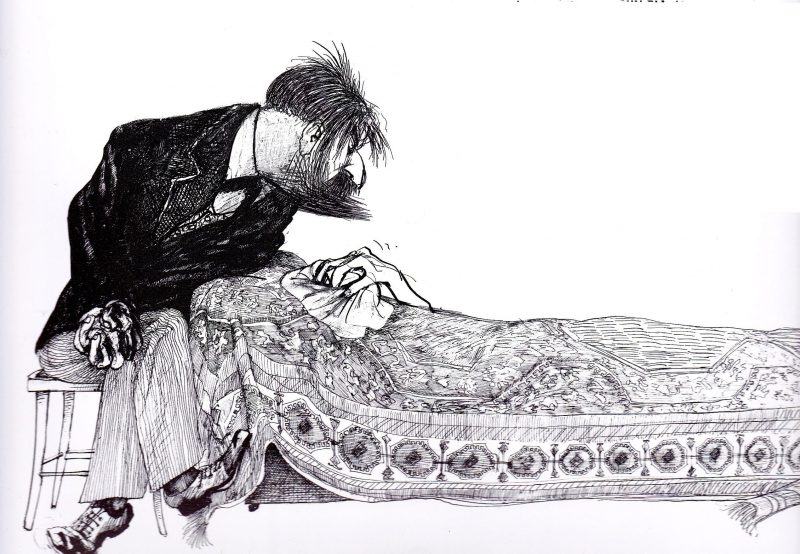
Sigmund Freud died in 1939, and the nearly eight decades since haven’t been kind to his psychoanalytical theories, but in some sense he survives. “For many years, even as writers were discarding the more patently absurd elements of his theory — penis envy, or the death drive — they continued to pay homage to Freud’s unblinking insight into the human condition,” writes the New Yorker’s Louis Menand. He claims that Freud thus evolved, “in the popular imagination, from a scientist into a kind of poet of the mind. And the thing about poets is that they cannot be refuted. No one asks of ‘Paradise Lost’: But is it true? Freud and his concepts, now converted into metaphors, joined the legion of the undead.”
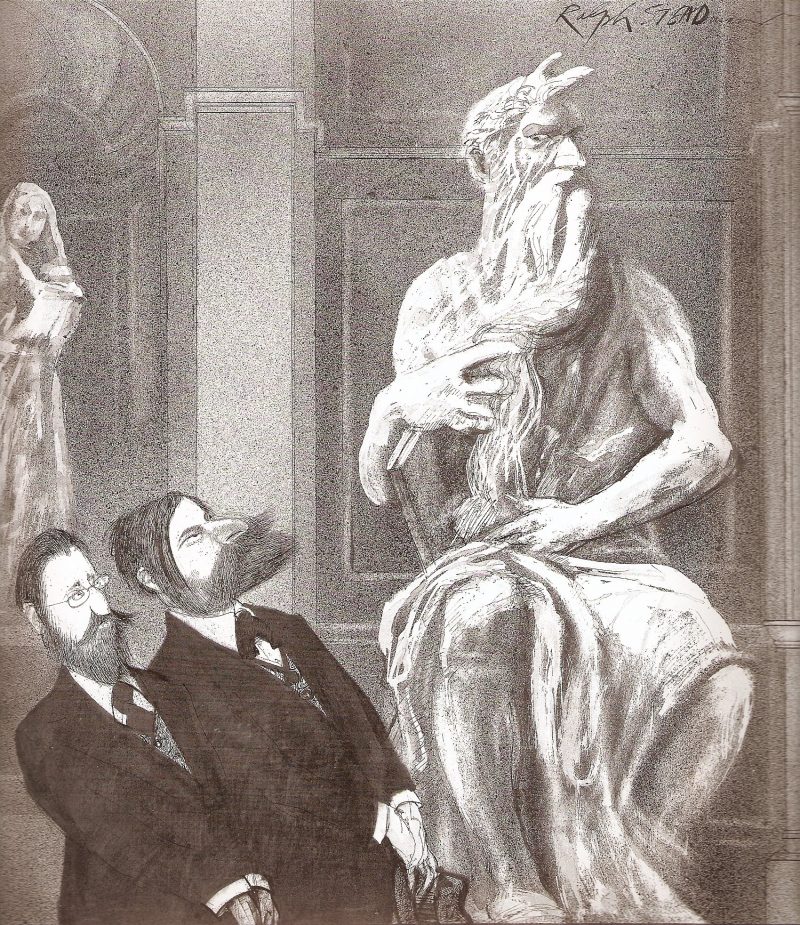
The master of a legion of undead psychological metaphors — who, in the ranks of living illustrators, could be more suited to render such a figure than Ralph Steadman? And how many of us know that he actually did so in 1979, when he produced an “art-biography” of the “Father of Psychoanalysis”?
Sigmund Freud, which has spent long stretches out of print since its first publication, tells the story of Freud’s life, beginning with his childhood in Austria to his death, not long after his emigration in flight from the Nazis, in London. It was there that he met Virginia Woolf, who in her diary describes him as “a screwed up shrunk very old man: with a monkey’s light eyes, paralyzed spasmodic movements, inarticulate: but alert.”
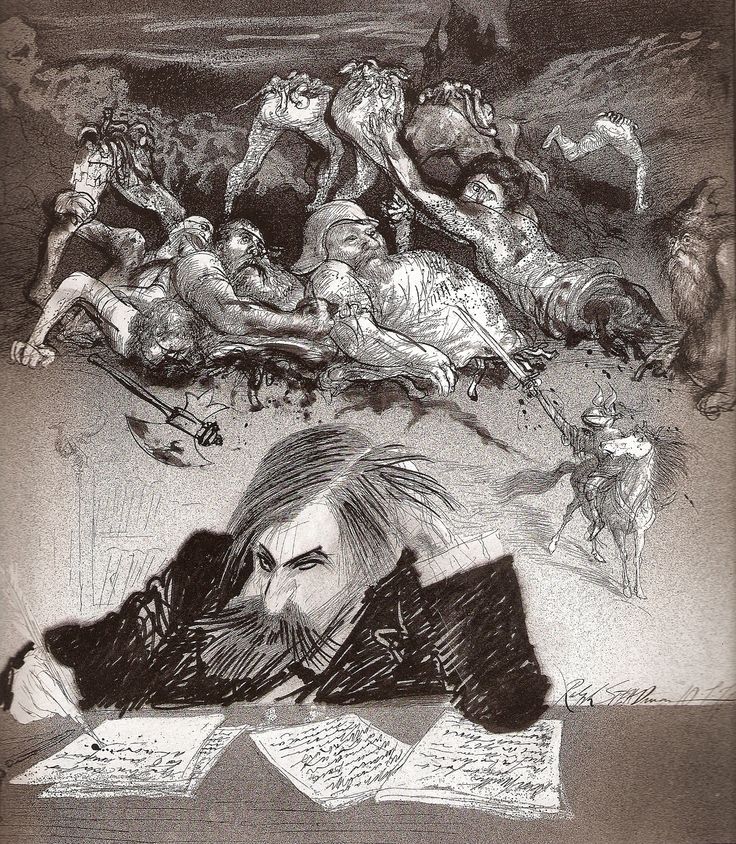
There, again, Freud sounds like one of Steadman’s drawings, sometimes outwardly unappealing but always possessed of an unignorable vitality generated by a solid core of perceptiveness. Earlier chapters of Freud’s life, characterized by intellectual as well as physical vigorousness aided by the 19th-century “miracle drug” of cocaine, also give the illustrator rich material to work with. One can’t help but think of Fear and Loathing in Las Vegas, which forged a permanent cultural link between Steadman’s art and Hunter S. Thompson’s prose. How “true” is the drug-fueled desert odyssey that book recounts? More so, perhaps, than many of Freud’s supposedly scientific discoveries. But as with the work of Freud, so with that of Thompson and Steadman: we return to it not because we want the truth, exactly, but because we can’t turn away from the often grotesque versions of ourselves it shows us.
You can pick up a copy of Steadman’s illustrated Sigmund Freud here.
Related Content:
Sigmund Freud, Father of Psychoanalysis, Introduced in a Monty Python-Style Animation
How a Young Sigmund Freud Researched & Got Addicted to Cocaine, the New “Miracle Drug,” in 1894
Ralph Steadman’s Wildly Illustrated Biography of Leonardo da Vinci (1983)
Gonzo Illustrator Ralph Steadman Draws the American Presidents, from Nixon to Trump
Based in Seoul, Colin Marshall writes and broadcasts on cities and culture. His projects include the book The Stateless City: a Walk through 21st-Century Los Angeles and the video series The City in Cinema. Follow him on Twitter at @colinmarshall or on Facebook.
Read More...The 50 Best Ambient Albums of All Time: A Playlist Curated by Pitchfork

What makes a good ambient record? I’m not sure I can even begin to answer that question, and I count myself a longtime fan of the genre, such as it is. Though conceived, ostensibly, by Brian Eno as modernist mood music—“as ignorable as it is interesting,” he wrote in the liner notes to 1978’s Ambient 1: Music for Airports—the term has come to encompass “tracks you can dance to all the way to harsh noise.” This description from composer and musician Keith Fullerton Whitman at Pitchfork may not get us any closer to a clear definition in prose, though “cloud of sound” is a lovely turn of phrase.
Unlike other forms of music, there is no set of standards—both in the jazz sense of a canon and the formal sense of a set of rules. Reverberating keyboards, squelching, burping synthesizers, droning guitar feedback, field recordings, found sounds, laptops, strings… whatever it takes to get you there—“there” being a state of suspended emotion, “drifting” rather than “driving,” the sounds “soothing, sad, haunting, or ominous.” (Cheerful, upbeat ambient music may be a contradiction in terms.)
Given the looseness of these criteria, it only stands to reason that “good” ambient must be judged on far more subjective terms than most any other kind of music. Next to “atmospheric,” a primary operative word in an ambient critical lexicon is “evocative,” and what the music evokes will differ vastly from listener to listener. “No one agrees on the language surrounding this music,” Whitman admits, “not the musicians who make it, not the audience.”
Ambient’s close association with trends in avant-garde minimalism, from Erik Satie to Steve Reich, La Monte Young, and Charlemagne Palestine, may prepare us for its many crossover strains in electronic music, but not, perhaps, for the seeming synergy between ambient and certain developments in heavy metal (though Lou Reed seems to have presaged this evolution). “There are many roads one can take into this particular sector,” writes Whitman, “virtually every extant sub- and micro-genre has an ambient shadow.”
Such ecumenicalism is a feature: it means that a list like Pitchfork’s “50 Best Ambient Albums of All Time” (stream most of those albums on the Spotify playlist above) can pull from an impressively wide array of musical domains, from the early experimental electronic music of Laurie Spiegel to the spiritual jazz of Alice Coltrane; the chill-out electronica of The Orb and The KLF to the ethereal indie post-folk dreampop of Grouper, a very rare entry with vocals.
If the genre has stars, Tim Hecker and William Basinski might be considered two of them; if it has august forebears, Pauline Oliveros, Terry Riley, and of course Eno are three. (Music for Airports comes in at number one, though another very well-chosen inclusion here is Eno and Harold Budd’s utterly gorgeous The Pearl.) Other entries I’m very pleased to see on this list include albums by Gas, composer Max Richter, and vocal experimentalist Juliana Barwick, artists who might never share a stage, but sit quite comfortably next to each other here.
What’s missing? Maybe the glacially slow, guitar and bass drones of Sunn O))) or the deeply unnerving noise of Prurient or the lush electro-acoustic compositions of Ashley Bellouin, I don’t know. These aren’t complaints but suggestions on the order of if you like Pitchfork’s “50 Best Ambient Albums of All Time,” check out…. I could go on, but I’d rather leave it to you, reader. What’s on your list that didn’t make the cut?
Visit Pitchfork’s list here.
Related Content:
The “True” Story Of How Brian Eno Invented Ambient Music
10 Hours of Ambient Arctic Sounds Will Help You Relax, Meditate, Study & Sleep
Josh Jones is a writer and musician based in Durham, NC. Follow him at @jdmagness
Read More...When Pinball Was Deemed Immoral & Outlawed in Major American Cities
I remember the early days of the video arcade, where my friends and I went to have fun and spent our parents’ cash on Galaga, Robotron 2084, or–if you were a really big spender–Dragon’s Lair. Then, when we’d get home, and we would see scare pieces on the national news about the evils of the very arcades we had just visited, dens of drugs and depravity! Where were *those* arcades, we wondered.
Nothing has changed, it seems. Let’s go back nearly 80 years to another moral panic: pinball.
As these two mini docs show, in the 1930s and ‘40s pinball was banned in cities like New York (by mayor and future airport Fiorello LaGuardia) and Chicago because of its association with organized crime, but also the appeal it had to the children of the working class.
They kind of had a point: early pinball machine were purely games of chance, which put it very close to gambling. (A modern pachinko machine is closer to these early versions.) Like a carny game, you paid your money, and you watched as the ball careened down the table, out of your control.
But with the invention of user-controlled flippers that sent the ball back in play, these games of chance became games of skill. But that didn’t stop some moral crusaders.
And, as several pinball fans have found out–like the gentleman in the VICE doc below who wanted to open a pinball museum–antiquated laws remained on the books from those early years and had never been changed for modern times.
Roger Sharpe, known as “The Man Who Saved Pinball,” even went to a Chicago court in 1976 to prove that pinball was a game of skill. In a scene that sounds perfect for a final act in a movie, Sharpe, with his barbershop quartet mustache and groovy outfit, played pinball in front of legislators. Calling shots like a pool player might, he soon convinced the court that skill was everything. Sharpe would go on to become a star witness in similar hearings in Ohio, West Virginia, and Texas over their pinball laws.
Ironically, while video games replaced pinball in most arcades, home systems and computers replaced the need for arcades. It’s now a perfect time for these purely analog and tactile machines to make a comeback. Hell, a rock band might even make a musical about it one day.
Related Content:
Orson Welles Teaches Baccarat, Craps, Blackjack, Roulette, and Keno at Caesars Palace (1978)
Ted Mills is a freelance writer on the arts who currently hosts the artist interview-based FunkZone Podcast and is the producer of KCRW’s Curious Coast. You can also follow him on Twitter at @tedmills, read his other arts writing at tedmills.com and/or watch his films here.
Read More...Explore 7,600 Works of Art by Edvard Munch: They’re Now Digitized and Free Online
If there were ever an exhibition of artistic “one-hit-wonders,” surely Edvard Munch’s The Scream would occupy a central place, maybe hung adjacent to Grant Wood’s American Gothic. The ratio of those who know this single painting to those who know the artist’s other works must be exponentially high, which is something of a shame. That’s not to say The Scream does not deserve its exalted place in popular culture—like Wood’s stone-faced Midwest farmers, the wavy figure, clutching its screaming skull-like head, resonates at the deepest of psychic frequencies, an archetypal evocation of existential horror.
Not for nothing has Sue Prideaux subtitled her Munch biography Behind the Scream. “Rarely in the canon of Western art,” writes Tom Rosenthal at The Independent, “has there been so much anxiety, fear and deep psychological pain in one artist. That he lived to be 80 and spent only one period in an asylum is a tribute not only to Munch’s physical stamina but to his iron will and his innate, robust psychological strength.” Born in Norway in 1863, the sickly Edvard, whose mother died soon after his birth, was raised by a harsh disciplinarian father who read Poe and Dostoevsky to his children and, in addition to beating them “for minor infractions,” would “invoke the image of their blessed mother who saw them from heaven and grieved over their misbehavior.”
The trauma was compounded by the death of Munch’s sister and, later, his brother, and by the institutionalization of another sister, Laura, diagnosed with schizophrenia. Munch’s own childhood illness made his schooling erratic, though he did manage to receive some artistic training, briefly, at Oslo’s Art Association, an artist’s club where he “learnt by copying the works on display.”
From there the young Munch launched himself into an extraordinarily productive career, punctuated by legendary bouts of drinking and carousing and intense friendships with literary figures like August Strindberg.
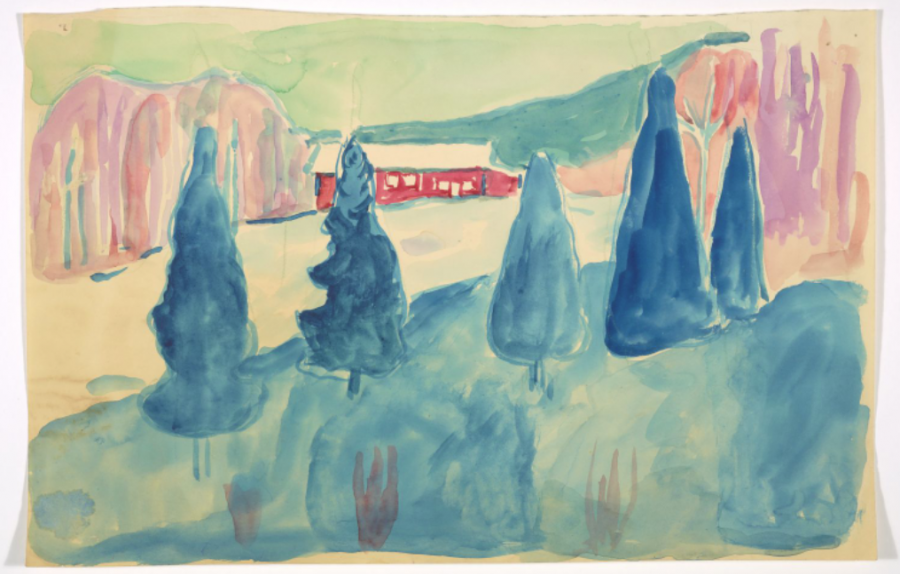
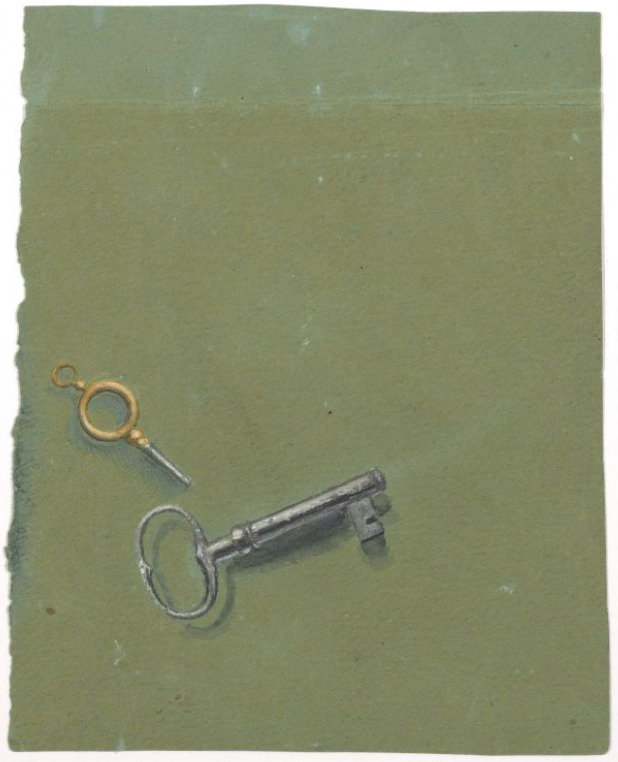
If we count ourselves among those who know little of Munch’s work, a new initiative from the Munch Museum in Oslo aims to correct that by making over 7,600 of Munch’s drawings available online. “The online catalog, free to all,” notes Hyperallergic’s Sarah Rose Sharp, “represents a tremendous feat of logistics, and features drawings that go back as far as the artist’s childhood, sketchbooks, studies of tools, coins, and keys that demonstrate Munch’s dedication as a disciplined draftsman, and watercolors of buildings that were some of the first bodies of work developed by the artist in his youth.”
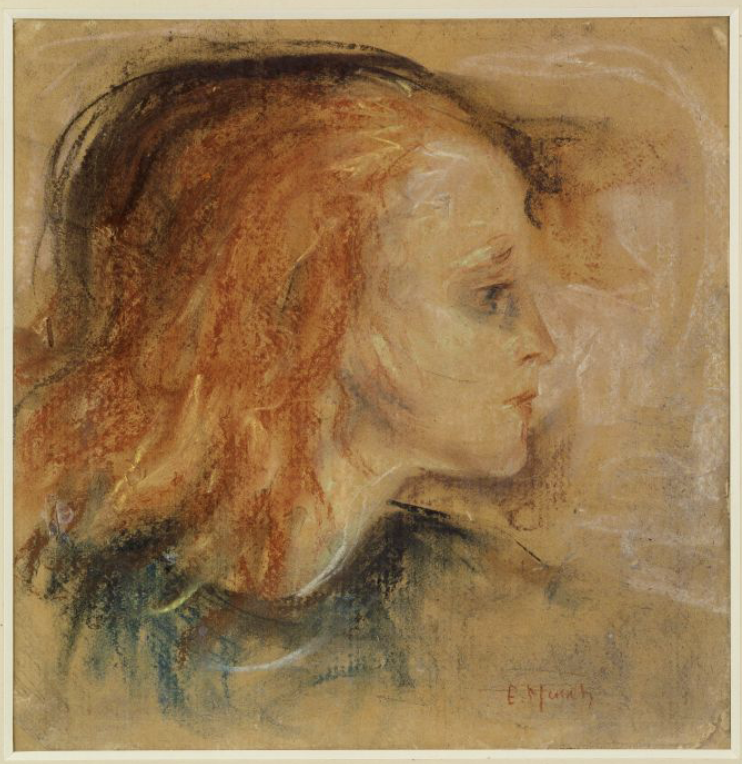
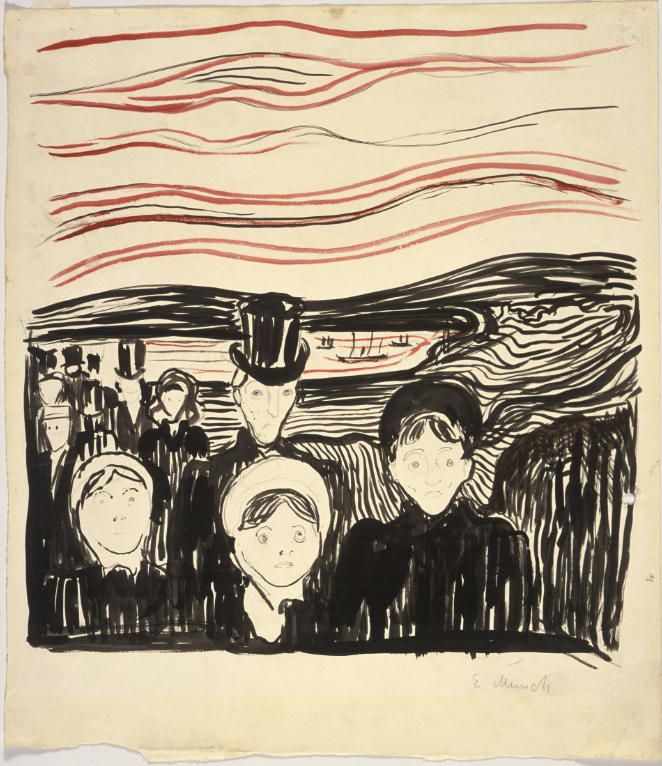
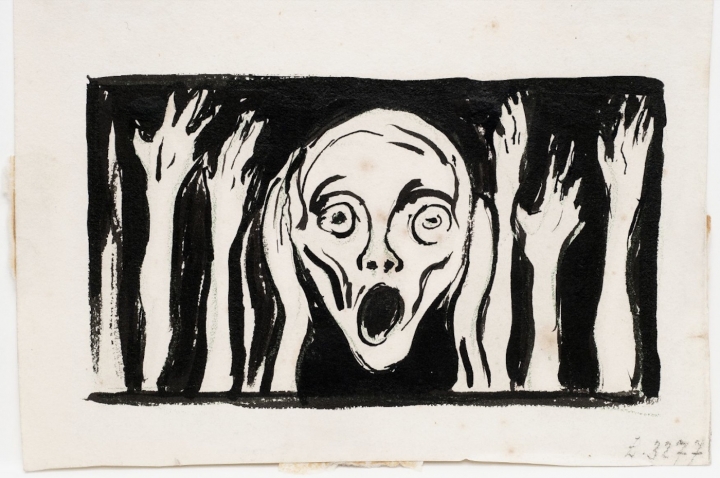
Over 90% of the drawings on digital display come from the Museum’s holdings, the rest from other public and private collections. “The goal is to make Munch’s art known and easily accessible to as many people as possible,” Magne Bruteig, Senior Curator for Prints and Drawings, tells Hyperallergic. “Since the majority of the drawings had never been exhibited or published in any way, it has been of special importance to reveal this ‘hidden treasure.’” The online collection, then, not only serves as an introduction for Munch novices but also for longtime admirers of the artist’s work, who have hitherto had little to no access to this huge collection of studies, preparatory sketches, watercolors, etc., which includes the miserable family grouping of Angst, at the top, the reprise of his infamous Scream figure, further up, from 1898, and The Sick Child, above, a portrait of his sister Sophie who died in childhood.
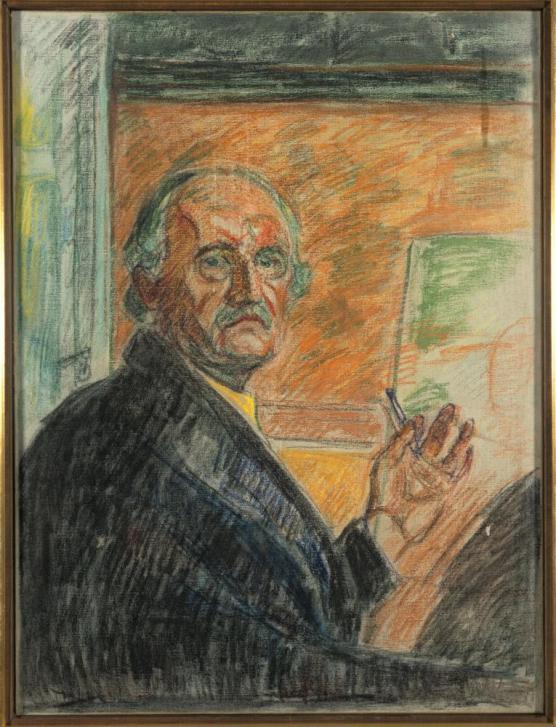
The drawings date back to 1873, when Munch was only ten years old and inserted a series of his own illustrations into a copy of Grimm’s Fairytales. The final works date from 1943, the year before the artist’s death, when he made the self-portrait above in pastel crayon. Munch’s work, writes Rosenthal, “is compulsively autobiographical.” Remaining a committed bachelor all of his life, he said that “his paintings were his children, even though he gave many of them a somewhat Spartan upbringing, deliberately leaving them not only unvarnished but exposed to the elements in his vast outdoor studio or hung on walls, unframed and with nails through them.” The several thousand drawings he fathered seem to have been treated with more care. Delve into the enormous collection at the Oslo Munch Museum site here, where you can also view many of the artist’s paintings and learn much more about his life and work through articles and essays.
Related Content:
30,000 Works of Art by Edvard Munch & Other Artists Put Online by Norway’s National Museum of Art
Edvard Munch’s Famous Painting “The Scream” Animated to the Sound of Pink Floyd’s Primal Music
The Edvard Munch Scream Action Figure
Josh Jones is a writer and musician based in Durham, NC. Follow him at @jdmagness
Read More...The Map of Philosophy: See All of the Disciplines, Areas & Subdivisions of Philosophy Mapped in a Comprehensive Video
In the introduction to his sweeping History of Western Philosophy, Bertrand Russell wastes no time getting to a definition of his subject. “The conceptions of life and the world which we call ‘philosophical,’” he writes in the first sentence, “are a product of two factors: one, inherited religious and ethical conceptions; the other, the sort of investigation which may be called ‘scientific,’ using the word in its broadest sense. … Philosophy, as I shall understand the word, is something intermediate between theology and science.” (Russell makes a similar argument, in slightly different terms, in the essay “Mysticism and Logic.”)
Although this distinction between broadly “theological” and broadly “scientific” thinking may not map directly onto the modern schism between “Continental” and “Analytic” philosophy, a comparison still seems highly relevant. Though some continental thinkers may not wish to admit it, their categories and modes of reasoning—or intuiting, reflecting, speculating, etc.—derive from theological thought denuded of its specific religious content or beliefs. Or as philosopher Thomas R. Wells writes at his blog The Philosopher’s Beard, the continental proceeds from a “direct concern with the human condition, its ambition, its reflexivity, its concern with the media as well as the message.”
The analytic, on the other hand, strives for “universal scope, clarity and public accountability…. It tries to systematize knowledge” and approximate scientific methods of inquiry (which also once mixed freely with the theological). Both approaches can move too close to the poles Russell identifies—can move too far away, that is, from philosophy and toward the obscure and purely mystical or the inhumanely, unreflectively rational. Perhaps one way of thinking about the history of philosophy is as a dance between this play of opposites, with each approach offering a corrective to the other’s excesses, sometimes within the same thinker’s body of work.
But before applying such abstractions, we should consider the ways philosophy developed as a discipline distinct from the hard sciences and theology—and from art, psychology, anthropology, physics, mathematics, linguistics, economics, etc. “Once upon a time,” notes the video at the top—a comprehensive “map of philosophy” made by Carneades.org— “Philosophy was anything you can study. Everything in the realm of study was a type of philosophy.” The breaking off of other fields into their own domains happened over the course of several hundred years. Nonetheless, “philosophy still had its fingers in all of those other pies.”
One can think philosophically about anything—philosophy can “put different disciplines on the same playing field to talk to each other.” It is, the video’s introduction declares, “the glue that holds all of academia together” (hence, the top academic degree, the Ph.D., or “doctor of philosophy”). For reasons of his own training, the video’s creator, who simply goes by the pseudonym “Carneades,” leans more heavily on the analytic side of things, neglecting or only lightly touching on much of the continental thought that flourished in the wake of Heidegger, Hegel, Nietzsche, Kierkegaard, Sartre, and others. (Further up, you can see a video focused on one specific school of moral philosophy—Consequentialism. See more such videos at the Carneades.org YouTube channel.)
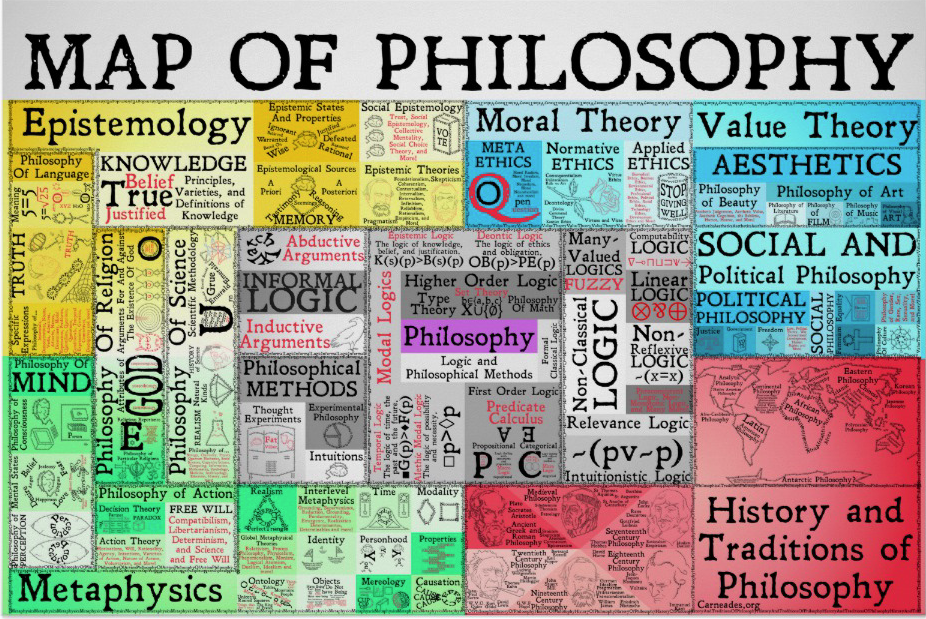
Carneades admits his biases and blind spots and welcomes corrections from those better versed in other traditions. To his credit, he includes Native American, African, Latin American, Afro-Caribbean, Polynesian, Japanese, Islamic, Tibetan, and many other global philosophical traditions in his extensive map—traditions that are usually completely ignored or deemed “unphilosophical” in other such surveys. His sensitivity to global thought may have something to do with the fact that he is not based in a Western academic department, but in West Africa, where he does humanitarian work.
See a complete table of contents, with links to specific sections, for the lengthy “Map of Philosophy” just below, and an image of the full map just above (purchase a hard copy here). Carneades’ intention to bring “these ideas back to the modern agora from the Ivory Tower” is a noble one. If you agree, and find these videos informative and intellectually stimulating, you can donate to or become a patron of his efforts at the Carneades.org Patreon page.
Table of Contents:
00:00 Introduction
01:44 Logic and Philosophical Methods
02:14 Formal Classical Logic
04:55 Non-Classical Logic
06:35 Informal Logic
08:00 Philosophical Methods
10:20 The History of Philosophy
13:30 Philosophical Traditions Around the World
20:55 Aesthetics
22:35 Political Philosophy
23:34 Social Philosophy
25:00 Moral Theory & Ethics
28:08 Epistemology
30:34 Metaphysics
34:13 Philosophy of Science
37:35 Philosophy of Religion
40:17 Philosophy of Language
41:58 Philosophy of Mind
43:49 Philosophy of Action
44:57 Full Map
Related Content:
Free Online Philosophy Courses
The History of Philosophy … Without Any Gaps
350 Animated Videos That Will Teach You Philosophy, from Ancient to Post-Modern
A History of Philosophy in 81 Video Lectures: From Ancient Greece to Modern Times
Josh Jones is a writer and musician based in Durham, NC. Follow him at @jdmagness
Read More...Muhammad Ali & Sly Stone Get Into a Heated Debate on Racism & Reparations on The Mike Douglas Show (1974)
Ah, the 70s… an American president was impeached for criminal activity; a congressman, Wayne Hays, resigned for sleeping with his secretary, after divorcing his wife to marry a different secretary; another congressman, Bud Shuster—who described Hays as “the meanest man in the house”—called for an investigation of Watergate special prosecutor Archibald Cox, after Cox was fired by the soon-to-be impeached president… ‘twas a different time, children, a simpler time….
Well, at any rate, they sure wore funny suits back then, eh? Those lapels…. But just like today, politics mixed freely with sports and entertainment in controversial and televisual ways. Boxers got ratings, singers got ratings, politicians like “meanest man in the house” Wayne Hays got ratings, even before his sex scandal, when he appeared on TV with boxers and singers—appeared, that is, on The Mike Douglas Show in 1974 with Muhammad Ali and Sly Stone. Actor and activist Theodore Bikel was there too, though you might blink and miss him in the fracas just above.
First, Hays offers some banal opinions on the subject of campaign financing, another one of those bygone 70s issues. But when Douglas poses the question to Ali of whether or not he’d ever run for office, things pick up, to say the least. Ali refuses to play the entertainer. He launches flurry after flurry of jabs at white America, and at Hays, who does his best to stay upright under the onslaught. “Ali is unyielding,” writes Dangerous Minds, “intense and brilliant.”
Ali takes on a serious question facing Black nationalists of the 60s and 70s, from the Panthers to the Nation of Islam, whose views Ali embraced at the time, along with, perhaps, some of their ugly anti-Semitism. (The following year he converted to Sunni Islam, and later became a Sufi.) Should Black activists participate in the oppressive systems of the U.S. government? Can anyone do good from inside the halls of imperialist power?
Hays makes an integrationist case, and champions Black leaders like congresswoman Barbara Jordan. Ali is relentlessly combative, calling for reparations. Sly slides in to clarify and pacify, playing mediator and referee. Douglas gets off the applause line, “isn’t it time we all tried to live together.” Ali refuses to gloss over racism and economic inequality. No peace, he says in effect, without justice. Aren’t we glad, forty-four years later, that we’ve ironed all this out? See the full show here for much more heavyweight commentary from Ali and sometimes fuzzy counterpoint from Sly. They go back and forth with Douglas for ten minutes before Hays and Bikel join.
Related Content:
Muhammad Ali Gives a Dramatic Reading of His Poem on the Attica Prison Uprising
James Baldwin Bests William F. Buckley in 1965 Debate at Cambridge University
Josh Jones is a writer and musician based in Durham, NC. Follow him at @jdmagness
Read More...Support Us
We're hoping to rely on loyal readers, rather than erratic ads. Please click the Donate button and support Open Culture. You can use Paypal, Venmo, Patreon, even Crypto! We thank you!

About Us

Open Culture scours the web for the best educational media. We find the free courses and audio books you need, the language lessons & educational videos you want, and plenty of enlightenment in between.
Advertise With Us

FREE UPDATES!
GET OUR DAILY EMAIL
Get the best cultural and educational resources on the web curated for you in a daily email. We never spam. Unsubscribe at any time.
FOLLOW ON SOCIAL MEDIA

Open Culture editor Dan Colman scours the web for the best educational media. He finds the free courses and audio books you need, the language lessons & movies you want, and plenty of enlightenment in between.
Advertise With Us


