The bombast, arrogance and bloviation–maybe you need a break from it all. You may need exactly the opposite–a little Fred Rogers. If so, we’ve got two things for you. First, head over to Twitch.TV where they’re currently livestreaming all 856 episodes of Mister Rogers Neighborhood (for a limited time). It’s a grand way of celebrating what would have been Fred’s 90th birthday this week. And then, above, watch the brand new trailer for Won’t You Be My Neighbor?, the upcoming documentary by Oscar-winning director Morgan Neville (20 Feet from Stardom). Due out in June, the film “takes us beyond the zip-up cardigans and the land of make-believe, and into the heart of a creative genius who inspired generations of children with compassion and limitless imagination.” As you watch the trailer, you’ll be reminded that Rogers worked his magic during other periods of chaos and discontent, and how sorely his calming presence is missing today.
If you would like to support the mission of Open Culture, consider making a donation to our site. It’s hard to rely 100% on ads, and your contributions will help us continue providing the best free cultural and educational materials to learners everywhere. You can contribute through PayPal, Patreon, and Venmo (@openculture). Thanks!
I don’t know how many people still watch WKRP in Cincinnati , or how well the jokes have aged, but there is a small but dedicated fan base out there. Part of it might be nostalgia not just for the sitcom itself, but for a time when radio stations were idiosyncratic things, not just part of vast media conglomerates that have a song playlist you could fit onto a thumb drive. Ask any boomer and they’ll recall their own favorite real-life versions of rock DJ Johnny Fever (Howard Hesseman) and funk/soul DJ Venus Flytrap (Tim Reid).
Recently, one dedicated fan went through the first season and identified every song played on the shows, and produced this spreadsheet first mentioned on BoingBoing. That then led to somebody wishing for a Spotify playlist and of course the Internet has provided. Find the playlist and stream all 202 tracks below. Someone also assembled a YouTube version that you can find at the bottom of the post.
What to make of the choices? DJ Johnny Fever starts off with Ted Nugent’s “Queen of the Forest” to announce the station’s switch from muzak to a rock/Top 40 format in the first episode. A majority of the songs are major label selections, with the Rolling Stones the favorite choice through the season with five songs total. Other bands are still staples of classic rock format stations to this day: Bob Seger, Boston, Styx, Van Morrison, Foreigner, The Grateful Dead, Blondie, The Doors. Venus Flytrap’s selections aren’t as common, but they are also a familiar cross-section of the disco era: Chic, A Taste of Honey, Evelyn Champagne King, and Marvin Gaye.
One interesting appearance was Michael Des Barres, former frontman of the rock band Detective (who were signed to Led Zeppelin’s Swan Song label), and post-Robert Palmer frontman of Power Station. He was cast as the lead singer of the punk band “Scum of the Earth” in one WKRP episode, where he sang three Detective tunes. (The band actually came dressed in business suits, so I’m not sure how “punk” they were). Now, the producers must have liked Michael Des Barres, because when the ill-fated sequel The New WKRP in Cincinnati premiered in 1991, he played one half of a morning show team.
Creator Hugh Wilson explains in this video how costly some of the original rights usages could be, where maybe “I could get 17 seconds of Pink Floyd for $3,000.” But as the show grew in popularity, record companies started to treat the show “like a real station” and providing music and merchandise to dress the sets.
The use of actual radio hits (and not “soundalikes”) became a problem for the show in syndication. When it was time to renew the rights, the various media companies wanted 10 times as much. As Wilson says, that was the end of WKRP in syndication.
The Shout Factory DVD boxset was able to reproduce most of Season one with 80 percent of the original music intact, and it’s possibly why only one season is out there.
That also may be why that $3,000 worth of Pink Floyd only exists as a very blurry YouTube video up at the top of the post.
Ted Mills is a freelance writer on the arts who currently hosts the artist interview-based FunkZone Podcast and is the producer of KCRW’s Curious Coast. You can also follow him on Twitter at @tedmills, read his other arts writing at tedmills.com and/or watch his films here.
Ask anyone who’s pursued a career in the sciences what first piqued their interest in what would become their field, and they’ll almost certainly have a story. Gazing at the stars on a camping trip, raising a pet frog, fooling around with computers and their components: an experience sparks a desire for knowledge and understanding, and the pursuit of that desire eventually delivers one to their specific area of specialization.
Or, as they say in science, at least it works that way in theory; the reality usually unrolls less smoothly. On such a journey, just like any other, it might help to have a map.
Enter the work of science writer and physicist Dominic Walliman, whose animated work on the Youtube channel Domain of Science we’ve previously featured here on Open Culture. (See the “Related Content” section below for the links.)
Walliman’s videos astutely explain how the subfields of biology, chemistry, mathematics, physics, and computer science relate to each other, but now he’s turned that same material into infographics readable at a glance: maps, essentially, of the intellectual territory. He’s made these maps, of biology, chemistry, mathematics, physics, and computer science, freely available on his Flickr account: you can view them all on a single page here along with a few more of his infographics..
As much use as Walliman’s maps might be to science-minded youngsters looking for the best way to direct their fascinations into a proper course of study, they also offer a helpful reminder to those farther down the path — especially those who’ve struggled with the blinders of hyperspecialization — of where their work fits in the grand scheme of things. No matter one’s field, scientific or otherwise, one always labors under the threat of losing sight of the forest for the trees. Or the realm of life for the bioinformatics, biophysics, and biomathematics; the whole of mathematics for the number theory, the differential geometry, and the differential equations; the workings of computers for the scheduling, the optimization, and the boolean satisfiability.
Based in Seoul, Colin Marshall writes and broadcasts on cities and culture. His projects include the book The Stateless City: a Walk through 21st-Century Los Angeles and the video series The City in Cinema. Follow him on Twitter at @colinmarshall or on Facebook.

In these times of high anxiety, battles over “free speech”—on college campuses, in corporate offices, on airwaves and the internet—can seem extremely myopic from a certain perspective. The perspective I mean is one in which a disturbing number of messages broadcast perpetually to millions of people bear little relationship to scientific, historical, or social facts, so that it becomes increasingly difficult for many people to tell fact from fiction. Debating whether or not such speech is “free” outside of any consideration for what purpose it serves, who it harms, and why it should drown out other speech because it appeals to widespread prejudices or powerful, monied interests seems grossly irresponsible at best.
Most philosophers who have considered these matters have stressed the important relationship between reason and ethics. In the classical formula, persuasive speech was considered to have three dimensions: logos—the use of facts and logical arguments; ethos—the appeal to common standards of value; and pathos—a consideration for the emotional resonance of language. While the forceful dialectical reasoning of Plato and his contemporaries valued parrhesia—which Michel Foucault translates as “free speech,” but which can also means “bold” or “candid” speech—classical thinkers also valued social harmony and did not intend that philosophical debate be a scorched-earth war with the intention to win at all costs.
Bertrand Russell, the brilliant mathematician, philosopher, and anti-war activist, invoked this tradition often (as in his letter declining a debate with British fascist Oswald Mosley). In the video above he answers the question, “what would you think it’s worth telling future generations about the life you’ve lived and the lessons you’ve learned from it.” His answer may not validate the prejudices of certain partisans, but neither does it evince any kind of special partisanship itself. Russell breaks his advice into two, interdependent categories, “intellectual and moral.”
When you are studying any matter or considering any philosophy, ask yourself only what are the facts and what is the truth that the facts bear out. Never let yourself be diverted either by what you wish to believe, or by what you think would have beneficent social effects if it were believed. But look only, and solely, at what are the facts.
The moral thing I should wish to say to them is very simple. I should say love is wise, hatred is foolish. In this world, which is getting more and more interconnected, we have to learn to tolerate each other, we have to learn to put up with the fact that some people say things that we don’t like. We can only live together in that way. And if we are to live together and not die together, we should learn the kind of tolerance which is absolutely vital to the continuation of human life on this planet.
The gist: our speech should conform to the facts of the matter; rather than wishful thinking, we should accept that people will say things we don’t like, but if we cannot love but only hate each other, we’ll probably end up destroying ourselves.
The video above, from the BBC program Face-to-Face, was recorded in 1959.
This month, First Draft has followed up with Verification Training, a free online course designed to help “teachers, journalists and the general public [learn] how to verify online media, so that they don’t fall for hoaxes, rumors and misinformation.” The handy and timely course was developed by Claire Wardle, First Draft’s executive director. You can sign up here.
The purpose of the monumental druidical structure known as Stonehenge has been lost to us, but many theories abound, “from the rational to the irrational to the magical.” On the magical end of the scale, we have the giant stones associated with King Arthur and the wizard Merlin. On the more rational side, speculation that the structure functioned as a calendar for religious ceremonies or agricultural seasons.
While the search for answers may be irresistible, we may never know exactly what the builders of Stonehenge intended. But we learn much by studying how others have approached the ancient monument in the past. Existent studies of Stonehenge with illustrations date back to the 14th century. These Medieval representations tried to situate the stones in a “Christian view of world history,” as Art History professor Sam Smiles writes at the British Library.
A century later, drawings of the stones show more of an interest in its architectural features. One manuscript includes “a tiny illustration of four trilithons (two vertical stones supporting a lintel).” Remarkably, writes Smiles, “the artist has understood how the lintels were fixed to the uprights by a mortise and tenon joint.” The drawing may represent “the earliest surviving representation of Stonehenge based on direct observation.”
The practice of drawing Stonehenge from life continued, and in the watercolor above by Flemish painter Lucas de Heere, dating from circa 1573, we see “a more topographical approach.” Related to other similar images created around the same time, the painting shows us an early example of what came to be called “chorography,” which archaeologist Michael Shanks describes as referring to “antiquarian works that dealt in topography, place, community, history, memory.”
Rather than considering it only as a mystical or sacred site or an architectural marvel, de Heere’s depiction of Stonehenge folds both of these interests into a larger concern with English landscape and history, of the kind exemplified by William Camden’s 1586 Britannia, a chorographical survey of Britain and Ireland. Works like de Heere’s and Camden’s are part of the “Re-Discovery of England,” as historian R.C. Richardson argues, that took place under the reign of Elizabeth I, and which produced a new national history, “designed to extend the boundaries of knowledge and understanding.”
As chorography developed as a discipline, Stonehenge and other ancient monuments continued to exert a fascination for their historical, topographical, and archeological features. By the “last quarter of the 18th century,” Smiles tells us, “prehistoric monuments began to be regularly included in topographical surveys,” such as Thomas Hearne’s 1779 Antiquities of Great Britain, which included the engraving just above as its final plate. Learn more about the development of topography and its interest in ancient British monuments, and see many more of these historic images, at the British Library’s site.
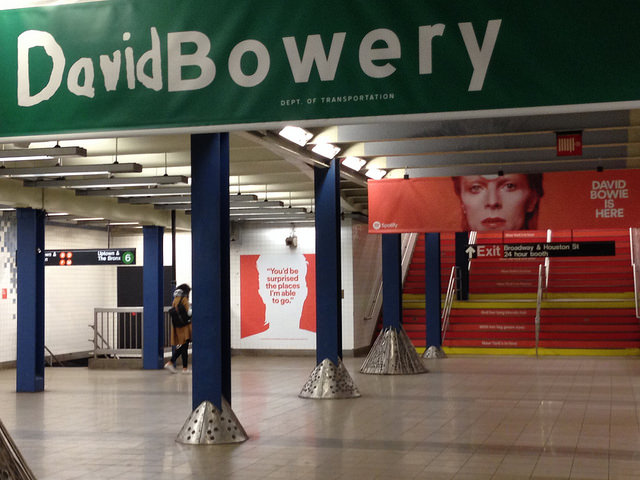
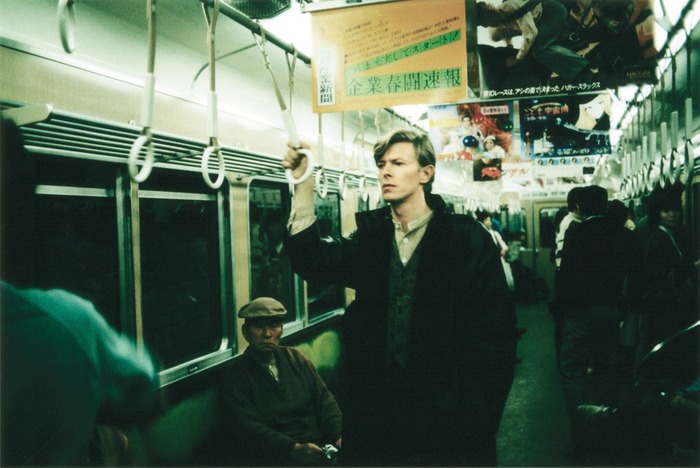
What, exactly, turned David Jones into David Bowie? Observers have been asking that question ever since the artistically inclined rock star — who, we might say, made rock stardom into a viable art form in the first place — began his high-profile experimentation with his own image in the early 1970s. Having put out his first big hit “Space Oddity” a few years before that, in 1969, he spent the period in between living, with his then-wife Angie, at a Victorian villa in South London called Haddon Hall. “The couple rented a ground-floor flat for £7 a week – the Spiders from Mars were, I think, sequestered around an upstairs landing – and in one of its cavernous rooms, their ceilings painted silver, Angie cut David’s hair and stitched the first Ziggy outfit.”
Those words come from the Guardian’s Rachel Cooke, reviewing the biographical graphic novel Haddon Hall: When David Invented Bowie. “Its author, the Tunisian-born French cartoonist Nejib, puts Bowie’s lost house centre stage, David and Angie having fallen instantly in love with its discreet decrepitude, its towers and mouldings and preposterously long corridors,” she writes. “Nejib is wonderfully alive to the influences on Bowie in this crucial period, from the final illness of his father, John, to Stanley Kubrick’s 1971 film adaptation of A Clockwork Orange (leaving the cinema after seeing it, the still struggling Bowie suddenly sees what he should be: a rock star ‘who’s all destruction and the future’).”
A Bowie scholar could argue that his and Angie’s Haddon Hall years provided the space for the most crucial gestation period and space in his career. In an interview with the Herald, Nejib relates his dissatisfaction with extant Bowie biographies, and how one biographer even admits that writing a satisfying one may be “rather impossible because Bowie is a fiction created by David Jones, a very secret man. I loved that idea and I consider Bowie as one of the most powerful fictional creations of this period. That was very liberating for me to make this ‘portrait’ of Bowie in a graphic novel,” which he describes as “not a documentary, but a fiction,” based on more than just facts and as a result “a mix of many things.”
More fascinated by “fragility and doubt than success and stardom,” Nejib — whose art style brings to mind cartoons seen in magazines of the late 1960s and early 1970s — focuses on a “gap” in Bowie’s life as its story has previously been told: “The man is close to becoming the genius we know, but he is full of doubt. I was inspired by an interview in which he said that he felt that all his influences were merging and he felt that it was the moment for him to make the big jump!” And make the big jump he did, not just once but over and over again throughout the course of his life, reinventing himself both musically and as a persona whenever necessary. Whatever importance any given Bowie fan grants his time in Haddon Hall, they’ve got to admit that those years make for a tale best told visually.
Based in Seoul, Colin Marshall writes and broadcasts on cities and culture. His projects include the book The Stateless City: a Walk through 21st-Century Los Angeles and the video series The City in Cinema. Follow him on Twitter at @colinmarshall or on Facebook.
Who among us wouldn’t want the ineffably mellow, witty, and wise Bill Murray to crash their party, wedding, or White House press briefing room? Maybe you’re one of the few who could resist his comic charms. But could you throw him out if he brought along a cellist and read Lawrence Ferlinghetti’s poem “Dog”? Not I.
Murray appeared at SXSW on Monday and read the poem as part of the promotional campaign for Wes Anderson’s new stop-motion animation film Isle of Dogs. And it can seem when we look back at Murray’s many public appearances over the last few years, that the one thing he’s done more than crash other people’s parties and star in Wes Anderson films has been read poetry in public.
Murray, as Ayun Halliday pointed out in a previous post, is a “documented poetry nut,” who once wrote poetry himself as a much younger man. He’s been “wise enough,” writes Gavin Edwards at Rolling Stone “not to share it with the world.” Perhaps we’re missing out.
But we do have many, many clips of Murray reading his favorites from other poets he admires, like Ferlinghetti, and like Wallace Stevens, whose “The Planet on The Table” and “A Rabbit as King of the Ghosts,” he reads above at New York’s Poets House, an institution he has wholeheartedly supported.
Wallace Stevens is a famously difficult poet, but he is also quite funny, in an obliquely droll way, and its no wonder Murray likes his verse. Poets House director Lee Bricoccetti observes that there is “an alignment between comedy and poetry… a precision in the way you handle language.” Some of my own favorite poets—like Frank O’Hara and the “willfully ridiculous” Stevie Smith—are also some of the funniest writers I’ve ever encountered in any form. Murray’s own poetic efforts, were we ever to hear them, may not measure up to the work of his favorites, but he is undoubtedly “a master of linguistic control and pacing.”
We also know that he can turn in finely nuanced dramatic performances when he wants to, and his mastery of the spoken word contributes just as much to moodier poets like Emily Dickinson, whom he reads above in a surprise performance for construction workers at work on the new Poets House home in 2009. You might agree, however, that he really shines with comic fare, like Billy Collins “Another Reason I Don’t Keep a Gun in the House” and Lorine Niedecker’s majorly condensed “Poet’s Work.”
Last month, I was thrilled to learn of a talk coming to my town called “The Writers of Wakanda.” I scored a (free) ticket, thinking that maybe the massive blockbuster movie’s director/writer Ryan Coogler might make an appearance (or his co-writer Joe Robert Cole), or maybe one or more of the high-profile writers who have expanded the comic’s world recently, like Ta-Nehisi Coates, Roxanne Gay, or Nnedi Okorafor. Well, either there was some kind of bait-and-switch at work or I naively failed to read the fine print. The event was a panel of devoted fans of the comic having a discussion about their lifelong fandom, the many iterations of the character through various Marvel writer’s hands, and the film’s huge cultural impact at home and abroad. It was slightly disappointing but also quite enjoyable and informative.
I learned, for example, that some of the most well-loved and highly-praised characters in the film appeared very late in the series’ run (which began with the character’s creation by Stan Lee and Jack Kirby in 1966) and were introduced by its first black writers, the “chronically underappreciated” Christopher Priest and the filmmaker Reginald Hudlin.
In the late 90s, Priest invented the Dora Milaje, the elite all-female fighting force who protect Wakanda’s kings (who each take on the mantle of superhero Black Panther once they ascend the throne). Hudlin created the character of Shuri, King T’Challa’s younger sister and the scientific mastermind behind his high-tech empire of vibranium-powered gear and gadgetry. Which brings us, at last, to the subject of this post, the Black Panther animated series, co-produced by BET and Marvel, who have released all six episodes on Marvel’s YouTube channel. Stream them all above.
Taking its story from Hudlin’s 2005 comics run, the series is less animation and more “a stop motion comic,” as Nerdist writes, “added to the artwork of John Romita, Jr.” This is all to its credit, as is its star-studded voice casting, with Kerry Washington as Shuri, Alfre Woodard as the Queen Mother, Jill Scott as Storm, and Djimon Hounsou as T’Challa/Black Panther. How does it compare to the blockbuster film? From its first salvo of Wakandan warrior prowess in a cold open set in the 5th century A.D., to its seventies-African-funk-inspired theme song, to a present-day scene in the White House, with a blustery racist army general (played by Stan Lee) who sounds like a member of the current administration, the first episode, above, suggests it will live up to Hudlin’s casting of the character as “an unapologetic African man,” as Todd Steven Burroughs writes at The Root, “openly opposed to white, Western supremacy.”
Hudlin wrote some of the comic’s most politically challenging stories, delving into “serious European colonization themes.” These themes are woven throughout the animated series, which features such characters now familiar to filmgoers as Everett Ross and the villain Klaw. Captain America parachutes in—in a flashback—meets an earlier Black Panther during World War II, and takes a beating. (“These are dangerous times,” says Cap, “you need to choose a side.” The reply: “We have, our own.”) The X‑Men’s Storm, formerly the first most-famous African superhero, plays a significant role. Not in the series, likely to many people’s disappointment, are the Dora Milaje, at least in starring roles, and the film’s primary antagonist Erik Killmonger.
But not to worry. The ass-kicking general Okoye and her cadre of warriors will soon get a spin-off comic written by Okorafor, and there’s been some speculation, at least, about whether Killmonger will return (resurrected, perhaps, as he was in the comics) in the inevitable Black Panther 2. In the meantime, both longtime and new fans of the character can get their fix in this six-episode series, which offers a thrilling, bloody, and historically fascinating take not only on the Black Panther himself, but on the complicated relationship of Wakanda to the machinations of the Western world throughout colonial history and into the present.
As we observed last October, Coursera has been undergoing an evolution of sorts. When the ed tech company started out, it offered an array of individual courses to students worldwide. A little of this. And a little of that. Now, they’re increasingly moving towards courses that work together in sequences. First came “coursespecializations”–collections of courses that allow students to gain a mastery of specialized topics like Deep Learning, Data Science (Johns Hopkins), Business Fundamentals (Wharton), Digital Marketing (University of Illinois), and Big Data (UC San Diego). Next it was just a logical jump to offering full-blown Bachelor’s and Master’s programs at a discounted price (roughly 1/3 the usual cost.) As of this month, Coursera offers one Bachelor’s program (Computer Science from the University of London), one MBA, and eight Master’s programs. The full list of degree programs appears below:
If you would like to support the mission of Open Culture, consider making a donation to our site. It’s hard to rely 100% on ads, and your contributions will help us continue providing the best free cultural and educational materials to learners everywhere. You can contribute through PayPal, Patreon, and Venmo (@openculture). Thanks!
Note: Open Culture has a partnership with Coursera. If readers enroll in certain Coursera courses, it helps support Open Culture.
Equipped with smartphones that grow more powerful by the year, gamers on the go now have a seemingly unlimited variety of playing options. A decade ago they relied on handheld game consoles with their thousands of available game cartridges and later discs, whose reign began with Nintendo’s introduction of the original Game Boy (a device whose unwrapping on Christmas 1990 remains one of my most vivid childhood memories). But even before the Game Boy and its successors, there were standalone handheld proto-video-games, “LCD, VFD and LED-based machines that sold, often cheaply, at toy stores and booths over the decades.”
“They are, of course, entertaining in themselves – these are attempts to put together inexpensive versions of video games of the time, or bringing new properties wholecloth into existence.” They also “represent the difficulty ahead for many aspects of digital entertainment, and as such are worth experiencing and understanding for that reason alone.”
So as you play, spare a thought for the developers of these handheld games, not just because of the dire intellectual property they often had to work with, but the severe technological restrictions they invariably had to work under. “This sort of Herculean effort to squeeze a major arcade machine into a handful of circuits and a beeping, booping shell of what it once was is an ongoing situation,” writes Scott. “Where once it was trying to make arcade machines work both on home consoles like the 2600 and Colecovision, so it was also the case of these plastic toy games. Work of this sort continues, as mobile games take charge and developers often work to bring huge immersive experiences to where a phone hits all the same notes.” And the day will certainly come when even the most impressive games we play now, handheld or otherwise, will seem just as hilariously simplistic.
Based in Seoul, Colin Marshall writes and broadcasts on cities and culture. His projects include the book The Stateless City: a Walk through 21st-Century Los Angeles and the video series The City in Cinema. Follow him on Twitter at @colinmarshall or on Facebook.
We're hoping to rely on loyal readers, rather than erratic ads. Please click the Donate button and support Open Culture. You can use Paypal, Venmo, Patreon, even Crypto! We thank you!
Open Culture scours the web for the best educational media. We find the free courses and audio books you need, the language lessons & educational videos you want, and plenty of enlightenment in between.