It’s getting close to that time of the year again, when the flu starts to wreak havoc. And so, with the help of NPR’s Robert Krulwich and medical animator David Bolinsky, we’re taking an animated look at what actually happens when a virus invades your body and tricks a single cell into making a million more viruses, and how your immune system eventually deals with the whole mess. It’s a nice demystification of phenomena that affects our everyday lives. If you feel inclined to get a flu shot after watching this clip, I can’t say that I blame you.
Follow us on Facebook and Twitter and share intelligent media with your friends. Or better yet, sign up for our daily email and get a daily dose of Open Culture in your inbox. And if you want to make sure that our posts definitely appear in your Facebook newsfeed, just follow these simple steps.
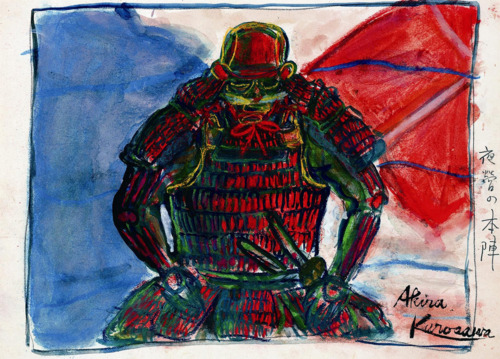
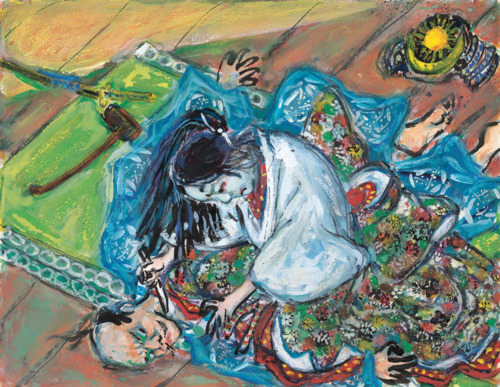
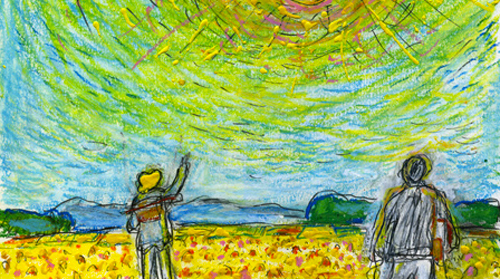
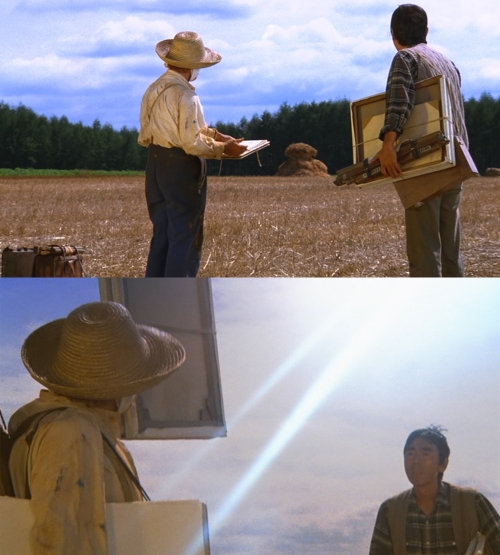
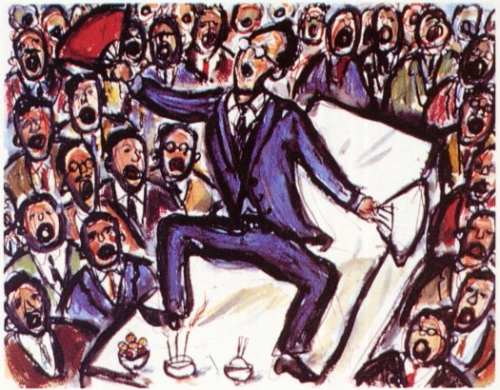
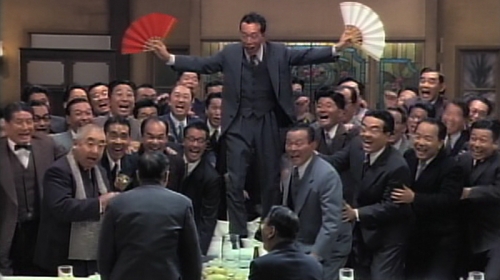
Appreciators of the finest works in cinema history often liken their images to paintings. In the case of Akira Kurosawa, maker of quite a few entries on that grand list of the finest works in cinema history, that makes professional sense: he began as a painter, only later turning filmmaker. “When I changed careers,” he writes, “I burnt all the pictures that I had painted up until then. I intended to forget painting once and for all. As a well-known Japanese proverb says, ‘If you chase two rabbits, you may not catch even one.’ I did no art work at all once I began to work in cinema. But since becoming a film director, I have found that drawing rough sketches was often a useful means of explaining ideas to my staff.”
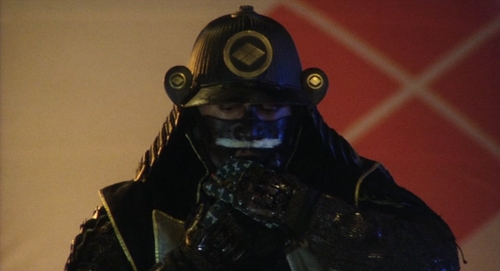
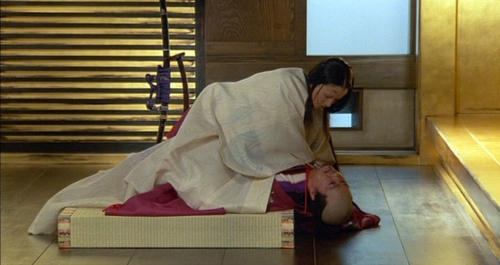
That comes quoted on “Akira Kurosawa: From Art to Film,” a roundup of such paintings by the Emperor (a nickname Kurosawa earned through his on-set manner), set beside the resulting frames from his movies. “As a painter and filmmaker, Kurosawa stuck to his own style,” writes Popmatters’ Ian Chant in an examination of this facet of his career, “informed heavily by traditional Japanese painting as well as European impressionists and expressionists, another arena of art where he answered to both eastern and western influences. These painstakingly crafted paintings formed the visual backbone of some of Kurosawa’s most lasting achievements.”
The most vivid examples of canvas-turned-celluloid come from Kurosawa’s later works, such as 1980’s Kagemusha, 1985’s Ran, 1990’s Dreams, and 1993’s Madadayo, selections from each of which you see in this post. “I cannot help but be fascinated by the fact that when I tried to paint well, I could only produce mediocre pictures,” continues the Emperor himself. “But when I concentrated on delineating the ideas for my films, I unconsciously produced works that people find interesting.” Holding the painted work up against his film work, only the strictest cinema purist could deny that, ultimately, Kurosawa caught both rabbits.
If you were to ask me in my callow years as a young art student to name my favorite painter, I would have answered without a moment’s hesitation: Wassily Kandinsky. His theoretical bent, his mysticism, his seemingly near total creative independence…. There were times when Kandinsky the thinker, writer, and teacher appealed to me even more than Kandinsky the painter. This may go a ways toward explaining why I left art school after my first year to pursue writing and teaching. But nowadays, having seen a tiny bit more of the world and its bountiful artistic treasures, I might pause for just a moment if asked about my favorite painter… then I’d answer: Wassily Kandinsky.
If you want to see the pioneering abstract expressionist’s art in the United States, your best bet is to get yourself to New York’s famed Guggenheim, which has a veritable treasure chest of Kandinsky’s work that documents his transition from paintings and woodcuts inspired by Russian folk art and French fauvism to completely non-representational canvases made entirely of intersecting lines, shapes, and colors—his own private symbology.
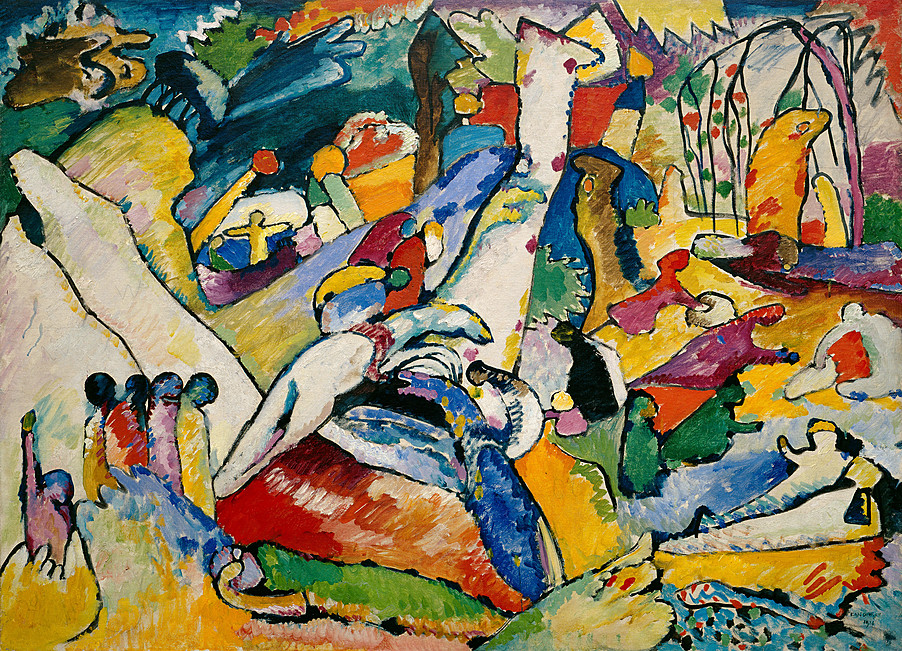
But if you can’t make it to New York, then just head on over to the Guggenheim’s online collection, where the museum has digitized “nearly 1600 artworks by more than 575 artists.” This is the most sweeping move toward greater accessibility since the private collection went public in 1937. You’ll find early representational Kandinskys; transitional Kandinskys like Sketch for Composition II from 1909-10 (top)—with still recognizable favorite motifs of his, like the horse and rider embedded in them; and you’ll find much more abstract Kandinskys like 1913’s Light Picture, above, showing his move even farther away from Matisse and Russian folks and closer to an inimitable individual aesthetic like that of Joan Miró or Paul Klee.
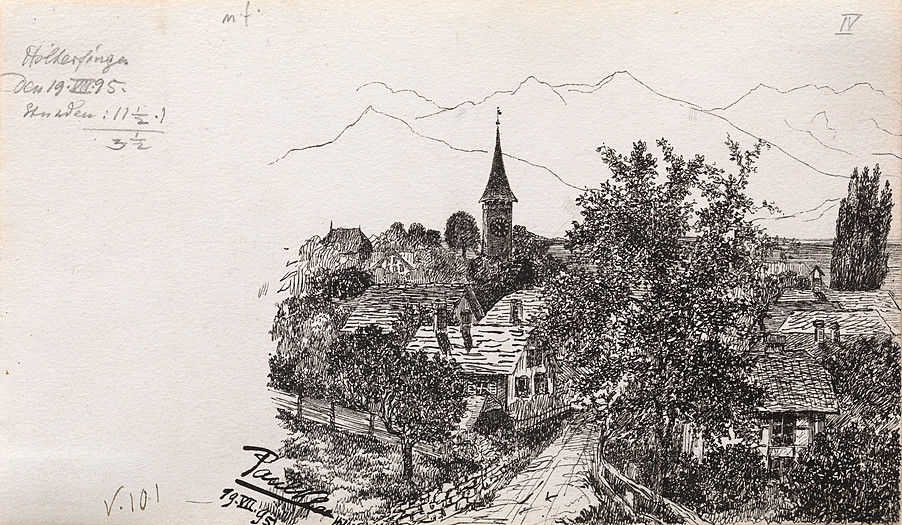
Speaking of Klee, another of my favorites, you’ll also find the sketch above, from 1895, before he began his formal training in Munich. It’s a far cry from his mature style—a primitive minimalism that drew inspiration from children’s art. If you know anyone who looks at abstract art and says, “I could do that,” show them the drawing above and ask if they could do this. Painters like Kandinsky and Klee, who worked and exhibited together, first learned to render in more rigorously formal styles before they broke every rule and made their own. It’s a necessary part of the discipline of art.
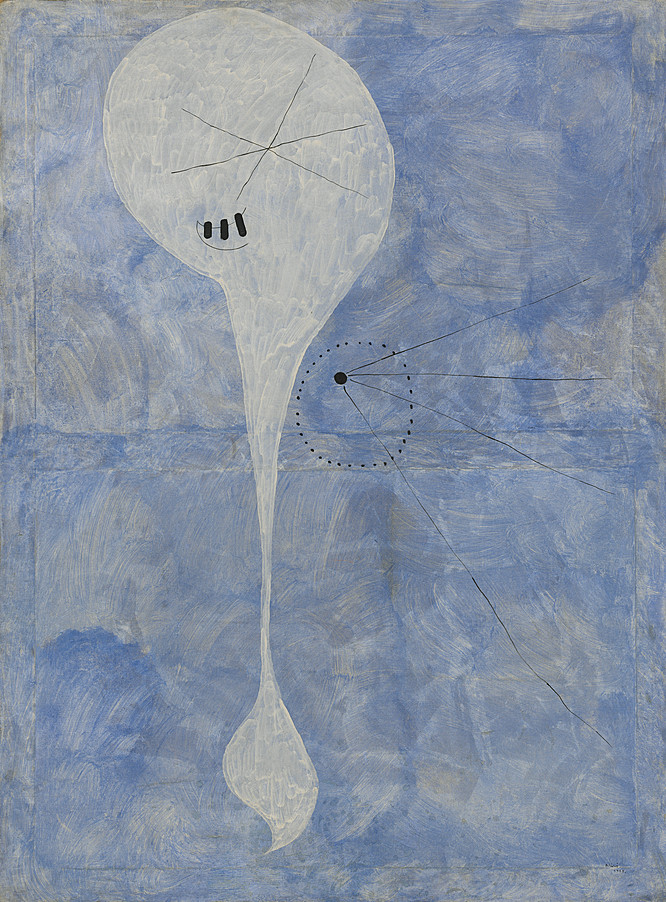
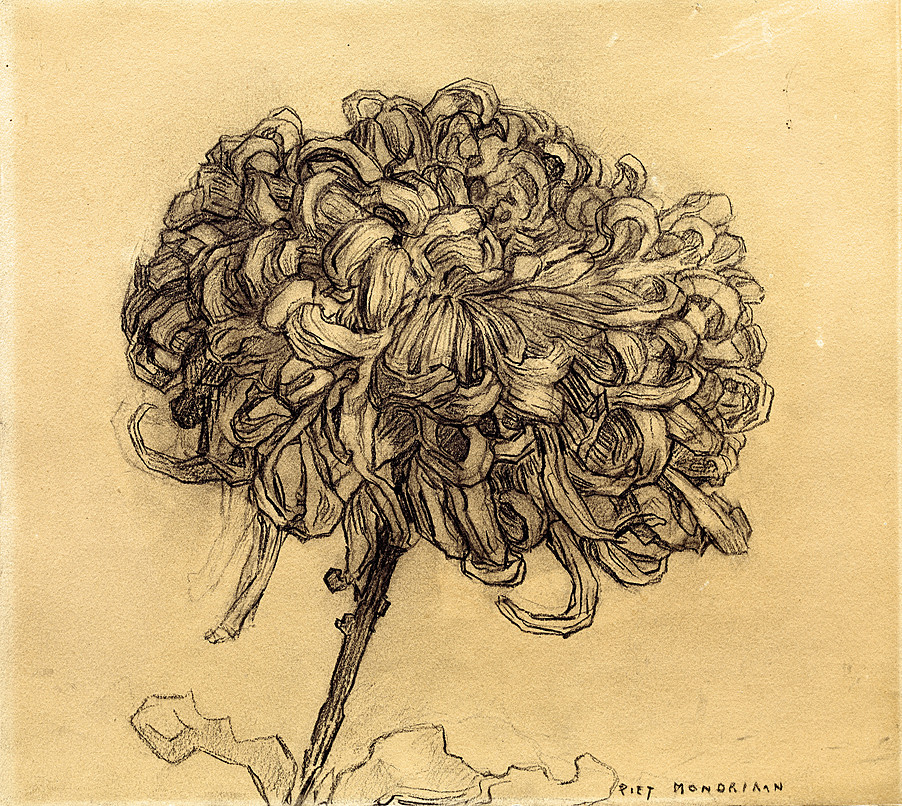
Of the three artists I’ve mentioned thus far, it is perhaps Miró who moved farthest away from any semblance of classical training. In works like Personage (above), the Spanish surrealist achieved his “assassination of painting” and the realist bourgeois values he detested in European art. Piet Mondrian, another artist who completely radicalized painting, did so by moving in the opposite direction, towards a formalism so exacting as to be almost chilling. But like all modern artists, Mondrian learned the classical rules before he tore them up for good, as evidenced by his drawing below, Chrysanthemum, from 1908-09.
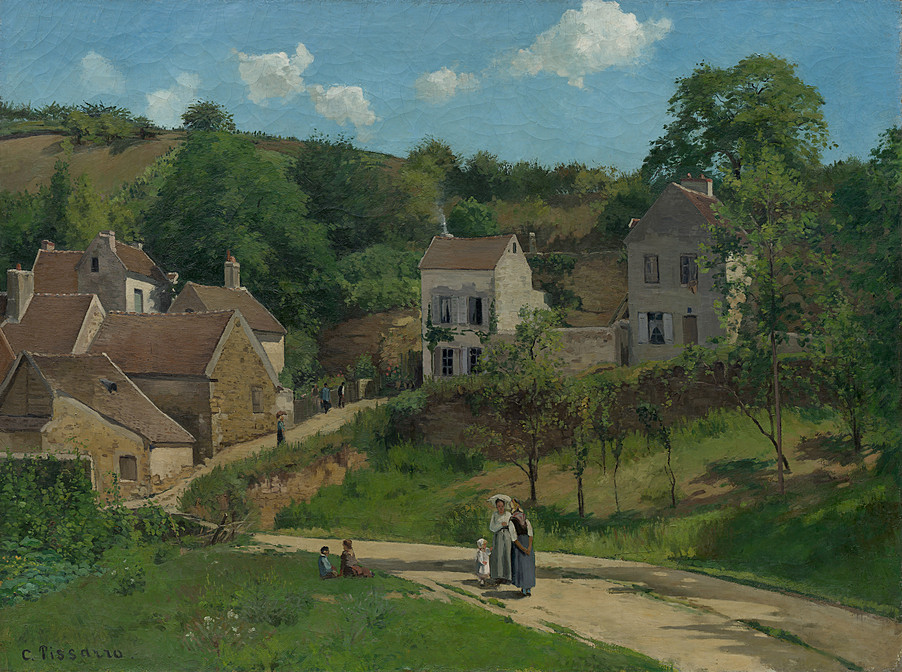
Of course you won’t only find artists from the early twentieth century in the Guggenheim’s online collection. This just happens to be one of my favorite periods, and the Guggenheim is most famous for its modernist collection. But you’ll also find work from more contemporary provocateurs like Marina Abramović and Ai Weiwei, as well as from early nineteenth century proto-impressionists like Camille Pissarro. (See Pissarro’s 1867 The Hermitage at Pontoise below.) And if you find yourself wanting more context, the Guggenheim has made it easy to give yourself a thorough education in modern art. As we’ve noted before, between 2012 and 2014, the museum placed over 100 art catalogues online, including a collection called “The Syllabus,” featuring books by the museum’s first curator. Looking for a way of understanding that weird phenomenon known as modern art? Look no further, the Guggenheim’s got you covered.
From Andreas Hykade, the Director of the Animation and Visual Effects program at Germany’s Filmakademie Baden-Württemberg, comes a short animated film called Nuggets. Things start off innocuously, with a kiwi taking a casual stroll down a road, eventually encountering and tasting some golden nuggets. The nuggets are delicious, it turns out, too delicious to resist. Then [spoiler alert!] things take a dark turn, as we watch our friendly kiwi sink into addiction and despair. In an interview conducted by the Animation World Network, Hykade says that he created the film for young teenagers who might be tempted one day (presumably by drugs). And when that day comes, he hopes they’ll think about Nuggets and its striking, stripped-down message about addiction and the life it brings.
If you would like to support the mission of Open Culture, consider making a donation to our site. It’s hard to rely 100% on ads, and your contributions will help us continue providing the best free cultural and educational materials to learners everywhere. You can contribute through PayPal, Patreon, and Venmo (@openculture). Thanks!
Joseph Herscher, a kinetic artist from New Zealand, has a knack for making some pretty imaginative Rube Goldberg machines. Back in 2012, we showed you The Page Turner, a device that gives creative assistance to anyone still reading newspapers in a print format. Next week, we’ll hopefully get a chance to feature his most recent contraption. (Stay tuned for more on that.) But for now, as we head into the weekend, let’s admire The Falling Water, Herscher’s cocktail-making machine that plays on the name of a famous Frank Lloyd Wright creation. You can watch it go above. And for those who want to play along at home, here is the recipe for the drink:
- 30mls (1Oz) 42BELOW Feijoa Vodka
— Ch’i or Lemonade
— Long slice of seedless cucumber
— Ice
Cut a long thin piece of cucumber on a diagonal.
Rest it against the inside of a Highball glass.
Fill the glass with ice, add 42BELOW Feijoa.
Top with Ch’i or Lemonade.
The short answer now, of course, is… Disney… and maybe J.J. Abrams. Given the explosion of franchising and merchandising begun by the coming tidal wave of new Star Wars films under Disney’s aegis, it will someday be difficult to convince youngsters that things were ever otherwise.
But in my day [insert old man wagging finger here] the critical debate was between Lucas and the fans. I’m pretty sure the fans won. The world-building of Star Wars will outlast its creator and its first couple generations of devoted viewers, and the grand tradition of Star Wars fan films—begun almost immediately after the first Star Wars’ release with the fond parody “Hardware Wars”—will live on. Star Wars fan films even have their own annual awards program.
There are many micro-genres of Star Wars fan film: Anime, Silent, Crowd-sourced, Action Figure, etc. Today we bring you perhaps the best example in the Documentary category, a “Complete Filmumentary” by filmmaker Jamie Benning. Although presented here in order of the first three Star Wars movies, this stellar example of fan craft and devotion actually began in 2006 with the film right above, Building Empire, which offers over two hours of “video clips, audio from cast and crew, alternate angles, reconstructed scenes, text facts and insights into the development and creation of The Empire Strikes Back.
Next, in 2007, came Returning to Jedi, another exhaustive presentation of outtakes, behind-the-scenes moments, audio commentary, technical details, and trivia from the first trilogy’s final film. Finally, in 2011, Benning completed his fan documentary trilogy with Star Wars Begins at the top. “If you’ve never seen the deleted scenes of Jabba the Hutt or Biggs Darklighter on Tatooine, or heard David Prowse saying Vader’s dialogue,” says the film’s press release, “then you will get a real kick out of this. Many reviews and comments have centered on the fact that it’s like watching your favourite movie but from an entirely different perspective.”
It’s also at times like watching what Star Wars might look like in an alternate universe. Some deleted scenes and early demo footage show us plot points and characters we never knew existed. In Star Wars Begins, for example, we see an early black and white silent edit, known as the “Lost Cut,” and featuring a droid named “Treadwell” who resembles Short Circuit’s Johnny 5. As fan films demonstrate, again and again into seeming eternity, the Star Wars universe is infinitely malleable—despite constant bickering over canon—and offers endless riches for imaginative plunder. And for that we’ll always have the films’ original creators to thank. Benning’s painstakingly-edited documentaries show us the incredible amount of work that went into building the world of Star Wars, a world that shows no signs of ever coming to an end.
I found it difficult to wrap my head around the sheer quantities of information Savage shoehorns into the seven minute video, giving similarly voluble and omnivorous mathmusician Vi Hart a run for her money. Clearly, he understands exactly what he’s talking about, whereas I had to take the review quiz in an attempt to retain just a bit of this new-to-me material.
I’m glad he glossed over Feynman’s childhood fascination with inertia in order to spend more time on the lesser known of his three subjects. Little Feynman’s observation of his toy wagon is charming, but the Nobel Prize winner’s life became an open book to me with Jim Ottaviani and Leland Myrick’s excellent graphic biography. What’s left to discover?
How about Eratosthenes? I’d never before heard of the Alexandrian librarian who calculated the Earth’s circumference with astonishing accuracy around 200 BC. (It helped that he was good at math and geography, the latter of which he invented.) Inspiration fuels the arts, much as it does science, and I’d like to learn more about him.
Ditto Fizeau, whom Savage describes as a less sexy scientific swashbuckler than methodical fact checker, which is what he was doing when he wound up cracking the speed of light in 1849. Two centuries earlier Galileo used lanterns to determine that light travels at least ten times faster than sound. Fizeau put Galileo’s number to the test, experimenting with his notched wheel, a candle, and mirrors and ultimately setting the speed of light at a much more accurate 313,300 Km/s. Today’s measurement of 299792.458 km/s was arrived at using technology unthinkable even a few decades ago.
Personally, I would never think to measure the speed of light with something that sounds like a zoetrope, but I might write a play about someone who did.
Ayun Halliday is an author, illustrator, and Chief Primatologist of the East Village Inky zine. Her play, Fawnbook, opens in New York City later this fall. Follow her @AyunHalliday
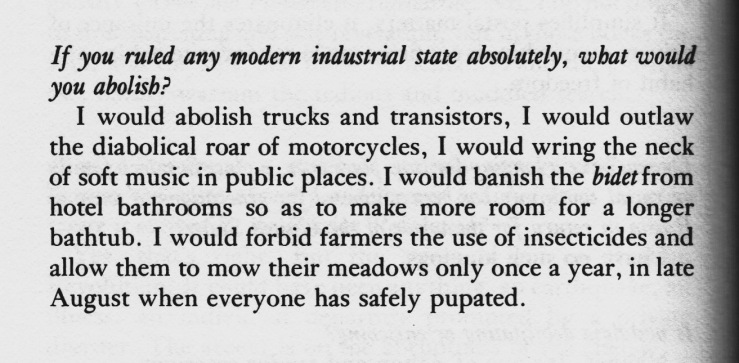
In 1969, the BBC’s James Mossman conducted an extensive interview with Vladimir Nabokov, which was first published in a magazine called The Listener, and later in a book entitled Strong Opinions. Some of Mossman’s questions were serious: “You’ve said that you’ve explored time’s prison and have found no way out. Are you still exploring…? Some were lighter: “Why do you live in hotels?” (Answer here.) And still other questions fell somewhere in between, like: “If you ruled any modern industrial state absolutely, what would you abolish?” It turns out that loud noises, muzak, bidets, and insecticides made the great novelist and lepidopterist’s list.
Which raises the question, if allowed to play benevolent dictator for a day, what would you obliterate? Me? I’d probably start with almost anything likely to appear in today’s Billboard Top 5 — dreck that’s not too far from muzak.
How does “non-musician” musician, former Roxy Music member, Talking Heads, U2, and Coldplay producer, and visual artist Brian Eno define art itself? “Everything that you don’t have to do.” He has expanded eloquently on that simple but highly clarifying notion in speech and writing many times over the past couple of decades, and this past Sunday he made it the intellectual centerpiece of the fifth annual John Peel Lecture, a series named for the influential BBC DJ and whose past speakers have included Pete Townshend, Billy Bragg, Charlotte Church, and Iggy Pop.
You can hear Eno’s introduction to his talk at the top of the post, stream the talk itself within the next 25 days at the BBC’s site, and read a transcript here. All of the John Peel Lecturers so far have discussed the relationship between music and wider human culture, and Eno has plenty of stories to tell about his own career in both music and the wider cultural realm: the importance of his time in art school, how he fell into performing with Roxy Music, how a relaxation of the band’s “strict non-drug” policy resulted in one “hilariously chaotic” performance, and how John Peel himself premiered his first album with Robert Fripp on the radio — by accidentally playing it backward.
All this will inspire even the most Eno-familiar fan to revisit the man’s catalog of recorded works, which you can easily do with the Spotify playlist “Touched by the Hand of Eno,” featuring “150 tracks handpicked from 150 albums/EPs/singles that credit Eno as composer, instrumentalist, vocalist, mixing engineer, or producer, sorted in chronological order.” (If you need to download Spotify’s free software, you’ll find it here.) The playlist includes cuts from Eno’s own albums, of course, but also those of Roxy Music, Genesis, Ultravox, David Bowie, Talking Heads, U2, Depeche Mode, Laurie Anderson, Coldplay, and many more. And after you’ve virtually flipped through these selections from Eno’s body of work, you can watch Eno flip through physical selections from Peel’s library of records just above. Sure, you don’t have to do any of this — if anyone can explain to you why you should, Eno can.
On May 27, 1956, millions of Americans tuned in to The Ed Sullivan Show, expecting the usual variety of comedians, talents and musical guests. What they weren’t prepared for was a short animated film that Sullivan introduced thusly:
Just last week you read about the H‑bomb being dropped. Now two great English writers, two very imaginative writers — I’m gonna tell you if you have youngsters in the living room tell them not to be alarmed at this ‘cause it’s a fantasy, the whole thing is animated — but two English writers, Joan and Peter Foldes, wrote a thing which they called “A Short Vision” in which they wondered what might happen to the animal population of the world if an H‑bomb were dropped. It’s produced by George K. Arthur and I’d like you to see it. It is grim, but I think we can all stand it to realize that in war there is no winner.
And with that, he screened the horrific bit of animation you can watch above. At the height of the atomic age, this film was a short sharp shock. Its vision of a nuclear holocaust is told in the style of a fable or storybook, with both animals and humans witnessing their last moments on earth, and ending with the extinguishing of a tiny flame. The mostly static art work is all the more effective when faces melt into skulls.
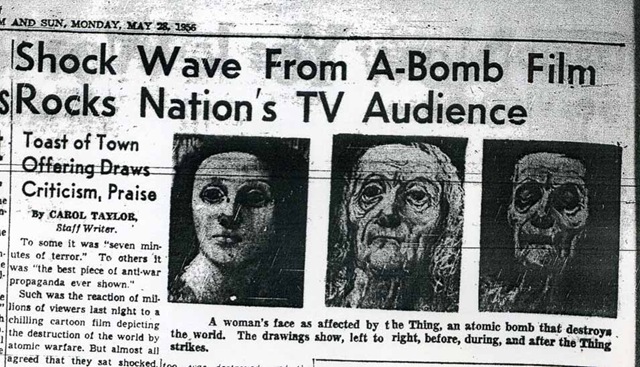
It was as formative a moment as The Day After would be to children of the ‘80s. The papers the next day reported on the short in salacious detail (“Shock Wave From A‑Bomb Film Rocks Nation’s TV Audience”) and Sullivan not only defended his decision, but showed the film again on June 10.
The film was created by married couple Peter and Joan Foldes, and shot for little money in their kitchen on a makeshift animation table. Peter was a Hungarian immigrant who had studied at the Slade School of Art and the Courtlaud Institute and apprenticed with John Halas where he learned animation.
(Halas is best known for the animated feature version of Orwell’s Animal Farm.)
A Short Vision would go on in September of that year to win best experimental film at the 17th Venice Film Festival. (Peter Foldes would later make another disturbing and award-winning short called Hunger.)
Once so shocking, A Short Vision fell out of circulation. But a generation grew up remembering that they had seen something horrific on television that night (in black and white, not the color version above.) For a time, it was hard to find a mention of the film on IMDB and a damaged educational print was one of the few copies circulating around. Fortunately the British Film Institute has made a pristine copy available of this important Cold War document.
Ted Mills is a freelance writer on the arts who currently hosts the FunkZone Podcast. You can also follow him on Twitter at @tedmills, read his other arts writing at tedmills.com and/or watch his films here.
According to Ruth Graham in Slate, Banned Books Week is a “crock,” an unnecessary public indulgence since “there is basically no such thing as a ‘banned book’ in the United States in 2015.” And though the awareness-raising week’s sponsor, the American Library Association, has shifted its focus to book censorship in classrooms, most of the challenges posed to books in schools are silly and easily dismissed. Yet, some other cases, like that of Persepolis—Marjane Satrapi’s graphic novel memoir of her Iranian childhood during the revolution—are not. The book was pulled from Chicago Public School classrooms (but not from libraries) in 2013.
Even now, teachers who wish to use the book in classes must complete “supplemental training.” The ostensibly objectionable content in the book is no more graphic than that in most history textbooks, and it’s easy to make the case that Persepolis and other challenged memoirs and novels that offer perspectives from other countries, cultures, or political points of view have inherent educational value. One might be tempted to think that school officials pulled the book for other reasons. Perhaps we need Banned Books Week after all.
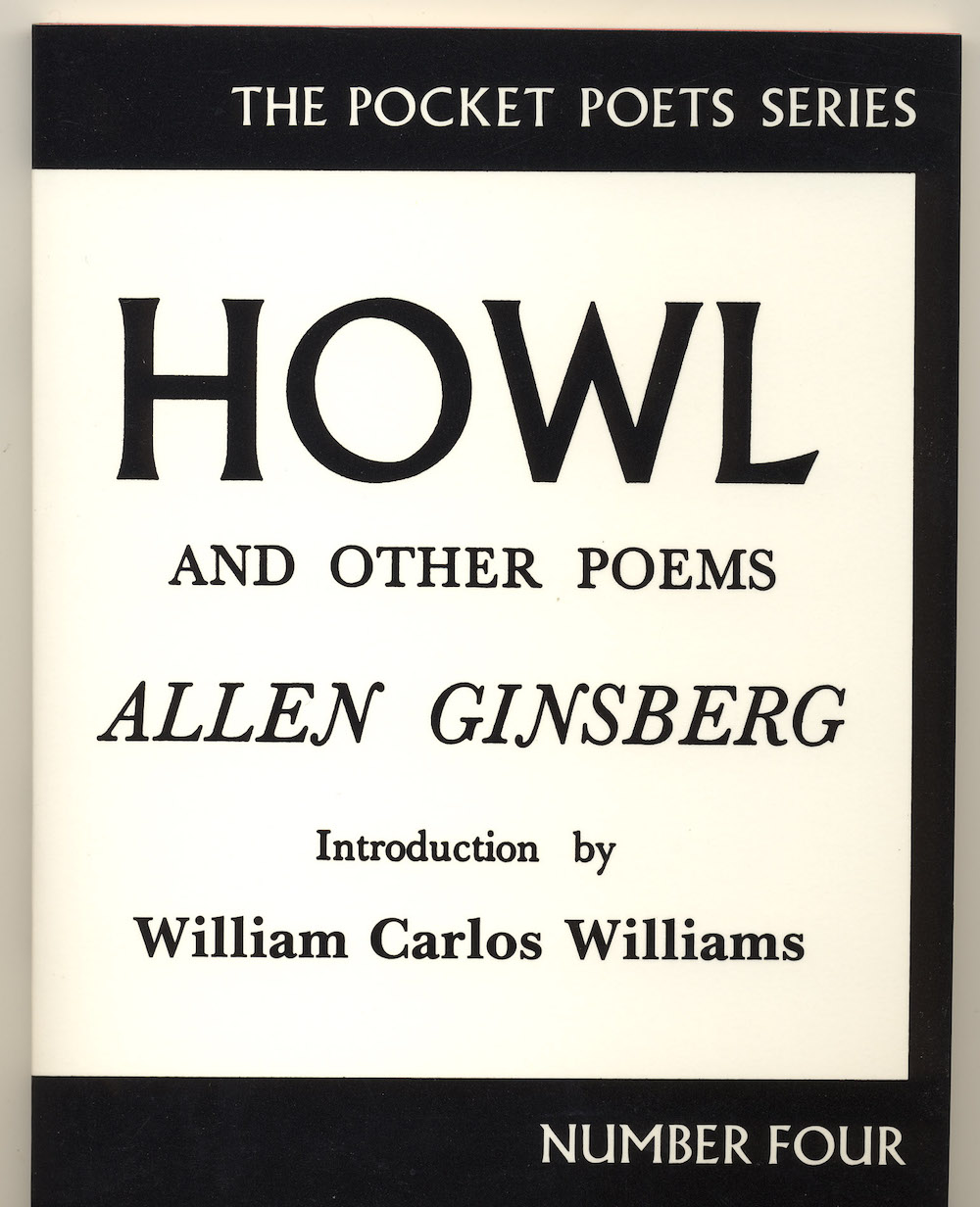
Another, perhaps fuzzier, case of a “banned” book—or poem—from this year involves a high school teacher’s firing over his classroom reading of Allen Ginsberg’s pornographic poem “Please Master.” The case of “Please Master” should put us in mind of a once banned book written by Ginsberg: epic Beat jeremiad “Howl.” When the poem’s publisher, Lawrence Ferlinghetti, attempted to import British copies of the poem in 1957, the books were seized by customs, then he and his business partner were arrested and put on trial for obscenity. After writers and academics testified to the poem’s cultural value, the judge vindicated Ferlinghetti, and “Howl.”
But the trial demonstrated at the time that the government reserved the right to seize books, stop their publication and sale, and keep material from the reading public if it so chose. As with this year’s dust-up over “Please Master,” the agents who confiscated “Howl” supposedly objected to the sexual content of Ginsberg’s poem (and likely the homosexual content especially). But that reasoning could also have been cover for other objections to the poem’s political content. “Howl,” after all, was very subversive in its day, and in a way served as a kind of manifesto against the status quo. It had a “cataclysmic impact,” writes Fred Kaplan, “not just on the literary world but on the broader society and culture.”
We’ve featured various readings of “Howl” in the past, and if you’ve somehow missed hearing those, never heard the poem read at all, or never read the poem yourself, then consider during this Banned Books Week taking the time to read it and hear it read—by the poet himself. You can hear the first recorded reading by Ginsberg, in 1956 at Portland’s Reed College. You can hear another impassioned Ginsberg reading from 1959. And above, hear Ginsberg read the poem in 1956, in San Francisco, where it was first published and where it stood trial.
You can also hear Ginsberg fan James Franco—who played the poet in a film called Howl—read the poem over a visually striking animation of its vivid imagery. And if Ginsberg isn’t your thing, consider checking out the ALA’s list of challenged or banned books for 2014–2015. (I could certainly recommend Persepolis.) While prohibiting books from the classroom may seem a far cry from government censorship, Banned Books Week reminds us that many people still find certain kinds of books deeply threatening, and should push us to ask why that is.
We're hoping to rely on loyal readers, rather than erratic ads. Please click the Donate button and support Open Culture. You can use Paypal, Venmo, Patreon, even Crypto! We thank you!
Open Culture scours the web for the best educational media. We find the free courses and audio books you need, the language lessons & educational videos you want, and plenty of enlightenment in between.