As Talking Heads went from CBGBs (see some vintage video) to college radio to a European tour opening for The Ramones in 1977, the band was slowly making its way out of New York City poverty while their art school rock was seeping into American culture at large. When “Take Me To the River,” their airy, nervous but still funky Eno-produced cover of the Al Green song became their first Billboard Top 30 hit, the band took a step towards national recognition.
And that leads us to this awkward March 17, 1979 appearance of the band on ABC’s American Bandstand, their first on American TV. Longtime host Dick Clark was pretty square–rock critic Nik Cohn described him as “a disc jockey who looked like an all-American choirboy”–but American Bandstand was a prime opportunity. In 1979, the New Wave and Post-Punk scenes were raging at the show’s doors. Talking Heads were one of the few acts that year from NYC’s creative cauldron of a music scene, apart from Blondie and Grace Jones, to make it onto Bandstand.
In the above clip, Clark apologizes for getting Tina Weymouth’s name wrong, then jumps in to interview David Byrne, who responds to Clark’s questions by shutting them down with embarrassed looks and matter-of-fact answers. Clark then turns back to Tina for some psychoanalytic help. “Is he always this enthusiastic?” he asks. It crumbles from there.
Weymouth remembered it slightly differently in this recent (2014) interview in New York Magazine:
I couldn’t explain to the record-label people why David’s behavior could be so incredibly odd. He had a freak-out on our first television appearance, on Dick Clark, on American Bandstand. David sort of froze, and Dick Clark sort of whirled around, and hands the microphone to me. And there were other things going on, too. I don’t think any person is one thing, or defined by a condition that they might have.
It’s not exactly freezing, but it is odd…for rock frontmen. And asking Byrne “Do you flog yourself into this?” tells you a bit more about Clark’s state of mind than anything else.
You can see the mimed performance of their hit here:
The other song they performed on the broadcast “Thank You for Sending Me an Angel” has not popped up on YouTube…yet.
Parting note: The other guest that night on Bandstand was twee, blue-eyed disco act Brooklyn Dreams with their single Make It Last.
Ted Mills is a freelance writer on the arts who currently hosts the FunkZone Podcast. You can also follow him on Twitter at @tedmills and/or watch his films here.
Like many film fans, I grew up familiar with the term “Spaghetti western,” but I’d nearly reached adulthood before figuring out what, exactly, America’s most popular Italian dish had to do with America’s once-most popular movie genre. But even if they don’t know the specific definition of a Spaghetti western, those who enjoy them know a Spaghetti western when they see one. Sergio Leone’s A Fistful of Dollars, For a Few Dollars More, and The Good, the Bad, and the Ugly; Sergio Corbucci’s Minnesota Clay and Django; Enzo Barboni’s They Call Me Trinity and Trinity Is Still My Name — if a picture belongs in that company, nobody doubts it.
You’ll notice that all those directors have Italian names, and indeed, western all’italiana, the Italian equivalent of “Spaghetti western,” simply means “Italian-style western.” These Italian-produced tales of the lawless 19th-century American west, sometimes featuring fading or rising Hollywood stars (as with the young Clint Eastwood, who would become identified with Leone’s “Man with No Name”), and often shot in the Spanish desert, rode high from the mid-1960s to the early 70s, bringing a fresh sensibility and visceral impact which had for the most part drained out of the homegrown variety.
Trust a genre-loving auteur like Quentin Tarantino (and one who made his very own Django a few years back) to know Spaghetti westerns inside and out. While even those of us who never turn down the chance to enjoy a good Spaghetti western might struggle to name ten of them, Tarantino can easily run down his personal top twenty:
You can watch all the trailers of these Spaghetti western masterpieces in the playlist above, created by The Spaghetti Western Database. Some may now strike you as disarmingly straightforward about ballyhooing the excitement promised by the feature they advertise, and you may find others surprisingly funny and more self-aware. While I defy anyone to watch the entire playlist of trailers without wanting to dive into this surprisingly little-explored tradition, nothing gets me quite as excited about watching a movie — old or new, subtle or schlocky, genre or otherwise — as Tarantino’s contagious cinephilia.
Now out. The second video in The Experimenters, a short series of animations highlighting three “icons of science” and “what spurred their creativity.” Episode 1 brought us into “the Geodesic Life” of Buckminster Fuller. This new installment gives us an animated look at Jane Goodall, the primatologist who has done such inspirational work with chimpanzees. (Don’t miss last week’s feature on her in The Times.) Drawing on a 2002 interview that aired on NPR’s Science Friday, this clip features Goodall recounting her life story — including how she got a PhD at Cambridge before getting an undergraduate degree — and it also veers into some fun terrain. Does Goodall believe in Bigfoot? You bet she does.
The next video in The Experimenters series will focus on Richard Feynman. Stay tuned.
Twin Peaks is, of course, a seminal cult TV series, a surrealist soap opera spun out of the mind of David Lynch. When it came out in the late 80s, America was seized with the show’s central mystery – who killed Laura Palmer? A tortured blonde beauty queen who wound up dead, wrapped in plastic. Its first season (US viewers can watch it on Hulu) was easily one of the best ever on television with great characters, inside jokes and just enough Lynchian weirdness to unnerve a mainstream audience without totally freaking them out. Too bad, then, that the quality of the show’s second season went off a cliff.
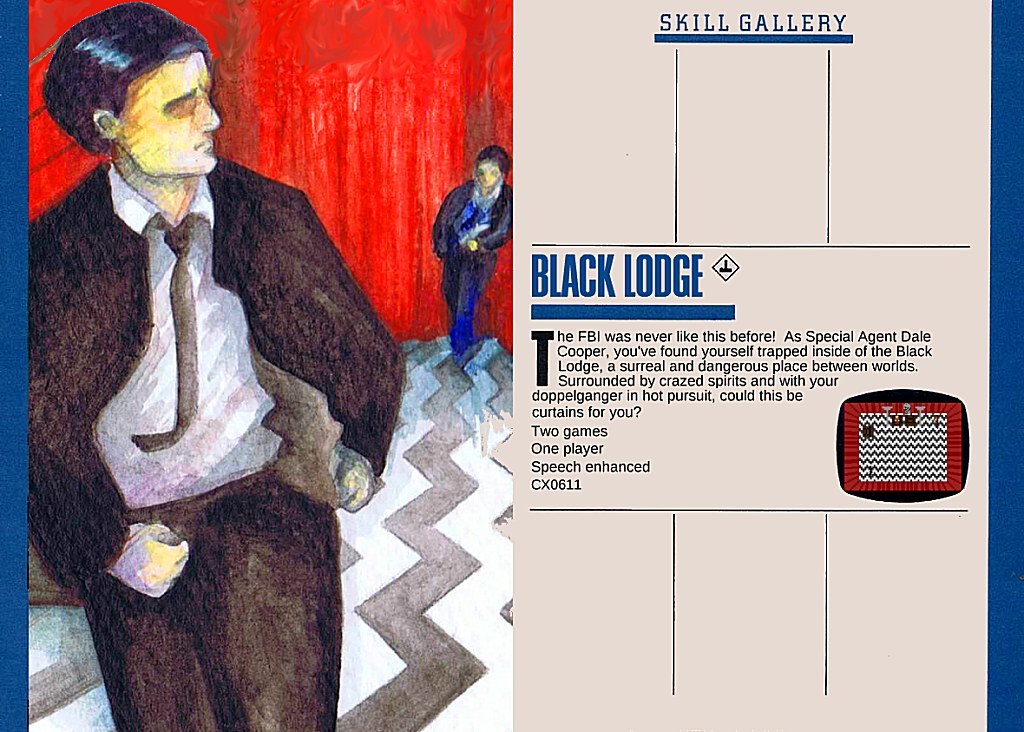
You would expect a video game about the series to be about the search for Laura Palmer’s killer, but no. Instead, the game, an Atari 2600-style work called Black Lodge 2600, is a riff on the show’s final angry episode. In that episode, FBI agent Dale Cooper delves into the otherworldly Black Lodge, which, in spite of its name, is decorated primarily in red curtains. There, Cooper is confronted by his doppelganger. Lynch’s Jungian obsessions have never been as bald as in that episode.
Basically, if you felt like your well-worn copy of Pitfall was strangely lacking in busts of Venus De Milo and a pervading sense of the Unheimliche, then this video game might be for you. The game’s manual, which has way too many exclamation points, sets the stage:
A day in the FBI was never like this before! You are Special Agent Dale Cooper and you’ve found yourself trapped inside the Black Lodge, a surreal and dangerous place between worlds. Try as you might, you can’t seem to find anything but the same room and hallway no matter which way you turn. Worse yet, your doppelganger is in hot pursuit! You have no choice but to keep running through the room and hallway (or is it more than one?) and above all else, don’t let your doppelganger touch you!
[…]
You’ll find quickly that you’re not alone in the Black Lodge, though your friends are few and far between. Not only that, the Lodge itself seems to be actively trying to trip you up at all times! You’ll be dodging chairs and crazed Lodge residents all while trying to keep your own sanity. How long can this go on?
Based on this description, I can’t tell if this game is compelling or if it will merely evoke the same feeling of existential futility I feel every time I call Time Warner Cable. Watch a video of the game below and judge for yourself. Or start downloading the game and the manual here.
Note: If you have problems getting the game going on a Mac, then follow these Black Lodge troubleshooting instructions: Go to “System Preferences”, open “Security & Privacy”, click the padlock to allow changes, then click the “Anywhere” option under “Allow applications downloaded from.”
Jonathan Crow is a Los Angeles-based writer and filmmaker whose work has appeared in Yahoo!, The Hollywood Reporter, and other publications. You can follow him at @jonccrow. And check out his blog Veeptopus, featuring lots of pictures of badgers and even more pictures of vice presidents with octopuses on their heads. The Veeptopus store is here.
It didn’t take long for Star Wars (1977) to start spinning off fan films. Just a year after the space opera hit American cinemas, Jonathan Crow tells us, “San Francisco filmmaker Ernie Fosselius had the brainwave to make a spoof.” And, as it turns out, the 13-minute film, made for $8,000, “became a pre-internet viral hit and a staple on the festival circuit, ultimately earning over $1,000,000 – an unheard of haul for a short film.” It’s called Hardware Wars, and you can find it in our archive.
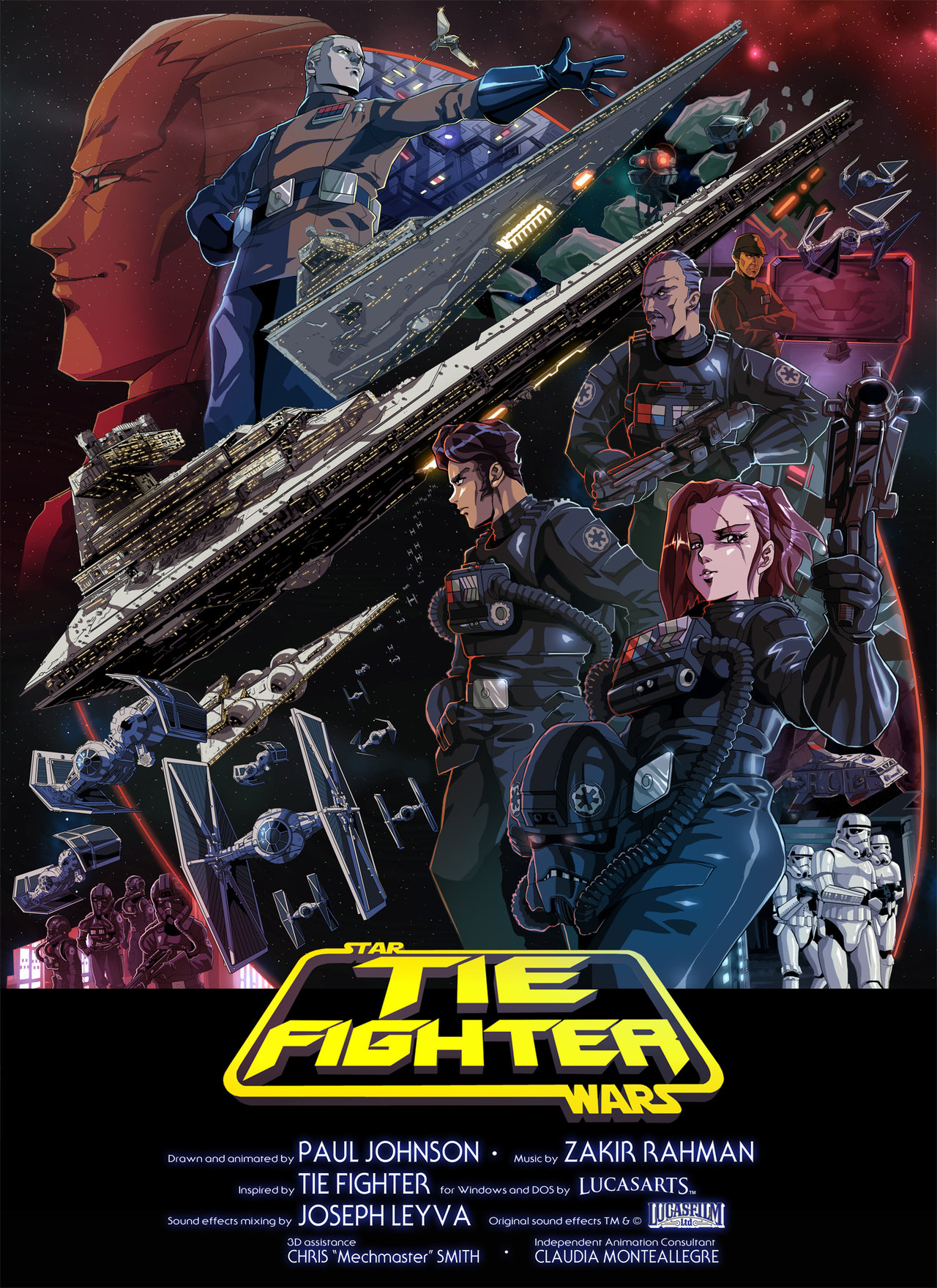
Star Wars fan films have kept coming ever since. Right through today. The latest is TIE Fighter (above). Drawn by Paul Johnson over a four-year period, the video adopts an anime style, made famous by the Japanese during the 1980s, and it tells the Star Wars story (or at least part of it), from the perspective of the Empire. A PDF of the story can be read online here. Find the official poster here.
The history books say that there were three Japanese filmmakers to emerge in the 1950s – Kenji Mizoguchi, Yasujiro Ozu and Akira Kurosawa. Never mind that Mizoguchi and Ozu made many of their best movies in the 1930s. Never mind that masterful, innovative directors like Mikio Naruse and Keisuke Kinoshita have been unfairly overshadowed by the brilliance of these three greats.
Mizoguchi was an early modernist who by the end of his career made meditative movies about how women suffer at the hands of men. His masterpieces like Ugetsu and Sansho Dayu feel like Buddhist scroll paintings come to life. Ozu, “the most Japanese” of all filmmakers, made quietly moving dramas about families, like Tokyo Story, but did so in a way that discarded such Hollywood principles as continuity editing and the 180 degree rule. Ozu was a quiet radical.
Compared to Ozu and Mizoguchi, Kurosawa’s movies are noisy, masculine and vital. Unlike Ozu, he didn’t challenge Hollywood film form but improved on it. Born roughly a decade after the other two filmmakers, Kurosawa spent his youth watching Western movies, absorbing the lessons of his cinematic heroes like John Ford, Howard Hawks and Frank Capra. At his creative height, in the 1950s and 60s, Kurosawa produced masterpiece after masterpiece. Hollywood would remake or reference Kurosawa constantly in the years that followed but few of those films had Kurosawa’s inventiveness.
Tony Zhou, who has made a career of dissecting movies in his excellent video series Every Frame a Picture,argues that the key to Kurosawa is movement. “A Kurosawa movie moves like no one else’s,” Zhou notes in his video. “Each one is a master class in different types of motion and also ways to combine them.”
Kurosawa had an innate understanding that there is inherent drama in the wind blowing in the trees. Like Andrei Tarkovsky and later Terrence Malick, he liked to place human drama squarely in the realm of nature. The rain falls, a fire rages and that movement makes an image compelling. He understood that graphic considerations outweighed psychological ones – he simplified and exaggerated a character’s movement with the frame to make character traits and emotions easy to register for the audience. His camera movements were clear, motivated and fluid. Zhou compares Seven Samurai with The Avengers. You might have thought that The Avengers was uninspired and soulless but after watching Zhou’s video, you’ll understand why – aside from the silly plot and characters – the movie was uninspired and soulless. The piece should be required viewing for filmmakers everywhere. You can watch it above.
And below you can see another video Zhou did on Kurosawa, focusing on his 1960 movie The Bad Sleep Well.
Jonathan Crow is a Los Angeles-based writer and filmmaker whose work has appeared in Yahoo!, The Hollywood Reporter, and other publications. You can follow him at @jonccrow. And check out his blog Veeptopus, featuring lots of pictures of badgers and even more pictures of vice presidents with octopuses on their heads. The Veeptopus store is here.
Even those who paid next to no attention to their history teachers know about Magna Carta — or at least they know it first came about in 1215. To deliver all the other relevant details, we now have a new teacher in the form of Monty Python’s Terry Jones, who, on the occasion of this great charter’s 800th anniversary, provides the narration for these two short animations, “Magna Carta: Medieval” and “Magna Carta: Legacy,” that tell the rest of its story.
Originally issued by King John of England (r.1199–1216) as a practical solution to the political crisis he faced in 1215, Magna Carta established for the first time the principle that everybody, including the king, was subject to the law.
[ … ]
Three clauses of the 1225 Magna Carta remain on the statute book today. Although most of the clauses of Magna Carta have now been repealed, the many divergent uses that have been made of it since the Middle Ages have shaped its meaning in the modern era, and it has become a potent, international rallying cry against the arbitrary use of power.
These animations, of course, add a great deal of visual, narrative, and comedic vividness to this important piece of Western political history, following it from the reign of King John (“one of the worst kings in history”), through civil war, the creation of the United States of America, struggles for voting rights and the freedom of the press, right up to the writing of the Universal Declaration of Human Rights, in a sense Magna Carta’s modern descendant. “Although very few of Magna Carta’s original clauses remain valid in English law,” says Jones, “it continues to inspire people worldwide. Not a bad legacy for an 800-year-old document.”
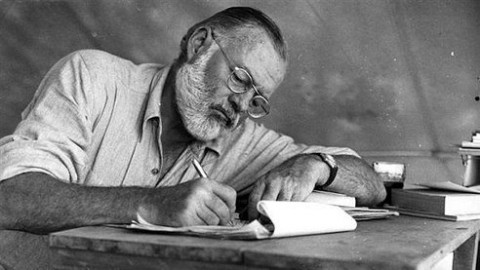
A piercingly dark piece of writing, taking the heart of a Dickens or Dostoevsky novel and carving away all the rest, Ernest Hemingway’s six-word story—fabled forerunner of flash- and twitter-fiction—is shorter than many a story’s title:
For sale, Baby shoes, Never worn.
The extreme terseness in this elliptical tragedy has made it a favorite example of writing teachers over the past several decades, a display of the power of literary compression in which, writes a querent to the site Quote Investigator, “the reader must cooperate in the construction of the larger narrative that is obliquely limned by these words.” Supposedly composed sometime in the ’20s at The Algonquin (or perhaps Luchow’s, depending on whom you ask), the six-word story, it’s said, came from a ten-dollar bet Hemingway made at a lunch with some other writers that he could write a novel in six words. After penning the famous line on a napkin, he passed it around the table, and collected his winnings. That’s the popular lore, anyway. But the truth is much less colorful.
In fact, it seems that versions of the six-word story appeared long before Hemingway even began to write, at least as early as 1906, when he was only 7, in a newspaper classified section called “Terse Tales of the Town,” which published an item that read, “For sale, baby carriage, never been used. Apply at this office.” Another, very similar, version appeared in 1910, then another, suggested as the title for a story about “a wife who has lost her baby,” in a 1917 essay by William R. Kane, who thought up “Little Shoes, Never Worn.” Then again in 1920, writes David Haglund in Slate, the supposed Hemingway line appears in a “1921 newspaper column by Roy K. Moulton, who ‘printed a brief note that he attributed to someone named Jerry,’ ”:
There was an ad in the Brooklyn “Home Talk” which read, “Baby carriage for sale, never used.” Would that make a wonderful plot for the movies?
Many more examples of the narrative device abound, including a 1927 comic strip describing a seven-word version—“For Sale, A Baby Carriage; Never Used!”—as “the greatest short story in the world.” The more that Haglund and Quote Investigator’s Garson O’Toole looked into the matter, the harder they found it to “believe that Hemingway had anything to do with the tale.”
It is possible Hemingway, wittingly or not, stole the story from the classifieds or elsewhere. He was a newspaperman after all, perhaps guaranteed to have come into contact with some version of it. But there’s no evidence that he wrote or talked about the six-word story, or that the lunch bet at The Algonquin ever took place. Instead, it appears that a literary agent, Peter Miller, made up the story whole cloth in 1974 and later published it in his 1991 book, Get Published! Get Produced!: A Literary Agent’s Tips on How to Sell Your Writing.
The legend of the bet and the six-word story grew: Arthur C. Clarke repeated it in a 1998 Reader’s Digest essay, and Miller mentioned it again in a 2006 book. Meanwhile, suspicions arose, and the final debunking occurred in a 2012 scholarly article in The Journal of Popular Culture by Frederick A. Wright, who concluded that no evidence links the six-word story to Hemingway.
So should we blame Miller for ostensibly creating an urban legend, or thank him for giving competitive minimalists something to beat, and inspiring the entire genre of the “six-word memoir”? That depends, I suppose, on what you think of competitive minimalists and six-word memoirs. Perhaps the moral of the story, fitting in the Twitter age, is that the great man theory of authorship so often gets it wrong; the most memorable stories and ideas can arise spontaneously, anonymously, from anywhere.
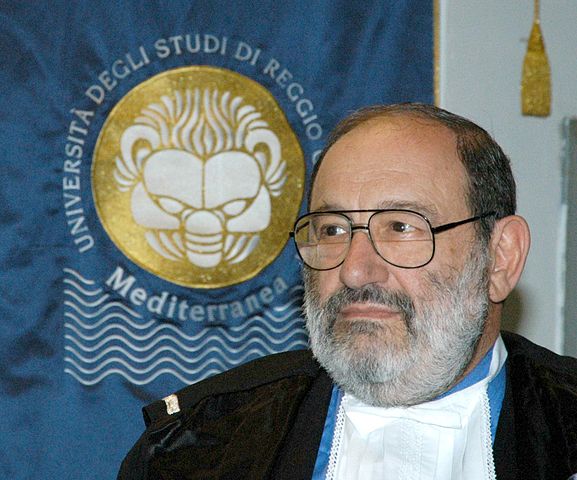
Image by Università Reggio Calabria, released under a C BY-SA 3.0 license.
In general, the how-to book—whether on beekeeping, piano-playing, or wilderness survival—is a dubious object, always running the risk of boring readers into despairing apathy or hopelessly perplexing them with complexity. Instructional books abound, but few succeed in their mission of imparting theoretical wisdom or keen, practical skill. The best few I’ve encountered in my various roles have mostly done the former. In my days as an educator, I found abstract, discursive books like Robert Scholes’ Textual Power or poet and teacher Marie Ponsot’s lyrical Beat Not the Poor Desk infinitely more salutary than more down-to-earth books on the art of teaching. As a sometime writer of fiction, I’ve found Milan Kundera’s idiosyncratic The Art of the Novel—a book that might have been titled The Art of Kundera—a great deal more inspiring than any number of other well-meaning MFA-lite publications. And as a self-taught audio engineer, I’ve found a book called Zen and the Art of Mixing—a classic of the genre, even shorter on technical specifications than its namesake is on motorcycle maintenance—better than any other dense, diagram-filled manual.
How I wish, then, that as a onetime (longtime) grad student, I had had access to the English translation, just published this month, of Umberto Eco’s How to Write a Thesis, a guide to the production of scholarly work worth the name by the highly celebrated Italian novelist and intellectual. Written originally in Italian in 1977, before Eco’s name was well-known for such works of fiction as The Name of the Rose and Foucault’s Pendulum, How to Write Thesis is appropriately described by MIT Press as reading: “like a novel”: “opinionated… frequently irreverent, sometimes polemical, and often hilarious.”
For example, in the second part of his introduction, after a rather dry definition of the academic “thesis,” Eco dissuades a certain type of possible reader from his book, those students “who are forced to write a thesis so that they may graduate quickly and obtain the career advancement that originally motivated their university enrollment.” These students, he writes, some of whom “may be as old as 40” (gasp), “will ask for instructions on how to write a thesis in a month.” To them, he recommends two pieces of advice, in full knowledge that both are clearly “illegal”:
(a) Invest a reasonable amount of money in having a thesis written by a second party. (b) Copy a thesis that was written a few years prior for another institution. (It is better not to copy a book currently in print, even if it was written in a foreign language. If the professor is even minimally informed on the topic, he will be aware of the book’s existence.
Eco goes on to say that “even plagiarizing a thesis requires an intelligent research effort,” a caveat, I suppose, for those too thoughtless or lazy even to put the required effort into academic dishonesty.
Instead, he writes for “students who want to do rigorous work” and “want to write a thesis that will provide a certain intellectual satisfaction.” Eco doesn’t allow for the fact that these groups may not be mutually exclusive, but no matter. His style is loose and conversational, and the unseriousness of his dogmatic assertions belies the liberating tenor of his advice. For all of the fun Eco has discussing the whys and wherefores of academic writing, he also dispenses a wealth of practical hows, making his book a rarity among the small pool of readable How-tos. For example, Eco offers us “Four Obvious Rules for Choosing a Thesis Topic,” the very bedrock of a doctoral (or masters) project, on which said project truly stands or falls:
1. The topic should reflect your previous studies and experience. It should be related to your completed courses; your other research; and your political, cultural, or religious experience.
2. The necessary sources should be materially accessible. You should be near enough to the sources for convenient access, and you should have the permission you need to access them.
3. The necessary sources should be manageable. In other words, you should have the ability, experience, and background knowledge needed to understand the sources.
4. You should have some experience with the methodological framework that you will use in the thesis. For example, if your thesis topic requires you to analyze a Bach violin sonata, you should be versed in music theory and analysis.
Having suffered the throes of proposing, then actually writing, an academic thesis, I can say without reservation that, unlike Eco’s encouragement to plagiarism, these four rules are not only helpful, but necessary, and not nearly as obvious as they appear. Eco goes on in the following chapter, “Choosing the Topic,” to present many examples, general and specific, of how this is so.
Much of the remainder of Eco’s book—though written in as lively a style and shot through with witticisms and profundity—is gravely outdated in its minute descriptions of research methods and formatting and style guides. This is pre-internet, and technology has—sadly in many cases—made redundant much of the footwork he discusses. That said, his startling takes on such topics as “Must You Read Books?,” “Academic Humility,” “The Audience,” and “How to Write” again offer indispensable ways of thinking about scholarly work that one generally arrives at only, if at all, at the completion of a long, painful, and mostly bewildering course of writing and research.
FYI: You can download Eco’s book, How to Write a Thesis, as a free audiobook if you want to try out Audible.com’s no-risk, 30-day free trial program. Find details here.
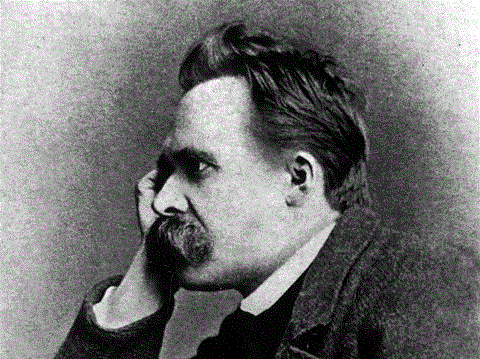
Whether they submit to his mighty philosophical influence, resist it with all their own might, or fall somewhere in between, everyone who’s read the pronouncements of Friedrich Nietzsche (find his ebooks here) recognizes his voice — well, his textual voice, that is. Having died in 1900 after spending the last decade of his life in a mental breakdown, the author of Thus Spake Zarathustra and Beyond Good and Evilhas an excuse for not leaving behind much in the way of audio material. But love Nietzsche or hate him, a reader has to wonder: what did the guy actually sound like?
Here to satiate our curiosity come Flavia Montaggio, Patricia Montaggio, and Imp Kerr, authors of the Investigative Genetics paper “DNA-based prediction of Nietzsche’s voice,” which supposedly offers a scientific means of doing just that. “We collected trace amounts of cellular material (Touch DNA) from books that belonged to the philosopher Friedrich Nietzsche,” reads the abstract, which goes on to describe the gathering of Nietzsche-related data eventually “converted into bio-measures that were used to 3D-print a vocal tract and larynx through which phonation was organically generated.” The result, after running everything through a series of text-to-speech simulations: “the first attempt at simulating the voice of a deceased person”:
It all seems legit, right? Or maybe you German-speakers out there will suspect something fishy, starting with the unlikely name of Imp Kerr. It actually belongs to “a Swedish-French artist living in New York City, mostly known for her fake American Apparel advertisement campaign,” or so reads the Wikipedia page quoted by a Language Log post on the project. “I have no idea whether anything in the Wikipedia article about Imp Kerr is true,” writes author Mark Liberman, “but it’s clear from internal evidence that the alleged Investigative Genetics article is a piece of performance art.”
Liberman breaks down the paper’s humorous elements, from its “many segments that display quasi-scientific terminology in meaningless or contradictory ways” to its simple inability to “restrain a certain telltale playfulness” (as when it deals with a resonance “lower than expected in regards of Nietzsche’s robust mandibles”). All this may remind you of the famous hoax wherein physicist Alan Sokal published a paperful of sheer nonsense in a respected cultural-studies journal. Or you may think of the film above, which purports, questionably, to show Nietzsche’s last days. It just goes to show that, if your ideas live on, you live on — or your readers will try to make you do so.
We're hoping to rely on loyal readers, rather than erratic ads. Please click the Donate button and support Open Culture. You can use Paypal, Venmo, Patreon, even Crypto! We thank you!
Open Culture scours the web for the best educational media. We find the free courses and audio books you need, the language lessons & educational videos you want, and plenty of enlightenment in between.