Some of the prints, like the one below, certainly have a foreign quality to them. They feel far away in terms of time and place. But others (like the shot above) feel remarkably close, something we can all relate to today.
According to the PDR, the pictures came to reside in the Dutch National Archive as a result of the centuries-long commercial relationship between the Dutch and the Japanese. More vintage pix can be viewed here.
Nelson Mandela, who died on December 5, 2013, had spent more than a quarter of his life serving time in various jails. While behind bars for the 18-year period between 1962 and 1980, the anti-apartheid revolutionary educated both himself and others to prepare for the advent of multiracial equality in South Africa. During his confinement at the Robben Island prison, Mandela studied law by correspondence at the University of London, learned Afrikaans to foster a rapport with jailhouse wardens, and was instrumental in launching the “University of Robben Island”, where prisoners possessing expertise in particular fields presented lectures to their fellow inmates.
Mandela’s stay, however, was frequently marred by demeaning and deplorable treatment. Initially, black prisoners were humiliated by being given shorts, commonly worn by children, rather than full-length pants as uniforms. Mandela was also forbidden from wearing sunglasses when forced to labor at a limestone quarry, and the harsh reflections from the rocks damaged his vision. The quarry dust also damaged his tear ducts, which made it impossible for him to cry until receiving corrective surgery in 1994. Perhaps the most painful moments arrived in the late 1960s, when Mandela lost his mother and firstborn son, and was denied permission to attend their funerals.
“That poem was his favorite… When he lost courage, when he felt like just giving up — just lie down and not get up again — he would recite it. And it would give him what he needed to keep going.”
Freeman, who played Mandela in the 2009 film Invictus, also provides a solemn and dignified recitation of the poem beginning at 3:51. Although the poem is best known for providing succour to Mandela in times of despair, its words of courage have served as inspiration to countless others. Famous figures who have drawn hope from “Invictus” include the father of Burmese opposition leader Aung San Suu Kyi during his struggle for Burmese independence and tennis champion Andre Agassi. Rumor has it that U.S. President Franklin D. Roosevelt was also quite fond of it. We’ve included the full text for “Invictus” below:
Out of the night that covers me,
Black as the Pit from pole to pole,
I thank whatever gods may be
For my unconquerable soul.
In the fell clutch of circumstance
I have not winced nor cried aloud.
Under the bludgeonings of chance
My head is bloody, but unbowed.
Beyond this place of wrath and tears
Looms but the Horror of the shade,
And yet the menace of the years
Finds, and shall find, me unafraid.
It matters not how strait the gate,
How charged with punishments the scroll.
I am the master of my fate:
I am the captain of my soul.
H/T to Bruno, one of our readers, for sending this video our way.
Ilia Blinderman is a Montreal-based culture and science writer. Follow him at @iliablinderman.
Yesterday, John McMillian, assistant professor of history at Georgia State University, appeared on KQED’s Forum in San Francisco (listen here) to talk about his new book Beatles vs. Stones. It offers a new look at how the two British bands co-existed, often helped one another, and strategically defined themselves against each other. The Beatles were everyman’s band. Wholesome, clean-cut, witty, the Fab Four appealed to the young and the old, the rich and the poor. The Stones, trying to make a name for themselves in the wake of Beatlemania, positioned themselves as the anti-Beatles. As the journalist Tom Wolfe once wrote, “The Beatles want to hold your hand, but the Stones want to burn down your town.”
50 years later, The Beatles still have a nearly universal appeal. The Boomers and their now middle-aged children haven’t let dust gather on The Beatles’ discography. And, if you plunk the grandchildren in front of old Beatles’ videos, they’ll love what they see. Just watch above.
Don’t miss anything from Open Culture. Sign up for our Daily Email or RSS Feed. And we’ll send quality culture your way, every day.
Fans of bratty New York punk-turned-serious writer Richard Hell or schlocky German horror director Ulli Lommel or—why not—both, will likely know of Lommel’s 1980 Blank Generation, a film unremarkable except for its casting of Hell and his excellent Voidoids as feature players. (Their debut 1977 album and single are also called Blank Generation.) The movie, as a reviewer puts it, “seems as if each member of the production was under the impression they were working on a different film than the rest of their collaborators…. You can’t help but think that something more watchable could be produced out of the raw footage with a good editor.”
One might approach an earlier film, also called Blank Generation—the raw 1976 documentary about the budding New York punk scene above—with similar expectations of coherent production and narrative clarity. But this would be mistaken. The first Blank Generation is a film that rewards no expectations, except perhaps expecting to be constantly disoriented. But that would seem to me a given for a genuine document of what Lydia Lunch christened “No Wave,” the deliberately tasteless 70s hybrid of punk, rock, new wave, noise, free jazz, and jarring combination of amateur and professional experimentation that came to define the sound of downtown for decades to come.
Shot and directed by frequent Lunch and Patti Smith collaborator Ivan Kral and pioneering indie filmmaker Amos Poe, the documentary features Smith, The Ramones, Talking Heads, Blondie, Television, The Heartbreakers, Wayne/Jayne County, and pretty much everyone else on the CBGB’s scene at the time. The Austin Film Society sums it up well. Kral and Poe’s Blank Generation
exemplified a punkish attitude toward film structure with handheld zooms, angled compositions, floodlight lighting, extreme close-ups, elliptical editing, flash pans, and a general in-your-face and “up-yours” stance. Sound and image purposely do not synch. In many cases music and image were recorded on separate nights—more economical because of the high cost of raw film stock with sound, but also an aesthetic nod to Jean-Luc Godard who had slashed the umbilical cord uniting sound and image. Out of the French New Wave came the New York No Wave.
The influence is evident, though it’s not particularly useful context. Really, all you need to know is contained within the frame: in the lilting rasp of Patti Smith’s “Gloria,” in close-up shots of Joey Ramone’s crotch and filthy sneakers, in the youthful David Byrne’s jangly acoustic guitar and the sleazy lounge-punk of Television’s tribute to Iggy Pop, “Little Johnny Jewel.” Of course later No Wave stalwarts like Teenage Jesus & The Jerks, Swans, Sonic Youth, John Zorn, DNA, and Mars don’t appear—but some get their due elsewhere. And while the Hell/Lommel film might be worth a watch for curiosity’s sake, the first Blank Generation is a truly incredible historical document that deserves repeated viewing.
You’d expect a bit of strangeness from David Cronenberg‘s student films, but for most of its short length, From the Drain, which he made in 1967 while attending the University of Toronto, seems to deliver strangeness of an unexpected kind. Playing more like Waiting for Godot than his later vivid-to-the point of harrowing pictures like Crash, Videodrome, or The Fly, this thirteen-minute black-and-white film, only Cronenberg’s second, presents us with two fellows seated, fully clothed, in a bathtub. The situation looks bizarre, and as soon as the players start talking, it reveals itself as even more bizarre than we’d thought: evidently, one of these men has mistaken the tub for “the Disabled War Veterans’ Recreation Center.” The conversation continues without its participants leaving their porcelain confines, making a certain kind of sense on the surface but none at all beneath. This feels almost like the realm of Monty Python’s Flying Circus, which wouldn’t debut and begin exerting its vast influence on young comedic filmmakers until 1969.
We’d feel more secure in our laughter if we didn’t know who its director would go on to become. These days, when you watch anything by Cronenberg, perhaps the best-known living auteur of technological menace, “body horror,” and formless dread, you can rest reasonably assured that something will sooner or later go horribly, viscerally awry onscreen. So it comes to pass in From the Drain, whose title gives some suggestion as to the nature of the ultimate malevolence. Don’t let the hyper-farcical dialogue, the goofy performances, or the classical guitar soundtrack mislead you; here we definitely have a project by the king of unsettlement, though at a time when he presumably had yet to earn even the title of prince of unsettlement, a point from which he could look forward to decades of more advanced and much creepier visual effects. At this point in his career, however, with the bleak-looking Hollywood satire Maps to the Stars due out in the near future, he seems to need nothing so elaborate, still unsettling us, but preferring to do it subtly.
Yakov Smirnoff has the distinction of being the most famous Russian comic in America. He’s also the only Russian comic in America (ba-dum-dum). But seriously: In his mid-80s heyday, he had the market cornered on Soviet humor in the U.S. Whatever demand there was, Smirnoff supplied it, singlehandedly, as a fixture in ads, TV show and film appearances, comedy specials, late-night talk shows…. His was the only face of Russian humor anyone knew in the 80s (unless we’re counting Ivan Drago). Smirnoff even warranted a Family Guy reference, which pretty much cements his reputation as endlessly recyclable pop culture syndication fodder.
And yet, post-Soviet Russia, it’s hard to imagine there’s a place for Yakov Smirnoff, since corny jokes at the expense of end-stage Russian communism were not only his bread and butter, but his whole comedic menu, such that Marc Maron introduces Smirnoff as a guest on his WTF Podcast above with: “that guy, with his hook, that certainly isn’t relevant anymore. How does a guy like that survive?” Ouch. But what a hook it was, says Maron: a wonderstruck immigrant exclaiming “What a country!” as he took in each new capitalist marvel. He was like a real-life version of one of Andy Kaufman’s characters, or a pre-Borat Eastern European innocent abroad. The act carried him beyond his mid-eighties 15 minutes of fame and through a 20-year career entertaining middle-class Americans in Branson, Missouri.
But was there much demand for Smirnoff’s brand of humor even at his peak? If you didn’t have the great fortune of living through the 80s, you might be surprised at just how popular his sort of thing could be—“a Russian comic talking about how great America was.” But it wasn’t only Smirnoff’s persona that flattered our sense of economic, political, and moral superiority. A whole genre of Soviet jokes had a prominent place in the discourse, with knee-slappers about KGB surveillance and bread lines and other privations commonly tossed around at dinner parties. Even Ronald Reagan tried his hand at it, as you can see here. Reagan’s delivery was never my cup of tea, but you can also see Smirnoff do his impression of Reagan telling the same joke in the video at the top of the post.
And while revisiting Smirnoff’s not exactly meteoric rise to fame in the U.S. is fun for its own sake, what’s even more interesting are Smirnoff’s serious reminiscences of his time growing up and working as a comic in Russia. The serious Smirnoff is full of psychological insights (he has a masters degree in the subject from Penn) and sociological anecdotes about life under a repressive communist regime—though he never misses a chance for some of the old Smirnoff material, complete with his honking, donkey-like laughter.
For example, about twenty minutes into his WTF interview, Smirnoff discuss the serious subject of joke approval in the Soviet Union. That’s right, in all seriousness, he tells us, comics were required to submit their material to a Department of Jokes. Smirnoff also once spoke expansively on the subject in a 1985 Chicago Tribune piece on him at his peak.
Yep. There’s a Department of Jokes. Actually, the Ministry of Culture has a very big department of humor. I’m serious now. Once a year they censor your material, and then you have to stay with what they have approved. You can‘t improvise or do anything like that. You write out your material and mail it to them, and they send it back to you with corrections. After that, you stay with it for a year.
It is perhaps for this reason that comics in Soviet Russia borrowed liberally from each other, rarely did original material, and never, ever improvised. Says Smirnoff: “I would do some original material, but that would be unusual. Also, it was OK for comedians to borrow—if one of the big comedians went on television and did a monolog, next day 10 or 20 other comedians would do the same thing in clubs. That wasn’t considered stealing.”
It also turns out that serious Yakov Smirnoff explains the comic stylings of his persona, the cornball character:
It was old jokes, more vaudeville type of humor. More like English-style comedy. Or like Henny Youngman. One-liners or stories that have been told over and over again but they’re still funny. No improvisation comedy. You don’t improvise. You don’t tell stories about yourself the way American comics do.
So it turns out that a lot of those bad jokes about Russia at the tail end of the Cold War actually descended from the source. Take this one from Smirnoff:
A funeral procession is going by, and they’re walking a goat behind the coffin. A guy comes over and says, “Why are you walking a goat behind the coffin?” The other guys says, “That goat killed my mother-in-law.” The first guy says, “Can I borrow this goat for a week?” The second guy says, “You see all these people in the procession? They’re all waiting. Get in line.”
See? It’s a joke about standing in line! Also, about mothers-in-law, which must be a truly universal subject. Find more of Smirnoff’s insights into Soviet humor and joke censorship at the full Chicago Tribune interview piece and on Maron’s WTF podcast.
In Everything is a Remix, digital filmmaker Kirby Ferguson has created a four-part serialized ode to remixing as innovation. Ferguson sees all artistic pursuits as derivative of their predecessors to some degree, and in parts 1 and 2, he methodically demonstrates how creative endeavors considered revolutionary in their fields are often highly reliant on the groundwork laid by their forerunners. It’s all about “standing on the shoulders of giants.” Heavy metal pioneers Led Zeppelin were thoroughly indebted to the blues, borrowing liberally from Howlin’ Wolf’s “Killing Floor” on “Lemon Song,” while Star Wars’shots can be matched, with a surprisingly high degree of correspondence, to scenes from Flash Gordon and Akira Kurosawa films.
Ferguson believes that all creation is the result of copying, transformation, and combination, and the series’ third and fourth installments show Apple to be the ideal example of this process. Xerox had initially developed the scroll bar, pop-up menus, and the desktop-inspired interface. Apple, however, copied Xerox’s work, transformed the interface by simplifying the user experience, and combined the computer with the idea of a home appliance, yielding its iconic Macintosh model. It was Apple’s lower price point and focus on everyday usability that made the Macintosh vastly more popular.
In the most recent addition to the Everything is a Remix series, above, Ferguson returns to Apple, and uses its iPhone as a standalone case study in innovation. Apart from the sizeable engineering problem of creating a viable multi-touch screen, Apple was forced into uncharted waters in phone design by removing the iPhone’s keypad and replacing it with screen area. To make the novel device seem accessible to consumers, Apple incorporated elements of old technologies: users saw a reel to reel tape deck in the podcast app, heard typewriter clicks when they entered text, and flipped virtual pages in iBooks. Ferguson demonstrates that it is precisely the coupling of the iPhone’s peculiar new touch screen with familiar visuals and interfaces that allowed Apple to woo a leading share of customers to its phone.
The most interesting development arrived by 2010, when multi-touch screens had become a smartphone standard, and Apple was forced to innovate in different ways. No longer needing to familiarize users with the technology, the company was free to work solely within the medium, which allowed the latest iteration of its mobile operating system, iOS 7, to have dramatically fewer features grounded in real-world design. Instead of looking for material inspiration in tapes and typewriters, Apple assessed its competitors and integrated their phones’ best attributes into iOS 7. This new iOS borrowed its control center and pull-down notifications features from the Android operating system, while its multitasking paid homage to Windows, Android, and perhaps even Palm Pre phones. The visuals, too, were dramatically simpler, flatter, and less realistic, in line with a style that’s become largely associated with the Windows phone. All in all, just another example of remixing as innovation.
To watch Ferguson’s complete series on remixing as a form of creativity and innovation, as well as more of his work, head to our previous post Everything is a Remix.
Ilia Blinderman is a Montreal-based culture and science writer. Follow him at @iliablinderman.
Readers often ask us, “What’s the best way to make sure that I don’t miss any of your posts?” The answer, right now, is pretty clear: Sign up for our daily email. Each day, you will receive an email that tidily wraps up everything we’ve featured on the site over a 24 hour period. Faithfully it will appear in your inbox each day. The other great option is our trusty RSS feed: https://feeds.feedburner.com/OpenCulture
You can always follow us on Twitter (or Google Plus), where we highlight our daily posts, plus many other cultural curiosities found on the web. The only downside is that a river of material flows through Twitter, so you’ll have to keep a pretty close eye on things to spot our posts.
Finally there’s Facebook, but you can almost forget about that. Although nearly a quarter million people have liked our Facebook page, Facebook has historically shown our posts to a fraction of that audience (something they’re candid about). And because of a new algorithm change, the fraction is getting substantially smaller. The unfortunate bottom line is that you can’t rely on Facebook to give you what you want. But you can rely on our daily email and our feed. They’re 100% guaranteed. Now back to our regularly scheduled program.
Fellow riders failing to observe proper commuter etiquette ranks high on the pet peeves list of habitual subway users worldwide. While passengers playing music loud enough for other commuters to hear would be inconceivable in Osaka, Japan, most straphangers wouldn’t bat an eye at iPods blasting in New York. Meanwhile, New Yorkers have their own spin on subway etiquette. Gothamist, a New York City blog, frequently posts photographic violations of the unspoken riders’ code of conduct; documented gaffes include bringing a Christmas tree on the subway and carrying a surfboard the wrong way.
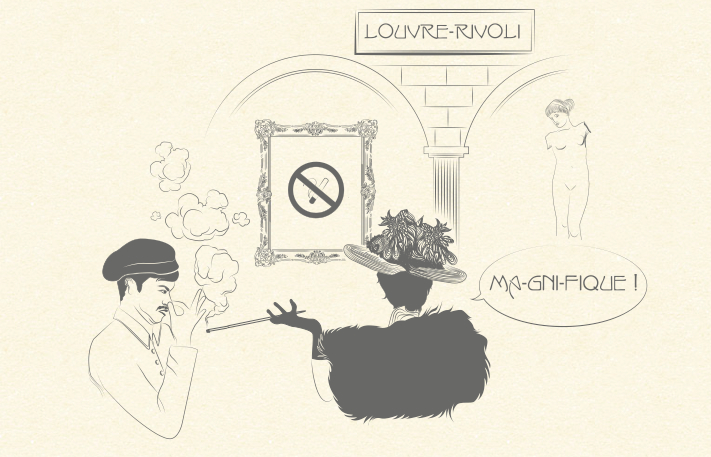
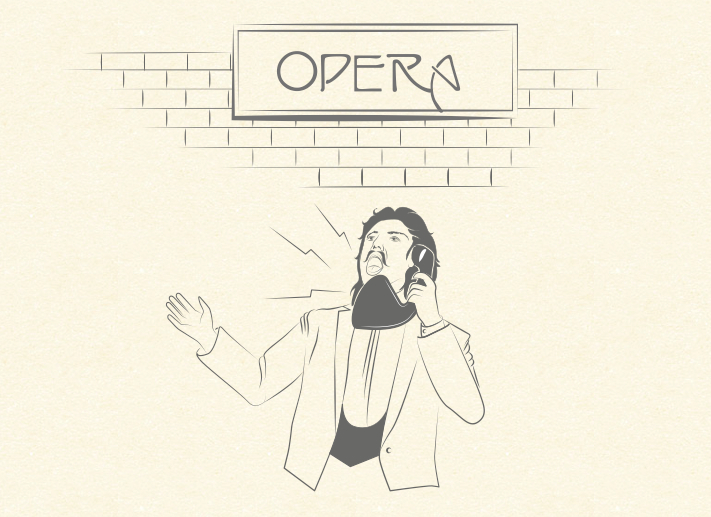
To prevent such faux pas from ruining the subway-riding experiences of Parisian commuters, France’s public transport operator (the RATP) has decided to nip such gauche behavior in the bud by issuing a short illustrated manual on subway manners. The Savoir Vivre Guide For The Modern Traveller, available here, is a quaint 1950s-style primer that provides much-needed pointers for hapless foreigners and rural French visitors alike. Its 12 guidelines, five of which are illustrated here, are a distillation of some 2000 tips that the RATP received in its crowdsourced etiquette campaign. For the sake of your reading pleasure and travelling know-how, we’ve included a number of the illustrations and tips below:
“Those No Smoking signs aren’t contemporary art — they mean no smoking”
(C’est comprendre que l’énorme cigarette barrée sur le quai n’est pas une œuvre d’art contemporain, mais une interdiction de fumer)
“Be considerate when using your cellphone”
(French readers will enjoy the pun: C’est ne pas faire de son portable un insupportable)
“Don’t be a creep and stare at people”
(C’est ne pas fixer une passagère avec insistance, quand bien même elle aurait les yeux revolver)
“On hot days, make like the emperor penguin — keep your arms low, and hold on to the bottom of the pole.”
(C’est les jours de grosse chaleur, tel le manchot empereur, bien garder les bras le long du corps et prendre sa meilleure prise en bas du poteau, pas tout en haut)
While Terkel is famous for interviewing everyday people for his oral histories of the Depression, work, and World War II, and his radio show featured its fair share of students, domestic workers, and veterans, this particular archive is full of big names: Actress and comedian Lily Tomlin. Literary theorist Edward Said. Actor and activist Sidney Poitier.
Currently, there are about twenty audio files available, and the archive promises more to come, pending digitization and the clearing of rights. (Let’s hope they hurry up! Some of the placeholder entries for not-yet-available interviews—Buckminster Fuller, Margaret Mead, Arthur C. Clarke—are most tantalizing.)
The one downside to this archive is that you can’t download the interviews—a potential drawback for addicted podcast fans. However, if you have a smartphone and a good data connection, it’s simple enough to listen to the files straight from your phone’s Chrome browser.
Above you can listen to Terkel interview a young Bob Dylan in 1963. The remaining parts of the interview can be found here. Note: The Dylan interview isn’t actually in the Pop Up archive. But it is another one of Terkel’s legendary interviews. So we wanted to add it to the mix.
Rebecca Onion is a writer and academic living in Philadelphia. She runs Slate.com’s history blog, The Vault. Follow her on Twitter: @rebeccaonion.
The Odyssey, one of Homer’s two great epics, narrates Odysseus’ long, strange trip home after the Trojan war. During their ten-year journey, Odysseus and his men had to overcome divine and natural forces, from battering storms and winds to difficult encounters with the Cyclops Polyphemus, the cannibalistic Laestrygones, the witch-goddess Circe and the rest. And they took a most circuitous route, bouncing all over the Mediterranean, moving first down to Crete and Tunisia. Next over to Sicily, then off toward Spain, and back to Greece again.
If you’re looking for an easy way to visualize all of the twists and turns in The Odyssey, then we’d recommend spending some time with the interactive map hosted on the University of Pennsylvania’s website. The map breaks down Odysseus’ voyage into 14 key scenes and locates them on a modern map.
Meanwhile, if you’re interested in the whole concept of ancient travel, I’d suggest revisiting one of our previous posts: Play Caesar: Travel Ancient Rome with Stanford’s Interactive Map. It tells you all about ORBIS, a geospatial network model, that lets you simulate journeys in Ancient Roman. You pick the points of origin and destination for a trip, and ORBIS will reconstruct the duration and financial cost of making the ancient journey. Pretty cool stuff.
If you would like to support the mission of Open Culture, consider making a donation to our site. It’s hard to rely 100% on ads, and your contributions will help us continue providing the best free cultural and educational materials to learners everywhere. You can contribute through PayPal, Patreon, and Venmo (@openculture). Thanks!
We're hoping to rely on loyal readers, rather than erratic ads. Please click the Donate button and support Open Culture. You can use Paypal, Venmo, Patreon, even Crypto! We thank you!
Open Culture scours the web for the best educational media. We find the free courses and audio books you need, the language lessons & educational videos you want, and plenty of enlightenment in between.