Michael Stevens knows something about viral videos. Yes, he’s a Googler who works on Programming Strategy at YouTube. That gives him some professional bona fides. But he also rolls up his sleeves and produces his own wildly popular videos under the Vsauce banner. Perhaps you’ll remember when Stevens asked the question late last year: Just how much does the entire internet — all 5 million terabytes of information — actually weigh? (That got 1.3 million views, putting it certainly into viral territory.) Two weeks ago, Stevens returned with another tantalizing question: What color is a mirror? Hint: It’s not what you think. And now, just two days ago, he dropped this question on us: What would happen if everyone on the planet jumped at once? Catch it below.
Bombastically billed as “a new landmark in human comprehension,” Ricky Gervais’ video podcast, “Learn English with Ricky Gervais” does, in a way, break new pedagogical ground. The trailer above provides a brief glimpse of the series’ first episode, currently available for free on iTunes. The premise of the show is that Gervais and his partner Karl Pilkington, in a posh-looking study with globe and fireplace, parody video language courses for non-English speakers. Gervais’ obnoxious grandiosity and the almost methodical obtuseness of Pilkington have become legendary to fans of HBO’s The Ricky Gervais Show. Missing here is the third member of that program, co-creator of the original British The Office, Stephen Merchant, but whatever the reason for his absence, this concept probably works better as a duo, with Gervais playing the overbearing and somewhat abusive teacher and Pilkington standing in for the hypothetical “students,” who would no doubt find this method as bewildering as he does.
The full episode includes subtitles in a language that resembles Welsh but mostly seems like gibberish (correct me, Welsh speakers, if I’m wrong), and Gervais and Pilkington’s exchanges are chock-full of non-sequiturs and insults, some benign, some skirting the boundaries of the uncomfortably xenophobic, but that’s kind of the point, and the source of much of the humor. The characters here are too culturally insensitive and dense to teach anyone anything. Gervais—with Merchant and Pilkington—uses a similar shtick in his An Idiot Abroad series, and it works, I think, but you’ll need to decide for yourself in the case of “Learn English,” and you’ll need to download iTunes (on the off chance you don’t have it) and subscribe to the podcast to view the full first episode, which debuted on August 14th. Gervais has said that future episodes may involve either a small fee or advertising to cover costs.
In the meantime, stop by our collection of Free Language Lessons, where you can download serious lessons in 40 different languages, including French, Spanish, Italian, Mandarin, Arabic, and, yes, English and Welsh.
Josh Jones is a doctoral candidate in English at Fordham University and a co-founder and former managing editor of Guernica / A Magazine of Arts and Politics.
“Hold back the edges of your gowns, Ladies, we are going through hell.” With those words, William Carlos Williams gives fair warning to anyone bold enough to read Allen Ginsberg’s harrowing poem from the dark underbelly of America, “Howl.”
“Howl” made quite a stir when it was first published in 1956, sparking a notorious obscenity trial and launching Ginsberg as one of the most celebrated and controversial poets of the 20th century. In 2010, Rob Epstein and Jeffrey Friedman made a film examining the events surrounding the poem’s inception and reception, starring James Franco as a young Ginsberg. The film is called Howl, and Newsweek called it “a response to a work of art that is art itself.”
Perhaps the most celebrated aspect of the film is its animated version of the poem itself. The sequence was designed by the artist Eric Drooker, a friend of the late Ginsberg who is perhaps best known for his covers for The New Yorker–including the famous October 10, 2011 cover showing a towering statue of a Wall Street bull with glowing red eyes and smokestack horns presiding over the city like the false god in Ginsberg’s poem:
Moloch whose eyes are a thousand blind windows! Moloch whose skyscrapers stand in the long streets like endless Jehovahs! Moloch whose factories dream and croak in the fog! Moloch whose smokestacks and antennae crown the cities!
Drooker first met Ginsberg in the summer of 1988, when they both lived on the Lower East Side of Manhattan. It was a time of local unrest, when police on horseback were cracking down on punks and squatters occupying Tompkins Square Park. The young Drooker had been plastering the neighborhood with political action posters, and as he recalls on his Web site, Ginsberg later “admitted that he’d been peeling them off brick walls and lampposts, and collecting them at home.”
The two men went on to collaborate on several projects, including Ginsberg’s final book, Illuminated Poems. So Drooker seemed a natural for Epstein and Friedman’s movie. “When they approached me with the ingenious idea of animating ‘Howl,’ ” he says, “I thought they were nuts and said ‘sure, let’s animate Dante’s Inferno while we’re at it!’ Then they told me I’d work with a team of studio animators who would bring my pictures to life… how could I say no?”
You can watch the beginning of Drooker’s animated (and slightly abridged) rendition of “Howl” above, and continue by clicking the following six links:
“No one knows why exactly Sonny Rollins, the tenor saxophone colossus, hasn’t recorded a good studio album since the 1960s,” writesNew York Review of Books blogger Christopher Carroll. “Yet anyone who has seen Rollins perform on a good night knows that, even at eighty-one, he is still capable of playing with the same brilliance that first made giants like Charlie Parker, Miles Davis, and Thelonious Monk take an interest in him in the 1950s.” “I haven’t heard every note that Rollins has ever recorded, but I’ve heard lots of them,” writes New Yorker film blogger Richard Brody, “and if I had to carry just one recorded performance of his to the hereafter, it would be one from Copenhagen, from 1965.” You’ll find a clip of this very show above, 45 minutes that might give you a sense of just what Rollins enthusiasts like Carroll and Brody are enthusing about.
As Brody describes the full show, “Rollins plays almost uninterruptedly for nearly an hour, picking up heat and whimsy as he goes along. His full, hearty sound is exceptionally sculptured, bluff, and pliable; the notes of the rising phrase in the opening number, ‘There Will Never Be Another You,’ seem to hang in the air like balloons. Dawson sets a brisk, light tempo, Rollins makes room for [bassist Niels-Henning Ørsted] Pedersen’s solo, and then sidles over into the harmonic wilds and lets fly cascades of notes and broken, modernistic tones while trading fours with the drummer, before ending with a suave solo cadenza.” For a more recent showcase of Rollins’ musical powers at work, see also the video just above, a 1992 performance from his sextet in München, Germany. Sometimes well-respected jazz players spend long stretches in the artistic wilderness — Rollins in particular having been “irreparably damaged by years spent experimenting with funk, disco, and fusion in the seventies and eighties,” in Carroll’s words — but you can never really take your ears off them.
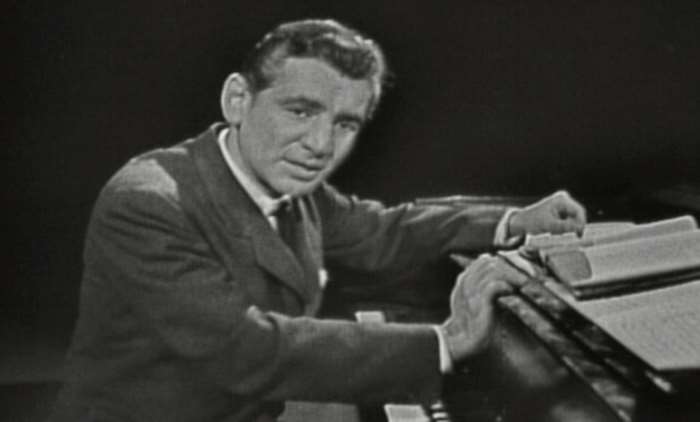
We’ve blogged before about Leonard Bernstein’s appearances on a 1950s television program called Omnibus, “the most successful cultural magazine series in the history of U.S. commercial television,” which featured scientists and artists presenting original ideas and compositions. In this documentary, Bernstein introduces his audience to “modern music,” including such a more or less classical composer as Stravinsky to the avant-garde instrumentation of John Cage’s prepared piano and early electronics of Pierre Henry’s musique concrete. After watching a sextet of “musicians” “playing” transistor radios, Bernstein admits, “Now compared with all these wildest outposts of experimentation… Stravinsky probably sounds tame or more like, well… music.” Bernstein then goes on to make a case for modern, experimental music, hoping to persuade his audience to “hate it less, or hate it more intelligently, or even grow to like it.” He’s a very patient teacher, and he anticipates his students’ first objection to the modernism of his time: “What has happened to beauty?” The beauty of Mozart, say, or Tchaikovsky?
In order to answer this question, Bernstein uses easily visualized analogies to baseball and numerous more or less familiar symphonic passages to explain basic music theory—tonality, harmonics, chord structure, scale patterns, melody, dissonance. By the time he comes to describe the conflict, post-Wagner, between atonal composers and more conservative “tonalists” around the twenty minute mark, you’ve got a pretty good idea of what he’s talking about, even if this debate is entirely new to you. It’s a captivating lecture tracing the history and logic of musical composition, and despite Bernstein’s range of references, he’s never esoteric. He had the patience of a Fred Rogers and media personality of a musical Carl Sagan (and, oddly, some of the mannerisms of Rod Serling). Like Rogers and Sagan, he was part of an age when television presenters could be educators first, entertainers second, and solipsists not at all. Luckily for us, we’ve got him on Youtube.
If you would like to support the mission of Open Culture, consider making a donation to our site. It’s hard to rely 100% on ads, and your contributions will help us continue providing the best free cultural and educational materials to learners everywhere. You can contribute through PayPal, Patreon, and Venmo (@openculture). Thanks!
On June 11th, Poets House hosted The 17th Annual Poetry Walk Across the Brooklyn Bridge. The event features “readings of the poetry of Walt Whitman, Marianne Moore, Langston Hughes and other greats,” all in order to raise funds for the New York City non-profit dedicated to cultivating a wider audience for poetry. And the event is regularly attended by the greatest cinematic supporter of Poets House — the actor Bill Murray.
Ramesh Raskar joined the MIT Media Lab in 2008, where he heads up the Lab’s Camera Culture research group. For some time, the researcher has drawn inspiration from another MIT professor, Harold Edgerton, a pioneer of stop-action photography, who famously photographed a bullet moving through an apple in 1964. Decades later, Raskar and his MIT crew have taken photography to a new level, creating imaging hardware and software that can capture light as it moves. They can visualize pictures as if they were recorded at a rate of one trillion frames per second. His cutting edge work in femto-photography is all on display above.
Above you can watch a rare 1975 meeting, of sorts, of three hugely influential twentieth-century cultural minds: Bob Dylan, Allen Ginsberg, and — in spirit, anyway — Jack Kerouac, who died six years before. This clip, though brief, would be fascinating enough by itself, but Sean Wilentz provides extensive backstory in “Penetrating Aether: The Beat Generation and Allen Ginsberg’s America,” an essay fron the NewYorker. “On a crisp scarlet-ocher November afternoon at Edson Cemetery in Lowell,” as he describes it, “Bob Dylan and Allen Ginsberg visited Kerouac’s grave, trailed by a reporter, a photographer, a film crew, and various others (including the young playwright Sam Shepard).” There “Ginsberg recited not from Kerouac’s prose but from poetry out of Mexico City Blues [ … ] invoking specters, fatigue, mortality, Mexico, and John Steinbeck’s boxcar America, while he and Dylan contemplated Kerouac’s headstone.” Why that particular collection? “Someone handed me Mexico City Blues in St. Paul in 1959,” Wilentz quotes Dylan as having told Ginsberg. “It blew my mind.”
In the piece, which comes adapted from his book Bob Dylan in America, Wilentz goes into great detail describing Dylan as a link between two sometimes compatible and sometimes antagonistic subcultures in midcentury America: the folk music movement and the Beat generation. “I came out of the wilderness and just naturally fell in with the Beat scene, the bohemian, Be Bop crowd, it was all pretty much connected,” Wilentz quotes Dylan as saying in 1985. “It was Jack Kerouac, Ginsberg, Corso, Ferlinghetti … I got in at the tail end of that and it was magic … it had just as big an impact on me as Elvis Presley.” Wilentz describes Dylan relating to Kerouac as “a young man from a small declining industrial town who had come to New York as a cultural outsider more than twenty years earlier—an unknown bursting with ideas and whom the insiders proceeded either to lionize or to condemn, and, in any case, badly misconstrue.” The Beats showed Dylan a path to maintaining his cultural relevance, a trick he’s managed over and over again in the decades since. “Even though Dylan invented himself within one current of musical populism that came out of the 1930s and 1940s,” Wilentz writes, “he escaped that current in the 1960s—without ever completely rejecting it—by embracing anew some of the spirit and imagery of the Beat generation’s entirely different rebellious disaffiliation and poetic transcendence.”
Note: Do you want to hear Sean Wilentz read Bob Dylan in America for free? (Find an audio sample here.) Justhead over to Audible.com and register for a 30-day free trial. You can download any audiobook for free. Then, when the trial is over, you can continue your Audible subscription, or cancel it, and still keep the audio book. The choice is entirely yours. And, in full disclosure, let me tell you that we have a nice arrangement with Audible. Whenever someone signs up for a free trial, it helps support Open Culture.
Here’s something fun. And a bit weird. Mnozil Brass is an Austrian septet that combines musical virtuosity with absurdist theatre. The group’s name means “nozzle,” and refers to the Mnozil Pub, a little place near the Vienna College of Music where the founding members used to get together to drink and play music. Since forming in 1992, and the group’s entertaining mixture of music and clowning has grown steadily in popularity. Above is a skit called “Slow Motion” from Mnozil Brass’s new DVD, Magic Moments. Think of it as a sort of “spaghetti western music recital.” There are several more samples below, to give you a sense of the lunacy:
In 1995, a group of 5th grade kids in Helena, Montana got together and made a PSA for the Internet (above). And, man, were they hip, with their techno music and their “by the time I’m in college, the internet will be your telephone, television, and workplace.” In the annals of overblown predictions and technological hubris, mid-nineties internet-fever will go down as the ultimate exception. These kids even anticipated the cute cat mania that would infect the internet forever. Of course, none of them could have foreseen the Twitter revolution, the Facebook decline, rubbable gifs, or spherical panoramic views of Mars, but that’s just quibbling.
It really is astonishing to look back a mere seventeen years at what a primitive technology the internet was. Of course it wasn’t necessarily evident at the time that the online world would indeed become our “telephone, television, and workplace,” and some naysayers, like astronomer and hacker-catcher Clifford Stoll, called BS on the hype. In a 1995 Newsweek articletitled “The Internet? Bah!,” Stoll wrote:
The truth is no online database will replace your daily newspaper, no CD-ROM can take the place of a competent teacher and no computer network will change the way government works.
In 2010, Stoll was forced to retract, commenting on Boing Boing coverage of his sourpuss skepticism with:
“Of my many mistakes, flubs, and howlers, few have been as public as my 1995 howler.
But who could blame him? This was the age of such clunky Web services as AOL, which promises much in a 95 ad below, but ultimately delivered little.
Not all web advertising in 1995 looks so dated and silly. AOL’s competitor Prodigy, which fared even worse, certainly had a better ad agency. Their 95 ad below, featuring Barry White, is a romp.
All of this reflection warrants more wisdom from a chastened Clifford Stoll, who in a 2006 TED talk says: “If you really want to know about the future, don’t ask a technologist, a scientist, a physicist. No! Don’t ask somebody who’s writing code. No, if you want to know what society’s going to be like in 20 years, ask a kindergarten teacher.”
We're hoping to rely on loyal readers, rather than erratic ads. Please click the Donate button and support Open Culture. You can use Paypal, Venmo, Patreon, even Crypto! We thank you!
Open Culture scours the web for the best educational media. We find the free courses and audio books you need, the language lessons & educational videos you want, and plenty of enlightenment in between.