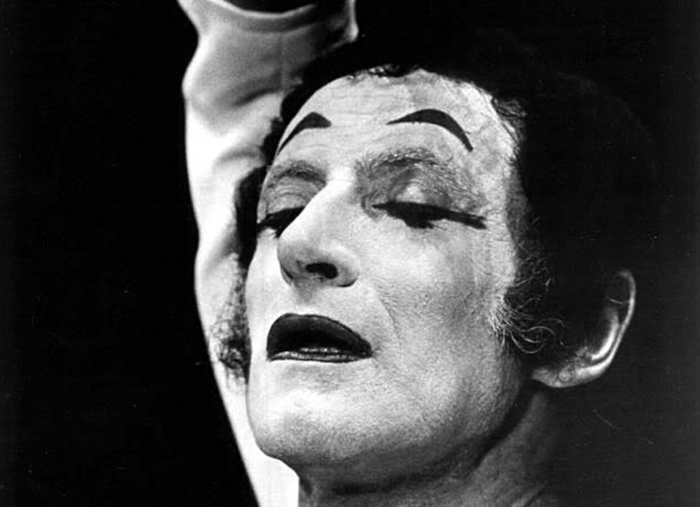
If we think about the times evil has most notably reared its head, many of our minds go right to the Holocaust — as, no doubt, did Marcel Marceau’s, especially since he had first-hand experience with the horror of the Nazis, having lost his father in Auschwitz, and even used the art of mime against it.
The Jewish Marceau (née Mangel) got his first exposure to mime from a Charlie Chaplin film, which he saw at the age of five. Later, when France entered the Second World War, he and his family moved around the country to flee the Nazis, from whom it became increasingly difficult to hide as time went on. “I was hidden by my cousin Georges Loinger who was a heroic Resistance fighter,” Marceau recounted in a 2001 speech. “He said, ‘Marcel must hide for a while. He will play an important part in the theater after the war.’ How did he know that? Because he knew that when I was a child I created a theater for children already.”
The skills Marceau cultivated performing for other children came in more than handy not just after the war but during it, as he performed for youngsters on the run from Hitler. ”Marceau started miming to keep children quiet as they were escaping,” said documentarian Philippe Mora, son of the Resistance fighter who smuggled refugees alongside Marceau. “It had nothing to do with show business. He was miming for his life.”
“Paris was liberated after the Americans entered in August,” said Marceau, “but the war wasn’t finished. Two months before the liberation of France, I entered a famous theater school and a master of mime, Étienne Decroux, said to the young students, ‘Who wants a part?’ And I said I. And I mimed the killer. And the killer was a Nazi, but of course I didn’t say Nazi.” Impressed with his impromptu embodiment of evil, Decroux asked his name. “I said Marcel Marceau,” his new surname inspired by a general who fought in the French Revolution, the “Marceau on the Rhine” of Victor Hugo’s poem (“and I was born in Strasbourg on the Rhine,” the artist adds). “That’s a beautiful name,” said Decroux. And thus the career of a mime legend truly began.
Needless to say, before the development and widespread use of photography in mass publications, illustrations provided the only visual accompaniment to religious texts, novels, books of poetry, scientific studies, and magazines literary, lifestyle, and otherwise. The development of techniques like etching, engraving, and lithography enabled artists and printers to better collaborate on more detailed and colorful plates. But whatever the media, behind each of the millions of illustrations to appear in manuscript and print—before and after Gutenberg—there was an artist. And many of those artists’ names are now well known to us as exemplars of graphic art styles.
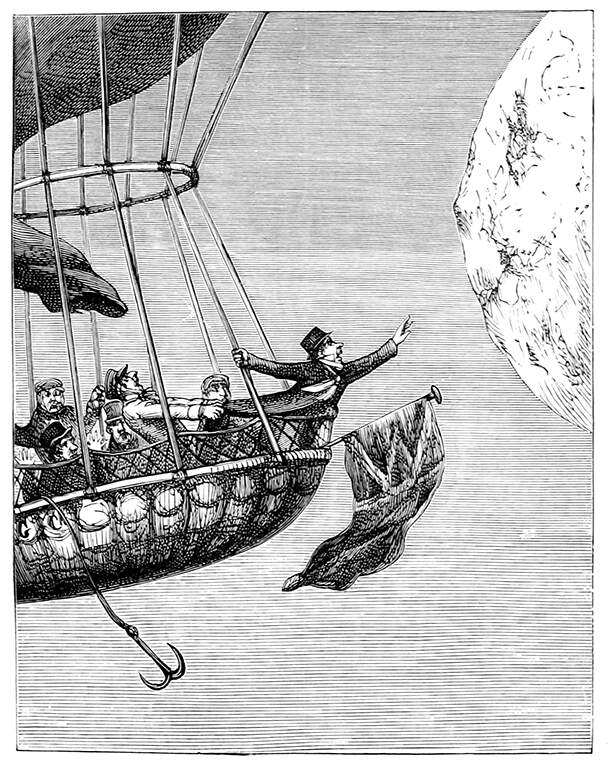
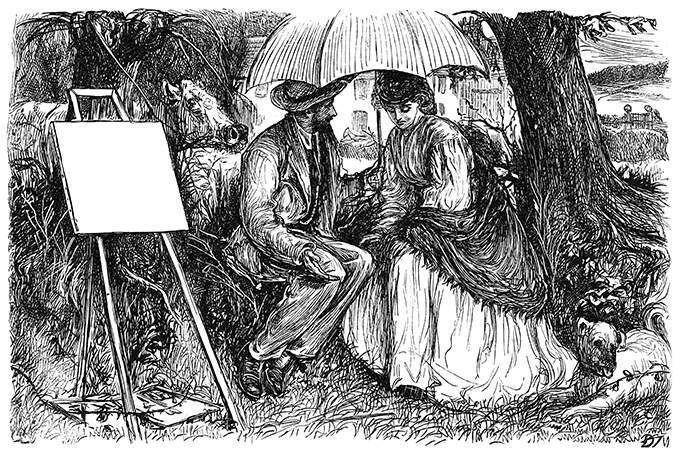
It was in the 19th century that book and magazine illustration began its golden age. Illustrations by artists like George Cruikshank (see his “’Monstre’ Balloon” above”) were so distinctive as to make their creators famous. The hugely influential English satire magazine Punch, founded in 1841, became the first to use the word “cartoon” to mean a humorous illustration, usually accompanied by a humorous caption. The drawings of Punch cartoons were generally more visually sophisticated than the average New Yorker cartoon, but their humor was often as pithy and oblique. And at times, it was narrative, as in the cartoon below by French artist George Du Maurier.
The lengthy caption beneath Du Maurier’s illustration, “Punch’s physiology of courtship,” introduces Edwin, a landscape painter, who “is now persuading Angelina to share with him the honours and profits of his glorious career, proposing they should marry on the proceeds of his first picture, now in progress (and which we have faithfully represented above).” The humor is representative of Punch’s brand, as is the work of Du Maurier, a frequent contributor until his death. You can find much more of Cruikshank and Du Maurier’s work at Old Book Illustrations, a public domain archive of illustrations from artists famous and not-so-famous. You’ll find there many other resources as well, such as biographical essays and a still-expanding online edition of William Savage’s 1832 compendium of printing terminology, A Dictionary of the Art of Printing.
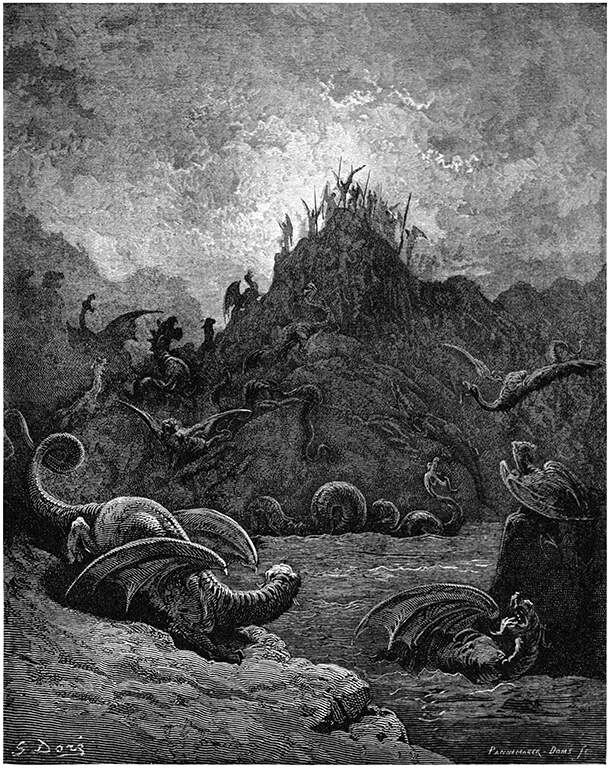
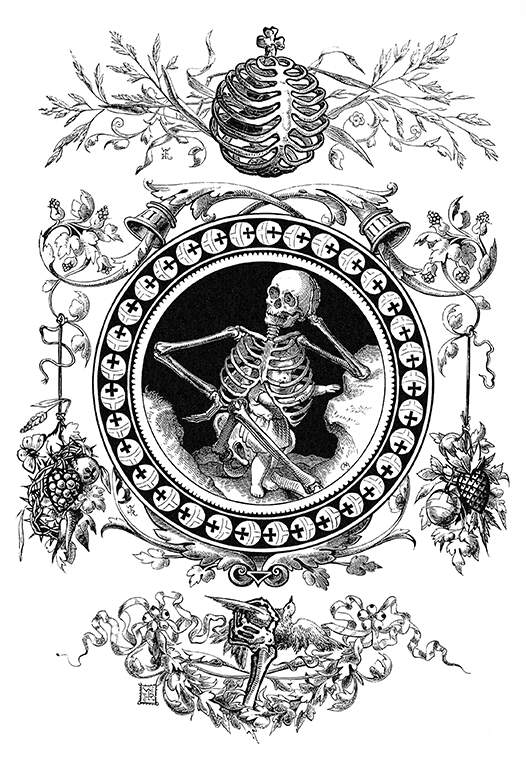
Old Book Illustrations allows you to download high resolution images of its hundreds of featured scans, “though it appears,” writes Boing Boing, “the scans are sometimes worse-for-wear.” Most of the illustrations also “come with lots of details about their original creation and printing.” You’ll find there many illustrations from an artist we’ve featured here several times before, Gustave Doré (see “Gorgons and Hydras” from his Paradise Lost edition, above). As much as artists like Cruikshank and Du Maurier can be said to have dominated the illustration of periodicals in the 19th century, Doré dominated the field of book illustration. In a laudatory biographical essay on the French artist, Elbert Hubbard writes, “He stands alone: he had no predecessors, and he left no successors.” You’ll find a beautifully, and morbidly, 19th century illustrated edition of 17th century poet Francis Quarles’ Emblems, with pages like that below, illustrating “The Body of This Death.”
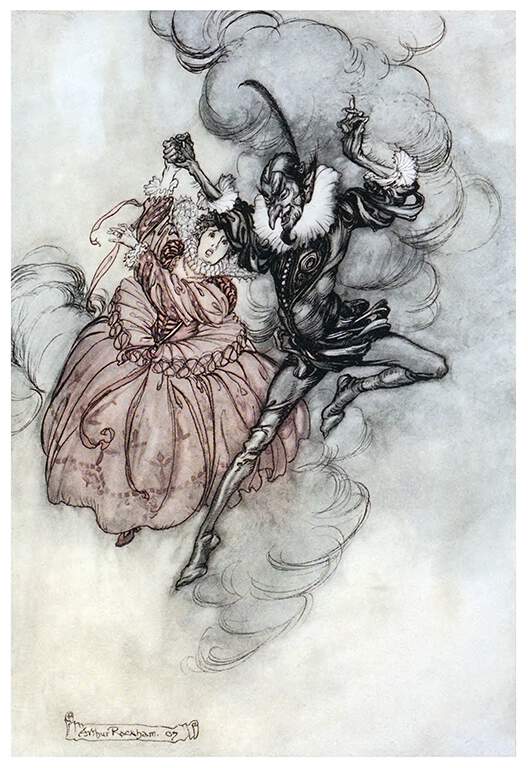
Not all of the illustrations at Old Book Illustrations date from the Victorian era, though most do. Some of the more striking exceptions come from Arthur Rackham, known primarily as an early 20th century illustrator of fantasies and folk tales. See his “Pas de Deux” below from his edition of The Ingoldsby Legends. These are but a very few of the many hundreds of illustrations available, and not all of them literary or topical (see, for example, the “Science & Technology” category). Be sure also to check out the OBI Scrapbook Blog, a running log of illustrations from other collections and libraries.
The title of the TED talk above, “Flow, the secret to happiness,” might make you roll your eyes. It does indeed sound like self-help snake oil. But as soon as you hear the speaker, psychologist Mihaly Csikszentmihalyi, describe the rationale for his happiness study, you might pay more serious attention. After living through the Second World War in Europe (he grew up in what is now Croatia), Csikszentmihalyi says he “realized how few of the grownups I knew were able to withstand the tragedies that were visited upon them; how few of them could even resemble a normal, contented, satisfied, happy life once their job, their home, their security was destroyed by the war.”
He became interested, he says, “in understanding what contributed to a life that was worth living.” Csikszentmihalyi’s concerns are far from trivial, and his background and wealth of research lend his ideas a good deal of weight and credibility.
After chancing upon a Jungian lecture in Switzerland by a speaker who turned out to actually be Carl Jung, Csikszentmihalyi embarked on a course of study in the field now widely known as “positive psychology.” He now co-directs the Quality of Life Research Center at Claremont Graduate University and studies “human strengths such as creativity, engagement, intrinsic motivation, and responsibility.” Yes, he may present his ideas in popular self-help books and articles, but this does not make his data or conclusions any less sound than in his academic work. “Flow” is the shorthand word he uses to refer to the thesis of his book of the same name: “A person can himself [or herself] be happy, or miserable, regardless of what is actually happening ‘outside,’ just by changing the contents of consciousness.”
What does this mean? Youtuber Fight Mediocrity’s short book video book review above—which also teaches us how to pronounce Csikszentmihalyi’s name—explains the concept in brief, noting the book’s references to Stoic philosophers Epictetus and Marcus Aurelius and psychologist and Holocaust survivor Viktor Frankl to point out that the idea isn’t new but has been around for centuries: The idea being, as Csikszentmihalyi says in his TED talk, that we naturally experience the greatest happiness when fully absorbed in work we find meaningful and fulfilling. What Csikszentmihalyi calls “flow” is a meditative state we might compare to the ancient Buddhist state of ekaggata—or “one-pointed concentration”—a state meditation teacher Shaila Catherine describes as “certainty, deep stability, and clarity…. The mind is completely unified and ‘one with the experience.’”
Indeed, like the Buddhist conception, which contrasts ekaggata with a restless greed that can never be satisfied, Csikszentmihalyi contrasts “flow” with wealth, and cites research suggesting that above a certain level of basic material well-being (which far too many people do not yet have), “increases in material resources do not increase happiness.” Csikszentmihalyi partly reached his conclusions by studying the emotional states of artists, musicians, scientists, and other creative individuals, who all reported experiencing pure states of contentment and joy when so fully concentrated on their work that they forgot themselves—or, more accurately, the constellation of daily anxieties, regrets, worries, fantasies, and preoccupations that we tend to call the self. As Csikszentmihalyi strongly suggests in his books and talks, the more we can lose ourselves intensely in creative activities that bring us fulfillment, the closer we come to being in harmony with ourselves and our world.
See another talk on “flow” and happiness above, from a 2014 “Happiness & its Causes” conference in Sydney, Australia.
If you would like to support the mission of Open Culture, consider making a donation to our site. It’s hard to rely 100% on ads, and your contributions will help us continue providing the best free cultural and educational materials to learners everywhere. You can contribute through PayPal, Patreon, and Venmo (@openculture). Thanks!
How can you make the invisible, visible? One way to do it is through a nineteenth century photography technique called Schlieren Flow Visualization. Better demonstrated than explained, the NPR video above shows Schlieren Flow Visualization in action, rendering visible (after the 2:00 minute mark) the sounds of hands clapping, a towel snapping, a firecracker cracking, and an AK-47 firing off a round. The images, which capture changes in air density, were provided by Michael Hargather, a professor who leads the Shock and Gas Dynamics Laboratory at New Mexico Tech.
Follow Open Culture on Facebook and Twitter and share intelligent media with your friends. Or better yet, sign up for our daily email and get a daily dose of Open Culture in your inbox. And if you want to make sure that our posts definitely appear in your Facebook newsfeed, just follow these simple steps.
Let’s face it, the holidays are a miserable time of year for many people. Writers have mined this fact for pathos and much dark humor in stories featuring low-rent mall Santas, squabbling family dinners, inept home invaders, and King of the Hill’s resident sad sack, Bill Dauterive. Most narratives of unhappy holidays end with some kind of redemption—someone discovers a Christmas miracle, the real Santa shows up, the Grinch’s heart grows to nearly bursting from his chest, Ebenezer Scrooge repents….
What if the redemption is one down-and-out junky sharing his only fix with a man suffering from kidney stones—that is, after the junky spends the day trying to steal enough to buy heroin, finds a suitcase containing two severed human legs, and finally scores a little morphine by goldbricking at a crooked doctor’s house? That’s the plot of William S. Burroughs’ story “The Junky’s Christmas,” which appeared in the 1989 collection Interzone and thereafter achieved some notoriety in two adaptations from 1993.
The first (above)—produced by Francis Ford Coppola and directed by Nick Donkin and Melodie McDaniel—-animates a reading by Burroughs in Claymation, with appearances from the man himself at the beginning and end. The story ends with a Christmas miracle of sorts, the “immaculate fix” the main character Danny receives as if from heaven after his unselfish act. It ain’t Frank Capra, but it’s a lot closer to some people’s real lives than It’s a Wonderful Life’s angelic visitation.
Also in 1993, Burroughs collaborated with another artist plagued by addiction, entering a studio in Lawrence, Kansas with Kurt Cobain to read an earlier version of “The Junky’s Christmas” titled “The ‘Priest’ They Called Him.” (Hear it in the fan-made video above.) This version of the story also has the suitcase full of severed legs, but this time the recipient of the junky’s charity is a disabled Mexican fellow addict suffering from withdrawal. Underneath Burroughs’ deadpan, Cobain plays bars of “Silent Night” on a guitar that sounds like it’s being strangled to death. You can read Burroughs’ earlier unhappy Christmas story in full here. And if you’re still not bummed out enough, check out Nerve’s “Ten Most Depressing Christmas Songs Ever Recorded.”
If you can rank the work of a filmmaker by the number of video essays it inspires, then Yasujirō Ozu must have made some of the greatest motion pictures of all time. Wes Anderson, despite having got his start 65 years later than Ozu, would also place well — and naturally, as we posted back in July, one video essay even examines the two men’s films (on most levels so seemingly different) in parallel. But today, let’s take a closer look at the midcentury Japanese auteur of Tokyo Story, Floating Weeds, Late Spring and many more in isolation, through Lewis Bond’s new video essay “The Depth of Simplicity.”
At first glance, most of Ozu’s more than thirty films — domestic dramas which, as critic Donald Richie wrote in his study of the director, “had but one major subject, the Japanese family, and but one major theme, its dissolution” — might seem similar to each other. But that first glance only reveals the parameters within which Ozu decided to work, the strictures that engaged his genius. “Although I may seem the same to other people,” he said in the quote that opens “The Depth of Simplicity,” “to me each thing I produce is a new expression and I always make each work from a new interest. It’s like a painter who always paints the same rose.” (Or maybe the same tea kettle?)
“Ozu wanted to capture the cinematic quality of everyday life,” says Bond, “and doing so required a very specific style.” Rather than adding techniques on to his cinematic vocabulary, Ozu eliminated them, making complete and meaningful use of those that remained: rigorous, painting-like compositions using frames within frames; a low-placed camera (set, legend has it, around the height of someone sitting on a traditional tatami mat) that hardly ever moves and always uses a human eyesight-like 50-millimeter lens; dialogue that cuts between straight-on close-ups of each speaker (breaking filmmaking’s sacred “180-degree rule” every time).
These techniques and others, which “seem false at first glance but begin to weave their way into the texture of his films,” give Ozu’s work what Bond calls its “radiantly calm tone,” its ability to “straddle the line of subjectivity and objectivity,” and its expression of mono no aware, one of those not-especially-translatable Japanese concepts having to do with the distinctive emotion felt upon recognition of the transience of all things. Of course, Ozu himself, who compared himself to a humble tofu-maker, would never have made such claims. “I just want to make good tofu,” he said, and cinephiles the world over continue to eat it up today.
As you can probably tell if you’ve interacted with any of his hard-core fans, the science fiction of Philip K. Dick has a way of getting into readers’ heads. What better way to adapt it, then, than in the medium of radio drama, with its direct route into the head through the ears? Science fiction in general provided radio drama with a good deal of bread-and-butter subject matter since pretty much its inception, and suitably so: its producers didn’t have to bother designing distant worlds, alien races and elaborately futuristic technologies when, with the right sound design, the listeners would design it all themselves in their imaginations.
But does it really do justice to Dick to call his work “science fiction”? Sure, he knocked out a fair few straight-ahead (or sub-straight-ahead) sci-fi potboilers in his productive career, but many of his writings, despite their rough edges, qualify under Walter Benjamin’s definition of great works of literature, which “either dissolve a genre or invent one.”
Some of Dick’s novels and stories even seem to do both at once, creating their own particular (as well as peculiar) psychological space in the process. Can radio drama render a Dickian world of multilayered reality and rich paranoia as easily as it does so many Martian colonies, laser guns, and sentient computers? So you can judge that for yourself, we submit today for your approval six radio plays adapted from Dick’s stories.
From the series Mind Webs, which ran on Wisconsin public radio from the 1970s to the 90s, we have “Impostor,” “The Preserving Machine,” and “The Builder.”
From NBC’s venerable X Minus One, which defined sci-fi at the tail end of old time radio’s “Golden Age,” we have “Colony” and “The Defenders.”
Into the mix we also throw Sci-Fi Radio’s “Sales Pitch,” Dick’s satirical tale of a self-marketing robot. Some of this material, of course, sounds not terribly different than the whiz-bang stories of outer-space adventure children of the 1950s grew up loving.
But some of it sounds altogether more, well… Dickian. Those children of the 1950s, after all, grew into the twentysomethings of the late 1960s and 70s, who knew a thing or two about tuning in to a different headspace.
There are good reasons to find the onslaught of religious music this time of year objectionable. And yet—though I want to do my part in the War on Christmas—I don’t so much object to the content of Christmas songs. It’s the music! It’s hackneyed and tired and grossly overplayed and a lot of it was never very good to begin with. I’d make the same distinction with any kind of music, religious or otherwise. I grew up in churches full of Christian music, and a lot of it was just terrible: the worst of kind of soft rock or adult contemporary paired with lyrics so insipid they would make the gospel writers—whoever they were—cringe. Updates with the slick production of alt-rock, hip-hop, or pop-country styles have only made things worse. On the other hand, some of the most powerful and moving music I’ve ever heard comes from the church, whether Handel, The Staples Singers, the Louvin Brothers, or so many other classical and gospel artists and composers.
Anyone with a deep affection for Western classical music probably has their share of favorite Christian music, whatever their personal beliefs. So, too, do fans of American folk, blues, and country. Some artists have covered the odd religious tune as part of a broad roots repertoire, like the Byrds’ cover of Bluegrass gospel legends the Louvin Brothers’ cornball “The Christian Life,” above, from 1968’s Sweetheart of the Rodeo. Though Gram Parsons, with the band for the recording of this album, had his traditional leanings, his musical religion was more “Cosmic American” than Christian. But before Parsons joined the band and turned ‘em full country rock for a time, the Byrds recorded another religious song, one of their biggest hits—Pete Seeger’s “Turn, Turn, Turn” (below), which cribs all of its lyrics verbatim from Chapter 3 of the Book of Ecclesiastes (easily the non-religious person’s favorite book of the Bible).
Other American legends have turned to faith in dramatic conversions and have written earnest, original religious music. Most famously, we have the case of Bob Dylan, whose conversion to evangelical Christianity saw him proselytizing from the stage. He also wrote some beautiful songs like “Precious Angel,” at the top of the post, which he claimed was for the woman who brought him to Christianity (and which supposedly contains a dig at his ex-wife Sara for not converting him). Though it features some of the more disturbing lyrical turns Dylan has taken in his career, it’s one of my favorite tunes of his from this strange period, not least because of the brilliant guitar work of Mark Knopfler.
Whatever beliefs he’s claimed over the decades, Dylan’s music has always been religious in some sense, partly because of the American folk traditions he draws on. Almost all of the early R&B and rock and roll artists came from the folk gospel world, from Elvis to Little Richard to Jerry Lee Lewis. Notably, the golden-voiced Sam Cooke got his start as a gospel singer with several vocal groups, including his own The Soul Stirrers. The harmonies in their rendition of gospel classic “Farther Along” (above) give me chills every time I hear it, even though I don’t credit the song’s beliefs.
It’s a common feeling I get with American soul, blues, and country singers who moved in and out of the popular and gospel worlds. Then there are those artists who left gospel for outlaw stardom, then returned to the fold and embraced their church roots later in life. A prime example of this kind of spiritual, and musical, renewal is that of Johnny Cash. There are many sides of gospel Cash. Perhaps the most poignant of his religious recordings come from his final years. Though it suffers from some commercial overuse, Cash’s recording of blues classic “God’s Gonna Cut You Down” (often titled “Run On”), above, is equal parts menacing and haunting, a Christian-themed memento mori that caught on big with lots of secular music fans.
The list of religious music that non-religious people love could go on and on. Though the examples here are explicitly Christian, they certainly don’t have to be. There’s Yusef Islam, formerly Cat Stevens, who came back to record stirring original music after his conversion to Islam, and whose powerful “Morning has Broken” moves believers and non-believers alike. There’s Bob Marley, or any number of popular Rastafarian reggae artists. Then there are more contemporary artists making religious music for largely secular audiences. One could reference indie darling Sufjan Stevens, whose religious beliefs are central to his songwriting. And there’s a favorite of mine, Mark Lanegan, former Screaming Trees singer and current rock and roll journeyman who often works with religious themes and imagery, most notably in the glorious “Revival,” above, with the Soulsavers project.
The love many non-religious people have for some religious music often comes from a religious upbringing, something singer/songwriter Iris Dement discussed in a recent interview on NPR’s Fresh Air. Dement has recorded one of the most moving renditions of a hymn I remember fondly from childhood church days: a powerfully spare version of “Leaning on the Everlasting Arms” from the 2010 True Grit soundtrack. She’s also written what may be one of the best religious songs for secular (or non-religious, or post-religious, whatever…) people. In “Let the Mystery Be,” above, Dement’s agnostic refrain expresses a very sensible attitude, in my view: “But no one knows for certain and so it’s all the same to me / I think I’ll just let the mystery be.”
These are but a few of the religious songs that move this mostly secular person. Whether you’re religious or not, what are some of your favorite religious songs that have broad crossover appeal? Feel free to name your favorites in the comments below.
Frank Zappa was kind of a control freak. But the way he tells it in a 1968 Rolling Stone interview, if he hadn’t been, he wouldn’t have had much of a career. In the mid-sixties, he took over the merchandising and advertising of his albums. “We wouldn’t have sold any records if we had left it up to the company,” he says, “They figured we were odd-ball. One shot novelty a‑go-go. But we weren’t. We had to show them ways they could make money on the product.”
It’s that entrepreneurial attitude and ability to take over that makes Zappa one of the most successful capitalists in experimental music. In 1967, he even founded his own ad agency, called Nifty Tough & Bitchin’, and made print and radio ads for Hagstrom Guitars, Panther Combo Organs, and Remington Razor Blades. (He also recorded a bizarre radio ad for Remington’s electric razor with Linda Ronstadt—see a fan-made video below).
That same year, animator and filmmaker Ed Seeman hired Zappa to score an ad for Luden’s Cough Drops. You can see the predictably weird results up top. According to Seeman, Zappa “requested $2,000 plus a studio for a day with a wide variety of instruments plus a guy to do cough sounds.” The ad went on to win a Clio award for “Best Use of Sound.”
After the ad wrapped, Zappa tapped Seeman to shoot 14 hours of footage over two years for a film project Zappa intended to produce called Uncle Meat (not to be confused with the album of the same name). The film was never completed, and Zappa only released the footage on video in 1987 (it has yet to see a DVD release).
The growth of the award-winning ad into a rare cult film—that doesn’t really exist in any final form—goes to show how Zappa’s musical talent for free association extended to all of his creative endeavors. Everything he touched took root and grew into several other branching projects, all of them fascinating to varying degrees. He joked that he was in it for the money, but the money he made in commercial ventures seemingly gave him the freedom to pursue any idea that popped into his head.
Seeman, who became a great Zappa admirer, went on to edit footage from Uncle Meat into a “40 minute impressionistic collage” set to Zappa’s “Who are The Brain Police” that Dangerous Minds describes as melding “Zappa’s cynical world view (perhaps prophetic) with a spookily psychedelic sound that creates a perfect paranoid whole” (see an excerpt above). Zappa didn’t do much more ad work after this commercially creative burst, outside of the promotion of his own records. That is, until two years before his death from cancer. In 1991, Zappa appeared in the ironic anti-ad for Portland General Electric in which he says he told the company “I refuse to sell your product.” Four years later, we saw the release of a posthumous Zappa best-of. Its title: Strictly Commercial.
In February, Oliver Sacks announced that he was suffering from terminal cancer. And, by August, he was gone — but not before showing us (if you read his op-eds in the Times) how to die with dignity and grace. All of this I was reminded of again today when I stumbled upon a recent animation inspired by Sacks’ work. Called The Lost Mariner, the short film offers an animated interpretation of a chapter in Sacks’ 1985 book The Man Who Mistook His Wife for a Hat. The chapter (also called “The Lost Mariner”) presents a curious case study of a patient known as Jimmie G. who, suffering from Korsakoff’s syndrome, loses the ability to form new memories. To see how Tess Martin made this award-winning short, you can watch the making-of video below.
Most writers find their individual voice only after they sojourn through periods of imitation. Though it’s an excellent way to appropriate experimental techniques and move out of comfortable ruts, imitation can only take us so far. But more prescriptive guidelines from famous authors can offer ways to refine our individual styles and visions. Advice, for example, from such a clear and succinct theorist as Kurt Vonnegut can go a very long way indeed for aspiring fiction writers.
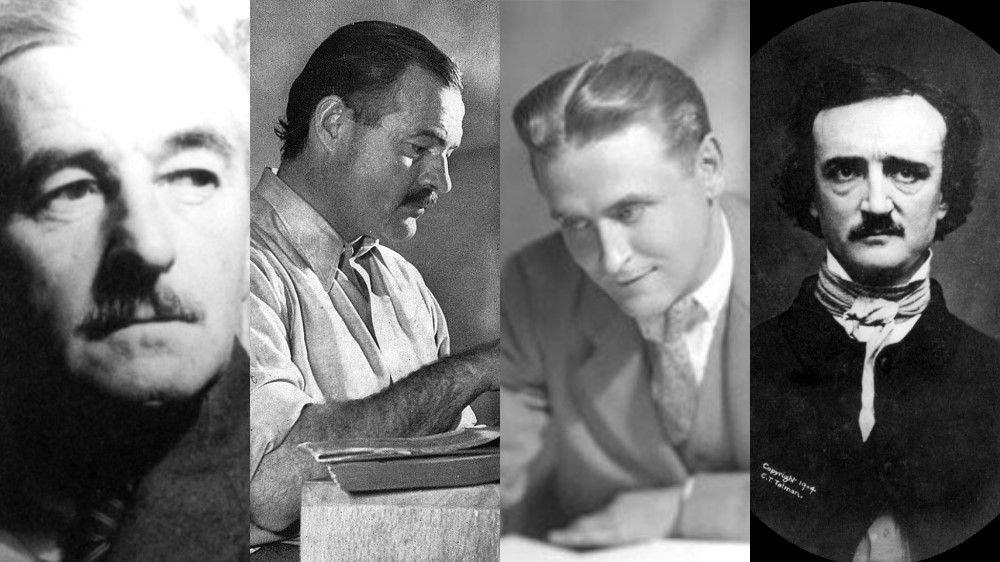
Another reason for appreciating great writers’ how-to guidelines accords with the injunction we often hear: to read, read, read as much as possible. Learning how William Faulkner conceived of his craft can give us useful insights into his novels. What did Faulkner think of the writing enterprise and the social role of the writer? How did he come to formulate his impressively dense style? What was his view of learning from other writers?
We can answer the last question by reference to seven writing tips we previously compiled from lectures and Q&A sessions Faulkner conducted while serving as writer-in-residence at the University of Virginia from 1957 to ’58. The first tip? Take what you need from other writers. To that end, we offer seven writing tips each from four American greats (or 28 tips in total). As writers, we’re free to take or leave their guidelines; as readers we may always find their philosophies of keen interest.
William Faulkner:
Take What You Need From Other Writers
During a writing class on February 25, 1957, Faulkner said the following:
I think the writer, as I’ve said before, is completely amoral. He takes whatever he needs, wherever he needs, and he does that openly and honestly because he himself hopes that what he does will be good enough so that after him people will take from him, and they are welcome to take from him, as he feels that he would be welcome by the best of his predecessors to take what they had done.
Faulkner’s advice can help tremendously–at least in a psychological sense–those writers who might have qualms about “stealing” from others. You have permission to do so from none other than perhaps the greatest American modernist writer of them all.
Faulkner also said “the young writer would be a fool to follow a theory,” a piece of advice we might bear in mind as we peruse famous writing theories. “The good artist,” he said, “believes that nobody is good enough to give him advice.”
Faulkner’s modernist foil and sometime rival Ernest Hemingway had some characteristically pragmatic advice for budding writers. Like many writers’ tips, some of his advice may do little but help you write more like Hemingway. And some of it, like “use a pencil,” is perfectly useless if you’ve already found your preferred method of working. One guideline, however, is intriguingly counter-intuitive. Hemingway counsels us to
Never Think about the Story When You’re Not Working
This is one thing Faulkner and Hemingway might agree on. In an Esquire article, Hemingway describes his experience during the composition of A Moveable Feast, one Faulkner characterizes in his writing advice as “never exhaust your imagination.”
When I was writing, it was necessary for me to read after I had written. If you kept thinking about it, you would lose the thing you were writing before you could go on with it the next day. It was necessary to get exercise, to be tired in the body, and it was very good to make love with whom you loved. That was better than anything. But afterwards, when you were empty, it was necessary to read in order not to think or worry about your work until you could do it again. I had learned already never to empty the well of my writing, but always to stop when there was still something there in the deep part of the well, and let it refill at night from the springs that fed it.
Despite his reputation as an undisciplined and messy writer, Fitzgerald has some of the most practical tips of all for organizing your ideas. One of his more philosophical prescriptions takes a similar tone as Hemingway’s in regard to the private world of the imagination:
Don’t Describe Your Work-in-Progress to Anyone
Fitzgerald offered this piece of advice in a 1940 letter to his daughter, Scottie, writing,
I think it’s a pretty good rule not to tell what a thing is about until it’s finished. If you do you always seem to lose some of it. It never quite belongs to you so much again.
This seems to me a good piece of advice for holding on to the magic of a creatively imagined world. Trying to summarize a good story in brief—like trying to explain a joke—generally has the effect of taking all the fun out of it.
Finally, we reach back to the 19th century, to the father of the American gothic and the detective story, Edgar Allan Poe, who had some very specific, very Poe things to say about the art of fiction. In his essay “The Philosophy of Composition,” Poe focuses on how to achieve what he vaguely called a “unity of effect,” the quality he desired most to produce in his narrative poem “The Raven.” Perhaps the clearest piece of advice Poe offers in his treatise is:
Know the Ending in Advance, Before You Begin to Write
You will likely find other authors who advise against this and tell you to write your way to the end. Bearing in mind Faulkner’s disclaimer—that we would be “fool to follow a theory”—we might at least try this practice and see if it works for us as it did for Poe. As he described it, “nothing is more clear than that every plot, worth the name, must be elaborated to its dénouement before any thing be attempted with the pen.”
Keeping the end “constantly in view,” wrote Poe, gives “a plot its indispensable air of consequence.” Poe’s advice applies to short works that can be read in a single sitting, the only ones he generally allows can achieve “unity of effect.” Novel-writing is different. I don’t know if it’s necessary to fully know the ending of a short story before one begins, but Vonnegut counsels writers to “start as close to the end as possible” when writing one.
Should you desire more writing advice, you’ll find no shortage here at Open Culture, from writers as diverse as Stephen King, Toni Morrison, Roberto Bolaño, H.P. Lovecraft, Haruki Murakami, Ray Bradbury, and many more. Whether or not we decide to take any of their advice, it always opens a window onto their art of creating fictional worlds, which can seem to many of us a creative act akin to magic.
We're hoping to rely on loyal readers, rather than erratic ads. Please click the Donate button and support Open Culture. You can use Paypal, Venmo, Patreon, even Crypto! We thank you!
Open Culture scours the web for the best educational media. We find the free courses and audio books you need, the language lessons & educational videos you want, and plenty of enlightenment in between.