Note: If you’re having difficulties getting this software running in your browser give Firefox a try. It seems to work the best.
Movies, commercials, radio shows, even books: we’ve enjoyed the ability to effortlessly pull up things we remember from our childhood on the internet just long enough that it feels strange and uncomfortable when we can’t. Up until now, though, we haven’t had an easy way to re-experience the computer software we remember using in decades past. In my case, of course — and likely in a fair few of yours as well — I spent most of my computer time in decades past playing games and not, say, building balance sheets. But whichever you did, the Internet Archive’s newly opened Historical Software Archive makes it easy to re-live those old days at the keyboard without having to buy a vintage computer on eBay, track down its software, remember all its required commands and keystrokes, and hope the floppy discs — or, heaven help us, cassette tapes — boot up correctly. They’ve made these wealth of games, applications, and oddities freely available with the development of JMESS, a Javascript-powered version of the Multi Emulator Super System, “a mature and breathtakingly flexible computer and console emulator that has been in development for over a decade and a half by hundreds of volunteers.”
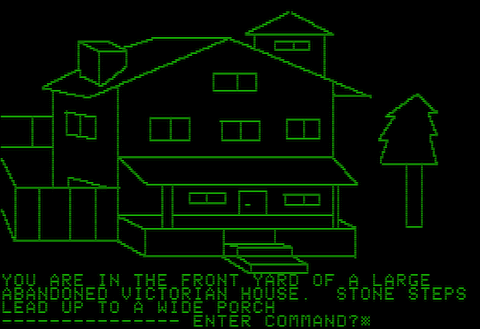
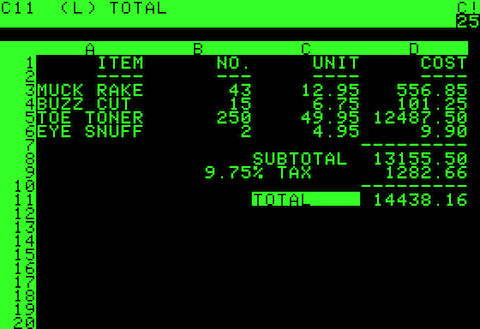
They say a bit more about the technology behind all this on the Internet Archive Blog, and the Historical Software Archive’s front page offers recommendations for which “ground-breaking and historically important software products” to try first, including 1.) Jordan Mechner’s Karateka (top), a hot game in 1980 and the most popular item in the archive today; 2) Sierra On-Line’s Mystery House (above), which gave rise more or less by itself to a vast genre of graphic adventures; 3) three adaptations of Namco’s Pac-Man (one for the Atari 2600, one remade for that same console, one lawsuit-inducing knockoff for the lesser-known Odyssey2); 4) E.T. the Extra-Terrestrial, a “1982 adventure video game developed and published by Atari, Inc. for the Atari 2600 video game console;” and 5) Dan Bricklin and Bob Frankston’s Visi-Calc (below), the granddaddy of all spreadsheet programs, and arguably the single application that turned computing from hobby into necessity. Or how about 6) WordStar, the early word processing program? Just click on the “Run an in-browser emulation of the program” link to fire up any of these and, if you’re under about 30, experience just what computer users of the late seventies and early eighties had to deal with — and how much fun they had.
In a post earlier this year, we showcased one of the few known sound films of Charlie Parker performing live. Above, we have another very rare clip, from 1950, with Parker, young upstart alto, trading lines with veteran tenor Coleman Hawkins. Buddy Rich plays drums, and Hank Jones and Ray Brown play piano and bass.
Parker looks characteristically cool between the distinguished poise of Hawkins and the boyish exuberance of natural bandleader Buddy Rich who, in the second tune, exudes much goofy enthusiasm as he destroys the snare drum. This take may be hard bop at its hardest, which makes Parker’s understated contest with Hawkins all the more vital, propelled by some of the most frenetic rhythms in jazz history.
There is much more after the first two takes, as a voiceover segment announces. The rhythm section gets a little time, then they’re joined by Bill Harris and Lester Young. And then, at 12:18, the already all-star cast gets rounded out by a scatting Ella Fitzgerald off stage left, leaned over Hank Jones’ piano. This is a hell of a fun performance to watch, whether you’re a student of bop, have a music-historical bent, or just love seeing live jazz at the top of its game.
Shakespeare sells: counterintuitive, but seemingly true. The film industry, which pumps out Shakespeare adaptations (of varying levels of creativity) on the regular, has known this ever since it could hardly have had much awareness of itself as a film industry. At the top, we have the only surviving scene from 1899’s King John, where Shakespeare on screen all started.
“The next three decades would see varied approaches to the challenge of filming Shakespeare in a medium denied the spoken word,” writes the British Film Institute’s Michael Brooke, “from the imaginative tableaux-style mime of Percy Stow’s The Tempest (1908) to truncated productions of the major tragedies (Richard III, 1911; Hamlet, 1913).” Excerpts from one of these last, F.R. Benson’s Richard III, you can watch just below:
Early Shakespeare adapters like Benson tended to make less Shakespeare films than, as Brooke puts it, “compilations of memorable moments” from the plays. Then again, every genre of movie attempted simple things back then, and Shakespearean productions would grow far richer in the sound era, which 1929’s The Taming of the Shrew ushered in for the Bard, and with no less a silver-screen legend than Mary Pickford in the role of Kate.
Seven years later, the not-yet-Sir Laurence Olivier, “cinema’s first great Shakespearean artist,” would make his Shakespeare debut as Orlando in Paul Czinner’s As You Like It(1936), which you can watch below. He’d almost made this debut as the lead in George Cukor’s Romeo & Juliet, but ultimately turned it down.
Xiangjun Shi, otherwise known as Shixie, studied animation at RISD and physics at Brown. Then, she harnessed her training in both disciplines to create an animation explaining the virtue of studying physics. Pretty quickly, it gets to the crux of the matter: Studying physics will change how you see the world and how you understand your place in it, all while letting you wrap your mind around some pretty electrifying concepts. I think I’m sold!
In a year that marks some significant pop culture 20th anniversaries—Wired magazine, Nirvana’s In Utero, The X‑Files–one in particular may get somewhat less press. This coming December will be twenty years since Frank Zappa died of prostate cancer at age 52, after achieving infamy, notoriety, and finally, actual, run-of-the-mill fame. The latter he didn’t seem to cherish as much, and certainly not during his sickness. Nevertheless, Zappa sat for a Today Show interview, one of his last, and discussed his current work and failing health. A young chipper Katie Couric gives Zappa an ambivalent intro as the “bizarre performer with a penchant for lascivious lyrics.” “What few know,” she goes on to say, “is that he’s also a serious and respected classical composer.” Zappa’s bona fides as a “serious” artist seem to grant him a pass, at least for a bit, from interviewer Jamie Gangel, who begins asking about the successful performances of his work in Europe, where he “sells out concert halls.”
Zappa responds respectfully, but is obviously quite bored and in pain. He’s subdued, downbeat, guarded. Then the inevitable grilling begins. “How much do you think you did for the sound and how much for the humor?” asks Gangel. “Both,” answers Zappa, “The goal here is entertainment.” Zappa pronounces himself “totally unrepentant” for his life. In answer to the question “is there anything you’ve done that you felt sorry for?” he simply says, “No.”
And why should he confess on national television? There are many more interesting things to discuss, such as Zappa’s stand against Tipper Gore’s Parents Music Resource Center (PMRC) during the legendary 1985 Senate Hearings (along with Dee Snider and, of all people, John Denver). When the conversation turns to that history, Zappa learns a fun fact about Gore that genuinely catches him off-guard. The interview goes to some very sad places, and while Zappa hangs in there, it’s not particularly entertaining to see him staunchly refuse to view his condition through Gangel’s lenses. He clearly doesn’t see his illness as theater and won’t play penitent or victim.
A much more lively interview, by a much better informed interviewer, six months before Zappa’s death, is with Ben Watson for Mojo. In both of these moments, however, Zappa insists on the only label he ever applied to himself: he’s an entertainer, nothing more. Whether touted as a “classical composer” (a phrase he doesn’t use) or thought of as an artist, Zappa to the very end dodged any hint of serious moral intentions in his music, which perhaps makes him one of the most honest musicians in all of pop culture history. He saved the serious intentions for an arena much more in need of them. His PMRC hearing testimony contains an eloquent statement of his ethos: “Bad facts make bad laws. And people who write bad laws are, in my opinion, more dangerous that songwriters who celebrate sexuality.”
In 1965, Woody Allen took time out from his first film What’s New Pussycatto tape a half-hour of stand up in front of a live television audience in the UK.
Exuberant and horny in an adorable, puppyish way, the 30-year-old comic seemed to relish this return to his nightclub act. The comedy is situational, observational, autobiographical — imagine Louis CK with a PG vocabulary, no kids, a necktie and a twinkle in his eye. Already ensconced on the Upper East Side, he paints a decidedly downtown vision of a New York populated by artists’ models, swinging Bennington girls, and women with pierced ears. Like Louis—or the young Brooklyn hipsters on Girls—he’s itching to score.
It does a body good to see him at this “childlike” stage of his career.
“…comics are childlike and they are suing for the approval of the adults. Something goes on in a theater when you’re fourteen years old and you want to get up onstage and make the audience laugh. You’re always the supplicant, wanting to please and to get warm laughs. Then what happens to comics — they make it and they become a thousand times more wealthy than their audience, more famous, more idolized, more traveled, more cultivated, more experienced, more sophisticated, and they’re no longer the supplicant. They can buy and sell their audience, they know so much more than their audience, they have lived and traveled around the world a hundred times, they’ve dined at Buckingham Palace and the White House, they have chauffeured cars and they’re rich and they’ve made love to the world’s most beautiful women — and suddenly it becomes difficult to play that loser character, because they don’t feel it. Being a supplicant has become much harder to sell. If you’re not careful, you can easily become less amusing, less funny. Many become pompous… A strange thing occurs: You go from court jester to king.”
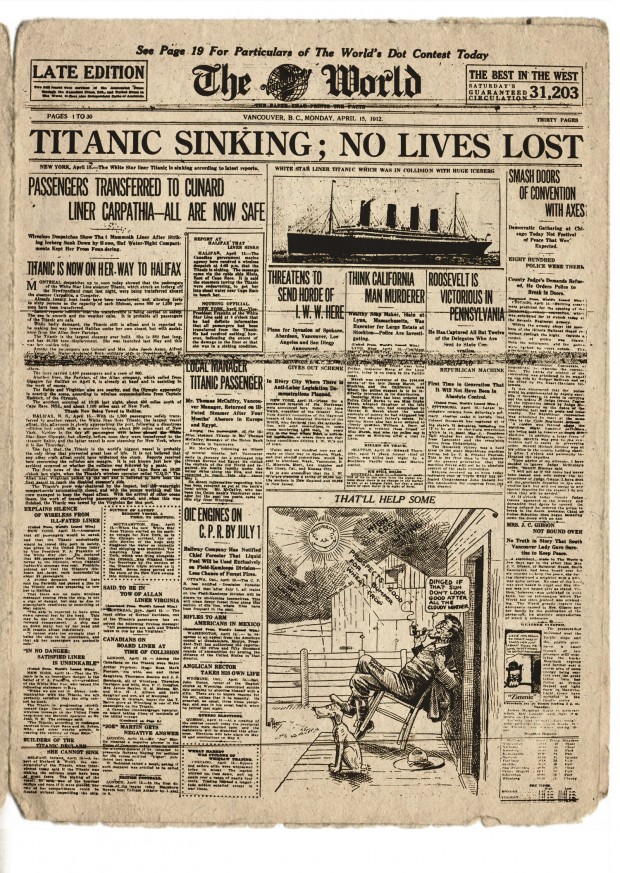
Over at the Retronaut they’ve highlighted some early, overly-optimistic newspaper reports that came out after the Titanic sank in the frigid waters of the North Atlantic Ocean on April 15, 1912. The World reported “Titanic Sinking; No Lives Lost.” The Vancouver Daily Province declared “The Titanic Sinking, But Probably No Lives Lost.” Meanwhile, The New York Times got closer to the truth with its lengthy headline:“Titanic Sinks Four Hours After Hitting Iceberg; 866 Rescued By Carpathia, Probably 1,250 Perish; Ismay Safe, Mrs. Astor Maybe, Noted Names Missing.” The real death toll climbed to 1,514. Last year, on the 100th anniversary of the maritime tragedy, Christopher Sullivan, an editor at the Associated Press, researched the story and tried to explain how newspapers fell so short of the mark. Speaking to the web site Journalism.co.uk he gave this explanation:
The “blooper” reel above from the filming of Star Wars: Episode 4, we’re told by io9, is “brand new” footage. Brand new to us, of course. Discovered by a Redditor, it made the rounds yesterday and everyone pronounced it amazing. And so it is. Many scenes lack audio, making the humor all the more subtle. We get some line flubs, action scenes gone awkward, and the vintage early title below.
If you’re anything like everyone else I know who’s seen this (if you’re reading this—you likely are), you’ll watch the two and a‑half minute reel at least two or three times, if not more. And if you find yourself less than jazzed about the coming of Star Wars: Episode 7 (or about the existence of episodes 1–3), we’ll at least have the hundreds of new memes spawned by this ridiculous footage. As i09 says, “get to GIF-ing, people.” And get to writing dialogue for those silent scenes.
Last week we highlighted a feature from the excellent website Neglected Books detailing two articles that appeared in The New Republic in 1934 on “good books that almost nobody has read.” The articles were the product of a query the magazine’s editor, Malcolm Cowley, sent out to the literary community of his day, asking them to list their favorite unsung books. Such lists are bound fast to their historical context; fame is fleeting, and great works are forgotten and rediscovered in every generation. Some of the books named then—like Franz Kafka’s The Castle or Nathaniel West’s Miss Lonelyhearts—have since gone on to notoriety. Most of them have not. This week, we thought we’d continue the theme with our own list of “neglected books.” I offer mine below, and I encourage readers to name your own in the comments. We’ll feature many of your suggestions in a follow-up post.
A few words about my by-no-means-definitive-and-certainly-incomplete list. These are not obscure works. And you’ll note that there are almost no recent works on it. This is due at least as much to my own lamentable ignorance of much contemporary literature as to a conviction that a work that isn’t widely read months after its publication is not, thereby, “neglected.” In the age of the internet, books can age well even after they’re remaindered, since instant communities of readers spring up overnight on fansites and places like Goodreads. Instead, my list consists of a few neglected classics and a book of poetry that I personally think should all be read by many more people than they are, and that I think are timely for one reason or another. Maybe some of these books have gotten their due in some small circles, and in some cases, their influence is much greater than sales figures can ever reflect. But they’re works more people should read, not simply read about, so I offer you below five titles I think are “neglected books.” You may interpret that phrase any way you like when you submit your own suggestions.
Jean Toomer’s Cane is well-known to students of the Harlem Renaissance, but it isn’t read much outside that academic context, I think, which is a shame because it is a beautiful book. Not a novel, but a collection of short stories, poems, and literary sketches inspired by Toomer’s stint as a substitute principal in Sparta, Georgia in 1921, Cane practically vibrates with the furious and fragile lives of a collection of characters in the Jim Crow South. Yet like all great books, it transcends its setting, elevating its subjects to archetypal status and immortalizing a time and place that seems to live only in caricature now. Read the first sketch, “Karintha,” and see what I mean.
Olive Schreiner is another writer who receives her due in scholarly circles but is little read outside the classroom. Schreiner was a white South African woman who turned her experiences of race, gender, and nation to literary fame with her novel The Story of an African Farm in 1883. The novel’s success at the time did not necessarily grant its author lasting fame, and while Schreiner has been lauded for transforming Victorian literature with her freethinking, feminist views, the book that once made her famous is an almost shockingly un-Victorian work. Short, stark, impressionistic, and very unsentimental, The Story of an African Farm may find purchase with scholars for historical or political reasons, but it should be read for its stunning prose descriptions and piercing dialogue.
Carpentier was a Cuban novelist, scholar, and musicologist who is not much read in the English-speaking world, and perhaps not much in Latin America. Although he coined the term “magical realism” (lo real maravilloso)—as part of his theory that Latin American history is so outlandish as to seem unreal—his literary fame in the States has never reached the degree of more fantastic practitioners of the style. Although perhaps best known, where he is known, for his harsh tale of Haiti’s first king, the brutal Henri Christophe, in The Kingdom of this World, Carpentier’s complex and mysterious 1953 The Lost Steps is a novel that justifies my calling him the Nabokov of Latin American letters.
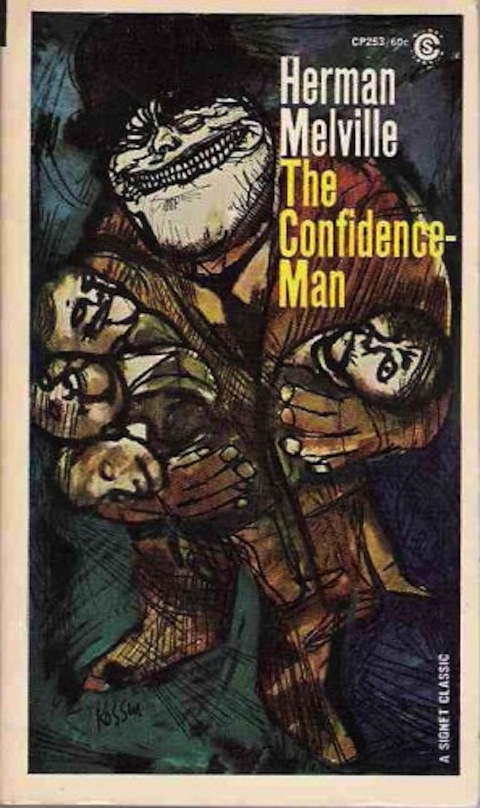
Melville was certainly a neglected writer in his time. He is, it should go without saying, no more. But while everyone knows Moby Dick (if not many finish it), Billy Budd, and “Bartelby,” few people read his, yes difficult, novel The Confidence Man. Also called The Confidence Man: His Masquerade, this was Melville’s last published novel in his lifetime. It’s a darkly comic book that sometimes sounds a bit like Twain in its colorful vernacular and shifting registers, but grows stranger and more unsettling as it progresses, becoming almost a cacophony of disembodied voices in a state of moral panic. The central character, a nameless shape-shifting grifter on a steamboat called the Fidele, takes on a succession of American identities, all of them thoroughly persuasive and all of them thoroughly, calculatedly, false.
The only book of poetry on my list also happens to be the only book by a living writer. It also happens to be a book that makes me tremble each time I think of it. De Kok, a South African poet, takes as her inspiration for her 2002 Terrestrial Things the transcripts from her country’s Truth and Reconciliation Commission. I’ll leave you with an excerpt from “The Sound Engineer,” a poem prefaced by the matter-of-fact statement that the “highest turnover” during the Commission, “was apparently among reporters editing sound for radio.”
Listen, cut; comma, cut;
stammer, cut;
edit, pain; connect, pain; broadcast, pain;
listen, cut; comma, cut.
Bind grammar to horror,
blood heating to the earphones,
beating the airwaves’ wings.
For truth’s sound bite,
tape the teeth, mouth, jaw,
put hesitation in, take it out:
maybe the breath too.
Take away the lips.
Even the tongue.
Leave just sound’s throat.
So there you have my list. I hope it has inspired you to go discover something new (or old). If not, I hope you will submit your own neglected books in the comments below and share your hidden literary treasures with our readers.
Public domain books listed above will be added to our collection of 500 Free eBooks.
Several years back, we featured Matteo, a band from Salt Lake City, performing the Talking Heads’ 1983 hit, “This Must Be the Place (Naive Melody).” And they were playing the Heads’ new wave, avant-garde music with traditional Chinese instruments. Now they’re back with another clip. Above we have them performing “What a Wonderful World,” a song written by Bob Thiele and George David Weiss, and first recorded and made famous by the great Louis Armstrong in 1967. Watch a classic performance below.
Last year, Matteo ran a Kickstarter campaign where they promised this to any backer who pledged more than $100: “Your choice of a song for MATTEO to cover (and we mean any song) which will then be dedicated and sung to you in a youtube video posted for the world to see…” Someone named “Jennifer” kicked in her $100+. And, for Jennifer, they performed Armstrong’s standard. Hope you enjoy. And don’t miss some other great instances of west-meets-east below.
We know British filmmaker Christopher Nolan best today for directing the latest trilogy of Batman films, Batman Begins, The Dark Knight, and The Dark Knight Rises. His recent high-profile non-superhero hit Inception made an impressive, if brief, splash as a mainstream brainbender, which, for me, faintly echoed the thrill he sent through the world of crossover independent film with 2000’s backward-told Memento. Yet, if this doesn’t make me too much of an I‑liked-the-early-stuff-cliché, I still think of him most fondly for directing his 1998 feature debut Following, a 16-millimeter, black-and-white, $6000-budget tale of theft, impersonation, and identity shot on the streets of London. (One of the characters breaks into an apartment with a now-striking Batman logo on its door.) But even a project as small-scale as Following has a predecessor, Doodlebug, which you can watch above.
“The depths of insanity are explored by a man chasing something in his apartment with a shoe,” promises the video description of the three-minute Doodlebug. In the center of this shadowy, paranoid tale we have Jeremy Theobald, who would go on to star in Following (and appear as a Gotham Water Board Technician in Batman Begins). Nolan shot it back in his days studying English literature at University College London, a school whose film society he led and which he chose expressly for the availability of its cameras and editing gear. His early, handmade pictures have become even more fascinating to watch in light of his declarations in a DGA Quarterly interviewthat he far prefers shooting in film to shooting digitally, and that 3D technology hasn’t much impressed him. But he hardly disdains spectacle, and the article contains a good deal of talk about how he uses CGI and crafts action sequences. Over the years, Nolan’s core enthusiasms seemingly haven’t changed; even Doodlebug, especially by student-film standards,has some pretty cool special effects.
We're hoping to rely on loyal readers, rather than erratic ads. Please click the Donate button and support Open Culture. You can use Paypal, Venmo, Patreon, even Crypto! We thank you!
Open Culture scours the web for the best educational media. We find the free courses and audio books you need, the language lessons & educational videos you want, and plenty of enlightenment in between.