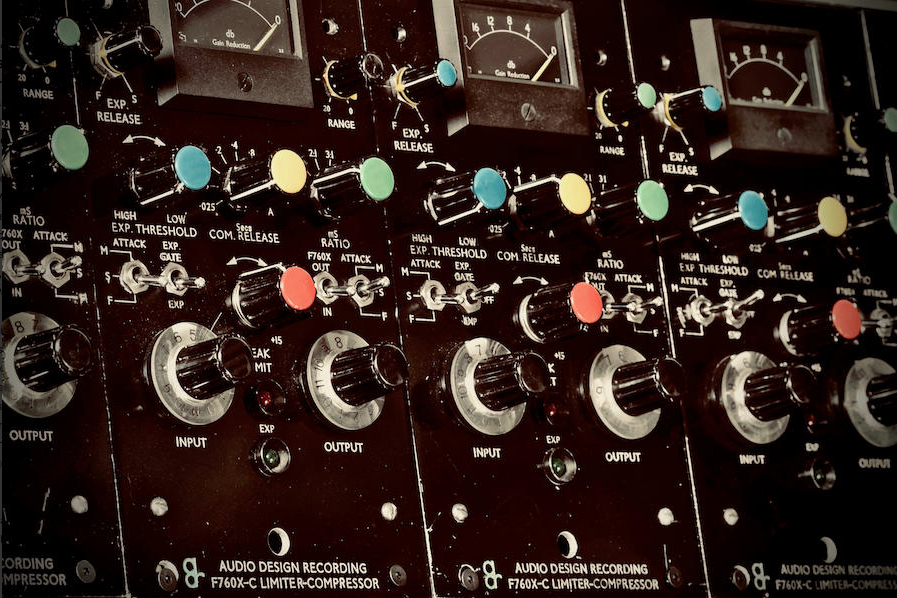
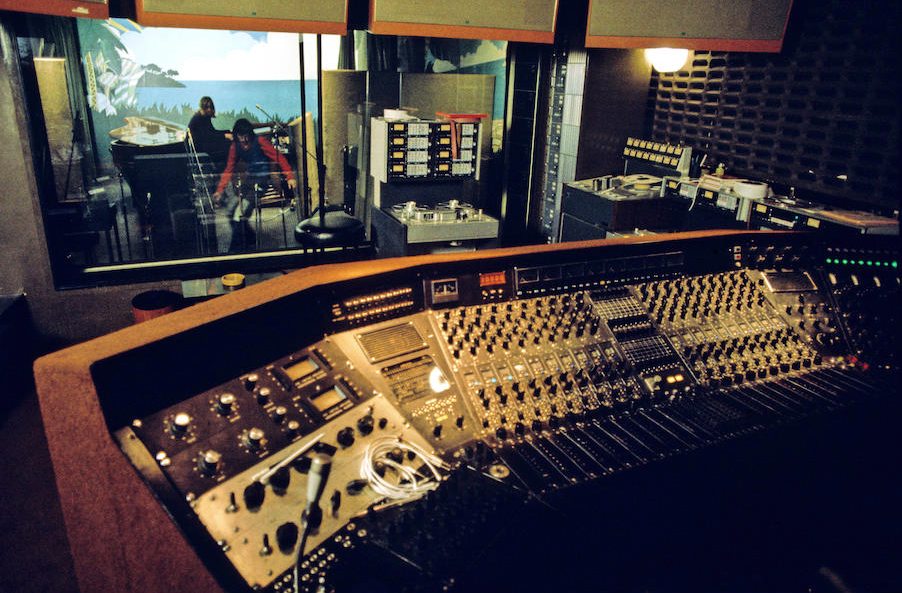
The amount of money one is willing to spend—should one have amounts of money—for a vintage recording console will vary greatly depending on who one is. The average person will see an enormous, heavy, wonky, wood and metal space hog with no apparent purpose. The musician, engineer, producer, or studio owner, on the other hand, will see a finely-tuned instrument, whose preamps, EQs, compressors, meters, and circuitry promise worlds of sonic warmth and depth.
In the case of one particular recording console, the so-called “Heliocentric Helios Console,” everyone will see a piece of music history, one that rightly belongs in a museum on public view. Such a fate is unlikely for this artifact, which goes on sale today at auction house Bonhams in London. It will end up in some well-heeled private hands, fetching a hefty sum for reasons far beyond its classic engineering.
“Songs and albums recorded on this bespoke console and its original parts rank among some of the most recognizable and best-loved pieces of music in existence, and have resulted in Grammys, Brit Awards and multiple number one spots,” says Bonham’s Claire Tole-Mole. “This console is a piece of Britain’s modern cultural history.” Actually an amalgam of two different historic consoles, combined in 1996, the Island Record section of the mixing desk was used by Led Zeppelin to record IV, the album featuring their most famous song, “Stairway to Heaven.”
This tantalizing bit is only a taste of the HeliosCentric console’s extensive provenance. Bob Marley recorded Catch a Fire and Burnin’ on the machine, Jimmy Cliff recorded “Many Rivers to Cross”; Eric Clapton’s “After Midnight” emerged from the console, as did songs and albums made by George Harrison, Steve Winwood, Mick Fleetwood, Steven Stills, Jimi Hendrix, Ronnie Wood, David Bowie, Free, The Rolling Stones, Sly Stone, Harry Nilsson, Cat Stevens, Jeff Beck, Mott the Hoople, Humble Pie, Paul Weller, Supergrass, Sia, KT Tunstall, Squeeze, the Pet Shop Boys, Keane, and Dido… among many more.
The number of top-notch artists who have used one or both parts of the console is astonishing, and its combining also provides devotees of rock history with a great story: the founder of Helios Electronics himself, Dick Swettenham, who formerly worked at Abbey Road, personally consulted on the construction of the new console, which was put together by Elvis Costello and Squeeze’s Chris Difford. You can read the machine’s full history at Bonhams, as great a story as you’re ever likely to hear about a piece of specialized studio equipment the size of a small car. The HelioCentric Console is expected to fetch six figures, but as Rolling Stone points out, the auction house recently sold the console used to record Pink Floyd’s Dark Side of the Moon for $1.8 million. What’s another few dozen classic albums and singles worth?
In the late 1950’s, pioneering free jazz bandleader Sun Ra played a gig at a Chicago mental hospital, booked there by his manager Alton Abraham, who had an interest in alternative medicine. The experiment in musical therapy worked wonders. One patient who had not moved or spoken in years reportedly got up, walked over to the piano, and yelled out, “you call that music!”
The anecdote illustrates just one experience among untold millions in which a person suffering from a debilitating neurological condition responds positively, even miraculously, it seems, to music.
As famed neurologist and writer Oliver Sacks puts it in his book Musicophilia, “musical perception, musical sensibility, musical emotion and musical memory can survive long after other forms of memory have disappeared.”
This medical fact makes musical therapy an ideal intervention for patients suffering from Alzheimer’s disease and dementia. In the short video above, Sacks describes his visits to patients in various old age homes. “Some of them are confused, some are agitated, some are lethargic, some have almost lost language,” he says, “but all of them, without exception, respond to music.”
We can see just such a response in the clip at the top, in which the barely responsive Henry Dryer, a 92-year-old nursing home resident with dementia, transforms when he hears music. “The philosopher Kant called music ‘the quickening art,’ and Henry’s being quickened,” says Sacks says of the dramatic change, “he’s being brought to life.” Suddenly lucid and happy, Henry looks up and says, “I’m crazy about music. Beautiful sounds.”
The clip comes from a documentary called Alive Inside, winner of a 2014 Sundance Audience Award (see the trailer above), a film that shows us several musical “quickenings” like Henry’s. “Before Dryer started using his iPod,” notes The Week, “he could only answer yes-or-no questions—and sometimes he sat silently and still for hours at a time.” Now, he sings, carries on conversations and can “even recall things from years ago.”
Sacks comments that “music imprints itself on the brain deeper than any other human experience,” evoking emotions in ways that nothing else can. A 2010 Boston University study showed that Alzheimer’s patients “learned more lyrics when they were set to music rather than just spoken.” Likewise, researchers at the University of Utah found music to be “an alternative route for communicating with patients.”
As senior author of the Utah study, Dr. Norman Foster, says, “language and visual memory pathways are damaged early as the disease progresses, but personalized music programs can activate the brain, especially for patients who are losing contact with their environment.” See the effects for yourself in this extraordinary film, and learn more about Sacks’ adventures with music and the brain in the 2007 discussion of Musicophilia, just above.
If you would like to support the mission of Open Culture, consider making a donation to our site. It’s hard to rely 100% on ads, and your contributions will help us continue providing the best free cultural and educational materials to learners everywhere. You can contribute through PayPal, Patreon, and Venmo (@openculture). Thanks!
What are you doing to celebrate the poet’s 188th birthday?
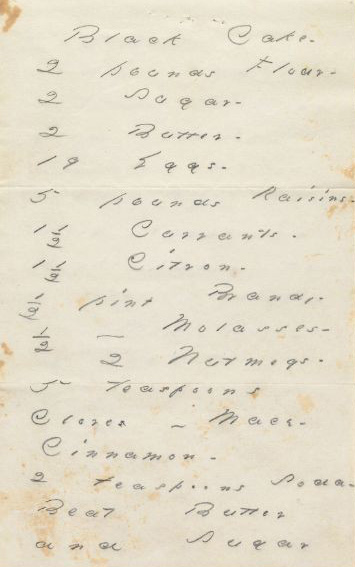
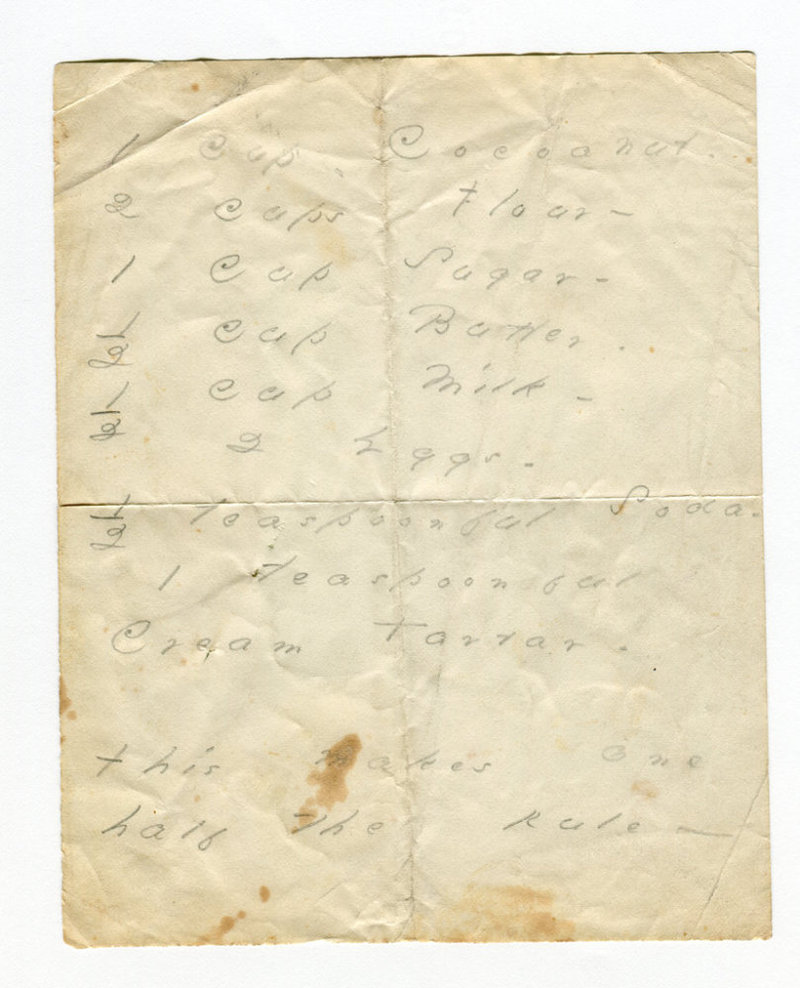
The Emily Dickinson Museum took advantage of the weekend to celebrate the occasion a couple of days early with Victorian crafts, readings, festive piano music, a display exploring the Dickinson family’s gift-giving tradition, and slices of coconut cake, baked from the birthday girl’s own recipe.
…whenever Dickinson saw children playing in her family gardens, “she headed for the pantry, filled a basket with cookies or slices of cake—often gingerbread—carried it upstairs to a window in the rear of the house (so their mothers wouldn’t see), and attached the basket to a rope to slowly lower it to the “storm-tossed, starving pirates” or the “lost, roaming circus performers” eagerly waiting below.
Truly, we owe it to her to return the favor.
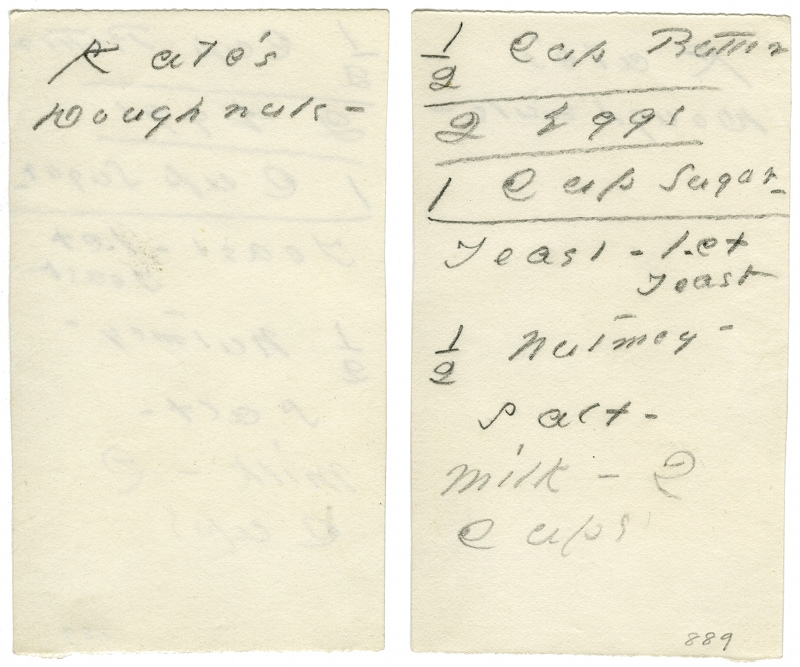
Shall we start with some Emily Dickinson doughnuts?
Like many experienced home cooks of the period, Dickinson’s instructions are a bit vague. She seems to have gotten the recipe from an acquaintance named Kate, jotting down measurements and ingredients, after which, she knew what to do.
If you’ve never worked with yeast before, you might want to proceed straight to her Black Cake recipe…
Or not. You may have 5 pounds of raisins on hand, but this is no spur-of-the-moment recipe.
As if those with December birthdays aren’t overshadowed enough by the tyranny of Christmas! Must their special day’s cake flavor be dictated by that big gorilla too? (For those who say yes, Rosa Lillo of Pemberley Cup and Cakes breaks the recipe down 21st-century style, adding a simple icing sugar glaze and an embossed floral pattern.)
Perhaps that famous coconut cake really is the best choice for observing Emily Dickinson Day.
See if you can detect a note of inspiration in that buttery flavor. As was her habit, Dickinson flipped the scrap of paper on which she’d listed the ingredients, and pencilled in the beginnings of a poem:
The Things that never can come back, are several —
Childhood — some forms of Hope — the Dead —
Though Joys — like Men — may sometimes make a Journey —
Predicting the state of the world in 2014 after a visit to the 1964 World’s Fair, Isaac Asimov wrote that “only unmanned ships will have landed on Mars, though a manned expedition will be in the works and in the 2014 Futurama will show a model of an elaborate Martian colony.” While we haven’t seen a Futurama show in some time (other than the one created by Matt Groening), he was certainly right about those unmanned ships, the latest of which, four years after the one about which he prophesied, has just picked up the first sounds ever recorded on the Red Planet. You can hear it, preferably with the use of a subwoofer or a pair of capably bass-reproducing headphones, in the video above.
“That’s the sound of winds blowing across NASA’s InSight lander on Mars, the first sounds recorded from the red planet,” writes the New York Times’ Kenneth Chang. “It’s all the more remarkable because InSight — which landed last week — does not have a microphone.”
Instead it picked up this rumble, which NASA describes as “caused by vibrations from the wind, estimated to be blowing between 10 to 15 mph (5 to 7 meters a second),” with its seismometer and air pressure sensor right there on Mars’ Elysium Planitia where it landed. “The winds were consistent with the direction of dust devil streaks in the landing area, which were observed from orbit.”
Science fiction enthusiasts will note that InSight’s recording of Martian wind, especially in the more easily audible pitched-up versions included in the video, sounds not unlike the way certain films and television shows have long imagined the sonic ambience of Mars. NASA didn’t launch InSight to test the theories implicitly presented by Hollywood sound designers — rather, to collect data on the formation of Mars and other rocky planets, as well as to check for the presence of liquid water — but they will equip the next Martian landers they send out in 2020 with proper microphones, and not just one but two of them. Among other scientific tasks, writes Big Think’s Stephen Johnson, those microphones will be equipped to “listen to what happens when the craft fires a laser at rocks on the surface.” Back here on Earth, one question looms above all others: which musician will be the first to sample all this?
Based in Seoul, Colin Marshall writes and broadcasts on cities, language, and culture. His projects include the book The Stateless City: a Walk through 21st-Century Los Angeles and the video series The City in Cinema. Follow him on Twitter at @colinmarshall or on Facebook.
The influence of J.R.R. Tolkien on metal is so wide and deep it has become almost cliché. There are countless Tolkien-themed songs, albums, band names, and an entire subgenre of Tolkien metal in which the fantasy master’s work has become “the foundation,” as Loudwire writes, that such bands “have built their persona upon.” After all, “the doomy hellscape of Mordor is a setting that rivals hell itself, making it the perfect fodder for lyrical brutality.”
Of course, there’s more to the fascination than doomy hellscape. Mysticism, magic, and mythology; “themes of friendship, adventure, betrayal, greed, and mortality.” The Hobbitand Lord of the Ringstrilogy fold literary richness and depth into a fully realized alternate reality full of swords and sorcery, goblins, orcs, and walking trees. What metalhead can resist? Even those who might want to have a hard time getting away from Tolkien.
He’s in the source code of the genre, in its classic rock chromosomes. The most prominent precursor of Tolkien metal, Led Zeppelin, really loved Tolkien. As Robert Plant put it in a later interview, “when I read those books, they kind of dissolved into me.” In the short video above from Polyphonic, we get a survey of the number of Tolkien references not only in Zeppelin, but in Genesis, Rush, and other proto-metal prog-rock bands.
One key feature of Tolkien that makes his work such great material for epic songs is that the novels are already full of epic songs (and poems, in Elvish and other languages). “Music plays an integral role in the very founding of Middle Earth.” Tolkien references crop up in Black Sabbath, Uriah Heep, and dozens of 70s progressive rock bands whose influence exceeds their fame.
One band the Polyphonic video doesn’t mention, The Beatles, aren’t often thought of as Tolkienesque, or as having much influence on heavy metal. But they were massive Tolkien fans and even approached the author in the 60s about making a Lord of the Rings film, with John as Gollum, Paul as Frodo, Ringo as Sam, and George as Gandalf. McCartney even approached Stanley Kubrick to direct.
Reportedly, when McCartney told Peter Jackson the story, the director replied, “It’s the songs I feel badly about. You guys could have banged out a few good tunes for this.” Tolkien himself didn’t think so and turned them down immediately. We don’t have any record of his thoughts on the 70s rock bands who enthusiastically adopted him, if he even knew of their existence. But we do know that he didn’t like The Beatles.
Does this mean he wouldn’t care for any of the classic rock and metal to whom he has inadvertently given so much? Probably. But one commenter in a discussion thread on this very question imagines another reaction Tolkien might have to hearing “Ramble On,” etc.: “I believe he raised a fist into the air and extended the index and little fingers in imitation of a horned creature, while vigorously, emphatically nodding his head back and forth, tossing his hair to and fro like a fishing boat caught in a raging storm.”
It’s the most unloved and derided of music genres, but the history of Smooth Jazz is not as bad as you might think. In another chapter of Vox’s excellent Earworm series (see Chapter 1 here and Chapter 2 here), Estelle Caswell explores the rise and fall of this modern day elevator music and asks if it’s worth reconsidering.
The undisputed star of smooth jazz has to be the “Songbird” himself, the frizzy-hair be-coifed Kenny G. (The only part of the video I took issue with is when one fan is quoted saying “he was the cool white boy.” Ma’am, all due respect, but Kenny G was never cool.) The man played alongside Clinton’s inauguration and once broke a world record by holding a note for 45 minutes. The smoothest of smooth jazz issued forth from his soprano sax and like it or not, his was a readily identifiable sound in a genre where nothing is supposed to stand out.
Earworm first traces the history of the form back to Grover Washington Jr., CTI Records, and other artists like Wes Montgomery. While Miles Davis was exploring difficult sonic textures, jazz headed into free improv territory, splitting from tonality in much the same split as befell classical music. What emerged was something closer to r’n’b and soul with improvised melodies over the top, or covers of popular pop hits from the ‘60s. This also could be seen as an evolution of jazz’s raiding of the Great American Songbook along with Broadway hits. If Coltrane could break “My Favorite Things” into cubism, surely there was a place for Wes Montgomery to riff over the groove of “Goin’ Out of My Head” by Little Anthony and the Imperials.
And from Montgomery we get to George Benson, silky smooth and undeniably funky. He even scat sang his solos at the same time as he played them on the guitar. His records went platinum which meant something in the days of rock’s ascendancy and jazz’s fall.
But as Earworm points out, Smooth Jazz only became a thing when marketing stepped in. As freeform stations were bought out by corporations, market research firms targeted audiences with focus groups. It was in one of those groups that a woman described the music like Benson and Bob James as “smooth jazz,” and the name stuck. It’s fitting that the west coast was the birthplace in 1987 of the first “smooth jazz” station, KTWV in Los Angeles, 94.7 THE WAVE, home of all sorts of laid-back grooves since the very beginning of jazz and pop. Other stations would soon follow suit, reaching a height of popularity in 1994, when Kenny G won Best Adult Contemporary Artist at the American Music Awards. It was “smooth sounds for a rough world,” as one adman called it, but what it really was comfort music for office drones.
Ironically, the forces that put smooth jazz at the top were responsible for its fall, as new technology to measure radio ratings found it couldn’t pick out the music from the background sounds. By 2008 and the financial implosion, smooth jazz radios stations were on the decline and the great recession killed it off.
It’s fitting because smooth jazz was the soundtrack to a dream of capitalism, all the rough edges burnished away, blinkered aspirations made into melody. But when the dream melted for everybody, smooth jazz evaporated. At least with soft rock you got songs and tales of heartache.
However, it would not surprise me to see Smooth Jazz make a nostalgic, ironic-but-not comeback. If Japan’s City Pop, which trades in similar smooth textures, can speak to the disaffected youth about a deep, affluent wish that never came true, Chuck Mangione can’t be too far behind. And it just feels. so. good.
P.S. If you have a hankerin’ to hear some smoothness right now, Vox has a Spotify playlist for what ails you.
Ted Mills is a freelance writer on the arts who currently hosts the artist interview-based FunkZone Podcast and is the producer of KCRW’s Curious Coast. You can also follow him on Twitter at @tedmills, read his other arts writing at tedmills.com and/or watch his films here.
Portman has done her homework with regard to breath pattern, pitch, and the refinement that strikes most 21st century ears as a bit stilted and strange. Most impressive to Singer is the way Portman transfers Kennedy’s oddly musical elongation of certain syllables to other words in the script. Tis no mere parrot job.
Jamie Foxx’s Oscar-winning turn as Ray Charles succeeds on copious research and his ability to inhabit Charles’ habitual smile. Obviously, the posture in which an individual holds their mouth has a lot to do with the sound of their voice, and Foxx was blessed with plenty of source material.
The 1982 epic Gandhi provided the versatile Ben Kingsley with the opportunity to showcase not one, but two, idiolects. The adult Gandhi underwent a dramatic and well documented evolution from the British accent he adopted as a young law student in London to a proudly Indian voice better suited to inspiring a nation to unify against its British colonizers.
It’s likely that many of us have never considered the speech-related building blocks Singer scrutinizes while analyzing 29 other performances for the WIRED video, above—epenthesis, tongue positions, relative degrees of emphatic muscularity, and retroflex consonants—but it’s easy to see how they play a part.
Singer invites you to expand his research and teaching library by recording yourself speaking extemporaneously and reading from two sample texts here. Pray that whoever plays you in the biopic gets it right.
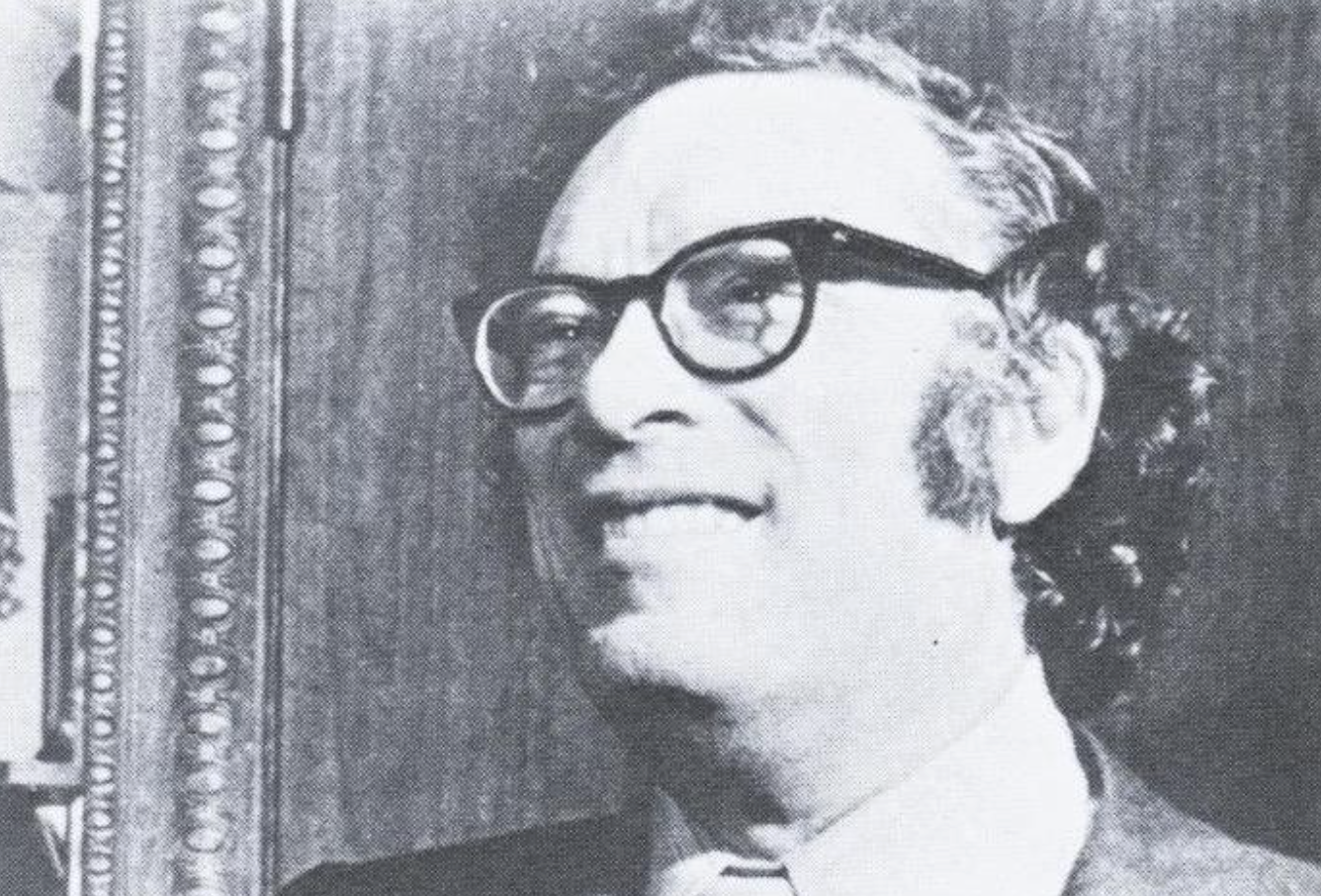
Isaac Asimov’s readers have long found something prophetic in his work, but where did Asimov himself look when he wanted to catch a glimpse of the future? In 1964 he found one at the New York World’s Fair, the vast exhibition dedicated to “Man’s Achievement on a Shrinking Globe in an Expanding Universe” that history now remembers as the most elaborate expression of the industrial and technological optimism of Space Age America. Despite the fanciful nature of some of the products on display, visitors first saw things there — computers, for instance — that would become essential in a matter of decades.
“What is to come, through the fair’s eyes at least, is wonderful,” Asimov writes in a piece on his experience at the fair for the New York Times. But it all makes him wonder: “What will life be like, say, in 2014 A.D., 50 years from now? What will the World’s Fair of 2014 be like?” His speculations begin with the notion that “men will continue to withdraw from nature in order to create an environment that will suit them better,” which they certainly have, though not so much through the use of “electroluminescent panels” that will make “ceilings and walls will glow softly, and in a variety of colors that will change at the touch of a push button.” Still, all the other screens near-constantly in use seem to provide all the glow we need for the moment.
“Gadgetry will continue to relieve mankind of tedious jobs,” Asimov predicts, and so it has, though our kitchens have yet to evolve to the point of preparing “ ‘automeals,’ heating water and converting it to coffee; toasting bread; frying, poaching or scrambling eggs, grilling bacon, and so on.” He hits closer to the mark when declaring that “robots will neither be common nor very good in 2014, but they will be in existence.” He notes that IBM’s exhibit at the World’s Fair had nothing about robots to show, but plenty about computers, “which are shown in all their amazing complexity, notably in the task of translating Russian into English. If machines are that smart today, what may not be in the works 50 years hence? It will be such computers, much miniaturized, that will serve as the ‘brains’ of robots.”
“The appliances of 2014 will have no electric cords,” Asimov writes, and in the case of our all-important mobile phones, that has turned out to be at least half-true. But we still lack the “long-lived batteries running on radioisotopes” produced by “fission-power plants which, by 2014, will be supplying well over half the power needs of humanity.” The real decade of the 2010s turned out to be more attached to the old ways, not least by cords and cables, than Asimov imagined. Even the United States of America hasn’t quite mastered the art of designing highways so that “long buses move on special central lanes” along them, let alone forms of ground travel that “take to the air a foot or two off the ground.”
But one advance in transportation Asimov describes will sound familiar to those of us living in the 2010s: “Much effort will be put into the designing of vehicles with ‘Robot-brains,’ vehicles that can be set for particular destinations and that will then proceed there without interference by the slow reflexes of a human driver.” Indeed, we hear about few reportedly imminent technologies these days as much as we hear about self-driving cars and their potential to get us where we’re going while we do other things, such as engage in communications that “will become sight-sound and you will see as well as hear the person you telephone,” on a screen used “not only to see the people you call but also for studying documents and photographs and reading passages from books.”
Conversations with the moon colonies, Asimov needlessly warns us, “will be a trifle uncomfortable” because of the 2.5‑second delay. But immediately thereafter comes the much more realistic prediction that “as for television, wall screens will have replaced the ordinary set.” Still, “all is not rosy” in the world of 2014, whose population will have swelled to 6,500,000,000 — or 7,298,453,033, as it happened. This has many implications for development, housing, and even agriculture, though the “mock-turkey” and “pseudosteak” eaten today has more to do with lifestyle than necessity. (“It won’t be bad at all,” Asimov adds, “if you can dig up those premium prices.”)
Finally, and perhaps most importantly, “the world of A.D. 2014 will have few routine jobs that cannot be done better by some machine than by any human being. Mankind will therefore have become largely a race of machine tenders.” Asimov foresees the need for a change in education to accommodate that, one hinted at even in General Electric’s exhibit in 1964, which “consists of a school of the future in which such present realities as closed-circuit TV and programmed tapes aid the teaching process.” His envisioned high-school curriculum would have students master “the fundamentals of computer technology” and get them “trained to perfection in the use of the computer language.”
But even with all these developments, “mankind will suffer badly from the disease of boredom, a disease spreading more widely each year and growing in intensity.” The “serious mental, emotional and sociological consequences” of that will make psychiatry an important medical specialty, and “the lucky few who can be involved in creative work of any sort will be the true elite of mankind, for they alone will do more than serve a machine.” Though Asimov may have been surprised by what we’ve come up with in the quarter-century since his death, as well as what we haven’t come up with, he would surely have understood the sorts of anxieties that now beset us in the future-turned-present in which we live. But even given all the ways in which his predictions in 1964 have proven more or less correct, he did miss one big thing: there was no World’s Fair in 2014.
Based in Seoul, Colin Marshall writes and broadcasts on cities, language, and culture. His projects include the book The Stateless City: a Walk through 21st-Century Los Angeles and the video series The City in Cinema. Follow him on Twitter at @colinmarshall or on Facebook.
If you’re reading this, there’s a good chance you’ve seen the German Expressionist classic The Cabinet of Dr. Caligari. As soon as Robert Weine’s 1920 film came out, it was described as essential. Or as one reviewer wrote, “so-called cultured people who fail to see it are neglecting their education.” There are dozens more German films to which that sentence might apply. Films from the country’s explosive Weimar moment—which also produced Metropolis, Nosferatu, M, Faust, etc.—to those of the New German Cinema movement of the 1960s and 70s, which gave the world such enfants terribles as Wim Wenders, Margarethe von Trotta, Werner Herzog, and Rainer Maria Fassbinder. The furiously prolific Fassbinder died in 1982 at 37, but the former three directors have continued to make internationally-known films into the 21st century.
You may have seen Von Trotta’s Hannah Arendt (trailer above), which won multiple awards in 2012. Or perhaps you caught Caroline Link’s WWII-themed Nowhere in Africa, which won an Oscar that same year. The Nazi era may have laid waste to the German film industry—whose biggest talents ended up exiled in Hollywood—and the postwar years are often thought of as a “lost decade” (wrongly, it seems). But on the whole, German filmmakers have produced some of the most visually distinctive, narratively thrilling, and emotionally raw films in world cinema since its beginnings.
Germany’s cultural institute, the Goethe Institut, is honoring the legacy of German film, from its classic to its contemporary periods, with 48 films free to stream on Kanopy. (The films include subtitles in English.) The initiative is just one part of Wunderbar, a celebration that includes “Goethe Pop Ups in the US,” with film screenings, festivals, appearances by German filmmakers, and an online series of critical articles by German and American experts.
If you haven’t seen Dr. Caligari, Nosferatu, Metropolis, or Faust, you can stream them now at the Goethe Institut’s Kanopy. You can also see Hannah Arendt, Nowhere in Africa, and other acclaimed contemporary films. Herzog’s 1971 Aguirre, the Wrath of God is in the collection, as is Frank Beyer’s far more obscure Trace of Stones from 1966, a film banned for 25 years by East German officials after its release.
There are documentaries on artists like Joseph Beuys and Gerhard Richter, on Marlene Dietrich and, naturally, German beer. Films by directors Anne Birkenstock, Christian Petzold, and Tom Tykwer. Berlin International Film Festival nominee Beloved Sisters appears. There are films that “so-called cultured people” are expected to have seen, and many more unlikely to show up on the syllabus of a survey course.
Perhaps only one of these movies has been specifically credited with grimly predicting the future—as Siegfried Kracauer alleged in his book Caligari to Hitler. But all of these are films that deserve a wide audience outside their national borders. To view the Goethe Institut’s selection of 48 films, you’ll need to sign up for a free Kanopy account, which you can do with your Google or Facebook logins or with an email address. Then simply set your home library as “Goethe-Institut” and you can stream any or all of the films in the collection, from 1920’s Caligari to 2017’s Axolotl Overkill, on IOS and Android devices, Apple TV, Roku, Chromecast, or your computer.
In a 1980 appearance on David Letterman, a deadpan Andy Kaufman tells a sob story about his nonexistent family leaving him. He then “admonishes the audience for laughing,” writes William Hughes at the AV Club, and panhandles for their spare change. “The genius of the bit, as always, is that Kaufman never blinks. Even as he’s led away by the show’s staff, there’s nothing about his unemotional entreaties that suggests that what he’s doing isn’t anything but the sober-cold truth.”
Rather than punching up or down, he punched out, openly exploiting our trust and abusing our patience. Kaufman invited us to mock him, only to reroute our responses into empathy, anger, confusion, or boredom. “Many crowds had streamed into comedy clubs only to endure Kaufman napping in a sleeping bag,” writes Rossen, “or reading earnestly from The Great Gatsby, threatening to start all over again if they interrupted.” Once given a choice between him reading or playing a record, a nightclub chose the record. “It was the sound of Kaufman reading.”
Just what is the proper response to this? The emotional misdirection works so well because we know we should react a certain way, for example, to a broken man in great distress—whether he’s asking for spare change or looking for all the world like a kidnap victim. In his Gatsby reading, Kaufman pulls a different lever—drawing on our innate sense of decorum during a literary event, one conducted by a vaguely European-sounding man in a tuxedo, no less. He incites his audience by making them laugh at a situation they would, in its proper context, try to take seriously.
In the clip of Kaufman reading Gatsby at the top, he begins with a couple ruses and feints: playing a snippet of a record that makes us think we might be in for a Mighty Mouse-like routine, introducing himself as an actor who plays a screwball American comic named Andy Kaufman. Once he launches into Gatsby, however, and it becomes clear he isn’t going to stop, that the reading is the act, the audience becomes incensed, expressing a palpable sense of betrayal.
You came for comedy, he tells them in his Letterman and Fridays bits; I’m going to give you humanity. You came for comedy, he announces in the Gatsby reading; I’m going to give you culture, whether you want it or not. But it’s not me who’s misbehaving, he says (in diabolical versions of “stop hitting yourself”), it’s you. In the clip above from Man on the Moon, Jim Carrey draws out the passive aggressive impulses inherent in these maneuvers, showing Andy breaking out Gatsby as an act of retaliation against a crowd who demands that he entertain them on their terms.
We're hoping to rely on loyal readers, rather than erratic ads. Please click the Donate button and support Open Culture. You can use Paypal, Venmo, Patreon, even Crypto! We thank you!
Open Culture scours the web for the best educational media. We find the free courses and audio books you need, the language lessons & educational videos you want, and plenty of enlightenment in between.