The 80s saw a number of hits by mostly UK synth-pop and new wave bands with prominent gay members (whether their fans knew it or not) like Culture Club, Soft Cell, Frankie Goes to Hollywood, and Wham!. One of the most impressively talented singers on this burgeoning 80s dance scene was Scottish musician Jimmy Somerville who defined the tremulous falsetto disco sound of bands like Bronski Beat and the Communards. Somerville’s first hit, 1984’s “Smalltown Boy,” was something of an early “It Gets Better” message coupled with a hard-edged dance-pop sound and a very autobiographical video (below). The song, writes Allmusic, dealt openly with Somerville’s sexuality, “a recurring theme [in his work] that met with surprisingly little commercial resistance.”
Today, Somerville lives in Berlin with his dog, and he’s still got that tremendous set of pipes. A Berlin street musician found this out recently while busking “Smalltown Boy” on an acoustic guitar, and bystanders happened to catch it on video (at top). As the young street performer hits the chorus, up walks Somerville to casually join in. The singer starts over and they finish the song in harmony. The more cynical corners of the internet swear the whole thing’s staged, perhaps for a Somerville comeback, but I like to think it’s genuine serendipity, especially at the end as the German busker suddenly has a flash of recognition: “it’s you?” he asks. “It’s me,” says Somerville, “it’s a hit.”
Dr. Martin Luther King, Jr.’s death could not have been more devastating to African American communities across the country hoping to see the civil rights leader live to build on the successes of the movement. Despite King’s painfully prophetic “I’ve Been to the Mountaintop” speech the day before his assassination in Memphis Tennessee, most people hoped to see him finish the work he’d begun. Those hopes were dashed on April, 4 1968. After King’s death, embittered and embattled minorities in cities North and South erupted in rioting. Boston—a city of de facto segregation to rival Birmingham’s—seemed poised to blow up as well in the Spring of ’68, its “race relations… already on a short fuse.” As public radio program Weekend America describes the conditions:
The tension had been escalating in the mid-60s as the city began to desegregate its public schools. The mayoral race in 1967 pitted a liberal reformer, Kevin White, against Louise Day Hicks, an opponent of desegregation. Hicks ran under the evasive slogan “You know where I stand.” White won the race by less than 12,000 votes.
In this starkly divided city, James Brown went onstage to perform the day after King’s death, and it seems, whether that impression is historically accurate or not, that Brown single-handedly quelled Boston’s unrest before it spilled over into rioting.
The city’s politicians may have had something to do with it as well. Before Brown took the microphone, the narrowly-elected Mayor White addressed the restless crowd (top), asking them to pledge that “no matter what any other community might do, here in Boston, we will honor Dr. King’s legacy in peace.” After Councilor Tom Atkin’s lengthy introduction and the mayor’s short speech, the audience seems receptive, if eager to get the show on.
The archival footage was shot by Boston’s WGBH, who broadcast Brown’s performance that night. (The clip comes from a VH1 “rockumentary” called, fittingly, “The Night James Brown Saved Boston.”) Not long after the band kicked in, the scene became chaotic after a Boston police officer shoved a young man off the stage. Brown intervened, calming the cops and the crowd. His drummer John Starks remembers it this way: “It was almost at a point where something bad was going to happen. And he said [to the police] ‘Let me talk to them.’ He had that power.” In the clip above, watch concertgoers and other bandmembers describe their impressions of Brown’s “power” to reach the crowd.
Brown’s calming effect went beyond this particular gig. See him in the footage above address an audience in Washington, D.C. two days after King’s death. “Education is the answer,” he says, and sets up his own exceptional boostrapping rise from poverty as a model to emulate (“today, I own that radio station”). And WFMU’s Beware of the Blog brings us the audio below, from the year before King’s death—a time still fraught with sporadic riots and nationwide unrest against a system increasingly perceived as oppressive, corrupt, and beyond reform.
On the record, which was “probably distributed to radio stations only,” Brown makes an impassioned plea for “black people, poor people” to “organize” against their conditions, rather than riot. While the message from “Soul Brother Number One”—a title he accepts with humility above—failed to douse the flames in cities like Washington, DC, Detroit, Chicago, and Louisville, KY, and over 100 others after King’s murder, in Boston, the audience at his concert and the people watching at home on television seemed to heed his calls for nonviolence. “Boston,” writes Weekend America, “remained quiet.”
Sure, you enjoyed hearing the way Ancient Greek music actually sounded last week, but what about the way Ancient Greek poetry actually sounded? We can find fewer finer or more recognizable examples of the stuff than Homer’s Iliad, and above you can hear a reading of a section of the Iliad (Book 23, Lines 62–107 ) in the original Ancient Greek language.
It comes from what may strike you as an unlikely source: Stanley Lombardo, a University of Kansas classicist (and also, as it happens, a Zen Buddhist) best known for his translations of the Iliad, the Odyssey, and Virgil’s Aeneid into contemporary-sounding English. “Sounding less like aristocratic warriors than like American G.I.‘s, perhaps,” writes classics-steeped critic Daniel Mendelsohn in the New York Times review of Lombardo’s Iliad, “his epic heroes ‘badmouth’ and ‘beat the daylights out of one another and witheringly call one another ‘trash’ and ‘pansy.’ ”
But Lombardo knows thoroughly the material he adapts. Even those of us who never learned Ancient Greek — if I may speak for this presumably large group of readers — can get a feel for Homer’s tale of the Trojan War and the soldiers’ long return home by listening to the professor’s delivery alone. Just above, you can see him give a reading from his English translation. It won’t surprise you to learn that he also reads the audio books. “We listened spellbound to the incantatory waves of Professor Stanley Lombardo’s voice telling the stories of Odysseus and his Odyssey and then those of the Trojan heroes of The Illiad,” writes Andrei Codrescu in an article on them for the Villager. “Professor Lombardo translated anew the immortal epics and immersed himself so deeply in their world his voice sounded as believable as the hills and valleys we crossed. His voice knows the tales and their enduring charms, and sounds for all the world like an ancient bard’s. Homer himself couldn’t have done better. In English no less, millennia later.”
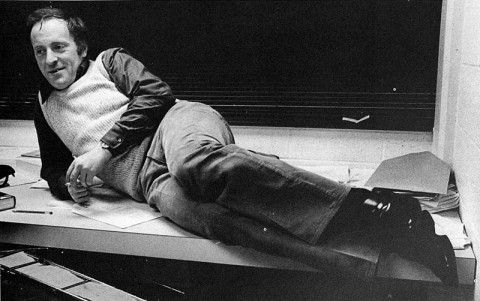
Although Joseph Brodsky was one of the most celebrated Soviet dissidents of the 20th century, the Nobel Prize-winning poet had been unerringly hounded by the repressive Soviet government, which had labeled his poetry as “pornographic and anti-Soviet.” Refusing to abandon his writing, Brodsky was repeatedly brought to court, and once sentenced to 18 months of labor in the Arctic region of Arkhangelsk. During one of his courtroom appearances, the young poet displayed an admirable level of testicular fortitude when the judge asked him, “Who has recognized you as a poet? Who has enrolled you in the ranks of poets?” Brodsky, defiant, replied “No one. Who enrolled me in the ranks of the human race?”
Brodsky’s remarks are far from the galvanizing dose of inspiration that many commencement addresses impart, and certainly not what Michigan graduates were expecting. Rather than uplift, the poet’s words soberly ground the audience; instead of wrapping them in a warm self-assuredness, the life tips are jarring, like an ice bath. Brodsky’s address is a mix of wry humour, acknowledgement of our absurdist existential dilemma, and bold, honest compassion. Reading Brodsky’s advice, one can’t help but feel that the poet valued his flawed humanity even more than his art; likely, they were inseparable.
Here’s a boiled-down version of the poet’s remarks:
1) “Treat your vocabulary the way you would your checking account.” Expression often lags behind experience, and one should learn to articulate what would otherwise get pent up psychologically. Learn to express yourself. Get a dictionary.
2) “Parents are too close a target… The range is such that you can’t miss.” Be generous with your family. Even if your convictions clash with theirs, don’t reject them—your skepticism of your infallibility can only benefit you. It will also save you a good deal of grief when they are gone.
3) “You ought to rely on your own home cooking.” Do not expect society to arrange itself to your benefit—there are too many people whose desires conflict for that to happen. Learn to rely on yourself, and help those who cannot.
4) “Try to not to stand out.” Do not covet money or fame for their own sake. It is best to be modest. There is comfort joining the ranks of those who follow their own discreet paths.
5) “A paralyzed will is no dainty for angels.” Do not indulge in victimhood. By blaming others, you undermine your determination to change your circumstances. When life confronts you with hardships, remember that they are no less an intrinsic part of existence. If you must struggle, do so with dignity.
6) “To be social is to be forgiving.” Do not let those who have hurt you live on in your complaints. Forget them.
The full text—irrevocably more pithy and eloquent—may be found here.
If you want to get familiar with the material covered in Hadfield’s book, I’d encourage you to listen to his recent interview with Terry Gross on Fresh Air.
The site specific opera Invisible Cities is up and running at LA’s historic Union Station. Location aside, something in this original work demands that I subject it to the New York Magazine Approval Matrix I carry around in my mind. It’s a snarky, quadfurcated rating system for the latest trends and happenings.
The phrase “based on an Italo Calvino novel” should guarantee it a spot in the Highbrow range.
Opera purists might consider the fact that ticket holders must rely on wireless headphones to get the full sound mix as reason enough to send this innovative work to the Despicable end of a “deliberately oversimplified guide to who falls where on our taste hierarchies.” A philistine myself, I think matching wandering singers to an invisible live orchestra (they’re sequestered in a nearby room) sounds Brilliant. It’s as if a silent disco and a flash mob mated, giving birth to a baby with impervious street cred and an incredible set of pipes. Here, have a listen…
Unlike the typical Improv Everywhere lark, the audience here is in on this gag. Though innocent passersby may wonder why various individuals are mooning around the terminal singing, Invisible Cities is a ticketed performance. Indeed, its popularity is such that the producers have needed to add extra free shows. Approval Matrix suggests it’s time to hop a train to LA.
Ayun Halliday dreams that her opera-hating 13-year-old son will one day consent to attend another free dress rehearsal at the Met, so that she can chaperone. Follow her @AyunHalliday
Yes, Halloween is behind us, and some people may desire a break from the Lou Reed tributes in order to mourn him silently. Fair enough. But indulge us once more, because Reed’s best music and the dark imaginative work of Edgar Allan Poe are always relevant, and when they come together, it’s reason to celebrate. And come together they did ten years ago with the recording of Reed’s concept album The Raven, a selection of musical and dramatic pieces put together by Reed. The album notably features actors such as Willem Dafoe, Steve Buscemi, Elizabeth Ashley, and Amanda Plummer and guest artists like David Bowie, Kate and Anna McGarrigle, and Ornette Coleman.
The collaboration, if you can call it such, between Reed and Poe makes perfect sense. As Mark Deming at Allmusic writes, “it’s no wonder why Lou Reed regards Poe as a kindred spirit.” Reed said as much in the liner notes: “I have reread and rewritten Poe to ask the same questions again. Who am I? Why am I drawn to do what I should not? … Why do we love what we cannot have? Why do we have a passion for exactly the wrong thing?” Despite its collection of seemingly mismatched parts, Reed’s The Raven worked, Deming writes, and Reed hadn’t “sounded this committed and engaged” in “over a decade” (Pitchfork had a decidedly different take on the album).
The Raven was originally a commissioned work for a stage production called POEtry, an adaptation of Poe’s work by Robert Wilson (who had previously worked with Tom Waits on The Black Rider). The title recording of Reed’s adapted “The Raven” (top) is actually read by a creepy-voiced Willem Dafoe. Ten years later, we have Reed himself reading his version of “The Raven” (above) at Cannes just this past June. He looks and sounds rather frail, but he’s mentally in top form. He breaks into his own reading to point out the fact that his version of the poem uses Poe’s “exact rhythm.” “If you don’t believe me,” he says, “you can check it line-by-line.” And so you can. Read Reed’s “The Raven” against Poe’s original. Of his modernization, Reed said:
The language is difficult, because there are a lot of arcane words that probably no one knew that they meant, even at the time – architectural terms and whatnot. So I spent a lot of time with the dictionary, to make it more contemporary, easy to read. Or easier, I should say.
The Reed/Poe/Robert Wilson collaboration also produced a 2011 book, also called The Raven and illustrated by artist Lorenzo Mattotti.
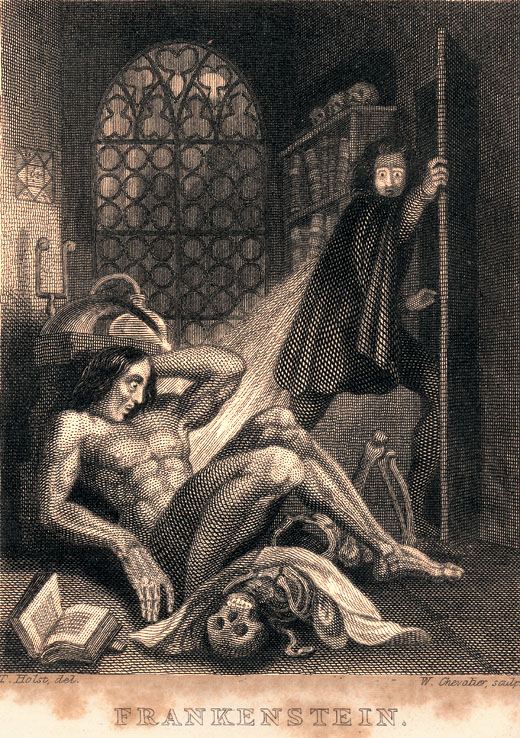
The story behind the writing of Frankenstein is famous. In 1816, Mary Shelley and Percy Bysshe Shelley, summering near Lake Geneva in Switzerland, were challenged by Lord Byron to take part in a competition to write a frightening tale. Mary, only 18 years old, later had a waking dream of sorts where she imagined the premise of her book:
When I placed my head on my pillow, I did not sleep, nor could I be said to think. My imagination, unbidden, possessed and guided me, gifting the successive images that arose in my mind with a vividness far beyond the usual bounds of reverie. I saw — with shut eyes, but acute mental vision, — I saw the pale student of unhallowed arts kneeling beside the thing he had put together. I saw the hideous phantasm of a man stretched out, and then, on the working of some powerful engine, show signs of life, and stir with an uneasy, half vital motion.
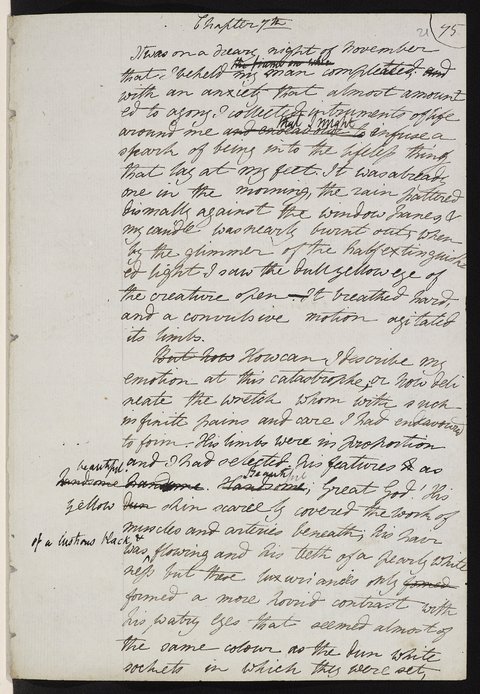
This became the kernel of Frankenstein; or, The Modern Prometheus, the novel first published in London in 1818, with only 500 copies put in circulation. In writing Frankenstein, Shelley used a series of notebooks that “can now be viewed in high quality, resizable page images.” Each hand-written page comes accompanied by a typed transcript. Find them all here.
Down the line, the Shelley-Godwin Archive “will provide the digitized manuscripts of Percy Bysshe Shelley, Mary Wollstonecraft Shelley, William Godwin, and Mary Wollstonecraft, bringing together online for the first time ever the widely dispersed handwritten legacy of this uniquely gifted family of writers.” So stay tuned for more.
Note: The Archive recommends using recent versions of Google’s Chrome browser or the latest version of Safari or Mozilla Firefox when viewing the manuscripts.
Six students from De Montfort University have created a stellar 3D representation of 17th century London, as it existed before The Great Fire of 1666. The three-minute video provides a realistic animation of Tudor London, and particularly a section called Pudding Lane where the fire started. As Londonist notes, “Although most of the buildings are conjectural, the students used a realistic street pattern [taken from historical maps] and even included the hanging signs of genuine inns and businesses” mentioned in diaries from the period.
Commenting on the video, one judge from the esteemed British Library had this to say:
Some of these vistas would not look at all out of place as special effects in a Hollywood studio production. The haze effect lying over the city is brilliant, and great attention has been given to key features of London Bridge, the wooden structure of Queenshithe on the river, even the glittering window casements. I’m really pleased that the Pudding Lane team was able to repurpose some of the maps from the British Library’s amazing map collection – a storehouse of virtual worlds – in such a considered way.
Follow Open Culture on Facebook and Twitter and share intelligent media with your friends. Or better yet, sign up for our daily email and get a daily dose of Open Culture in your inbox. And if you want to make sure that our posts definitely appear in your Facebook newsfeed, just follow these simple steps.
Back in college, I took a fall-quarter introductory music course. We happened to have class on Halloween (an event quite seriously taken around the University of California, Santa Barbara, in case you didn’t know), and the professor held an especially memorable lecture that day. He had us study “Der Erlkönig,” music by Franz Schubert, words by none other than Johann Wolfgang von Goethe. While I will not claim that this tale of the haunting of a moribund child, even with its driving score, genuinely frightened me, I will say that it put the fear into me in a more existential way, a blow which only a simple story can land effectively.
“Who rides, so late, through night and wind?” asks Goethe’s poem, translated from the German. “It is the father with his child. He has the boy well in his arm. He holds him safely, he keeps him warm.” The man feels concern for his ailing son, but the boy has troubles of his own: “Father, do you not see the Erlking?” The father explains his son’s vision of this menacingly regal figure away as the fog, as the wind, as the trees. But the child insists: “My father, my father, he’s grabbing me now! The Erlking has done me harm!” By the time their horse reaches home, indeed, the Erlking — or some obscure agent of mortality — has him. Hear this fable sung, and watch it vividly animated with sand on glass (no doubt a painstaking process) by Ben Zelkowicz above. Halloween itself may have just passed, but “Der Erlkönig” remains timelessly haunting.
We’ll add “Der Erlkönig” to the Animation section of our collection of Free Movies Online.
There was lots of money to be made at the end of the 19th century and Dudley Docker made his share of it. He was what they called a “baron of industry” at a time when manufacturing was exploding in Britain. Docker made his fortune in paint, motorcycles, arms manufacturing, railways, and banking. He was an industrial booster, acting as one of the three major financiers behind Ernest Shackleton’s Trans-Antarctic Expedition. In 1916, he founded a major association of British industry to promote business interests.
A charming result of that work is a recently digitized film made in 1925 to demonstrate the work inside Oxford University Press. For book arts lovers, this is a fascinating peek into the early days of mechanized printing.
Above we watch a worker use a mould to make lead type, hundreds of them, by pouring the molten lead in at the top, making a quick upward motion and releasing the quickly dried type. A separate team of workers then sets up monotype composing machines, and we watch as men demonstrate their use.
The film follows the process of printing a run of Oxford English Dictionaries. Books were bound by gender-divided teams: A room of women labored in the “girls” bindery section while men bound books in their own separate room. We see the sewing, cutting and the fascinating process of gilding the page edges.
In our digital age, the old analog processes take on a new, deeper significance. This film presents a terrific 18-minute tutorial on one of the greatest achievements of the modern age: printing mass quantities of bound books.
We're hoping to rely on loyal readers, rather than erratic ads. Please click the Donate button and support Open Culture. You can use Paypal, Venmo, Patreon, even Crypto! We thank you!
Open Culture scours the web for the best educational media. We find the free courses and audio books you need, the language lessons & educational videos you want, and plenty of enlightenment in between.