How can you present scientific ideas to an audience of all ages — scientists and non-scientists alike — so that these ideas will stick in people’s minds? Since 2012, BBC Two has been trying to answer this question with its series “Dara Ó Briain’s Science Club.” Irish stand-up comedian and TV presenter Dara Ó Briain invites experts to his show to tackle the biggest concepts in science in a way that is understandable to non-experts as well. Film clips and animations are used to visualize the ideas and concepts dealt with in the show.
In 2012, Åsa Lucander, a London-based animator originally from Finland, was approached by the BBC with the task of creating an animation about the history of physics. The result is as entertaining as it is instructive. The clip deals with the discoveries of four major scientists and the impact of their findings: Galileo Galilei, Isaac Newton, James Clerk Maxwell and Albert Einstein.
Physclips — Physics animations and film clips by the University of New South Wales, Sydney
By profession, Matthias Rascher teaches English and History at a High School in northern Bavaria, Germany. In his free time he scours the web for good links and posts the best finds on Twitter.
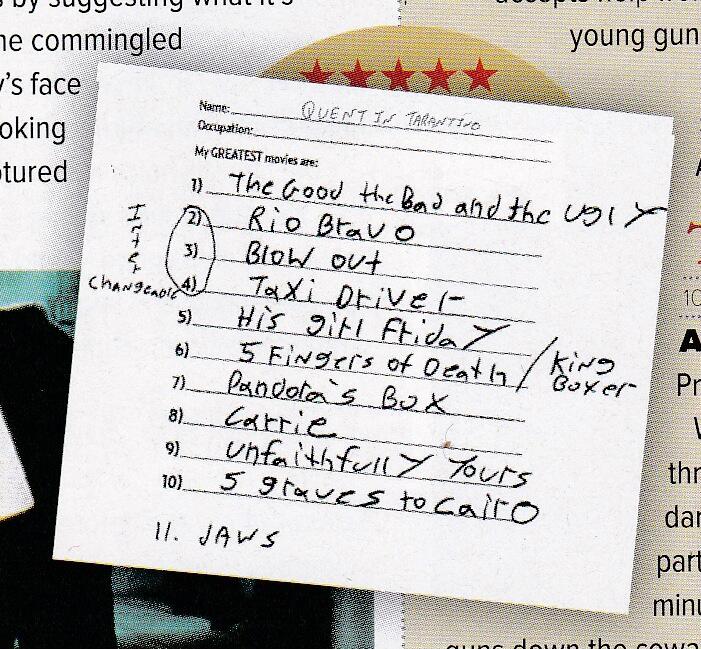
Earlier this week, we featured a list of Quentin Tarantino’s 12 Favorite Films of All Time, given in response to Sight & Sound’s 2012 poll. This morning, one of our friendly followers on Twitter (@LoSceicco1976) made us aware of another list — a handwritten list that Tarantino apparently submitted in 2008, to Empire Magazine. Do the two lists have some commonalities? Yup, Taxi Driver, His Girl Friday, The Good, the Bad, and the Ugly, etc. But this handwritten list also includes a number of new titles — take for example, Chang-hwa Jeong’s Five Fingers of Death, Brian De Palma’s Blow Out, and Howard Hawks’ Rio Bravo, starring John Wayne. (See our collection of 21 Free John Wayne Westerns here.) And, sorry to say, The Bad News Bears didn’t make the cut.
It just goes to show, if you ask directors to jot down their favorite movies, the list can change from day to day, and year to year. Speaking of, you might also want to see a video where Tarantino Lists His Favorite Films Since 1992. Yet more new films to save for a rainy day.
If you would like to support the mission of Open Culture, consider making a donation to our site. It’s hard to rely 100% on ads, and your contributions will help us continue providing the best free cultural and educational materials to learners everywhere. You can contribute through PayPal, Patreon, and Venmo (@openculture). Thanks!
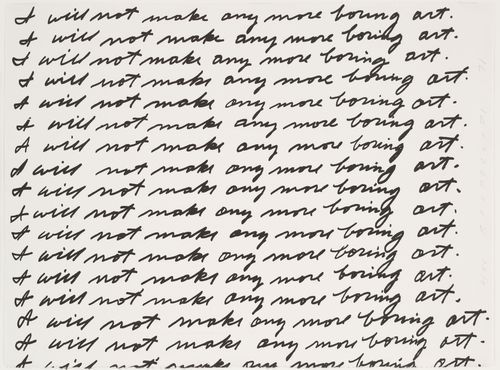
If you’re on the fence about the merits of Conceptual Art, you may be swayed to learn the history of the piece documented above. The year before its creation, John Baldessari incinerated his oeuvre, an act he referred to as The Cremation Project. Shortly thereafter, he responded to Nova Scotia College of Art and Design’s invitation to exhibit with a letter instructing students to be his surrogates in a punishment piece:
The piece is this, from floor to ceiling should be written by one or more people, one sentence under another, the following statement: I will not make any more bad art. At least one column of the sentence should be done floor to ceiling before the exhibit opens and the writing of the sentence should continue everyday, if possible, for the length of the exhibit. I would appreciate it if you could tell me how many times the sentence has been written after the exhibit closes. It should be hand written, clearly written with correct spelling….
Once the students had punished themselves to his specifications, the artist permitted the school to publish a fundraising lithograph, modeled on his handwriting.
It’s not a stretch to imagine that writing this sentence over and over could have changed more than a few participants’ lives, or at least rerouted the path their careers would take. What will happen if you take 13 minutes—the length of the video above—to try it yourself.
Many film fans wish we could have a director like Ingmar Bergman working today. Just as many television fans surely wish we could have a talk show host like Dick Cavett working today. But both Bergman, who died in 2007, and Cavett, who still writes but seems to have put televisual pursuits behind him, produced substantial bodies of work. And, thanks to the internet, you can experience their films and broadcasts even more easily than when they first appeared. Take, for instance, this 1971 Dick Cavett Show episode featuring the curious and dry-witted conversationalist’s interview with the Swedish maker of such pictures still viewed widely and enthusiastically as The Seventh Seal, The Virgin Spring, Persona, and Fanny and Alexander. No enthusiast of serious conversation about film would want to miss the hour when these two men’s worlds collide. But we get an insight into more than these men’s worlds: partway through the episode, and to the delight of Bergman’s fans, actress Bibi Andersson turns up.
Eventually to star in more than ten Bergman pictures, including Persona, The Magician, and The Passion of Anna, Andersson appears ostensibly in promotion of her and Bergman’s then-most recent collaboration, The Touch. “Does he understand women?” Cavett suddenly asks Andersson, who replies with every interviewer’s bête noire, the one-word answer: “Yes.” Bergman then explains his conviction that women possess greater natural acting ability and comfort with the craft than men do. “Acting,” he says, “is a very special woman’s profession.” The full conversation reveals more about the filmmaker’s surprising feminism, as well as his childhood fear of movies, his lifelong fear of drugs, his views on punctuality, his on-set temper, his struggles with restless leg syndrome, the pride he takes in his soap commercials, his homeland’s supposed preponderance of beautiful women, and how many more films he intends to make. “Five, maybe six,” the director guesses. “Make it six, could you?” asks the host. He ended up making twelve.
It seems to me that Georgia O’Keeffe tends to get pegged as a regional Southwestern painter or as the woman who painted close-ups of flowers that look suspiciously like female anatomy, or both—a casualty of marketing for the dorm-room set. As in many a stereotype, there’s some truth in both over-simplifications, but O’Keeffe was, of course, much more, as she was more than the passionate younger wife and frequent subject of Alfred Stieglitz, though that is also a true and lovely story. Like any artist—like any human being, perhaps—Georgia O’Keeffe does not reduce into a single portrait.
But amid all the simplistic popularizations of O’Keeffe, it’s nice to encounter her afresh as just herself, speaking directly to the camera about her life and work. In the documentary clip at the top, we’re treated to several minutes of vintage footage of O’Keeffe in her New Mexico surroundings, intercut with interviews with the much older artist reminiscing. The interview was shot in 1977, when O’Keeffe was nearly 90, and for some reason, this image of her—as an aged, white-haired woman—also seems inscribed in the popular imagination. Perhaps this is because she only became famous somewhat later in life, and her fame only increased as she grew older.
In the clip above, see O’Keeffe discuss another rarely-discussed aspect of her career: her paintings of New York City, where she lived on and off for over two decades and where she fell in love with Stieglitz and joined his modernist inner circle. One reason that O’Keeffe’s New York paintings get neglected is, perhaps, that the most recognizable NYC scenes tend to look a bit dated and generic, while the best of them do what all of her best work does—simplify the subject, eliminate superfluous detail, turn the moment into timeless form and color. Perhaps another reason O’Keeffe gets pigeonholed as an artist of local color or veiled femininity is one that she suggests herself. She is said to have remarked, “The men liked to put me down as the best woman painter. I think I’m one of the best painters.”
Unfortunately, the full O’Keeffe documentary is not available online, but these clips provide ample insight into the reclusive artist’s mind and method. For more face-time with Georgia O’Keeffe, check out this short film of the 92-year-old artist showing off her beloved New Mexico landscapes.
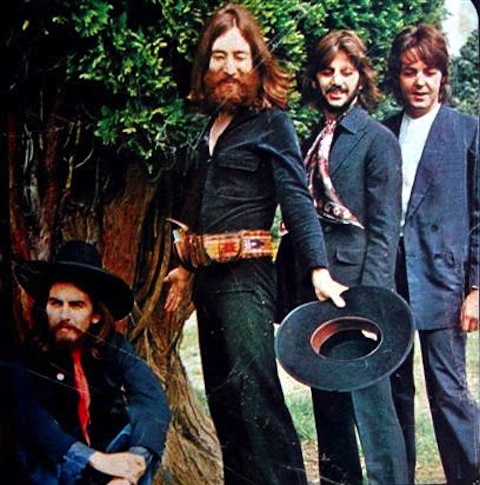
Well, this is bittersweet. The photo above comes from The Beatles’ final photo shoot together at John Lennon’s newly purchased estate in Sunninghill Berkshire: clearly not a welcome event for at least one Beatle. The band had just completed their final two album releases, Let it Be and Abbey Road—famously contentious recording sessions in which George Harrison walked out for a few days with a flippant “See you ‘round the clubs,” prompting John Lennon to snap (according to director Michael Lindsay-Hogg), “Let’s get in Eric [Clapton]. He’s just as good and not such a headache.”
George later recalled the circumstances of the shoot:
They were filming us having a row. It never came to blows, but I thought, ‘What’s the point of this? I’m quite capable of being relatively happy on my own and I’m not able to be happy in this situation. I’m getting out of here.’
Everybody had gone through that. Ringo had left at one point. I know John wanted out. It was a very, very difficult, stressful time, and being filmed having a row as well was terrible. I got up and I thought, ‘I’m not doing this any more. I’m out of here.’ So I got my guitar and went home and that afternoon wrote Wah-Wah.
It became stifling, so that although this new album was supposed to break away from that type of recording (we were going back to playing live) it was still very much that kind of situation where he already had in his mind what he wanted. Paul wanted nobody to play on his songs until he decided how it should go. For me it was like: ‘What am I doing here? This is painful!’
See many more photos from the shoot and read more painful details about the sessions and, yes, Yoko, over at Messy Nessy Chic.
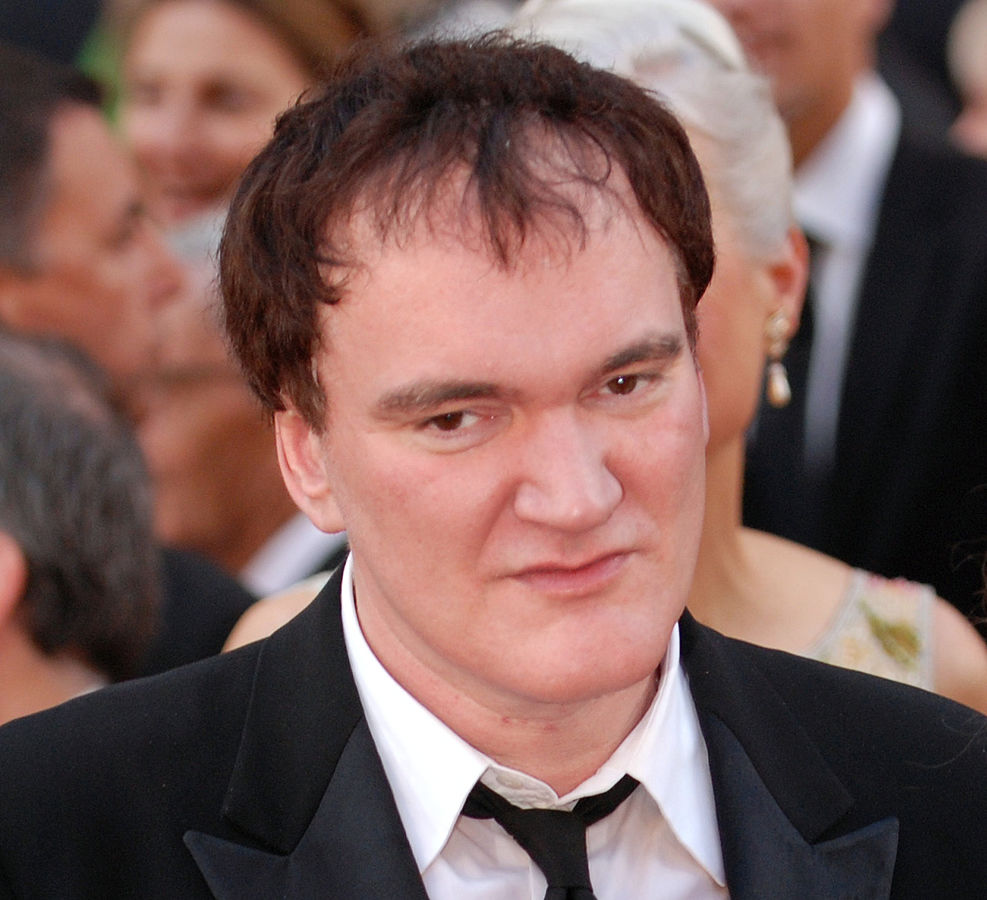
Any list of the most respected American filmmakers of the past half-century would have to include Stanley Kubrick, Woody Allen, and Martin Scorsese. The latter two have kept creating, and prolifically, but that doesn’t delay those heated debates about who will most proudly carry the auteur’s tradition into the next few decades. Much smart money bets on Quentin Tarantino, who, at age 50, has already racked up over twenty years (and if you count My Best Friend’s Birthday, over 25) of demonstrating his distinctive cinematic sensibility.
That sensibility has made him a director of renown, but it comes in large part from his equally formidable stature as a film fan: his beginnings as a highly curatorial video-store clerk, his ownership of the revival theater the New Beverly Cinema (which I myself frequent), his cinephile’s-dream home theater and large collection of prints. Having featured top-movie lists from Kubrick, Allen, and Scorsese, let’s take a look at one from Tarantino:
Apocalypse Now (Francis Ford Coppola, 1979)
The Bad News Bears (Michael Ritchie, 1976)
Carrie (Brian de Palma, 1976)
Dazed and Confused (Richard Linklater, 1993)
The Good, the Bad, and the Ugly (Sergio Leone, 1966)
The Great Escape (John Sturges, 1963)
His Girl Friday (Howard Hawks, 1939)
Jaws (Steven Spielberg, 1975)
Pretty Maids All in a Row (Roger Vadim, 1971)
Rolling Thunder (John Flynn, 1997)
Sorcerer (William Friedkin, 1977)
Taxi Driver (Martin Scorsese, 1976)
The director of Pulp Fiction, Jackie Brown, and Django Unchained voted for these pictures in Sight & Sound’s 2012 poll. Not only does this high-profile auteur select several other high-profile auteurs, he favors ones who show a similar enthusiasm for genre: de Palma, Leone, Hawks, Spielberg, Friedkin. Other selections, like Apocalypse Now and Taxi Driver, come from filmmakers associated with the “New Hollywood” movement of the seventies, the last major burst of creative filmmaking in the American mainstream before — you guessed it — the “Indiewood” boom of the late eighties and nineties which launched the career of not only Tarantino himself but also Richard Linklater, whose breakout Slacker you can watch online. You can also catch, free on the internet, one of the classic Hollywood productions Tarantino includes: His Girl Friday. As for the seemingly inexplicable presence of the 1976 kids’ sports comedy The Bad News Bears, I haven’t found it free online yet, but everybody tells me you really do need to see it to truly appreciate it.
One day we’ll maybe have a LinkedIn page. For now, you can follow us on Facebook, Twitter and Google Plus and share intelligent media with your friends! They’ll thank you for it.
Here’s something to lighten your day a little: Monty Python’s John Cleese as Sherlock Holmes in the 1977 British television film The Strange Case of the End of Civilization as We Know It.
As the title suggests, it’s a very silly film. Cleese plays Arthur Sherlock Holmes, grandson of the famous detective. His sidekick, Dr. Watson, is similarly descended from a familiar character in the Arthur Conan Doyle stories. Together they set out to foil a diabolical plot by their nemesis, a descendent of Professor Moriarty. The modern-day Holmes has some of the same mannerisms as his famous grandfather, but is decidedly less clever and likes to keep his calabash pipe filled with exotic varieties of cannabis.
Cleese co-wrote the script with Jack Hobbs and the film’s director, Joseph McGrath, who is best known for directing the Peter Sellers movies Casino Royale and The Magic Christian. It was produced for London Weekend Television by Humphrey Barclay, who is generally credited with bringing together much of what eventually became the Monty Python cast, including American animator Terry Gilliam, in the subversive late-1960s children’s show Do Not Adjust Your Set. Cleese’s wife at the time, Connie Booth, who was also collaborating with him on the TV series Fawlty Towers, plays the detective’s landlady Mrs. Hudson. And Arthur Lowe is very funny as the dim-witted Dr. Watson.
The Strange Case of the End of Civilization as We Know It is a low-budget affair — extremely goofy — and not for everyone. But if you’re a fan of classic British TV comedy and you love outlandish gags, you should get a kick out of it. The funniest parts begin after the 13-minute mark, when Cleese arrives onscreen.
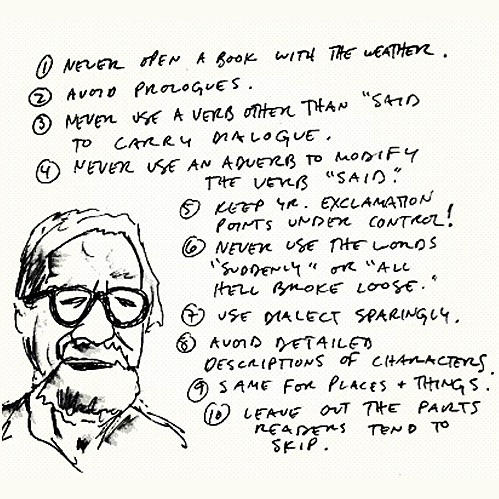
Note: Elmore Leonard, the crime writer who gave us Get Shorty, Freaky Deaky, and Glitz, died at his home in Bloomfield Village, Michigan. He was 87. If you never had a chance to read Leonard, you can start with “Ice Man,” a 2012 story that appeared in The Atlantic. It’s free online. You can also get a feel for his writing by revisiting a post written here by Mike Springer last year. It gives an overview of Leonard’s tips for aspiring writers. And, in so doing, it provides valuable insight into how Leonard approached his craft. Elmore Leonard’s Ultimate Guide for Would-Be Writers is reprinted in full below.
“If it sounds like writing,” says Elmore Leonard, “I rewrite it.”
Leonard’s writing sounds the way people talk. It rings true. In novels like Get Shorty, Rum Punch and Out of Sight, Leonard has established himself as a master stylist, and while his characters may be lowlifes, his books are received and admired in the highest circles. In 1998 Martin Amis recalled visiting Saul Bellow and seeing Leonard’s books on the old man’s shelves. “Bellow and I agreed,” said Amis, “that for an absolutely reliable and unstinting infusion of narrative pleasure in a prose miraculously purged of all false qualities, there was no one quite like Elmore Leonard.”
In 2006 Leonard appeared on BBC Two’s The Culture Show to talk about the craft of writing and give some advice to aspiring authors. In the program, shown above, Leonard talks about his deep appreciation of Ernest Hemingway’s work in general, and about his particular debt to the 1970 crime novel The Friends of Eddie Coyle, by George V. Higgins. While explaining his approach, Leonard jots down three tips:
“You have to listen to your characters.”
“Don’t worry about what your mother thinks of your language.”
“Try to get a rhythm.”
“I always refer to style as sound,” says Leonard. “The sound of the writing.” Some of Leonard’s suggestions appeared in a 2001 New York Times article that became the basis of his 2007 book, Elmore Leonard’s 10 Rules of Writing. Here are those rules in outline form:
You can read more from Leonard on his rules in the 2001 Times article. And you can read his new short story, “Ice Man,” in The Atlantic.
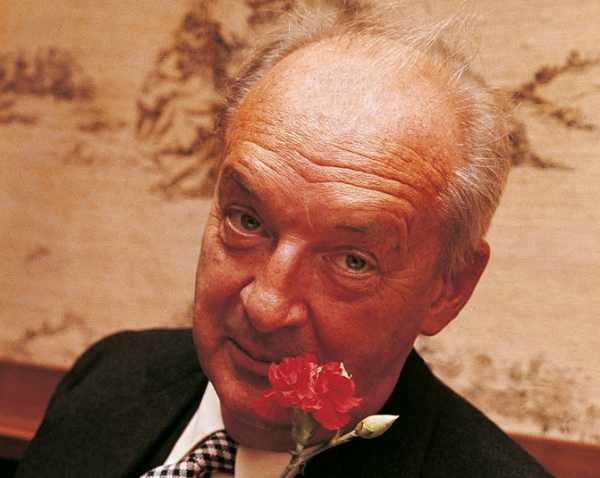
There may be no more a despicable yet ridiculous narrator in twentieth century fiction than the sleazy, condescending Humbert Humbert. And there may be no better name in twentieth century fiction than Dolores Haze, Humbert’s 12-year-old stepdaughter and love interest, whom he calls, among other things, his “nymphette,” Lolita.
Vladimir Nabokov’s tragicomic 1955 novel Lolitastill has the power to shock, disgust, and elicit wry laughter from readers, with its satirical take on decadent old Europe and wisecracking young America. True to its mid-century U.S. setting and sensationalistic subject matter, the novel is packed not only with Humbert’s obsessively creepy description and layers of literary allusion, but also with plenty of pulpy action, if we are to believe in the events Humbert narrates.
In the novel’s penultimate chapter, Humbert tracks down Clare Quilty, another predatory older man who takes advantage of Lolita. Humbert confronts, then kills Quilty (or so it seems). In the final chapter, Humbert also dies, and we learn that the novel is in fact his memoir, willed only to be published after he and Lolita have died. In the audio clip at the top, hear Vladimir Nabokov himself read from the climactic chapter in which Humbert faces Quilty down, and directly above, see the author read those first unforgettable lines: “Lolita, light of my life, fire of my loins. My sin, my soul. Lo-lee-ta.”
Find more recordings of Nabokov reading his work here.
We're hoping to rely on loyal readers, rather than erratic ads. Please click the Donate button and support Open Culture. You can use Paypal, Venmo, Patreon, even Crypto! We thank you!
Open Culture scours the web for the best educational media. We find the free courses and audio books you need, the language lessons & educational videos you want, and plenty of enlightenment in between.