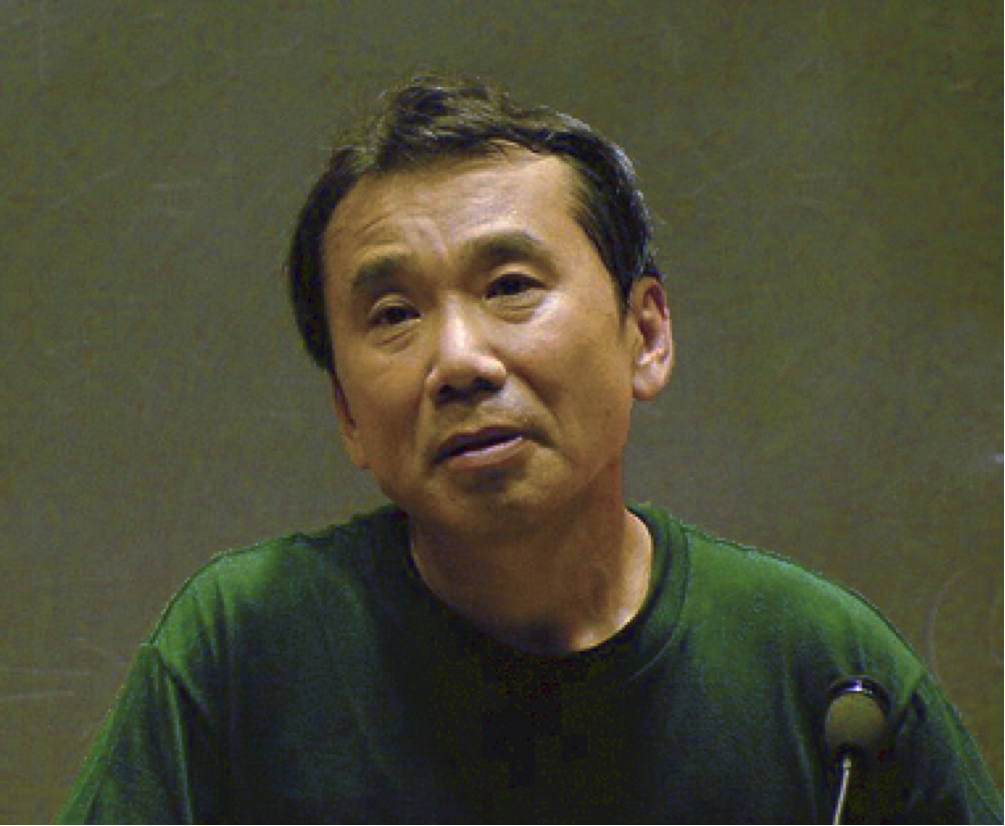
Photo via Wikimedia Commons
Haruki Murakami has been famous as a novelist since the 1980s. But for a decade or two now, he’s become increasingly well known around the world as a novelist who runs. The English-speaking world’s awareness of Murakami’s roadwork habit goes back at least as far as 2004, when the Paris Review published an Art of Fiction interview with him. Asked by interviewer John Ray to describe the structure of his typical workday, Murakami replied as follows:
When I’m in writing mode for a novel, I get up at four a.m. and work for five to six hours. In the afternoon, I run for ten kilometers or swim for fifteen hundred meters (or do both), then I read a bit and listen to some music. I go to bed at nine p.m. I keep to this routine every day without variation. The repetition itself becomes the important thing; it’s a form of mesmerism. I mesmerize myself to reach a deeper state of mind. But to hold to such repetition for so long — six months to a year — requires a good amount of mental and physical strength. In that sense, writing a long novel is like survival training. Physical strength is as necessary as artistic sensitivity.
This stark physical departure from the popular notion of literary work drew attention. Truer to writerly stereotype was the Murakami of the early 1980s, when he turned pro as a novelist after closing the jazz bar he’d owned in Tokyo. “Once I was sitting at a desk writing all day I started putting on the pounds,” he remembers in The New Yorker. “I was also smoking too much — sixty cigarettes a day. My fingers were yellow, and my body reeked of smoke.” Aware that something had to change, Murakami performed an experiment on himself: “I decided to start running every day because I wanted to see what would happen. I think life is a kind of laboratory where you can try anything. And in the end I think it was good for me, because I became tough.”
Adherence to such a lifestyle, as Murakami tells it, has enabled him to write all his novels since, including hits like Norwegian Wood, The Wind-Up Bird Chronicle, and Kafka on the Shore. (On some level, it also reflects his protagonists’ tendency to make transformative leaps from one version of reality into another.) Its rigor has surely contributed to the discipline necessary for the rest of his output as well: translation into his native Japanese of works including The Great Gatsby, but also large quantities of first-person writing on his own interests and everyday life. Protective of his reputation in English, Murakami has allowed almost none of the latter to be published in this language.
But in light of the voracious consumption of self-improvement literature in the English-speaking world, and especially in America, translation of his memoir What I Talk About When I Talk About Running must have been an irresistible proposition. “I’ve never recommended running to others,” Murakami writes in The New Yorker piece, which is drawn from the book. “If someone has an interest in long-distance running, he’ll start running on his own. If he’s not interested in it, no amount of persuasion will make any difference.” For some, Murakami’s example has been enough: take the writer-vlogger Mel Torrefranca, who documented her attempt to follow his example for a week. For her, a week was enough; for Murakami, who’s been running-while-writing for nearly forty years now, there could be no other way.
Related Content:
Haruki Murakami Lists the Three Essential Qualities For All Serious Novelists (And Runners)
The Daily Habits of Famous Writers: Franz Kafka, Haruki Murakami, Stephen King & More
Haruki Murakami Translates The Great Gatsby, the Novel That Influenced Him Most
Haruki Murakami’s Passion for Jazz: Discover the Novelist’s Jazz Playlist, Jazz Essay & Jazz Bar
Read 12 Stories By Haruki Murakami Free Online
Based in Seoul, Colin Marshall writes and broadcasts on cities, language, and culture. His projects include the Substack newsletter Books on Cities, the book The Stateless City: a Walk through 21st-Century Los Angeles and the video series The City in Cinema. Follow him on Twitter at @colinmarshall or on Facebook.