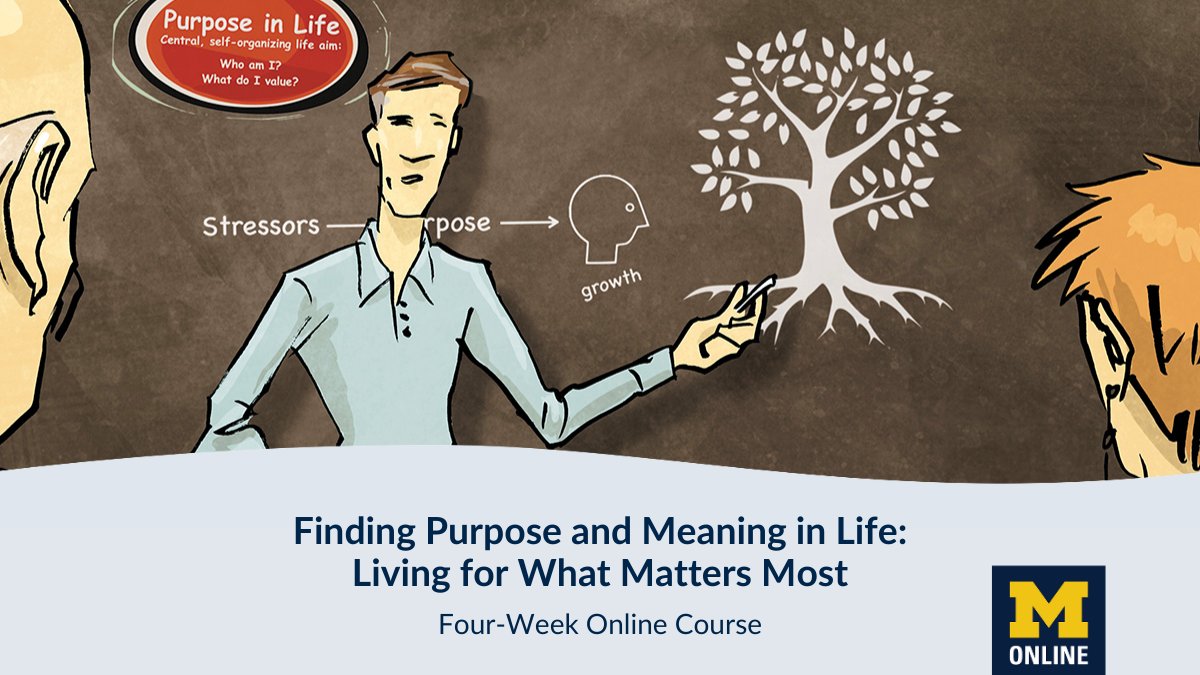
In this course, you’ll learn how science, philosophy and practice all play a role in both finding your purpose and living a purposeful life. You will hear from historical figures and individuals about their journeys to finding and living a purposeful life, and will walk through different exercises to help you find out what matters most to you so you can live a purposeful life.
1. Understand that having a strong purpose in life is an essential element of human well-being.
2. Know how self-transcending purpose positively affects well-being.
3. Be able to create a purpose for your life (don’t be intimidated, this is different from creating “the purpose” for your life).
4. Apply personal approaches and skills to self-change and become and stay connected to your purpose every day.
To take the course for free, selection the Audit Only option available upon registration.
Anyone interested can watch Vic Strecher’s TED Talk here.
If you would like to support the mission of Open Culture, consider making a donation to our site. It’s hard to rely 100% on ads, and your contributions will help us continue providing the best free cultural and educational materials to learners everywhere. You can contribute through PayPal, Patreon, and Venmo (@openculture). Thanks!
Volodymyr Zelenskyy invited U2 to perform in Kyiv as a show of solidarity with the Ukrainian people. And they showed up, playing an improvised acoustic set in a Kyiv Metro station, which now doubles as a bomb shelter. Above you can watch Bono and the Edge perform “Stand by Me,” “Angel of Harlem,” and “With or Without You.” At points, they’re joined by members of the Ukrainian band Antytila.
As an artistic child growing up on a farm in the 1860s and early 1870s, Anna Mary Robertson (1860–1961) used ground ochre, grass, and berry juice in place of traditional art supplies. She was so little, she referred to her efforts as “lambscapes.” Her father, for whom painting was also a hobby, kept her and her brothers supplied with paper:
He liked to see us draw pictures, it was a penny a sheet and lasted longer than candy.
She left home and school at 12, serving as a full-time, live-in housekeeper for the next 15 years. She so admired the Currier & Ives prints hanging in one of the homes where she worked that her employers set her up with wax crayons and chalk, but her duties left little time for leisure activities.
Free time was in even shorter supply after she married and gave birth to ten children — five of whom survived past infancy. Her creative impulse was confined to decorating household items, quilting, and embroidering gifts for family and friends.
At the age of 77 (circa 1937), widowed, retired, and suffering from arthritis that kept her from her accustomed household tasks, she again turned to painting.
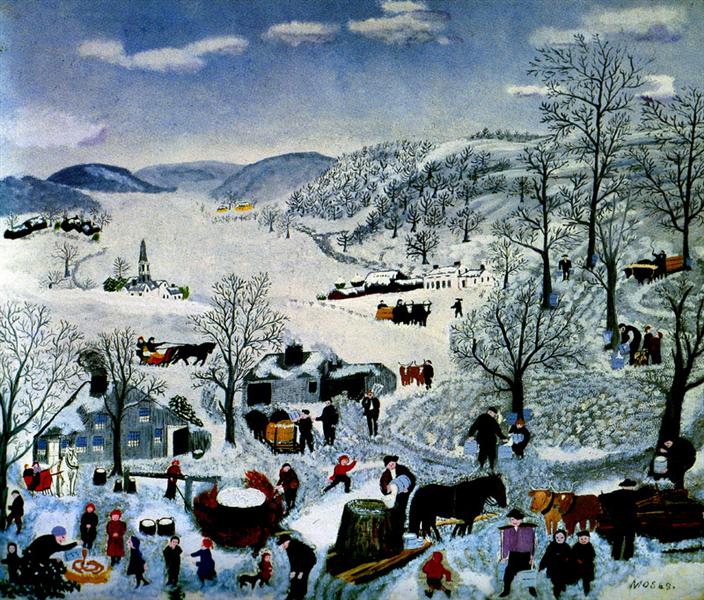
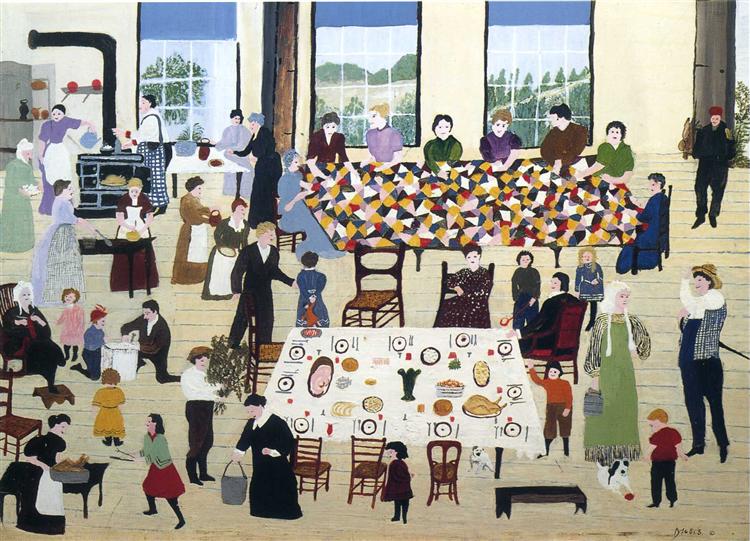
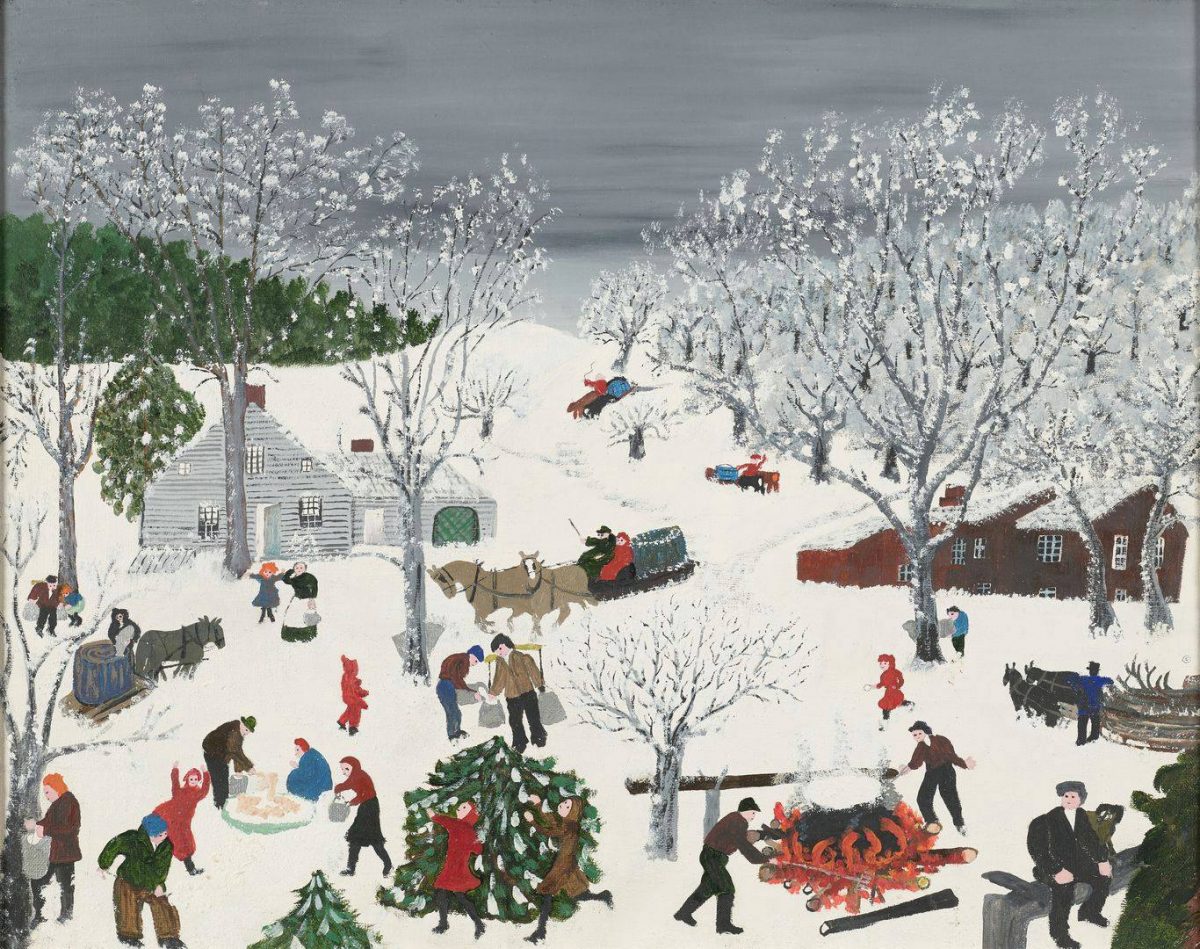
Setting up in her bedroom, she worked in oils on masonite prepped with three coats of white paint, drawing on such youthful memories as quilting bees, haying, and the annual maple sugar harvest for subject matter, again and again.
Thomas’ Pharmacy in Hoosick Falls, New York exhibited some of her output, alongside other local women’s handicrafts. It failed to attract much attention, until art collector Louis J. Caldor wandered in during a brief sojourn from Manhattan and acquired them all for an average price tag of $4.
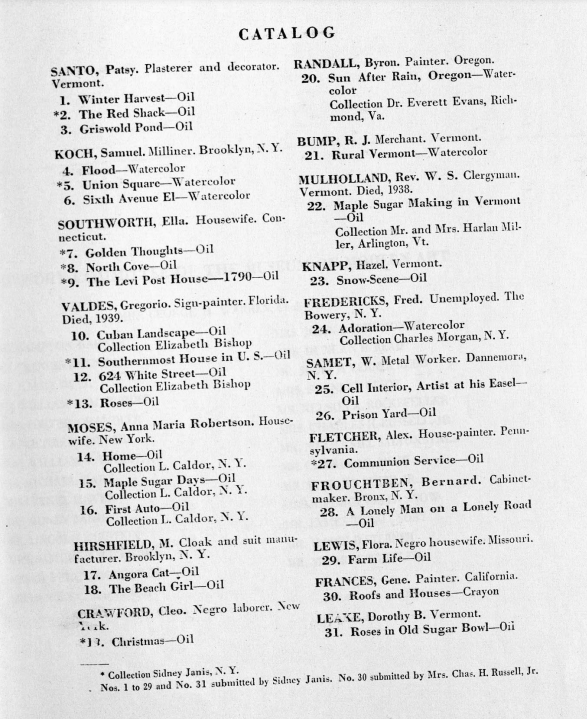
The next year (1939), Mrs. Moses, as she was then known, was one of several “housewives” whose work was included in the Museum of Modern Art’s exhibit “Contemporary Unknown American Painters”. The emphasis was definitely on the untaught outsider. In addition to occupation, the catalogue listed the non-Caucasian artists’ race…
In reviewing the 1940 show, the New York Herald Tribune’s critic cited the folksy nickname (“Grandma Moses”) favored by some of the artist’s neighbors. Her wholesome rural bonafides created an unexpected sensation. The public flocked to see a table set with her homemade cakes, rolls, bread and prize-winning preserves as part of a Thanksgiving-themed meet-and-greet with the artist at Gimbels Department Store the following month.
In general, the New York press distanced the artist from her creative identity. They commandeered her from the art world, fashioning a rich public image that brimmed with human interest…Although the artist’s family and friends addressed her as “Mother Moses” and “Grandma Moses” interchangeably, the press preferred the more familiar and endearing form of address. And “Grandma” she became, in nearly all subsequent published references. Only a few publications by-passed the new locution: a New York Times Magazine feature of April 6, 1941; a Harper’s Bazaar article; and the landmark They Taught Themselves: American Primitive Painters of the 20th Century, by the respected dealer and curator Sidney Janis, referred to the artist as “Mother Moses,” a title that conveyed more dignity than the colloquial diminutive “Grandma.”
But “Grandma Moses” had taken hold. The avalanche of press coverage that followed had little to do with the probity of art commentary. Journalists found that the artist’s life made better copy than her art. For example, in a discussion of her debut, an Art Digest reporter gave a charming, if simplified, account of the genesis of Moses’ turn to painting, recounting her desire to give the postman “a nice little Christmas gift.”Not only would the dear fellow appreciate a painting, concluded Grandma, but “it was easier to make than to bake a cake over a hot stove.” After quoting from Genauer and other favorable reviews in the New York papers, the report concluded with a folksy supposition: “To all of which Grandma Moses perhaps shakes a bewildered head and repeats, ‘Land’s Sakes’.” Flippantly deeming the artist’s achievements a marker of social change, he noted: “When Grandma takes it up then we can be sure that art, like the bobbed head, is here to stay.”
Urban sophisticates were besotted with the plainspoken, octogenarian farm widow who was scandalized by the “extortion prices” they paid for her work in the Galerie St. Etienne. As Tom Arthur writes in a blog devoted to New York State historical markers:
New Yorkers found that, once wartime gasoline rationing ended, Eagle Bridge made a nice excursion destination for a weekend trip. Local residents were usually willing to talk to outsiders about their local celebrity and give directions to her farm. There they would meet the artist, who was a delight to talk to, and either buy or order paintings from her. Songwriter/impresario Cole Porter became a regular customer, ordering several paintings every year to give to friends around Christmas.
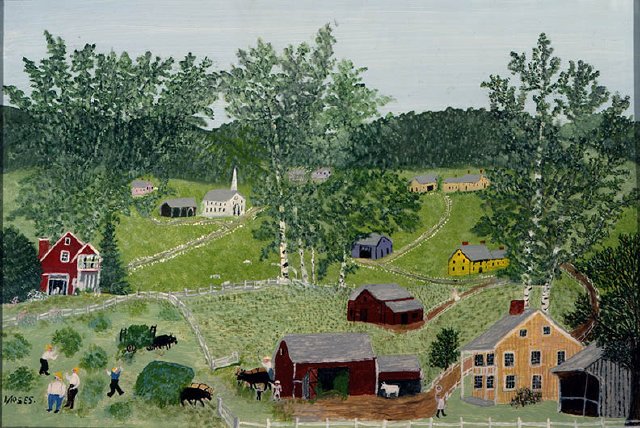
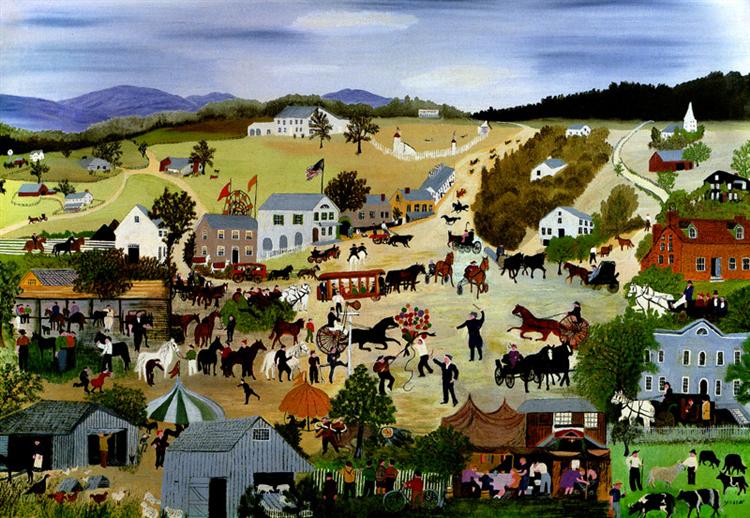
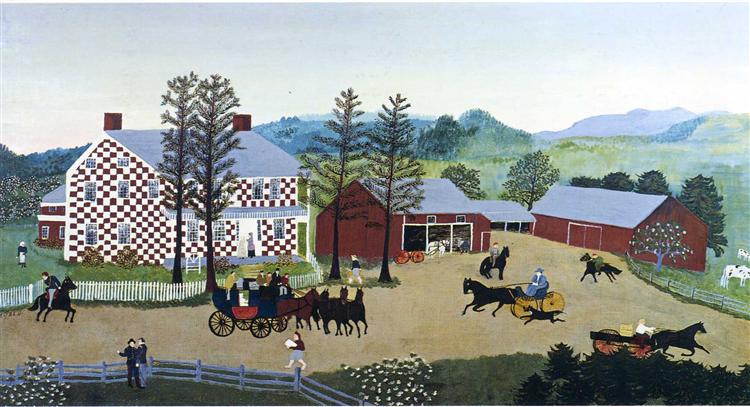
In the two-and‑a half decades between picking her paintbrush back up and her death at the age of 101, she produced over 1600 images, always starting with the sky and moving downward to depict tidy fields, well kept houses, and tiny, hard working figures coming together as a community. In the above documentary she alludes to other artists known to depicting “trouble”… such as livestock busting out of their enclosures.
She preferred to document scenes in which everyone was seen to be behaving.
In a land and in a life where a woman can grow old with fearlessness and beauty, it is not strange that she should become an artist at the end. — poet Archibald MacLeish
Hmm.
Read Judith Stein’s fascinating essay in its entirety here.
“Existentialism is both a philosophy and a mood,” says Hazel Barnes by way of opening the television series Self-Encounter: A Study in Existentialism. “As a mood, I think we could say that it is the mood of the twentieth century — or, at least, of those people in the twentieth century who are discontent with things as they are. It expresses the feeling that, somehow or other, all of those systems — whether they be social, psychological, or scientific — which have attempted to define and explain and determine man, have somehow missed the living individual person.”
Existentialism was on the rise in 1961, when Barnes spoke those words, and the subsequent six decades have arguably done little to assuage its discontent. By the time of Self-Encounter’s broadcast in ’61, Barnes was already well-known in philosophical circles for her English translation of Jean-Paul Sartre’s Being and Nothingness. When she took on that job, with what she later described as “three years of badly taught high school French and one yearlong course in college, and a bare minimum of background in philosophy,” she couldn’t have known that it would set her on the road to becoming the most famous popularizer of existentialism in America.
Five years after the publication of Barnes’ Sartre translation, along came the opportunity to host a ten-part series on National Public Educational Television (a predecessor of PBS) explaining Sartre’s thought as well as that of other writers like Simone de Beauvoir, Albert Camus, and Richard Wright, between dramatizations of scenes drawn from existentialist literature. Self-Encounter was once “thought to be entirely lost, the original tapes having been reported recorded over,” writes Nick Nielsen. But after the series’ unexpected rediscovery in 2017, all of its episodes gradually made their way to the web. You can watch all ten of them straight through in the nearly five-hour video at the top of the post, or view them one-by-one at the American Archive of Public Broadcasting.
“Self Encounter was produced in 1961 and first broadcast in 1962,” Nielsen writes. “I cannot help but note that Route 66 aired from 1960 to 1964, The Outer Limits aired from 1963 to 1965, Rawhide aired from 1959 to 1965, and Perry Mason aired from 1957 to 1966” — not to mention The TwilightZone, from 1959 to 1964. “It would be difficult to name another television milieu of comparable depth. Our mental image of this period of American history as being one of stifling conformity is belied by these dark perspectives on human nature.” And as for the social, psychological, scientific, and of course technological systems in effect today, the existentialists would surely take a dim view of their potential to liberate us from conformity — or any other aspect of the human condition.
Based in Seoul, Colin Marshall writes and broadcasts on cities, language, and culture. His projects include the Substack newsletterBooks on Cities, the book The Stateless City: a Walk through 21st-Century Los Angeles and the video series The City in Cinema. Follow him on Twitter at @colinmarshall, on Facebook, or on Instagram.
FYI: MasterClass is offering up to 35% off an annual subscription for Mother’s Day. Through Sunday, May 8th you can become a member and gain access to 150 courses, featuring some of our leading creative minds–from Annie Leibovitz, David Sedaris and Neil Gaiman, to Margaret Atwood, David Lynch and Helen Mirren. You can sign up by clicking here.
Note: If you get a MasterClass subscription, Open Culture will receive a small fee that helps support our operation.
In light of its being recently banned in some settings, we discuss Art Spiegelman’s Maus (1980–91), which conveys his father’s account of living through the Holocaust. We also consider other war-related graphic novels like Marjane Satrapi’s Persepolis (2000) and George Takei’s They Called Us Enemy (2019).
Are comics particularly effective in changing hearts and minds when they display people’s hardships? Should kids be exposed to the horrors of the world in this way? What about the complexities of social justice and gender identity? We also touch on Gilbert Gottfried and the relationship between humor and tragedy, learning history vs. reading one person’s experience, the ages at which became political, and how comics may have aided that.
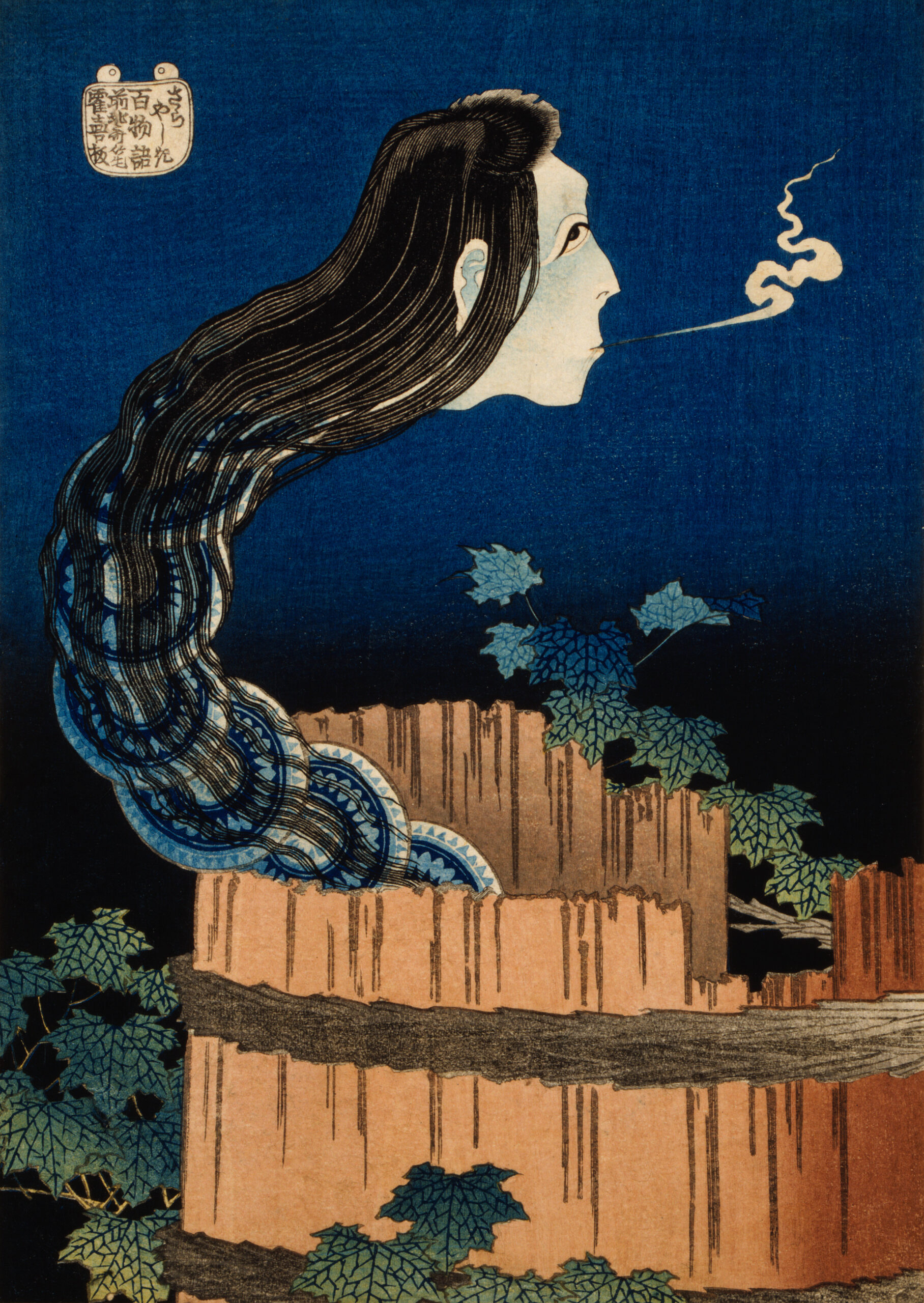
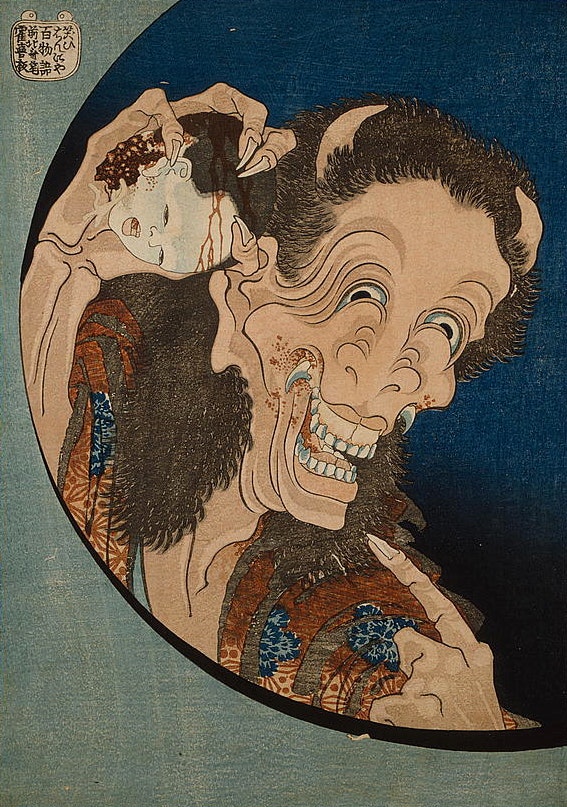
When Halloween comes around this year, consider playing a round of hyakumonogatari. You’ll need to assemble a hundred candles beforehand, but that’s the easy part; you and your friends will also need to know just as many ghost stories. In early nineteenth-century Japan, “participants would sit in a candlelit room and take turns telling frightening tales. After each one was shared, a candle would be extinguished until there was no light left, in the room. It was then that the yōkai [“strange apparitions”) would appear.” So says Youtuber Hochelaga (who’s previously covered the Biblical apocalypse and long-ago predictions of the future) in the video above, “The Ghosts of Hokusai.”
We all know the name of Katsushika Hokusai, the most widely renowned master of the traditional Japanese woodblock-print art called ukiyo‑e. In a lifetime spanning the mid-eighteenth to the mid-nineteenth century, Hochelaga notes, Hokusai created around 30,000 unique pieces of art, including The Great Wave off Kanagawa, part of Thirty-Six Views of Mount Fuji.
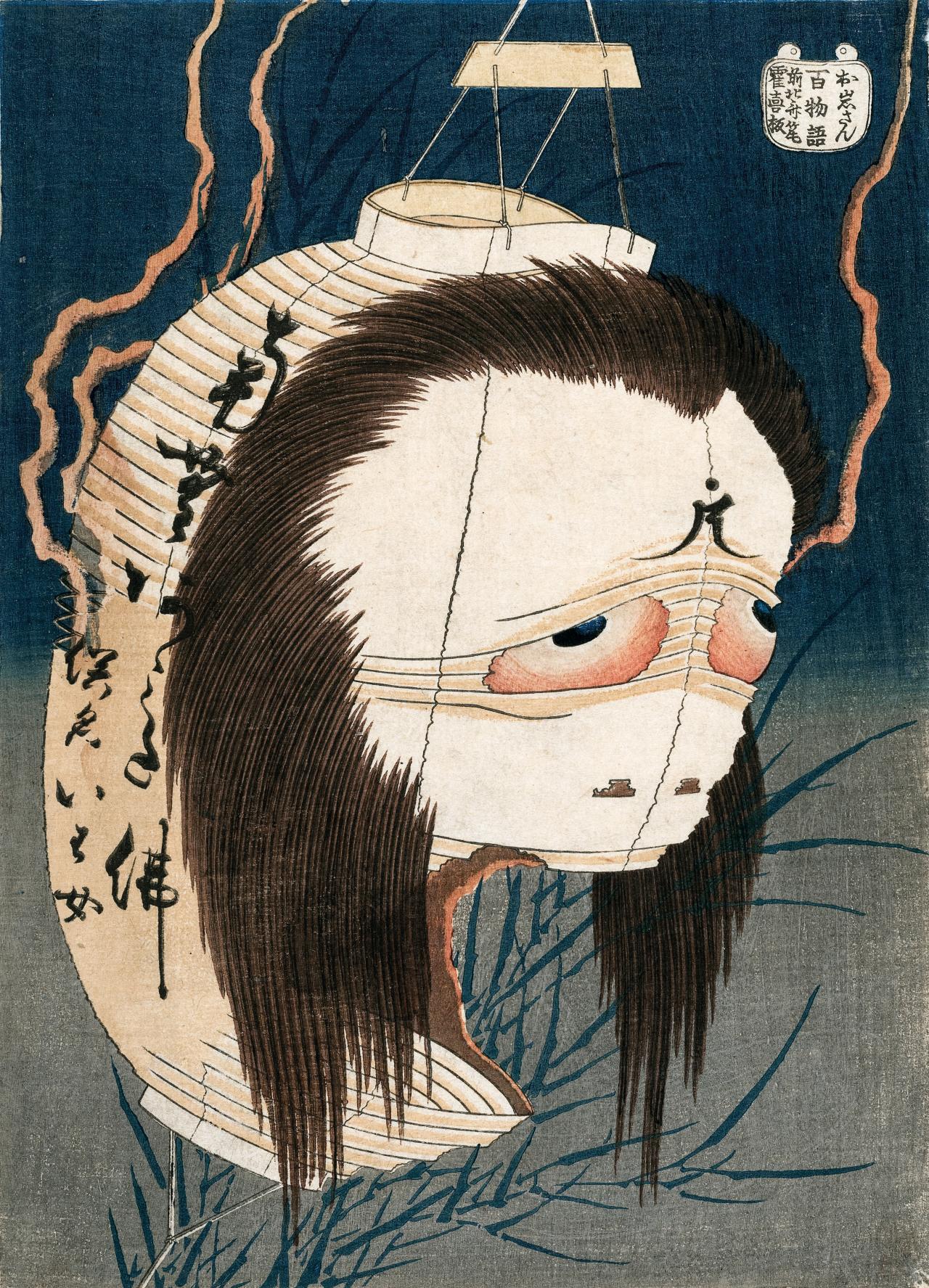
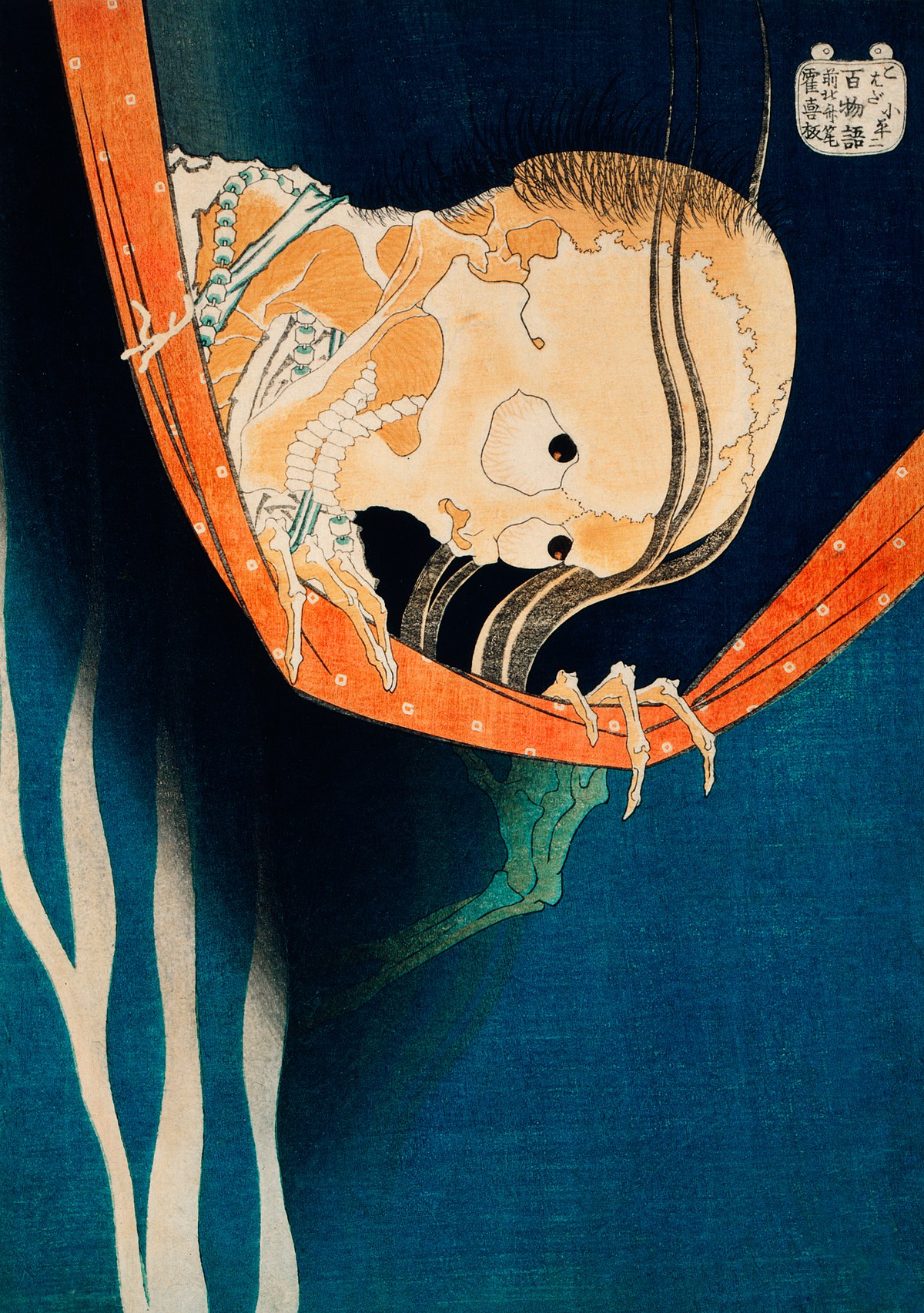
But before executing that triumphant late series, Hokusai made his own Hyakumonogatari (literally, “hundred tales”) — or rather, he rendered in his distinctive style five of those traditional ghost stories’ tragic, grotesque, and often humorous protagonists.
These characters are yōkai, those “weird and mysterious beings” that “inhabit supernatural Japan.” They “come in all shapes and sizes, from friendly household spirits to fierce demons,” including the Oyajirome, who literally has an eye in the back of his head, and the Ushi-oni, “one part bull, one part crab, and the rest nightmare fuel.” Hokusai’s interest tended toward yōkai who had once been normal humans: the neglected wife of a samurai whose spirit became trapped in a lantern, the murdered kabuki actor whose skeletal remains emerged from a swamp to hunt down his killers.
You can read more about these yōkai, and take a look at Hokusai’s depictions of them, at the Public Domain Review and Thoughts on Papyrus. Soon after Hokusai’s death Japan opened to the world, beginning its transformation into a state of hypermodernity. But tales of yōkai still have a certain influence on the Japanese cultural imagination, as evidenced by the Miyoshi Mononoke Museum in Hiroshima. Japan has been more or less closed once again these past couple of years, but once it re-opens, why not make a trip to collect a few scary monogatari for yourself?
Based in Seoul, Colin Marshall writes and broadcasts on cities, language, and culture. His projects include the Substack newsletterBooks on Cities, the book The Stateless City: a Walk through 21st-Century Los Angeles and the video series The City in Cinema. Follow him on Twitter at @colinmarshall, on Facebook, or on Instagram.
As we noted back in March, investor Ray Dalio has published his latest bestseller, Principles for Dealing with the Changing World: Why Nations Succeed and Fail. A history of the rise and fall of empires over the last 500 years, the book uses the past to contemplate the future, particularly the fate of the United States and China. Today, for Teacher Appreciation Week, Dalio has announced that he’s willing to give a copy of the book “to any high school or college educator who wants it—and to all of their students if they intend to have them read it.” He writes:
Since releasing my book and animated video [above], Principles for Dealing with the Changing World Order, many people have told me that both would be helpful for teaching history in schools and asked me if I would help make that happen. So, during this Teacher Appreciation Week I will give a copy of the book to any high school or college educator who wants it—and to all of their students if they intend to have them read it. And if there’s a lot of interest, I’d be happy to extend the offer past this week. Of course, the Youtube video is already free and easily available and I encourage you to check that out if you want an overview of what’s in the book.
When you sign up, let me know if you’re interested in me hosting a live online session for classrooms, which I’ll do if people would like it. If you are not an educator but know some who might be interested in this offer, please share this link with them.
If you would like to support the mission of Open Culture, consider making a donation to our site. It’s hard to rely 100% on ads, and your contributions will help us continue providing the best free cultural and educational materials to learners everywhere. You can contribute through PayPal, Patreon, and Venmo (@openculture). Thanks!
We're hoping to rely on loyal readers, rather than erratic ads. Please click the Donate button and support Open Culture. You can use Paypal, Venmo, Patreon, even Crypto! We thank you!
Open Culture scours the web for the best educational media. We find the free courses and audio books you need, the language lessons & educational videos you want, and plenty of enlightenment in between.