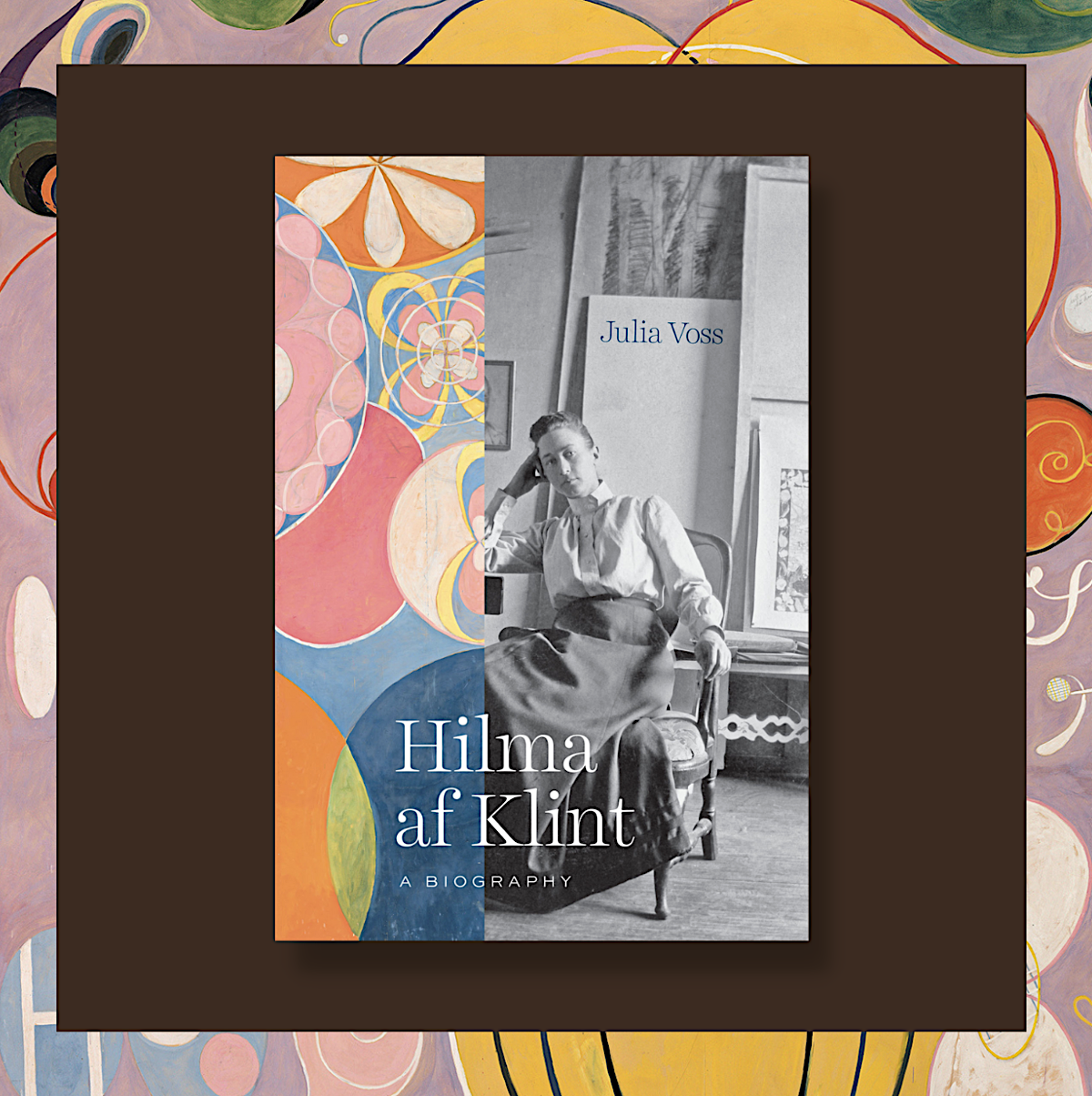
A quick heads up: The University of Chicago Press will soon publish the first biography of the Swedish avant-garde painter Hilma af Klint–an artist we have explored here many times before. Written by Julia Voss, the 440-page biography features nearly 100 images of Klint’s life and art. Until October 27th, you can get 40% of the new book if you use the code VOSS40at this site.
If you would like to support the mission of Open Culture, consider making a donation to our site. It’s hard to rely 100% on ads, and your contributions will help us continue providing the best free cultural and educational materials to learners everywhere. You can contribute through PayPal, Patreon, and Venmo (@openculture). Thanks!
“Her Majesty’s a pretty nice girl, but she doesn’t have a lot to say,” sings Paul McCartney on the Beatles’ “Her Majesty.” That comic song closes Abbey Road, the last album the band ever recorded, and thus puts a cap on their brief but wondrous cultural reign. In 2002 McCartney played the song again, in front of Queen Elizabeth II herself as part of her Golden Jubilee celebrations. Earlier this year her Platinum Jubilee marked a full 70 years on the throne, but now — 53 years after that cheeky tribute on Abbey Road — Her Majesty’s own reign has drawn to a close with her death at the age of 96. She’d been Queen since 1953, but she’d been a British icon since at least the Second World War.
In October 1940, at the height of the Blitz, Prime Minister Winston Churchill asked King George VI to allow his daughter, the fourteen-year-old Princess Elizabeth, to make a morale-boosting speech on the radio. Recorded in Windsor Castle after intense preparation and then broadcast on the BBC’s Children’s Hour, it was ostensibly addressed to the young people of Britain and its empire.
“Evacuation of children in Britain from the cities to the countryside started in September 1939,” says BBC.com, with ultimate destinations as far away as Canada. “It is not difficult for us to picture the sort of life you are all leading, and to think of all the new sights you must be seeing and the adventures you must be having,” Princess Elizabeth tells them. “But I am sure that you, too, are often thinking of the old country.”
In the event, millions of young and old around the world heard the broadcast, which arguably served Churchill’s own goal of encouraging American participation in the war. But it also gave Britons a preview of the dignity and forthrightness of the woman who would become their Queen, and remain so for an unprecedented seven decades. As Paul McCartney implied, Queen Elizabeth II turned out not to be given to prolonged flights of rhetoric. But though she may not have had a lot to say, she invariably spoke in public at the proper moment, in the proper words, and with the proper manner. Today one wonders whether this admirable personal quality, already in short supply among modern rulers, hasn’t vanished entirely.
Based in Seoul, Colin Marshall writes and broadcasts on cities, language, and culture. His projects include the Substack newsletterBooks on Cities, the book The Stateless City: a Walk through 21st-Century Los Angeles and the video series The City in Cinema. Follow him on Twitter at @colinmarshall, on Facebook, or on Instagram.
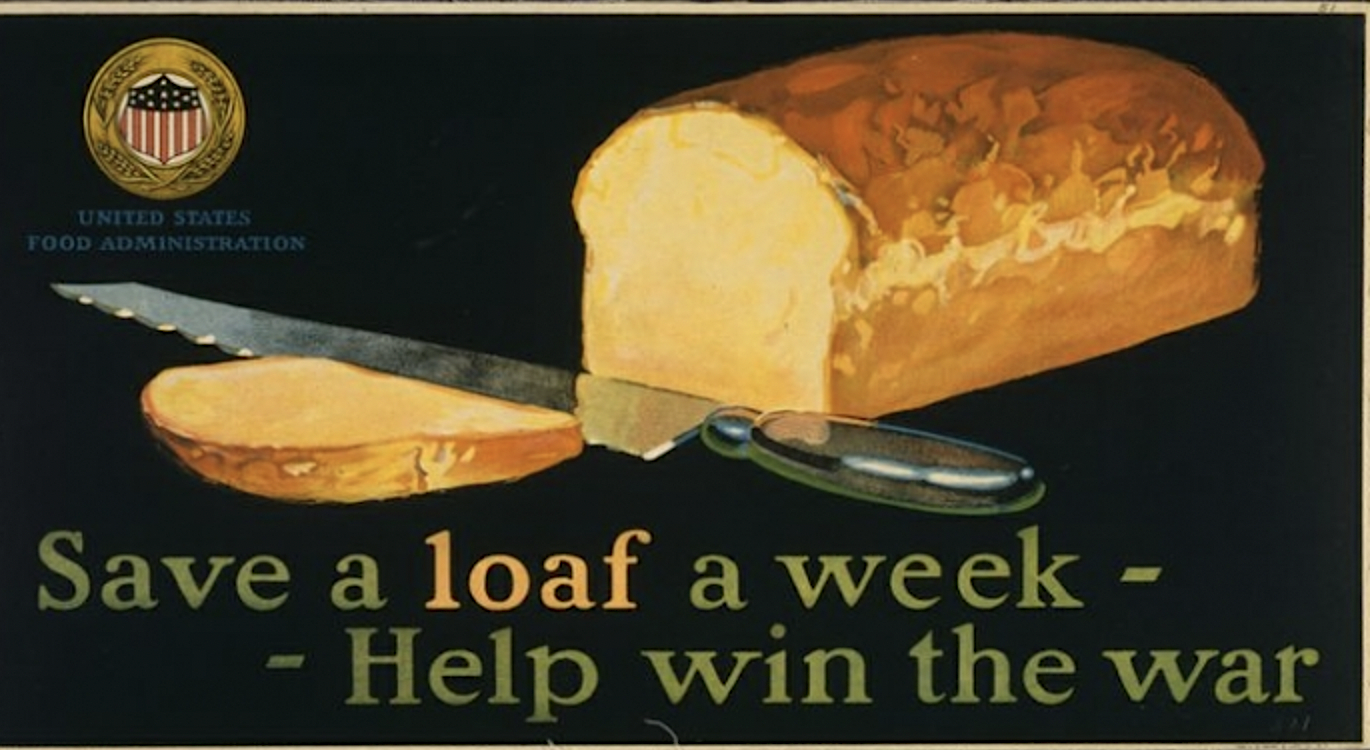
Home baked sourdough had its moment during the early days of the pandemic, but otherwise bread has been much maligned throughout the 21st century, at least in the Western World, where carbs are vilified by body-conscious consumers.
This was hardly the case on January 18, 1943, when Americans woke up to the news that the War Foods Administration, headed by Secretary of Agriculture Claude R. Wickard, had banned the sale of sliced bread.
The reasons driving the ban were a bit murky, though by this point, Americans were well acquainted with rationing, which had already limited access to high-demand items as sugar, coffee, gasoline and tires.
Though why sliced bread, of all things?
Might depriving the public of their beloved pre-sliced bread help the war effort, by freeing up some critical resource, like steel?
War production regulations prohibited the sale of industrial bread slicing equipment for the duration, though presumably, existing commercial bakeries wouldn’t have been in the market for more machines, just the odd repair part here and there.
Wax paper then? It kept sliced bread fresh prior to the invention of plastic bags. Perhaps the Allies had need of it?
No, unlike nylon, there were no shortages of waxed paper.
Flour had been strictly regulated in Great Britain during the first World War, but this wasn’t a problem stateside in WWII, where it remained relatively cheap and easy to procure, with plenty leftover to supply overseas troops. 1942’s wheat crop had been the second largest on record.
There were other rationales having to do with eliminating food waste and relieving economic pressure for bakers, but none of these held up upon examination. This left the War Production Office, the War Price Administration, and the Office of Agriculture vying to place blame for the ban on each other, and in some cases, the American baking industry itself!
While the ill considered ban lasted just two months, the public uproar was considerable.
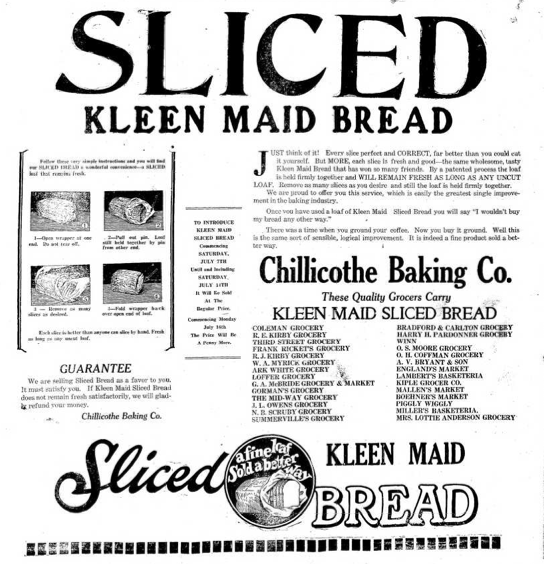
Although pre-sliced bread hadn’t been around all that long, in the thirteen-and-a-half years since its introduction, consumers had grown quite dependent on its convenience, and how nicely those uniform slices fit into the slots of their pop up toasters, another recently-patented invention.
A great pleasure of the History Guy’s coverage is the name checking of local newspapers covering the Sliced Bread Ban:
An absence of data did not prevent a reporter for the Wilmington News Journal from speculating that “it is believed that the majority of American housewives are not proficient bread slicers.”
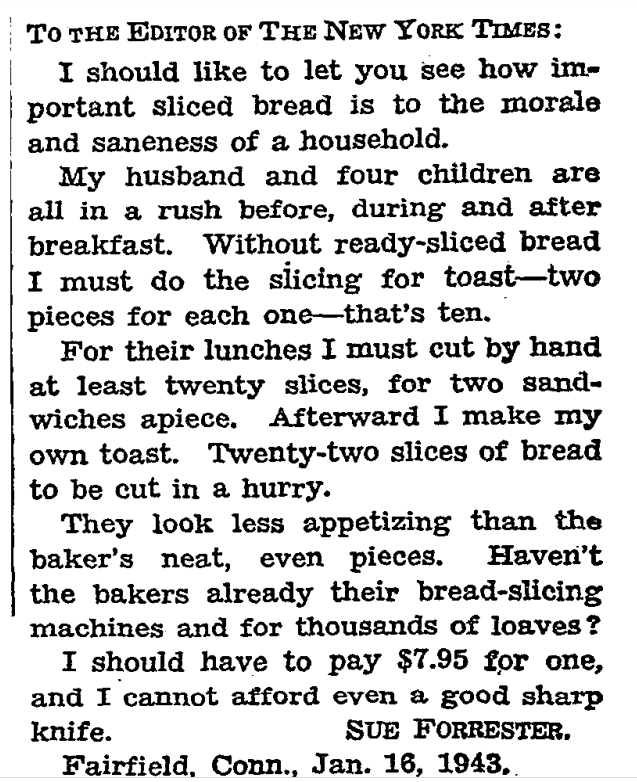
One such housewife, having spent a hectic morning hacking a loaf into toast and sandwiches for her husband and children, wrote a letter to the New York Times, passionately declaring “how important sliced bread is to the morale and saneness of a household.”
The more stiff upper lipped patriotism of Vermont home economics instructor Doris H. Steele found a platform in the Barre Times:
In Grandmother’s day, the loaf of bread had a regular place at the family table. Grandmother had an attractive board for the bread to stand on and a good sharp knife alongside. Grandmother knew that a steady hand and a sharp knife were the secrets of slicing bread. She sliced as the family asked for bread and in this way, she didn’t waste any bread by cutting more than the family could eat. Let’s all contribute to the war effort by slicing our own bread.
Then, as now, celebrities felt compelled to weigh in.
First the Titanic was claimed by the ocean; now it’s being eaten by the ocean. “The iconic ocean liner that was sunk by an iceberg is now slowly succumbing to metal-eating bacteria,” the Associated Press’ Ben Finley reported last year. “Holes pervade the wreckage, the crow’s nest is already gone and the railing of the ship’s iconic bow could collapse at any time.” Given the loss to bacteria of “hundreds of pounds of iron a day,” some predictions indicate that “the ship could vanish in a matter of decades as holes yawn in the hull and sections disintegrate.”
This makes the documentation of this best-known of all shipwrecks a more pressing matter than ever — and, incidentally, provides a convenient reason for enterprising ocean-explorers to promote and sell the experience of Titanic tourism.
“OceanGate, a privately owned underwater exploration company founded in 2009, began offering annual journeys to the wreck of the Titanic in 2021,” writes Smithsonian.com’s Michelle Harris. “This year, civilian ‘mission specialists’ paid $250,000 each for the privilege of joining diving experts, historians and scientists on the expedition.”
OceanGate’s latest expedition produced the video above. It features a brief clip of footage of the Titanic in 8K resolution, the highest-quality video yet used to shoot the ship in its final resting place two and a half miles beneath the North Atlantic. (Stephen Low’s 1992 documentary Titanica used IMAX film, an extremely high-resolution medium but one difficult to compare with modern digital video.) That level of detail captures aspects of the Titanic previously only suggested in photographs, or indeed never before seen — at least not in this ruinous and eerily majestic suboceanic state. The survivors of the sinking are all long gone, but how long will the ship itself be able to reveal its secrets to us?
Based in Seoul, Colin Marshall writes and broadcasts on cities, language, and culture. His projects include the Substack newsletterBooks on Cities, the book The Stateless City: a Walk through 21st-Century Los Angeles and the video series The City in Cinema. Follow him on Twitter at @colinmarshall, on Facebook, or on Instagram.
Mikhail Gorbachev, the 8th and final leader of the Soviet Union, died last month at age 91, a news event that triggered responses ranging from “Who?” to “Wow, was he still alive?” The first response reflects poorly on the teaching of history: journalists reporting on Gorbachev’s death have been obliged to explain his significance to many American readers just a few decades after his name filled U.S. headlines. But it’s also true that Gorbachev left a thoroughly ambiguous legacy that seems to grow only more muddled with time.
As historian Richard Sakwa wrote on the 20th anniversary of the short-lived Soviet empire’s collapse, Gorbachev is remembered in the U.S. — depending on who’s remembering — as either a “magnificent failure” or a “tragic success.” Some former Soviets, especially those more partial to the authoritarianism of a Stalin or Putin, omit any positive descriptions of Gorbachev’s major achievement – to wit, reforming the U.S.S.R. out of existence in the late 1980s with little need, really, for Reagan’s extravagant nuclear posturing.
Putin himself calls the fall of the U.S.S.R. “the greatest geopolitical catastrophe” of the previous century, an assessment shared by many who agree with him on nothing else. At the end of the 80s, however, an emerging generation of Russians had no clear sense of what was happening as their country fell apart. “I was 6 when the Soviet Union broke up,” Anatoly Kurmanaev writes at The New York Times. “I had no idea at the time that the person most responsible for the overwhelming changes transforming my hometown in Siberia was a man called Mikhail Gorbachev. I remember standing in line for bread in the dying days of Communism, but I don’t remember much discussion of his ‘perestroika.’ ”
Mixed admiration and contempt for Gorbachev trickled down to a younger generation a few years later. “The snatches of conversation I could hear were about people being fed up,” writes Kurmanaev, “not about the man with a distinctive birthmark sitting in the Kremlin…. Ironically, my first distinct, independent memory of Mr. Gorbachev, as perhaps for many of my generation, dates to a 1998 commercial for Pizza Hut,” an ad made by the U.S. fast-food company to celebrate the opening of a restaurant near Red Square, and made by Gorbachev because… well, also ironic, given the ad’s premise… he needed the money.
Written by Tom Darbyshire of ad agency BBDO, the commercial stages a debate between patrons at the restaurant before Gorbachev’s arrival calms things down. “Meant to be tongue-in-cheek,” Maria Luisa Paul writes at The Washington Post, the ad intended to show that “pizza is one of those foods that brings people together and bridges their differences,” says Darbyshire. In yet another irony, Gorbachev himself — who negotiated for a year before agreeing to the spot — refused to eat pizza on camera, allowing his granddaughter the honor instead.
Though he wouldn’t touch the stuff, Gorbachev defended himself against critics, including his own wife, Raisa, by saying “pizza is for everyone. It’s not only consumption. It’s also socializing.” What was the talk at Gorbachev’s local Pizza Hut on the day he popped in with his grandchild to socialize? Why, it was talk of Gorbachev.
“Because of him, we have economic confusion!” one diner alleges.
“Because of him, we have opportunity!” retorts another.
“Because of him, we have political instability,” the first responds.
An older woman breaks the impasse by stating their obvious mutual affinities for pizza, to which all reply, “Hail to Gorbachev!”
Try as they might, not even Pizza Hut could heal the wounds caused by the country’s economic confusion and political instability.
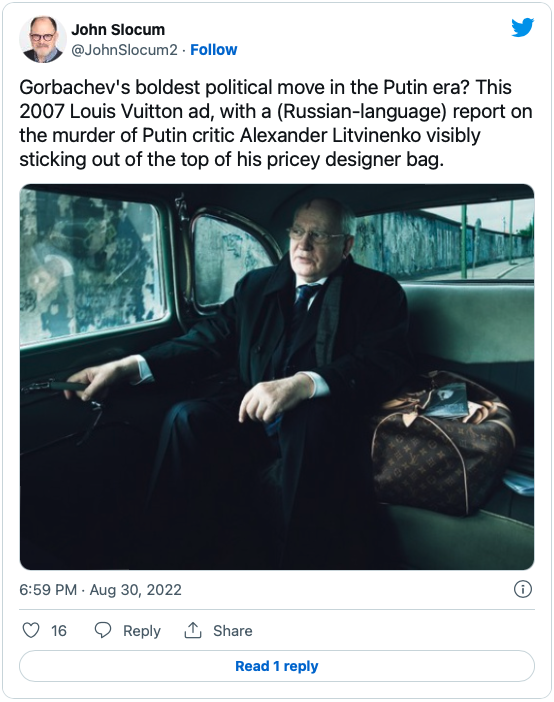
The ad has circulated on social media, and in history classes, before and after Gorbachev’s death as an example of mass media that “still reflects his legacy,” writes Paul. Gorbachev may be largely forgotten — at least in the U.S. — decades after the Pizza Hut ad aired, but it wouldn’t be his last attempt to leave his mark in advertising, as we see in the 2007 Louis Vuitton ad above, featuring a product much less accessible than pizza to the average Russian.
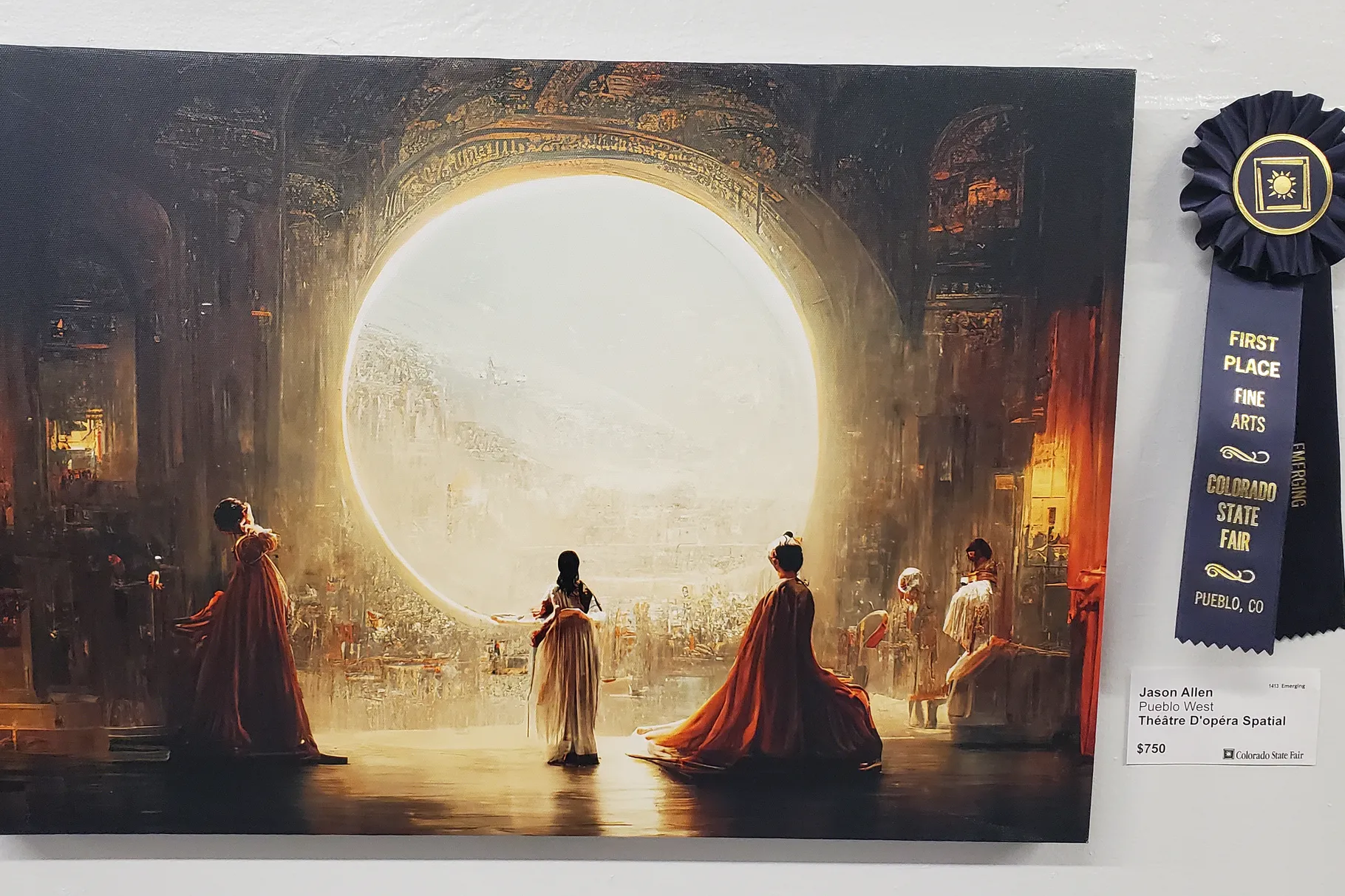
Théâtre D’opéra Spatial by Jason Allen Jason Allen via Discord
The technology behind artificial intelligence-aided art has long been in development, but the era of artificial intelligence-aided art feels like a sudden arrival. Since the recent release of DALL‑E and other image-generation tools, our social-media feeds have filled up with elaborate artworks and even photorealistic-looking pictures created entirely through the algorithmic processing of a simple verbal description. We now live in a time, that is to say, where we type in a few words and get back an image nobody has ever before imagined, let alone seen. And if we do it right, that image could win a blue ribbon at the state fair.
“This year, the Colorado State Fair’s annual art competition gave out prizes in all the usual categories: painting, quilting, sculpture,” reports the New York Times’ Kevin Roose. “But one entrant, Jason M. Allen of Pueblo West, Colo., didn’t make his entry with a brush or a lump of clay. He created it with Midjourney, an artificial intelligence program that turns lines of text into hyper-realistic graphics.” The work, Théâtre D’opéra Spatial, “took home the blue ribbon in the fair’s contest for emerging digital artists,” and it does look, at first glance, like an impressionistic and ambience-rich past-future vision that could grace the cover of one of the better class of science-fiction or fantasy novels.
Reactions have, of course, varied. Roose finds at least one Twitter user insisting that “we’re watching the death of artistry unfold right before our eyes,” and an actual working artist claiming that “this thing wants our jobs.” Allen himself provides a helpfully brash closing quote: “This isn’t going to stop. Art is dead, dude. It’s over. A.I. won. Humans lost.” Over on Metafilter, one commenter makes the expected reference: “It has a sort of Duchamp-submitting-Fountain vibe, only in reverse. Instead of the proposition being that the jury would wrongly fail to recognize something trivial and as art, now we have the proposition that the jury would wrongly fail to recognize that the art is something trivial.”
However little desire you may have to hang Théâtre D’opéra Spatial on your own wall, a moment’s thought will surely lead you to suspect that, on another level, the conditions that brought about its victory are anything but trivial. Midjourney, as the original poster on Metafilter explains, “can be run on any computer with a decent GPU, a Google collab, or run through their own servers.” The ability to generate more-or-less convincing works of art (often littered, it must be said, with the bizarre visual glitches that have been the technology’s signature so far) out of just a few keystrokes will only become more powerful and more widespread. And so the “real” artists must find a new form too vital for the machines to master — just as they’ve had to do all throughout modernity.
Based in Seoul, Colin Marshall writes and broadcasts on cities, language, and culture. His projects include the Substack newsletterBooks on Cities, the book The Stateless City: a Walk through 21st-Century Los Angeles and the video series The City in Cinema. Follow him on Twitter at @colinmarshall, on Facebook, or on Instagram.
The great thinkers of the past knew nothing of Youtube — which, we might be tempted to say today, enabled them to become great thinkers in the first place. This is, of course, uncharitable: surely the rise of streaming media counts among the most important developments in the history of education. Many college students today may genuinely wonder how previous generations got by without Youtube’s background-music mixes engineered, as the New Yorker’s Amanda Petrusich wrote not long ago, “to facilitate and sustain a mood, which in turn might enable a task: studying, folding laundry, making spreadsheets, idly browsing the Internet.”
If Youtube had been available to important minds of previous centuries — indeed, previous millennia — what sort of studying music would it have served to them? This is, in some sense, a philosophical question, and a philosophy channel has been providing answes: a host of answers, in fact, each in the form of a themed Youtube mix.
Based in Seoul, Colin Marshall writes and broadcasts on cities, language, and culture. His projects include the Substack newsletterBooks on Cities, the book The Stateless City: a Walk through 21st-Century Los Angeles and the video series The City in Cinema. Follow him on Twitter at @colinmarshall, on Facebook, or on Instagram.
This fall, historian Timothy Snyder is teaching a course at Yale University called The Making of Modern Ukraine. And he’s generously making the lectures available on YouTube–so that you can follow along too. All of the currently-available lectures appear above (or on this playlist), and we will keep adding new ones as they come online. A syllabus for the course can be found here. Key questions covered by the course include:
What brought about the Ukrainian nation? Ukraine must have existed as a society and polity on 23 February 2022, else Ukrainians would not have collectively resisted Russian invasion the next day. Why has the existence of Ukraine occasioned such controversy? In what ways are Polish, Russian, and Jewish self-understanding dependent upon experiences in Ukraine? Just how and when did a modern Ukrainian nation emerge? Just how for that matter does any modern nation emerge? And why some nations and not others? What is the balance between structure and agency in history? Can nations be chosen, and does it matter? Can the choices of individuals influence the rise of much larger social organizations? If so, how? Ukraine was the country most touched by Soviet and Nazi terror: what can we learn about those systems, then, from Ukraine? Is the post-colonial, multilingual Ukrainian nation a holdover from the past, or does it hold some promise for the future?
If you would like to support the mission of Open Culture, consider making a donation to our site. It’s hard to rely 100% on ads, and your contributions will help us continue providing the best free cultural and educational materials to learners everywhere. You can contribute through PayPal, Patreon, and Venmo (@openculture). Thanks!
We're hoping to rely on loyal readers, rather than erratic ads. Please click the Donate button and support Open Culture. You can use Paypal, Venmo, Patreon, even Crypto! We thank you!
Open Culture scours the web for the best educational media. We find the free courses and audio books you need, the language lessons & educational videos you want, and plenty of enlightenment in between.