When it comes to tourist pilgrimage sites in the United States, the Hoover Dam may not quite rank up there with the Statue of Liberty, the Lincoln Memorial, Mount Rushmore, the Grand Canyon, or Disneyland. But that’s not due to a lack of importance, nor even a lack of impressiveness. Proper appreciation of its man-made majesty, however, requires an understanding of not just the vital function it serves, but the enormous task of its construction. The guides at the Hoover Dam have been trained to explain just that to its many visitors, of course, but all of us could benefit from going in prepared with a little knowledge. Watch the hour-long video on the dam’s design and construction from Animagraffs above, and you may be prepared with enough knowledge to tell the guides a thing or two.
Animagraffs is the YoTtube channel of Jacob O’Neal, which we’ve previously featured here on Open Culture for its acclaimed explanations on a sixteenth-century explorer’s sailing ship and the Golden Gate Bridge, another iconic construction project of the Great Depression. Like those, his Hoover Dam video uses detailed 3D models based on serious research, not least into the project’s original design documents.
This allows O’Neal to show each element of the dam and its complex system of supporting infrastructure in detail and from every angle, as well as in a kind of x‑ray vision. We’ve all seen photographs of the Hoover Dam, and maybe even bought some from its gift shop, but even the most sublime aerial view doesn’t reveal as much about its ambition as a look into its inner workings.
And the ambition of the Hoover Dam is one aspect guaranteed to impress any viewers. It required thousands of workers about five years to re-shape the Nevada and Arizona landscape at a grand enough scale to make possible human control of the mighty — and, more to the point, mightily unpredictable — Colorado River. With its large turbines, the engineering and installation of which O’Neal explains in full, it managed to generate enough electricity to repay its construction cost of more than $811 million in today’s dollars by 1987, just over 50 years after it opened. And in an achievement almost impossible to believe today, it opened more than two years ahead of schedule. We hear a good deal today about the concept of “state capacity,” and how the U.S. could regain it. At the Hoover Dam, we behold state capacity quite literally made concrete.
Based in Seoul, Colin Marshall writes and broadcasts on cities, language, and culture. He’s the author of the newsletterBooks on Cities as well as the books 한국 요약 금지 (No Summarizing Korea) and Korean Newtro.Follow him on the social network formerly known as Twitter at @colinmarshall.
The phone gives us a lot but it takes away three key elements of discovery: loneliness, uncertainty and boredom. Those have always been where creative ideas come from. — Lynda Barry
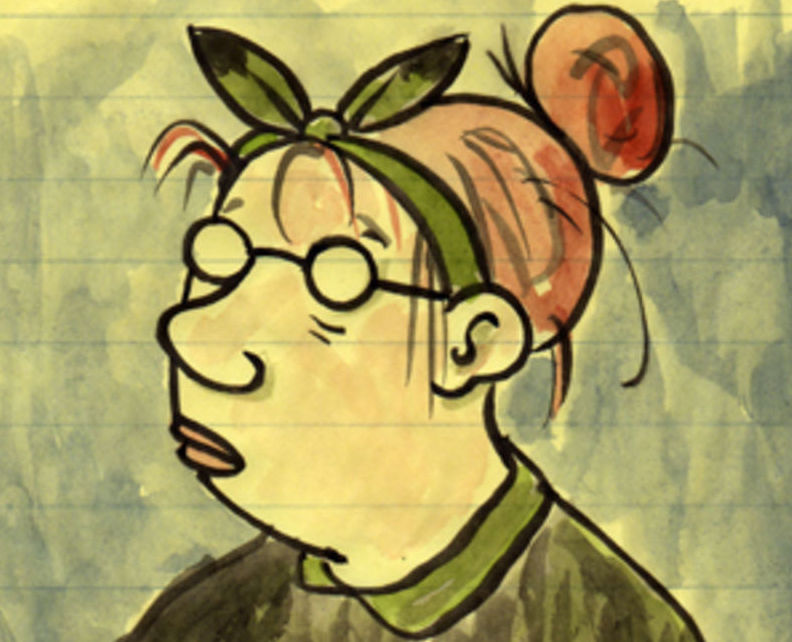
In the spring of 2016, the great cartoonist and educator, Lynda Barry, did the unthinkable, prior to giving a lecture and writing class at NASA’s Goddard Space Flight Center.
She demanded that all participating staff members surrender their phones and other such personal devices.
Her victims were as jangled by this prospect as your average iPhone-addicted teen, but surrendered, agreeing to write by hand, another antiquated notion Barry subscribes to:
The delete button makes it so that anything you’re unsure of you can get rid of, so nothing new has a chance. Writing by hand is a revelation for people. Maybe that’s why they asked me to NASA – I still know how to use my hands… there is a different way of thinking that goes along with them.
Barry—who told the Onion’s AV Club that she crafted her book What It Is with an eye toward bored readers stuck in a Jiffy Lube oil-change waiting room—is also a big proponent of doodling, which she views as a creative neurological response to boredom:
Boring meeting, you have a pen, the usual clowns are yakking. Most people will draw something, even people who can’t draw. I say “If you’re bored, what do you draw?” And everybody has something they draw. Like “Oh yeah, my little guy, I draw him.” Or “I draw eyeballs, or palm trees.” … So I asked them “Why do you think you do that? Why do you think you doodle during those meetings?” I believe that it’s because it makes having to endure that particular situation more bearable, by changing our experience of time. It’s so slight. I always say it’s the difference between, if you’re not doodling, the minutes feel like a cheese grater on your face. But if you are doodling, it’s more like Brillo. It’s not much better, but there is a difference. You could handle Brillo a little longer than the cheese grater.
Meetings and classrooms are among the few remaining venues in which screen-addicted moths are expected to force themselves away from the phone’s inviting flame. Other settings—like the Jiffy Lube waiting room—require more initiative on the user’s part.
Once, we were keener students of minor changes to familiar environments, the books strangers were reading in the subway, and those strangers themselves. Our subsequent observations were known to spark conversation and sometimes ideas that led to creative projects.
Now, many of us let those opportunities slide by, as we fill up on such fleeting confections as funny videos and all-you-can-eat servings of social media.
It’s also tempting to use our phones as defacto shields any time social anxiety looms. This dodge may provide short term comfort, especially to younger people, but remember, Barry and many of her cartoonist peers, including Daniel Clowes, Simon Hanselmann, and Ariel Schrag, toughed it out by making art. That’s what got them through the loneliness, uncertainty, and boredom of their middle and high school years.
The book you hold in your hands would not exist had high school been a pleasant experience for me… It was on those quiet weekend nights when even my parents were out having fun that I began making serious attempts to make stories in comics form.
- Adrian Tomine, introduction to 32 Stories
Barry is far from alone in encouraging adults to peel themselves away from their phone dependency for their creative good.
Photographer Eric Pickersgill’sRemoved imagines a series of everyday situations in which phones and other personal devices have been rendered invisible. (It’s worth noting that he removed the offending articles from the models’ hands, rather that Photoshopping them out later.)
Computer Science Professor Calvin Newport’s book, Deep Work, posits that all that shallow phone time is creating stress, anxiety, and lost creative opportunities, while also doing a number on our personal and professional lives.
Author Manoush Zomorodi’s TED Talk on how boredom can lead to brilliant ideas, below, details a weeklong experiment in battling smartphone habits, with lots of scientific evidence to back up her findings.
But what if you wipe the slate of digital distractions only to find that your brain’s just… empty? A once occupied room, now devoid of anything but dimly recalled memes, and generalized dread over the state of the world?
The aforementioned AV Club interview with Barry offers both encouragement and some useful suggestions that will get the temporarily paralyzed moving again:
I don’t know what the strip’s going to be about when I start. I never know. I oftentimes have—I call it the word-bag. Just a bag of words. I’ll just reach in there, and I’ll pull out a word, and it’ll say “ping-pong.” I’ll just have that in my head, and I’ll start drawing the pictures as if I can… I hear a sentence, I just hear it. As soon as I hear even the beginning of the first sentence, then I just… I write really slow. So I’ll be writing that, and I’ll know what’s going to go at the top of the panel. Then, when it gets to the end, usually I’ll know what the next one is. By three sentences or four in that first panel, I stop, and then I say “Now it’s time for the drawing.” Then I’ll draw. But then I’ll hear the next one over on another page! Or when I’m drawing Marlys and Arna, I might hear her say something, but then I’ll hear Marlys say something back. So once that first sentence is there, I have all kinds of choices as to where I put my brush. But if nothing is happening, then I just go over to what I call my decoy page. It’s like decoy ducks. I go over there and just start messing around.
Note: An earlier version of this post appeared on our site in 2017.
When asked for their favorite Sesame Street segment, many children of the 70s and 80s point to Pinball Number Count. Psychedelic animation, the Pointer Sisters, odd time signatures—what’s not to love? But for the serious Sesame Street buff, the “Jazz Numbers” series above deserves the silver medal. It’s got free jazz, Yellow Submarine-style surrealistic animation, and a vocal from Grace Slick of Jefferson Airplane. How many young parents recognized her distinctive voice, I wonder?
Also known as “Jazzy Spies,” this 1969 series of animations was devoted to the numbers 2 through 10 (there was no film for “one” as it is the loneliest number that you’ll ever do), and was an essential element in Sesame Street’s first season. Highlights include the dream-like elevator door sequence of “2,” the Jackson 5 reference in “5,” and the racing fans in “10.”
Slick got involved through her first husband, Jerry Slick, who produced the segments for San Francisco-based animation studio Imagination, Inc. Headed by animator Jeff Hale, the company also produced the Pinball segments, as well as the famous anamorphic “Typewriter Guy,” the Ringmaster, and the Detective Man. Hale, by the way, has a cameo as Augie “Ben” Doggie in the well-loved Lucas parody Hardware Wars.)
The delirious music was composed and performed by Columbia jazz artist Denny Zeitlin, who would go on to score the 1979 remake of Invasion of the Body Snatchers. Zeitlin plays both piano and clavinet; accompanying him is Bobby Natanson on drums and Mel Graves on bass. According to Zeitlin, Grace Slick overdubbed her vocals later.
This wasn’t Slick’s first encounter with Jim Henson. In 1968, she and other members of Jefferson Airplane were part of a counterculture documentary called Youth ’68, the trailer for which you can groove on here.
Sesame Street, with all its primary colors, plastic merchandise, and Elmo infestation, may have lost its edge, but these early works show its revolutionary foundations.
Note: An earlier version of this post appeared on our site in 2015.
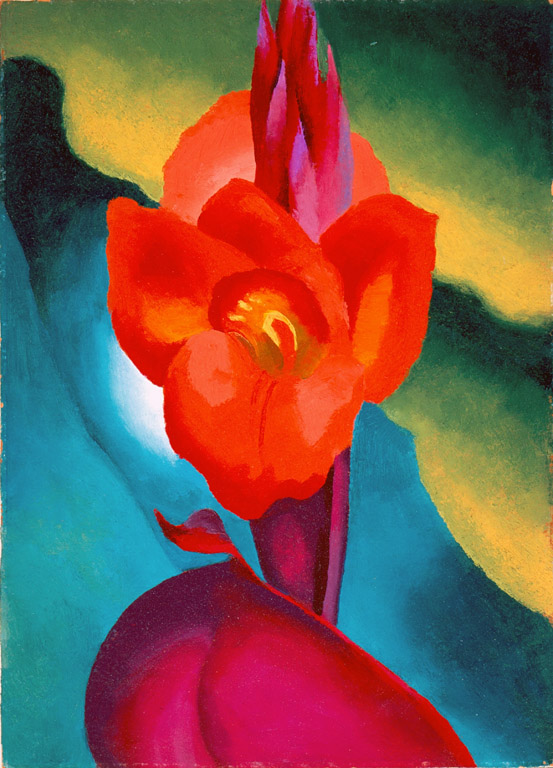
Upon hearing the names of Arthur Dove or Marsden Hartley, the saturated colors and organically askew lines of those painters’ landscapes may appear before your mind’s eye. But unless you have a special interest in American modernists of the early twentieth century, they probably don’t. The name Georgia O’Keeffe, by contrast, can hardly fail to bring a few images even to the mind of the strictly casual art appreciator: New Mexican mesas, animal skulls, and above all flowers in extreme close-up. Apart from the artistic skill and distinctive vision with which she created it, O’Keeffe’s work persists in the wider culture because of how well it happens to reproduce in a variety of contexts, including postcards, mugs, and even apparel, such as that sold at her eponymous museum in Santa Fe.
Keeping such products around is, of course, no substitute for seeing the real thing; in their physical reality, O’Keeffe’s paintings have a way of rebuffing all the interpretations with which they’ve been freighted for more than a century now. If you can’t make it out to New Mexico, the Georgia O’Keeffe Museum has been working to make every single one of her pieces (including sculptures and photographs) available for viewing online at a just-launched portal called Access O’Keeffe.
The museum describes it as a “user-friendly, searchable website with high-resolution images, visual descriptions, exhibition histories, archival materials, and research data associated with the artist’s two-volume catalogue raisonné.” The site’s visitors “can browse by color, shape, or medium, explore the context of works created before and after a specific painting, trace historic exhibitions, create lists of favorites, and download images.”
Access O’Keeffe makes it easy to find the artist’s most famous paintings, but also works that may surprise viewers who only know her mesas, skulls, and flowers. Take, for example, such nocturnally themed canvases as her early Starlight Night, from 1917, or her late Untitled (City Night), from the nineteen-seventies. O’Keeffe’s America, we must remember, isn’t limited to the desert: though she did spend most of her nearly century-long life’s second half in New Mexico, it also took her from Wisconsin to Virginia to Texas to New York, with stints in South Carolina and Hawaii. Given the importance of understanding any artist’s contexts both geographical and social, Access O’Keeffe also provides an archive of artifacts and exhibitions related to the people and organizations associated with her — Arthur Dove and Marsden Hartley included.
Based in Seoul, Colin Marshall writes and broadcasts on cities, language, and culture. He’s the author of the newsletterBooks on Cities as well as the books 한국 요약 금지 (No Summarizing Korea) and Korean Newtro.Follow him on the social network formerly known as Twitter at @colinmarshall.
Incompetent people tend to see themselves as not just competent, but highly competent. So, at any rate, holds the theory of the “Dunning-Kruger effect,” previously featured here on Open Culture. But does the converse also hold: do highly competent people tend to see themselves as incompetent? That would seem to be an implication of what’s been called “impostor syndrome,” a persistent sense of inadequacy relative to one’s status or position, unsupported by any objective evidence. If you yourself have been afflicted with that condition, it may be a tad hasty to take it as a sign of your own effectiveness, but as the Harvard Business School’s Arthur C. Brooks explains in the clip above, it may nonetheless benefit you to lean into it.
“What all strivers I’ve ever met have in common is that, the higher they climb and the more success they have, the more insecure they feel in their own success because they’re not quite sure that they’ve earned it or deserve it,” Brooks says. Ironically, in his experience, “people who deserve success through hard work and merit and personal responsibility are not quite sure they deserve it, and the people who don’t deserve it are often the people who are actually most sure that they do.”
In that last group are possessors of the so-called “dark triad” traits: narcissism, Machiavellianism, and psychopathy. A “good, normal, healthy person,” by contrast, will naturally wonder if they really merit the promotions, rewards, and accolades they receive, and if they’re truly up to each task ahead.
To combat impostor syndrome, Brooks recommends you “understand it, keep up to date with it, and keep trying to get better at the things you’re not good at yet.” Humanity’s general negativity bias may keep most of us suspecting that we’ve been overestimated, but that doesn’t mean we should ignore the opportunities for genuine self-improvement that such feelings present. “The truth is, if things are really, really rough for you, you’re not all weaknesses, and if things are going really well for you, you’re not all strengths.” It just happens that at some times, everyone focuses on the former, and at other times, the latter, and what’s important is not to let yourself be too heavily influenced in either case. Perhaps you can stay grounded by bearing in mind a couple of trusty old adages: that nobody’s perfect, and that you do, sometimes, have to fake it ’til you make it.
Based in Seoul, Colin Marshall writes and broadcasts on cities, language, and culture. He’s the author of the newsletterBooks on Cities as well as the books 한국 요약 금지 (No Summarizing Korea) and Korean Newtro.Follow him on the social network formerly known as Twitter at @colinmarshall.
Just days ago, a game came out whose unlikely premise has already drawn a good deal of attention. “Manage your very own video store in the early 90s!” exclaims the description of Retro Rewind. “Rent, sell, decorate and expand your business from the ground up and relive the golden ages of video rentals!” Those of us old enough to have relied on such establishments for our early cinematic education can all too easily remember how frustrating they could be, what with their physically limited selections, seldom-rewound tapes, and punitive late fees. Even so, younger generations aren’t wrong to imagine that some were special places where it felt like a cinephile’s dreams could come true. Just ask Quentin Tarantino.
The clip above comes from Joe Rogan’s interview with Tarantino and Roger Avary, who worked together at Manhattan Beach’s Video Archives before they co-wrote Pulp Fiction. “Working at that store, I just got caught up in the little life there,” Tarantino says. Yet he also remembers himself thinking, “Well, this isn’t my dream. This isn’t what I wanted to do working at a video store for years. I wanted to actually make movies. It’s not my dream, what I’m doing — but it’s dream-adjacent!” It turned out that getting paid to watch movies all day long (to say nothing of becoming locally famous for sheer cinephilia) without putting in any serious manual labor “put my ambitions to sleep a little bit.”
Tarantino explains that his awakening from this retail reverie began with witnessing the sudden embitterment of fellow clerks who passed the age of thirty doing the same “cool” jobs they always had. This set him on the path to undergoing a series of dark nights of the soul he called “Quentin detest fests,” during which he would make a no-excuses accounting of all the mistakes he was actively or passively making. “I would spend all night laying out everything I’m doing that’s wrong, and then I would spend the last two hours figuring out how I could change it. And as opposed to just doing it and then going to get some sleep, and then you forget about it and fall back into your routine, I decided to change my life.”
Attachment to his job was a big part of the problem. “I’ve got to just move to Hollywood, I’ve got to get involved there, I’ve got to meet other people that are in the business,” he realized. “I shouldn’t be making money until I’m making money doing what I want to do.” Not long after relocating from the South Bay to Koreatown — still well south of Hollywood, but close enough — he started making connections in the low-budget horror world. “Well, if these guys can do it, I can do it,” he came to believe, and within a year and a half he was making a living as a screenwriter. The video rental industry has long since collapsed, but Quentin Tarantino is still going strong as a filmmaker. If he takes a break from working on what may be his last picture to play Retro Rewind, we’d surely all be interested in hearing what memories it brings back. Maybe he and Avary can discuss it on their Video Archives Podcast.
Based in Seoul, Colin Marshall writes and broadcasts on cities, language, and culture. He’s the author of the newsletterBooks on Cities as well as the books 한국 요약 금지 (No Summarizing Korea) and Korean Newtro.Follow him on the social network formerly known as Twitter at @colinmarshall.
Above, you can watch a primer on the Strait of Hormuz, the narrow passage between Iran and Oman through which roughly 20% of the world’s oil supply flows. Produced by Vox, the video explains why this chokepoint has long played a central role in tensions between the United States and Iran. Since the 1980s, Iran has threatened to disrupt traffic through the Strait, all as a way to exert pressure on the global economy. Now, facing an attack from the United States and Israel, it’s making good on its threats, slowing traffic to a trickle. With oil prices surging, the Trump administration has yet to demonstrate that it has a coherent plan for countering a strategy that Iran announced decades ago. Stay tuned for more…
If you would like to support the mission of Open Culture, consider making a donation to our site. It’s hard to rely 100% on ads, and your contributions will help us continue providing the best free cultural and educational materials to learners everywhere. You can contribute through PayPal, Patreon, and Venmo (@openculture). Thanks!
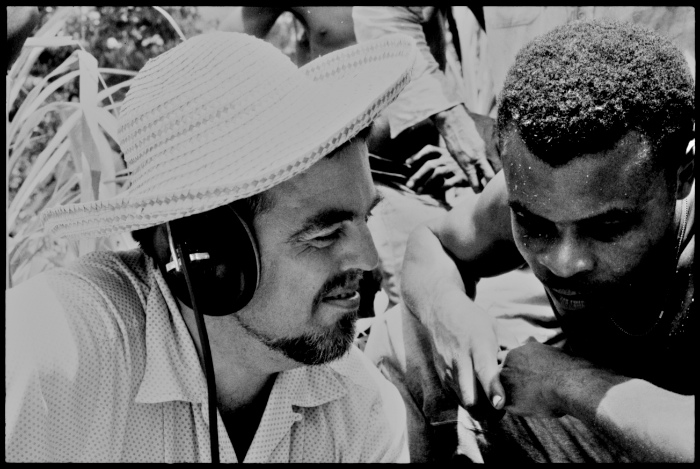
A huge treasure trove of songs and interviews recorded by the legendary folklorist Alan Lomax from the 1940s into the 1990s has been digitized and made available online for free listening. The Association for Cultural Equity, a nonprofit organization founded by Lomax in the 1980s, has posted some 20,000 recordings.
“For the first time,” Cultural Equity Executive Director Don Fleming told NPR’s Joel Rose, “everything that we’ve digitized of Alan’s field recording trips are online, on our Web site. It’s every take, all the way through. False takes, interviews, music.”
It’s an amazing resource. For a quick taste, here are a few examples from one of the best-known areas of Lomax’s research, his recordings of traditional African American culture:
“John Henry” sung by prisoners at the Mississippi State Penitentiary, Parchman Farm, in 1947.
“Come Up Horsey,” a children’s lullaby sung in 1948 by Vera Hall, whose mother was a slave.
But that’s just scratching the surface of what’s inside the enormous archive. Lomax’s work extended far beyond the Deep South, into other areas and cultures of America, the Caribbean, Europe and Asia. “He believed that all cultures should be looked at on an even playing field,” his daughter Anna Lomax Wood told NPR. “Not that they’re all alike. But they should be given the same dignity, or they had the same dignity and worth as any other.”
Note: An earlier version of this post originally appeared on our site in March 2012.
If you would like to support the mission of Open Culture, consider making a donation to our site. It’s hard to rely 100% on ads, and your contributions will help us continue providing the best free cultural and educational materials to learners everywhere. You can contribute through PayPal, Patreon, and Venmo (@openculture). Thanks!
We're hoping to rely on loyal readers, rather than erratic ads. Please click the Donate button and support Open Culture. You can use Paypal, Venmo, Patreon, even Crypto! We thank you!
Open Culture scours the web for the best educational media. We find the free courses and audio books you need, the language lessons & educational videos you want, and plenty of enlightenment in between.