It takes a fearless filmmaker indeed to adapt Dune. Atop its rich linguistic, political, philosophical, religious, and ecological foundations, Frank Herbert’s saga-launching 1965 novel also happens to have a plot “convoluted to the point of pain.” So writes David Foster Wallace in his essay on David Lynch, who directed the first cinematic version of Dune in 1984. That the result is remembered as a “huge, pretentious, incoherent flop” (with an accompanying glossary handout) owes to a variety of factors, not least studio meddling and the unsurprising incompatibility of the man who made Eraserhead with large-scale Hollywood sci-fi. The question lingered: could Dune be successfully adapted at all?
Well before Lynch took his crack, El Topo and The Holy Mountain director Alejandro Jodorowsky put together his own Dune adaptation. If all had gone well it would have come out as a ten-hour film featuring the art of H.R. Giger and Moebius as well as the performances of Orson Welles, Gloria Swanson, David Carradine, Alain Delon, Mick Jagger, and Salvador Dalí.
But all did not go well, and cinema was deprived of what would have been a singular spectacle no matter how it turned out. At least one element of Jodorowsky’s Dune has survived, however, in the latest attempt to bring Herbert’s complex bestseller to the screen: the music of Pink Floyd, heard in the just-released trailer for Denis Villeneuve’s Dune, starring Timothée Chalemet as the young hero Paul Atreides (as well as Oscar Isaac, Josh Brolin, and a host of other currently big names), scheduled for release in December.
If a credible Dune movie is possible, Villeneuve is the man to direct it. His previous two pictures, Blade Runner 2049 and the alien-visitation drama Arrival, demonstrate not just his capabilities with science fiction but his sense of the sublime. Beginning with its setting, the desert-wasteland planet of Arrakis, Dune demands to be envisioned with the kind of beauty that inspires something close to dread and fear. (The first director asked to adapt Dune was David Lean, perhaps due to his track record with majestic views of sand.) Villeneuve has also made the wise choice of refusing to compress the entire book into a single feature, presenting this as the first of a two-part adaptation. And as a lifelong Dune fan, he understands the attitude necessary to approaching this challenge: “Fear is the mind-killer,” as Paul famously puts it — so famously that the trailer couldn’t possibly exclude Chalamet’s delivery of the line.
Based in Seoul, Colin Marshall writes and broadcasts on cities, language, and culture. His projects include the book The Stateless City: a Walk through 21st-Century Los Angeles and the video series The City in Cinema. Follow him on Twitter at @colinmarshall, on Facebook, or on Instagram.
Maintaining the balance of power among European states has always been a fraught affair, but it was especially so in the years when mercantilism made fragile alliances during the religious wars of the 17th century. This was a time when merchants made excellent diplomats, not only because they traveled extensively and learned foreign tongues and customs, but because they spoke the universal language of trade.
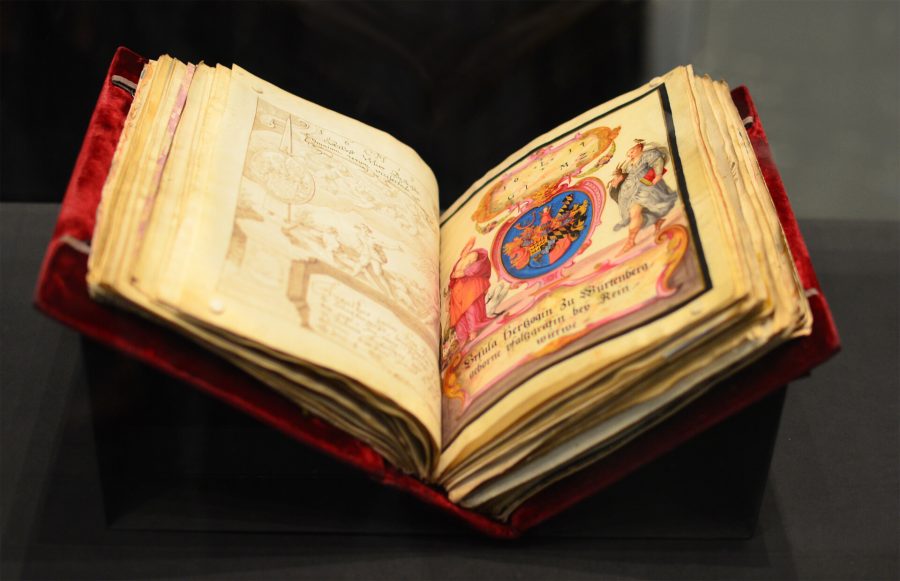
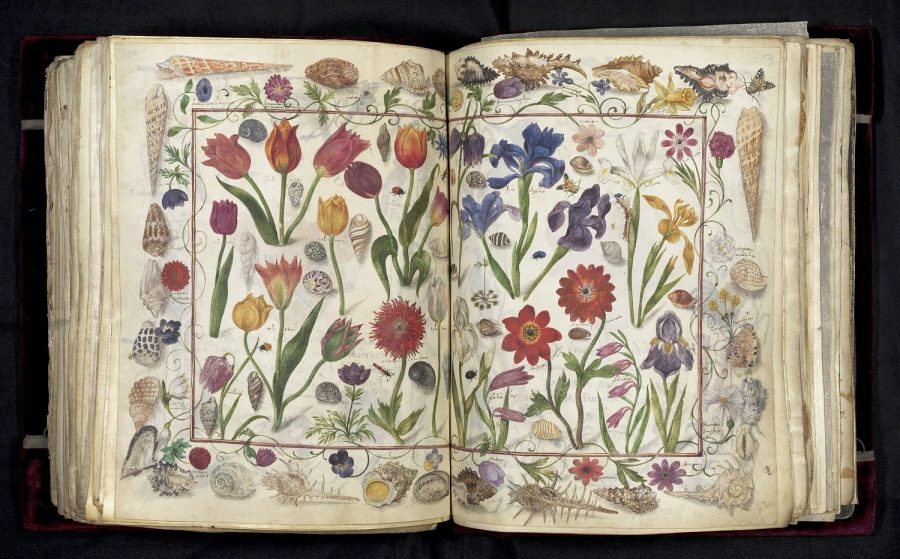
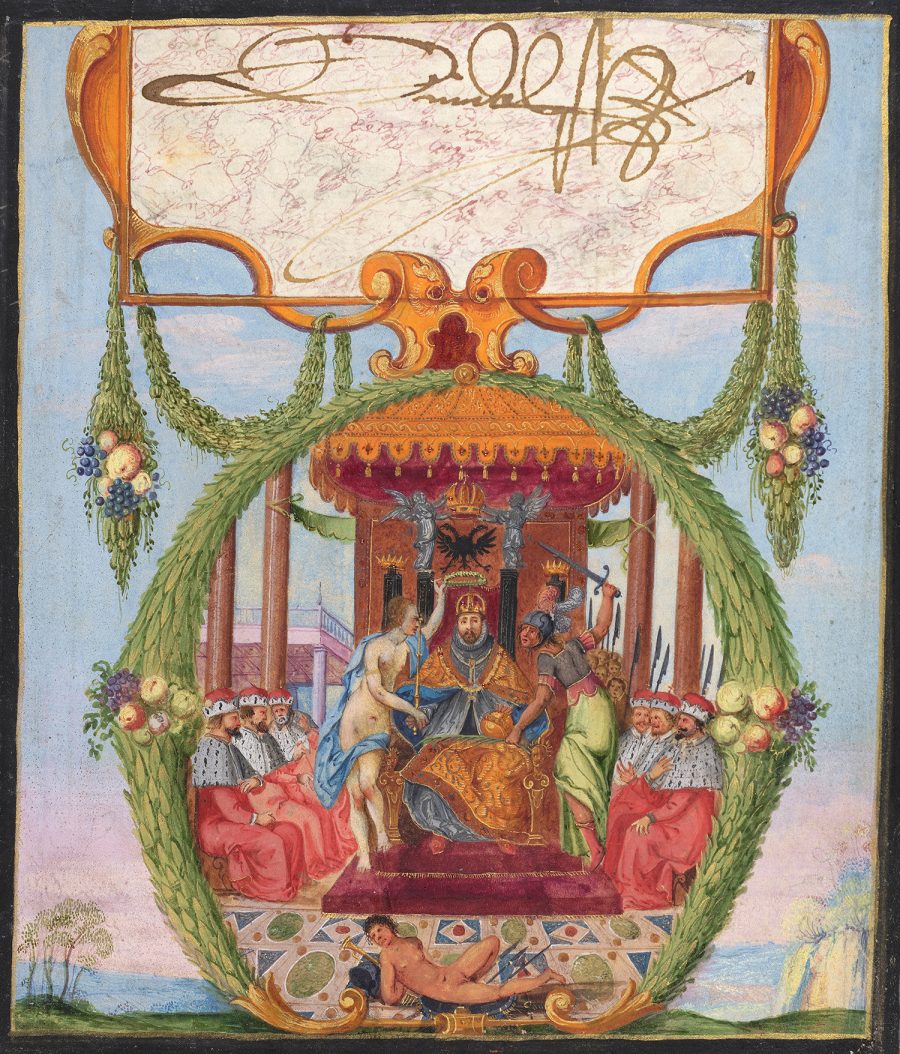
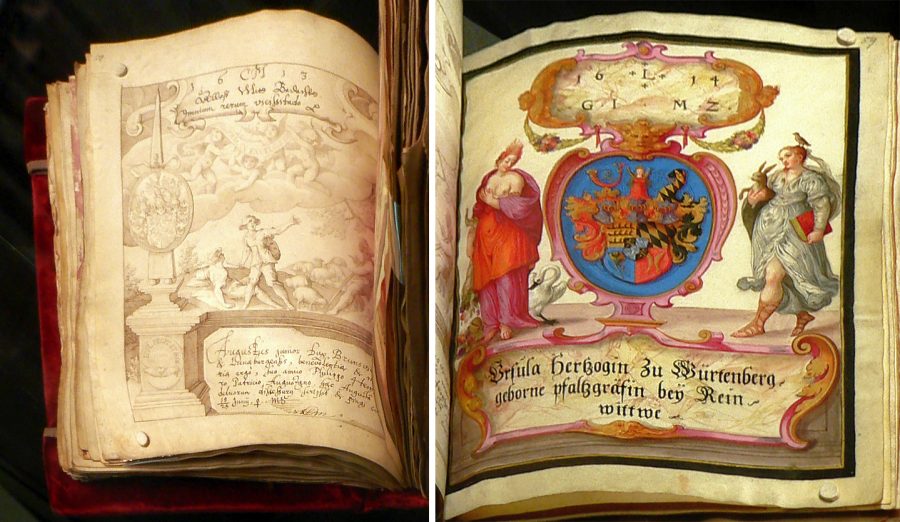
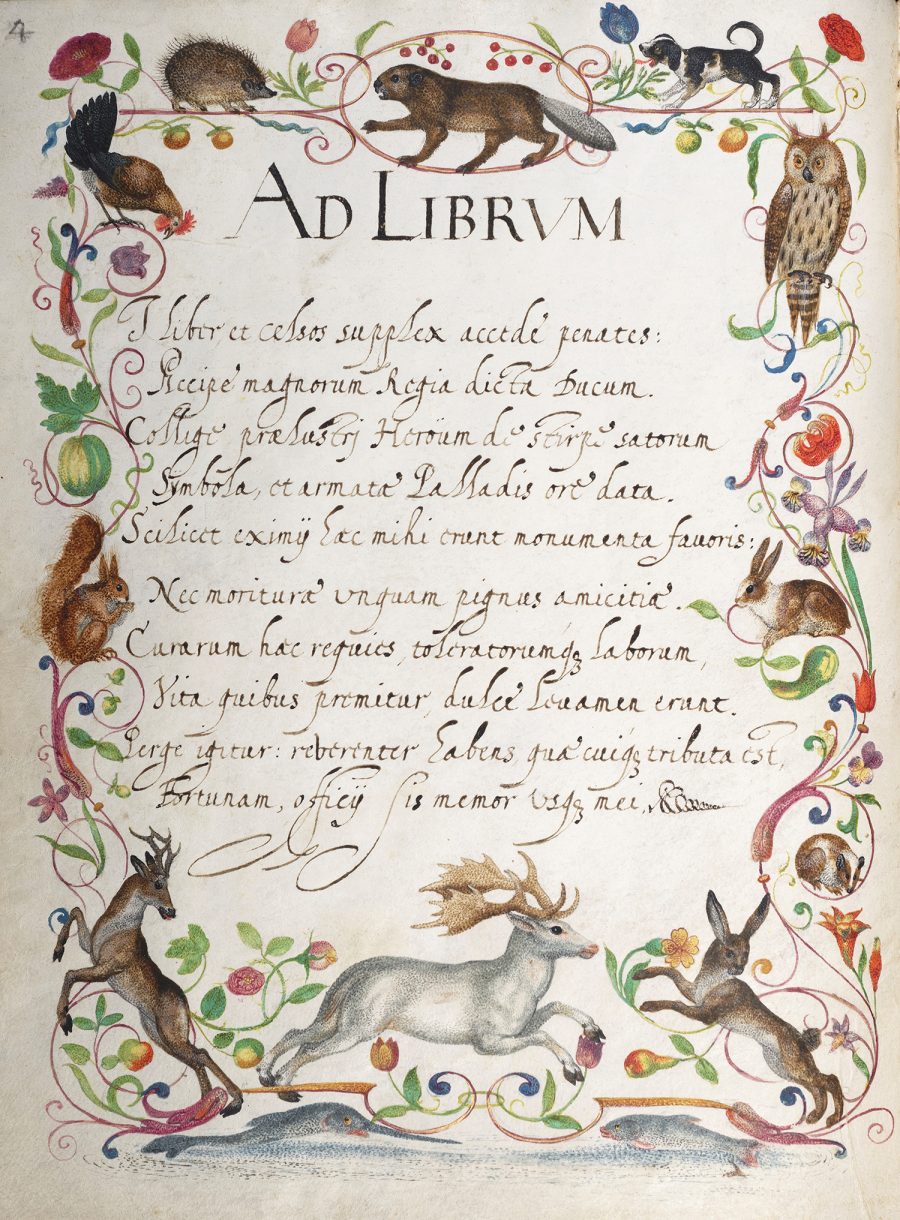
German merchant and diplomat Philipp Hainhofer from Augsburg was such a figure, traveling from court to court to meet with Europe’s renowned dignitaries. As he did so, he would ask them to sign his album amicorum, or “friendship book,” also called a stammbuch. Each signer would then “commission an artist to create a painting accompanying their signatures,” Alison Flood writes at The Guardian.
“There are around 100 drawings” in his autograph book, known as the Große Stammbuch, “which took more than 50 years to compile.” After Hainhofer’s death in 1647, his friend August the Younger—who helped collect the hundreds of thousand of books in the Herzog August Bibliothek—tried to acquire the book but failed. Now it has finally landed in the huge library, one of the world’s oldest, almost 400 years later, after a purchase at a private auction this week.
Friendship books were commonly used at the time to record the names of family and friends. Students used them as yearbooks, and Hainhofer began his collection of signatures as a college student. He gradually gained a select clientele as his career advanced. Signatories, the History Blog points out, “include Holy Roman Emperor Rudolf II, another HRE Matthias, Christian IV of Denmark and Norway, Cosimo II de’Medici, Grand Duke of Tuscany…” and many others.
Hainhofer’s Große Stammbuch is, as you can see, a beautiful work of art—or almost 100 collected works of art—in its own right. “The elaborateness of the illustrations directly corresponds to the signatory’s status and rank in society,” as Grace Ebert notes at Colossal. It is also a fascinating record of Early Modern European politics, trade, and diplomacy, a fine art all its own.
The art of drawing is not the art of observing forms and objects alone, it is not mere mimicry of these objects; it is the art of knowing how far and wherein, and with what just limitations, those forms and objects can be reproduced in a picture, or in a decorative work. — Eugène Grasset, 1896
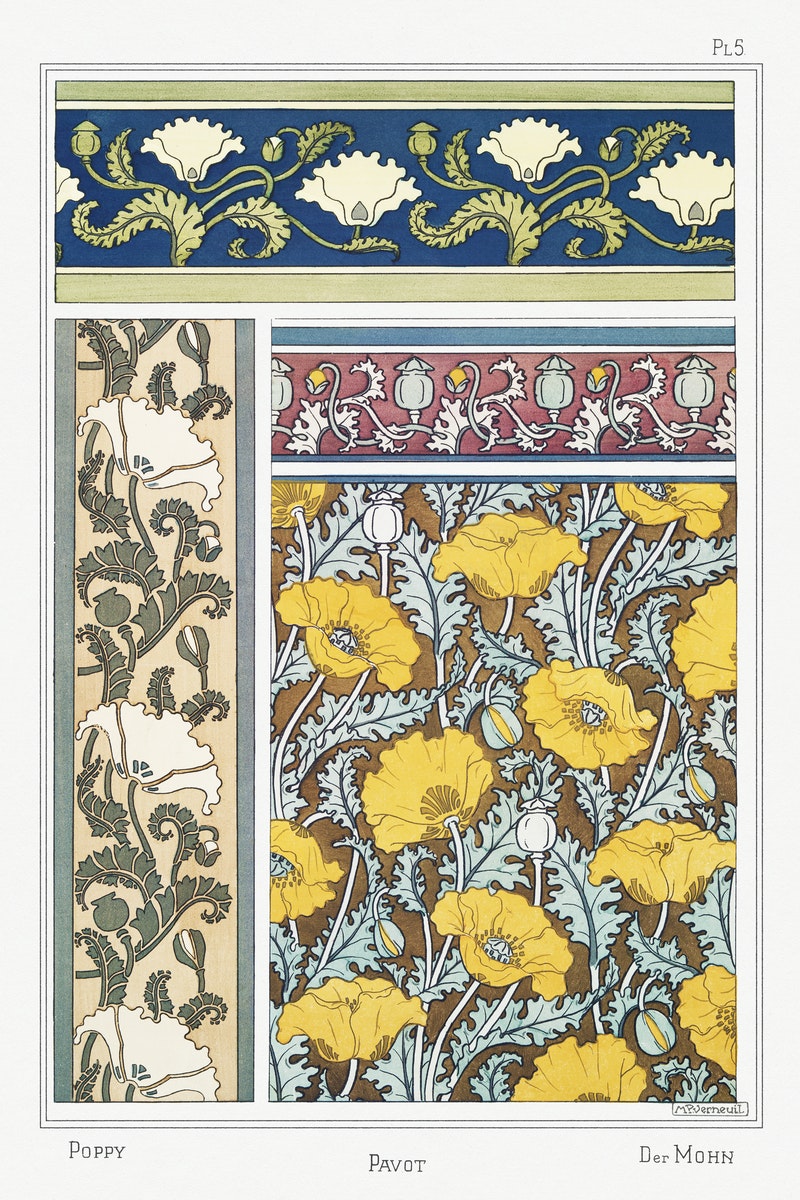
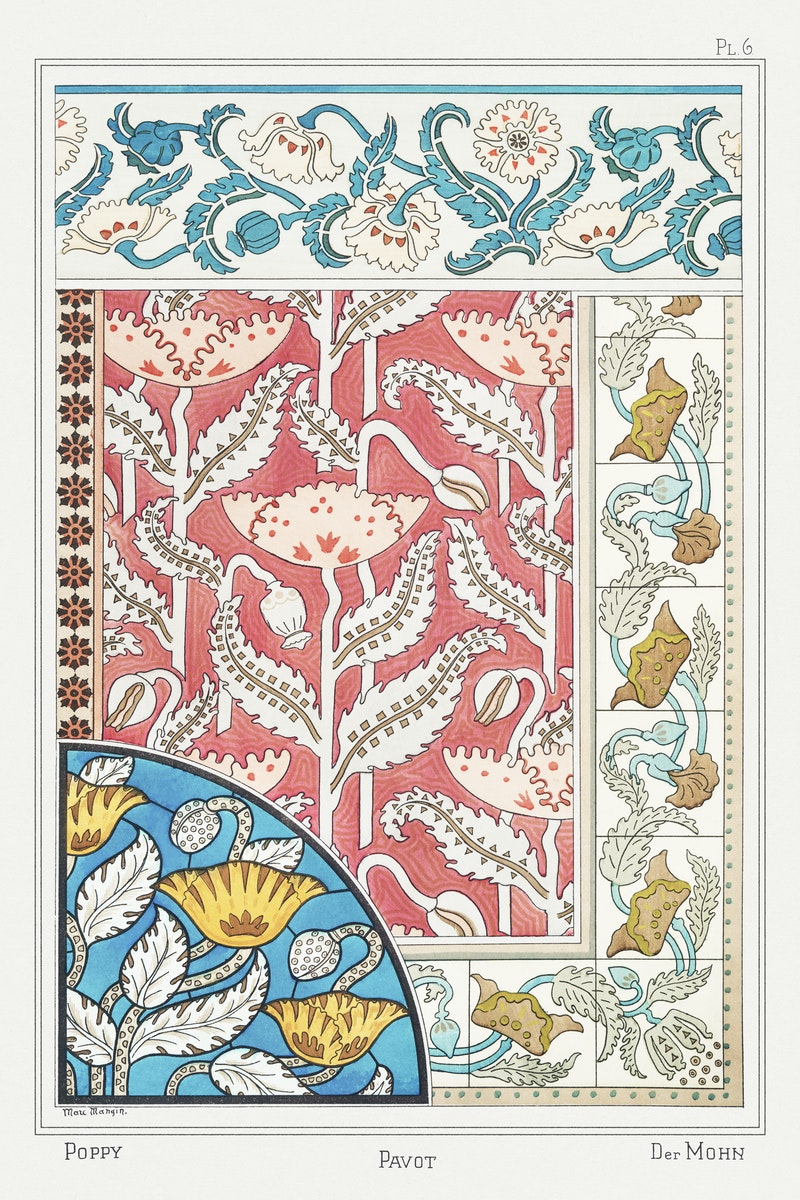
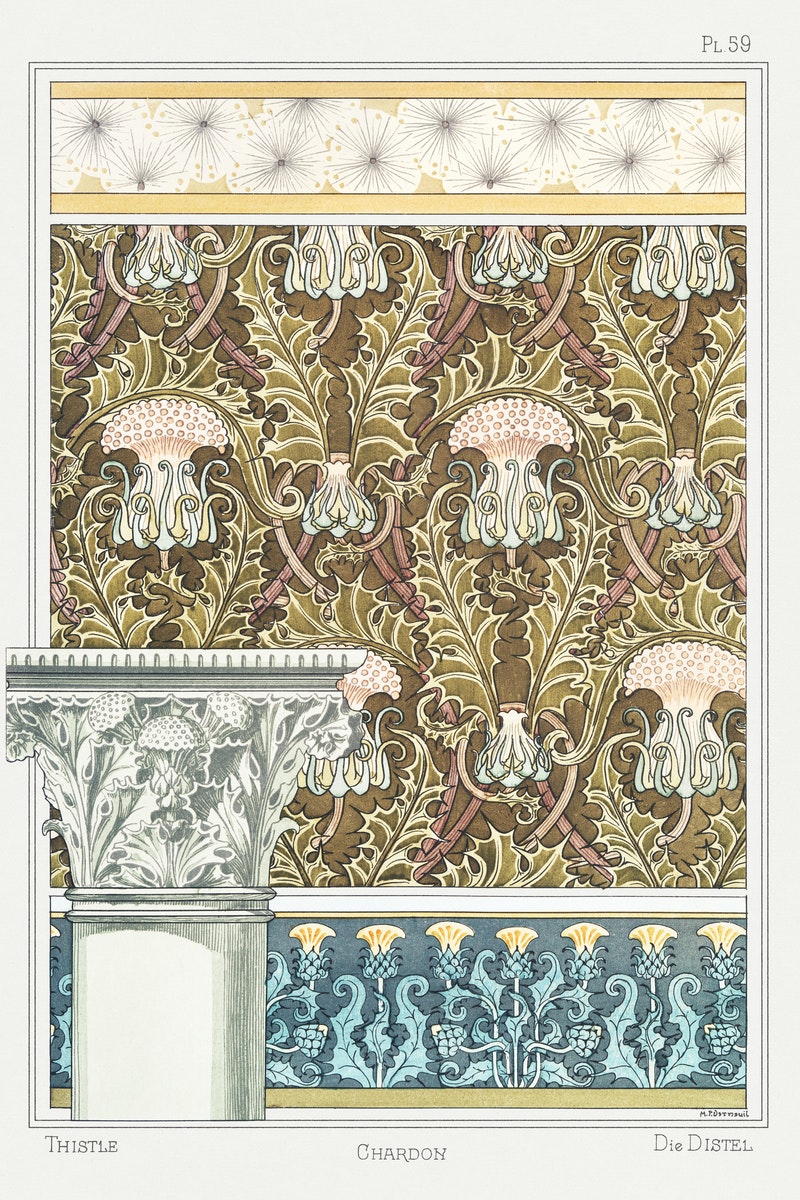
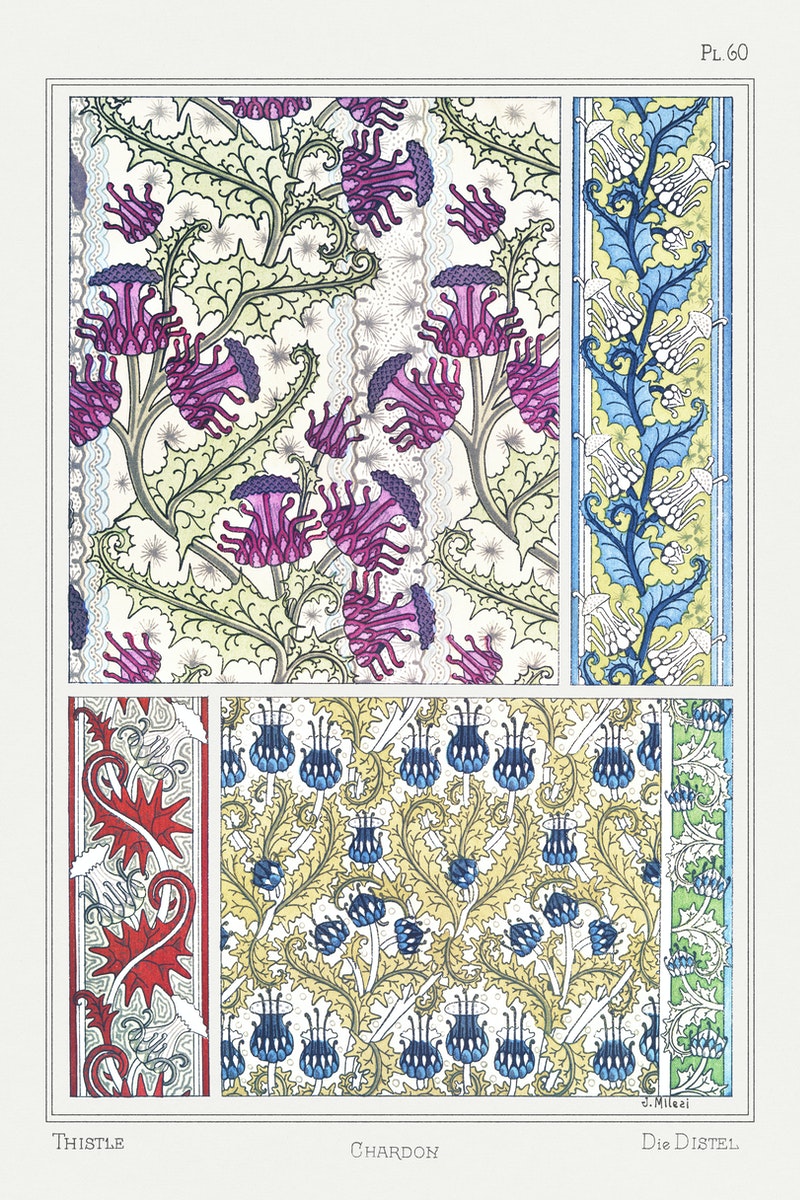
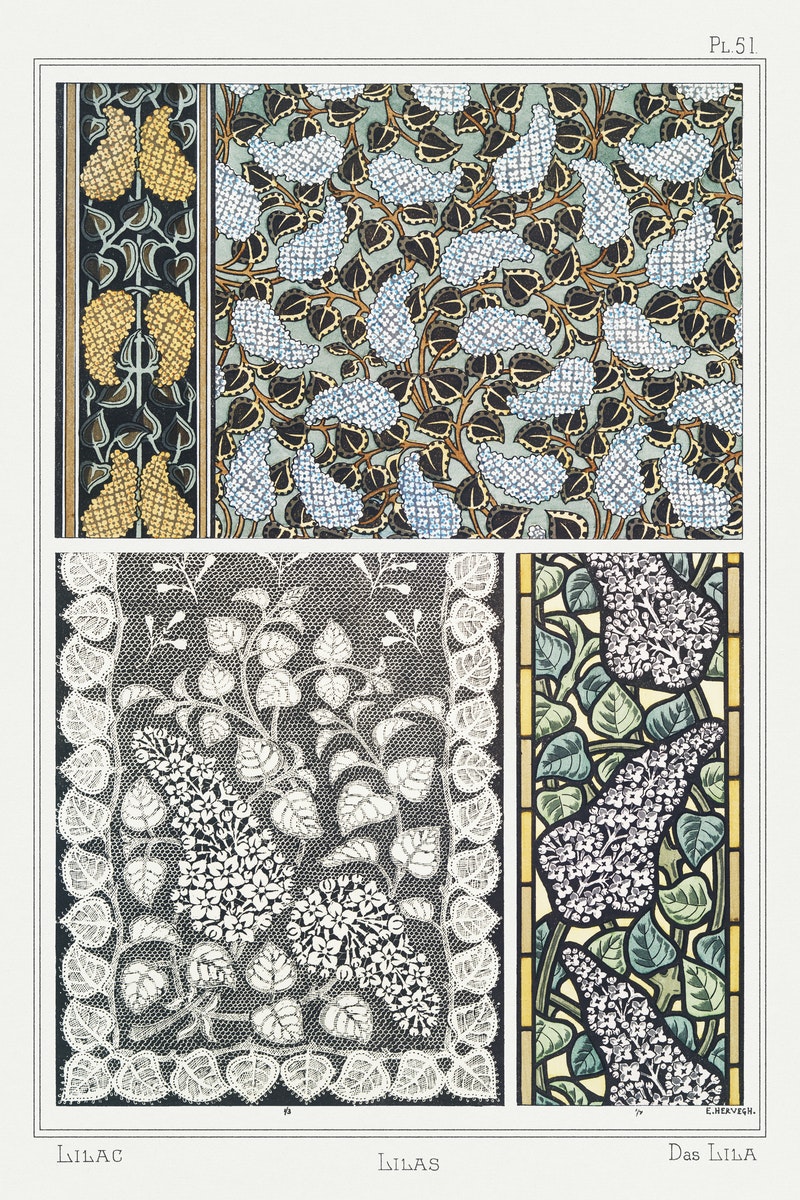
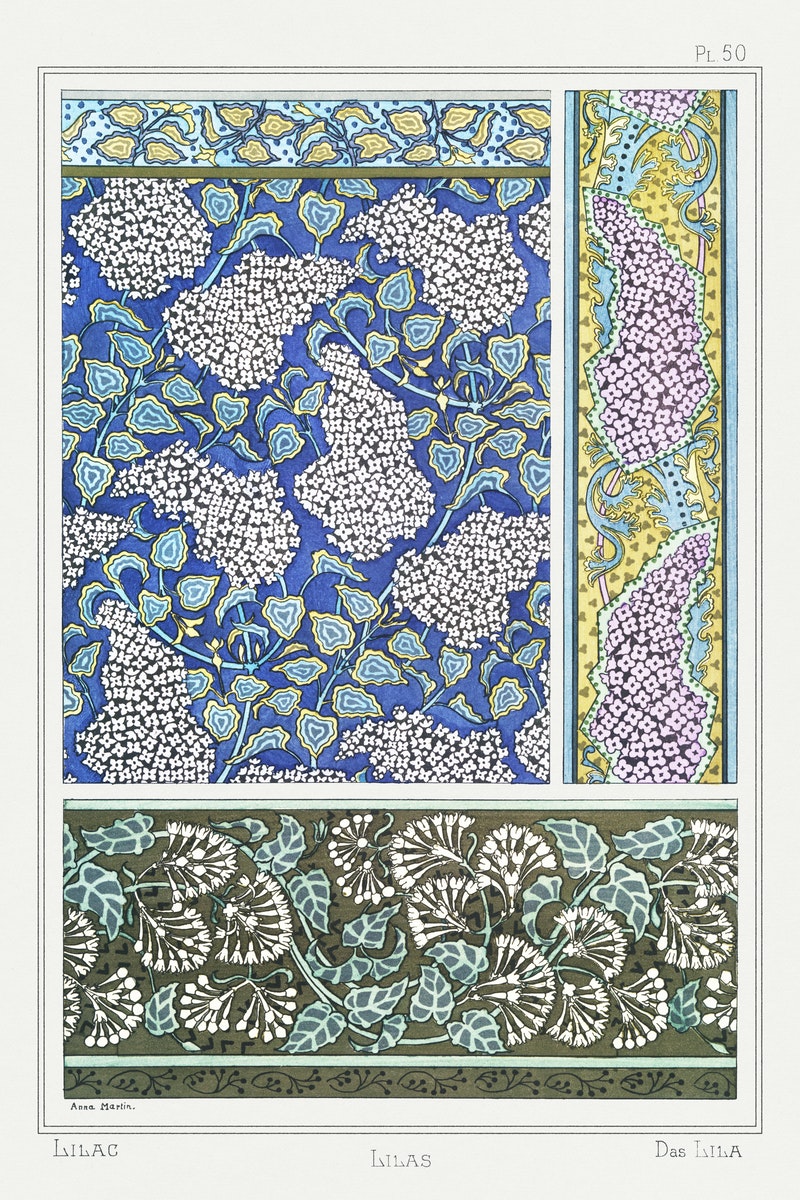
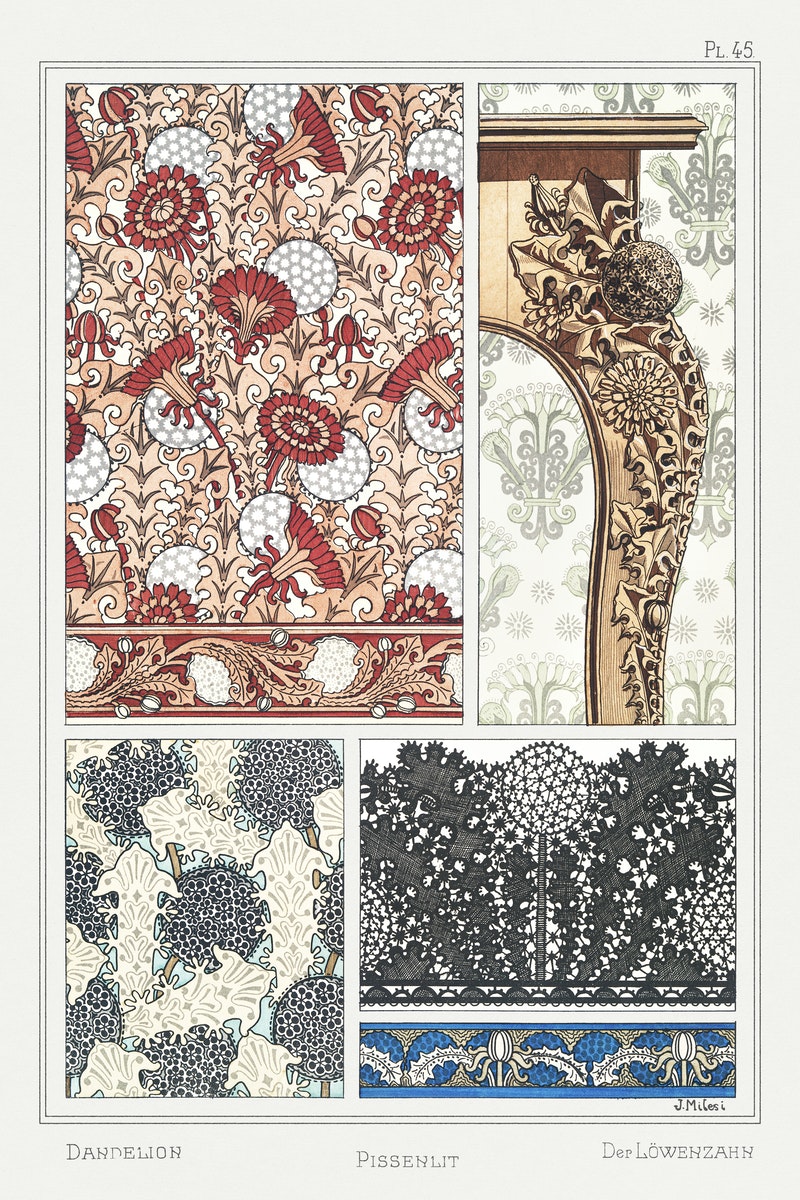
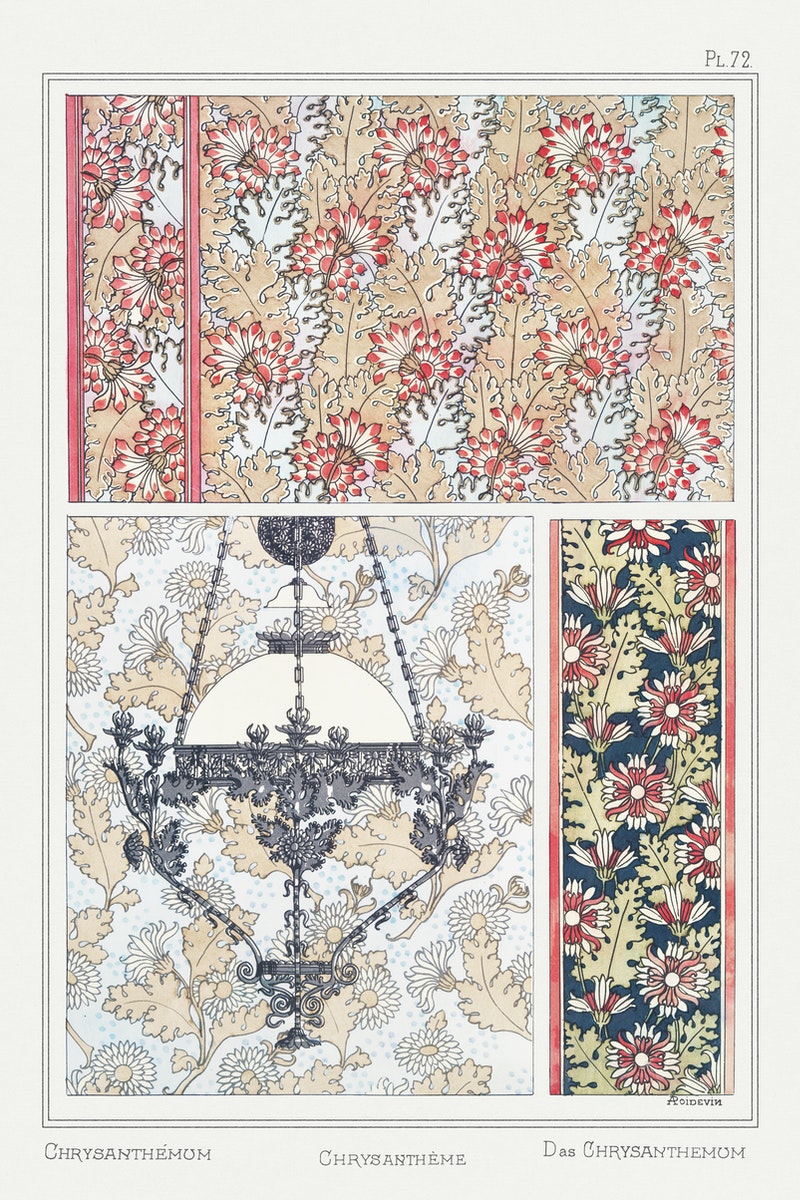
Twenty-four flowering plants were selected for consideration, from humble specimens like dandelions and thistle to such Art Nouveau heavy hitters as poppies and irises.
Each flower is represented by a realistic botanical study, with two additional color plates in which its form is flattened out and mined for its decorative, stylistic elements.
The plates were rendered by Grasset’s students at the École Guérin, young artists whom he had “forbidden to condescend to the art of base and servile imitation”:
The art of drawing is not the art of observing forms and objects alone, it is not mere mimicry of these objects; it is the art of knowing how far and wherein, and with what just limitations, those forms and objects can be reproduced in a picture, or in a decorative work.
He also expected students to hone their powers of observation through intense study of the organic structures that would provide their inspiration, becoming intimately acquainted with the character of petal, leaf, and stem:
Beautiful lines are the foundation of all beauty. In a work of art, whatever it be, apparent or hidden symmetry is the visible or secret cause of the pleasure we feel. Everything that is created must have some repetition in its parts to be understood, retained in the memory, and perceived as a whole
When it came to adorning household implements such as vases and plates, Grasset insisted that decorative elements exist in harmony with their hosts, sniping that any artist who would distort form with ill considered flourishes should make a bas-relief instead.
Thusly do chrysanthemum stems provide logical-looking ballast for a chandelier, and a dandelion’s curved leaves hug the contours of a table leg.
Grasset’s best known student, Maurice Pillard Verneuil, whose career spanned Art Nouveau to Art Deco, absorbed and articulated the master’s teachings:
It is no longer the nature (artists) see that they represent, that they transcribe, but the nature that they aspire to see; nature more perfect and more beautiful and of which they have the interior vision.
Revisiting Ernest Hemingway’s A Moveable Feast a couple of decades after I read it last, I notice a few things right away: I am still moved by the prose and think it’s as impressive as ever; I am less moved by the machismo and alcoholism and more interested in characters like Sylvia Beach, founder of Shakespeare and Company, the bookstore that served as a base of operations for the famed Lost Generation of writers in Paris.
“Sylvia had a lively, sharply sculptured face, brown eyes that were as alive as a small animal’s and as gay as a young girl’s,” Hemingway wrote of her in his memoir. “She was kind, cheerful and interested, and loved to make jokes and gossip. No one that I ever knew was nicer to me.” Indeed, Hemingway also “recounts being given access to the whole of Sylvia Beach’s library at Shakespeare and Company for free after his first visit,” notes writer RJ Smith.
Beach founded the shop in 1919, encouraged (and funded) by her partner Adrienne Monnier, who owned a French-language bookstore. Beach’s mostly English-language Shakespeare and Company would become a lending-library, post office, bank, and even hotel for authors who congregated there. She supported the great expatriate modernists and hosted French writers like André Gide and Paul Valéry. She also published James Joyce’s Ulysses in 1922 when no one else would, after earlier published excerpts were deemed “obscene.”
Joyce was shaped by Paris, and owed a huge debt of gratitude to Beach, just as readers of Ulysses do almost 100 years later. Forty years after the novel’s publication, Beach traveled to Ireland to celebrate and sat down for the long interview above in which she remembers those heady times. She also tells the story of how a Presbyterian minister’s daughter—who went to church in Princeton, NJ with Grover Cleveland and Woodrow Wilson—became a pioneering out lesbian modernist bookseller in Paris.
Beach remembers meeting “all the French writers” at Monnier’s shop after her time studying at the Sorbonne and how American writers all came to Paris to escape prohibition at home. “For Hemingway and his most of his friends,” says Harvard historian Patrice Higonnet, “Paris was one long binge, all the more enjoyable because it wasn’t very expensive.” For Beach, Paris became home, and Shakespeare and Company a home away from home for waves of expats until the Nazis shut it down in 1941. (Ten years later, a different Shakespeare and Company was opened by bookseller George Whitman.)
“They were disgusted in America because they couldn’t get a drink,” Beach says, “and they couldn’t get Ulysses. I used to think those were the two great causes of their discontent.” Her interviews, letters, and her own memoir, Shakespeare and Company, tell the story of the Lost Generation from her point of view, one animated by an absolute devotion to literature, and in particular, to Joyce, who did not reciprocate. When Ulysses sold to Random House in 1932, he offered her no share of his very large advance.
Beach was forgiving. “I understood from the first,” she said, “that working with or for Mr. Joyce, the pleasure was mine—an infinite pleasure: the profits were for him.” She was doing something other than running a business. She was “cross-fertilizing,” as French writer Andre Chamson put it. “She did more to link England, the United States, Ireland, and France than four great ambassadors combined.” She did so by giving writers what they needed to make the work she knew they could, at a very rare time and place in which such a thing was briefly possible.
“Great literature is one of two stories,” we often quote Leo Tolstoy as saying: “a man goes on a journey or a stranger comes to town.” That’s all well and good for the author of War and Peace, but what about the thousands of screenwriters struggling to come up with the next hit movie, the next hit television series, the next hit platform-specific web and/or mobile series? Some, of course, have found in that aphorism a fruitful starting point, but others opt for different premises that number the basic plots at three (William Foster-Harris), six (researchers at the University of Vermont’s Computational Story Lab), twenty (Ronald Tobias), 36 (George Polti) — or, as some struggling screenwriters of a century ago read, 37.
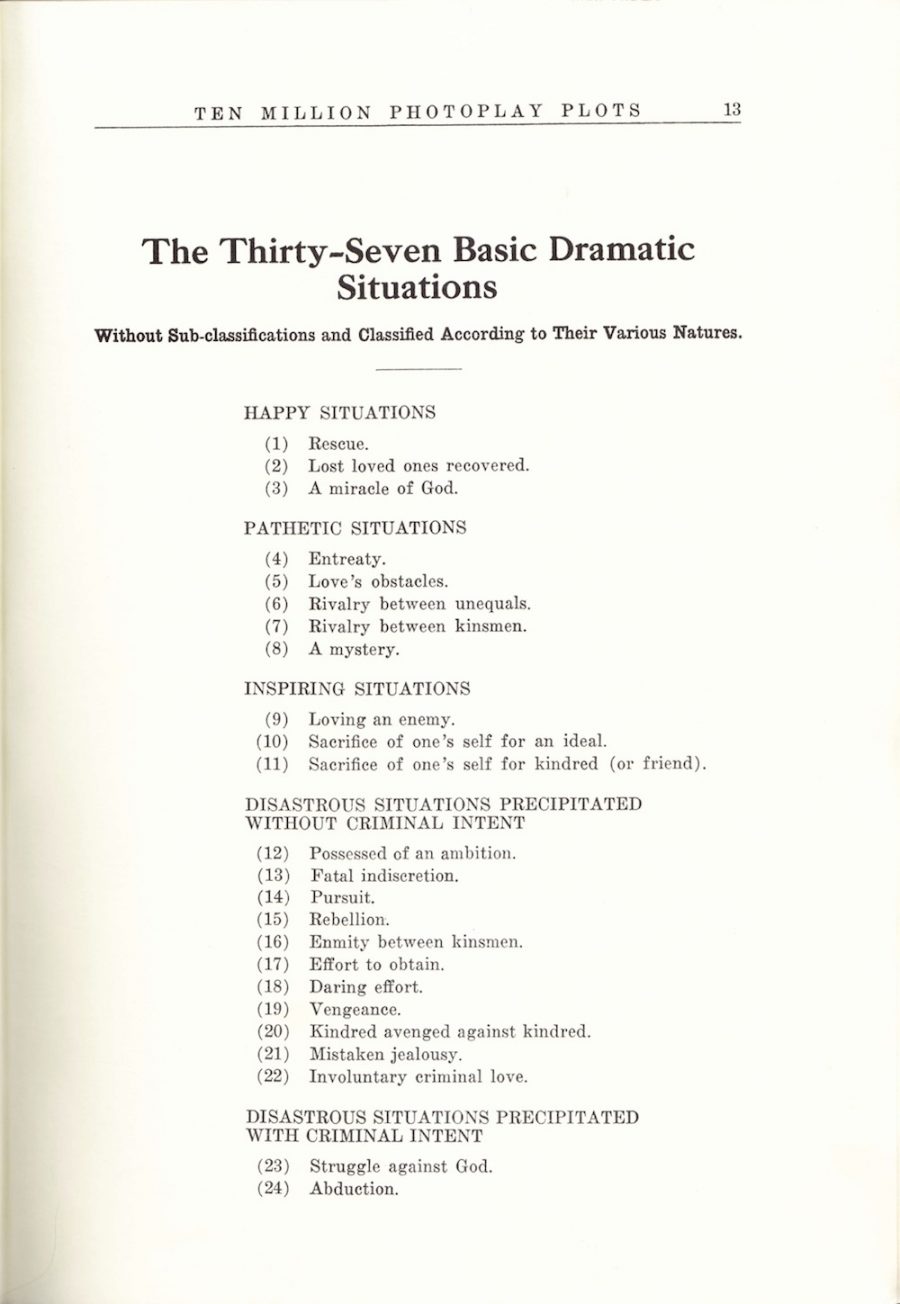
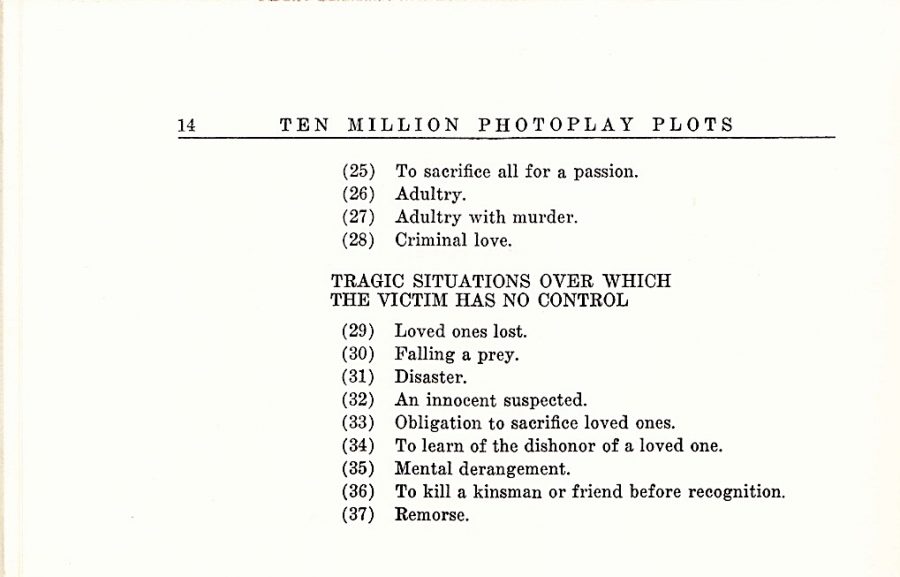
The year was 1919. America’s biggest blockbusters included D.W. Griffith’s Broken Blossoms, Cecil B. DeMille’s Male and Female, and The Miracle Man, which made Lon Chaney into a silver-screen icon. The many aspirants looking to write their way into the ever more celebrated and lucrative movie business could turn to a newly published manual called Ten Million Photoplay Plots by Wycliff Aber Hill. “Hill, who published more than one aid to struggling ‘scenarists,’ positioned himself as an authority on the types of stories that would work well onscreen,” writes Slate’s Rebecca Onion. In this book he provides a “taxonomy of possible types of dramatic ‘situations,’ first running them down in outline form, then describing each more completely and offering possible variations.”
Hill’s 37 basic dramatic situations include such “happy situations” as “rescue,” “loved ones lost and recovered,” and “a miracle of God”; such “pathetic situations” as “love’s obstacles,” “rivalry between unequals,” and “a mystery”; and such “disastrous situations precipitated without criminal intent” as “possessed of an ambition,” “enmity between kinsmen,” and “vengeance.” (Naturally, Hill also includes a separate category involving criminal intent.) These dramatic concepts then break down into more specific scenarios like “rescue by strangers who are grateful for favors given them by the unfortunate one,” “an appeal for refuge by the shipwrecked,” “the sacrifice of happiness for the sake of a loved one where the sacrifice is caused by unjust laws,” and “congenial relations between husband and wife made impossible by the parents-in-law.”
Already more than a few films new and old come to mind whose stories proceed from such dramatic concepts. Indeed, one could think of examples from not just cinema but literature, television, theater, comics, and other forms of narrative art besides. Situations we all know from real life may also follow similar contours, which plays no small part in giving them their impact when properly translated to the screen. Clearly aiming for timelessness, Hill enumerates plots that could have been employed in stories centuries before his time, and will continue to be long after ours. But what, exactly, is the relationship between plot and story? We now quote E.M. Forster on the matter, specifically a line from his Aspects of the Novel — a book for which Ten Million Photoplay Plots’ first readers would have to wait eight more years.
Based in Seoul, Colin Marshall writes and broadcasts on cities, language, and culture. His projects include the book The Stateless City: a Walk through 21st-Century Los Angeles and the video series The City in Cinema. Follow him on Twitter at @colinmarshall, on Facebook, or on Instagram.
We may all have the best of intentions when we collect and share reading lists. We buy the books, stack them neatly by the chair or bed, then something happens. Like… literally, every day, something happens…. Let’s cut ourselves some slack. We’ll get to those books, or give them away to people who will read them, which is also a good thing to do.
But even if we can’t keep up, reading lists are still essential educational tools, especially for kids, young adults, and their parents and teachers. As we celebrate the centenary of the 19th Amendment (which fell on August 18th) and talk about its many shortcomings, it may be more important than ever to understand the U.S. history that brought us to the current moment.
This is a history in which—whether rights were guaranteed by the constitution or not—people historically denied suffrage have always had to struggle. Each generation of women, but most especially Black, Latinx, Indigenous, and LGBTQ women, must claim or reclaim basic rights, liberties, and protections. More than ever, feminist reading lists reflect the vast differences in collective and personal experience that fall under the label “Feminist.”
To illustrate the continued critical importance of feminist history, theory, and literature, the New York Public Library published reading lists for adults, kids, and teens on the 19th Amendment’s 100th anniversary. These books can help create community and solidarity and inspire deep reflection as kids are pushed back into schools and parents and teachers try to help them cope.
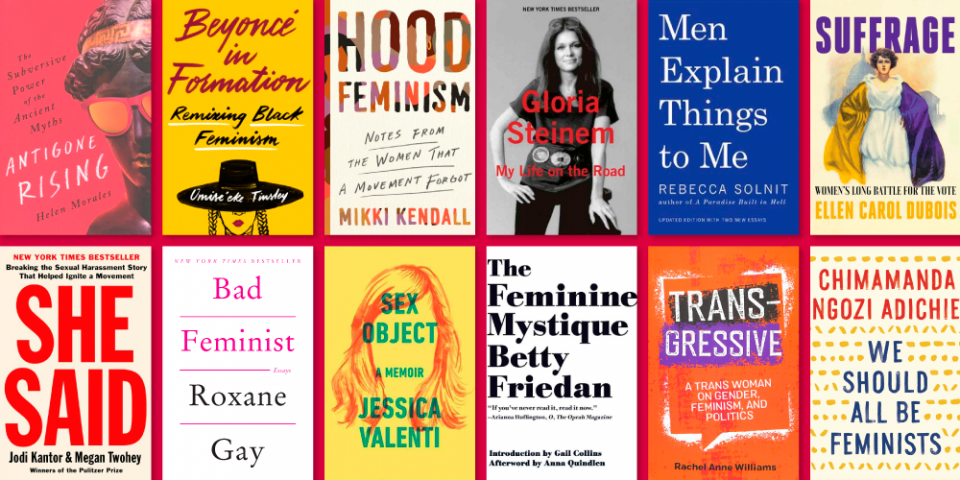
The adult list contains 126 books and includes links to the library catalog or e‑Book editions. “The titles bridge the past and present of feminist movements, from Simone de Beauvoir’s The Independent Woman(1949) to Roxane Gay’s Bad Feminist: Essays (2014), and from the earliest manifestos for equality to contemporary writings on intersectionality,” Valentina Di Liscia writes at Hyperallergic.
The lists for kids and teens are of a more manageable length, and “if you’re looking to stock the bookshelves before history class starts this fall,” you can hardly do better than to start with these titles (or just bookmark the lists for now), as Danielle Valente—who helpfully transcribes both lists, below—notes at Time Out New York.
Alice Paul and the Fight for Women’s Rights by Deborah Kops
Ask a Queer Chick: A Guide to Sex, Love, and Life for Girls Who Dig Girls by Lindsay King-Miller
Because I Was a Girl: True Stories for Girls of All Ages by Melissa de la Cruz
Beyond Magenta: Transgender Teens Speak Out by Susan Kuklin
Beyond the Gender Binary by Alok Vaid-Menon
Brazen: Rebel Ladies Who Rocked the World by Pénélope Bagieu
The Bride Was a Boy by Chii
Colonize This!: Young Women of Color on Today’s Feminism by Daisy Hernández and Bushra Rehman (eds.)
Dear Ijeawele, or a Feminist Manifesto In Fifteen Suggestions by Chimamanda Ngozi Adichie
Feminism Is… by Alexandra Black, Laura Buller, Emily Hoyle and Dr. Megan Todd
Feminism: Reinventing the F‑Word by Nadia Abushanab Higgins
Fierce Femmes and Notorious Liars: A Dangerous Trans Girl’s Confabulous Memoir by Kai Cheng Thom
Fight Like a Girl: 50 Feminists Who Changed the World by Laura Barcella
Full Frontal Feminism: A Young Woman’s Guide to Why Feminism Matters by Jessica Valenti
Girl Rising: Changing the World One Girl at a Time by Tanya Lee Stone
Girls Resist!: A Guide to Activism, Leadership, and Starting a Revolution by KaeLyn Rich
Girls Write Now: Two Decades of True Stories from Young Female Voices
Here We Are: Feminism for the Real World by Kelly Jensen (ed.)
I Know Why the Caged Bird Sings by Maya Angelou
I, Rigoberta Menchú: An Indian Woman In Guatemala by Rigoberta Menchú
Lighting the Fires of Freedom: African American Women in the Civil Rights Movement by Janet Dewart Bell
Modern Herstory: Stories of Women and Nonbinary People Rewriting History by Blair Imani
Muslim Girl: A Coming of Age by Amani Al-Khatahtbeh
Not for Ourselves Alone: The Story of Elizabeth Cady Stanton and Susan B. Anthony by Geoffrey C. Ward and Ken Burns
#NotYourPrincess: Voices of Native American Women by Lisa Charleyboy and Mary Beth Leatherdale (eds.)
Rethinking Normal: A Memoir in Transition by Katie Rain Hill
She Came to Slay: The Life and Times of Harriet Tubman by Erica Armstrong Dunbar
Sissy: A Coming-of-Gender Story by Jacob Tobia
Tomboy: A Graphic Memoir by Liz Prince
Trans Teen Survival Guide by Owl and Fox Fisher
Trans+: Love, Sex, Romance, and Being You by Kathryn Gonzales and Karen Rayne
Votes for Women!: American Suffragists and the Battle for the Ballot by Winifred Conkling
With Courage and Cloth: Winning the Fight for a Woman’s Right to Vote by Ann Bausum
You Don’t Have to Like Me: Essays on Growing Up, Speaking Out, and Finding Feminism by Alida Nugent
Amazons, Abolitionists, and Activists: A Graphic History of Women’s Fight for Their Rights by Mikki Kendall
This is, indeed, an excellent place to start. Given younger generations’ levels of engagement with current events, it’s likely your kids or students are already familiar with many of the newer books on the lists.
If there’s any overarching theme to be found among such a vast and ever-expanding canon of feminist literature, it might be summed up best in the title of a recent Angela Davis book on feminist movements around the world: “Freedom is a constant struggle.”
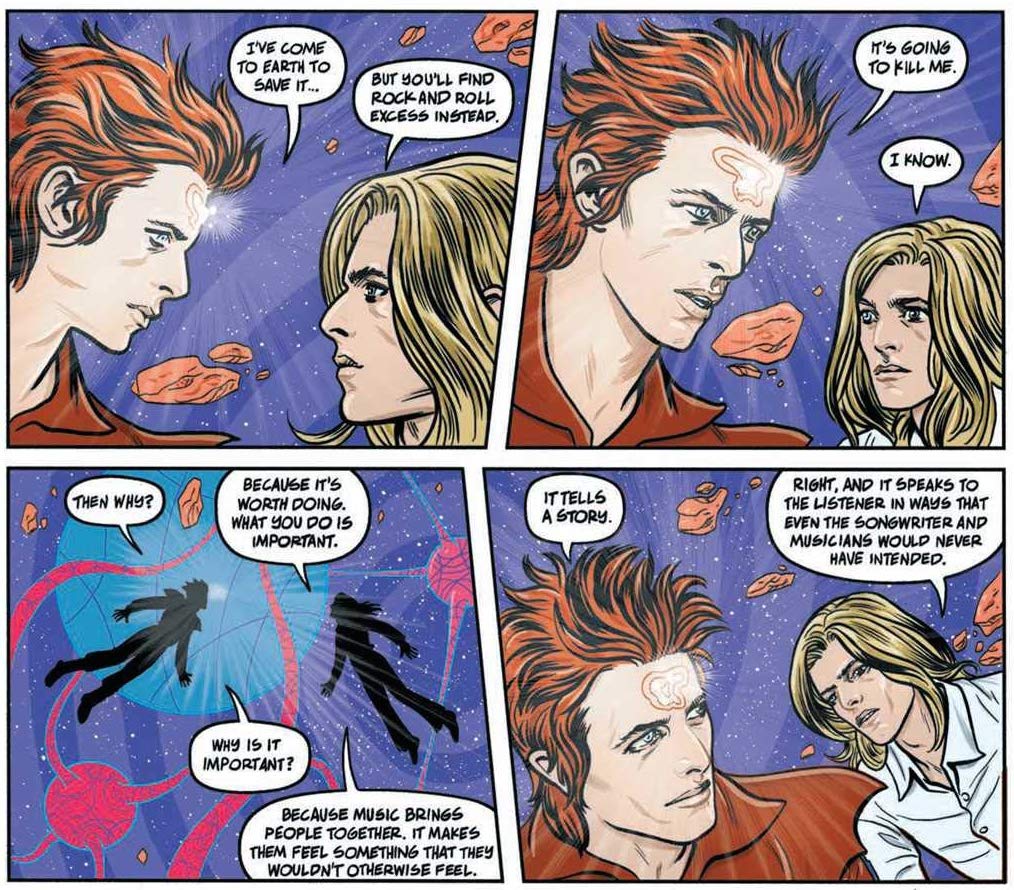
If you’re fascinated by certain artists and thinkers, you can learn about them from books. Anyone who has a significant cultural or intellectual influence on humanity sooner or later gets a biography written about them, and usually more than one. But how many get their own graphic novels? The versatility of the “comic book,” long unsuspected by many Western readers, has been more and more widely discussed in recent decades. Some of those readers, however, won’t believe what can be done with the form until they see what can be done with it. So why not show them the graphic novel on the life of David Bowie published not long ago — and if they remain unconvinced, why not show them the other one?
Few subjects demand a visual form as much as Bowie, because of the centrality of his ever-changing appearance to his artistic project as well as the need to evoke the effervescent cultural periods he lived through and did more than his part to define.
You can also read a graphic-novel adaptation of a source work never completed in the first place — but never completed, one must note, by Salvador Dalí and the Marx Brothers. A collaboration between pop-culture scholar Josh Frank, artist Manuela Pertega, and comedian Tim Heidecker, Giraffes on Horseback Salad realizes on the page a film that not only was never, but quite possibly could never have been made. For readers closer to worldly reality, there’s Jim Ottaviani and Leland Myrick’s Feynman: A Biography, which tells and shows the life of world-famous theoretical physicist, teacher, and bon vivant Richard Feynman. Never before, surely, has a comic book had to legibly and convincingly depict quantum electrodynamics, safe-cracking, and bongo-paying — to name just three of Feynman’s pursuits.
Based in Seoul, Colin Marshall writes and broadcasts on cities, language, and culture. His projects include the book The Stateless City: a Walk through 21st-Century Los Angeles and the video series The City in Cinema. Follow him on Twitter at @colinmarshall, on Facebook, or on Instagram.
Twenty years after his death, it’s cooler than ever to like Edward Gorey. This is evidenced not just by the frequent posting of his intensively crosshatched, Victorian- and Edwardian-period-inflected, grimly comic art on social media, but by the number of artists who now claim him as an influence. Where, one wonders, did they come across Gorey in the first place? Having published more than a hundred books in his lifetime (if often in small runs from obscure presses), he certainly put the work out there to be found.
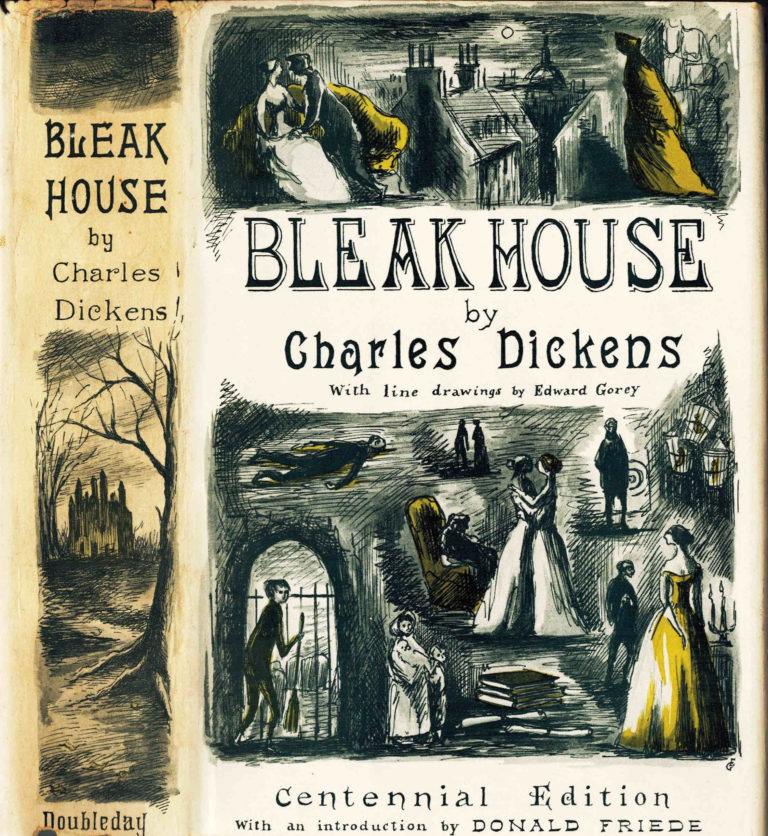
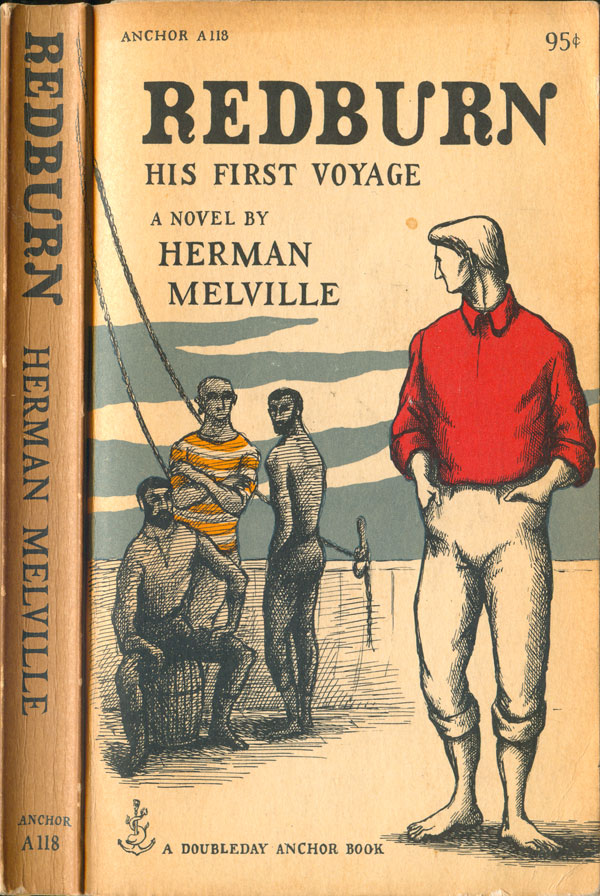
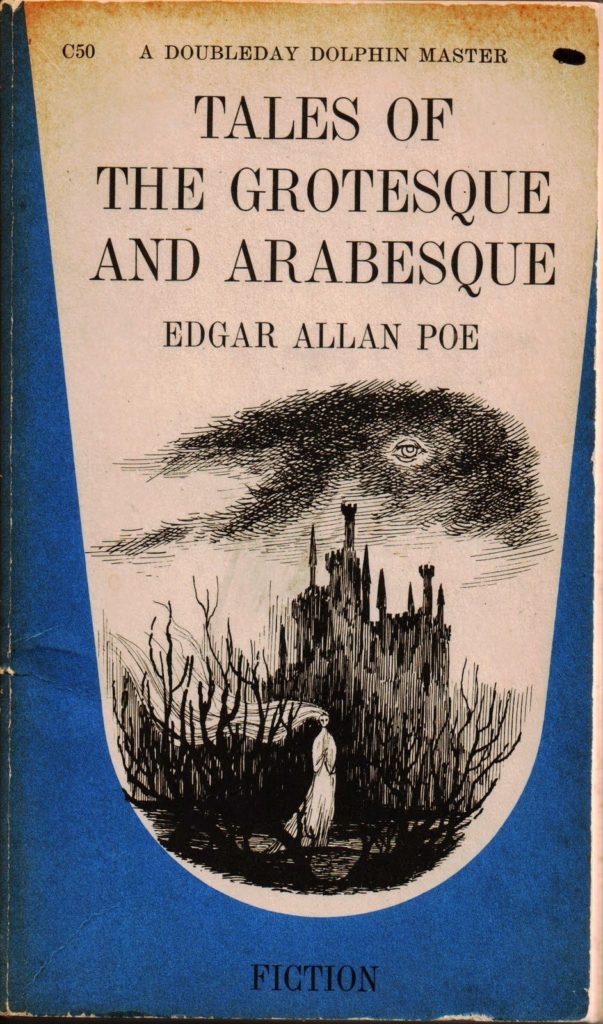
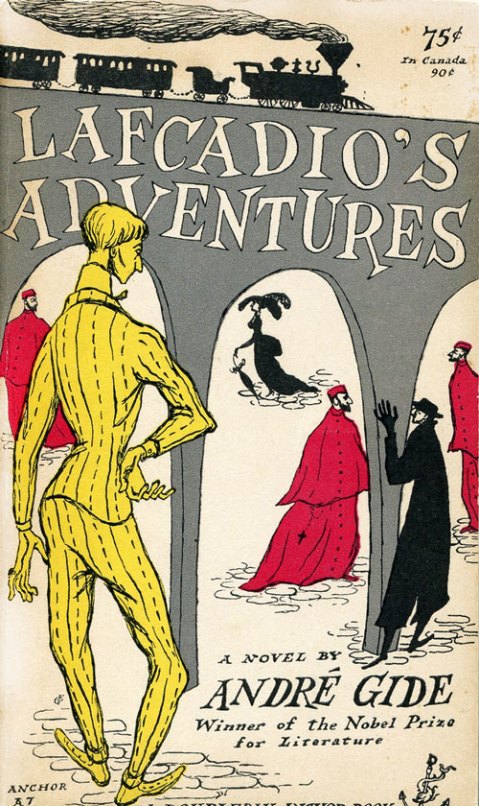
But it was the much more well-known books of other writers like Charles Dickens, Joseph Conrad, T.S. Eliot, and Herman Melville that first propagated Gorey’s sensibility of, as The New York Times’ Steven Kurutz puts it, “camp-macabre, ironic-gothic or dark-whimsy.”
Gorey designed the covers for these books and others between 1953 to 1960, when he worked at the art department of publishers Doubleday Anchor. He had been tasked specifically with their new series of paperbacks meant to be “serious,” as opposed to the abundance of cheap, lowbrow, and often salaciously packaged novels that had inspired the term “pulp fiction.”
Of the first 200 titles in this series, says Goreyography, “about a fourth of these have line drawn covers by Gorey.” Even when other artists (the lineup of whom included Leonard Baskin, Milton Glaser, Philippe Julian, and Andy Warhol) drew the illustration, “Gorey then designed the finished product lending a uniform appearance to the whole line.” You can see a variety of Gorey’s Doubleday Anchor paperback covers at Lithub, the most Goreyesque of which (such as Joseph Conrad’s The Secret Agent at the top of the post) not only bear his illustrations but contain nothing not drawn by Gorey, text and colophon included.
“When these covers first appeared against the backdrop of mass-market covers in general,” according to Goreyography, “they were hailed as ‘modern’ and ‘arty.’ Print magazine praised ‘a feeling of unity… a quality of their own.’ ” The end of Gorey’s time at Doubleday didn’t mean the end of his work on others’ books: in the 1970s, for example, he contributed suitably eerie cover and interior art to John Bellairs’ young-adult novel The House with a Clock in Its Walls and five of the sequels that would follow it. It was in Bellairs’ books that I first encountered the visions of Edward Gorey. More than a few readers of my generation and the generations since could say the same — and also that we’ve been pleasurably haunted by them ever since.
Based in Seoul, Colin Marshall writes and broadcasts on cities, language, and culture. His projects include the book The Stateless City: a Walk through 21st-Century Los Angeles and the video series The City in Cinema. Follow him on Twitter at @colinmarshall, on Facebook, or on Instagram.
We're hoping to rely on loyal readers, rather than erratic ads. Please click the Donate button and support Open Culture. You can use Paypal, Venmo, Patreon, even Crypto! We thank you!
Open Culture scours the web for the best educational media. We find the free courses and audio books you need, the language lessons & educational videos you want, and plenty of enlightenment in between.