Earlier this month, NBC reporter and analyst William Arkin ended a 30-year career as a journalist, announcing in a “scathing letter,” Democracy Now! reports, that “he would be leaving the network. Arkin accuses “the media of warmongering while ignoring the, quote, ‘creeping fascism of homeland security.’” He does not equivocate in a follow-up interview with Amy Goodman. “The generals and the national security leadership” are also now, he says, “the commentators and the analysts who populate the news media” (Arkin himself is a former Army intelligence officer).
The problem isn’t only NBC, in his estimation, and it isn’t only supposed journalists cheerleading for war. Most of the conflicts the country is currently engaged in are un- or under-reported in major sources. His letter “applies to all of the mainstream networks, applies to CNN and Fox, as well…. We’ve just become so shallow that we’re not really able even to see the truth, which is that we’re at war right now in nine countries around the world where we’re bombing, and we hardly report any of it on a day-to-day basis.”
This isn’t the case with independent media organizations like Democracy Now!, The Intercept, or Airwars. Secular and religious refugee relief organizations like the International Rescue Committee, World Relief, or Muslim Global Relief are paying attention. Many of these organizations are non‑U.S.-based or connected to the “civilian experts” Arkin says once appeared regularly in the national media and represented opposing views, “people who might be university professors or activists… or experts who were associated with think tanks.”
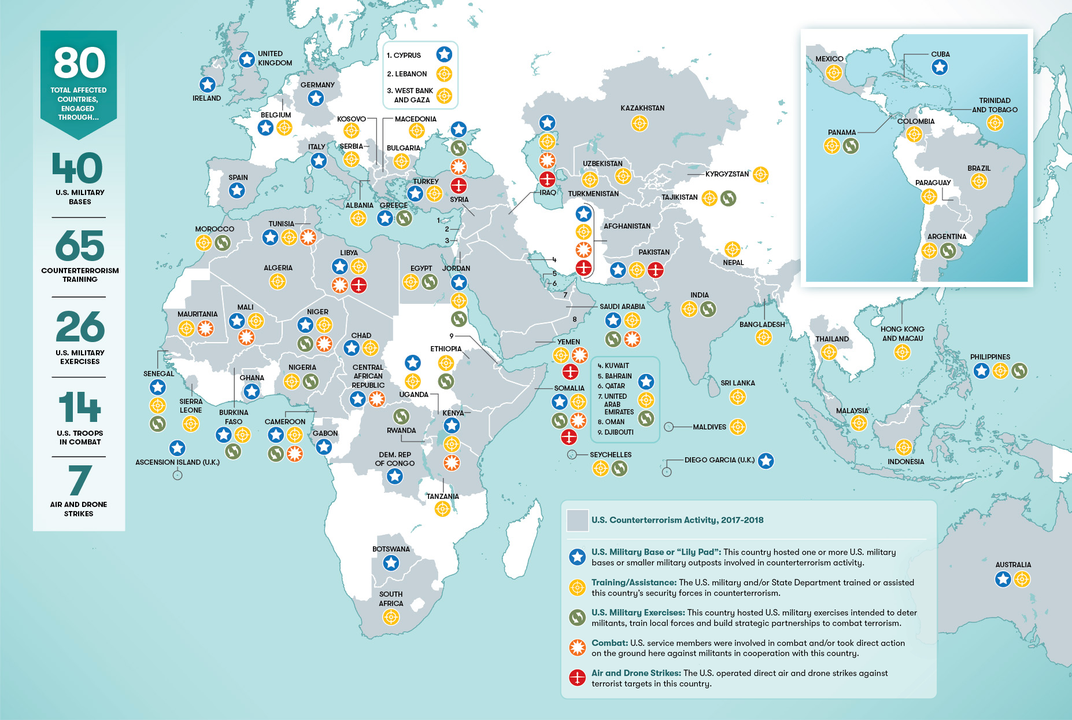
At the top of the post, see a map (view in a larger format here) from the Cost of War Project’s Stephanie Savell, 5W Infographics, and the Smithsonian of all the regions where the U.S. is “combatting terrorism.” While most of the media orgs and non-profits mentioned above would probably dispute the use of that term in some or all of the conflict zones, Savell sticks with the official language to describe the situation—one in which the nation “is now operating in 40 percent of the world’s nations,” as she writes at Smithsonian.com.
Maybe no one needs an editorial to imagine the enormous toll this level of military engagement has taken over the course of 17 years since the inception of the “Global War on Terror.” The map covers the past two, illustrating “80 countries, engaged through 40 U.S. military bases,” and conducting training, exercises, active combat, and air and drone strikes on six continents. The selections, writes Savell, are “conservative,” and sourced from both independent and mainstream media outlets and international government and military sources.
“The most comprehensive depiction in civilian circles of U.S. military and government antiterrorist actions overseas,” the America at War map provides information we don’t often get in our daily—or hourly, or by-the-minute—diet of news. “Contrary to what most Americans believe, the war on terror is not winding down.” It is expanding. Given the country’s history of sustained mass movements against legally suspect, grossly expensive wars with high civilian casualties, disease epidemics, starvation, and refugee crises, one would think that a sizable segment of the population would want to know what their country’s military and civilian defense contractors are doing around the world.
For millions watching in the UK and around the world, anticipating the looming Brexit deadline over the past two years has been like watching the slowest train wreck in history. But for those not following the coverage daily, the impending UK secession from the European Union is mystifying. Just how many trains are there, and where are they coming from, and how fast, exactly, are they going?
From the future of food and drug imports, to the status of the “currently invisible” border between Northern Ireland and the Republic of Ireland, to all of the legal minutiae no one mentioned during the campaign, the consequences of the recent failure of a Brexit deal could be disastrous. Were “leave” campaigners honest in their sale of Brexit to the voters? Did they have any idea how such a thing would work? Ample evidence shows the answer to both questions is an unqualified No.
The Vote Leave campaign director now describes the referendum as a “dumb idea.” Wealthy UK residents, including many a Brexit politician, are fast moving their assets out of the country. So how did Brexit get sold to voters if it’s such a potential catastrophe? The usual methods worked quite well, Stephen Fry explains in the video above.
By stoking xenophobic fears over migrants and refugees, Brexiteers, he says, created “false assumptions about the EU, some very dark, and some comical.” They were assisted in conjuring a “mythical EU dragon” by tabloid journalists who called migrants “cockroaches” and “feral humans.” Rhetoric indistinguishable from Nazi propaganda drove a spike in hate crimes on both sides of the Atlantic.
Despite the insistence of many voters that their choice was not driven by racial animus, the Brexit campaign, like the Trump campaign, Fry says above, undeniably was. The consequences of these votes for migrant workers and refugees speak for themselves. In the UK, Theresa May’s “hostile environment” policies have deprived British citizens from migrant families of livelihoods and safety. Some have faced threats of deportation, a situation similar to that facing the children of Vietnam War refugees in the US.
Fry calls for identifying a “new enemy” of the people: misleading information like the false claim that the NHS would save 350 million pounds a week after Brexit and the repeated lies in the U.S. about undocumented immigrants, crime, and terrorism. “Perception of crime levels,” he says, “has become completely detached from reality,” especially since the biggest security threats come from hate crimes and right-wing violence, a situation reported on, warned about, and ignored, for several years.
As in the US, so in the UK: relentlessly repeated claims about “invasions” has created a very hostile environment for millions of people. Are the facts likely to sway those voters who were carried away by excesses of hate and fear? Probably not. But those who care about the truth should pay attention to Fry’s debunking. The facts about immigration and other issues used to sell far right policies and politicians, as he outlines in these videos, are entirely different than what Brexit leaders and their counterparts in the US want the public to believe.
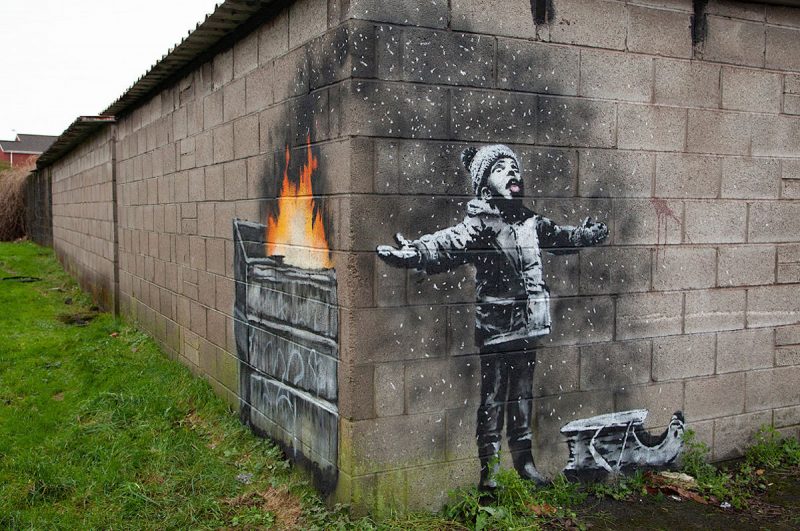
Season’s greetings from Banksy. Two months after shredding a painting at a London auction, the street artist has resurfaced again. This time in Port Talbot, Wales, where he spray-painted a holiday mural on two sides of a garage. One sides shows a young boy frolicking in what looks like falling snow. The other side makes you realize that the snow is really a fire spewing toxic ash.
According to the BBC, Gary Owen, a Port Talbot resident, messaged Banksy last summer and asked him to put a spotlight on Port Talbot’s chronic pollution problem. The steelworks of the industrial town puts dust in the air, creating potential health risks for children. When Owen learned about the mural, he reportedly said: “It’s brilliant. I couldn’t take it in. I didn’t think it was true.” That’s all before some “some drunk halfwit” tried to attack the painting–very fortunately to no avail.
If you would like to support the mission of Open Culture, consider making a donation to our site. It’s hard to rely 100% on ads, and your contributions will help us continue providing the best free cultural and educational materials to learners everywhere. You can contribute through PayPal, Patreon, and Venmo (@openculture). Thanks!
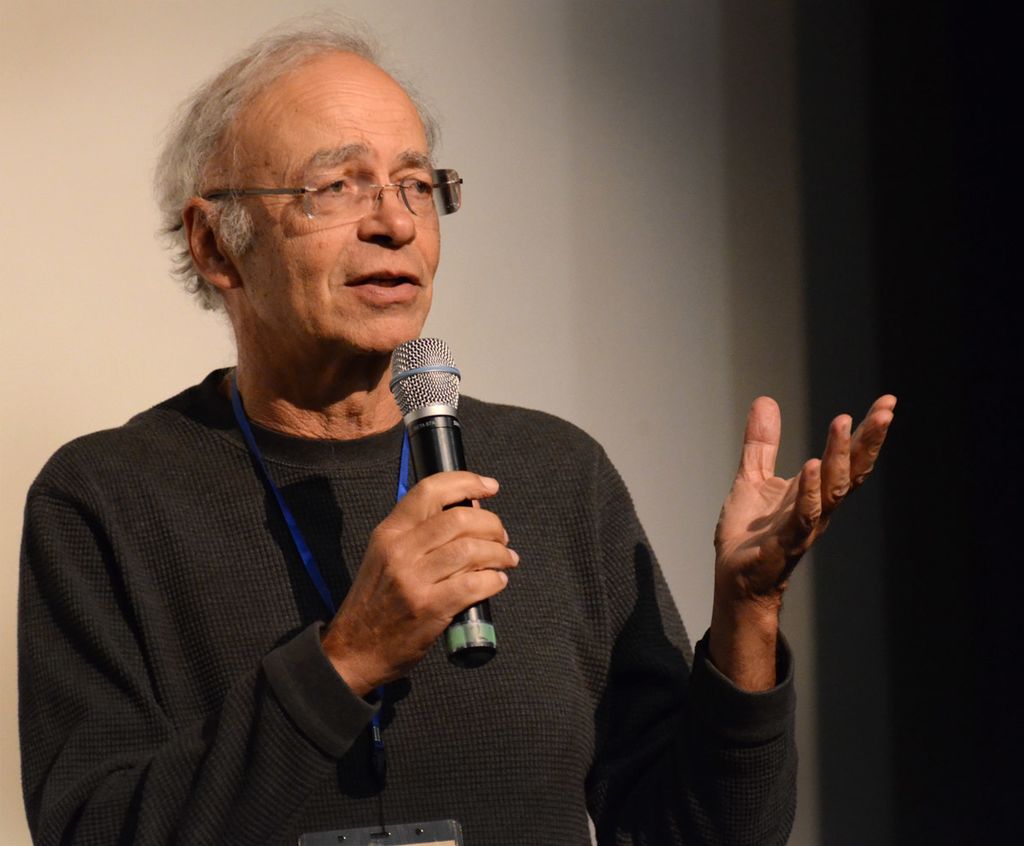
Australian bioethicist Peter Singer has made headlines as few philosophers do with claims about the moral status of animals and the “Singer solution to world poverty,” and with far more controversial positions on abortion and disability. Many of his claims have placed him outside the pale for students at Princeton, his current employer, where he has faced protests and calls for his termination. “I favor the ability to put new ideas out there for discussion,” he has said in response to what he views as a hostile academic climate, “and I see an atmosphere in which some people may be intimated from doing that.”
For those who, like him, make controversial arguments such as those for euthanizing “defective infants,” for example, as he wrote about in his 1979 Practical Ethics, Singer has decided to launch a new venue, The Journal of Controversial Ideas. As The Chronicle of Higher Educationreports, the journal aims to be “an annual, peer-reviewed, open-access publication that will print worthy papers, and stand behind them, regardless of the backlash.” The idea, says Singer, “is to establish a journal where it’s clear from the name and object that controversial ideas are welcome.”
Is it true that “controversial ideas” have been denied a hearing elsewhere in academia? The widely-covered tactics of “no-platforming” practiced by some campus activists have created the impression that censorship or illiberalism in colleges and universities has become an epidemic problem. No so, argues Princeton’s Eddie Glaude, Jr., who points out that figures who have been disinvited to speak at certain institutions have been welcomed on dozens of other campuses “without it becoming a national spectacle.” Sensationalized campus protests are “not the norm,” as many would have us believe, he writes.
But the question Singer and his co-founders pose isn’t whether controversial ideas get aired in debates or lecture forums, but whether scholars have been censored, or have censored themselves, in the specialized forums of their fields, the academic journals. Singer’s co-founder/editor Jeff McMahan, professor of moral philosophy at Oxford, believes so, as he told the BBC in a Radio 4 documentary called “University Unchallenged.” The new journal, said McMahan, “would enable people whose ideas might get them in trouble either with the left or with the right or with their own university administration, to publish under a pseudonym.”
Those who feel certain positions might put their career in jeopardy will have cover, but McMahan declares that “the screening procedure” for publication “will be as rigorous as those for other academic journals. The level of quality will be maintained.” Some skepticism may be warranted given the journal’s intent to publish work from every discipline. The editors of specialist journals bring networks of reviewers and specialized knowledge themselves to the usual vetting process. In this case, the core founding team are all philosophers: Singer, McMahan, and Francesca Minerva, postdoctoral fellow at the University of Ghent.
One might reasonably ask how that process can be “as rigorous” on this wholesale scale. Though the BBC reports that there will be an “intellectually diverse international editorial board,” board members are rarely very involved in the editorial operations of an academic journal. Justin Weinberg at Daily Nous has some other questions, including whether the degree, or existence, of academic censorship even warrants the journal’s creation. “No evidence was cited,” he writes “to support the claim that ‘a culture of fear and self-censorship’ is preventing articles that would pass a review process” from seeing publication.
Furthermore, Weinberg says, the journal’s putative founders have given no argument “to allay what seems to be a reasonable concern that the creation of such a journal will foster more of a ‘culture of fear and self-censorship’ compared to other options, or that it plays into and reinforces expertise-undermining misconceptions about academia bandied about in popular media that may have negative effects…. Given that the founding team is comprised of people noted for views that emphasize empirical facts and consequences, one might reasonably hope for a public discussion of such evidence and arguments.”
Should scholars publish pseudonymously in peer-reviewed journals? Shouldn’t they be willing to defend their ideas on the merits without hiding their identity? Is such subterfuge really necessary? “Right now,” McMahan asserts, “in current conditions something like this is needed…. I think all of us will be very happy if, and when, the need for such a journal disappears, and the sooner the better.” Given that the journal’s co-founders paint such a broadly dire picture of the state of academia, it’s reasonable to ask for more than anecdotal evidence of their claims. A few high-profile incidents do not prove a widespread culture of repression.
It is also “fair to wonder,” writes Annabelle Timsit at Quartz, “whether the board of a journal dedicated to free speech might have a bias toward publishing particularly controversial ideas in the interest of freedom of thought” over the interests of good scholarship and sound ethical practice.
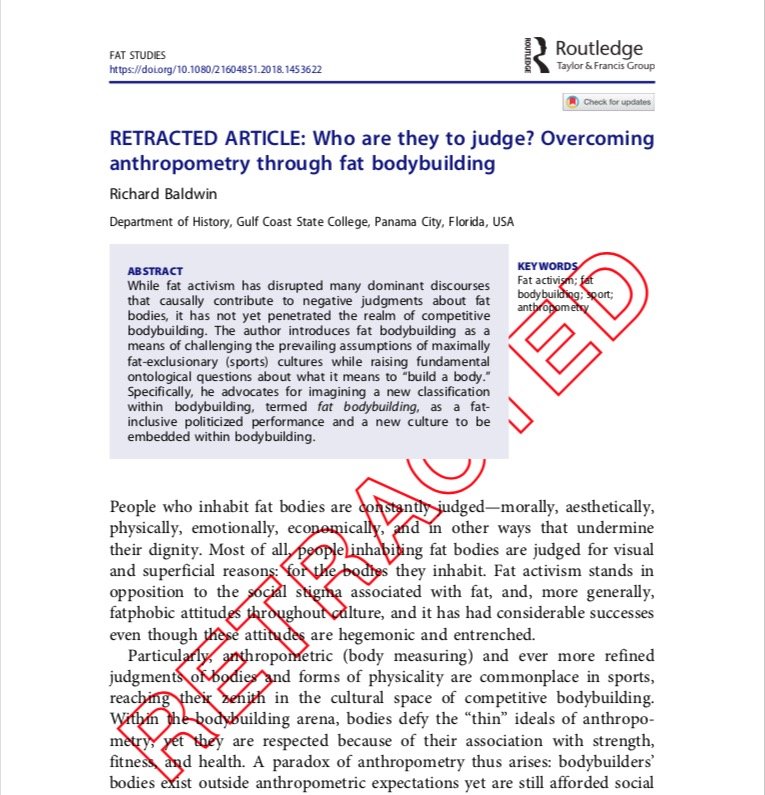
We should be suspicious when researchers assume their conclusion; when the results of an academic study merely confirm the author’s pre-existing biases. Humans are wired to seek confirmation, a cognitive deficit so deeply engrained that it can be exploited among laypeople and specialists alike. Art historians have been fooled by forgeries, historians by fake manuscripts, and paleontologists by phony fossils. Physicist Steven Weinberg referenced such high-level hoaxes in a 1996 essay in The New York Review of Books, and he placed that year’s academic scandal—known as the “Sokal Hoax”—among them.
The gist of the Sokal affair runs as follows: NYU mathematical physicist Alan Sokal suspected that post-structuralist-influenced cultural studies was jargon-laden, obfuscating BS, and he set out to prove it by authoring his own “postmodernist” text, an article full of misused terminology from quantum physics. He sent it off to the journal Social Text, who published it in their Spring/Summer issue. Sokal then revealed in another journal, Lingua Franca, that the article had been a fraud, “liberally salted with nonsense,” and had only been accepted because “(a) it sounded good and (b) it flattered the editor’s ideological preconceptions.”
Sokal’s hoax, it was roundly claimed, demonstrated that certain fashionable quarters of the academic humanities had deteriorated into babble, signifying nothing more than rigid ideological commitments and a general disregard for the actual meanings of words and concepts. Weinberg wasn’t so sure. At most, perhaps, it showed the editorial failings of Social Text. And while humanists may abuse scientific ideas, Weinberg points out that scientists of the stature of Werner Heisenberg have also been prone to slipshod, quasi-mystical thinking.
But the Sokal hoax did expose to the wider public a tendency among a coterie of academics to indulge in mystifying language, including the misuse of jargon from other fields of study, usually in imitation of French theorists like Jacques Lacan, Julia Kristeva, or Jacques Derrida—whom, it must be said, all wrote in a very different intellectual culture (one that expects, Michel Foucault once admitted, at least “ten percent incomprehensible”). For a good many people in the academic humanities, this wasn’t much of a revelation. (Sokal has since published a more thoroughly critical book with the apt title Beyond the Hoax.)
Part of the problem with his hoax as a serious critique is that it began with its conclusion. Cultural studies are rife with crap arguments, ideology, and incomprehensible nonsense, Sokal believed. And so, when his paper was accepted, he simply rested his case, making no effort to engage charitably with good scholarship while he ridiculed the bad. Which brings us to the current state of the academic humanities, and to a contemporary, Sokal-like attack on them by a trio of writers who rest their case on a slightly broader base of evidence—20 fraudulent articles sent out to various niche cultural studies journals over a year: four published (since retracted), three accepted but not published, seven under review, and six rejected.
The authors—academic philosopher Peter Boghossian and writers Helen Pluckrose and James A. Lindsay—revealed the hoax this week in an article published at the Pluckrose-edited Areo magazine. One needn’t read past the title to understand the authors’ take on cultural studies in general: “Academic Grievance Studies and the Corruption of Scholarship.” While all three hoaxers identify as left-leaning liberals, the broad-brush characterization of whole fields as “grievance studies” reveals a prejudicial degree of contempt that seems unwarranted. In the article, they reveal their motivations and methods, outline the successes of the project, and post the comments of the articles’ referees, along with a video of themselves having a good laugh at the whole thing.
This last bit is unnecessary and obnoxious, but does the new hoax—“Sokal Squared” as it’s been called—genuinely undermine the credibility of cultural studies as a whole? Is it “’hilarious and delightful,’” asks Alexander C. Kafka at The Chronicle of Higher Education, or “an ugly example of dishonesty and bad faith?” Harvard political scientist Yascha Mounk tactfully finds in it a serious case for concern: “Some academic emperors—the ones who supposedly have the most to say about these crucial topics [discrimination, racism, sexism]—have no clothes.”
This is a point worth pursuing, and certain recent scandals should give everyone pause to consider how bullying and groupthink manifest on the academic left at the highest level of prestige. But the great majority of academics are not “emperors” and have very little social or economic power. And Mounk is careful not to overstate the case. He points out how the hoax has unfortunately given welcome “ammunition” to right-wing conservative axe-grinders:
Many conservatives who are deeply hostile to the science of climate change, and who dismiss out of hand the studies that attest to deep injustices in our society, are using Sokal Squared to smear all academics as biased culture warriors. The Federalist, a right-wing news and commentary site, went so far as to spread the apparent ideological bias of a few journals in one particular corner of academia to most professors, the mainstream media, and Democrats on the Senate Judiciary Committee.
The Federalist specializes in irresponsible conspiracy-mongering, the kind of thing that sells ads and wins elections but doesn’t belong in academic debate. The question Mounk doesn’t ask is whether the hoaxers’ own attitudes encourage and share in such hostility, an issue raised by several of their critics. As physicist Sean Carroll wrote on Twitter, “What strikes me about stunts like this is their fundamental meanness. No attempt to intellectually engage with ideas you disagree with; just trolling for the lulz.” McGill University political theorist Jacob T. Levy expressed similar reservations in an interview, notes The New York Times, saying
even some colleagues who are not fans of identity-oriented scholarship are looking at the hoax and saying ‘this is potentially unethical and doesn’t show what they think it is showing.’ Besides, he added, “We all recognized that this kind of thing could also be done in our disciplines if people were willing to dedicate a year to do it.”
Therein lies another problem with Sokal Squared. Hoaxes have been perpetuated by smart, dedicated forgers, con-artists, and pranksters in nearly every field, showing up all sorts of experts as potential dupes. The singling out of cultural studies for particular ridicule—the characterization of studies of race, gender, disability, etc. as “grievance studies”—reveals an aggrieved agenda all its own, one that ignores the serious problems corrupting other disciplines (e.g. industry funding in academic sciences, or the gross overuse of undergraduate students as the main subjects of studies—groups that hardly represent the general population.)
Some, but not all, of the successfully-published hoax papers sound ludicrous and terrible. Some, in fact, do not, as Justin Weinberg shows at Daily Nous, and should not shame the editors who published them. Some of the journals have much higher editorial standards than others. (An early hoax attempt by Boghossian targeted an ill-reputed, pay-to-play publication.) The whole affair may speak to broader failures in academic publishing that go beyond a tiny corner of the humanities. In part, those failures may stem from a general trend toward overworked, underpaid, increasingly precarious scholars whose disciplines, and funding, have been under relentless political attack since at least the 1990s and who must keep grinding out publications, sometimes of dubious merit, as part of the overall drive toward sheer productivity as the sole measure of success.
If you would like to support the mission of Open Culture, consider making a donation to our site. It’s hard to rely 100% on ads, and your contributions will help us continue providing the best free cultural and educational materials to learners everywhere. You can contribute through PayPal, Patreon, and Venmo (@openculture). Thanks!
The waters of academia have grown choppy of late, and many veteran sailors have found themselves ill-equipped to navigate the brave new world student activists are forging at a breakneck pace.
Admissions brochures and campus tours make frequent mention of their institution’s commitment to social justice. They have to—many high schoolers share the undergrads’ beliefs.
Those of us whose college years are but a distant memory shouldn’t depend on our school’s alumni mag to paint an accurate picture of the battles that may be raging within. Sustainability, preferred pronouns, and inclusive bathroom facilities may get a mention, but the official organ’s unlikely to peek into the abyss where tolerance goes to die.
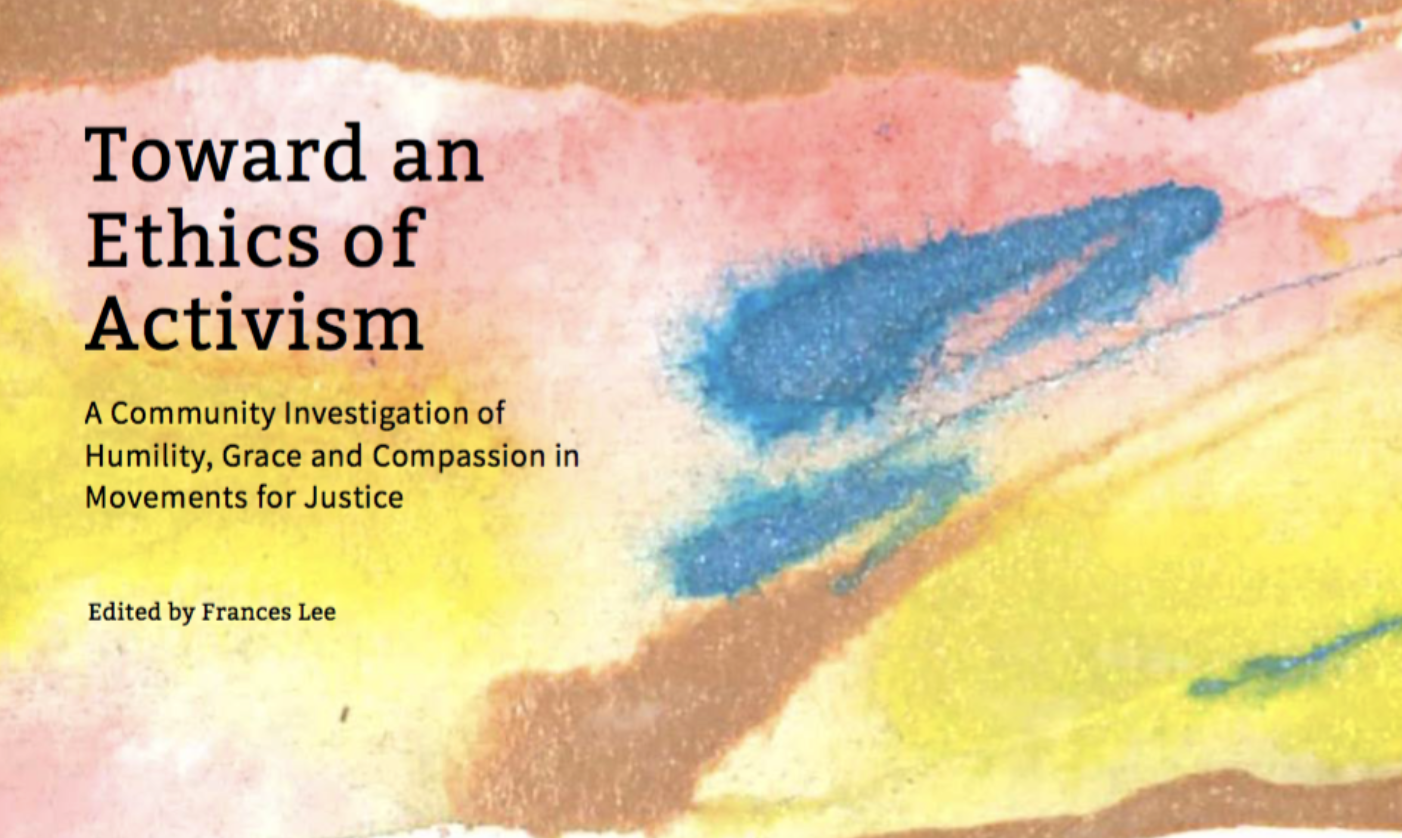
Cultural scholar Frances Lee, a queer trans person of color recovering from a forced conversion to evangelical Christianity, took a hard look at the problem of intolerance within activist circles as a second year Masters student in Cultural Studies at the University of Washington.
Telling people what to do and how to live out their lives is endemic to religious and to dogmatic activism. It’s not that my comrades are the bosses of me, but that dogmatic activism creates an environment that encourages people to tell other people what to do. This is especially prominent on Facebook. Scrolling through my news feed sometimes feels Iike sliding into a pew to be blasted by a fragmented, frenzied sermon. I know that much of the media posted there means to discipline me to be a better activist and community member. But when dictates aren’t followed, a common procedure of punishment ensues. Punishments for saying/doing/believing the wrong thing include shaming, scolding, calling out, isolating, or eviscerating someone’s social standing. Discipline and punishment have been used for all of history to control and destroy people. Why is it being used in movements meant to liberate all of us? We all have made serious mistakes and hurt other people, intentionally or not. We get a chance to learn from them when those around us respond with kindness and patience. Where is our humility when examining the mistakes of others? Why do we position ourselves as morally superior to the lowly un-woke?
Intended for community leaders, political activists, and organizers, Lee welcomed anyone with any interest in the subject, provided they were willing “to stay open to dissenting or unpopular ideas for the sake of discussion, instead of foreclosing certain topics or ideas by judging them as not worthy of attention.”
There’s even a Sufjan Stevens song that evolved from cheap shots at skater Tonya Harding’s expense to something that considered the “wholeness of the person… with dignity and grace.”
Following Lee’s course materials seems a much more rational way to confront the current social climate than binging on confessional essays by liberal arts professors who feel hamstrung by not-unfounded fears that their students could cost them their jobs … and the good reputation required to secure another.
We're hoping to rely on loyal readers, rather than erratic ads. Please click the Donate button and support Open Culture. You can use Paypal, Venmo, Patreon, even Crypto! We thank you!
Open Culture scours the web for the best educational media. We find the free courses and audio books you need, the language lessons & educational videos you want, and plenty of enlightenment in between.




/https://public-media.si-cdn.com/filer/76/45/7645fe6c-a982-4828-bdff-7043074884b2/counterterrorismmapweb.png)
