Why did Russia launch an unprovoked war in Ukraine and risk creating a wider global conflict? If you haven’t closely tracked the ambitions of Vladimir Putin, this primer offers some helpful context. In 30 minutes, the video covers the geopolitical, economic and environmental backstory. As you watch the explainer, it’s worth keeping one thing in mind: For years, European nations have long resisted bringing Ukraine into the NATO fold, precisely because they knew it would trigger a conflict with Putin. And there had been no recent plan to revisit the issue. All of this suggests that Putin has highlighted the NATO threat (amply discussed in the video) because it would provide him a useful pretext for an invasion. There was hardly an imminent threat.
If you’re looking for other rationales not covered by this video, you could focus on two reasons provided by Hein Goemans, a professor of political science at the University of Rochester: Putin “wants to reestablish directly or indirectly, by annexation or by puppet-regimes, a Russian empire—be it the former USSR or Tsarist Russia. A second possible answer has to do with the role of domestic Russian politics, which the standard literature on conflict takes very seriously: Putin has seen what happened in some former Soviet successor republics and the former Yugoslavia, several of which experienced ‘Color Revolutions’ and democratized. Indeed, it was a Color Revolution in Ukraine in 2014, which Putin mischaracterizes as a military coup. He wants to prevent more of these revolutions and prevent a democratic encirclement of countries around him, which could provide a safe haven for Russian dissidents who’d be dangerous to Putin’s political survival. Both of these goals overlap in the sense that he is seeking regime change, which is a dangerous game.”
If you would like to support the mission of Open Culture, consider making a donation to our site. It’s hard to rely 100% on ads, and your contributions will help us continue providing the best free cultural and educational materials to learners everywhere. You can contribute through PayPal, Patreon, and Venmo (@openculture). Thanks!
On Twitter, he gave advice to civilians resistors in Ukraine, especially Kyiv, on how to resist the Russian invasions. His tweet thread reads as follows:
So I’ve been asked what my advice would be to civilian resistors in Ukriane, especially Kyiv. Someone with no military training but wanting to resist. Here are a few things #Kyiv#UkraineUnderAttack :
You have the power but you have to fight smart. The urban defense is hell for any soldier. It usually take 5 attackers to 1 defender. Russians do not have the numbers. Turn Kyiv and any urban area leading to Kyiv into a porcupine.
Go out and build obstacles in the streets! Start with any bridge you can find (they should have been destroyed). Block them with cars, trucks, concrete, wood, trash, anything! Then block any spot in the city where there are tall buildings on each side. Already tight areas.
If it is a street you still need to use. Build a S pattern obstacle that still slows a vehicle down. Think police check point (which you could set up if you wanted to catch saboteurs before military reach your location)
Once you have obstacles (never stop building). I really mean thousands of barriers/obstacles. You can decided places to fight. Places to shoot from or ambush any soldier or vehicle that stops or slows down at your obstacles.
Do NOT stand in the open and shoot or throw anything (to include molotov cocktail) at a Russian soldier or vehicles. Shoot from windows, behind cars, around alleyway corners. Build positions (concrete best) to fire from.
You must prepare for the Russians to start using artillery to help their troops. Make sure the places you choose to shoot from are strong. If in a building, make holes in the walls so you can shoot from and bigger ones to move to other rooms or buildings. You must survive.
Yes, use your molotov cocktails. Think about where you will stand to throw (then run). Dropping from windows above vehicles most ideal. Vehicles without weapons on top the most vulnerable, but if it is armor, choose where to hit.
Form into groups. Ideally 3 to 5 and decided where to shoot at Russians from. You get to decide. Best if coordinated with another group and using your obstacles to slow something and shoot at from concealed and protected positions.
Again, your survival to fight is important so think hard about where you will shoot from. Elevated positions down long streets. Shoot and run. Ambushes. Aim for the windows and doors of non-armor vehicles. Soldiers in open. One of the greatest fears of a soldier is a sniper.
You are not a sniper, but you can put fear in their hearts if they think there are snipers everywhere. Again take care of yourselves to be able to resist. Drink water. 3 days without water and you won’t be able to fight. More later.
Rough Ukrainian Translation (Courtesy of Google Translate):
Тож мене запитали, що б я порадив цивільним резисторам в Україні, особливо в Києві. Хтось без військової підготовки, але хоче чинити опір. Ось кілька речей #Kyiv #UkraineUnder Attack :
У вас є сила, але ви повинні боротися розумно. Міська оборона — це пекло для будь-якого солдата. Зазвичай потрібно 5 нападників на 1 захисника. У росіян немає цифр. Перетворіть Київ і будь-яку міську територію, що веде до Києва, на дикобраза.
Виходьте і будуйте перешкоди на вулицях! Почніть з будь-якого мосту, який ви можете знайти (їх слід було знищити). Блокуйте їх автомобілями, вантажівками, бетоном, деревом, сміттям, чим завгодно! Потім заблокуйте будь-яке місце в місті, де з обох боків є високі будівлі. Вже тісні ділянки.
Якщо це вулиця, вам все одно потрібно користуватися. Побудуйте перешкоду типу S, яка все ще уповільнює транспортний засіб. Уявіть поліцейський контрольно-пропускний пункт (який ви можете встановити, якщо хочете зловити диверсантів до того, як військові прибудуть до вашого місця)
Як тільки у вас є перешкоди (ніколи не припиняйте будувати). Я дійсно маю на увазі тисячі бар’єрів/перешкод. Ви можете визначити місця для боротьби. Місця для стрілянини або засідки будь-якого солдата чи транспортного засобу, які зупиняються або сповільнюються на ваших перешкодах.
Do NOT stand in the open and shoot or throw anything (to include molotov cocktail) at a Russian soldier or vehicles. Shoot from windows, behind cars, around alleyway corners. Build positions (concrete best) to fire from.
Ви повинні підготуватися до того, що росіяни почнуть використовувати артилерію для допомоги своїм військам. Переконайтеся, що місця, з яких ви обираєте стріляти, є міцними. Якщо в будівлі, зробіть отвори в стінах, щоб ви могли стріляти з більших, щоб переміститися в інші кімнати або будівлі. Ви повинні вижити.
Так, використовуйте свої коктейлі Молотова. Подумайте, куди ви будете стояти, щоб кинути (тоді бігти). Найідеальнішим варіантом є падіння з вікон над транспортними засобами. Транспорт без зброї зверху найбільш вразливий, але якщо це броня, вибирайте, куди вдарити.
Об’єднайтеся в групи. В ідеалі 3 до 5 і вирішив, звідки стріляти в росіян. Вам вирішувати. Найкраще, якщо координуватись з іншою групою та використовувати свої перешкоди, щоб уповільнити щось і стріляти з прихованих і захищених позицій.
Знову ж таки, ваше виживання для боротьби важливе, тому добре подумайте, звідки ви будете стріляти. Піднесені позиції на довгих вулицях. Стріляй і бігай. Засідки. Націлюйтеся на вікна та двері неброньованих транспортних засобів. Солдати відкрито. Один з найбільших страхів солдата — снайпер.
Ви не снайпер, але можете вселити в їхні серця страх, якщо вони думають, що снайпери всюди. Знову подбайте про себе, щоб мати можливість протистояти. Пити воду. 3 дні без води і ти не зможеш битися. Ще пізніше.
“Who’s afraid of critical race theory?” asked lawyer, legal scholar and Harvard professor Derrick Bell in a 1995 essay. Bell helped pioneer the discipline in the 70s, and until recently, it remained mostly confined to academic journals, grad school seminars and the pages of progressive magazines. Now the phrase is everywhere. What happened? Did radical scholars force third graders to read footnotes? Or did conservatives show up fifty years late to a conversation, skip the reading, and decide the best way to respond was to lash out indiscriminately at every identity and civil rights issue that makes them uncomfortable, starting with kindergarten and working their way up? Maybe Bell’s question has answered itself.
In the recent moral panic over CRT, the term has become a denunciation, a shibboleth that can apply to any history, civics, or literature lesson broadly construed, whether taught through current events, fiction, poetry, memoir, nonfiction, or any material — to use the language of the “anti-CRT” Texas House Bill 3979 — that might make a student “feel discomfort, guilt, anguish, or any other form of psychological distress on account of the individual’s race or sex.” Connections to Bell’s critical race theory are tenuous, at best. As Allyson Waller notes at the Texas Tribune, that academic discipline “is not being taught in K‑12 schools.”
This fact means little to right wing legislators, school board members and parents’ groups, who have found a convenient boogeyman on which to project their anxieties. What the Texas bill means in practice has been impossible to parse. American Civil Liberties Union lawyer Emerson Sykes filed a federal suit over a similar law in Oklahoma, arguing that it’s “so vague,” as Michael Powell reports at The New YorkTimes, “that it fails to provide reasonable legal guidance to teachers and could put jobs in danger.” A Black principal near Dallas has already been forced to resign in the anti-CRT panic, for writing a public letter after George Floyd’s death that declared, “Education is the key to stomping out ignorance, hate, and systemic racism.”
In another part of the state, a district-level executive director of curriculum has recommended teaching “other perspectives” on the Holocaust to meet the bill’s mandates. Teachers and administrators are not the only ones targeted by the bill and its supporters. “One minute they’re talking critical race theory,” says middle school librarian Carrie Damon. “Suddenly I’m hearing librarians are indoctrinating students. One library in Llano County, about 80 miles northwest of Austin, shut down for three days for a “thorough review” of every children’s book. At the statewide level, Texas Republican State Representative Matt Krause launched an anti-CRT witch-hunt, in advance of a run for State Attorney General, by emailing a list 850 books to state superintendents, asking if any of them appeared in their libraries.
The list, writes Danika Ellis at Book Riot, is “a bizarre assortment of titles, formatted in a way that suggests it’s copy-and-pasted from library listings.” It includes books about human rights, sex education, any and every LGBTQ topic, race, American history, and policing. Ironically, it also includes books about burning books and bullying (a problem causing student walkouts around the country). The books range from those for young children to middle and high school students and college-aged young adults. Most of them “were written by women, people of color and LGBTQ writers.” It also includes “a particularly puzzling choice,” writes Powell (probably a mistake?): Cynical Theories by Helen Pluckrose and James Lindsay, two authors who have made careers out of exposing what they allege are illegitimate “grievances” in academia.
You can see Krause’s full list here. The state rep’s “motive was unclear,” Powell writes, but it seems clear enough he wished to flag these books for possible removal. Given that critical race theory is not, in fact, a phrase that means “anything that makes conservatives feel guilty and/or uncomfortable” but is foremost a legal theory, we might ask legal questions like cui bono? – “who benefits” from banning the books on Krause’s list? Who feels uncomfortable and guilty when they read about racist policing, healthy gay relationships, or the civil rights movement– and why? Should that discomfort provide just cause for censorship and the violation of other students’ rights to quality educational material? How can the subjective standard of “comfort” be used to evaluate the educational value of a book?
Debates over free inquiry in education seem never to end. (Consider that the first book banned in Colonial North America mocked the Puritans, who themselves loved nothing more than banning things.) As we approach the question this time around, it seems we might have learned not to ban books under vague laws that empower bigots to hunt down an amorphous enemy so insidious it can lurk anywhere and everywhere. Such laws have their own history, too, in the U.S. and elsewhere. Nowhere have they led to a state of affairs most of us want, one free from violence, bigotry, discrimination and state repression — that is, unless we need such things to make us comfortable.
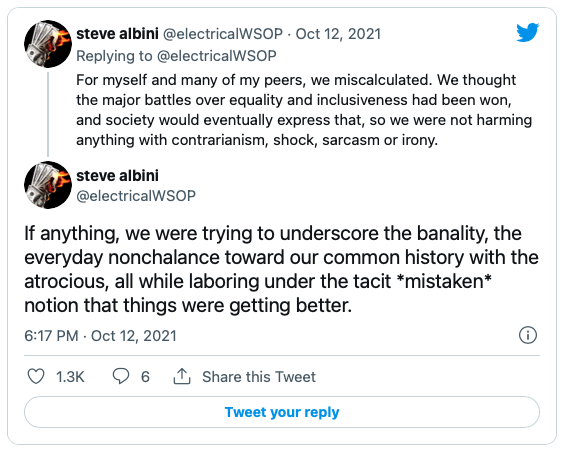
In a recent series of Tweets and a follow-up interview with MEL magazine, legendary alt-rock producer and musician Steve Albini took responsibility for what he saw as his part in creating “edgelord” culture — the jokey, meme-worthy use of racist, misogynist and homophobic slurs that became so normalized it invaded the halls of Congress. “It was genuinely shocking when I realized that there were people in the music underground who weren’t playing when they were using language like that,” he says. “I wish that I knew how serious a threat fascism was in this country…. There was a joke made about the Illinois Nazis in The Blues Brothers. That’s how we all perceived them — as this insignificant, unimportant little joke. I wish that I knew then that authoritarianism in general and fascism specifically were going to become commonplace as an ideology.”
Perhaps, as Stephen Fry explains in the video clip above from his BBC documentary series Planet Word, we might better understand how casual dehumanization leads to fascism and genocide if we see how language has worked in history. The Holocaust, the most prominent but by no means only example of mass murder, could never have happened without the willing participation of what Daniel Goldhagen called “ordinary Germans” in his book Hitler’s Willing Executioners. Christopher Browning’s Ordinary Men, about the Final Solution in Poland, makes the point Fry makes above. Cultural factors played their part, but there was nothing innately Teutonic (or “Aryan”) about genocide. “We can all be grown up enough to know that it was humanity doing something to other parts of humanity,” says Fry. We’ve seen examples in our lifetimes in Rwanda, Myanmar, and maybe wherever we live — ordinary humans talked into doing terrible things to other people.
But no matter how often we encounter genocidal movements, it seems like “a massively difficult thing to get your head around,” says Fry: “how ordinary people (and Germans are ordinary people just like us)” could be made to commit atrocities. In the U.S., we have our own version of this — the history of lynching and its attendant industry of postcards and even more grisly memorabilia, like the trophies serial killers collect. “In each one of these genocidal moments… each example was preceded by language being used again and again and again to dehumanize the person that had to be killed in the eyes of their enemies,” says Fry. He briefly elaborates on the varieties of dehumanizing anti-Semitic slurs that became common in the 1930s, referring to Jewish people, for example, as vermin, apes, untermenschen, viruses, “anything but a human being.”
“If you start to characterize [someone this way], week after week after week after week,” says Fry, citing the constant radio broadcasts against the Tutsis in the Rwandan genocide, “you start to think of someone who is slightly sullen and disagreeable and you don’t like very much anyway, and you’re constantly getting the idea that they’re not actually human. Then it seems it becomes possible to do things to them we would call completely unhuman, and inhuman, and lacking humanity.” While it’s absolutely true, he says, that language “guarantees our freedom” through the “free exchange of ideas,” it can really only do that when language users respect others’ rights. When, however, we begin to see “special terms of insult for special kinds of people, then we can see very clearly, and history demonstrates it time and time again, that’s when ordinary people are able to kill.”
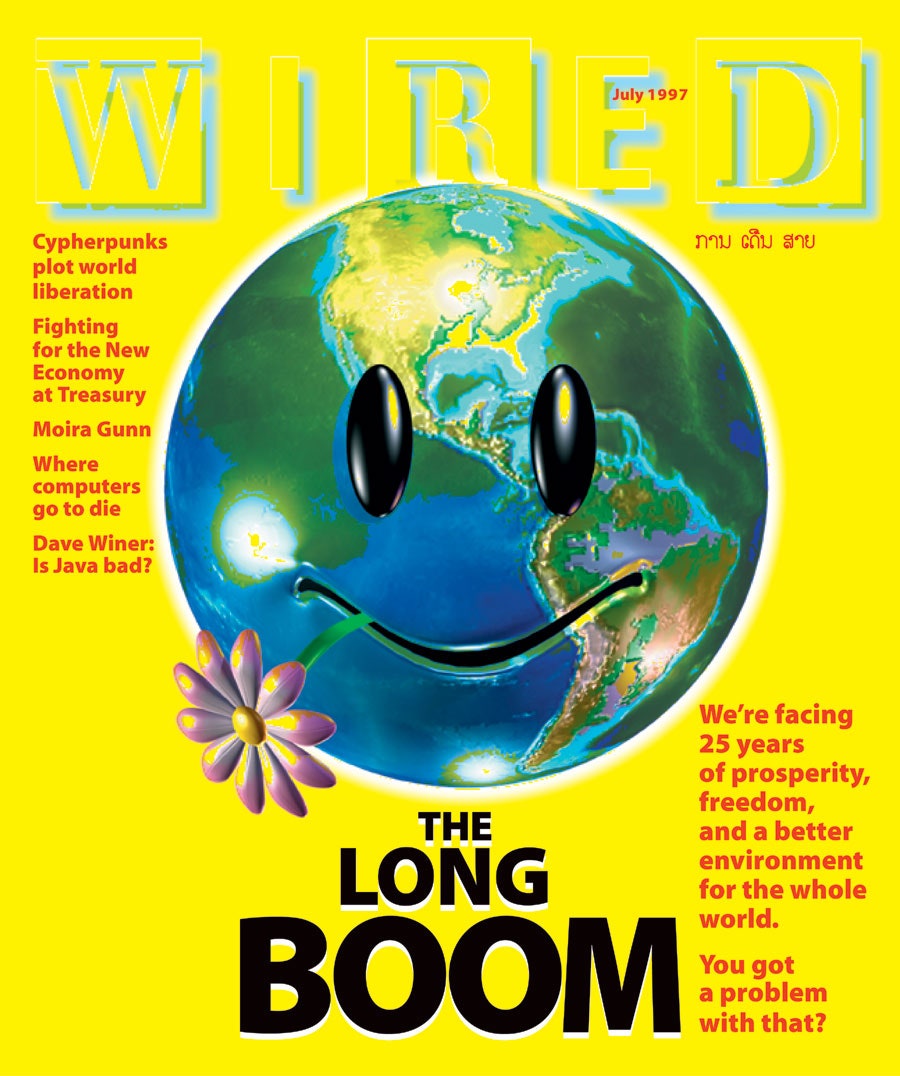
Hydrogen-powered cars. Biological, then quantum computing. Gene-therapy cancer treatments. An end to the War on Drugs. Reliable automatic translation. The impending end of the nation-state. Man setting foot on Mars. These are just a few of the developments in store for our world by the year 2020 — or so, at any rate, predicts “The Long Boom,” the cover story of a 1997 issue of Wired magazine, the official organ of 1990s techno-optimism. “We’re facing 25 years of prosperity, freedom, and a better environment for the whole world,” declares the cover itself. “You got a problem with that?”
Since the actual year 2020, this image has been smirkingly re-circulated as a prime example of blinkered End-of-History triumphalism. From the vantage of 2021, it’s fair to say that the predictions of the article’s authors Peter Schwartz and Peter Leyden (who expanded their thesis into a 2000 book) went wide of the mark.
But their vision of the 21st century hasn’t proven risible in every aspect: a rising China, hybrid cars, video calls, and online grocery-shopping have become familiar enough hardly to merit comment, as has the internet’s status as “the main medium of the 21st century.” And who among us would describe the cost of university as anything but “absurd”?
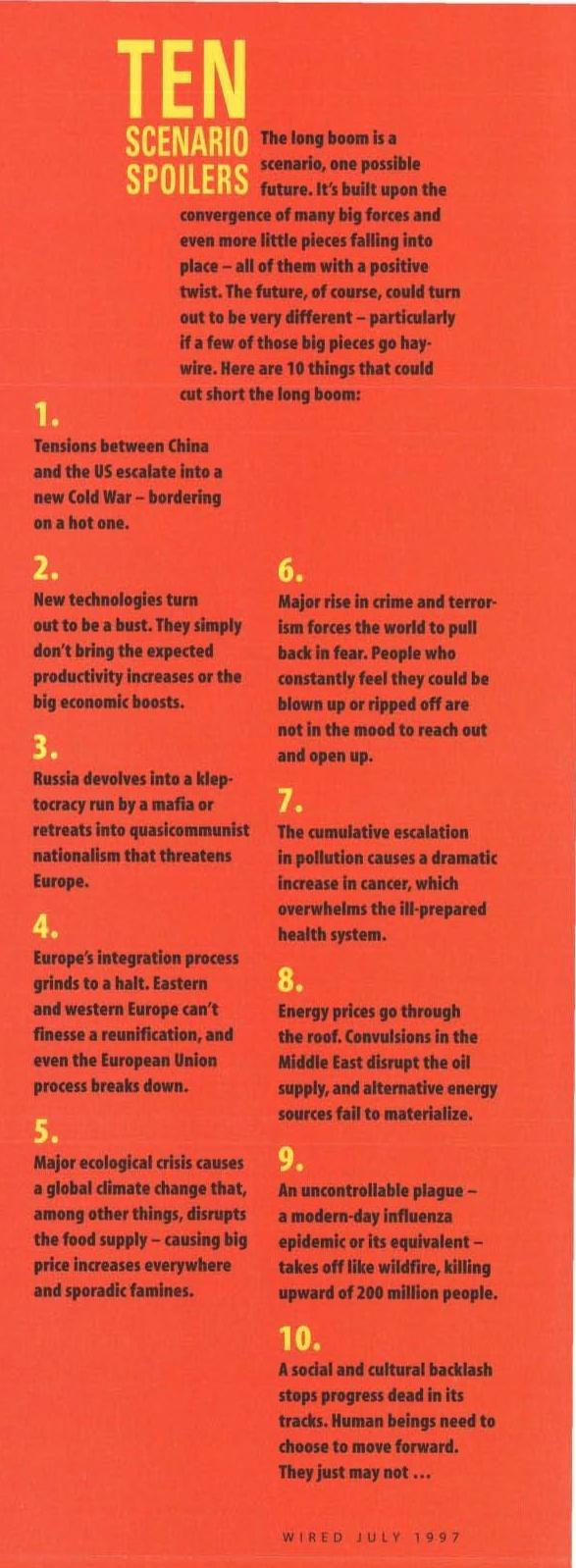
Schwartz and Leyden do allow for darker possibilities than their things-can-only-get-better rhetoric make it seem. Some of these they enumerate in a sidebar (remember sidebars?) headlined “Ten Scenario Spoilers.” Though not included in the article as archived on Wired’s web site, it has recently been scanned and posted to social media, with viral results. A “new Cold War” between the U.S. and China; a “global climate change that, among other things, disrupts the food supply”; a “major rise in crime and terrorism forces the world to pull back in fear”; an “uncontrollable plague — a modern-day influenza epidemic or its equivalent”: to one degree or another, every single one of these ten dire developments seems in our time to have come to pass.
“We’re still on the front edge of the great global boom,” we’re reminded in the piece’s conclusion. “A hell of a lot of things could go wrong.” You don’t say. Yet for all of the 21st-century troubles that few riding the wave of first-dot-com-boom utopianism would have credited, we today run the risk of seeing our world as too dystopian. Now as then, “the vast array of problems to solve and the sheer magnitude of the changes that need to take place are enough to make any global organization give up, any nation back down, any reasonable person curl up in a ball.” We could use a fresh infusion of what Schwartz and Leyden frame as the boom’s key ingredient: American optimism. “Americans don’t understand limits. They have boundless confidence in their ability to solve problems. And they have an amazing capacity to think they really can change the world.” In that particular sense, perhaps we all should become Americans after all.
Based in Seoul, Colin Marshall writes and broadcasts on cities and culture. His projects include the book The Stateless City: a Walk through 21st-Century Los Angeles and the video series The City in Cinema. Follow him on Twitter at @colinmarshall or on Facebook.
Without climate change, we couldn’t inhabit the Earth as we do today. The greenhouse effect, by which gases in a planet’s atmosphere increase the heat of that planet’s surface, “makes life on Earth possible.” So says Carl Sagan in the video above. He adds that without it, the temperature would be about 30 degrees centigrade cooler: “That’s well below the freezing point of water everywhere on the planet. The oceans would be solid.” A little of the climate change induced by the greenhouse effect, then, is a good thing, but “here we are pouring enormous quantities of CO2 and these other gases into the atmosphere every year, with hardly any concern about its long-term and global consequences.”
It’s fair to say that the level of concern has increased since Sagan spoke these words in 1985, when “climate change” wasn’t yet a household term. But even then, his audience was Congress, and his fifteen-minute address, preserved by C‑SPAN, remains a succinct and persuasive case for more research into the phenomenon as well as strategies and action to mitigate it.
What audience would expect less from Sagan, who just five years earlier had hosted the hit PBS television series Cosmos, based on his book of the same name. Its broadcast made contagious his enthusiasm for scientific inquiry in general and the nature of the planets in particular. Who could forget, for example, his introduction to the “thoroughly nasty place” that is Venus, research into whose atmosphere Sagan had conducted in the early 1960s?
Venus is “the nearest planet — a planet of about the same mass, radius, density, as the Earth,” Sagan tells Congress, but it has a “surface temperature about 470 degrees centigrade, 900 Fahrenheit.” The reason? “A massive greenhouse effect in which carbon dioxide plays the major role.” As for our planet, estimates then held that, without changes in the rates of fossil fuel-burning and “infrared-absorbing” gases released into the atmosphere, there will be “a several-centigrade-degree temperature increase” on average “by the middle to the end of the next century.” Given the potential effects of such a rise, “if we don’t do the right thing now, there are very serious problems that our children and grandchildren will have to face.” It’s impossible to know how many listeners these words convinced at the time, though they certainly seem to have stuck with a young senator in the room by the name of Al Gore.
Based in Seoul, Colin Marshall writes and broadcasts on cities, language, and culture. His projects include the Substack newsletterBooks on Cities, the book The Stateless City: a Walk through 21st-Century Los Angeles and the video series The City in Cinema. Follow him on Twitter at @colinmarshall or on Facebook.
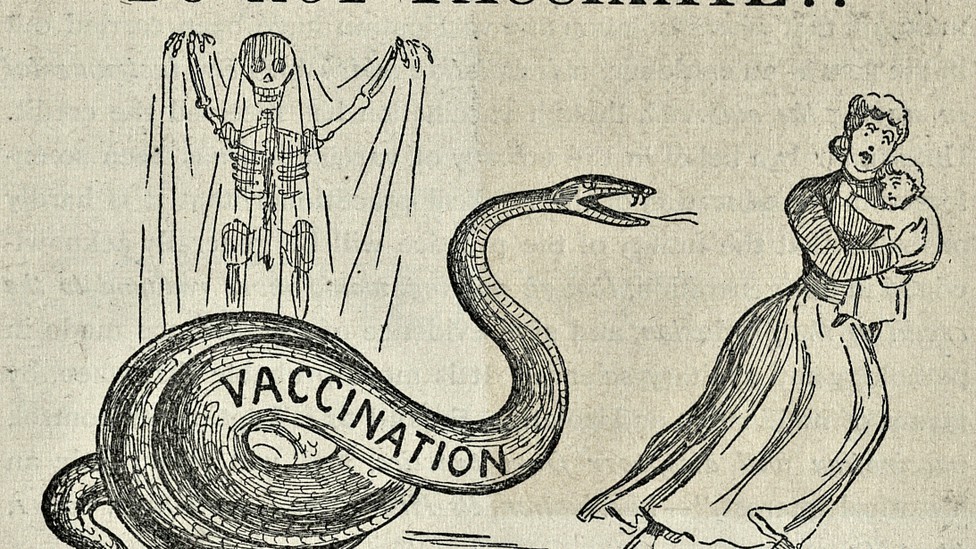
A cartoon from a December 1894 anti-vaccination publication (Courtesy of The Historical Medical Library of The College of Physicians of Philadelphia)
For well over a century people have queued up to get vaccinated against polio, smallpox, measles, mumps, rubella, the flu or other epidemic diseases. And they have done so because they were mandated by schools, workplaces, armed forces, and other institutions committed to using science to fight disease. As a result, deadly viral epidemics began to disappear in the developed world. Indeed, the vast majority of people now protesting mandatory vaccinations were themselves vaccinated (by mandate) against polio, smallpox, measles, mumps, rubella, etc., and hardly any of them have contracted those once-common diseases. The historical argument for vaccines may not be the most scientific (the science is readily available online). But history can act as a reliable guide for understanding patterns of human behavior.
In 1796, Scottish physician Edward Jenner discovered how an injection of cowpox-infected human biological material could make humans immune to smallpox. For the next 100 years after this breakthrough, resistance to inoculation grew into “an enormous mass movement,” says Yale historian of medicine Frank Snowden. “There was a rejection of vaccination on political grounds that it was widely considered as another form of tyranny.”
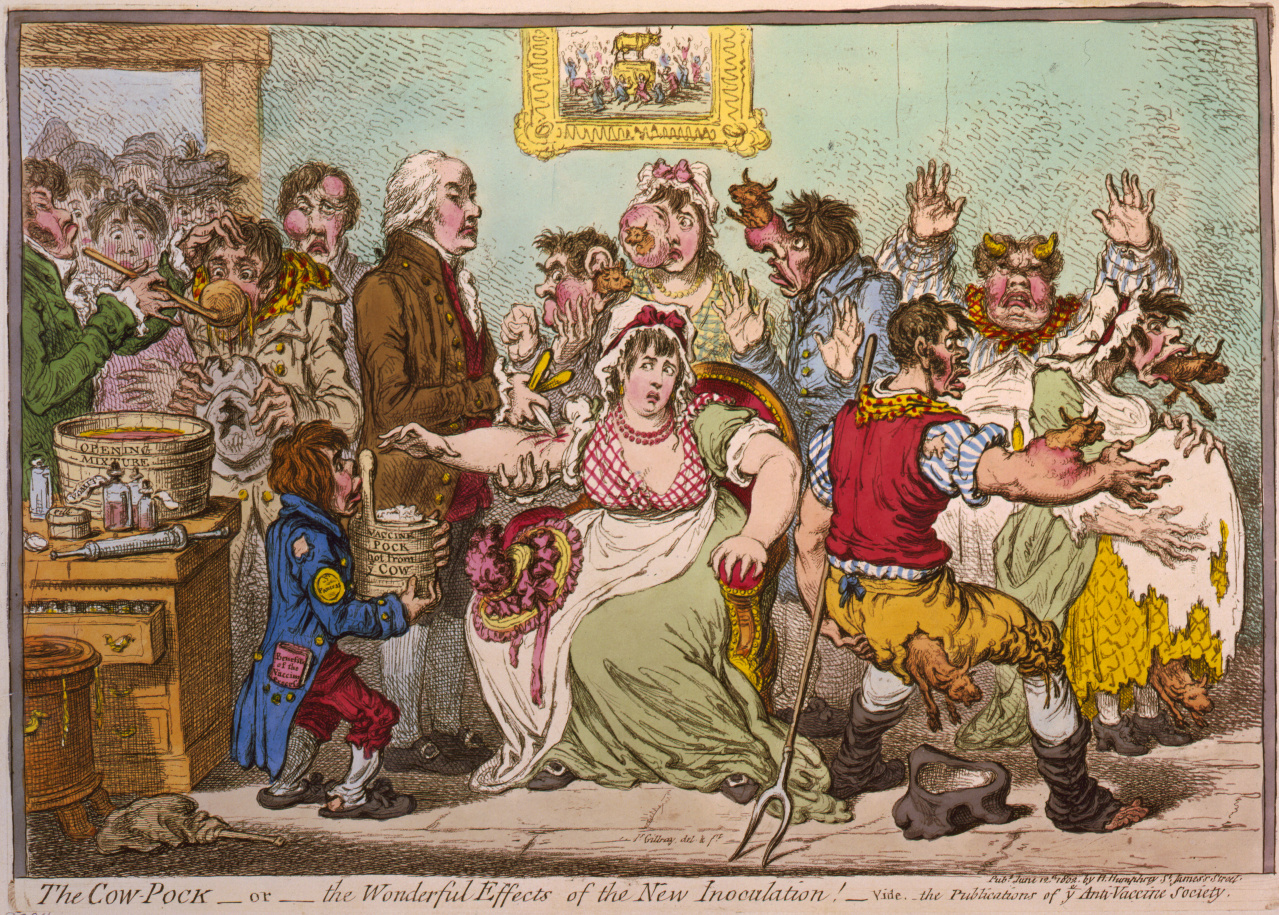
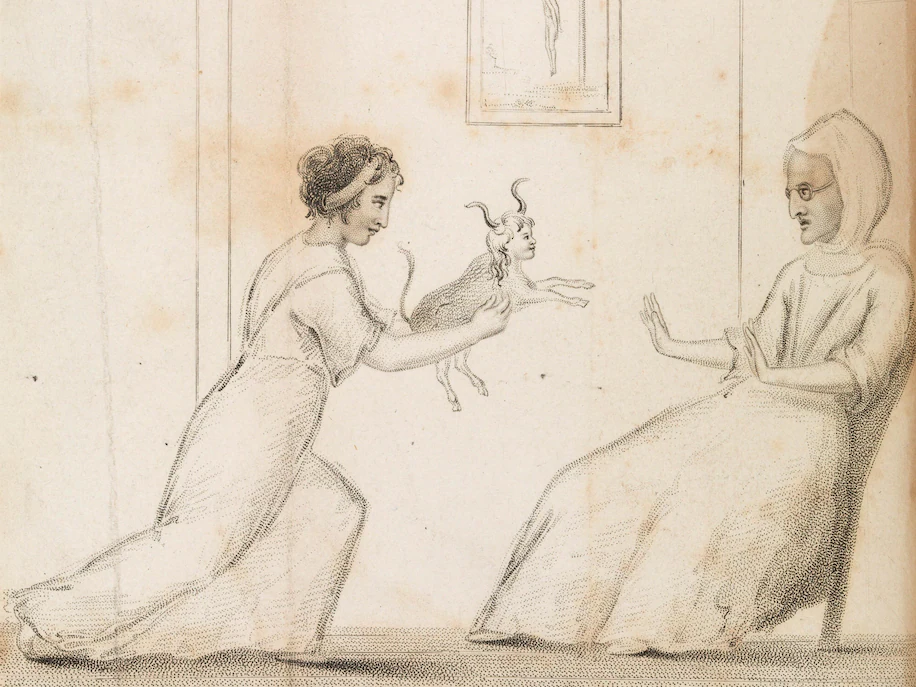
Fears that injections of cowpox would turn people into mutants with cow-like growths were satirized as early as 1802 by cartoonist James Gilray (below). While the anti-vaccination movement may seem relatively new, the resistance, refusal, and denialism are as old as vaccinations to infectious disease in the West.
Image via Wikimedia Commons
“In the early 19th century, British people finally had access to the first vaccine in history, one that promised to protect them from smallpox, among the deadliest diseases in the era,” writes Jess McHugh at The Washington Post. Smallpox killed around 4,000 people a year in the UK and left hundreds more disfigured or blinded. Nonetheless, “many Britons were skeptical of the vaccine.… The side effects they dreaded were far more terrifying: blindness, deafness, ulcers, a gruesome skin condition called ‘cowpox mange’ — even sprouting hoofs and horns.” Giving a person one disease to frighten off another one probably seemed just as absurd a notion as turning into a human/cow hybrid.
Jenner’s method, called variolation, was outlawed in 1840 as safer vaccinations replaced it. By 1867, all British children up to age 14 were required by law to be vaccinated against smallpox. Widespread outrage resulted, even among prominent physicians and scientists, and continued for decades. “Every day the vaccination laws remain in force,” wrote scientist Alfred Russel Wallace in 1898, “parents are being punished, infants are being killed.” In fact, it was smallpox claiming lives, “more than 400,000 lives per year throughout the 19th century, according to the World Health Organization,” writes Elizabeth Earl at The Atlantic. “Epidemic disease was a fact of life at the time.” And so it is again. Covid has killed almost 800,000 people in the U.S. alone over the past two years.
Then as now, medical quackery played its part in vaccine refusal — in this case a much larger part. “Never was the lie of ‘the good old days’ more clear than in medicine,” Greig Watson writes at BBC News. “The 1841 UK census suggested a third of doctors were unqualified.” Common causes of illness in an 1848 medical textbook included “wet feet,” “passionate fear or rage,” and “diseased parents.” Among the many fiery lectures, caricatures, and pamphlets issued by opponents of vaccination, one 1805 tract by William Rowley, a member of the Royal College of Physicians, alleged that the injection of cowpox could mar an entire bloodline. “Who would marry into any family, at the risk of their offspring having filthy beastly diseases?” it asked hysterically.
Then, as now, religion was a motivating factor. “One can see it in biblical terms as human beings created in the image of God,” says Snowden. “The vaccination movement injecting into human bodies this material from an inferior animal was seen as irreligious, blasphemous and medically wrong.” Granted, those who volunteered to get vaccinated had to place their faith in the institutions of science and government. After medical scandals of the recent past like the Tuskegee experiments or Thalidomide, that can be a big ask. In the 19th century, says medical historian Kristin Hussey, “people were asking questions about rights, especially working-class rights. There was a sense the upper class were trying to take advantage, a feeling of distrust.”
The deep distrust of institutions now seems intractable and fully endemic in our current political climate, and much of it may be fully warranted. But no virus has evolved — since the time of the Jenner’s first smallpox inoculation — to care about our politics, religious beliefs, or feelings about authority or individual rights. Without widespread vaccination, viruses are more than happy to exploit our lack of immunity, and they do so without pity or compunction.
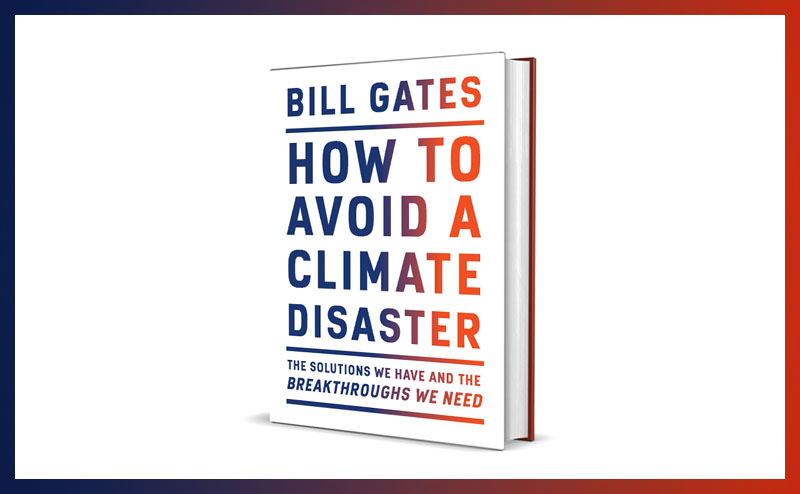
The book can be downloaded an .epub file which can be opened in a compatible e‑reader application on many devices. An email address, along with a name of college/university, is required. Find the book here.
We're hoping to rely on loyal readers, rather than erratic ads. Please click the Donate button and support Open Culture. You can use Paypal, Venmo, Patreon, even Crypto! We thank you!
Open Culture scours the web for the best educational media. We find the free courses and audio books you need, the language lessons & educational videos you want, and plenty of enlightenment in between.