Elton John is packing up his fabulous outfits and hitting stages for the last time, making a graceful exit from the road at age 75 with his “Farewell Yellow Brick Road” tour. He will, of course, make a stop at Dodger Stadium, where he played one of his most famous concerts in 1975, striding onto the stage in a sequined Dodgers uniform, one of many shimmering costumes he would don during the 3‑hour marathon set.
When John played Dodger stadium, his songs had been “hitting the airwaves with a sense of fantastical futurism,” writes Far Out, “all packaged in flamboyant costumes and dressed in number one albums. Loved by critics and adored by fans, he resembled something entirely different.” Different from what?
John answered that question in a 2020 interview with Vogue: “I wasn’t glam rock. I wasn’t David Bowie. I was me being a blokey guy wearing these clothes. I had to have humor in my costume.” Thus, his turns as Donald Duck, Minnie Mouse, and the Statue of Liberty, all costumes “designed to complement the corresponding performance,” Janelle Okwodu writes at Vogue.
John may not have thought of himself as a glam rock superstar, but his legacy of sparkling, sequined outfits, platform boots, feather boas, and bluesy rock hits says otherwise. In the video above, see the retiring Rocketman break down his most iconic looks. “Let’s begin,” he says, “at the very beginning” — decades before designer Sean Dixon tailored 30 bespoke suits (at 90 hours each to make) for John’s 2018 Million Dollar Piano show.
In 1968, John donned bell bottoms, a three-button jacket, and a fedora for his first publicity shot. “That was probably all I could afford, and it shows,” he remarks. Not a single Swarovski crystal in sight. In the early 70s, it was denim, “and I absolutely loathe denim now.” In 1997, for his 50th birthday party, John appeared in glorious full drag ensemble made by Sandy Powell, but in his later years, he’s mostly dressed down.… which for Elton John means changing into an endless series of bespoke, bedazzled suits.
Now that he’s heading into retirement from performing, we may be entitled to wonder about his bathrobe collection.…
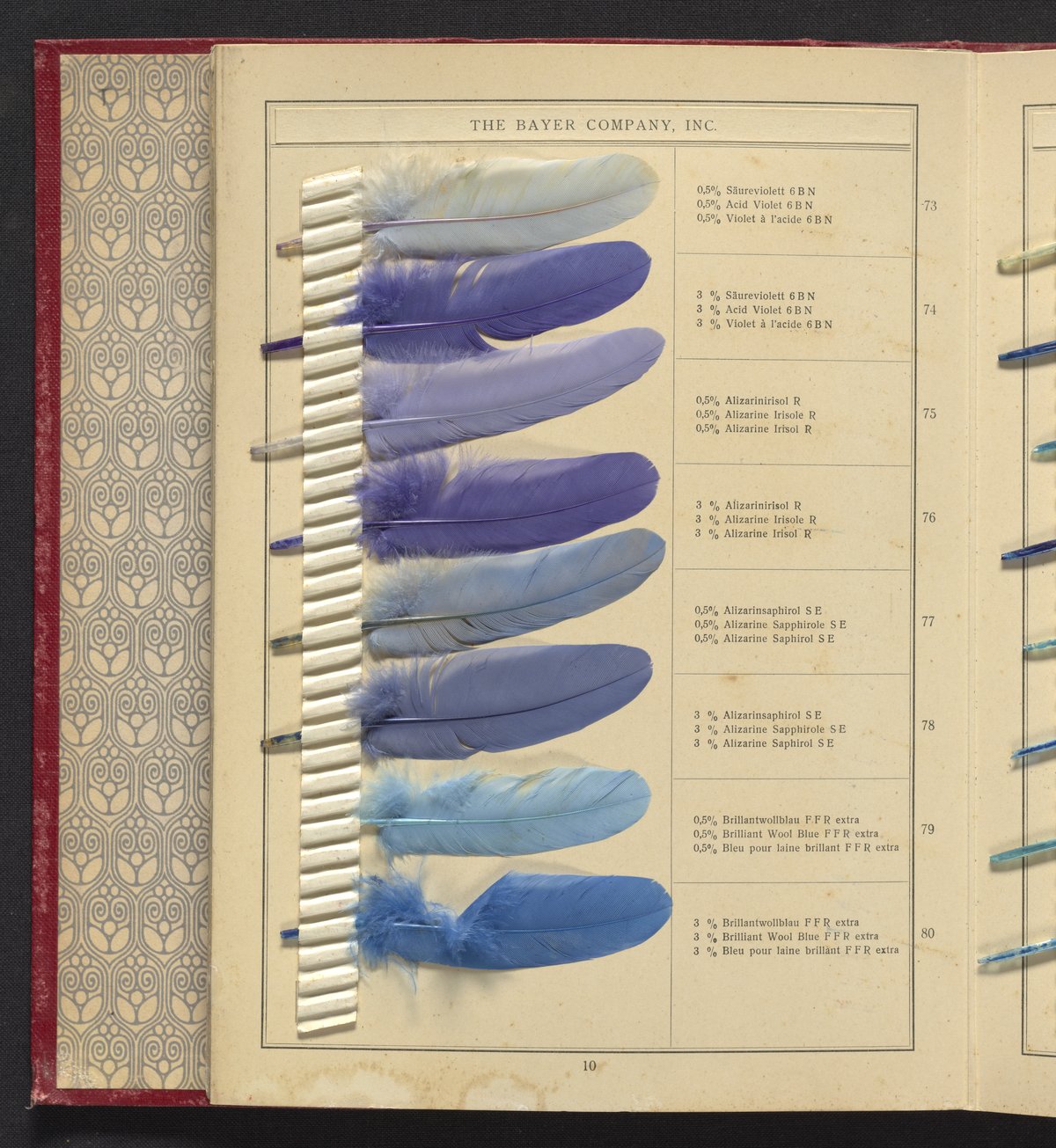
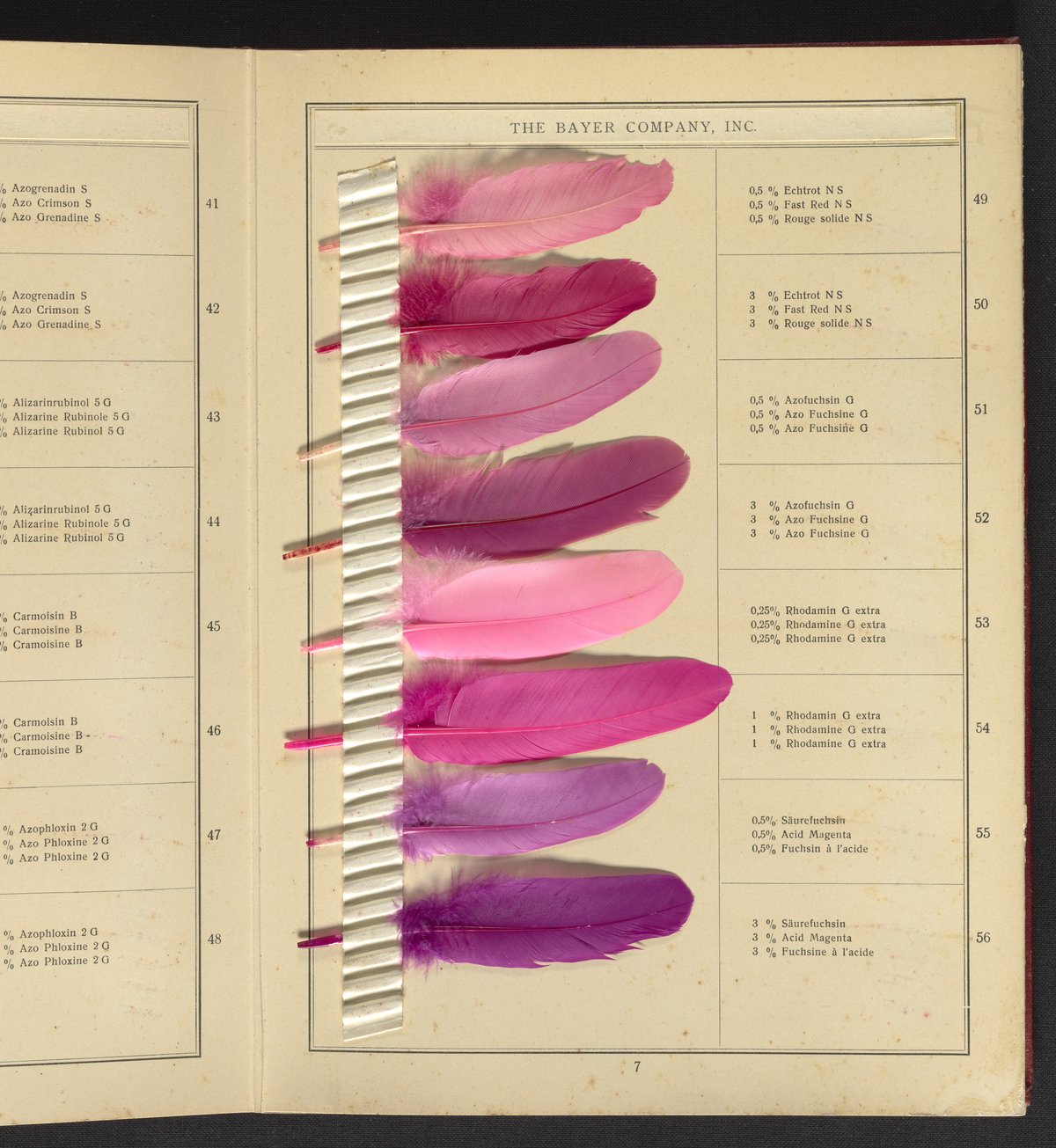
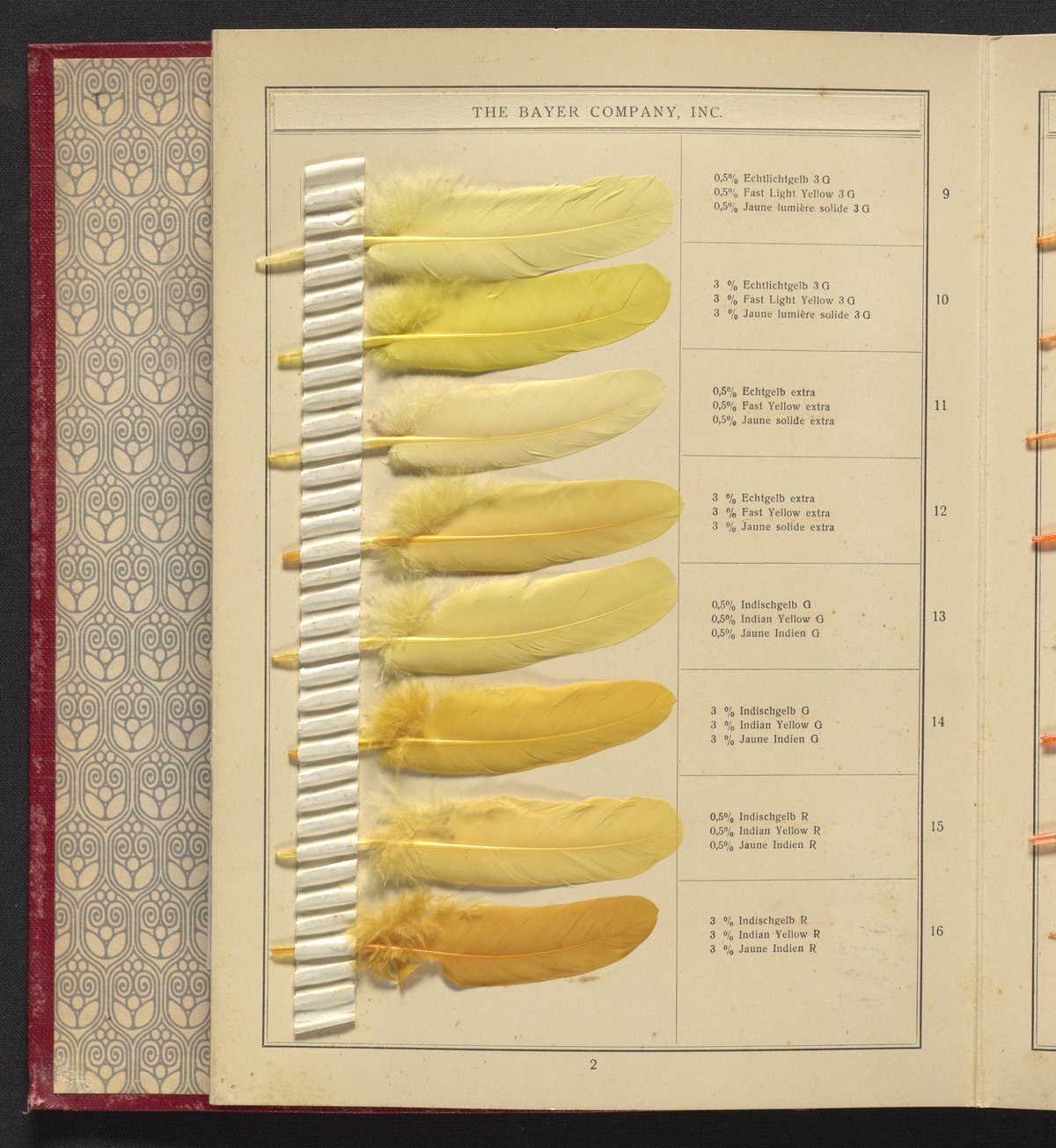
Perhaps the 143 colors showcased in The Bayer Company’s early 20th-century sample book, Shades on Feathers, could be collected in the field, but it would involve a lot of travel and patience, and the stalking of several endangered if not downright extinct avian species.
Far easier, and much less expensive, for milliners, designers and decorators to dye plain white feathers exotic shades, following the instructions in the sample book.
Such artificially obtained rainbows owe a lot to William Henry Perkin, a teenage student of German chemist August Wilhelm von Hofmann, who spent Easter vacation of 1856 experimenting with aniline, an organic base his teacher had earlier discovered in coal tar. Hoping to hit on a synthetic form of quinine, he accidentally hit on a solution that colored silk a lovely purple shade — an inadvertent eureka moment that ranks right up there with penicillin and the pretzel.
Perkin named the colour mauve and the dye mauveine. He decided to try to market his discovery instead of returning to college.
On 26 August 1856, the Patent Office granted Perkin a patent for ‘a new colouring matter for dyeing with a lilac or purple colour stuffs of silk, cotton, wool, or other materials’.
Perkin’s next step was to interest cloth dyers and printers in his discovery. He had no experience of the textile trade and little knowledge of large-scale chemical manufacture. He corresponded with Robert and John Pullar in Glasgow, who offered him support. Perkin’s luck changed towards the end of 1857 when the Empress Eugénie, wife of Napoleon III, decided that mauve was the colour to wear. In January 1858, Queen Victoria followed suit, wearing mauve to her daughter’s wedding.
(The sample book recommends cleaning the feathers prior to dying in a lukewarm solution of small amounts of olive oil soap and ammonia.)
The Science History Institute, owner of this unusual object, estimates that the undated book was produced between 1913 and 1918, the year the Migratory Bird Act Treaty outlawed the hunting of birds whose feathers humans deemed particularly fashionable.
Peruse the Science History Institute of Philadelphia’s digitized copy of the Shades on Feathers sample bookhere.
“The inhabitants of fifteenth-century Florence included Brunelleschi, Ghiberti, Donatello, Masaccio, Filippo Lippi, Fra Angelico, Verrocchio, Botticelli, Leonardo, and Michelangelo,” writes essayist and venture capitalist Paul Graham. “There are roughly a thousand times as many people alive in the U.S. right now as lived in Florence during the fifteenth century. A thousand Leonardos and a thousand Michelangelos walk among us.” But “to make Leonardo you need more than his innate ability. You also need Florence in 1450”: its community of artists, and indeed everyone of all classes who constituted its uncommonly fruitful society.
Florence’s cultural flourishing lasted into the sixteenth century. Above, you can see a morning in the life of one Florentine of the 1500s recreated in a video by Crow’s Eye Productions. Previously featured here on Open Culture for their re-creations of the dressing processes of the fourteenth, seventeenth, and eighteenth centuries, they show us this time how a woman would put herself together — or by the help, be put together — in turn-of-the-sixteenth-century Florence, which, “like many other Italian regions, had developed its own distinctive fashion style.” The camurra gown, the separate golden sleeves, the informal guarnello over-gown: all evoke this particular time and place.
As each garment and accessory is applied to the model, she may begin to look oddly familiar. “In 1503, a silk merchant from Florence, Francesco del Giocondo, commissioned a portrait of his young wife to adorn a wall in their new home, and perhaps to celebrate the safe arrival of their third child,” the video’s narrator tells us. “The artist commissioned was Leonardo da Vinci.” His portrait of Madonna Giacondo is “an intimate portrayal of a young married woman,” expensively but modestly dressed, wearing a smile “that seems intended for Francesco’s eyes only.” Yet until Leonardo’s death, the picture never left his own possession — perhaps because he sensed it had a destiny much greater than the wall of the del Giocondos’ bedchamber.
Based in Seoul, Colin Marshall writes and broadcasts on cities, language, and culture. His projects include the Substack newsletterBooks on Cities, the book The Stateless City: a Walk through 21st-Century Los Angeles and the video series The City in Cinema. Follow him on Twitter at @colinmarshall, on Facebook, or on Instagram.
The flapper is the Roaring 20s’ enduring emblem — a liberated, young woman with bobbed hair, rolled down stockings, and a public thirst for cocktails.
(My grandmother longed to be one, and succeeded, as best one could in Cairo, Illinois, only to marry an older man at the age of 17, and give birth to my father a few months before the stock market crashed, bringing the frivolity of the decade to an abrupt halt.)
Our abiding affection for the flapper is stoked on F. Scott Fitzgerald’s Jazz Age novella, The Great Gatsby, and its many stage and screen adaptations, with their depictions of wild parties featuring guests like Miss Baedecker (“When she’s had five or six cocktails she always starts screaming like that”) and Lucille (“I never care what I do, so I always have a good time.”)
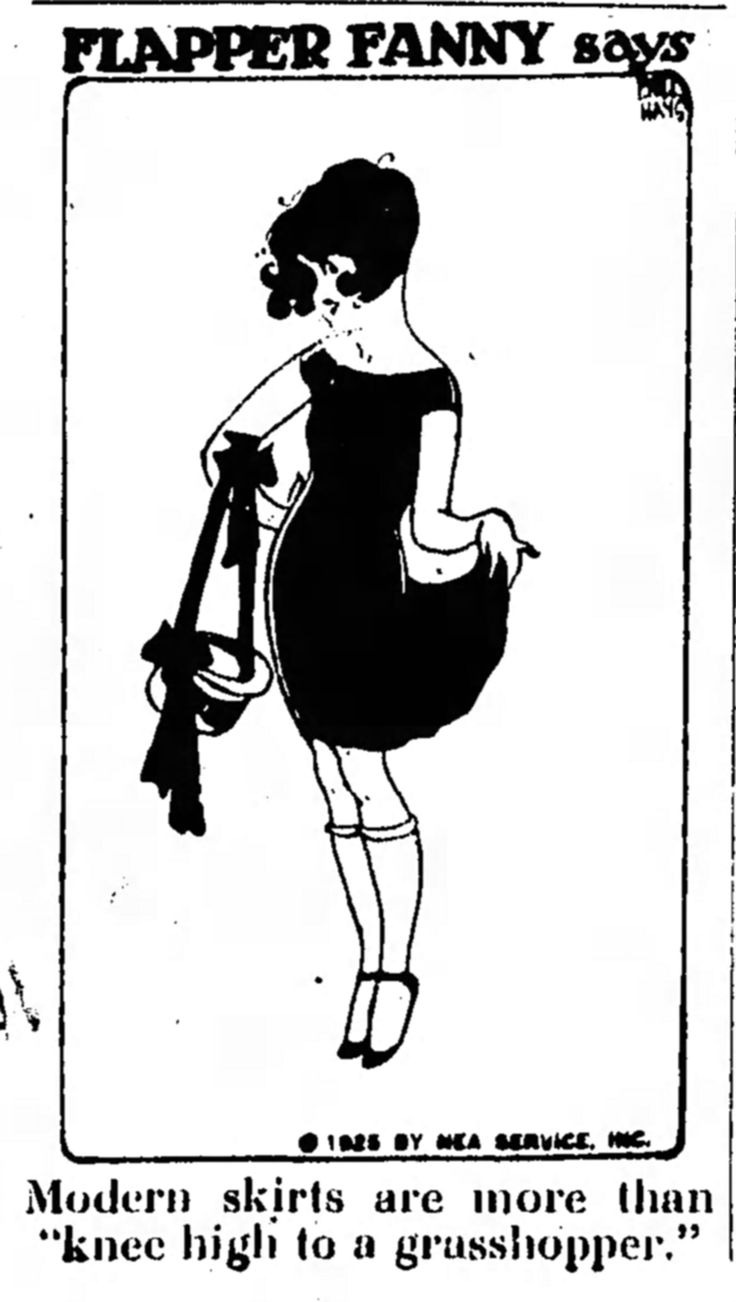
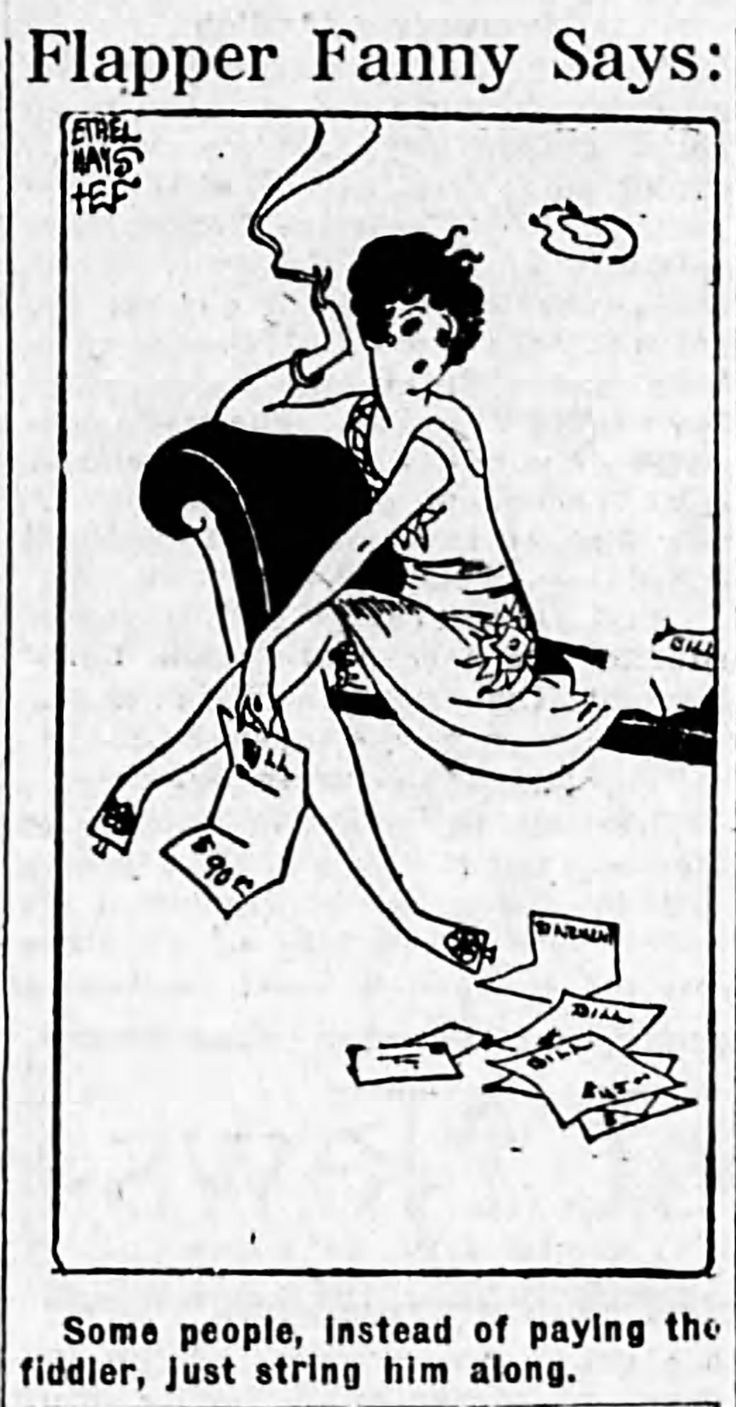
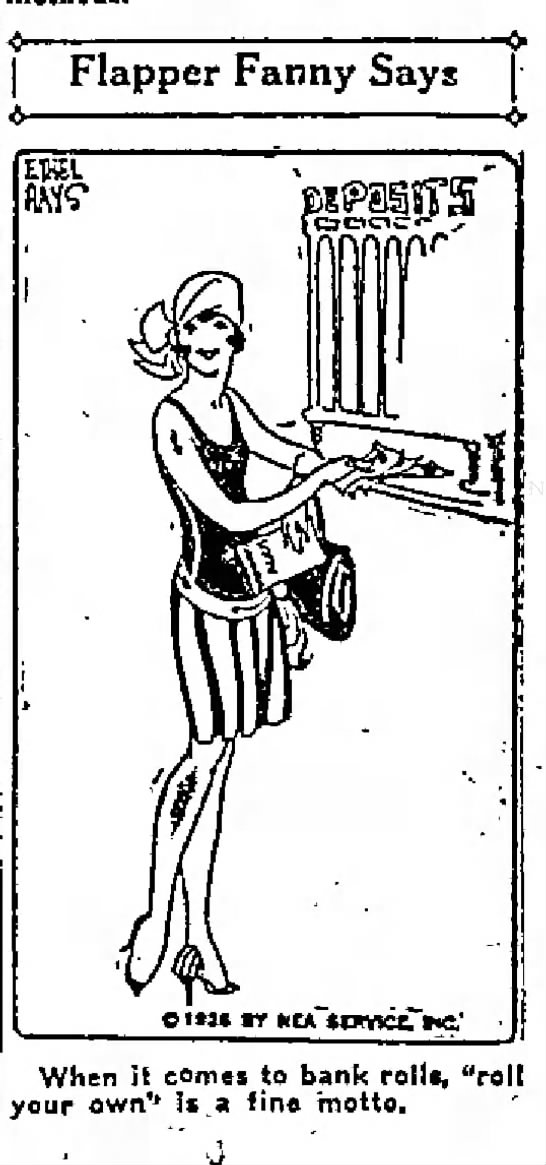
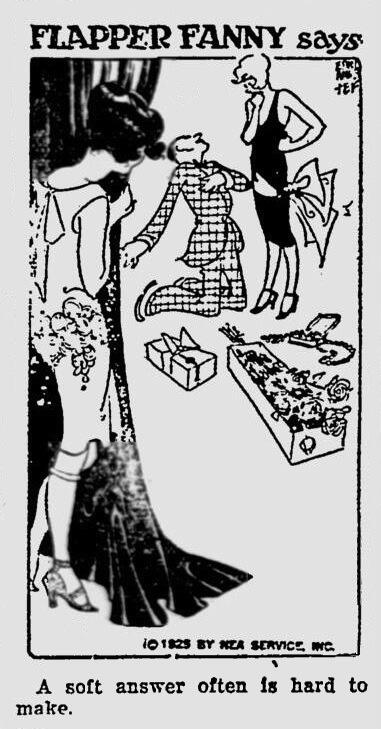
The vintage fashion blog Glamour Daze’s newly colorized footage of a 1929 fashion show in Buffalo, New York, at the top of this post, presents a vastly more sedate image than Fitzgerald, or Ethel Hays, whose single-panel daily cartoon Flapper Fanny was wildly popular with both young women and men of the time.
The scene it presents seems more wholesome than one might have found in New York City, with what Fitzgerald dubbed its “wild promise of all the mystery and the beauty in the world”. The models seem more eager amateurs than runway professionals, though lined up jauntily on a wall, all exhibit “nice stems.”
My young grandmother would have gone ga ga for the cloche hats, tea dresses, bathing suits, lounging pajamas, golf and tennis ensembles, and evening gowns, though the Deep Exemplar-based Video Colorization process seems to have stained some models’ skin and teeth by mistake.
Added sound brings the period to life with nary a mention of the Charleston or gin, though if you want a feel for 20s fashion, check out the collection’s non-silent Movietone clip devoted to the latest in 1929 swimwear — this is a modernistic beach ensemble of rayon jersey with diagonal stripes and a sun back cut…
It’s the cat’s pajamas. As is this playlist of hits from 1929.
Explore Glamour Daze’s guide to 1920s fashion history here.
Watch the original black and white footage of the Buffalo, New York fashion show here.
Admittedly jewelry is not one of our areas of expertise, but when we hear that a bracelet costs €10,000, we kind of expect it to have a smattering of diamonds.
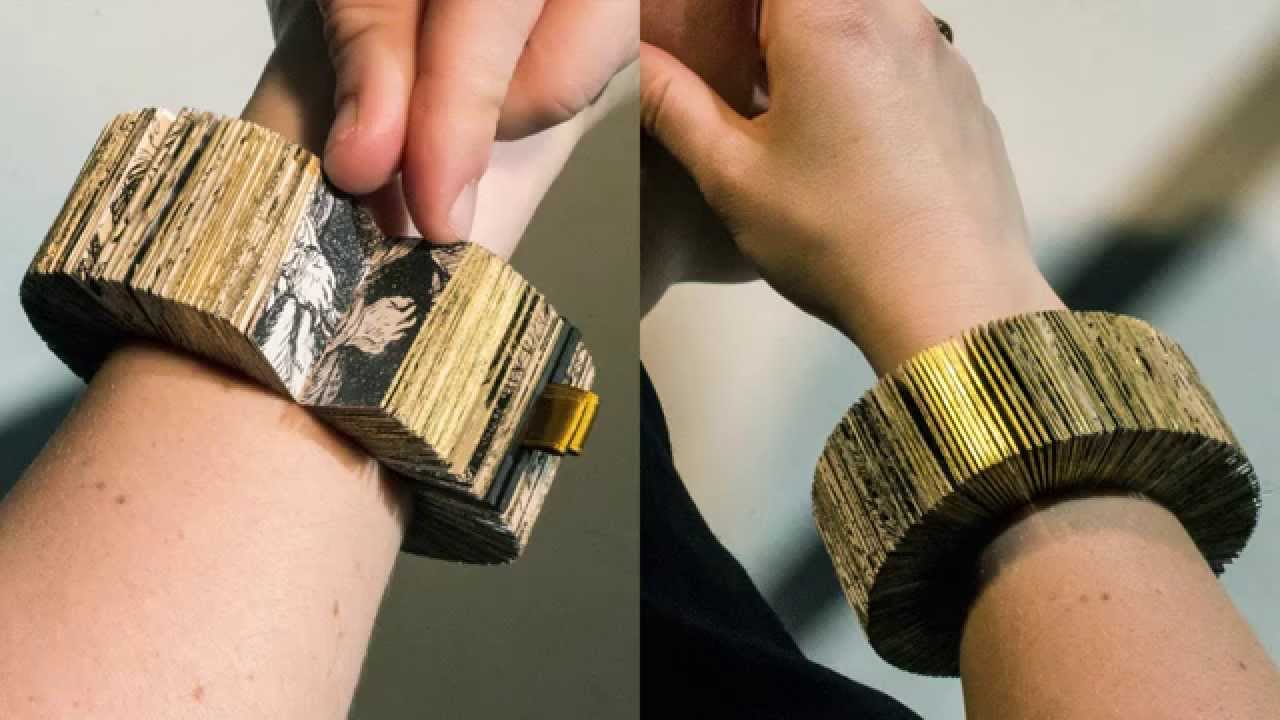
Designers Lyske Gais and Lia Duinker are getting that amount for a wristlet comprised chiefly of five large paper sheets printed with high res images downloaded free from the Rijksmuseum’s extensive digital archive of Rembrandt drawings and etchings.
Your average pawnbroker would probably consider its 18-karat gold clasp, or possibly the custom-made wooden box in which it can be stored when not in use the most precious thing about this ornament.
An ardent bibliophile or art lover is perhaps better equipped to see the book bracelet’s value.
Each gilt edged page — 1400 in all — features an image of a hand, sourced from 303 downloaded Rembrandt works.
An illustration on the designers’ Duinker and Dochters website details the painstaking process whereby the bookbracelet takes shape in 8‑page sections, or signatures, cross stitched tightly alongside each other on a paper band. Put it on, and you can flip through Rembrandt hands, Rolodex-style. When you want to do the dishes or take a shower, just pack it flat into that custom box.
The Rembrandt’s Hands and a Lion’s Paw bracelet, titled like a book and published in a limited edition of 10, nabbed first prize in the 2015 Rijksstudio Awards, a competition that challenges designers to create work inspired by the Rijksmuseum’s collection.
But what about that special art loving bibliophile who already has everything, including a Rembrandts Hands and a Lions Paw boekarmband?
Maybe you could get them Collier van hondjes, Gais and Duinker’s follow up to the book bracelet, a rubber choker with an attached 112-page book pendant showcasing Rembrandt dogs sourced from various museum’s digital collections.
What does it take to wear an ancient Roman toga with dignity and grace?
Judging from the above demonstration by Dr Mary Harlow, Associate Professor of Ancient History at the University of Leicester, a couple of helpers, who, in the first century CE, would have invariably been enslaved, and thus ineligible for togas of their own.
The iconic outer garments, traditionally made of wool, begin as single, 12–16m lengths of fabric.
Extra hands were needed to keep the cloth from dragging on the dirty floor while the wearer was being wrapped, to secure the garment with additional pleats and tucks, and to create the pouch-like umbo at chest level, in a manner as aesthetically pleasing as every other fold and drape was expected to be.
As formal citizen’s garb, the toga was suitable for virtually every public occasion, as well as an audience with the emperor.
In addition to slaves, the toga was off-limits to foreigners, freedmen, and, with the notable exception of adulteresses and prostitutes, women.
Wealthier individuals flaunted their status by accenting their outfit with stripes of Tyrian Purple.
The BBC reports that dying even a single small swatch of fabric this shade “took tens of thousands of desiccated hypobranchial glands wrenched from the calcified coils of spiny murex sea snails” and that thus dyed, the fibers “retained the stench of the invertebrate’s marine excretions.”
Achieving that Tyrian Purple hue was “a very smelly process,” Dr. Harlow confirms, “but if you could retain a little bit of that fishy smell in your final garment, it would show your colleagues that you could afford the best.”
The students also share how toga-clad Romans dealt with stairs, and introduce viewers to 5 forms of toga:
Toga Virilis — the toga of manhood
Toga Praetexta — the pre-toga of manhood toga
Toga Pulla — a dark mourning toga
Toga Candida- a chalk whitened toga sported by those running for office
Toga Picta- to be worn by generals, praetors celebrating games and consuls. The emperor’s toga picta was dyed purple. Uh-oh.
Their youthful enthusiasm for antiquity is rousing, though Quintilian, the first century CE educator and expert in rhetoric might have had some thoughts on their clownish antics.
He certainly had a lot of thoughts about togas, which he shared in his instructive masterwork, Institutio Oratoria:
The toga itself should, in my opinion, be round, and cut to fit, otherwise there are a number of ways in which it may be unshapely. Its front edge should by preference reach to the middle of the shin, while the back should be higher in proportion as the girdle is higher
behind than in front. The fold is most becoming, if it fall to a point a little above the lower edge of the tunic, and should certainly never fall below it. The other fold which passes obliquely like a belt under the right shoulder and over the left, should neither be too tight nor too loose. The portion of the toga which is last to be arranged should fall rather low, since it will sit better thus and be kept in its place. A portion of the tunic also should be drawn back in order that it may not fall over the arm when we are pleading, and the fold should be thrown over the shoulder, while it will not be unbecoming if the edge be turned back. On the other hand, we should not cover the shoulder and the whole of the throat, otherwise our dress will be unduly narrowed and will lose the impressive effect produced by breadth at the chest. The left arm should only be raised so far as to form a right angle at the elbow, while the edge of the toga should fall in equal lengths on either side.
Quintillian was willing to let some of his high standards slide if the wearer’s toga had been untidied by the heat of rousing oration:
When, however, our speech draws near its close, more especially if fortune shows herself kind, practically everything is becoming; we may stream with sweat, show signs of fatigue, and let our dress fall in careless disorder and the toga slip loose from us on every side…On the other hand, if the toga falls down at the beginning of our speech, or when we have only proceeded but a little way, the failure to replace it is a sign of indifference, or sloth, or sheer ignorance of the way in which clothes should be worn.
We’re pretty sure he would have frowned on classical archaeologist Shelby Brown’s experiments using a twin-size poly-blend bed sheet in advance of an early 21st-century College Night at the Getty Villa.
Prospective guests were encouraged to attend in their “best togas.”
Could it be that the party planners , envisioning a civilized night of photo booths, classical art viewing, and light refreshments in the Herculaneum-inspired Getty Villa, were so ignorant of 1978’s notorious John Belushi vehicle Animal House?
There was a period in the late 20th-century when having hair long enough to sit on was considered something of an accomplishment.
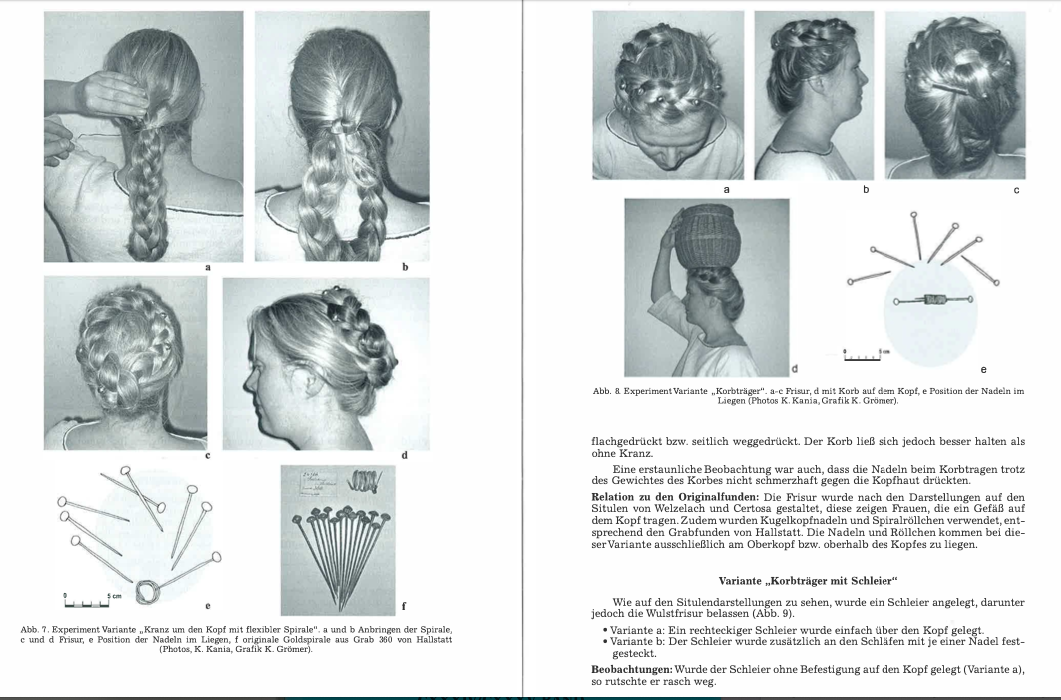
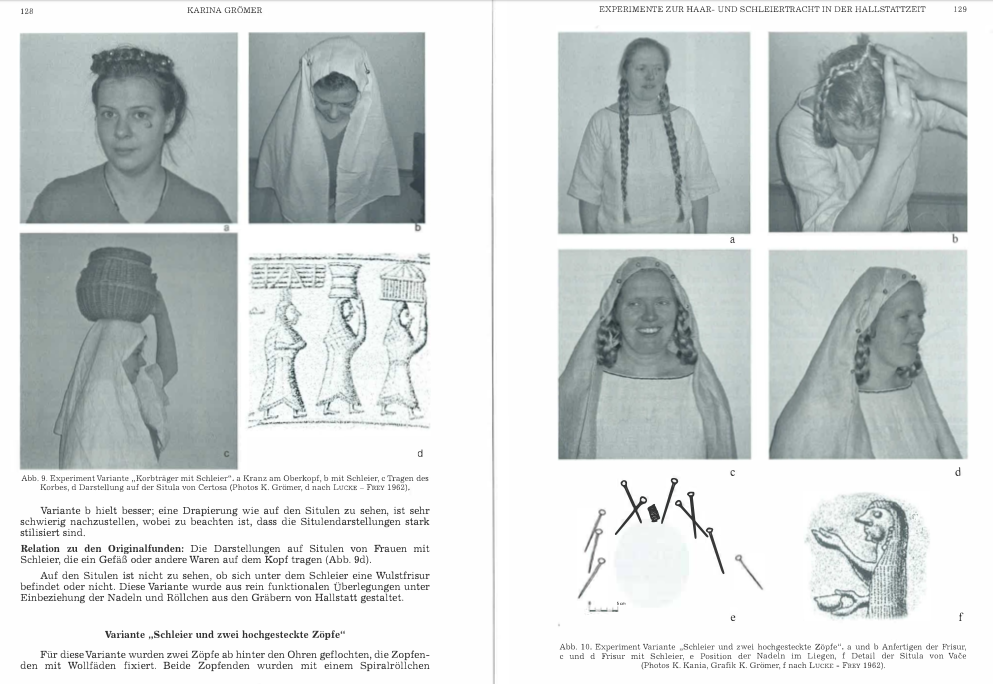
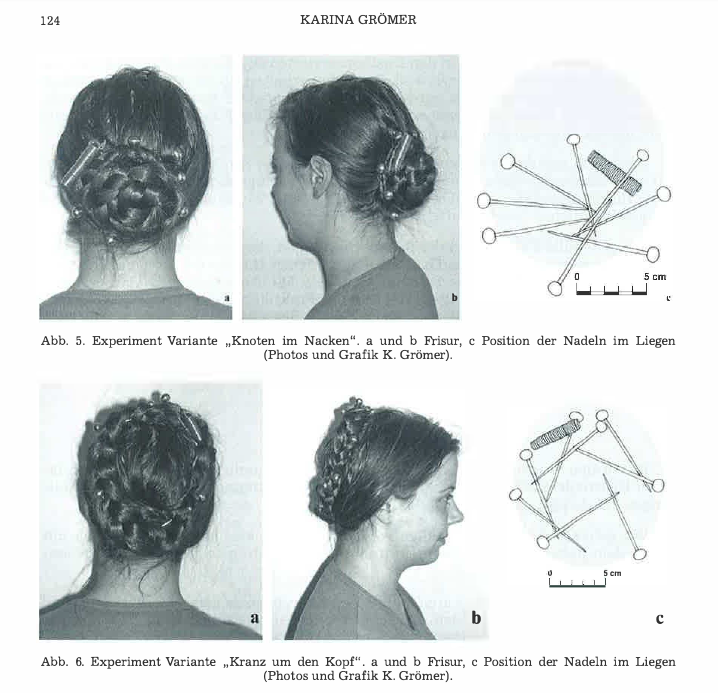
Judging by the long hair pins unearthed from Austria’s Hallstatt burial site, extreme length was an early Iron Age hair goal, too, possibly because a coronet of thick braids made it easier to balance a basket on your head or keep your veil securely fastened.
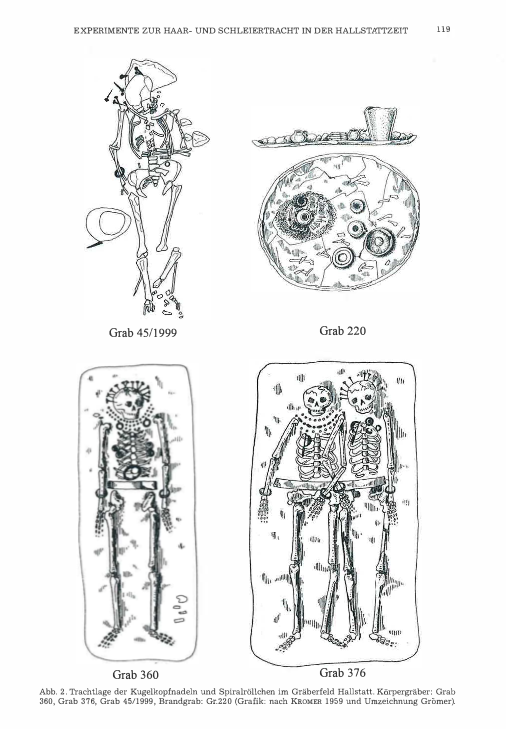
Gromer, the vice-head of the Vienna Natural History Museum’s Department of Prehistory, published precise diagrams showing the position of the hair ornaments in relation to the occupants of various graves.
For example, the skeleton in grave 45, below, was discovered with “10 bronze needles to the left of and below the skull, (and) parts of a bronze spiral roll in the neck area.”
Although no hair fibers survive, researchers cross-referencing the pins’ position against figural representations from period artifacts, have made a pretty educated guess as to the sort of hair do this individual may have sported in life, or more accurately, given the context, death.
As to the “bronze spiral roll” — which Donner persists in referring to as a spiral “doobly doo” — it functioned much like a modern day elastic band, preventing the braid from unravelling.
Donner twists hers from wire, after arranging to have replica hairpins custom made to historically accurate dimensions. (The manufacturer, perhaps misunderstanding her interest in history, coated them with an antiquing agent that had to be removed with “brass cleaner and a bit of rubbing.”
Most of the styles are variants on a bun. All withstand the “shake test” and would look right at home in a bridal magazine.
Star Wars fans will be gratified to find not one, but two iconic Princess Leia looks.
Our favorites were the braided loops and double buns meant to be sported beneath a veil.
“The braids do kind of act nicely as an anchor point for the veil to sit on,” Donner reports, “Not a lot of modern application per se for this particular style but it’s cute. It’s fun.”
Either would give you some serious Medieval Festival street cred, even if you have to resort to extensions.
Donner’s video gets a lot of love in the comments from a number of archaeology professionals, including a funerary archaeologist who praises the way she deals with the “inherent issues of preservation bias.”
The final nine minutes contain a DIY tutorial for those who’d like to make their own hairpins, as well as the spiral “doobly doo”.
If you’re of a less crafty bent, a jewelry designer in Finland is selling replicas based on the grave finds of Hallstatt culture on Etsy.
Watch a playlist of Donner’s historical hair experiments and tutorials, though a peek at her Instagram reveals that she got a buzzcut last fall, currently grown out to pixie-ish length.
Download Grömer’s illustrated article on Hallstatt period hairstyles and veils for free (in German) here.
Remember how it felt to be bundled into tights, socks, jeans, a thick sweater, a snowsuit, mittens, only to realize that you really needed to pee?
Back in 1665, the Little Ice Age compelled the well-to-do ladies of Delft to turn themselves out with a similar eye toward keeping warm, but their ensembles had a distinct advantage over the Christmas Story snowsuit approach.
Relieving themselves was as easy as hiking their skirts, petticoats, and voluminous, lace-trimmed chemise. No flies for freezing fingers to fumble with. In fact, no drawers at all.
Historical costumer Pauline Loven, a creator of the Getting Dressed In… series, builds this elite outfit from the innermost layer out, above, noting that clothing was an avenue for well-to-do citizens to flaunt their wealth:
A long, full, Linen or silk chemise trimmed with lace at the cuff
A waist-tied hip pad to bolster several layers of cozy, lined petticoats
An elegant silk gown comprised of several components:
A flat fronted skirt tucked into pleats at the sides and back
A laced up bodice stiffened with whale bone stays
Detachable sleeves
A stomacher for front-laced bodices
A loose fitting, fur-trimmed velvet or silk jacket
Silk or woolen thigh-high stockings gartered below the knee (created for the episode by heritage educator, and knitwear designer Sally Pointer)
A linen or silk kerchief pinned or tied at the breast
Square-toed leather shoes with a curved heel (created for the episode by Kevin Garlick, who specializes in handmade shoes for re-enactors.)
Fashionable accessories might include a foot warming, charcoal powered voeten stoofand understated jewelry, like the pearls Johannes Vermeer painted to such luminous effect.
If that doesn’t tip you off to the direction this historic recreation is headed, allow us to note that the attendant, who’s far from the focus of this episode, is garbed so as to suggest The Milkmaid by a certain Dutch Baroque Period painter who specialized in domestic interior scenes…and whose initials are J.V.
We're hoping to rely on loyal readers, rather than erratic ads. Please click the Donate button and support Open Culture. You can use Paypal, Venmo, Patreon, even Crypto! We thank you!
Open Culture scours the web for the best educational media. We find the free courses and audio books you need, the language lessons & educational videos you want, and plenty of enlightenment in between.