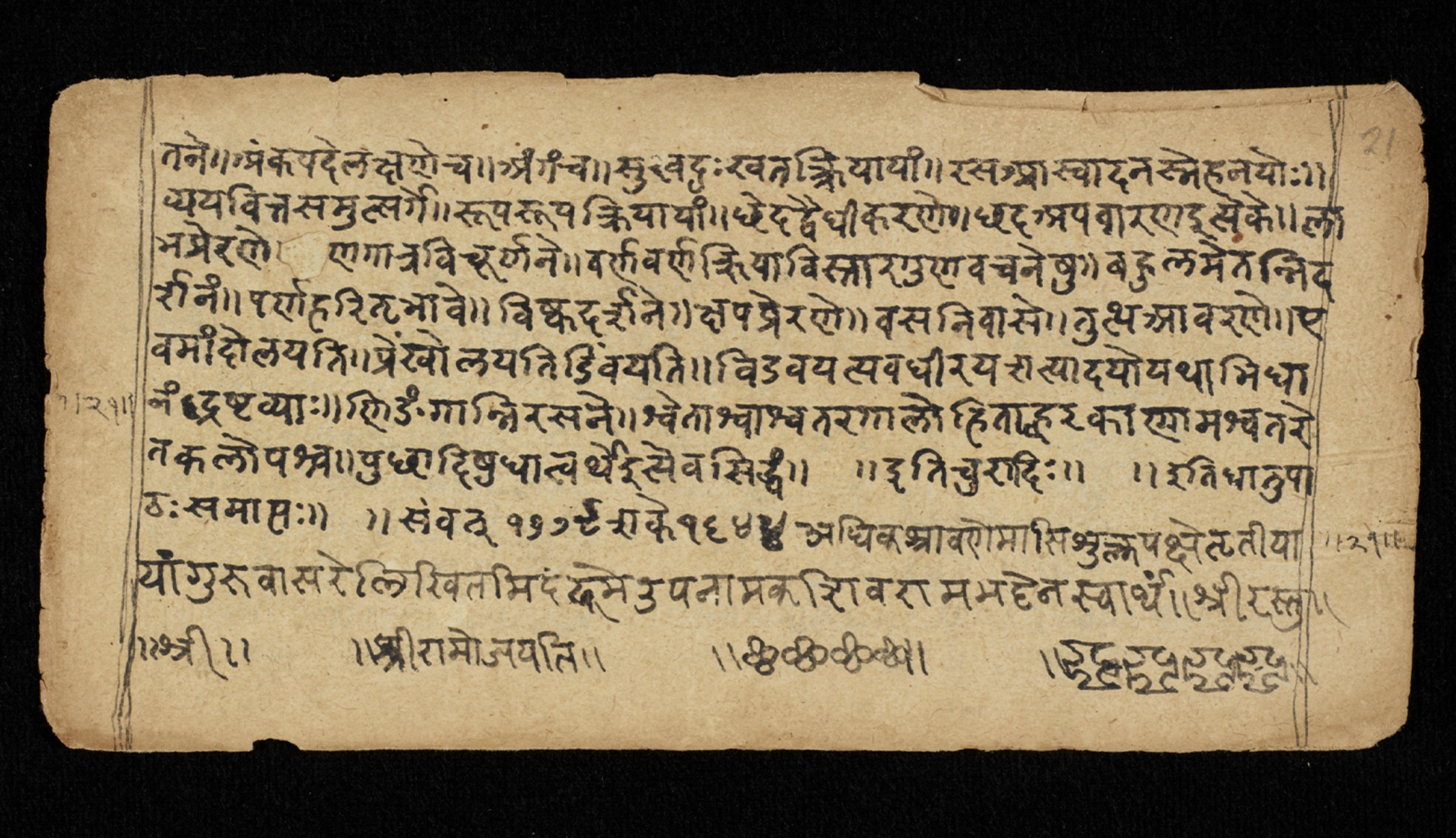
If you find yourself grappling with an intellectual problem that’s gone unsolved for millennia, try taking a few months off and spending them on activities like swimming and meditating. That very strategy worked for a Cambridge PhD student named Rishi Rajpopat, who, after a summer of non-research-related activities, returned to a text by the ancient grammarian, logician, and “father of linguistics” Pāṇini and found it newly comprehensible. The rules of its composition had stumped scholars for 2,500 years, but, as Rajpopat tells it in an article by Tom Almeroth-Williams at Cambridge’s website, “Within minutes, as I turned the pages, these patterns started emerging, and it all started to make sense.”
Pāṇini composed his texts using a kind of algorithm: “Feed in the base and suffix of a word and it should turn them into grammatically correct words and sentences through a step-by-step process,” writes Almeroth-Williams. But “often, two or more of Pāṇini’s rules are simultaneously applicable at the same step, leaving scholars to agonize over which one to choose.” Or such was the case, at least, before Rajpopat’s discovery that the difficult-to-interpret “metarule” meant to apply to such cases dictates that “between rules applicable to the left and right sides of a word respectively, Pāṇini wanted us to choose the rule applicable to the right side.”
That may not be immediately understandable to those unfamiliar with the structure of Sanskrit. Almeroth-Williams’ piece clarifies with an example using mantra, one word from the language that everybody knows. “In the sentence ‘devāḥ prasannāḥ mantraiḥ’ (‘The Gods [devāḥ] are pleased [prasannāḥ] by the mantras [mantraiḥ]’) we encounter ‘rule conflict’ when deriving mantraiḥ, ‘by the mantras,’ ” he writes. ” The derivation starts with ‘mantra + bhis.’ One rule is applicable to the left part ‘mantra’ and the other to right part ‘bhis.’ We must pick the rule applicable to the right part ‘bhis,’ which gives us the correct form ‘mantraih.’ ”
Applying this rule renders interpretations of Pāṇini’s work almost completely unambiguous and grammatical. It could even be employed, Rajpopat has noted, to teach Sanskrit grammar to computers being programmed for natural language processing. It no doubt took him a great deal of intensive study to reach the point where he was able to discover the true meaning of Pāṇini’s clarifying metarule, but it didn’t truly present itself until he let his unconscious mind take a crack at it. As we’ve said here on Open Culture before, there are good reasons we do our best thinking while doing things like walking or taking a shower, a phenomenon that philosophers have broadly recognized through the ages — and, like as not, was understood by the great Pāṇini himself.
Related content:
Learn Latin, Old English, Sanskrit, Classical Greek & Other Ancient Languages in 10 Lessons
Introduction to Indian Philosophy: A Free Online Course
How Scholars Finally Deciphered Linear B, the Oldest Preserved Form of Ancient Greek Writing
Based in Seoul, Colin Marshall writes and broadcasts on cities, language, and culture. His projects include the Substack newsletter Books on Cities and the book The Stateless City: a Walk through 21st-Century Los Angeles. Follow him on Twitter at @colinmarshall or on Facebook.