Dedicated teachers often go well beyond the call of duty, sacrificing large amounts of free time for the betterment of their classrooms and their pupils.
Any teacher who’s ever paid for supplies out of their own pocket, then spent the weekend constructing an elaborate bulletin board display, will appreciate the herculean efforts of Sarah Ellen Harding Baker.
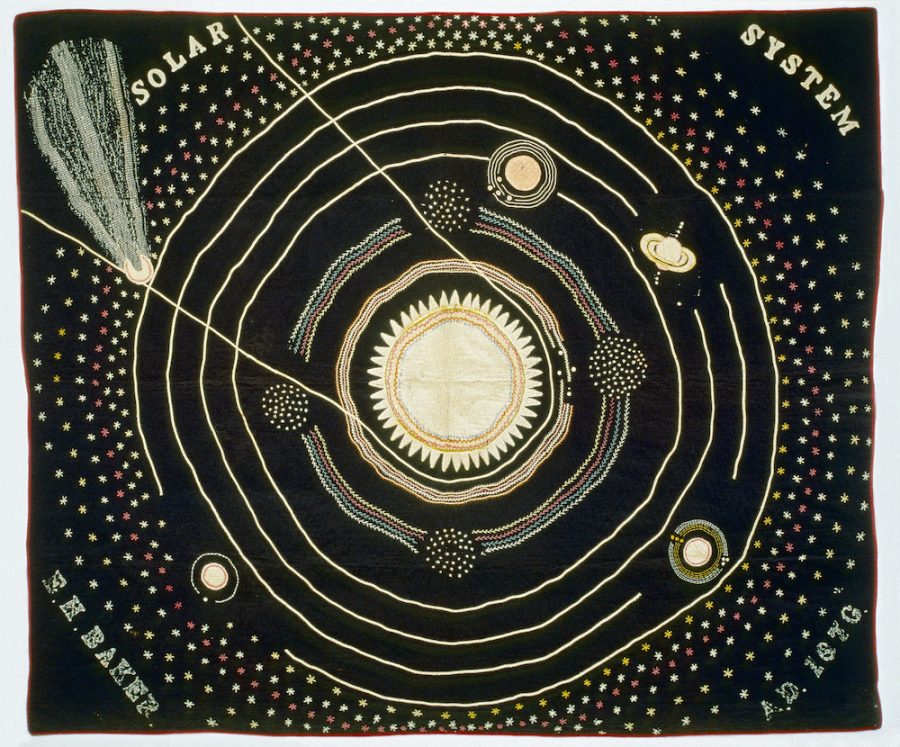
Baker, a teacher and astronomer in Cedar County, Iowa, is rumored to have spent 7 years embroidering a beautiful appliquéd quilt to use as a visual aid in lectures.
Finished in 1876, the quilt is large enough that even a near-sighted student could see its planets and moons from the back row.
Orbits are indicated with silken threads against a black background.
A comet in the upper left is thought to be Halley’s Comet, whose last appearance would have been in 1835, 12 years before Baker’s birth.
The Smithsonian National Museum of American History, where Baker’s quilt is housed, notes that astronomy was deemed an acceptable interest for 19th-century women, which may explain the number of celestial-themed quilts that date to the period.
Baker got just ten years out of her quilt before succumbing to tuberculosis at the age of 39, the mother of 7 children, 5 of whom survived her.
Music lovers bracing against the annual onslaught of the Singing Dogs’ “Jingle Bells” may find their savage beasts soothed somewhat by Eddy Chen’s performance of Pachelbel’s Canon, above.
It retains its relaxing musicality. Chen, one half of Australian duo TwoSetViolin, plays that bird like the disciplined, classically-trained pro he is.
The duo describes its mission as “upholding the integrity of classical music” while making it “relevant to the modern generation through fun, humour and simplicity,” noting, in a joint interview with Violinist.com:
There are people out there who are ready to love classical music, and we have to actively find them. It is the way classical music has been presented so far that makes it so austere. We were lucky that we learned the instrument for 20 years; if we were not musicians, it would be very hard to get into.
Everyone has the potential to like it, but sometimes musicians alienate and scare potential listeners with our pride.
Back when classical music was new, it was not ‘classical’; it was just music.
Today our (classical music audience) is very small, but there are many great musicians
Granted, the standards for classical music are there for a good reason: people want the best art, and that is a standard we should uphold. At the same time, sometimes we see people breaking down and freaking out because of those standards. It is sad to think of all that lost potential and love for music. We feel we are losing audiences; we are losing people who used to love music.
The chicken definitely appeals to young listeners, though surely there’s no age limit for enjoying its take on Erik Satie’s Gymnopédie No.1…
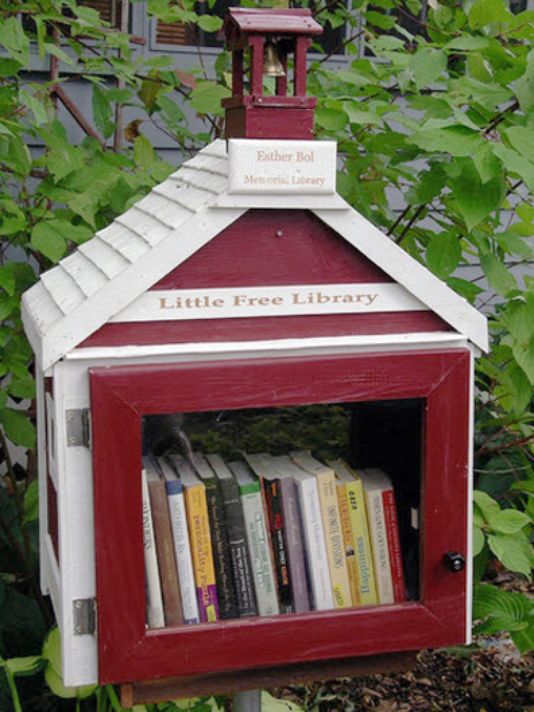
“The Little Free Library: Billions and billions read.”
In the 2013 Ted‑X talk above, Todd Bol, founder of the Little Free Library movement, expressed the desire that one day, he might be able to boast that his labor of love had surpassed McDonalds with regard to the number of customers’ served.
He seemed proudest of the libraries’ community building effect (though he was also pretty chuffed when Reader’s Digest ranked the project above Bruce Springsteen in its 2013 feature ”50 Surprising Reasons We Love America.” )
A steward who posted news of his dog’s death on the side of his library received sympathy cards from neighbors both known and unknown to him.
A steward who specializes in giving away cookbooks, and invites patrons to snip herbs from an adjacent garden, frequently wakes to find homemade quiche and other goodies on the doorstep.
I’d be happy if I could think that the role of the library was sustained and even enhanced in the age of the computer. —Bill Gates
The New York Public Library excels at keeping a foot in both worlds, particularly when it comes to engaging younger readers.
Visitors from all over the world make the pilgrimage to see the real live Winnie-the-Pooh and friends in the main branch’s hopping children’s center.
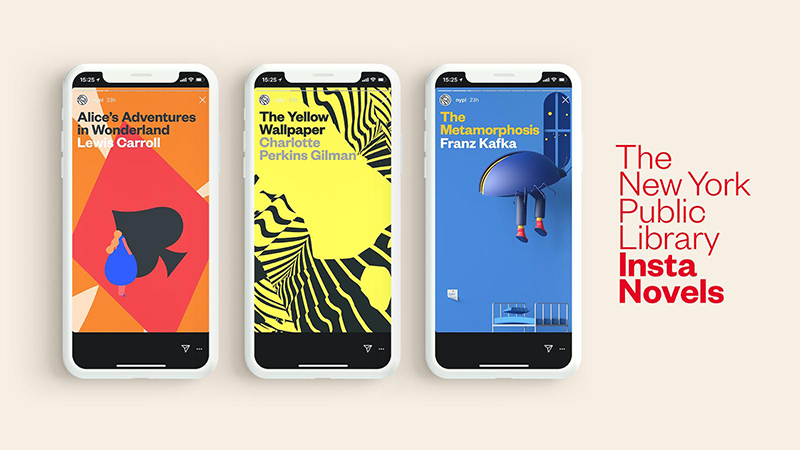
And now anyone with a smartphone and an Instagram account can “check out” their digital age take on Lewis Carroll’s Alice’s Adventures in Wonderland—no library card required. See Part 1 here and Part 2 here.
Working with the design firm Mother, the library has found a way to make great page-turning use of the Instagram Stories platform—more commonly used to share blow-by-blow photographic evidence of road trips, restaurant outings, and hash-tagged weddings.
The Wonderland experience remains primarily text-based.
In other words, sorry, harried caregivers! There’s no handing your phone off to the pre-reading set this time around!
No trippy Disney teacups…
Sir John Tenniel’s classic illustrations won’t be springing to animated life. Instead, you’ll find conceptual artist Magoz’s bright minimalist dingbats of keyholes, teacups, and pocket watches in the lower right hand corner. Tap your screen in rapid succession and they function as a crowd-pleasing, all ages flip book.
Elsewhere, animation allows the text to take on clever shapes or reveal itself line by line—a pleasantly theatrical, Cheshire Cat like approach to Carroll’s impudent poetry.
Navigating this new media can be a bit confusing for those whose social media fluency is not quite up to speed, but it’s not hard once you get the hang of the controls.
Tapping the right side of the screen turns the page.
Tapping left goes back a page.
And keeping a thumb (or any finger, actually) on the screen will keep the page as is until you’re ready to move on. You’ll definitely want to do this on animated pages like the one cited above. Pretend you’re playing the flute and you’ll save a lot of frustration.
The library plans to introduce your phone to Charlotte Perkins Gilman’s short story “The Yellow Wallpaper” and Franz Kafka’s The Metamorphosis via Instagram Stories over the next couple of months. Like Alice, both works are in the public domain and share an appropriate common theme: transformation.
Use these links to go directly to part 1 and part 2 of Alice’s Adventures in Wonderland on Instagram Stories. Both parts are currently pinned to the top of the library’s Instagram account.
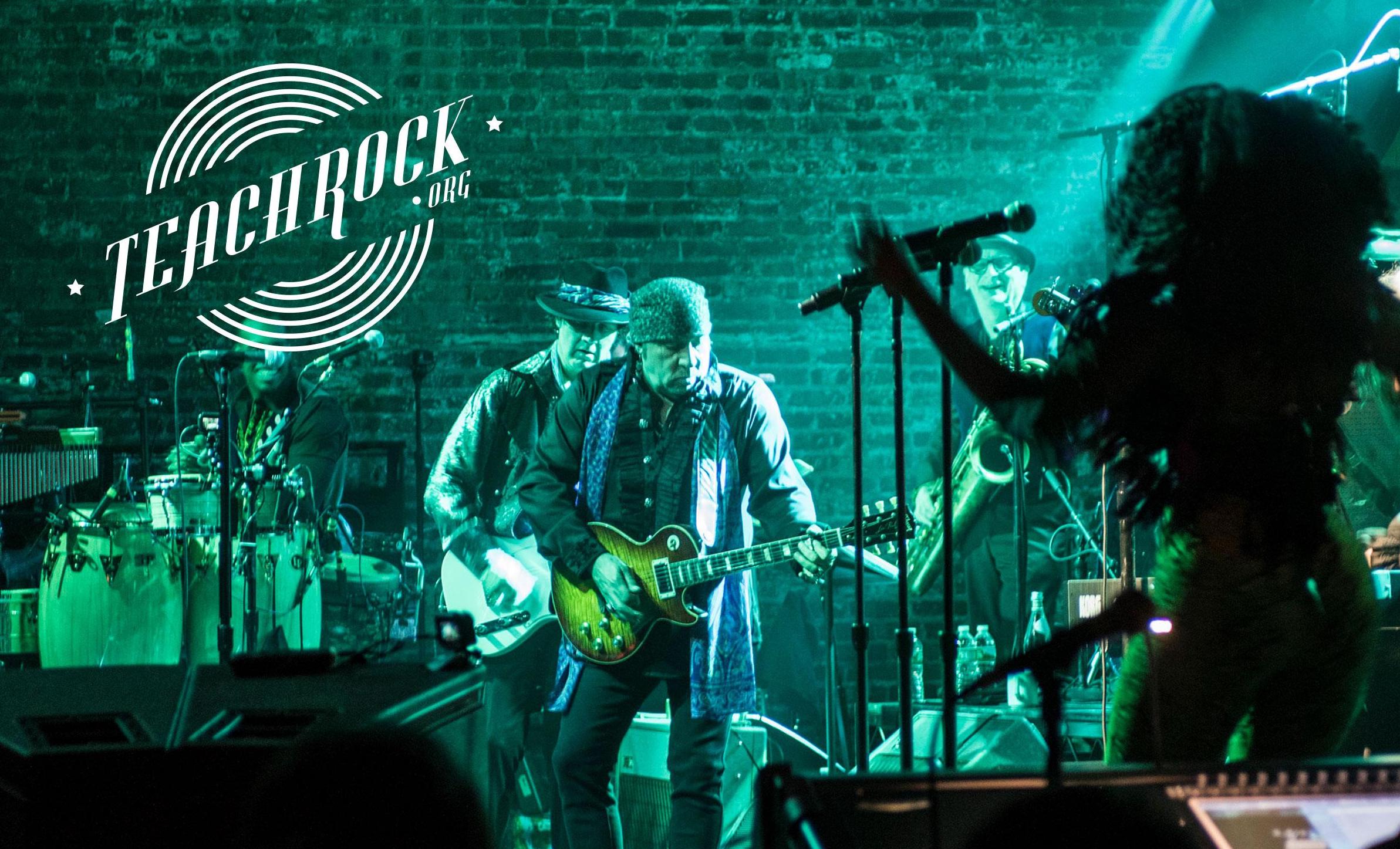
When I think of rock ‘n’ roll high school, I think of the Ramones, but in the 1979 Roger Corman film no one really learns much. In reality, however, another legendary musician, still going strong after five decades in the business, has put his cred to serious use, leveraging stardom as a musician and actor to create a music curriculum teachers can use for free, with lessons on rock history, Native American politics, Bob Dylan’s poetry, immigration and the blues, civil disobedience, the fight to end Apartheid, and much more. That man is Steven Van Zandt—aka Little Steven of the E Street Band, or Silvio Dante of The Sopranos, or Frank Tagliano of Lilyhammer, or a few other aliases and fictional characters.
“For the past decade,” writes John Seabrook at The New Yorker, the bandana-clad guitarist has been “working on a way to recreate” a “dynamic, out-of-school learning experience inside classrooms, through his Rock and Roll Forever Foundation.” Working, that is, to recreate his own experience as a disaffected youth who “had no interest in school whatsoever,” he recalls. What interested him was music: the Beatles, at first, but as he learned more about them, he picked up “bits of information” about Eastern religion and orchestration. He learned about literature from Dylan.
“You didn’t get into it to learn things,” he says, “but you learn things anyway.” At least if you’re as curious and open-minded as Van Zandt, who came to value education through his non-traditional course. Over ten years ago, when the National Association for Music Education told him that “No Child Left Behind legislation was really devastating art classes,” he confronted Ted Kennedy and Mitch McConnell, telling them, “did you ever hear that every kid who takes music class does better in math and science?” They apologized,” he says, “but they said they weren’t going to fix it.”
So Van Zandt decided to do it himself with a program called TeachRock. Working with two ethnomusicologists, he built the curriculum to connect with kids through music. “Instead of telling the kid, ‘Take the iPod out of your ears,’” he told a crowd of teachers gathered at Times Square’s Playstation Theater in May, “we ask them, ‘What are you listening to?’” Van Zandt calls his curriculum “teaching in the present tense,” and while his own back catalog may not necessarily be streaming on kids’ current playlists, he incorporates not only his music and the fifties and sixties rock ‘n’ roll he loves, but also hip-hop, pop, punk, and the “Latin rhythms of ‘Despacito.’” He even uses Beyoncé’s “Single Ladies” video to prompt a discussion on the slave trade.
The focus on popular music as a force for change is fully in keeping with Van Zandt’s own path. His self-education led him into activism in the 80s when he wrote and recorded “Sun City” with 50 other artists to protest South African Apartheid. Unlike some other benefit songs of the time (like the cringe-inducing “Do They Know It’s Christmas”), “Sun City,” with its accompanying video (above), took effective political action—a blanket boycott of the Sun City resort—and didn’t sugar-coat the issues one bit (“relocation to phony homelands/separation of families, I can’t understand”). The Sun City boycott gets its own module.
As Van Zandt told Fast Company in 2015, “I had been researching American foreign policy post-World War II just to educate myself, which I had never done, being obsessed with rock ‘n’ roll my whole life. I was quite shocked to find that we were not always the good guys.” His discoveries compelled him to visit South Africa and to “dedicate my five-record solo career to that learning process, and also combine a bit of journalism with the rock art form.” That same passion for justice informs all of the TeachRock lessons, which you can browse and download for free at the TeachRock site. The multi-media units incorporate video, audio, images, activities, informative handouts, and other resources.
Each lesson also explains how its objectives meet Common Core State Standards (or the state standards of New Jersey and Texas). “TeachRock is rooted in a teaching philosophy that believes students learn best when they truly connect with the material to which they’re introduced,” notes the site’s “Welcome Teachers” page. “Obviously, popular music is one such point of connection.” Perhaps not every kid who learns through music as Van Zandt did will go out and try to change the world, but they’re more than likely to stay engaged and stay in school. And that’s exactly what he hopes to accomplish.
“Teaching kids something they’re not interested in,” he told the teachers in New York, “it didn’t work then, and it’s even worse now. We have an epidemic dropout rate.” Then, in his refreshingly honest way, he concluded, “Where are we going to be in twenty years? How are we going to get smarter looking at this Administration? You know, we’re just getting stupider.” Not if Little Steven has anything to say about it. He’s currently on tour with his Disciples of Soul, and offering free tickets to teachers, provided they show up early for a TeachRock workshop. Sign up here!
You can’t fault people for turning away from current events these days, but there are many pockets of light, even if they rarely make headlines or get curated by gloom and doom algorithms. Some optimism has come to us by way of musicians like David Byrne, whose good-news aggregator “Reasons to Be Cheerful” showcases positive developments around the world. Indie rock drummer Thor Harris has encouraged fans with tips on how to stay healthy in trying times, and he has announced a run for governor of Texas. And last fall, Cheap Trick’s bassist Tom Petersson started a project called Rock Your Speech, which “leverages the power of music to build language skills in children who are working to overcome speech delay associated with autism.”
As Petersson and his wife Alison explain above, they were inspired by their experience with their son, Liam, who, “until the age of five,” reports David Chiu at Huffington Post, “had difficulty communicating,” They discovered that music could help when Liam began singing along to one of her favorite Elton John songs. Petersson wanted “to help other parents,” he told HuffPo, “and to let people know they’re not alone.” An L.A. benefit concert harnessed the collective power of celebrities and indie artists to jumpstart the project, with bands like the Dandy Warhols and Red Kross and actors Ed Asner and Billy Bob Thornton participating.
Rock Your Speech is not the only such initiative, but it is probably the most high-profile, and could bring attention to similar efforts like Auditory-Motor Mapping Training, developed by Dr. Gottfried Schlaug of the Music and Neuroimaging Laboratory. At the Autism Speaks blog, Schlaug writes, “as many as three in ten children with autism are nonverbal. Yet many children with autism have superior auditory skills and a particular attraction to music.” Like Rock Your Speech, his approach uses “forms of music-making that encourage vocalization as a pathway to developing language.” Musician and psychologist Adam Reece has also written about his research showing the positive role music therapy can play in language acquisition for kids on the spectrum.
Petersson’s project puts a rock star face on music therapy and comes “from the point of view of the parent,” he says. Rock Your Speech not only raises autism awareness but also offers original music and videos designed to stimulate and inspire kids. Hear “Blue” from the Rock Your Speech, Volume 1album above, one of several songs Petersson wrote that “employs actual rock music,” Chiu writes, “not necessarily the gentle, kiddie-type of sounds that are generally prevalent in children’s music.” Videos on the Rock Your Speech site for “Blue” and other songs “not only show the words but also demonstrate to kids how those words are formed and mouthed.”
The project’s Vimeo channel shows the Petersson family involved in Liam’s speech development through music, including his older sister Lilah coaching her brother with a song called “Wash Your Hands.” (See Lilah’s video above for her song “All the Same,” written for Liam.) Liam, now ten, has come a long way. “He’s in school,” says Petersson, “He loves music… He’s definitely on the autism spectrum, but he speaks, he’s social. He’s the sweetest little guy.” His musical family has a lot to do with that, but Rock Your Speech offers even non-musician parents a wealth of catchy tools to help kids struggling with speech to connect with language through rock ‘n’ roll. For many families, that could be very good news indeed.
A series of videos has been going around showing Zakk Wylde, former guitarist for Ozzy Osbourne, playing classic rock and metal songs on diminutive Hello Kitty guitars. They’re funny: seeing the burly, bearded legend rock out on a kid’s guitar; but they’re also pretty impressive, when he wrings real grit and feeling from these unlikely instruments.
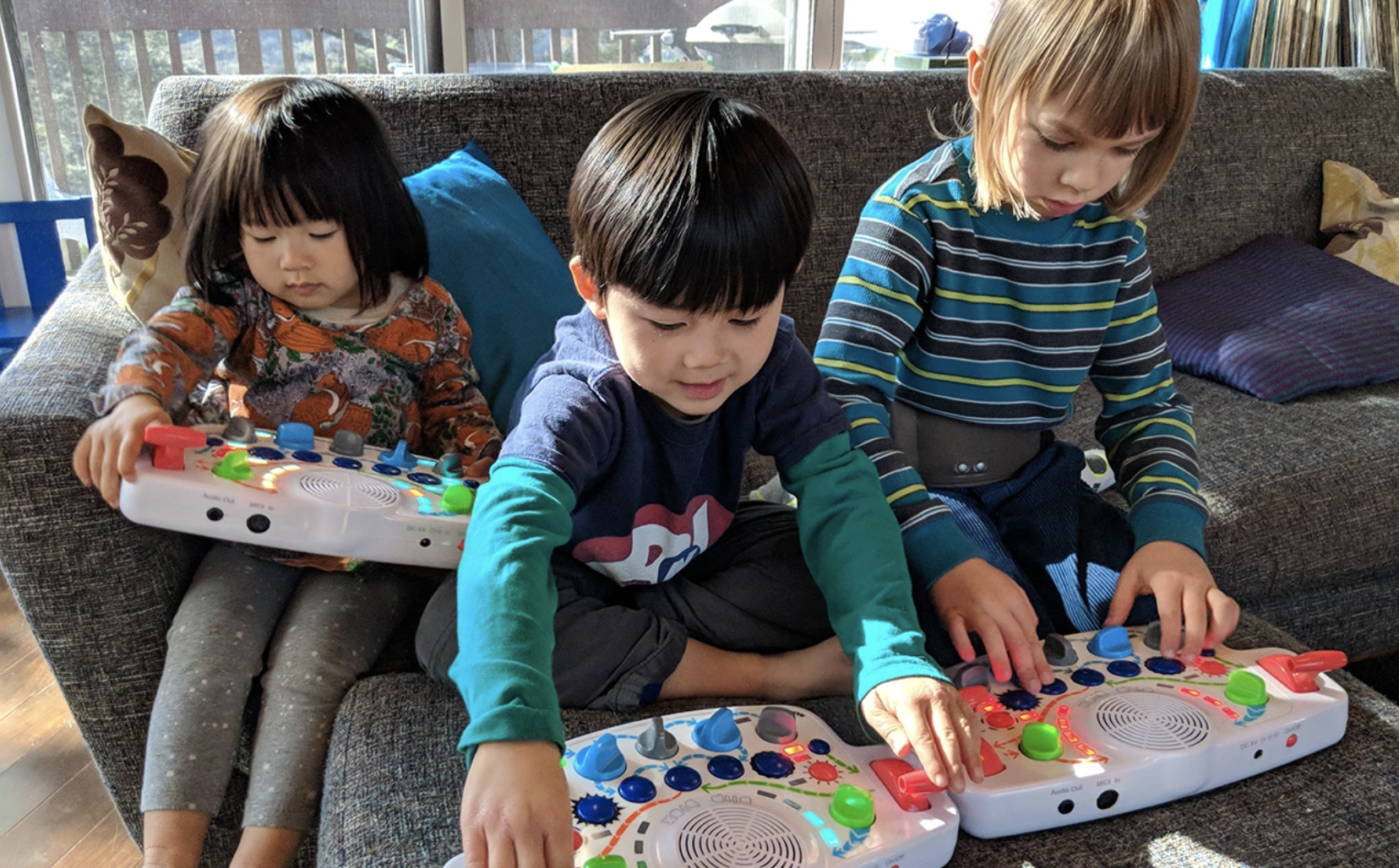
I imagine it won’t be long before we’ll see a similar stunt with someone like Moby, for example, ripping out danceable grooves on the Blipblox, a kids’ toy that is also a fully-functioning synthesizer (“actually, it’s both”!).
While the Blipblox may look like one of thousands of noisy console-like toddler toys, it’s one that won’t tempt parents to do what many parents do (be honest)—pull out the batteries and hide them where they can’t ever be found.
Apologies to Hello Kitty guitars, but by comparison with most instruments made for kids, the Blipblox is seriously sophisticated. “What sets this apart from other toys,” writes Mixmag, “is that it uses ‘a proprietary algorithm that synthesizes completely unique waveforms’ allowing users to create their own soundwave. The features include one low pass filter, two envelope generators, eight oscillator modulation schemes, two LFOs and MIDI, plus more.”
If those specs sound like an alien language to you, they won’t make any more sense to your 3‑year-old, and they don’t need to. “The blipblox was made to have fun without fully understanding how it works,” says the toy synthesizer’s creator in an introductory video above. Turn it on and start hitting buttons, twisting dials, and pushing the two joystick-like controllers back and forth, and beats, bleeps, bloops, blurps, and other synth‑y sounds spill out, at various tempos and pitches.
As kids (or parents who hijack the device) gain more control, they can start refining their technique and create original compositions, as you can see happening in the “studio sessions” video above. Then they can output their sounds to mom and dad’s home studio, or wherever—Blipblox is ready, as its Indiegogo campaign promises, for “a pro studio setup.” Or just lots of entertaining goofing around.
The Blipblox is a brilliant invention and has already won a 2018 award for “Best Teaching Tool for Pre-School Students” and made an appearance at the very grown-up 2018 NAMM (National Association of Music Merchants) convention—see below. Priced at $159, the Blipblox ships this summer. Sign up at Indiegogo for “early bird perks.”
Teaching child visitors how to write their names using an unfamiliar or antique alphabet is a favorite activity of museum educators, but Dr. Irving Finkel, a cuneiform expert who specializes in ancient Mesopotamian medicine and magic, has grander designs.
His employer, the British Museum, has over 130,000 tablets spanning Mesopotamia’s Early Dynastic period to the Neo-Babylonian Empire “just waiting for young scholars to come devote themselves to (the) monkish work” of deciphering them.
Writing one’s name might well prove to be a gateway, and Dr. Finkel has a vested interest in lining up some new recruits.
The museum’s Department of the Middle East has an open access policy, with a study room where researchers can get up close and personal with a vast collection of cuneiform tablets from Mesopotamia and surrounding regions.
As the extremely personable Dr. Finkel shows Matt Gray and Tom Scott of Matt and Tom’s Park Bench, above, cuneiform consists of three components—upright, horizontal and diagonal—made by pressing the edge of a reed stylus, or popsicle stick if you prefer, into a clay tablet.
The mechanical process seems fairly easy to get the hang of, but mastering the oldest writing system in the world will take you around six years of dedicated study. Like Japan’s kanji alphabet, the oldest writing system in the world is syllabic. Properly written out, these syllables join up into a flowing calligraphy that your average, educated Babylonian would be able to read at a glance.
Even if you have no plans to rustle up a popsicle stick and some Play-Doh, it’s worth sticking with the video to the end to hear Dr. Finkel tell how a chance encounter with some naturally occurring cuneiform inspired him to write a horror novel, which is now available for purchase, following a successful Kickstarter campaign.
Ayun Halliday is an author, illustrator, theater maker and Chief Primatologist of the East Village Inky zine. Her solo show Nurse!, in which one of Shakespeare’s best loved female characters hits the lecture circuit to set the record straight premieres in June at The Tank in New York City. Follow her @AyunHalliday.
We're hoping to rely on loyal readers, rather than erratic ads. Please click the Donate button and support Open Culture. You can use Paypal, Venmo, Patreon, even Crypto! We thank you!
Open Culture scours the web for the best educational media. We find the free courses and audio books you need, the language lessons & educational videos you want, and plenty of enlightenment in between.