This year marks the 700th anniversary of Dante Alighieri’s death — which means it also marks the 701st anniversary of his great work the Divina Commedia, known in English as the Divine Comedy. We’ve all got to go some time, and it’s somehow suitable that Dante went not long after telling the tale of his own journey through the afterlife, complete with stops in Hell, Purgatory, and Paradise. It remains a journey we can all take and re-take — and interpretively grapple with — still these seven centuries later. Starting this month, you can take it as a group tour, so to speak, by joining 100 Days of Dante, the largest Dante reading group in the world.
A project of Baylor University’s Honors College (with support from several other American educational institutions), 100 Days of Dante has launched a web site “through which modern seekers and pilgrims can follow the great epic poem with free video presentations three times a week.”
So writes Aleteia’s John Burger, who explains that “the three books of the Divine Comedy, known in Italian as Inferno, Purgatorio, and Paradiso, are divided into 33 chapters known as cantos. [Inferno actually had 34.] Each video will present one canto, with commentary on it from leading experts in Dante studies.” You can also read the entire work on 100 Days of Dante’s web site, in English or Italian — a language Dante’s own poetry did much to shape.
Nobody interested in the language of Italy, let alone the country’s history and culture, can do without experiencing the Divine Comedy. One of 100 Days of Dante’s aims is a re-emphasis of its nature as a thoroughly religious work, one that renders in vivid, sometimes harrowing detail the worldview held by Christians of Dante’s place and time. But believer or otherwise, you can join in the reading from when it begins on September 8, to when it concludes on Easter 2022. You may well find, as the long Italy-resident English writer and translator Tim Parks observes, that Dante has a way of slipping through convenient interpretative frameworks cultural, historical, and even religious. “Long after the fires of Hell have burned themselves out,” he writes, “the debate about the Divina Commedia rages on.” Find more educational resources on Dante and The Divine Comedy below.
Based in Seoul, Colin Marshall writes and broadcasts on cities, language, and culture. His projects include the Substack newsletterBooks on Cities, the book The Stateless City: a Walk through 21st-Century Los Angeles and the video series The City in Cinema. Follow him on Twitter at @colinmarshall or on Facebook.
In fiction the inspirational high-school English teacher is a cliché, despite (or indeed due to) the fact that so many of us have had at least one of them in real life. For generations of students who passed through San Francisco’s prestigious Lowell High School, that teacher was Flossie Lewis. Long after her retirement, she went surprisingly viral in a 2016 PBS interview clip about her thoughts on aging. It seemed she retained her power to inspire, not just for her more than seven million online viewers, but also for the PBS producers who later reunited her with her former students in the very same classroom where she once taught them.
You can see this reunion take place in the video above, which also includes Flossie telling her own story of having fled Brooklyn spinsterhood on a Greyhound bus headed west. “I could command the attention of a class,” she says of the source of her power as a teacher. “I had a voice. I had that kind of personality that did not seem teacherly, but was provocative.”
Onetime student Daniel Handler, better known as the novelist Lemony Snicket, credits Flossie with an “ability to startle.” Another, now an architect, remembers “gravitas” — and his having been “intimidated by her name. Flossie is a very unusual name.” Or at least it is today, its popularity (driven, it seems, by the Bobbsey Twins books) having peaked in the early 20th century.
Flossie is also representative of her generation in another way: not particularly caring for the music of Bob Dylan. Though she can’t have been thrilled with that guitar-playing (relative) youngster’s 2016 Nobel Prize for Literature, she’s willing to hear her students out on the subject. “The trivial task before us is to decide whether Bobby Dylan is worth the laureate,” she declares to the group of Lowell alumni gathered in her old classroom. Now all middle-aged, her former students include Dylan defenders and Dylan deniers alike, but what unites them are their undimmed memories of their teacher’s mixture of rigor, compassion, and sheer eccentricity. As one of them recalls, “You read us a sonnet from Shakespeare and said, ‘It’s no good.’ ” Whatever his generational relevance, the poet from Hibbing may never have stood a chance.
Based in Seoul, Colin Marshall writes and broadcasts on cities, language, and culture. His projects include the Substack newsletterBooks on Cities, the book The Stateless City: a Walk through 21st-Century Los Angeles and the video series The City in Cinema. Follow him on Twitter at @colinmarshall or on Facebook.
At this year’s Cannes Film Festival, the Award for Best Screenplay went to Ryusuke Hamaguchi’s Drive My Car, an adaptation of a story by Haruki Murakami. So did FIPRESCI Prize, the Prize of the Ecumenical Jury, and no small amount of criticalacclaim, suggesting that the code for translating Murakami onto the screen might finally have been cracked. Every now and again over the past forty years, a bold filmmaker has taken on the challenge of turning a work of that most world-famous Japanese novelist into a feature. But until recently, the results have for the most part not been received as especially consequential in and of themselves.
In general, short fiction tends to produce more satisfying adaptations than full-fledged novels, and Murakami’s work seems not to be an exception (as underscored a few years ago by Korean auteur Lee Chang-dong’s Burning). Hamaguchi’s film spins some 40 pages into a running time of nearly three hours, doing the opposite of what other Japanese filmmakers have done with Murakami’s short stories. In 1982, Naoto Yamakawa made one of them into Attack on a Bakery, a short film running less than twenty minutes; the following year, he made another into the even shorter A Girl, She is 100%, running less than fifteen. Today Murakami fans everywhere can watch them both on Youtube, complete with English subtitles.
The material will feel familiar to English-language Murakami readers. A main character of the story “The Second Bakery Attack” reminisces about a robbery he attempted as a hungry young man that went comically off the rails, in a manner similar to the one in Yamakawa’s first short. (In 2010 “The Second Bakery Attack,” wherein the now-married narrator robs a fast-food joint with his new bride, itself became a short film directed by Carlos Cuarón, brother of Alfonso.) Though “The Bakery Attack” has never been officially published in English, “On Seeing the 100% Perfect Girl One Beautiful April Morning” has, and it now stands as one of Murakami’s representative short works in that language; it also, in the original, provides the basis for A Girl, She Is 100%.
“She doesn’t stand out in any way,” Murakami’s narrator says of the titular figure. “Her clothes are nothing special. The back of her hair is still bent out of shape from sleep. She isn’t young, either — must be near thirty, not even close to a ‘girl,’ properly speaking. But still, I know from fifty yards away: She’s the 100% perfect girl for me.” Yamakawa dramatizes a similar fleeting encounter and the romantic speculations that resonate in the man’s mind. Like the half-baked philosophical and political convictions of the would-be robbers, these inspire the director to the kind of visual and formal inventiveness one would expect given his background in Godard and Scorsese scholarship. But the only filmmaker name-checked is Woody Allen, which fans will recognize as a characteristic Murakami reference. So as are the inclusions of Wagner, D.H. Lawrence, jazz music — and of course, an unexpected cat.
Based in Seoul, Colin Marshall writes and broadcasts on cities, language, and culture. His projects include the Substack newsletterBooks on Cities, the book The Stateless City: a Walk through 21st-Century Los Angeles and the video series The City in Cinema. Follow him on Twitter at @colinmarshall or on Facebook.
A newspaper article about this speech could well be titled: AUTHOR CLAIMS TO HAVE SEEN GOD BUT CAN’T GIVE ACCOUNT OF WHAT HE SAW. — PKD
In 1977, cult writer Philip K. Dick arrived at a science fiction convention in Metz, France to deliver a speech called, “If You Find this World Bad, You Should See Some of the Others.” (Read an edited transcript here.) The audience would leave bewildered, mystified. His talk ranged widely across such topics as cosmological time, the possibility of the universe as a computer simulation, the experience of deja vu, and the oppressive regime of Richard Nixon. It would become a sort of rebus for decoding Dick’s fiction.
But just as Dick claimed that the events of his 1981 novel V.A.L.I.S. were real– he had actually had a visionary encounter with “God” after dental surgery in 1974 — so here he claims to have actually experienced, or remembered, multiple realities and, after said encounter, to have recognized them all as true.
I, in my stories and novels, often write about counterfeit worlds, semi-real worlds, as well as deranged private worlds inhabited, often, by just one person, while, meantime, the other characters either remain in their own worlds throughout or are somehow drawn into one of the peculiar ones. …At no time did I have a theoretical or conscious explanation for my preoccupation with these pluriform pseudoworlds, but now I think I understand. What I was sensing was the manifold or partially actualized realities lying tangent to what evidently is the most actualized one, the one that the majority of us, by consensus gentium, agree on.
“The world of Flow My Tears is an actual (or rather once actual) alternate world, and I remember it in detail. I do not know who else does. Maybe no one else does. perhaps all of you were always — have always been — here. But I was not. In novel after novel, story after story, over a twenty-five year period, I wrote repeatedly about a particular other landscape, a dreadful one. In March 1974, I understood why. …I had good reason to. My novels and stories were, without my realizing it consciously, autobiographical. It was — this return of memory — the most extraordinary experience of my life. …
The narrower subject of his speech, Dick says by way of introduction, is “orthogonal time,” or “right-angle time.” To explain this he calls up an image of parallel universes overlapping at the edges of a “lateral axis.” These blend and “come into focus,” as an entity he calls “the Programer-Reprogrammer” changes the variables, while a “counterentity” he calls the “Dark Counterplayer” tries to mess things up. Despite the use of software terms, Dick’s imagery seems to draw as much from chess, or Taoism, as computer science. The interplay of programmer/counterprogrammer is a dialectic, resulting in new syntheses. God is not an independent, self-existent being but something more akin to Atman, “the view of the oldest religion of India, and to some extent… of Spinoza and Alfred North Whitehead …. God within the universe… The Sufi saying [from Rumi] ‘The workman is invisible within the workshop’ applies here.”
We cannot see the workings of this mystical intelligence except when the illusion of seamlessness breaks down and memories of past or alternate lives intrude. These are not memories of a linear time, but of other possible present times, all existing at once just out of focus. Dystopian police states, an alternate present ruled by Nazi Germany and Imperial Japan… Thesecurrentlyexist, Dick says, on the orthogonal line of time, only we cannot see them because the variables, and our memories, have been changed to suit the latest version of reality, a synthesis and updated improvement. However, it’s entirely possible that we’re all experiencing slightly different realities, depending on the “memories” of alternate presents leaking into our experience.
Thus, the talk’s title: not only could the world be worse, he says, but it iscurrentlyworse in the multiverse of rejected alternate worlds we can’t (or can’t quite) see. Here, at the end of his speech, Dick gets theological, and teleological, again, claiming to have seen a vision of a “parklike” world that “was not what my Christian training had prepared me for at all.” His description sounds ripped from the cover of a 70s pulp fantasy novel, complete with a naked goddess and an alien “landscape beyond a golden rectangle doorway.” He takes pains to distance his vision from the Christian garden of Eden, but his final remarks sound more like C.S. Lewis than the paranoid, drug-addled conspiracist his audience might have been prepared to meet:
The best I can do …is to play the role of prophet, of ancient prophets and such oracles as the sibyl at Delphi, and to talk of a wonderful garden world, much like that which once our ancestors are said to have inhabited — in fact, I sometimes imagine it to be exactly that same world restored, as if a false trajectory of our world will eventually be fully corrected and once more we will be where once, many thousands of years ago, we lived and were happy.
…I believe I know a great secret. When the work of restoration is completed, we will not even remember the tyrannies, the cruel barbarisms of the Earth we inhabited… the vast body of pain and grief and loss and disappointment within us will be expunged as if it had never been. I believe that process is taking place now, has always been taking place now. And, mercifully, we are already being permitted to forget that which formerly was. And perhaps in my novels and stories I have done wrong to urge you to remember.
Was Philip K. Dick out of his mind? He sounds perfectly lucid in other interviews he gave at the same time, and dismisses the notion that his ideas are the product of mental illness. Travis Diehl writes at Art Papers that Dick has come to seem more like an actual than a self-styled prophet in the decades since this interview, and his “paranoia comes to seem more and more like prescience,” foreseeing the major themes of The Matrix, Jean Baudrillard’s postmodern classic Simulacra and Simulation, and favorite philosopher of Silicon Valley Nick Bostrom.
Whatever the source of the author’s experiences, “the rupture that pushed Dick’s life toward a knowledge of other worlds — towards gnosis — was an aesthetic one: Dick’s visions appeared accompanied, or induced, by art,” and it was only by means of art that he claimed to apprehend them. “Our God is the deus absconditus: the hidden god.” We cannot know what it is, he says. But this does not exempt us from the making and remaking of the world. No one is — to use a current term of art — a non-playable character. “Concealed though the form is,” Dick says, “the latter will confront us; we are involved in it — in fact, we are instruments by which it is accomplished.”
Thanks to “the rise of comics as a ‘respectable’ medium,” Ross Johnson writes at Barnes and Noble, graphic novel adaptations now constantly reimagine literary classics for young readers. One Goodreads list collects over 200 recent graphic adaptations of classics from Austen to Kafka. These adaptations “aim to honor and embellish rather than replace the books on which they are based,” writes Johnson, “because how could they?” They do, however, allow us to “see, literally and figuratively, the stories we love from new angles.” They also give kids and adults who may not fancy themselves readers new ways to access and enjoy literary classics.
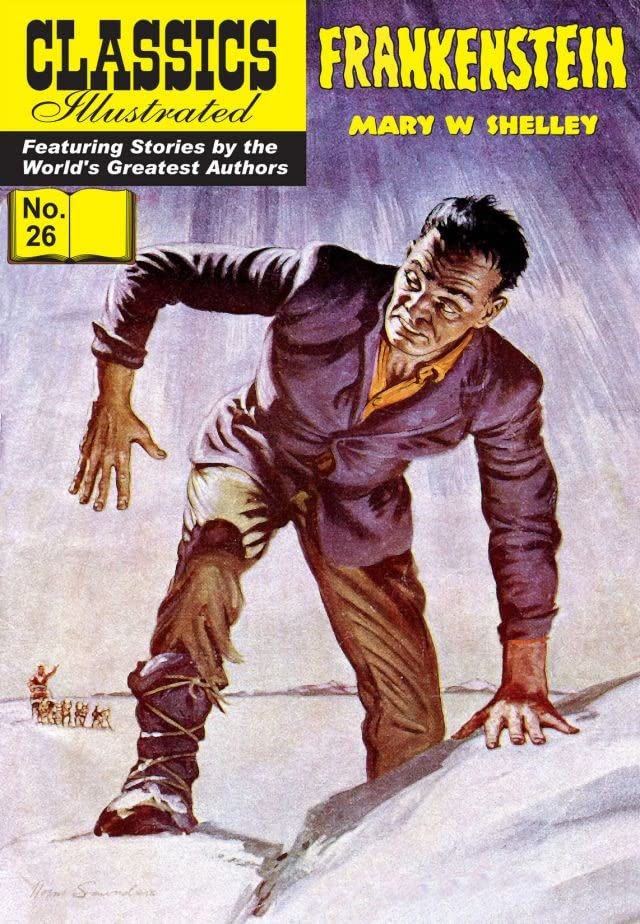
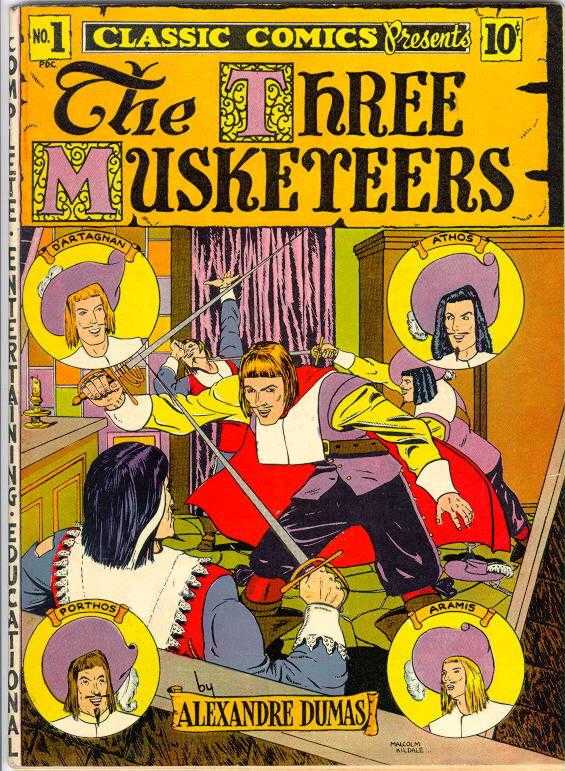
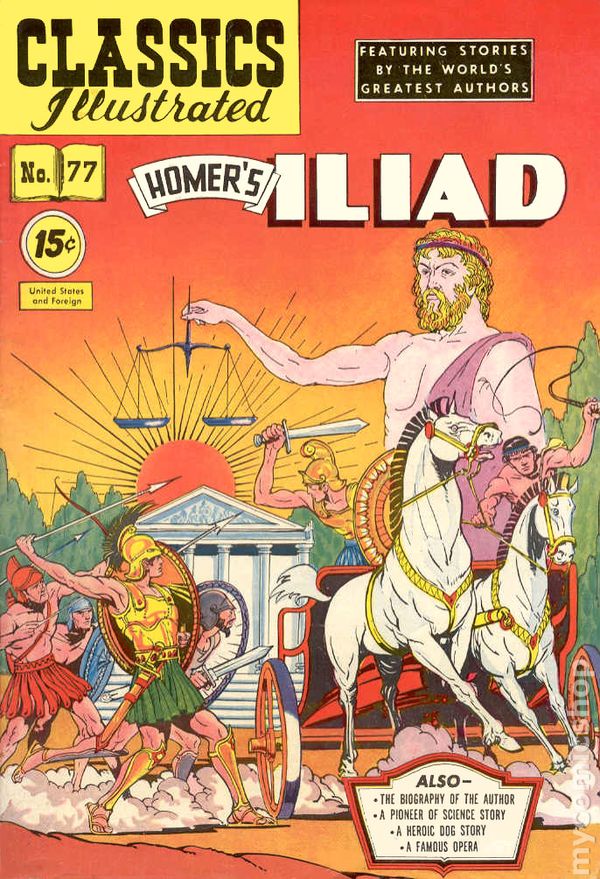
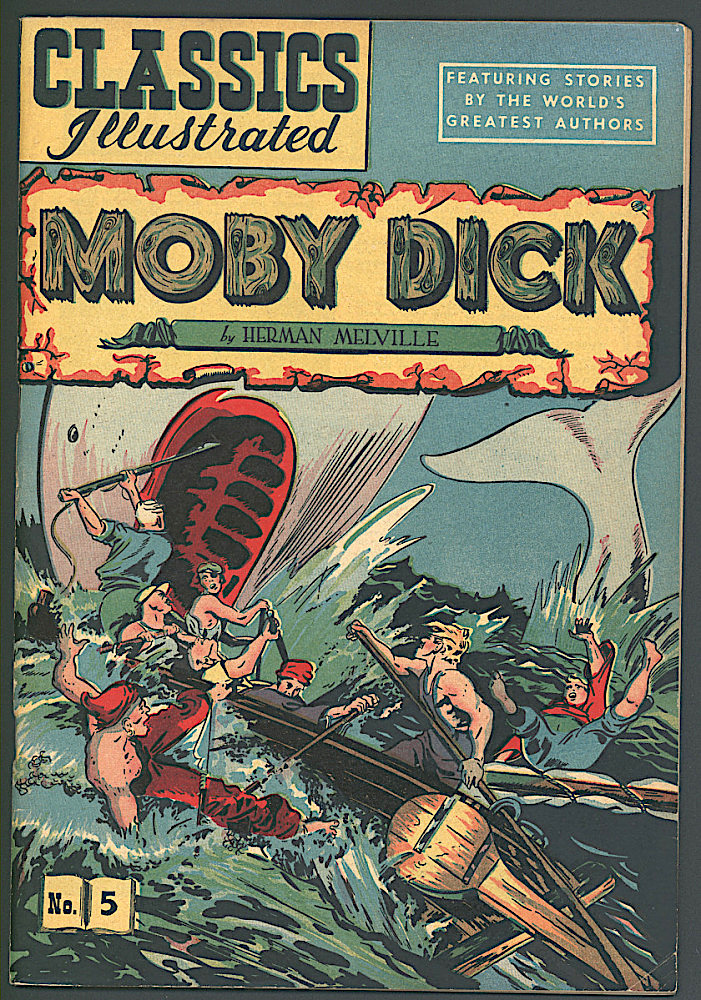
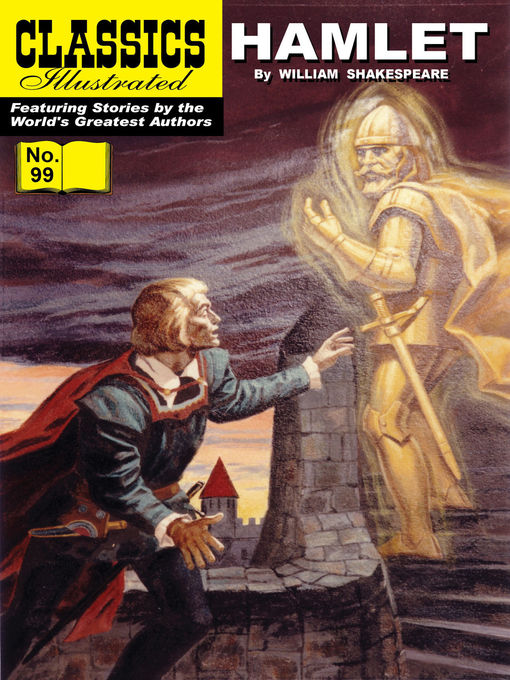
But are graphic adaptations really a new phenomenon? They may be newly respectable, but they’ve been around since the very dawn of comic books as a medium. Superman debuted in 1938, Batman in 1939, and in 1941, the first issue of Classics Illustrated appeared — an adaptation of The Three Musketeers, followed by Ivanhoe and The Count of Monte Cristo. The series was founded by Russian-born publisher Albert Kanter, who immediately seized on the potential of comic books as educational tools during what is now known as the Golden Age of Comics.
Even as a prestige series supposedly promoting “great literature,” Classics Illustrated did not escape the notice of Dr. Fredric Wertham, whose book Seduction of the Innocent began the moral panic over comic books in the 1950s. Wertham found fault with the graphic adaptations of Dr. Jekyll and Mr. Hyde and Uncle Tom’s Cabin for reducing the novels to their most stereotypical and sensationalist elements. It’s the kind of criticism we might find levied against graphic adaptations of literature today, and in many cases, it may be warranted.
Few accused these graphic literary adaptations of being great art in their own right. But they accomplished Kanter’s purpose of getting comics readers excited about classic novels. The series ran for 30 years, ending in 1971, and became an international phenomenon. In Brazil and Greece, it published adaptations of authors from those countries.
A Classics Illustrated Junior series appeared in 1953, bringing children comics versions of folktales and myths. After the series first run, special issues, reprints, and revivals appeared in later decades, as well a series of television films in the 70s and 80s. You can peruse over 200 of these adaptations digitally scanned at the Internet Archive, artifacts of the Golden Age and ancestors of our current explosion of graphic novel adaptations of classic literature. For a deeper study of this publication, you can purchase the 2017 book, Classics Illustrated: A Cultural History.
The extended Sherlock Holmes Universe, as we might call it, has grown so vast in the last century (as with other franchises that have universes) that it’s possible to call oneself a fan without ever having read the source material. Depending on one’s persuasion, this is either heresy or the inevitable outcome of so much mediation by Holmesian high priests, none of whom can resist writing Holmes fan fiction of their own. But Sherlockians agree: the true Holmes Canon (yes, it’s capitalized) consists of only 60 works — 56 short stories and four novels, excluding apocrypha. No more, no less. (And they’re in the public domain!)
The Canon safeguards Arthur Conan Doyle’s work against the extra-voluminous flood of pastichists, parodists, and imposters appearing on the scene since Holmes’ first appearance in 1892. (Doyle personally liked Peter Pan author J.M. Barrie’s Holmes parody, “The Adventure of the Two Collaborators,” so much he included it in his autobiography.) The Holmes Canon remains untouchable for its wit, ingenuity, and the true strangeness of its detective — a portrait of perhaps the most emotionally avoidant protagonist in English literature when we first meet him:
All emotions, and [love] particularly, were abhorrent to his cold, precise but admirably balanced mind. He was, I take it, the most perfect reasoning and observing machine that the world has seen, but as a lover he would have placed himself in a false position. He never spoke of the softer passions, save with a gibe and a sneer. They were admirable things for the observer—excellent for drawing the veil from men’s motives and actions. But for the trained reasoner to admit such intrusions into his own delicate and finely adjusted temperament was to introduce a distracting factor which might throw a doubt upon all his mental results. Grit in a sensitive instrument, or a crack in one of his own high-power lenses, would not be more disturbing than a strong emotion in a nature such as his.
How to make such a cold fish compelling? With a host of quirks, an ingenious mind, a “Bohemian soul,” some unsavory qualities, and at least one or two human attachments, if you can call them that. Sherlock’s cold, logical exterior masks considerable passion, inspiring fan theories about an ancestral relationship to Star Trek’s Spock.
But of course, we see Holmes almost entirely through the eyes of his sidekick and amanuensis, James Watson, who has his biases. When Holmes stepped out of the stories and into radio and screen adaptations, he became his own man, so to speak — or a series of leading men: Basil Rathbone, John Gielgud, Ian McKellen, Michael Caine, Robert Downey, Jr., Benedict Cumberbatch, and the late Christopher Lee, who played not one of Doyle’s characters, but four, beginning with his role as Sir Henry Baskerville, with Peter Cushing as Holmes, in a 1959 adaptation.
In 1962, Lee took on the role of Holmes himself in a German-Italian production, Sherlock Holmes and the Deadly Necklace, an original story based on Doyle’s work. He played Holmes’ smarter but unmotivated older brother, Mycroft, in 1970, then played a much older Holmes twice more in the 90s, pausing along the way for the role of Arnaud, a character in another Doyle adaptation, The Leather Funnel, in 1973 and the narrator of a 1985 Holmes documentary, The Many Faces of Sherlock Holmes. In an extraordinary career, Lee became an icon in the worlds of horror, science fiction, fantasy, and Sherlock Holmes, a genre all its own, into which he fit perfectly.
In the videos here, you can hear Lee read four of the last twelve Holmes stories Doyle wrote in the final decade of his life. These were collected in 1927 in The Case-Book of Sherlock Holmes. We begin, at the top, with the very last of the 56 canonical stories, “The Adventure of Shoscombe Old Place.” Lee may never have played Dr. Watson, but we can imagine him bringing his familiar gravitas to that role, too, as he narrates in his deep mellifluous voice. Find links to 7 more stories from Doyle’s last collection, read by Lee, on Metafilter, and hear him narrate The Many Faces of Sherlock Holmes, just below.
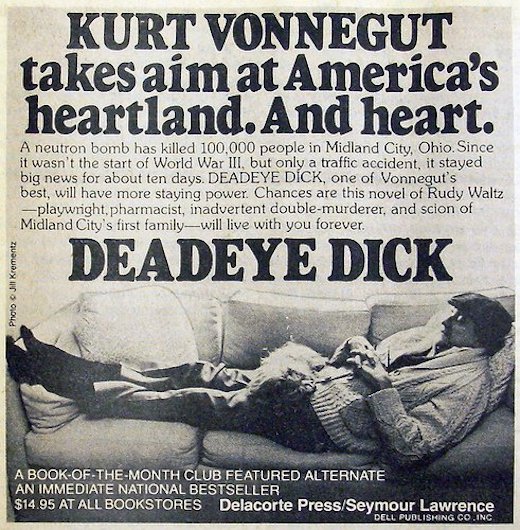
He writes in the preface that these recipes are intended to provide “musical interludes for the salivary glands,” warning readers that “no one should use this novel for a cookbook. Any serious cook should have the reliable originals in his or her library anyway.”
So with that caveat in mind…
Early on, the narrator/titular character, née Rudy Waltz, shares a recipe from his family’s former cook, Mary Hoobler, who taught him “everything she knew about cooking and baking”:
MARY HOOBLER’S CORN BREAD
Mix together in a bowl half a cup of flour, one and a half cups of yellow corn-meal, a teaspoon of salt, a teaspoon of sugar, and three teaspoons of baking powder.
Add three beaten eggs, a cup of milk, a half cup of cream, and a half cup of melted butter.
Pour it into a well-buttered pan and bake it at four hundred degrees for fifteen minutes.
Cut it into squares while it is still hot. Bring the squares to the table while they are still hot, and folded in a napkin.
Barely two paragraphs later, he’s sharing her barbecue sauce. It sounds delicious, easy to prepare, and its placement gives it a strong flavor of Slaughterhouse-Five’s“so it goes” and “Poo-tee-weet?” — as ironic punctuation to Father Waltz’s full on embrace of Hitler, a seeming non sequitur that forces readers to think about what comes before:
When we all posed in the street for our picture in the paper, Father was forty-two. According to Mother, he had undergone a profound spiritual change in Germany. He had a new sense of purpose in life. It was no longer enough to be an artist. He would become a teacher and political activist. He would become a spokesman in America for the new social order which was being born in Germany, but which in time would be the salvation of the world.
This was quite a mistake.
MARY HOOBLER’S BARBECUE SAUCE
Sauté a cup of chopped onions and three chopped garlic cloves in a quarter of a pound of butter until tender.
Add a half cup of catsup, a quarter cup of brown sugar, a teaspoon of salt, two teaspoons of freshly ground pepper, a dash of Tabasco, a tablespoon of lemon juice, a teaspoon of basil, and a tablespoon of chili powder.
Bring to a boil and simmer for five minutes.
Rudy’s father is not the only character to falter.
Rudy’s mistake happens in the blink of an eye, and manages to upend a number of lives in Midland City, a stand in for Indianapolis, Vonnegut’s hometown.
His family loses their money in an ensuing lawsuit, and can no longer engage Mary Hoobler and the rest of the staff.
Young Rudy, who’s spent his childhood hanging out with the servants in Mary’s cozy kitchen, finds it “easy and natural” to cater to his parents in the manner to which they were accustomed:
As long as they lived, they never had to prepare a meal or wash a dish or make a bed or do the laundry or dust or vacuum or sweep, or shop for food. I did all that, and maintained a B average in school, as well.
What a good boy was I!
EGGS À LA RUDY WALTZ (age thirteen)
Chop, cook, and drain two cups of spinach.
Blend with two tablespoons of butter, a teaspoon of salt, and a pinch of nutmeg.
Heat and put into three oven-proof bowls or cups.
Put a poached egg on top of each one, and sprinkle with grated cheese.
Bake for five minutes at 375 degrees. Serves three: the papa bear, the mama bear, and the baby bear who cooked it—and who will clean up afterwards.
By high school, Rudy’s heavy domestic burden has him falling asleep in class and reproducing complicated desserts from recipes in the local paper. (“Father roused himself from living death sufficiently to say that the dessert took him back forty years.”)
LINZER TORTE (from the Bugle-Observer)
Mix half a cup of sugar with a cup of butter until fluffy.
Beat in two egg yolks and half a teaspoon of grated lemon rind.
Sift a cup of flour together with a quarter teaspoon of salt, a teaspoon of cinnamon, and a quarter teaspoon of cloves. Add this to the sugar-and-butter mixture.
Add one cup of unblanched almonds and one cup of toasted filberts, both chopped fine.
Roll out two-thirds of the dough until a quarter of an inch thick.
Line the bottom and sides of an eight-inch pan with dough.
Slather in a cup and a half of raspberry jam.
Roll out the rest of the dough, make it into eight thin pencil shapes about ten inches long. Twist them a little, and lay them across the top in a decorative manner. Crimp the edges.
Bake in a preheated 350-degree oven for about an hour, and then cool at room temperature.
A great favorite in Vienna, Austria, before the First World War!
Rudy eventually relocates to the Grand Hotel Oloffson in Port au Prince, Haiti, which is how he manages to survive the — SPOILER — neutron bomb that destroys Midland City.
Here is a recipe for chocolate seafoams, courtesy of one of Midland City’s fictional residents:
MRS. GINO MARTIMO’S SPUMA DI CIOCCOLATA
Break up six ounces of semisweet chocolate in a saucepan.
Melt it in a 250-degree oven.
Add two teaspoons of sugar to four egg yolks, and beat the mixture until it is pale yellow.
Then mix in the melted chocolate, a quarter cup of strong coffee, and two tablespoons of rum.
Whip two-thirds of a cup of cold, heavy whipping cream until it is stiff. Fold it into the mixture.
Whip four egg whites until they form stiff peaks, then fold them into the mixture.
Stir the mixture ever so gently, then spoon it into cups, each cup a serving.
Refrigerate for twelve hours.
Serves six.
Other recipes in Rudy’s repertoire originate with the Grand Hotel Oloffson’s most valuable employee, headwaiter and Vodou practitioner Hippolyte Paul De Mille, who “claims to be eighty and have fifty-nine descendants”:
He said that if there was any ghost we thought should haunt Midland City for the next few hundred years, he would raise it from its grave and turn it loose, to wander where it would.
We tried very hard not to believe that he could do that.
But he could, he could.
HAITIAN FRESH FISH IN COCONUT CREAM
Put two cups of grated coconut in cheesecloth over a bowl.
Pour a cup of hot milk over it, and squeeze it dry.
Repeat this with two more cups of hot milk. The stuff in the bowl is the sauce.
Mix a pound of sliced onions, a teaspoon of salt, a half teaspoon of black pepper, and a teaspoon of crushed pepper.
Sauté the mixture in butter until soft but not brown.
Add four pounds of fresh fish chunks, and cook them for about a minute on each side.
Pour the sauce over the fish, cover the pan, and simmer for ten minutes. Uncover the pan and baste the fish until it is done—and the sauce has become creamy.
Serves eight vaguely disgruntled guests at the Grand Hotel Oloffson.
HAITIAN BANANA SOUP
Stew two pounds of goat or chicken with a half cup of chopped onions, a teaspoon of salt, half a teaspoon of black pepper, and a pinch of crushed red pepper. Use two quarts of water.
Stew for an hour.
Add three peeled yams and three peeled bananas, cut into chunks.
Simmer until the meat is tender. Take out the meat. What is left is eight servings of Haitian banana soup.
Bon appétit!
The recipe that closes the novel is couched in an anecdote that’s equal parts scatology and epiphany.
As a daughter of Indianapolis who was a junior in high school the year Deadeye Dick was published, I can attest that Polka-Dot Brownies would have been a hit at the bake sales of my youth:
POLKA-DOT BROWNIES
Melt half a cup of butter and a pound of light-brown sugar in a two-quart saucepan. Stir over a low fire until just bubbly.
Cool to room temperature.
Beat in two eggs and a teaspoon of vanilla.
Stir in a cup of sifted flour, a half teaspoon of salt, a cup of chopped filberts, and a cup of semisweet chocolate in small chunks.
Spread into a well-greased nine-by-eleven baking pan.
Bake at two hundred and thirty-five degrees for about thirty-five minutes.
Cool to room temperature, and cut into squares with a well-greased knife.
Enjoy, in moderation of course.
I was wearing my best suit, which was as tight as the skin of a knackwurst. I had put on a lot of weight recently. It was the fault of my own good cooking. I had been trying out a lot of new recipes, with considerable success. — Rudy Waltz
Here are some things you may not know about Vincent Price:
He was once a young man.
Before becoming a horror icon in the 1950s, he was a successful character actor. “Only a third of his movies that he made were actually horror films,” says his daughter, Victoria Price. “He made 105 films. People don’t realize he had an extensive career in theater and radio.”
He came from a wealthy St. Louis family and harbored early anti-semitic views and a misguided admiration for Hitler in the 1930s.
He completely changed his views after moving to New York and was placed on Sen. Joseph McCarthy’s “Premature Anti-Nazi Sympathizer list” in the 1950s, along with Eleanor Roosevelt, notes Susan King at the L.A. Times, a list that “raised questions about those who had been against the Nazis before the U.S. went to war with Germany.”
He was a gourmet cook, had a degree in art history, and worked for nine years in the sixties as an art consultant for Sears….
He was blacklisted for being anti-Nazi too early….
After being denied work for almost a year, as Price’s daughter writes in her 1999 memoir, Vincent Price: A Daughter’s Biography, he chose to sign a “secret oath” offered by the FBI to salvage his career. Perhaps not coincidentally, he took a radio part soon afterward in Australia, as a split narrator/Winston Smith in a 1955 Lux Radio Theater adaptation of George Orwell’s 1984, perhaps fearful of a future in which secret oaths became the norm.
Orwell himself had made it perfectly clear what he feared. “Radical in his politics and in his artistic tastes,” Lionel Trilling wrote in a New Yorker review the year the book came out, “Orwell is wholly free of the cant of radicalism”; his talent as a writer of fiction is to make “common sense” political observations serve plot and character. Perhaps the most chilling of these arrives in the first few paragraphs of 1984:
In the far distance a helicopter skimmed down between the roofs, hovered for an instant like a bluebottle, and darted away again with a curving flight. It was the police patrol, snooping into people’s windows. The patrols did not matter, however. Only the Thought Police mattered.
We may be reminded of the distinctions between what “Orwellian” means and what it does not, as Noah Tavlin describes in a recent explainer: if someone’s “talking about mass surveillance and intrusive government, they’re describing something authoritarian, but not necessarily Orwellian.” Authoritarianism is pure brute force. The Orwellian requires a constant misuse of language, a violent twisting of conscience, a perpetual shouting of lies as truth until the two are indistinguishable. No one is served by this but nihilistic oligarchs, Trilling writes:
The rulers of Orwell’s State know that power in its pure form has for its true end nothing but itself, and they know that the nature of power is defined by the pain it can inflict on others. They know, too, that just as wealth exists only in relation to the poverty of others, so power in its pure aspect exists only in relation to the weakness of others, and that any power of the ruled, even the power to experience happiness, is by that much a diminution of the power of the rulers.
Orwellian societies exist solely to spread hatred and misery, even to their detriment, a point Price made at the end of another radio broadcast, a 1950 episode of NBC’s The Saint, in which the actor denounced racism and religious prejudice. Not long afterward, his name appeared on McCarthy’s list.
Price learned that the government could deprive him of his happiness unless he swore fealty to an insanely nonsensical political morality. His daughter offers the experience as one reason for his love of playing villains. “Most of the villains that he played had been wronged in some way. There was a reason for their villainy.”
We're hoping to rely on loyal readers, rather than erratic ads. Please click the Donate button and support Open Culture. You can use Paypal, Venmo, Patreon, even Crypto! We thank you!
Open Culture scours the web for the best educational media. We find the free courses and audio books you need, the language lessons & educational videos you want, and plenty of enlightenment in between.