As time places us ever further from the event, our knowledge of (and—generally speaking—interest in World War I) has shrunk precipitously. That trend is reversing as the centennial of Archduke Franz Ferdinand’s assassination draws nigh.
Before I started studying this game-changing catastrophic event with my young son, one of my few germane pieces of information was that a lot of soldiers lived and died in trenches dug along the Western front. Even without photos, statistics, or personal stories, this defining aspect hits home hard in Emperor Tigerstar’s animated map of the Great War’s changing front lines in Europe and the Middle East, above.
The trenches were built following the First Battle of the Marne in September 1914. Eventually they covered over 25,000 miles. Hundreds of thousands met their ghastly ends there, via bombs, illness, and poison gas attacks, but these losses resulted in very little geographic gain for one side or the other.
If you’re looking for change, keep your eye peeled for the Russian Revolution. The Western Front was a deadlock.
When I was a kid, my father brought home from I know not where an enormous collection of National Geographic magazines spanning the years 1917 to 1985. I found, tucked in almost every issue, one of the magazine’s gorgeous maps—of the Moon, St. Petersburg, the Himalayas, Eastern Europe’s ever-shifting boundaries. I became a cartography enthusiast and geographical sponge, poring over them for years just for the sheer enjoyment of it, a pleasure that remains with me today. Whether you’re like me and simply love the imaginative exercise of tracing a map’s lines and contours and absorbing information, or you love to do that and you get paid for it, you’ll find innumerable ways to spend your time on the new Open Access Maps project at the New York Public Library. The NYPL announces the release with the explanation below:
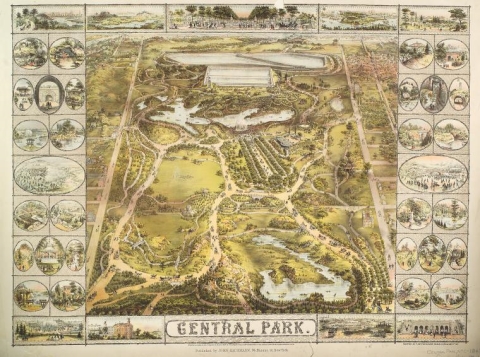
What does this mean? Simply put, “it means you can have the maps, all of them if you want, for free, in high resolution.” Maps like that above, of New York’s Central Park, issued in 1863, ten years before Frederick Law Olmsted and Calvert Vaux completed their historic re-design.
Can you—as I did with my neatly folded, yellowing archive—have all the maps in full-color print? Well, no, unless you’re prepared to bear the cost in ink and paper and have some specialized printing equipment that can render each map in its original dimensions. But you can access something worlds away from what I could have imagined—a digital enhancement technology called “warping,” also known as “georectification.”
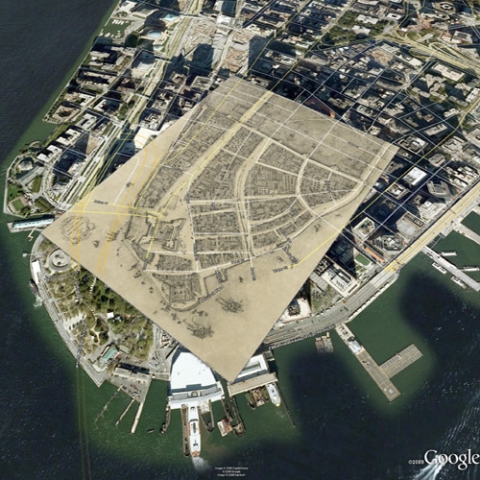
This, explains the NYPL, “is the process where digital images of maps are stretched, placing the maps themselves into their geographic context, rendered either on the website or with tools such as Google Earth.” For example, below see a “warping” of the 1916 Redraft of the 1660 “Castello Plan” for then-New Amsterdam over a current-day Google Earth image of lower Manhattan (and note how much the island has been expanded past its 17th century shores). The “warping” technology is open access, meaning that “anybody with a computer can create an account, log in, and begin warping and tracing maps.” User contributions remain, “a la Wikipedia,” and add “one more piece to this new historical geographic data model.”
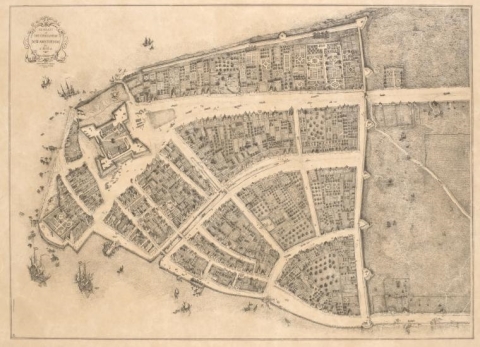
The “warper” is a special feature that helps place historical maps in a modern visual field, but it in no way ruins the enjoyment of those maps as archival pieces or art objects. You can see cartographer John Wolcott Adams original 1916 Castello Plan redraft below, and visit NYPL’s Digital Collections for a high resolution image, fully zoomable and, yes, printable. For more on the incredible warping technology NYPL makes available to us, see this extended blog post, “Unbinding the Atlas: Working with Digital Maps.” Over ten thousand of the collection’s maps are of New York and New Jersey, dating from 1852 to 1922, including property, zoning, and topographic maps. In addition, over one thousand of the maps depict Mid-Atlantic cities from the 16th to the 19th centuries, and over 700 are topographic maps of the Austro-Hungarian Empire between 1877 and 1914. That should be enough to keep any amateur or professional map-lover busy for a good long while. Start digging into the maps here.
Now we can share an interactive tool that is using some of those Landsat images to stop illegal deforestation.
With help from Google Earth Engine, the World Resources Institute launched Global Forest Watch, an online forest monitoring and alert system that allows individual computer users to watch forests around the world change in an almost real-time stream of imagery.
Whistle blowers are making powerful use of the Global Forest Watch tool. Using spatial data streams available on the site to observe forest changes in southeastern Peru, a number of users submitted alerts about rapidly escalating deforestation near a gold mine and river valley. In another case, observers submitted an alert about illegal logging in the Republic of the Congo.
Five years ago, NASA and the U.S. Geological Survey lifted protocols that kept Landsat images proprietary. Now, agencies like the World Resources Institute—and even tiny citizen watchdog groups around the world—have access to incredibly rich tools and data. Some of the imagery is hard to interpret. Global Forest Watch developed a number of different data layers for users to apply, making it possible to monitor forest areas for trends or illegal logging. The video at the top of this page gives a good overview of how the site works. This one gives more detail about how to use the maps on the Global Forest Watch site.
Select an area of the world and then select a data set that interests you. Choose to look at terrain, satellite, road, tree height, or composite images of a particular region. Data layers can be layered on top of one another to show trends in forest management. In Indonesia, for example, you can use the FORMA alerts button to see what has already been reported in that area of the humid tropics.
How can you tell if forest change is due to illegal logging? Turn on the Forest Use filters to see which areas are authorized for logging and mining and which are protected. In Indonesia, many areas are designated for oil palm production, but expansion of those crops are often associated with loss of natural forest.
Do your own sleuthing. The site is designed to harness data from government and academic scientists, along with observation from individuals (us). There is even information about companies that are growing oil palm trees, so it’s possible that a diligent user could catch an over-aggressive grower stepping over the forest boundary.
A couple weeks ago, Colin Marshall highlighted for you Jack Kerouac’s Hand-Drawn Map of the Hitchhiking Trip Narrated in On the Road. Now we have another Kerouacian map for you — a map for our times. Gregor Weichbrodt, a German college student, took all of the geographic stops mentioned in On the Road, plugged them into Google Maps, and ended up with a 45-page manual of driving directions, divided into chapters paralleling those of Kerouac’s original book. You can read the manual — On the Road for 17,527 Miles– as a free ebook. Just click the image above to view it online (or click here). Likewise, you can purchase a print copy on Lulu and perhaps make it the basis for your own road trip. Wondering how long such a trip might take? Google Maps indicates that Kerouac’s journey covered some 17,527 miles and theoretically took some 272 hours.
If you would like to support the mission of Open Culture, consider making a donation to our site. It’s hard to rely 100% on ads, and your contributions will help us continue providing the best free cultural and educational materials to learners everywhere. You can contribute through PayPal, Patreon, and Venmo (@openculture). Thanks!
“And what becomes of all the little boys who never comb their hair? They’re lined up all around the block, on the Nickel over there.” So sings Tom Waits on 1980’s “On the Nickel,” which he originally composed for Ralph Waite’s eponymous feature film, a story of shame, degradation, and good times in the sketchiest part of downtown Los Angeles, through which runs 5th Street — the “Nickel” of the title. That part of town has managed an astonishing cleanup since 1980 (then again, most parts of town have, including the once-seething corner referenced by Heartattack and Vine, the title of Waits’ album from that year) to the point that you’ll now find, just off 5th, the new-wave retro, hipster-friendly Nickel Diner: a favorite eatery of mine, incidentally, but hardly one describable with Waits’ signature rasp, a forcefully resigned instrument tuned to evoke the classically, near-mythologically ragged American life.
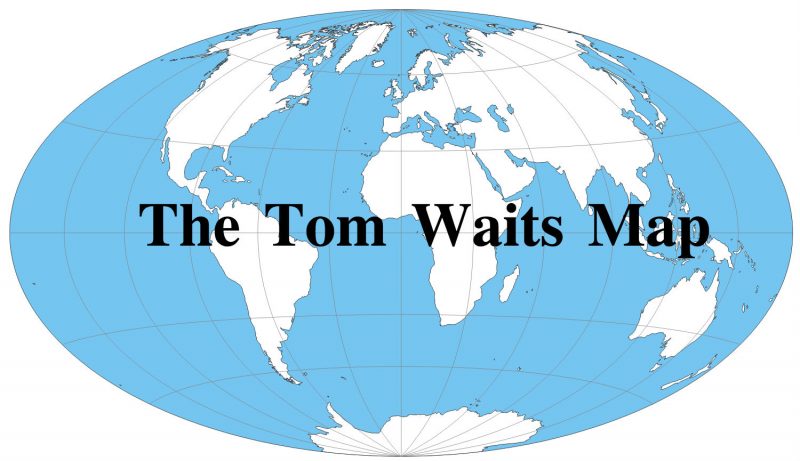
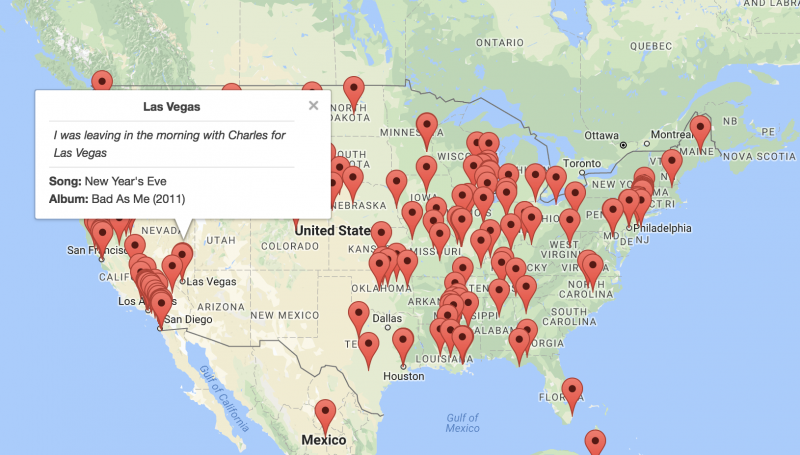
Still, you can find the old Nickel on The Tom Waits Map, which marks out all the lyrically identifiable places in Waits’ America, from Minneapolis’ 9th Street (“Hey Charlie, I’m pregnant and living on the 9th street,” goes “Christmas Card From A Hooker In Minneapolis”) to the state of Idaho (“Danny says we gotta go, gotta go to Idaho, but we can’t go surfing ’cause it’s 20 below,” on “Danny Says”).
We may think of Waits’ artistic persona as a certain lower slice of America made song, but this map, when zoomed out to a global level, reveals references to many exotic lands, as when he sings about “a Hong Kong drizzle on Cuban heels,” from the perspective of a character who “drank with all the Chinamen, walked the sewers of Paris” and of “Radion the human torso, deep from the jungles of Africa.”
The Tom Waits map itself, in fact, comes from an obviously die-hard Swedish fan by the name of Jonas Nordström. As he and the rest of the Waits faithful know, the man doesn’t just speak to an askew sensibility in America; he speaks to askew sensibilities all throughout humanity.
If you would like to support the mission of Open Culture, consider making a donation to our site. It’s hard to rely 100% on ads, and your contributions will help us continue providing the best free cultural and educational materials to learners everywhere. You can contribute through PayPal, Patreon, and Venmo (@openculture). Thanks!
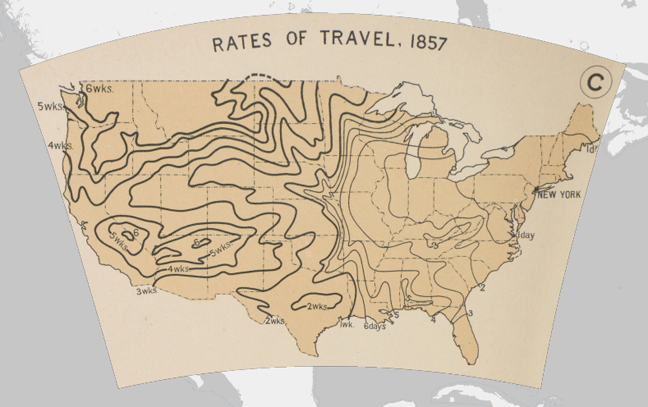
The Atlas of the Historical Geography of the United States remains a valuable historical resource today. But, for all of these years, it had one notable shortcoming. Around the time of its first publication, John K. Wright acknowledged that “The ideal historical atlas might well be a collection of motion-picture maps, if these could be displayed on the pages of a book without the paraphernalia of projector, reel, and screen.” The technology that would lend itself to creating motion-picture maps wasn’t available in the 1930s. But it is today. And thanks to the University of Richmond’s Digital Scholarship Lab, we can now view The Atlas of the Historical Geography of the United States in a new digital, sometimes animated format. If you want to see a good example of historical data put into motion, then you might want to check out this map of American Explorations in the West, 1803–1852. (Click here and then click “Animate” at the bottom of the screen.) This map will trace for you the expeditions of Lewis and Clark and many other explorers. Then, if you’re ready to be an explorer yourself, you can start your journey through the digitized atlas by entering the Table of Contents.
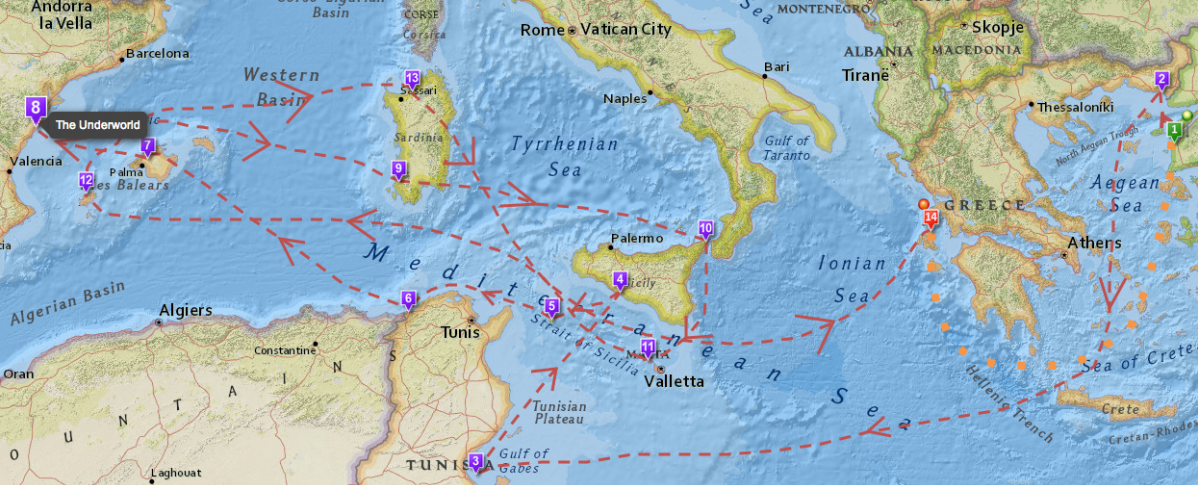
The Odyssey, one of Homer’s two great epics, narrates Odysseus’ long, strange trip home after the Trojan war. During their ten-year journey, Odysseus and his men had to overcome divine and natural forces, from battering storms and winds to difficult encounters with the Cyclops Polyphemus, the cannibalistic Laestrygones, the witch-goddess Circe and the rest. And they took a most circuitous route, bouncing all over the Mediterranean, moving first down to Crete and Tunisia. Next over to Sicily, then off toward Spain, and back to Greece again.
If you’re looking for an easy way to visualize all of the twists and turns in The Odyssey, then we’d recommend spending some time with the interactive map hosted on the University of Pennsylvania’s website. The map breaks down Odysseus’ voyage into 14 key scenes and locates them on a modern map.
Meanwhile, if you’re interested in the whole concept of ancient travel, I’d suggest revisiting one of our previous posts: Play Caesar: Travel Ancient Rome with Stanford’s Interactive Map. It tells you all about ORBIS, a geospatial network model, that lets you simulate journeys in Ancient Roman. You pick the points of origin and destination for a trip, and ORBIS will reconstruct the duration and financial cost of making the ancient journey. Pretty cool stuff.
If you would like to support the mission of Open Culture, consider making a donation to our site. It’s hard to rely 100% on ads, and your contributions will help us continue providing the best free cultural and educational materials to learners everywhere. You can contribute through PayPal, Patreon, and Venmo (@openculture). Thanks!
“Wishing to get a better view than I had yet had of the ocean, which, we are told, covers more than two thirds of the globe, but of which a man who lives a few miles inland may never see any trace…I have spent, in all, about three weeks on the Cape; walked from Eastham to Provincetown twice on the Atlantic side, and once on the Bay side also…but having come so fresh to the sea, I have got but little salted.”
You can click the image above to see it in a larger format. For many other maps made by Thoreau, visit the “Thoreau Lands and Property Survey” collection at the Concord Free Public Library. Also find works by Thoreau in our collection of Free eBooksand Free Audio Books.
If you would like to support the mission of Open Culture, consider making a donation to our site. It’s hard to rely 100% on ads, and your contributions will help us continue providing the best free cultural and educational materials to learners everywhere. You can contribute through PayPal, Patreon, and Venmo (@openculture). Thanks!
We're hoping to rely on loyal readers, rather than erratic ads. Please click the Donate button and support Open Culture. You can use Paypal, Venmo, Patreon, even Crypto! We thank you!
Open Culture scours the web for the best educational media. We find the free courses and audio books you need, the language lessons & educational videos you want, and plenty of enlightenment in between.