Two Animated Maps Show the Expansion of the U.S. from the Different Perspectives of Settlers & Native Peoples

After John Ford, the his­to­ry of U.S. expan­sion went by the name “How the West Was Won.” Decades ear­li­er, in his essay “Annex­a­tion,” Jack­son­ian jour­nal­ist John O’Sullivan famous­ly coined the phrase “man­i­fest des­tiny.” His­to­ri­an Richard Slotkin called it “regen­er­a­tion through vio­lence” and nov­el­ist Cor­mac McCarthy summed up the jagged, ever-mov­ing line of west­ward expan­sion from sea to sea with two words: Blood Merid­i­an.

Indige­nous ver­sions of the sto­ry do not tend to enter com­mon par­lance in quite the same way, a fact upon which Vine Delo­ria, Jr. remarks in his “Indi­an Man­i­festo,” Custer Died for Your Sins. Vio­lence is always cen­tral to the sto­ry. Usu­al­ly the sav­agery of Native peo­ple is tak­en for grant­ed. Sav­agery of set­tlers may be more or less empha­sized. Yet the long his­to­ry of land theft over the course of the cen­turies is also one of bro­ken treaty after treaty.

Few tribes were defeat­ed in war by the Unit­ed States, but most sold some land and allowed the Unit­ed States to hold the remain­der in trust for them. In turn, the tribes acknowl­edged the sov­er­eign­ty of the Unit­ed States in pref­er­ence to oth­er pos­si­ble sov­er­eigns.

Caught between war­ring Euro­pean empires, Indige­nous nations made the best deals they could with the advanc­ing U.S. and its army of Civ­il War vet­er­ans. “From this hum­ble begin­ning the fed­er­al gov­ern­ment stole some two bil­lion acres of land and con­tin­ues to take what it can with­out arous­ing the ire of the igno­rant pub­lic.”

The bru­tal­i­ty of the 19th cen­tu­ry became pro­fes­sion­al­ized, car­ried out by reg­u­lars in uni­form, hence the detached lan­guage of “Indi­an wars.” These were fol­lowed by oth­er kinds of vio­lence: insti­tu­tion­al­ized pater­nal­ism, fur­ther encroach­ment and enclo­sure, and the forced removal of thou­sands of chil­dren from their par­ents and into reed­u­ca­tion camps.

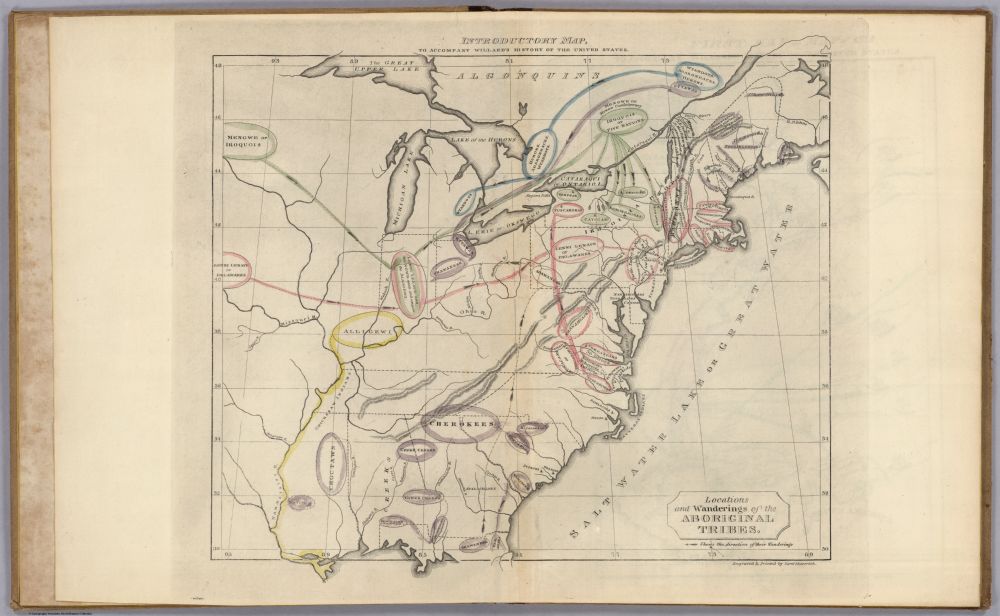
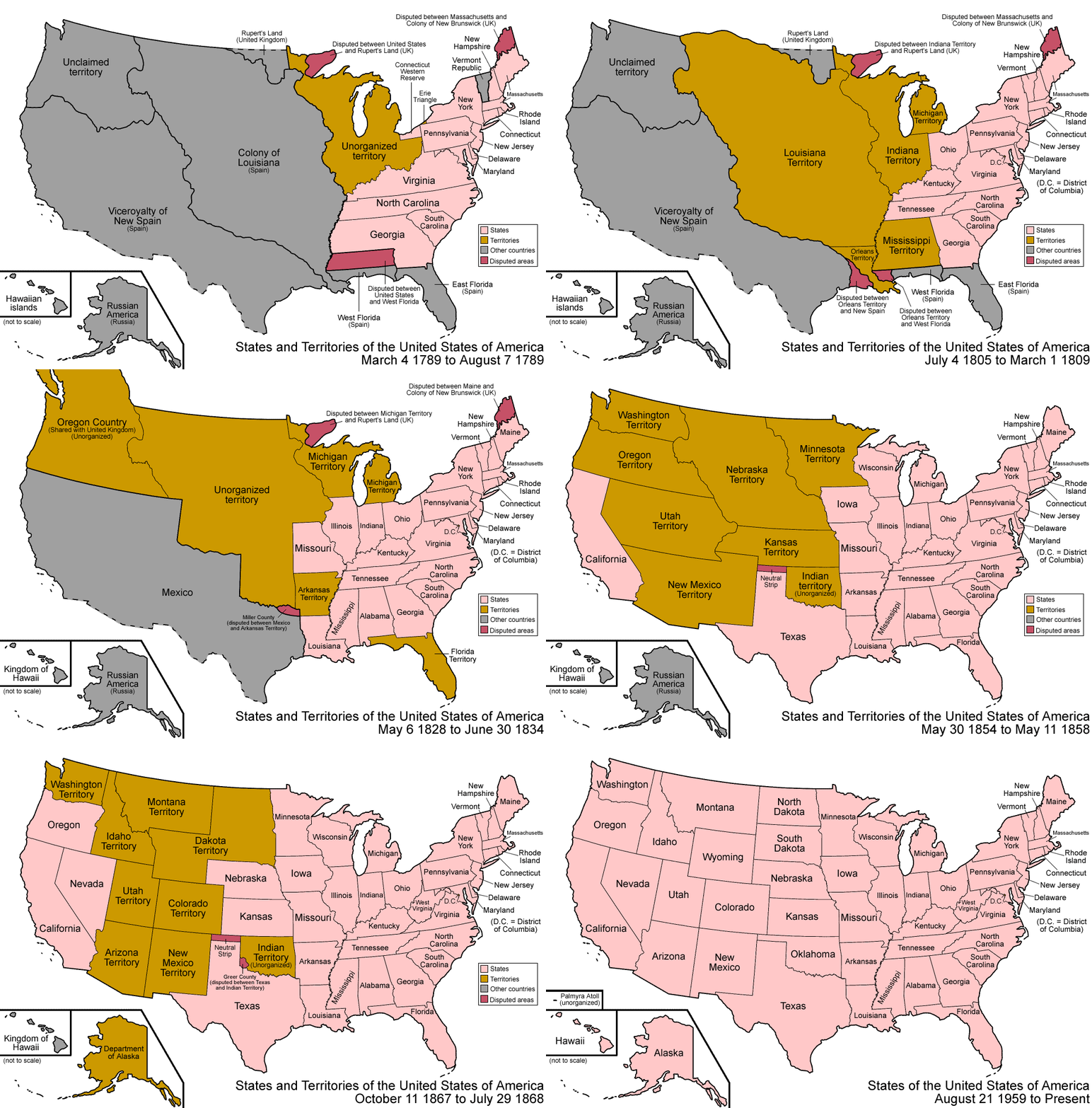
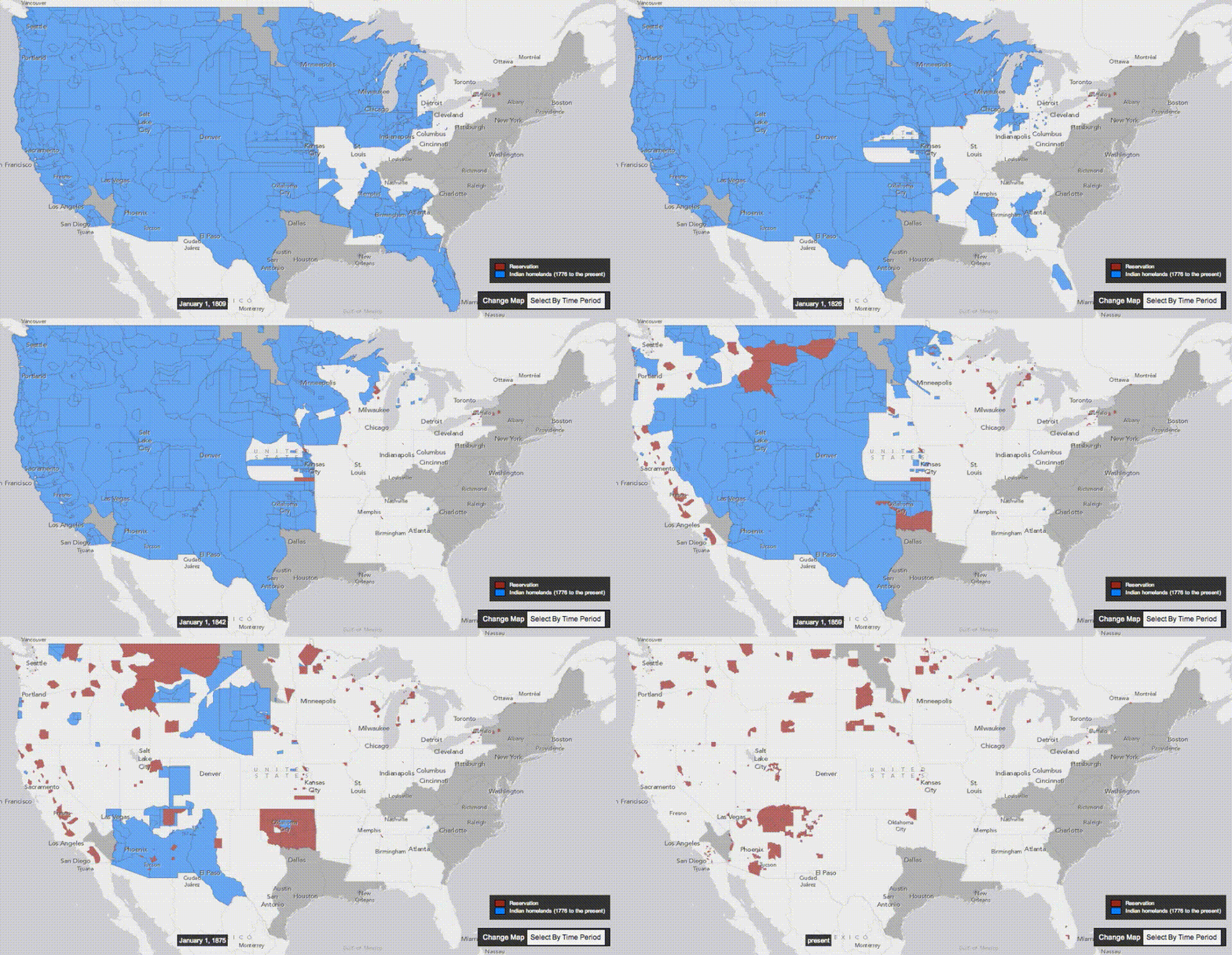
The two maps you see here, with sweep­ing­ly broad visu­al ges­tures in gif form, illus­trate the 19th cen­tu­ry seizure of land across the North Amer­i­can con­ti­nent from the per­spec­tive of a U.S. nation­al his­to­ry and that of an Indige­nous mul­ti-nation­al his­to­ry. The map at the top traces the sto­ry from the coun­try’s begin­nings in the 13 colonies to the annex­a­tion, pur­chase, and final­ly state­hood of Hawaii and Alas­ka in 1959.

The above map is more focused, span­ning the years 1810 to 1891. As Nick Rout­ley points out in a post at Visu­al Cap­i­tal­ist, “five of the largest expan­sion events in U.S. his­to­ry” took place dur­ing the 1800s, though the first one he cites falls out­side the time­line above. The 1803 Louisiana Pur­chase end­ed up acquir­ing what now makes up “near­ly 25% of the cur­rent ter­ri­to­ry of the Unit­ed States, stretch­ing from New Orleans all the way up to Mon­tana and North Dako­ta.”

Oth­er notable events include the 1819 pur­chase of Flori­da from Spain by John Quin­cy Adams, the afore­men­tioned pur­chase of Alas­ka from Rus­sia, and the 1845 annex­a­tion of Texas. The Mex­i­can-Amer­i­can War of 1848 gets less men­tion these days, though it expand­ed slav­ery and was quite hot­ly debat­ed at the time by such prin­ci­pled fig­ures as Hen­ry David Thore­au, who refused to pay his poll tax over it and wrote “Civ­il Dis­obe­di­ence” while in jail.

In the so-called Mex­i­can Ces­sion, Texas became a state and “the Unit­ed States took con­trol of a huge par­cel of land that includes the present-day states of Cal­i­for­nia, Neva­da, and Utah, as well as por­tions of Ari­zona, Col­orado, New Mex­i­co, and Wyoming.” Mex­i­co, on the oth­er hand, “saw the size of their ter­ri­to­ry halved.” After each seizure of ter­ri­to­ry, mass migra­tions west­ward com­menced in wave upon wave.

Route­ly does not sur­vey these migra­tion events, but you can learn about them in accounts like Rox­anne Dunbar-Ortiz’s Indige­nous People’s His­to­ry of the Unit­ed States and Deloria’s man­i­festo. When we approach the found­ing and expan­sion of the U.S. from mul­ti­ple per­spec­tives, both visu­al and his­tor­i­cal, we under­stand why crit­i­cal his­to­ri­ans often use the phrase “set­tler colo­nial­ism” rather than “west­ward expan­sion” or its syn­onyms. And why the overused and lim­it­ed phrase “nation of immi­grants” might just as well be “nation of migrants.”

via Visu­al Cap­i­tal­ist

Relat­ed Con­tent:

Inter­ac­tive Map Shows the Seizure of Over 1.5 Bil­lion Acres of Native Amer­i­can Land Between 1776 and 1887

Native Lands: An Inter­ac­tive Map Reveals the Indige­nous Lands on Which Mod­ern Nations Were Built

The Atlantic Slave Trade Visu­al­ized in Two Min­utes: 10 Mil­lion Lives, 20,000 Voy­ages, Over 315 Years

Josh Jones is a writer and musi­cian based in Durham, NC. Fol­low him at @jdmagness

The Meandering Mississippi River and How It Evolved Over Thousands of Years Visualized in Brilliant Maps from 1944

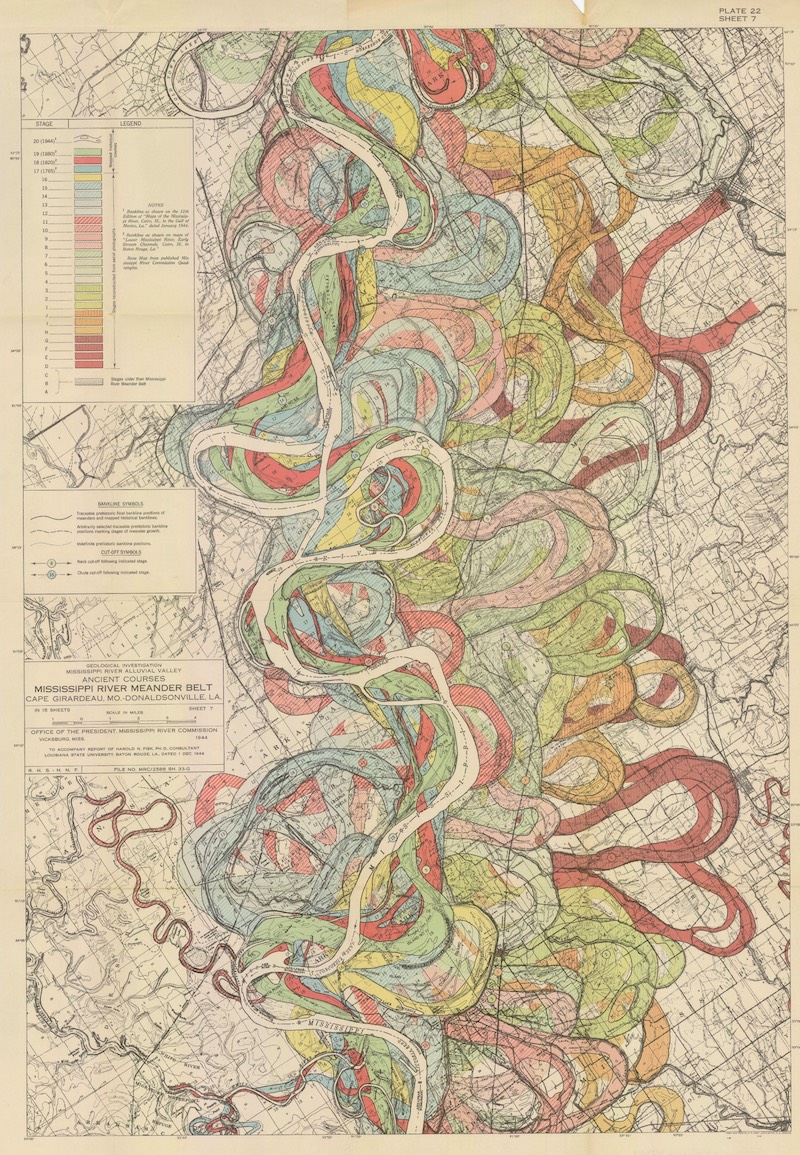
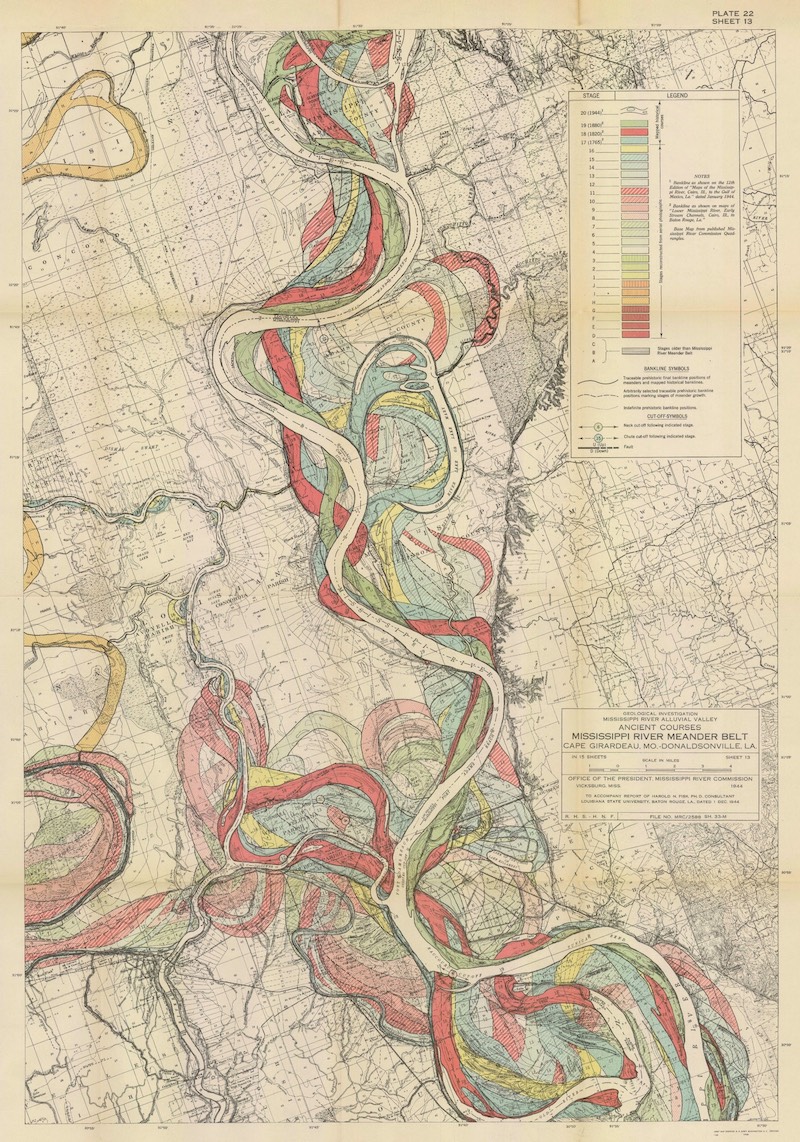
Giv­en that Turkey’s Büyük Menderes Riv­er was his­tor­i­cal­ly known as the Mean­der, you might well imag­ine how un-straight­for­ward a path it takes through the coun­try. But the Eng­lish adjec­tive descend­ed from its name describes a fair few oth­er twist­ing, turn­ing rivers as well, and also a form of riv­er map­ping that suits them. “I have long admired the Mis­sis­sip­pi Riv­er mean­der maps designed by Army Corps of Engi­neers car­tog­ra­ph­er Harold Fisk,” writes Jason Kot­tke at Kottke.org by way of an intro­duc­tion to his short essay on them at the site of print­mak­er 20x200.

“In their relent­less flow to low­er ground, rivers like to roam over the land­scape, cut­ting through sol­id rock and loamy soil alike, gain­ing advan­tage here and there where they can,” goes Kot­tke’s expla­na­tion of how mean­der­ing rivers come to be.

“The best and eas­i­est course for a riv­er to take down­hill is its cur­rent course… right up until the moment when it’s not.” Each col­or in Fisk’s mean­der maps of the longest riv­er in North Amer­i­ca “rep­re­sents a new course, a mark­er of each time a bend had become too bendy and the riv­er ‘decid­ed’ to take a more direct path.” Kot­tke sum­ma­rizes these maps’ appeal suc­cinct­ly: “They are time machines.”

“Stand­ing before a paint­ing by Hilma af Klint, a sculp­ture by Berni­ni, or a cave paint­ing in Chau­vet, France draws you back in time in a pow­er­ful way: you know you’re stand­ing pre­cise­ly where those artists stood hun­dreds or even thou­sands of years ago, lay­ing paint to sur­face or chis­el to stone.” Here, thanks to a “clever map­mak­er with an artis­tic eye,” we can imag­ine the Mis­sis­sip­pi “as it was dur­ing the Euro­pean explo­ration of the Amer­i­c­as in the 1500s, dur­ing the Cahokia civ­i­liza­tion in the 1200s (when this city’s pop­u­la­tion matched Lon­don’s), when the first humans came upon the riv­er more than 12,000 years ago, and even back to before humans, when mam­moths, camels, dire wolves, and giant beavers roamed the land and gazed upon the riv­er.”

You can buy prints of three dif­fer­ent Mis­sis­sip­pi mean­der maps from 20x200, all of them orig­i­nal­ly part of Fisk’s report “Geo­log­i­cal Inves­ti­ga­tion of the Allu­vial Val­ley of the Low­er Mis­sis­sip­pi Riv­er com­plet­ed in 1944. The study was made to learn about the for­ma­tion of the val­ley over time, and about the major fac­tors that dic­tate its flow and flood­ing in the mod­ern era.” Fisk drew upon data col­lect­ed through approx­i­mate­ly 16,000 bor­ings, and “also found the river’s heart in this jum­ble of loops and purls,” pro­duc­ing a reflec­tion of the river’s dis­tinc­tive per­son­al­i­ty in “this explo­sive, autumn-col­ored palette.” Regard­ing these maps, we can’t help but won­der in what shape some future team of intre­pid sur­vey­ors will find the Mis­sis­sip­pi a few thou­sand years hence — and what new words, in what lan­guages, that shape might inspire.

via Kot­tke

Relat­ed Con­tent:

The Moth­er of All Maps of the “Father of Waters”: Behold the 11-Foot Traveler’s Map of the Mis­sis­sip­pi Riv­er (1866)

All the Rivers & Streams in the U.S. Shown in Rain­bow Colours: A Data Visu­al­iza­tion to Behold

William Faulkn­er Draws Maps of Yok­na­p­ataw­pha Coun­ty, the Fic­tion­al Home of His Great Nov­els

Learn the Untold His­to­ry of the Chi­nese Com­mu­ni­ty in the Mis­sis­sip­pi Delta

View and Down­load Near­ly 60,000 Maps from the U.S. Geo­log­i­cal Sur­vey (USGS)

Down­load 67,000 His­toric Maps (in High Res­o­lu­tion) from the Won­der­ful David Rum­sey Map Col­lec­tion

Based in Seoul, Col­in Mar­shall writes and broad­casts on cities, lan­guage, and cul­ture. His projects include the book The State­less City: a Walk through 21st-Cen­tu­ry Los Ange­les and the video series The City in Cin­e­ma. Fol­low him on Twit­ter at @colinmarshall, on Face­book, or on Insta­gram.

An Interactive Map of Odysseus’ 10-Year Journey in Homer’s Odyssey

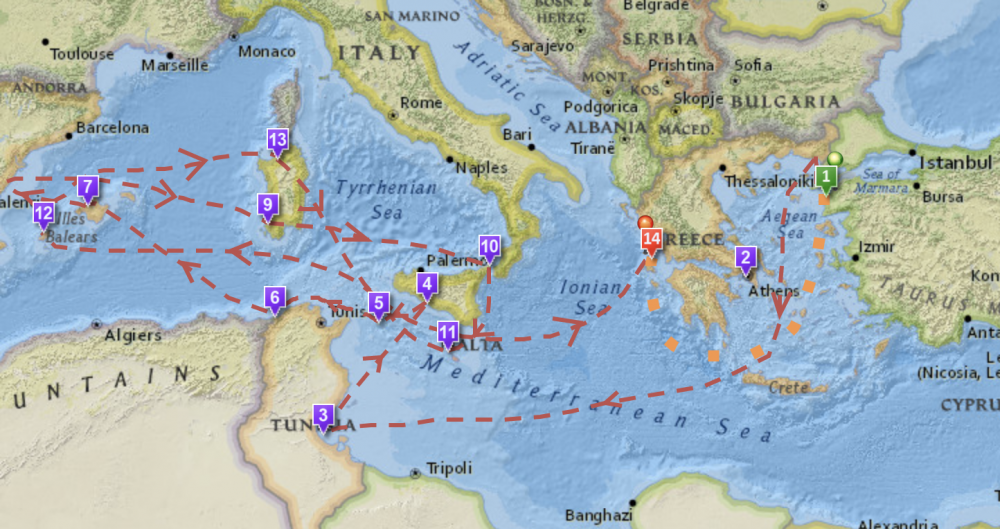
The Odyssey, one of Home­r’s two great epics, nar­rates Odysseus’ long, strange trip home after the Tro­jan war. Dur­ing their ten-year jour­ney, Odysseus and his men had to over­come divine and nat­ur­al forces, from bat­ter­ing storms and winds to dif­fi­cult encoun­ters with the Cyclops Polyphe­mus, the can­ni­bal­is­tic Laestry­gones, the witch-god­dess Circe and the rest. And they took a most cir­cuitous route, bounc­ing all over the Mediter­ranean, mov­ing first down to Crete and Tunisia. Next over to Sici­ly, then off toward Spain, and back to Greece again.

If you’re look­ing for an easy way to visu­al­ize all of the twists and turns in The Odyssey, then we’d rec­om­mend spend­ing some time with the inter­ac­tive map cre­at­ed by Gisèle Moun­z­er“Odysseus’ Jour­ney” breaks down Odysseus’ voy­age into 14 key scenes and locates them on a mod­ern map designed by Esri, a com­pa­ny that cre­ates GIS map­ping soft­ware.

Mean­while, if you’re inter­est­ed in the whole con­cept of ancient trav­el, we’d sug­gest revis­it­ing one of our pre­vi­ous posts: Play Cae­sar: Trav­el Ancient Rome with Stanford’s Inter­ac­tive Map. It tells you all about ORBIS, a geospa­tial net­work mod­el, that lets you sim­u­late jour­neys in Ancient Roman. You pick the points of ori­gin and des­ti­na­tion for a trip, and ORBIS will recon­struct the dura­tion and finan­cial cost of mak­ing the ancient jour­ney.

If you would like to sign up for Open Culture’s free email newslet­ter, please find it here. It’s a great way to see our new posts, all bun­dled in one email, each day.

If you would like to sup­port the mis­sion of Open Cul­ture, con­sid­er mak­ing a dona­tion to our site. It’s hard to rely 100% on ads, and your con­tri­bu­tions will help us con­tin­ue pro­vid­ing the best free cul­tur­al and edu­ca­tion­al mate­ri­als to learn­ers every­where. You can con­tribute through Pay­Pal, Patre­on, and Ven­mo (@openculture). Thanks!

Note: An ear­li­er ver­sion of this post appeared on our site in Decem­ber, 2013.

Relat­ed Con­tent:

Hear Homer’s Ili­ad Read in the Orig­i­nal Ancient Greek

What Ancient Greek Music Sound­ed Like: Hear a Recon­struc­tion That is ‘100% Accu­rate’

Dis­cov­er the “Brazen Bull,” the Ancient Greek Tor­ture Machine That Dou­bled as a Musi­cal Instru­ment

Learn­ing Ancient His­to­ry for Free

by | Permalink | Make a Comment ( 13 ) |

New Interactive “Murder Map” Reveals the Meanest Streets of Medieval London

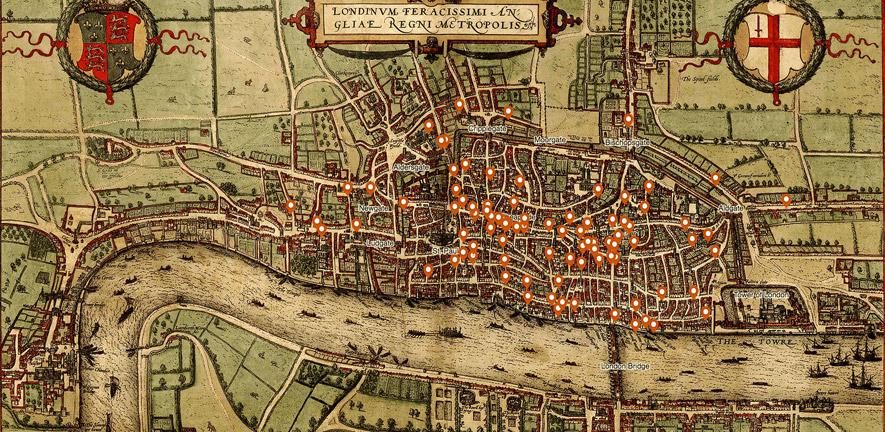
How dan­ger­ous was medieval Lon­don? That’s a ques­tion that has recent­ly been stud­ied by the Uni­ver­si­ty of Cambridge’s Vio­lence Research Cen­ter, and they have pro­vid­ed a handy inter­ac­tive map for our perusal. Just in case we go back in time in a TARDIS or some such machine, we’ll know what parts of the city to avoid. And those parts are…well, most of it, actu­al­ly.

The data con­tain­ing info of 142 homi­cides comes from sur­viv­ing coroner’s rolls from the first half of the 14th cen­tu­ry. A coro­ner dur­ing this time was a bit clos­er to a police detec­tive in ours, called to the scene of any sud­den and unnat­ur­al death. And if it looked liked foul play a neigh­bor­hood jury of some­where between 12 and 50 peo­ple were called to offer a ver­dict.

Hov­er over a mark­er on the map and you can dis­cov­er what hap­pened at that loca­tion. Here are a few exam­ples:

On the evening of July 20, 1325, Peter Clark, a bak­er, was stabbed in the heart by a fel­low bak­er called Wal­ter after an argu­ment. Wal­ter took sanc­tu­ary in a church, con­fessed to the crime, and a month lat­er made his way out of the coun­try by boat.

On Decem­ber 21, 1325, Roger Scott, a tai­lor, was quar­rel­ing with Robert de Oun­dle in the streets of Bish­op­gate, when Robert stabbed Roger with a hid­den knife, killing him instant­ly. He also fled, to where nobody knew.

On Feb­ru­ary 13, 1324, William War­rock and William de Northamp­tone were argu­ing in the high street of Cas­tle Bay­nard, when the for­mer stabbed the lat­ter in the heart. War­rock, who had no belong­ings, dis­ap­peared.

Sens­ing a theme here? We’ll nev­er know the rea­son for these fatal alter­ca­tions, but the knife indus­try was doing well out of it. The study crunched the num­bers and found some sta­tis­tics: the time of year did not seem to be a fac­tor, but like today, the week­end was a dead­lier time. And the hours between ear­ly evening and the first hour of London’s cur­few, when the city insist­ed all fires be extin­guished and peo­ple go to bed.

A whop­ping 52% of mur­ders hap­pened in the pub­lic square or the high street. No oth­er loca­tion cracks 10%. And long knives were the weapon of choice at 35%, sec­ond only to short knives at 20%. And though it wasn’t reflect­ed in the three ran­dom exam­ples, most peo­ple got stabbed in the head. Unsur­pris­ing­ly men com­mit­ted the major­i­ty of the crimes, and all class­es of soci­ety and pro­fes­sion mur­dered their way around Lon­don, includ­ing priests. (One exam­ple is giv­en of a priest who stabs a gar­den­er to death when the lat­ter dis­cov­ered him steal­ing apples.)

Pro­fes­sor and crim­i­nol­o­gist Manuel Eis­ner summed up the work of his group thus:

“The events described in the Coro­ners’ Rolls show weapons were nev­er far away, male hon­our had to be pro­tect­ed, and con­flicts eas­i­ly got out of hand. They give us a detailed pic­ture of how homi­cide was embed­ded in the rhythms of urban medieval life.”

And in fact, giv­en the pro­por­tion of crime to the gen­er­al pop­u­la­tion, Lon­don was pret­ty dead­ly, about 15–20 times high­er than a mod­ern British city.

But Eis­ner notes the com­par­isons can only go so far: “We have firearms, but we also have emer­gency ser­vices. It’s eas­i­er to kill but eas­i­er to save lives.”

Vis­it the inter­ac­tive medieval mur­der map here.

Relat­ed Con­tent:

An Inter­ac­tive Map of the 2,000+ Sounds Humans Use to Com­mu­ni­cate With­out Words: Grunts, Sobs, Sighs, Laughs & More

An Inter­ac­tive Map Shows Just How Many Roads Actu­al­ly Lead to Rome

An Inter­ac­tive Map of Odysseus’ 10-Year Jour­ney in Homer’s Odyssey

Ted Mills is a free­lance writer on the arts who cur­rent­ly hosts the artist inter­view-based FunkZone Pod­cast and is the pro­duc­er of KCR­W’s Curi­ous Coast. You can also fol­low him on Twit­ter at @tedmills, read his oth­er arts writ­ing at tedmills.com and/or watch his films here.

A Subway Map of Human Anatomy: All the Systems of Our Body Visualized in the Style of the London Underground

We all have bod­ies, but how many of us tru­ly know our way around them? Plen­ty of books explain in detail the func­tions of and rela­tion­ships between each and every part of our anato­my, but few of them do it in a way the lay­man — and espe­cial­ly the lay­man not yet accus­tomed to the sight of human vis­cera laid bare — can read­i­ly grasp. We need a visu­al­iza­tion of the human body, but what kind of visu­al­iza­tion can best rep­re­sent it with a max­i­mum of clar­i­ty and a min­i­mum of mis­lead­ing dis­tor­tion?

“Most peo­ple might imag­ine an intri­cate net­work of blood ves­sels or the com­plex neur­al cir­cuits of the brain,” writes Visu­al Cap­i­tal­ist’s Iman Ghosh. “Or we might pic­ture dia­grams from the icon­ic med­ical text­book, Gray’s Anato­my.” But how about a visu­al­iza­tion of the body in the style of a clas­sic piece of infor­ma­tion design we’ve all seen at least once, the Lon­don Under­ground map? “Cre­at­ed by Jonathan Sim­monds M.D., a res­i­dent physi­cian at Tufts Med­ical Cen­ter,” Ghosh writes, “it’s a sim­ple yet beau­ti­ful­ly intu­itive demon­stra­tion of how effi­cient­ly our bod­ies work.”

Just as Har­ry Beck­’s orig­i­nal 1933 Lon­don Under­ground map straight­ened out and col­or-cod­ed each of the lines then in oper­a­tion, Sim­monds’ anatom­i­cal map traces thir­teen dif­fer­ent “lines” through the body, each of which rep­re­sents a dif­fer­ent sys­tem of the body: the ner­vous sys­tem in yel­low, for exam­ple, the air­way sys­tem in black, and the lym­phat­ic sys­tem in green. “While dashed lines rep­re­sent deep­er struc­tures, sec­tions with ‘trans­fers’ show where dif­fer­ent organ sys­tems inter­sect,” Ghosh writes. If you’re won­der­ing where to start, she adds, “there’s a help­ful ‘You Are Here’ at the heart.”

You can take a close look at Sim­monds’ work in a large, high-res­o­lu­tion ver­sion here. Not only does fol­low­ing the mod­el of the Lon­don Under­ground map intro­duce a degree of imme­di­ate leg­i­bil­i­ty sel­dom seen (at least by non-med­ical stu­dents) in anatom­i­cal dia­grams, it also under­scores an aspect of the very nature of our human bod­ies that we don’t often con­sid­er. We might instinc­tive­ly think of them as sets of dis­crete organs all encased togeth­er and func­tion­ing inde­pen­dent­ly, but in fact they’re more like cities: just as busy, just as inter­con­nect­ed, just as depen­dent on con­nec­tions and rou­tines, and just as improb­a­bly func­tion­al.

via Visu­al Cap­i­tal­ist

Relat­ed Con­tent:

Down­load the Sub­lime Anato­my Draw­ings of Leonar­do da Vin­ci: Avail­able Online, or in a Great iPad App

Map­ping Emo­tions in the Body: A Finnish Neu­ro­science Study Reveals Where We Feel Emo­tions in Our Bod­ies

The Roman Roads of Britain Visu­al­ized as a Sub­way Map

The Genius of Har­ry Beck’s 1933 Lon­don Tube Map–and How It Rev­o­lu­tion­ized Sub­way Map Design Every­where

A Won­der­ful Archive of His­toric Tran­sit Maps: Expres­sive Art Meets Pre­cise Graph­ic Design

Based in Seoul, Col­in Mar­shall writes and broad­casts on cities, lan­guage, and cul­ture. His projects include the book The State­less City: a Walk through 21st-Cen­tu­ry Los Ange­les and the video series The City in Cin­e­ma. Fol­low him on Twit­ter at @colinmarshall, on Face­book, or on Insta­gram.

136 Maps Reveal Where Tourists & Locals Take Photos in Major Cities Across the Globe

How to tell the tourists in a city from the locals? Poten­tial­ly reli­able indi­ca­tors include the lan­guage they speak, the terms they use, the way they dress, the way they walk, and whether they’re stand­ing in the mid­dle of the side­walk squint­ing at a map. But few fac­tors draw the line between tourist and local more stark­ly than where they go and don’t go: no mat­ter the city, one will soon­er or lat­er hear talk of places locals know that tourists don’t, places locals don’t go because tourists do know about them, places tourists go when they want to act like locals, places locals go when they want to act like tourists, and so on.

In his project “Tourists and Locals,” Eric Fis­ch­er has found one way of quan­ti­fy­ing this great divide: where do the mem­bers of each group take the pho­tos they upload to the inter­net? You can view the results in 136 dif­fer­ent city maps or explore a whole world map, both of which use the same col­or cod­ing: “The red bits indi­cate pho­tos tak­en by tourists,” says Bril­liant Maps, “while the blue bits indi­cate pho­tos tak­en by locals and the yel­low bits might be either.”

Using “Map­Box and Twit­ter data from Gnip to cre­ate the maps,” Fis­ch­er defined locals as “those who tweet­ed from the same loca­tion for at least a month” and tourists as “those who were con­sid­ered local in anoth­er city but were tweet­ing in a dif­fer­ent loca­tion.”

Here, from the top of the post down, we have Fis­cher’s maps of Paris, Tokyo, Dublin, and San Fran­cis­co, all cities with vary­ing degrees of over­lap between the realm of the local and that of the tourist. Parisian attrac­tions like the Parc de Belleville and the Bassin de la Vil­lette show a rel­a­tive­ly healthy tourist-local bal­ance, where­as out­siders dom­i­nate in places like La Défense with its high­ly pho­tograph­able sky­scrap­ers, and of course the Lou­vre (to say noth­ing of the red-sat­u­rat­ed Ver­sailles, not pic­tured in this seg­ment of the map). Com­pare that with Tokyo, which of course has world-famous spots — the quaint­ly his­toric Asakusa, the sub­lime­ly urban Shibuya Cross­ing — but whose form does­n’t encour­age quite as strict a phys­i­cal sep­a­ra­tion of tourist and local.

The path a tourist takes through Dublin might over­lap a great deal with the one Leopold Bloom took on June 16, 1904, but less so with the paths an aver­age Dublin­er takes in the 2010s. The Irish cap­i­tal also offers a host of must-sees apart from the Ulysses tour — the Guin­ness Store­house, Trin­i­ty Col­lege’s Old Library, home of The Book of Kells— but vis­i­tors would do well to fol­low the exam­ple of Dublin’s locals and get a bit more dis­tance from the city cen­ter. They could do the same in San Fran­cis­co, a city of icon­ic tourist attrac­tions on which, before the tech boom, its very sur­vival seemed to depend. But do true trav­el­ers, as opposed to tourists, need this kind of data pro­cess­ing and infor­ma­tion design to know their time would be bet­ter spent some­where oth­er than Fish­er­man’s Wharf?

See 136 dif­fer­ent city maps here.

via Bril­liant Maps

Relat­ed Con­tent:

Take a Visu­al Jour­ney Through 181 Years of Street Pho­tog­ra­phy (1838–2019)

The Shift­ing Pow­er of the World’s Largest Cities Visu­al­ized Over 4,000 Years (2050 BC-2050 AD)

How Leonar­do da Vin­ci Drew an Accu­rate Satel­lite Map of an Ital­ian City (1502)

James Joyce’s Dublin Cap­tured in Vin­tage Pho­tos from 1897 to 1904

An Online Gallery of Over 900,000 Breath­tak­ing Pho­tos of His­toric New York City

A Won­der­ful Archive of His­toric Tran­sit Maps: Expres­sive Art Meets Pre­cise Graph­ic Design

Based in Seoul, Col­in Mar­shall writes and broad­casts on cities, lan­guage, and cul­ture. His projects include the book The State­less City: a Walk through 21st-Cen­tu­ry Los Ange­les and the video series The City in Cin­e­ma. Fol­low him on Twit­ter at @colinmarshall, on Face­book, or on Insta­gram.

Download 91,000 Historic Maps from the Massive David Rumsey Map Collection

Three years ago, we high­light­ed one of the most com­pre­hen­sive map col­lec­tions in exis­tence, the David Rum­sey Map Col­lec­tion, then new­ly moved to Stan­ford Uni­ver­si­ty. The Rum­sey Col­lec­tion, we wrote then, “con­tains a seem­ing­ly inex­haustible sup­ply of car­to­graph­ic images”—justifiable hyper­bole, con­sid­er­ing the amount of time it would take any one per­son to absorb the over 150,000 phys­i­cal arti­facts Rum­sey has amassed in one place.

By 2016, Rum­sey had made almost half the collection—over 67,000 images—freely avail­able in a dig­i­tal archive that has been grow­ing since 1996. Each entry fea­tures high-res­o­lu­tion scans for spe­cial­ists (you can down­load them for free) and more man­age­able image sizes for enthu­si­asts; a wealth of data about prove­nance and his­tor­i­cal con­text; and dig­i­tal, user-friend­ly tools that use crowd-sourc­ing to mea­sure the accu­ra­cy of anti­quat­ed maps against GPS ren­der­ings.

A completist’s dream, the archive “includes rare 16th through 21st cen­tu­ry maps of Amer­i­caNorth Amer­i­caSouth Amer­i­caEurope, Asia, AfricaPacif­icArc­ticAntarc­tic, and the World.” Among the seem­ing­ly innu­mer­able exam­ples of car­to­graph­ic inge­nu­ity we find ear­ly data visu­al­iza­tions, util­i­tar­i­an primers, pho­to­graph­ic sur­veys, intri­cate topogra­phies, abstract objets d’art, and his­tor­i­cal cor­ner­stones of Euro­pean map-mak­ing like Abra­ham Ortellus’s 1570 map of “Flan­dria” at the top.

The Ortel­lus “The­atrum” holds “a unique posi­tion in the his­to­ry of car­tog­ra­phy,” notes the Rum­sey Col­lec­tion, as “’the world’s first reg­u­lar­ly pro­duced atlas.’” It was also the first exam­ple of a “The­atre of the World,” a style that would become ubiq­ui­tous in the fol­low­ing cen­tu­ry, and it was “the first under­tak­ing of its kind to reduce the best avail­able maps to a uni­form for­mat.”

To make this doc­u­ment even more com­pelling, it con­tains its own bib­li­og­ra­phy. Ortel­lus “men­tioned the names of the authors of the orig­i­nal maps” he drew from “and added a great many names of oth­er car­tog­ra­phers and geo­g­ra­phers.” Not all of the 91,000 and count­ing maps in the Rum­sey dig­i­tal col­lec­tion com­bine this degree of styl­is­tic mas­tery, his­tor­i­cal import, and schol­ar­ly rig­or. But a sur­vey of the Collection’s cat­e­gories will pro­duce few that dis­ap­point in any one of these areas.

The “impor­tant and rare” 1806 map of the U.S. and West Indies by Charles Piquet; the Tolkien-like Ver­gle­ichen­des Tableau der bedeu­tend­sten Hoe­hen der Erde, from 1855, a “dec­o­ra­tive chart… show­ing com­par­a­tive tables of the great­est moun­tains and vol­ca­noes of the world”; the almost-expres­sion­ist map of Chel­tenham from 1899 by the Geo­log­i­cal Sur­vey of Great Britain and Ire­land; the fan­ci­ful­ly-illus­trat­ed star-shaped star chart made by Ignace Gas­ton Par­dies in 1693; Mike Cressy’s 1988 “Lit­er­ary Map of Latin Amer­i­ca”…..

This briefest overview of the Collection’s high­lights already feels exhaus­tive. No mat­ter your lev­el of inter­est in maps, from the casu­al to the life­long obses­sive, The David Rum­sey col­lec­tion will deliv­er mul­ti­ple points of entry to maps you nev­er knew exist­ed, and with them, new ways of see­ing cities, regions, nations, ter­ri­to­ries, con­ti­nents, plan­ets, and beyond. Enter the col­lec­tion here.

Relat­ed Con­tent:

Down­load 67,000 His­toric Maps (in High Res­o­lu­tion) from the Won­der­ful David Rum­sey Map Col­lec­tion

The His­to­ry of Car­tog­ra­phy, “the Most Ambi­tious Overview of Map Mak­ing Ever Under­tak­en,” Is Free Online

View and Down­load Near­ly 60,000 Maps from the U.S. Geo­log­i­cal Sur­vey (USGS)

Josh Jones is a writer and musi­cian based in Durham, NC. Fol­low him at @jdmagness

The Strikingly Beautiful Maps & Charts That Fired the Imagination of Students in the 1880s

We all remem­ber the world maps that hung on the walls of our class­rooms, the ones at which we spent count­less hours star­ing when we could­n’t focus on the les­son at hand. Did we look at them and imag­ine flee­ing school for one of the far-off lands they pic­tured — or indeed find­ing a way to escape plan­et Earth itself? Such time-pass­ing fan­tasies unite school­child­ren of all eras, though some eras have pro­vid­ed their school­child­ren rich­er mate­r­i­al to fire up their imag­i­na­tions than oth­ers.

Take, for instance, the rich, vivid maps of Yag­gy’s Geo­graph­i­cal Study, which depict not just the world but the cos­mos, and which were first pro­duced for class­rooms in 1887. The epony­mous Levi Wal­ter Yag­gy, says Boston Rare Maps, “seems to have viewed him­self as an inno­va­tor and entre­pre­neur tap­ping into a trans­for­ma­tion­al moment in Amer­i­can edu­ca­tion.”

An adver­tise­ment for Yag­gy’s Chica­go-based West­ern Pub­lish­ing House lays out the com­pa­ny’s mis­sion: “Instead of offer­ing the pub­lic old things ‘made over,’ it has come to the help of teach­ers and schools with a series of appli­ances which in design, mech­a­nism and man­ner of illus­tra­tion, are new, ele­gant and prac­ti­cal.

It also points to “the enthu­si­asm which has been aroused in edu­ca­tion­al cir­cles by this new depar­ture” as “proof of the fact that teach­ers are tired of stereo­typed and worn-out means of school-room illus­tra­tion.”

One can well imag­ine the enthu­si­asm aroused among school­child­ren of the late 19th cen­tu­ry when the teacher brought out Yag­gy’s Geo­graph­i­cal Study, a ply­wood box filled with col­or­ful, large-for­mat maps mea­sur­ing rough­ly two by three feet that revealed a wealth of knowl­edge about the Earth and out­er space.

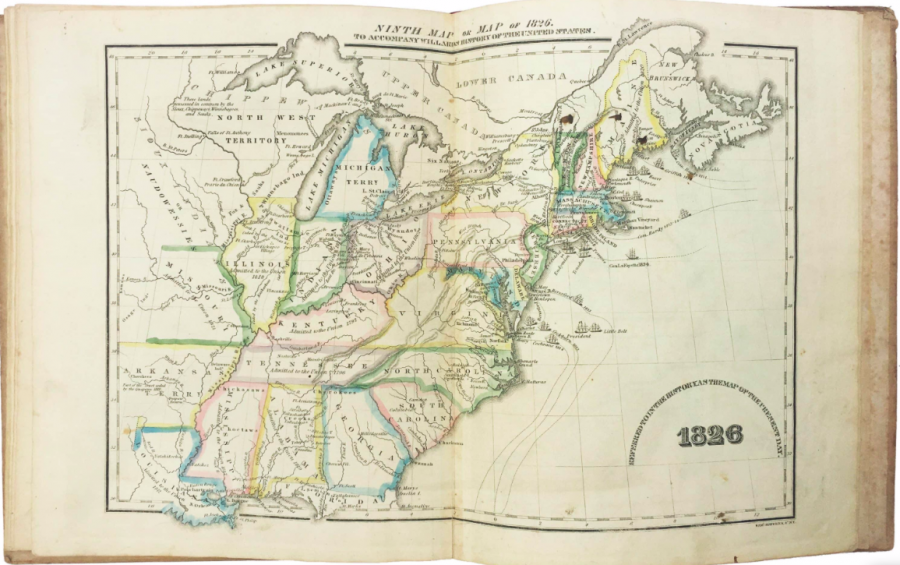
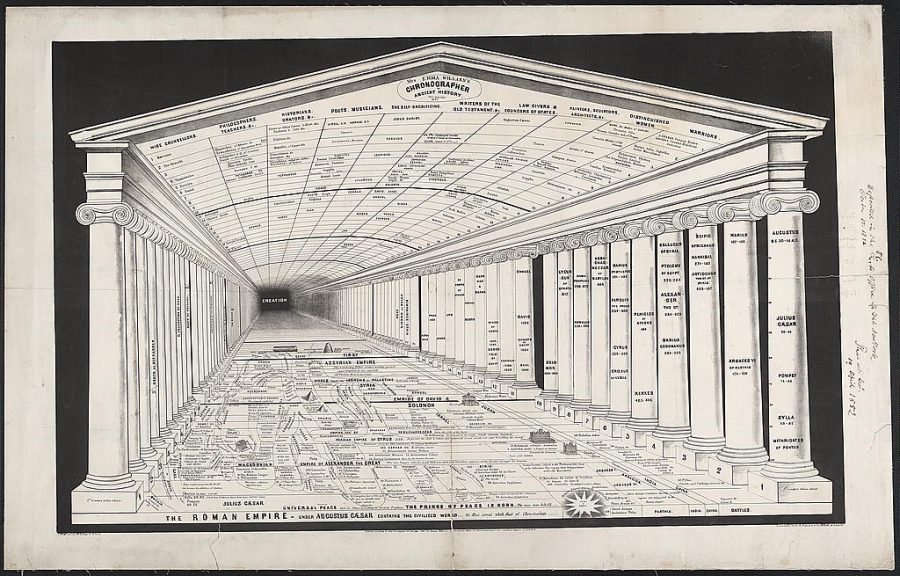
The David Rum­sey Map Col­lec­tion has dig­i­tized and made avail­able to down­load every­thing that came inside, includ­ing the cross-sec­tion of the geo­log­i­cal stra­ta of “pre-Adamite Earth”; the illus­tra­tion of the civ­i­liza­tions of five cli­mat­ic zones “Show­ing in a Graph­ic Man­ner the Cli­mates, Peo­ples, Indus­tries & Pro­duc­tions of The Earth”; the 3D relief map of the Unit­ed States built into the back of the box; and the jew­el in the crown of Yag­gy’s Geo­graph­i­cal Study, the star chart.

The star chart, as Nation­al Geo­graph­ic’s Greg Miller describes it, “has five pan­els held in place by tiny met­al latch­es. Each pan­el can be opened to reveal a more detailed dia­gram. One shows the phas­es of the moon, for exam­ple, while anoth­er includes a slid­er to illus­trate how the posi­tion of the sun changes rel­a­tive to Earth with the sea­sons,” the whole thing “designed to high­light cer­tain fea­tures when a bright light is placed behind it.”

Despite dis­play­ing here and there what we now regard as sci­en­tif­ic inac­cu­ra­cies (Miller points to how the ellip­ti­cal orbit of plan­ets are shown as cir­cles) and unfash­ion­able social atti­tudes, Yag­gy’s Geo­graph­i­cal Study also embod­ies the spir­it of its time in a way that still fires up the imag­i­na­tion. The gold­en age of explo­ration had already entered its final chap­ter and space trav­el remained the stuff of sci­ence fic­tion (a genre that had only recent­ly tak­en the form in which we know it today), but with maps like these on the wall, no day­dream­ing stu­dent of the 1880s could doubt that real­i­ty still offered much to dis­cov­er.

via Flash­bak

Relat­ed Con­tent:

Down­load 67,000 His­toric Maps (in High Res­o­lu­tion) from the Won­der­ful David Rum­sey Map Col­lec­tion

A Plan­e­tary Per­spec­tive: Tril­lions of Pic­tures of the Earth Avail­able Through Google Earth Engine

3D Map of Uni­verse Cap­tures 43,000 Galax­ies

A Mas­sive, Knit­ted Tapes­try of the Galaxy: Soft­ware Engi­neer Hacks a Knit­ting Machine & Cre­ates a Star Map Fea­tur­ing 88 Con­stel­la­tions

How Leonar­do da Vin­ci Drew an Accu­rate Satel­lite Map of an Ital­ian City (1502)

Based in Seoul, Col­in Mar­shall writes and broad­casts on cities, lan­guage, and cul­ture. His projects include the book The State­less City: a Walk through 21st-Cen­tu­ry Los Ange­les and the video series The City in Cin­e­ma. Fol­low him on Twit­ter at @colinmarshall, on Face­book, or on Insta­gram.

« Go BackMore in this category... »
Quantcast