Each generation takes what it needs from early punk and discards what it doesn’t, so that countless subgenres have descended from a small, eccentric collection of punk bands from the late 1970s. The speed and brute simplicity of the Ramones took over in the 80s. The Clash’s strident, reggae-inflected anthems guided much of the 90s. The angular art rock and new wave disco of Television, Talking Heads, and Blondie defined the 2000s.
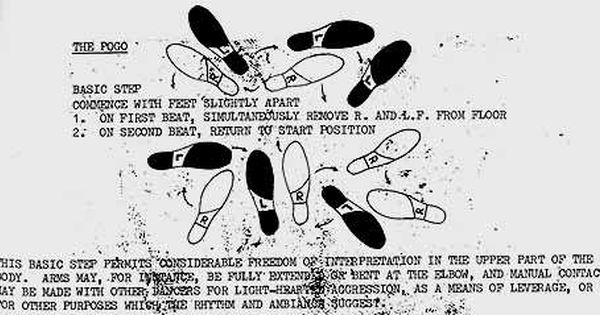
But some things became almost terminally passé, or terminally stupid, after punk’s first wave: like signing to major labels or wearing swastikas, ironically or otherwise. Already out of fashion by 1978, the first punk dance, the pogo, was so tragically unhip that Debbie Harry pronounced it dead on arrival in the U.S. on famed Manhattan cable access show TV Party, above. She offers to demonstrate it anyway as a “historical” artifact.
Her commentary seems like both a sarcastic rip on the ridiculous spread of trends and a genuine warning to those who might try to make this, like, a thing in New York. Don’t bring a creaky pogo stick with you to the club. Do pour beer over your head after a sweaty half-hour of whatever dance you do. There was so much to learn about punk etiquette even then. Unless you happened to be Sid Vicious, or in the audience of the first Sex Pistols shows. Then it was all fair game.
The pogo originated, so the lore goes, with Sid. As Steve Severin of Siouxsie and the Banshees remembers it, “We first met [Sid] at one of the concerts. He began bouncing around the dance floor, the so called legend of the pogo dance. It was merely Sid jumping up and down, trying to see the band, leaping up and down because he was stuck in the back somewhere.” Just as everyone who saw the Sex Pistols started their own band, everyone who saw Sid bounce around started to pogo.
What at first looks like harmless fun, especially compared to the brutal mosh pits that took over for the pogo, was anything but. “Pogoing was very violent and very painful,” one eyewitness remembers. “People were not quite crushed to death, but serious injuries occurred.” We might rethink Men Without Hats’ “The Safety Dance,” the 80s hit written in defense of pogoing. Lead singer Ivan Doroschuk penned the tune after he was kicked out of a club for doing the pogo. “I think people can relate to the empowering kind of message of ‘The Safety Dance,’” he says.
“The Safety Dance” would not have been the empowering worldwide smash it was had it been called “Pogo Dancing,” a minor hit for the Vibrators in 1976. Not nearly as iconic, and overshadowed by a hipper dance of the same name in the 80s, was the robot, elegized by The Saints in “Doing the Robot.” This dance was “both more expressive and less spontaneous,” as cultural theorist Dick Hebdige describes it in Subculture: The Meaning of Style, consisting of “barely perceptible twitches of the head or hands or more extravagant lurches (Frankenstein’s first steps?) which were abruptly halted at random points.” Hardly as practical as the pogo, but probably a lot safer.
First came the album and tour in 2018. Then the Broadway show in 2019. And now the latest incarnation of David Byrne’s American Utopia–the concert film directed by Spike Lee. Debuting on HBO Max on October 17th, this Spike Lee joint shows David Byrne “joined by an ensemble of 11 musicians, singers, and dancers from around the globe, inviting audiences into a joyous dreamworld where human connection, self-evolution, and social justice are paramount.” If the movie is anything like the tour, it will be sublime. For now, we’ll whet your appetite with the sneak preview above.
If you would like to support the mission of Open Culture, consider making a donation to our site. It’s hard to rely 100% on ads, and your contributions will help us continue providing the best free cultural and educational materials to learners everywhere. You can contribute through PayPal, Patreon, and Venmo (@openculture). Thanks!
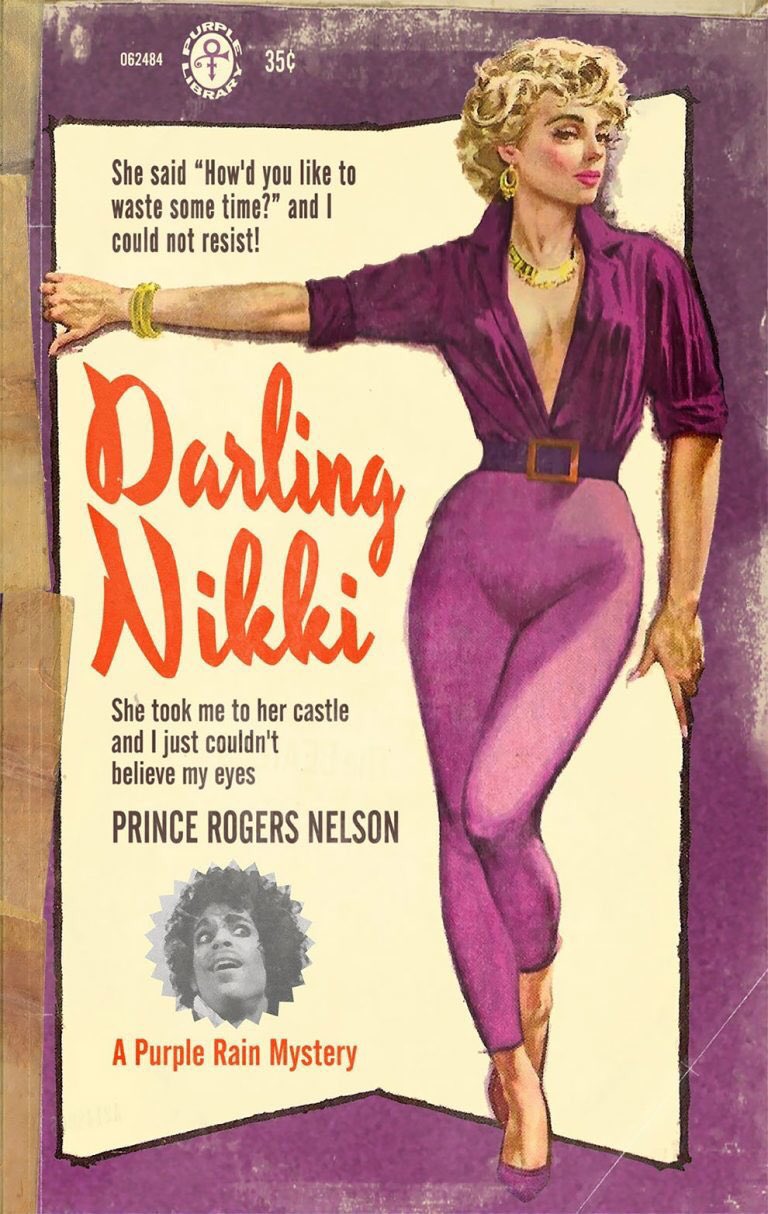
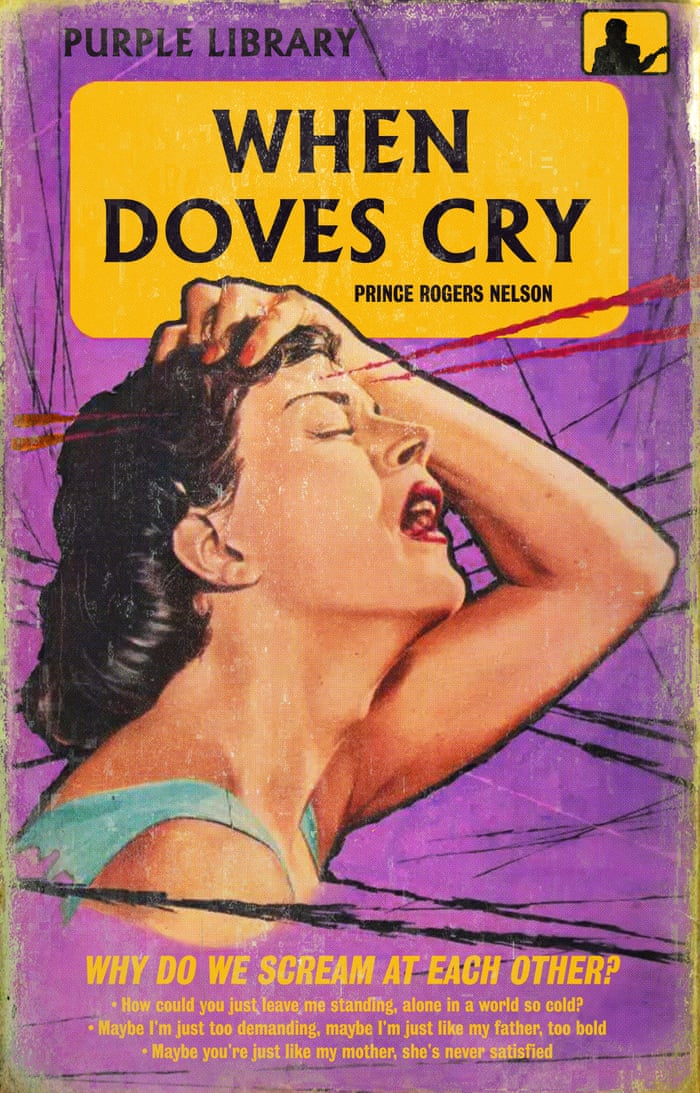
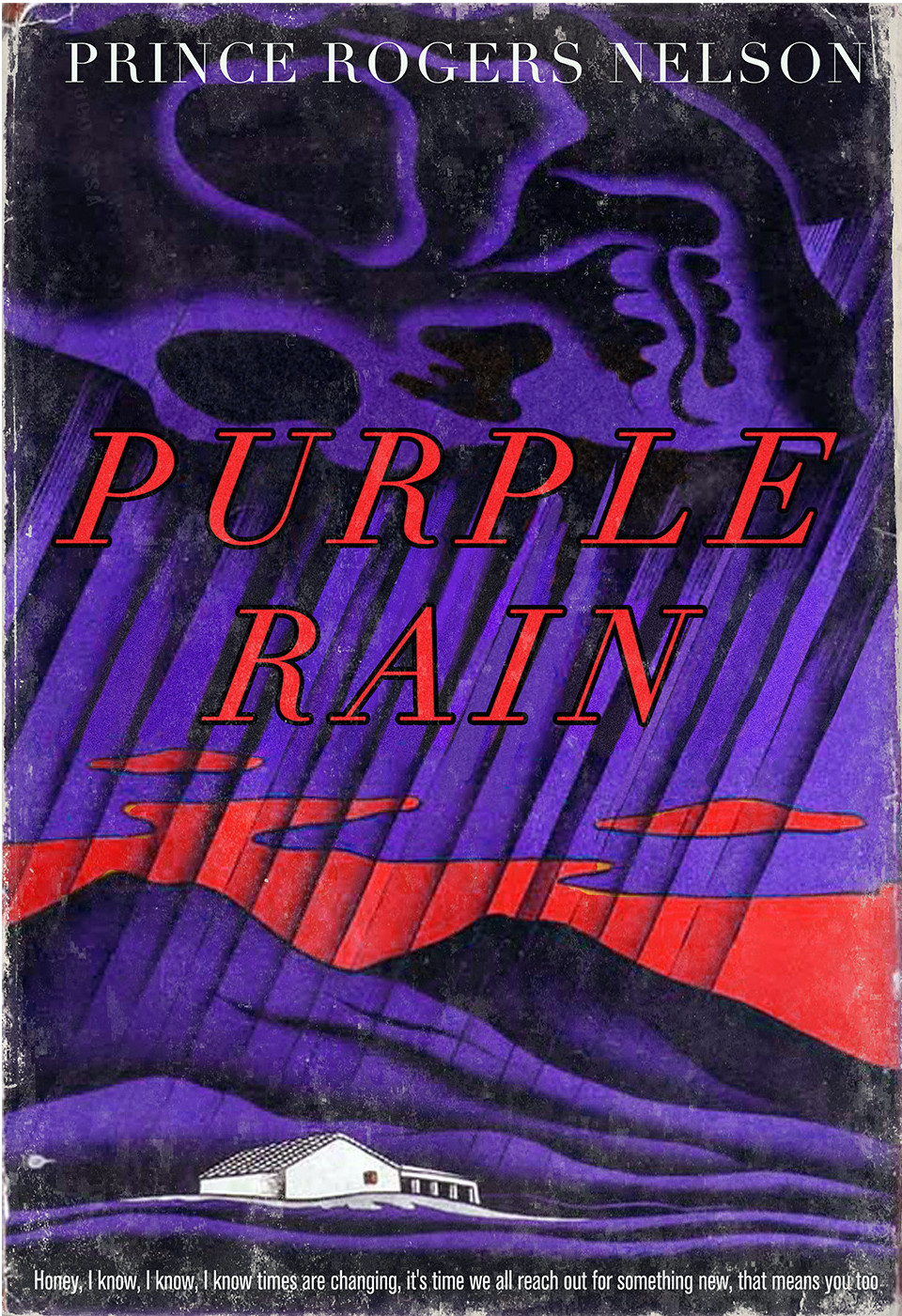
There’s a book-lined Knowledge Room in the late Prince Rogers Nelson’s Paisley Park, but the Prince-inspired faux-books that artist Todd Alcott imagines are probably better suited to the estate’s purple-lit Relaxation Room.
The Knowledge Room was conceived of as a library where the world’s most famous convert to Jehovah’s Witnesses could delve into religious literature, reflect on the meaning of life, and study the Bible deep into the night.
Alcott’s covers harken to an earlier stage in Prince’s evolution—one the star eventually disavowed—as well as several bygone eras of book design.
Alcott’s 1950s pulp novel treatment, above, is similarly graphic. Those skintight purple curves are a promise that even purpler prose lays within, or would, were there any text couched behind that steamy cover.
“When Doves Cry” makes for a pretty purple cover, too. In this case, the inspiration is a 1950s self-help book, enriched with some Freudian taglines from Prince’s own pen. (“Maybe you’re just like my mother, she’s never satisfied.”)
Alcott remembers Prince being “an incredibly liberating figure” when he burst onto the scene:
There was his flamboyant, outrageous sexuality, but also his musical omnivorousness; he played funk, rock, pop, jazz, everything. Purple Rain was the Sergeant Pepper’s of its day, a wall-to-wall brilliant album that everyone could recognize as a remarkable achievement. I remember when I first saw Purple Rain, at the very beginning of the movie, before the movie has even begun, the Warner Bros logo came up and you heard the sound of an expectant crowd, and an announcer says “Ladies and Gentlemen, The Revolution,” and the first shot is of Prince, backlit, silhouetted in purple against a dense mist, and he says “Dearly beloved, we have gathered here today to get through this thing called life.” And I was instantly, incontrovertibly, a fan for life. The confidence of that opening, the sheer audacity of it, adopting the tone of a priest at a wedding, in his Hendrix outfit and hairdo, the sheer gutsiness of that statement, alone, just blew me away. And then he proceeded to play “Let’s Go Crazy” which completely lived up to that opening. After that he could have run Buick ads for the rest of the movie and I’d still be a fan.
Decades later, I was sitting in a Subway restaurant at the end of a very, very long, tiring day, and was feeling completely exhausted and miserable, and out of nowhere, “When Doves Cry” came on the sound system. And I was reminded that the song, which was a huge hit in 1984, the song of the year, had no bass line. The arrangement of it made no sense. It was a song put together by force of will, with its metal guitar and its synth strings and its electronic drums. And in that moment, at the end of a long, tiring day, I was reminded that miracles are possible.
In 2016, Laurie Anderson recreated the experience of Lou Reed’s Metal Machine Music in Saint Mark’s chapel in Brighton. The five-day-long performance piece involved “some eight unmanned guitars leaning on a similar number of vintage amps,” Mark Sheerin writes, all of them cranked up, feeding back, and echoing around the Anglican church’s vaulted ceiling. It was a fitting tribute to Reed, a sustained, dissonant drone that also invokes “the mysteries of faith and the incarnation of rebel angels.”
If five days seems like a long time to hold a single note, however, consider the performance of John Cage’s composition “ORGAN/ASLSP” or “A Slow as Possible” that began in the St. Burchardi church, in the German town of Halberstadt, on September 5th, 2001, what would have been Cage’s 89th birthday. The artists staging this piece intend it to last for 639 years. If the organ doesn’t fall apart and if a new generation of curators continues to take the place of the old, it will play until the year 2640.
Those are some big Ifs, but as long as it lasts, the piece should draw crowds every few years when a chord changes, as just happened recently, despite the pandemic, after the organ had played the same chord for almost 7 years. The change occurred on September 5th, 2020, Cage’s birthday, 19 years after the performance began. Lest we think its length insanely perverse, we should bear in mind that Cage himself never specified a tempo for “As Slow as Possible.” The score itself only “consists of eight pages of music, to be played,” writes Kyle Macdonald at Classic FM, “well, very, very slowly.”
Typically, organists and pianists have interpreted this direction within the space of an hour. Some have stretched single performances “up to, and beyond, 12 hours.” Obviously, no single person, or even team of people, could sustain playing the piece for 233,235 days. Nor, however, has the extreme slowness of the John Cage Organ Project version been made possible by digital means. Instead, a group of artists built a special pipe organ for the task. Each time a chord changes, new pipes are added manually. On Saturday, a masked crowd gathered “to see the G sharp and E notes meticulously installed.”
The organ is automated, by mechanical means. No one needs to sit and hold keys for several years. But can the long-term coordination needed to maintain this solemnly quixotic installation extend over six hundred years for a grand finale in 2640 (IF the organ, the church, and the planet, survive)? The question seems almost irrelevant since no one living can answer it with any degree of certainty. It depends on whether future generations see the St. Buruchardi “As Slow as Possible” as a phenomenon that should continue to exist. But why, we might ask, should it?
Maybe one way of thinking of the John Cage Organ Project is through the lens of the Long Now Project’s 10,000 Year Clock, a device being constructed (“no completion date scheduled”) to radically change humans’ relationship to time, to push us to think beyond—hundreds and thousands of years beyond—our meager lifetimes. Cage, I think, would appreciate the effort to turn his eight page composition into a musical manifestation of the future’s longue durée.
Jazz has often moved forward in seismic shifts, powered by revolutionary figures who make everything that came before them seem quaint by comparison and radiate their influence beyond the jazz world. Perhaps no figure epitomizes such a leap forward more than Charlie Parker. The legendary inventor of bebop, born a little over a century ago, may be the most universally respected and admired musician in jazz, and far beyond.
Kansas City trumpet player Lonnie McFadden, who grew up hearing stories about hometown hero Parker, was told by everyone he met to learn from the master. “Everybody. It was a consensus. All of them said, ‘You got to listen to Bird. You got to listen to Charlie Parker.’” Furthermore, he says, “every tap dancer I know, every jazz musician I know, every rock and blues musician I know honors Charlie Parker.”
Parker has been called “The Greatest Individual Musician Who Ever Lived.” Not just jazz musician, but musician, period, as the PBS Sound Field short introduction above notes, because there had never been one single musician who influenced “all instruments.” Kansas City saxophone player Bobby Watson and archivist Chuck Haddix explain how Parker made such an impact at such a young age, before dying at 34.
Unlike the swing of Benny Goodman or Louis Armstrong, Parker’s bebop is completely non-danceable. He didn’t care. He was not an entertainer, he insisted, but an artist. Jazz might eventually return to danceability in the late 20th century, but the music—and popular music writ large—would never be the same.
The video’s host, LA Buckner gives a brief summary of the evolution of jazz in four regional centers—New Orleans, Chicago, Kansas City, and New York. Parker made a transit through the last three of these cities, eventually ending up on big apple stages. “By 1944,” Jazzwise writes, “the altoist was… making a huge impact on the young Turks hanging out in Harlem, Dizzy Gillespie and Thelonious Monk in particular… no one had ever played saxophone in this manner before, the harmonic, rhythmic and melodic imagination and the emotional intensity proving an overwhelming experience.”
It’s too bad more musicians didn’t listen to Bird when it came to playing high. “Anyone who said they played better when on drugs or booze ‘are liars. I know,’” he said. Heroin and alcohol abuse ended his career prematurely, but perhaps no single instrumental musician since has cast a longer shadow. Jazz critic Stanley Crouch, author of Parker biography Kansas City Lightning: The Rise and Times of Charlie Parker, explains in an interview how Parker created his own mystique.
Parker sometimes gave the impression that he was largely a natural, an innocent into whom the cosmos poured its knowledge while never bothering his consciousness with explanations.
The facts of his development were quite different. He worked for everything he got, and whenever possible, he did that work in association with a master.
Parker was not appreciated at first, either in his hometown of Kansas City or in New York, where “people didn’t like the way he played” when he first arrived in 1939. He responded to criticism with ceaseless practice, learning, and experimentation, an almost superhuman work ethic that probably wasn’t great for his health but has grown into a legend all its own, giving musicians in every form of music a model of dedication, intensity, and fearlessness to strive toward.
Foo Fighter Dave Grohl, formerly of Nirvana, and Nandi Bushell, an Ipswich elementary schooler, have something in common besides their incredible command of the drums.
By all appearances, both seem to have benefited from being reared by grounded, encouraging parents.
Nandi, at 10, likely has a few more years under her folks’ roof despite her growing renown—she’s jammed with Lenny Kravitz, gone viral in last year’s Argos Christmas advert, and most recently, matched Grohl beat for beat in an epic drum battle, above.
Nandi demonstrated a natural rhythmic ear at an early age, bobbing along to the Teletubbies while still in diapers.
Of course, everything she’s achieved thus far can be considered to have occurred at an early age.
On the other hand, it was half a lifetime ago when her father, a software engineer and self-described “massive music fan” introduced the then-5-year-old to “Hey, Jude,” as part of a weekly tradition wherein he makes pancakes with his children while sharing YouTube links to favorite songs.
She was immediately taken with Ringo Starr, and the joy he exuded behind his kit.
Shortly thereafter, she passed a math exam, earning a trip to Toys “R” Us to pick out a promised treat. Her eye went immediately to a £25 kiddie drum set.
The plastic toy was a far cry from the professional kit she uses today, but she’s shown herself to be adaptable in a recent series of video tutorials for Daniel Bedingfield’s “Gonna Get Through This,” encouraging viewers who lack equipment to bang on whatever’s handy—colanders, pot lids, biscuit tins… She recommends kebab skewers tipped with cellophane tape for the stickless.
Her YouTube channel definitely reveals a preference for hard rock.
Her father, John, dislikes playing publicly, but occasionally accompanies her on guitar, hoping she’ll grow accustomed to playing with other people.
Documenting his daughter’s performances lies more within his comfort zone as he told Drum Talk TV in a very glitchy, early-pandemic virtual interview. Asked by host Dan Shinder to share tips for other parents of young drummers, particularly girls, he counsels exposing them to as many musical genres as possible, nurturing their desire to play, and resolving to have as much fun as possible.
It’s clear that Nandi is having a ball twirling her sticks and whaling on the drum part of Foo Fighters’ hit “Everlong,” in a video uploaded last month.
Grohl got wind of the video and the challenge contained therein.
He took the bait, responding with an “epic” video of his own, playing a set of drums borrowed from his 11-year-old daughter:
I haven’t played that song since the day I recorded it in 1997, but Nandi, in the last week I’ve gotten at least 100 texts from people all over the world saying ‘This girl is challenging you to a drum-off, what are you going to do?’
Look, I’ve seen all your videos. I’ve seen you on TV. You’re an incredible drummer. I’m really flattered that you picked some of my songs… and you’ve done them all perfectly. So today, I’m gonna give you something you may not have heard before. This is a song called “Dead End Friends” from a band called Them Crooked Vultures… now the ball is in your court.
(Fast forward to the final thirty seconds if you want to see the ultimate in happy dances.)
The young challenger calls upon the rock Gods of old—Bonzo, Baker, Peart, Moon—to back her side for “THE GREATEST ROCK BATTLE IN THE HISTORY OF ROCK!!!”
(In addition to drum lessons, and participation in the Ipswich Rock Project and junior jam sessions, it looks like her acting classes at Stagecoach Performing Arts Ipswich are so paying off.)
Five days after Grohl threw down his gauntlet, she’s back on her drum throne, clad in a preteen version of Grohl’s buffalo check shirt and black pants, her snare bearing the legend “Grohl rocks.”
A born entertainer in his mother’s opinion, Grohl didn’t take up music until he was around the age Nandi is now, after which it monopolized his focus and energy, leading to a disastrous 6th grade report card.
Rather than freaking out about general education dips, Virginia, a public school teacher, was supportive when the opportunity arose for him to tour Europe at 17 with the Washington, DC band Scream after the departure of drummer Kent Stax.
Wise move. Her son may be a high school drop-out, but he’s using his fame to shine a spotlight on the concerns of teachers, who are essential workers in his view. Check out his essay in The Atlantic, in which he writes that he wouldn’t trust the U.S. Secretary of Percussion to tell him how to play “Smells Like Teen Spirit” if they had never sat behind a drum set:
It takes a certain kind of person to devote their life to this difficult and often-thankless job. I know because I was raised in a community of them. I have mowed their lawns, painted their apartments, even babysat their children, and I’m convinced that they are as essential as any other essential workers. Some even raise rock stars! Tom Morello of Rage Against the Machine, Adam Levine, Josh Groban, and Haim are all children of school workers (with hopefully more academically rewarding results than mine).
He’s also leaving time in his schedule for another drum battle:
Ok, @Nandi_Bushell .…..you win round one.…but it ain’t over yet! Buckle up, cuz I have something special in mind…
There are so many origin stories of punk that no single history can count as definitive. But there’s also no disputing its roots in the New York poetry scene from which Patti Smith emerged in the 1960s and 70s. She learned from Allen Ginsberg and William S. Burroughs, and Gregory Corso and Sam Shepherd inspired the poetry/rock hybrid that would become the music of Horses.
Corso, who called himself a “punk debauche” in his 1960 poem “1959,” lived up to the label. He would heckle poets “during their listless performances,” writes Kembrew McLeod in Downtown Pop Underground, “yelling, ‘Shit! Shit! No blood! Get a transfusion!’ Sitting at Corso’s side,” during poetry readings hosted by the Poetry Project at St. Mark’s Church, “Smith made a mental note not to be boring.”
She followed her friend Sam Shepard’s advice to add music to her first public reading and called guitar player Lenny Kaye to accompany her. “It was primarily a solo poetry reading,” McLeod writes, “with occasional guitar accompaniment.” The 1971 appearance, which you can hear in the recording above, set the tone for almost all of her subsequent performances for the next several decades.
“We did ‘Mack the Knife,” Kaye recalls, “because it was Bertolt Brecht’s birthday, and then I came back for the last three musical pieces. I hesitate to call them ‘songs,’ but in a sense they were the essence of what we would pursue.” Oddly, that year also marked the first usage of “punk” to describe a style of music, though it was applied to the garage rock of ? and the Mysterians, not to Smith and Kaye’s music. She herself has said she didn’t consider what they were doing to be “punk” at all.
This doesn’t much matter. It was attitude and the energy Smith translated from St. Marks to the CBGBs scene that secures her “Godmother” status. She was impressed, as she says above, by Jim Morrison and Jimi Hendrix. She was also impressed by a 1971 essay written by Andrew Wylie, who published her first book after her St. Mark’s reading. “Living as we were in an extremely violent, fragile time,” Smith’s Unauthorized Biographyrecounts, “[Wylie] was drawn to short, almost amputated works.” He concluded that “just to be alive in such times was an act of violence.”
Punk poetry, or whatever we want to call it, was born in a church on St. Mark’s Place in New York City in 1971. From then on, whatever other strains came together to make punk rock, Smith’s channeling of Corso, Shepard, Burroughs, Morrison, etc., backed by Kaye’s steady guitar work, has resonated through the music into the present.
Trauma is repetition, and the United States seems to inflict and suffer from the same deep wounds, repeatedly, unable to stop, like one of the ancient Biblical curses of which Bob Dylan was so fond. The Dylan of the early 1960s adopted the voice of a prophet, in various registers, to tell stories of judgment and generational curses, symbolic and historical, that have beset the country from its beginnings.
The verses of “Blowin’ in the Wind,” from 1963’s The Freewheelin’ Bob Dylan, enact this repetition, both traumatic and hypnotic. In its dual refrains—“how many times…?” and “the answer is blowin’ in the wind” (ephemeral, impossible to grasp)—the song cycles between earnest Lamentations and the acute, world-weary resignation of Ecclesiastes. “This ambiguity is one reason for the song’s broad appeal,” as Peter Dreier writes at Dissent.
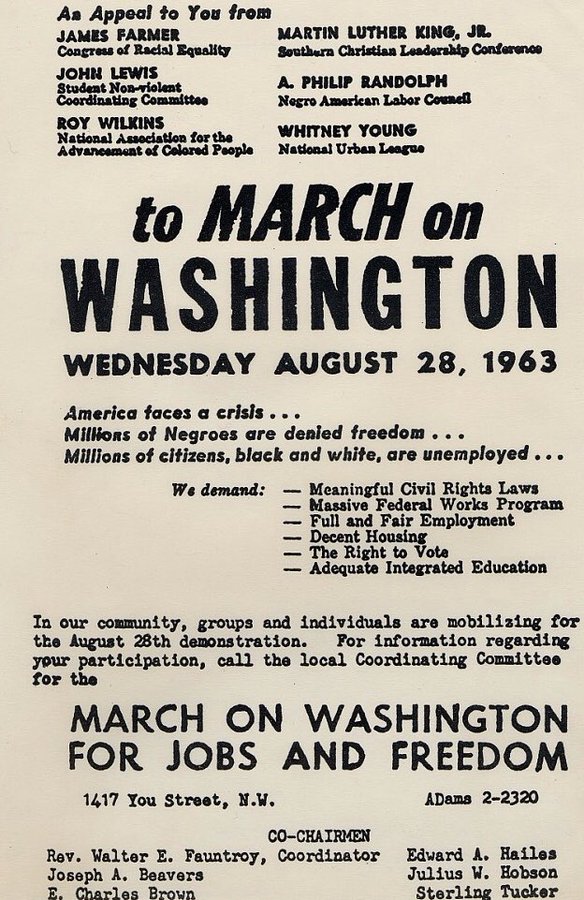
Just three months after its release, when Dylan performed at the March on Washington for Jobs and Freedom on August 28, 1963, “Blowin’ in the Wind” had become a massive civil rights anthem. But he had already ceded the song to Peter, Paul & Mary, who played their version that day. Dylan ignored his sophomore album entirely to play songs from the upcoming The Times They Are a‑Changing—songs that stand out for their indictments of the U.S. in some very specific terms.
Dylan played three songs from the new album: “When the Ship Comes In” with Joan Baez, “Only a Pawn in Their Game,” and “With God on Our Side.” (He also played the popular folk song “Keep Your Eyes on the Prize.”) In contrast to his vaguely allusive popular anthems, “Only a Pawn in Their Game”—about the murder of Medgar Evers—isn’t coy about the culprits and their crimes. We might say the song offers an astute analysis of institutional racism, white supremacy, and stochastic terrorism.
A bullet from the back of a bush
Took Medgar Evers’ blood
A finger fired the trigger to his name
A handle hid out in the dark
A hand set the spark
Two eyes took the aim
Behind a man’s brain
But he can’t be blamed
He’s only a pawn in their game
A South politician preaches to the poor white man
“You got more than the blacks, don’t complain
You’re better than them, you been born with white skin, ” they explain
And the Negro’s name
Is used, it is plain
For the politician’s gain
As he rises to fame
And the poor white remains
On the caboose of the train
But it ain’t him to blame
He’s only a pawn in their game
The deputy sheriffs, the soldiers, the governors get paid
And the marshals and cops get the same
But the poor white man’s used in the hands of them all like a tool
He’s taught in his school
From the start by the rule
That the laws are with him
To protect his white skin
To keep up his hate
So he never thinks straight
‘Bout the shape that he’s in
But it ain’t him to blame
He’s only a pawn in their game
From the poverty shacks, he looks from the cracks to the tracks
And the hoofbeats pound in his brain
And he’s taught how to walk in a pack
Shoot in the back
With his fist in a clinch
To hang and to lynch
To hide ‘neath the hood
To kill with no pain
Like a dog on a chain
He ain’t got no name
But it ain’t him to blame
He’s only a pawn in their game
Today, Medgar Evers was buried from the bullet he caught
They lowered him down as a king
But when the shadowy sun sets on the one
That fired the gun
He’ll see by his grave
On the stone that remains
Carved next to his name
His epitaph plain
Only a pawn in their game
These lyrics have far too much relevance to current events, and they’re indicative of the changing tone of Dylan’s muse. His refrains drip with irony. The killer of Medgar Evers “can’t be blamed”—an evasion of responsibility that becomes a powerful force all its own.
Dylan revisits the themes of generational trauma and murder in “With God on Our Side” (hear him sing it with Baez at Newport, above). The song is a sharp satire of his historical education, with its inevitable repetitions of war and slaughter. Here, Dylan presents the exponentially gross, existentially dreadful, consequences of a national abdication of blame for historical violence.
Oh my name it ain’t nothin’
My age it means less
The country I come from
Is called the Midwest
I was taught and brought up there
The laws to abide
And that land that I live in
Has God on its side
Oh, the history books tell it
They tell it so well
The cavalries charged
The Indians fell
The cavalries charged
The Indians died
Oh, the country was young
With God on its side
The Spanish-American
War had its day
And the Civil War, too
Was soon laid away
And the names of the heroes
I was made to memorize
With guns in their hands
And God on their side
The First World War, boys
It came and it went
The reason for fighting
I never did get
But I learned to accept it
Accept it with pride
For you don’t count the dead
When God’s on your side
The Second World War
Came to an end
We forgave the Germans
And then we were friends
Though they murdered six million
In the ovens they fried
The Germans now, too
Have God on their side
I’ve learned to hate the Russians
All through my whole life
If another war comes
It’s them we must fight
To hate them and fear them
To run and to hide
And accept it all bravely
With God on my side
But now we got weapons
Of chemical dust
If fire them, we’re forced to
Then fire, them we must
One push of the button
And a shot the world wide
And you never ask questions
When God’s on your side
Through many a dark hour
I’ve been thinkin’ about this
That Jesus Christ was
Betrayed by a kiss
But I can’t think for you
You’ll have to decide
Whether Judas Iscariot
Had God on his side.
So now as I’m leavin’
I’m weary as Hell
The confusion I’m feelin’
Ain’t no tongue can tell
The words fill my head
And fall to the floor
That if God’s on our side
He’ll stop the next war
Dylan’s race/class analysis in “Only a Pawn in the Game” and his succinct People’s History of Christian Nationalism in “With God on Our Side” stand out as interesting choices for the March for several reasons. For one thing, it’s as though he had written these songs expressly to take the political, economic, and religious mechanisms and mythologies of racism apart. This was radical speech in an event that was policed by its organizers to tone down inflammatory rhetoric for the cameras.
23-year-old John Lewis, for example, was forced to temper his speech, in which he meant to say, “We will march through the South, through the heart of Dixie, the way Sherman did. We shall pursue our own scorched earth policy and burn Jim Crow to the ground — nonviolently.… the revolution is at hand, and we must free ourselves of the chains of political and economic slavery.” As a popular white artist, rather than a potentially seditious Black organizer, Dylan had far more license and could “use his privilege,” as they say, to describe the systems of political and economic oppression Lewis had wanted to name.
Dylan’s performance was one of a handful of memorable musical appearances. Most of the singers made a far bigger impression, like Mahalia Jackson, Marian Anderson, and Baez herself, whose “We Shall Overcome” created a legendary moment of harmony. No one sang along to Dylan’s new songs—they wouldn’t have known the words. But Dylan was never careless. He chose these words for the moment, hoping to have some impact in the only way he could.
The 1963 March’s purpose has been overshadowed by a few passages in Martin Luther King, Jr.‘s powerful “I Have a Dream” speech, co-opted by everyone and reduced to meme-able quotes. But the protest “remains one of the most successful mobilizations ever created by the American Left,” historian William P. Jones writes. “Organized by a coalition of trade unionists, civil rights activists, and feminists–most of them African American and nearly all of them socialists.”
Dylan sang stories of how the country got to where it was, through a history of violence still playing out before the marchers’ eyes. Whatever political tensions there were among the various organizers and speakers did not distract them from pushing through the 1964 Civil Rights Act and the Fair Employment Practices clause banning discrimination on the basis of race, religion, national origin, or sex—protections that have been broadened since that time, and also challenged, threatened, and stripped away.
Fifty-seven years later, as the RNC convention ends and another March on Washington happens, we might reflect on Dylan’s small but prescient contributions in 1963, in which he aptly characterized the traumatic repetitions we’re still convulsively experiencing over half a century later.
We're hoping to rely on loyal readers, rather than erratic ads. Please click the Donate button and support Open Culture. You can use Paypal, Venmo, Patreon, even Crypto! We thank you!
Open Culture scours the web for the best educational media. We find the free courses and audio books you need, the language lessons & educational videos you want, and plenty of enlightenment in between.