Take an Intellectual Odyssey with a Free MIT Course on Douglas Hofstadter’s Pulitzer Prize-Winning Book Gödel, Escher, Bach: An Eternal Golden Braid

In 1979, math­e­mati­cian Kurt Gödel, artist M.C. Esch­er, and com­pos­er J.S. Bach walked into a book title, and you may well know the rest. Dou­glas R. Hof­s­tadter won a Pulitzer Prize for Gödel, Esch­er, Bach: an Eter­nal Gold­en Braid, his first book, thence­forth (and hence­forth) known as GEB. The extra­or­di­nary work is not a trea­tise on math­e­mat­ics, art, or music, but an essay on cog­ni­tion through an explo­ration of all three — and of for­mal sys­tems, recur­sion, self-ref­er­ence, arti­fi­cial intel­li­gence, etc. Its pub­lish­er set­tled on the pithy descrip­tion, “a metaphor­i­cal fugue on minds and machines in the spir­it of Lewis Car­roll.”

GEB attempt­ed to reveal the mind at work; the minds of extra­or­di­nary indi­vid­u­als, for sure, but also all human minds, which behave in sim­i­lar­ly unfath­omable ways. One might also describe the book as oper­at­ing in the spir­it — and the prac­tice — of Her­man Hesse’s Glass Bead Game, a nov­el Hesse wrote in response to the data-dri­ven machi­na­tions of fas­cism and their threat to an intel­lec­tu­al tra­di­tion he held par­tic­u­lar­ly dear. An alter­nate title (and key phrase in the book) Mag­is­ter Ludi, puns on both “game” and “school,” and alludes to the impor­tance of play and free asso­ci­a­tion in the life of the mind.

Hesse’s eso­teric game, writes his biog­ra­ph­er Ralph Freed­man, con­sists of “con­tem­pla­tion, the secrets of the Chi­nese I Ching and West­ern math­e­mat­ics and music” and seems sim­i­lar enough to Hof­s­tadter’s approach and that of the instruc­tors of MIT’s open course, Gödel, Esch­er, Bach: A Men­tal Space Odyssey. Offered through the High School Stud­ies Pro­gram as a non-cred­it enrich­ment course, it promis­es “an intel­lec­tu­al vaca­tion” through “Zen Bud­dhism, Log­ic, Meta­math­e­mat­ics, Com­put­er Sci­ence, Arti­fi­cial Intel­li­gence, Recur­sion, Com­plex Sys­tems, Con­scious­ness, Music and Art.”

Stu­dents will not study direct­ly the work of Gödel, Esch­er, and Bach but rather “find their spir­its aboard our men­tal ship,” the course descrip­tion notes, through con­tem­pla­tions of canons, fugues, strange loops, and tan­gled hier­ar­chies. How do mean­ing and form arise in sys­tems like math and music? What is the rela­tion­ship of fig­ure to ground in art? “Can recur­sion explain cre­ativ­i­ty,” as one of the course notes asks. Hof­s­tadter him­self has pur­sued the ques­tion beyond the entrench­ment of AI research in big data and brute force machine learn­ing. For all his daunt­ing eru­di­tion and chal­leng­ing syn­the­ses, we must remem­ber that he is play­ing a high­ly intel­lec­tu­al game, one that repli­cates his own expe­ri­ence of think­ing.

Hof­s­tadter sug­gests that before we can under­stand intel­li­gence, we must first under­stand cre­ativ­i­ty. It may reveal its secrets in com­par­a­tive analy­ses of the high­est forms of intel­lec­tu­al play, where we see the clever for­mal rules that gov­ern the mind’s oper­a­tions; the blind alleys that explain its fail­ures and lim­i­ta­tions; and the pos­si­bil­i­ty of ever actu­al­ly repro­duc­ing work­ings in a machine. Watch the lec­tures above, grab a copy of Hofstadter’s book, and find course notes, read­ings, and oth­er resources for the fas­ci­nat­ing course Gödel, Esch­er, Bach: A Men­tal Space Odyssey archived here. The course will be added to our list, 1,700 Free Online Cours­es from Top Uni­ver­si­ties.

Relat­ed Con­tent: 

How a Bach Canon Works. Bril­liant.

Math­e­mat­ics Made Vis­i­ble: The Extra­or­di­nary Math­e­mat­i­cal Art of M.C. Esch­er

The Mir­ror­ing Mind: An Espres­so-Fueled Inter­pre­ta­tion of Dou­glas Hofstadter’s Ground­break­ing Ideas

Josh Jones is a writer and musi­cian based in Durham, NC. Fol­low him at @jdmagness

Are We All Getting More Depressed?: A New Study Analyzing 14 Million Books, Written Over 160 Years, Finds the Language of Depression Steadily Rising


The rela­tions between thought, lan­guage, and mood have become sub­jects of study for sev­er­al sci­en­tif­ic fields of late. Some of the con­clu­sions seem to echo reli­gious notions from mil­len­nia ago. “As a man thin­keth, so he is,” for exam­ple, pro­claims a famous verse in Proverbs (one that helped spawn a self-help move­ment in 1903). Pos­i­tive psy­chol­o­gy might agree. “All that we are is the result of what we have thought,” says one trans­la­tion of the Bud­dhist Dhamma­pa­da, a sen­ti­ment that cog­ni­tive behav­ioral ther­a­py might endorse.

But the insights of these tra­di­tions — and of social psy­chol­o­gy — also show that we’re embed­ded in webs of con­nec­tion: we don’t only think alone; we think — and talk and write and read — with oth­ers. Exter­nal cir­cum­stances influ­ence mood as well as inter­nal states of mind. Approach­ing these ques­tions dif­fer­ent­ly, researchers at the Lud­dy School of Infor­mat­ics, Com­put­ing, and Engi­neer­ing at Indi­ana Uni­ver­si­ty asked, “Can entire soci­eties become more or less depressed over time?,” and is it pos­si­ble to read col­lec­tive changes in mood in the writ­ten lan­guages of the past cen­tu­ry or so?

The team of sci­en­tists, led by Johan Bollen, Indi­ana Uni­ver­si­ty pro­fes­sor of infor­mat­ics and com­put­ing, took a nov­el approach that brings togeth­er tools from at least two fields: large-scale data analy­sis and cog­ni­tive-behav­ioral ther­a­py (CBT). Since diag­nos­tic cri­te­ria for mea­sur­ing depres­sion have only been around for the past 40 years, the ques­tion seemed to resist lon­gi­tu­di­nal study. But CBT pro­vid­ed a means of ana­lyz­ing lan­guage for mark­ers of “cog­ni­tive dis­tor­tions” — think­ing that skews in over­ly neg­a­tive ways. “Lan­guage is close­ly inter­twined with this dynam­ic” of thought and mood, the researchers write in their study, “His­tor­i­cal lan­guage records reveal a surge of cog­ni­tive dis­tor­tions in recent decades,” pub­lished just last month in PNAS.

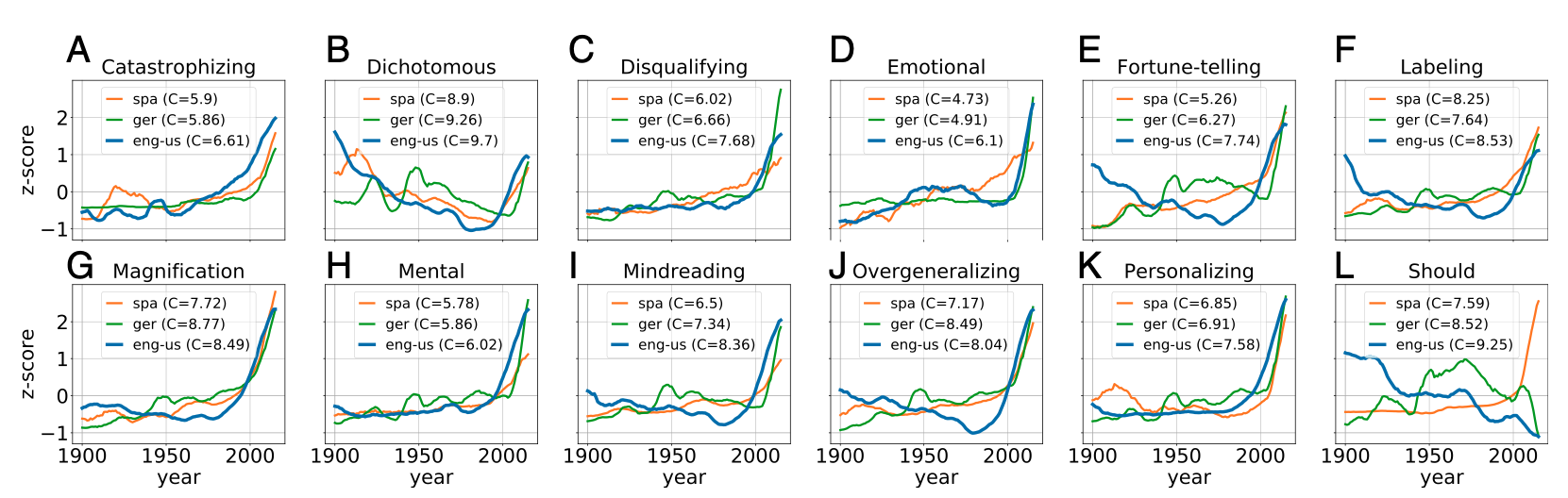
Choos­ing three lan­guages, Eng­lish (US), Ger­man, and Span­ish, the team looked for “short sequences of one to five words (n‑grams), labeled cog­ni­tive dis­tor­tion schema­ta (CDS).” These words and phras­es express neg­a­tive thought process­es like “cat­a­stro­phiz­ing,” “dichoto­mous rea­son­ing,” “dis­qual­i­fy­ing the pos­i­tive,” etc. Then, the researchers iden­ti­fied the preva­lence of such lan­guage in a col­lec­tion of over 14 mil­lion books pub­lished between 1855 and 2019 and uploaded to Google Books. The study con­trolled for lan­guage and syn­tax changes dur­ing that time and account­ed for the increase in tech­ni­cal and non-fic­tion books pub­lished (though it did not dis­tin­guish between lit­er­ary gen­res).

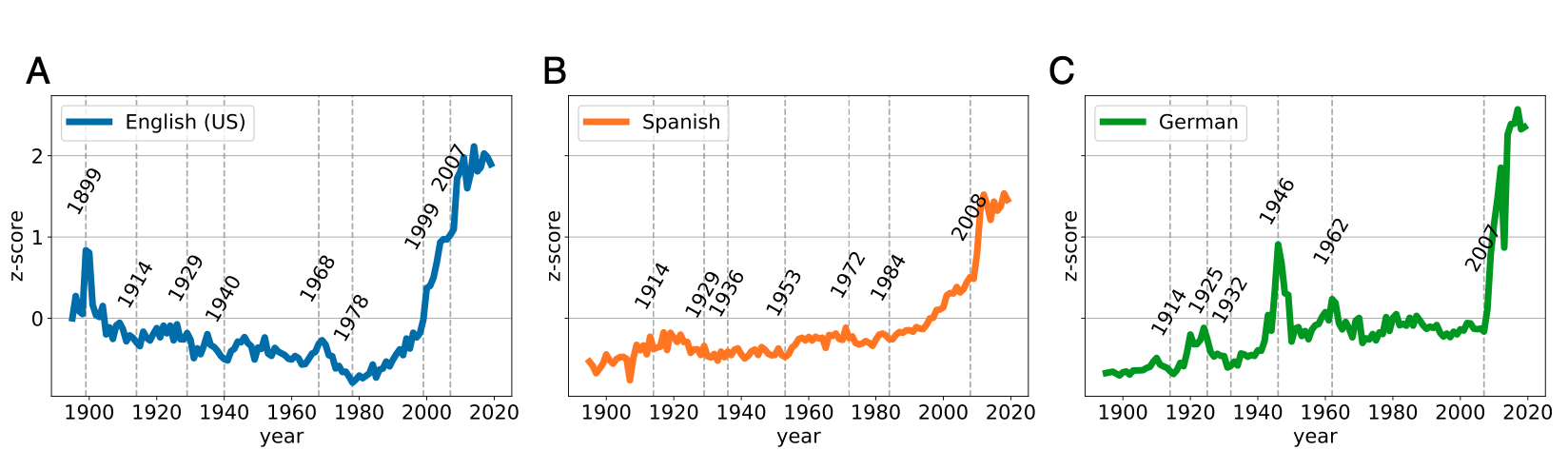
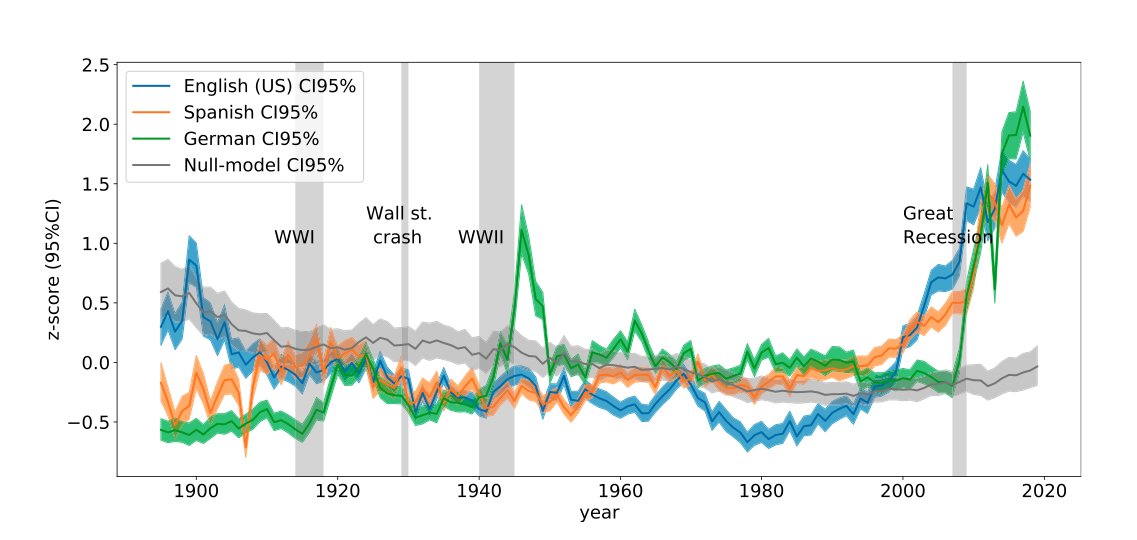
What the sci­en­tists found in all three lan­guages was a dis­tinc­tive “‘hock­ey stick’ pat­tern” — a sharp uptick in the lan­guage of depres­sion after 1980 and into the present time. The only spikes that come close on the time­line occur in Eng­lish lan­guage books dur­ing the Gild­ed Age and books pub­lished in Ger­man dur­ing and imme­di­ate­ly after World War II. (High­ly inter­est­ing, if unsur­pris­ing, find­ings.) Why the sud­den, steep climb in lan­guage sig­ni­fy­ing depres­sive think­ing? Does it actu­al­ly mark a col­lec­tive shift in mood, or show how his­tor­i­cal­ly oppressed groups have had more access to pub­lish­ing in the past forty years, and have expressed less sat­is­fac­tion with the sta­tus quo?

While they are care­ful to empha­size that they “make no causal claims” in the study, the researchers have some ideas about what’s hap­pened, observ­ing for exam­ple:

The US surge in CDS preva­lence coin­cides with the late 1970s when wages stopped track­ing increas­ing work pro­duc­tiv­i­ty. This trend was asso­ci­at­ed with ris­es in income inequal­i­ty to recent lev­els not seen since the 1930s. This phe­nom­e­non has been observed for most devel­oped economies, includ­ing Ger­many, Spain and Latin Amer­i­ca.

Oth­er fac­tors cit­ed include the devel­op­ment of the World Wide Web and its facil­i­ta­tion of polit­i­cal polar­iza­tion, “in par­tic­u­lar us-vs.-them think­ing… dichoto­mous rea­son­ing,” and oth­er mal­adap­tive thought pat­terns that accom­pa­ny depres­sion. The scale of these devel­op­ments might be enough to explain a major col­lec­tive rise in depres­sion, but one com­menter offers an addi­tion­al gloss:

The globe is *Lit­er­al­ly* on fire, or his­tor­i­cal­ly flood­ing — Mul­ti­ple eco­nom­ic crash­es bare­ly decades apart — a ghost town of a hous­ing mar­ket — a mul­ti-year glob­al pan­dem­ic — wealth con­cen­tra­tion at the .01% lev­el — ter­ri­ble pay/COL equa­tions — block­ing unionization/workers rights — abu­sive mil­i­ta­rized police, with­out the restraint or train­ing of actu­al mil­i­tary —  You can’t afford X for a month­ly mort­gage pay­ment!  Pay 1.5x for rent instead! — end­less wars for the last… 30…years? 50 if we include stuff like Korea, Cold War, Viet­nam… How far has the IMC been milk­ing the gov for funds to make the rich rich­er? Oh, and a bil­lion­aire 3‑way space race to deter­mine who’s got the biggest “rock­et”

These sound like rea­sons for glob­al depres­sion indeed, but the arrow could also go the oth­er way: maybe cat­a­stroph­ic rea­son­ing pro­duced actu­al cat­a­stro­phes; black and white think­ing led to end­less wars, etc…. More study is need­ed, says Bollen and his col­leagues, yet it seems prob­a­ble, giv­en the data, that “large pop­u­la­tions are increas­ing­ly stressed by per­va­sive cul­tur­al, eco­nom­ic, and social changes” — changes occur­ring more rapid­ly, fre­quent­ly, and with greater impact on our dai­ly lives than ever before. Read the full study at PNAS

Relat­ed Con­tent: 

Stanford’s Robert Sapol­sky Demys­ti­fies Depres­sion, Which, Like Dia­betes, Is Root­ed in Biol­o­gy

A Uni­fied The­o­ry of Men­tal Ill­ness: How Every­thing from Addic­tion to Depres­sion Can Be Explained by the Con­cept of “Cap­ture”

Charles Bukows­ki Explains How to Beat Depres­sion: Spend 3–4 Days in Bed and You’ll Get the Juices Flow­ing Again (NSFW)

Josh Jones is a writer and musi­cian based in Durham, NC. Fol­low him at @jdmagness

B.F. Skinner Demonstrates His “Teaching Machine,” the 1950s Automated Learning Device

The name B.F. Skin­ner often pro­vokes dark­ly humor­ous ref­er­ences to such bizarre ideas as “Skin­ner box­es,” which put babies in cage-like cribs, and put the cribs in win­dows as if they were air-con­di­tion­ers, leav­ing the poor infants to raise them­selves. Skin­ner was hard­ly alone in con­duct­ing exper­i­ments that flout­ed, if not fla­grant­ly ignored, the eth­i­cal con­cerns now cen­tral to exper­i­men­ta­tion on humans. The code of con­duct on tor­ture and abuse that osten­si­bly gov­erns mem­bers of the Amer­i­can Psy­cho­log­i­cal Asso­ci­a­tion did not exist. Rad­i­cal behav­ior­ists like Skin­ner were redefin­ing the field. His work has come to stand for some of its worst abus­es.

But Skin­ner has been mis­char­ac­ter­ized in the pop­u­lar­iza­tion of his ideas — a pop­u­lar­iza­tion, it’s true, in which he enthu­si­as­ti­cal­ly took part. The actu­al “Skin­ner box” was cru­el enough — an elec­tri­fied cage for ani­mal exper­i­men­ta­tion — but it was not the infant win­dow box that often goes by the name. This was, instead, called an “air­crib” or “baby-ten­der,” and it was loaded with crea­ture com­forts like cli­mate con­trol and a com­ple­ment of toys. “In our com­part­ment,” Skin­ner wrote in a 1945 Ladies Home Jour­nal arti­cle, “the wak­ing hours are invari­ably active and hap­py ones.” Describ­ing his first test sub­ject, his own child, he wrote, “our baby acquit­ted an amus­ing, almost ape­like skill in the use of her feet.”

Skin­ner was not a soul­less mon­ster who put babies in cages, but he also did not under­stand mam­malian babies’ need for phys­i­cal touch. Like­wise, when it came to edu­ca­tion, Skin­ner had ideas that can seem con­trary to what we know works best, name­ly a vari­ety of meth­ods that hon­or dif­fer­ent learn­ing styles and abil­i­ties. Edu­ca­tors in the 1950s embraced far more reg­i­ment­ed prac­tices, and Skin­ner believed humans could be trained just like oth­er ani­mals. He treat­ed an ear­ly exper­i­ment in class­room tech­nol­o­gy just like an exper­i­ment teach­ing pigeons to play ping-pong. It was, in fact, “the foun­da­tion for his edu­ca­tion tech­nol­o­gy,” says edu­ca­tion jour­nal­ist Audrey Wat­ters, “that we’ll build machines and they’ll give stu­dents — just like pigeons — pos­i­tive rein­force­ment and stu­dents — just like pigeons — will learn new skills.”

To this end, Skin­ner cre­at­ed what he called the Teach­ing Machine in 1954 while he taught psy­chol­o­gy at Har­vard. He was hard­ly the first to design such a device, but he was the first to invent a machine based on behav­ior­ist prin­ci­ples, as Abhishek Solan­ki explains in a Medi­um arti­cle:

The teach­ing machine was com­posed of main­ly a pro­gram, which was a sys­tem of com­bined teach­ing and test items that car­ried the stu­dent grad­u­al­ly through the mate­r­i­al to be learned. The “machine” was com­posed of a fill-in-the-blank method on either a work­book or on a com­put­er. If the stu­dent was cor­rect, he/she got rein­force­ment and moved on to the next ques­tion. If the answer was incor­rect, the stu­dent stud­ied the cor­rect answer to increas­ing the chances of get­ting rein­forced next time.

Con­sist­ing of a wood­en box, a met­al lid with cutouts, and var­i­ous paper discs with ques­tions and answers writ­ten on them, the machine did adjust for dif­fer­ent stu­dents’ needs, in a way. Skin­ner “not­ed that the learn­ing process should be divid­ed into a large num­ber of very small steps and rein­force­ment must be depen­dent upon the com­ple­tion of each step. He believed this was the best pos­si­ble arrange­ment for learn­ing because it took into account the rate of learn­ing for each indi­vid­ual stu­dent.” He was again inspired by his own chil­dren, com­ing up with the machine after vis­it­ing his daugh­ter’s school and decid­ing he could improve on things.

The method and means of learn­ing, as you’ll see in the demon­stra­tion films above, were not indi­vid­u­al­ized. “There was very, very lit­tle free­dom in Skin­ner’s vision,” says Wat­ters. “Indeed Skin­ner wrote a very well-known book, Beyond Free­dom and Dig­ni­ty in the ear­ly 1970s, in which he said free­dom does­n’t exist.” While Skin­ner’s machine did­n’t itself become wide­ly used, his ideas about edu­ca­tion, and edu­ca­tion tech­nol­o­gy, are still very much with us. We see Skin­ner’s machine “tak­ing new forms with adap­tive teach­ing and e‑learning,” writes Solan­ki.

And we see the dark­er side of his design in class­room tech­nol­o­gy, says Wat­ters, in an indus­try that prof­its from alien­at­ing, one-size-fits all ed-tech solu­tions. But she also sees “stu­dents who are resist­ing and com­mu­ni­ties who are build­ing prac­tices that serve their needs rather than serv­ing the needs of engi­neers.” Skin­ner’s the­o­ries of con­di­tion­ing were and are incred­i­bly per­sua­sive, but his reduc­tive views of human nature seem to leave out more than they explain. Learn more about the his­to­ry of teach­ing machines in Wat­ters’ new book, Teach­ing Machines: The His­to­ry of Per­son­al­ized Learn­ing.

Relat­ed Con­tent: 

The Lit­tle Albert Exper­i­ment: The Per­verse 1920 Study That Made a Baby Afraid of San­ta Claus & Bun­nies

Her­mann Rorschach’s Orig­i­nal Rorschach Test: What Do You See? (1921)

A Brief Ani­mat­ed Intro­duc­tion to Noam Chomsky’s Lin­guis­tic The­o­ry, Nar­rat­ed by The X‑Files‘ Gillian Ander­son

Josh Jones is a writer and musi­cian based in Durham, NC. Fol­low him at @jdmagness

Moralities of Everyday Life: A Free Online Course from Yale University

How can we explain kind­ness and cru­el­ty? Where does our sense of right and wrong come from? Why do peo­ple so often dis­agree about moral issues? This course from Yale Uni­ver­si­ty, Moral­i­ties of Every­day Life, explores the psy­cho­log­i­cal foun­da­tions of our moral lives. Taught by psy­chol­o­gy & cog­ni­tive sci­ence pro­fes­sor Paul Bloom, the course focus­es on the ori­gins of moral­i­ty, com­pas­sion, how culture/religion influ­ence moral thought and moral action, and beyond. If you select the “Audit” option, you can take the course for free.

Moral­i­ties of Every­day Life will be added to our col­lec­tion of Free Psy­chol­o­gy Cours­es, a sub­set of our larg­er col­lec­tion, 1,700 Free Online Cours­es from Top Uni­ver­si­ties.

If you would like to sign up for Open Culture’s free email newslet­ter, please find it here. It’s a great way to see our new posts, all bun­dled in one email, each day.

If you would like to sup­port the mis­sion of Open Cul­ture, con­sid­er mak­ing a dona­tion to our site. It’s hard to rely 100% on ads, and your con­tri­bu­tions will help us con­tin­ue pro­vid­ing the best free cul­tur­al and edu­ca­tion­al mate­ri­als to learn­ers every­where. You can con­tribute through Pay­Pal, Patre­on, and Ven­mo (@openculture). Thanks!

Relat­ed Con­tent:

Intro­duc­tion to Psy­chol­o­gy: A Free Course from Yale Uni­ver­si­ty

Pos­i­tive Psy­chol­o­gy: A Free Online Course from Har­vard Uni­ver­si­ty

A Crash Course on Psy­chol­o­gy: A 30-Part Video Series from Hank Green

The Rashomon Effect: The Phenomenon, Named After Akira Kurosawa’s Classic Film, Where Each of Us Remembers the Same Event Differently

Toward the end of The Simp­sons’ gold­en age, one episode sent the tit­u­lar fam­i­ly off to Japan, not with­out resis­tance from its famous­ly lazy patri­arch. “Come on, Homer,” Marge insists, “Japan will be fun! You liked Rashomon.” To which Homer nat­u­ral­ly replies, “That’s not how I remem­ber it!” This joke must have writ­ten itself, not as a high-mid­dle­brow cul­tur­al ref­er­ence (as, say, Frasi­er would lat­er name-check Tam­popo) but as a play on a uni­ver­sal­ly under­stood byword for the nature of human mem­o­ry. Even those of us who’ve nev­er seen Rashomon, the peri­od crime dra­ma that made its direc­tor Aki­ra Kuro­sawa a house­hold name in the West, know what its title rep­re­sents: the ten­den­cy of each human being to remem­ber the same event in his own way.

“A samu­rai is found dead in a qui­et bam­boo grove,” says the nar­ra­tor of the ani­mat­ed TED-Ed les­son above. “One by one, the crime’s only known wit­ness­es recount their ver­sion of the events that tran­spired. But as they each tell their tale, it becomes clear that every tes­ti­mo­ny is plau­si­ble, yet dif­fer­ent, and each wit­ness impli­cates them­selves.”

So goes “In a Grove,” a sto­ry by cel­e­brat­ed ear­ly 20th-cen­tu­ry writer Ryūno­suke Aku­ta­gawa. An avid read­er, Kuro­sawa com­bined that lit­er­ary work with anoth­er of Aku­ta­gawa’s to cre­ate the script for Rashomon. Both Aku­ta­gawa and Kuro­sawa “use the tools of their media to give each char­ac­ter’s tes­ti­mo­ny equal weight, trans­form­ing each wit­ness into an unre­li­able nar­ra­tor.” Nei­ther read­er nor view­er can trust any­one — nor, ulti­mate­ly, can they arrive at a defen­si­ble con­clu­sion as to the iden­ti­ty of the killer.

Such con­flicts of mem­o­ry and per­cep­tion occur every­where in human affairs: this TED-Ed les­son finds exam­ples in biol­o­gy, anthro­pol­o­gy, pol­i­tics, and media. Suf­fi­cient­ly many psy­cho­log­i­cal phe­nom­e­na con­verge to give rise to the Rashomon effect that it seems almost overde­ter­mined; it may be more illu­mi­nat­ing to ask under what con­di­tions does­n’t it occur. But it also makes us ask even tougher ques­tions: “What is truth, any­way? Are there sit­u­a­tions when an objec­tive truth does­n’t exist? What can dif­fer­ent ver­sions of the same event tell us about the time, place, and peo­ple involved? And how can we make group deci­sions if we’re all work­ing with dif­fer­ent infor­ma­tion, back­grounds, and bias­es?” We seem to be no clos­er to defin­i­tive answers than we were when Rashomon came out more than 70 years ago — only one of the rea­sons the film holds up so well still today.

Relat­ed Con­tent:

Why Time Seems to Fly By As You Get Old­er, and How to Slow It Down: A Sci­en­tif­ic Expla­na­tion by Neu­ro­sci­en­tist David Eagle­man

How to Improve Your Mem­o­ry: Four TED Talks Explain the Tech­niques to Remem­ber Any­thing

How Did Aki­ra Kuro­sawa Make Such Pow­er­ful & Endur­ing Films? A Wealth of Video Essays Break Down His Cin­e­mat­ic Genius

What Is Déjà Vu? Michio Kaku Won­ders If It’s Trig­gered by Par­al­lel Uni­vers­es

Based in Seoul, Col­in Mar­shall writes and broad­casts on cities, lan­guage, and cul­ture. His projects include the Sub­stack newslet­ter Books on Cities, the book The State­less City: a Walk through 21st-Cen­tu­ry Los Ange­les and the video series The City in Cin­e­ma. Fol­low him on Twit­ter at @colinmarshall or on Face­book.

The Psychology of Video Game Engagement — Pretty Much Pop: A Culture Podcast #94 with Jamie Madigan

Why do peo­ple play video games, and what keeps them play­ing? Do we want to have to think through inno­v­a­tive puz­zles or just lose our­selves in mind­less reac­tiv­i­ty? Your hosts Mark Lin­sen­may­er, Eri­ca Spyres, and Bri­an Hirt are joined by Dr. Jamie Madi­gan, an orga­ni­za­tion­al psy­chol­o­gist who runs the Psy­chol­o­gy of Video Games pod­cast, to dis­cuss what sort of a thing this is to research, the evo­lu­tion of games, play­er types, moti­va­tion vs. engage­ment, incen­tives and feed­back, as well as the gam­i­fi­ca­tion of work or school envi­ron­ments. Some games we touch on include Don­key Kong, Dark Souls, It Takes Two, Retur­nal, Hades, Sub­nau­ti­ca, Fort­nite, and Age of Z.

Some of the episodes of Jamie’s pod­cast rel­e­vant for our dis­cus­sion are:

Check out his books and arti­cles too. Here are a cou­ple of addi­tion­al sources about engage­ment:

The site Eri­ca men­tions about dis­abled modes in gam­ing is caniplaythat.com.

Hear more of this pod­cast at prettymuchpop.com. This episode includes bonus dis­cus­sion that you can access by sup­port­ing the pod­cast at patreon.com/prettymuchpop. This pod­cast is part of the Par­tial­ly Exam­ined Life pod­cast net­work.

Pret­ty Much Pop: A Cul­ture Pod­cast is the first pod­cast curat­ed by Open Cul­ture. Browse all Pret­ty Much Pop posts.

Ray Dalio & Adam Grant Launch Free Online Personality Assessment to Help You Understand Yourself (and Others Understand You)

Back in 2017, Ray Dalio pub­lished Prin­ci­ples: Life and Work, a best­selling book where the cre­ator of the world’s largest hedge fund shared “the uncon­ven­tion­al prin­ci­ples that he’s devel­oped, refined, and used over the past forty years to cre­ate unique results in both life and busi­ness.” You can find a dis­tilled ver­sion of those uncon­ven­tion­al prin­ci­ples in a 30-minute ani­ma­tion video pre­vi­ous­ly fea­tured on our site.

To accom­pa­ny his book, Dalio has now released, along with Uni­ver­si­ty of Penn­syl­va­nia orga­ni­za­tion­al psy­chol­o­gist Adam Grant, a free per­son­al­i­ty assess­ment tool called Prin­ci­plesY­ou. The assess­ment takes about 30 to 40 min­utes to com­plete, and we would strong­ly encour­age you to sign up for an account before you get start­ed, so that you can save the results of the assess­ment after­wards. Oth­er­wise you will lose the results.

Accord­ing to psy­chol­o­gist Bri­an Lit­tle, “Prin­ci­plesY­ou was devel­oped over a two-year inten­sive and cre­ative R&D process with two goals in mind. First, it mea­sures traits that Ray Dalio and his team have observed and stud­ied for many years as crit­i­cal for per­son­al and orga­ni­za­tion­al suc­cess. Sec­ond, it is based on the lat­est research in per­son­al­i­ty sci­ence. The assess­ment pro­vides a person’s score on a com­pre­hen­sive set of traits, their under­ly­ing facets and inter­ac­tive pat­terns, and it has high reli­a­bil­i­ty, inter­nal struc­ture, re-test reli­a­bil­i­ty and valid­i­ty of these traits and facets. A dis­tinc­tive strength is its abil­i­ty to pre­dict an extra­or­di­nary array of actu­al behav­iors observed by the Bridge­wa­ter staff over many years.”

Adam Grant adds: “To achieve suc­cess, you need to know your­self and the peo­ple around you. Although your car comes with an owner’s man­u­al, your mind doesn’t—and nei­ther do your col­leagues. We designed Prin­ci­plesY­ou to help you gain the self-aware­ness and oth­er-aware­ness that are crit­i­cal to mak­ing good deci­sions, get­ting things done, and turn­ing a group of cowork­ers into a great team.”

You can watch Grant and Dalio dis­cuss Prin­ci­plesY­ou above. You can lis­ten to Grant fea­ture Dalio’s insights on his Work Life pod­cast here. And final­ly you can start the free per­son­al­i­ty assess­ment here.

Relat­ed Con­tent:

Free Online Psy­chol­o­gy & Neu­ro­science Cours­es

The Prin­ci­ples for Suc­cess by Entre­pre­neur & Investor Ray Dalio: A 30-Minute Ani­mat­ed Primer

Eco­nom­ics 101: Hedge Fund Investor Ray Dalio Explains How the Econ­o­my Works in a 30-Minute Ani­mat­ed Video

How to Raise Cre­ative Chil­dren Who Can Change the World: 3 Lessons from Whar­ton Pro­fes­sor Adam Grant


by | Permalink | Make a Comment ( 1 ) |

What Are the Real Causes of Zoom Fatigue? And What Are the Possible Solutions?: New Research from Stanford Offers Answers

The tech­nol­o­gy we put between our­selves and oth­ers tends to always cre­ate addi­tion­al strains on com­mu­ni­ca­tion, even as it enables near-con­stant, instant con­tact. When it comes to our now-pri­ma­ry mode of inter­act­ing — star­ing at each oth­er as talk­ing heads or Brady Bunch-style gal­leries — those stress­es have been iden­ti­fied by com­mu­ni­ca­tion experts as “Zoom fatigue,” now a sub­ject of study among psy­chol­o­gists who want to under­stand our always-con­nect­ed-but-most­ly-iso­lat­ed lives in the pan­dem­ic, and a top­ic for Today show seg­ments like the one above.

As Stan­ford researcher Jere­my Bailen­son vivid­ly explains to Today, Zoom fatigue refers to the burnout we expe­ri­ence from inter­act­ing with dozens of peo­ple for hours a day, months on end, through pret­ty much any video con­fer­enc­ing plat­form. (But, let’s face it, most­ly Zoom.) We may be famil­iar with the symp­toms already if we spend some part of our day on video calls or lessons. Zoom fatigue com­bines the prob­lems of over­work and tech­no­log­i­cal over­stim­u­la­tion with unique forms of social exhaus­tion that do not plague us in the office or the class­room.

Bailen­son, direc­tor of Stan­ford University’s Vir­tu­al Human Inter­ac­tion Lab, refers to this kind of burnout as “Non­ver­bal Over­load,” a col­lec­tion of “psy­cho­log­i­cal con­se­quences” from pro­longed peri­ods of dis­em­bod­ied con­ver­sa­tion. He has been study­ing vir­tu­al com­mu­ni­ca­tion for two decades and began writ­ing about the cur­rent prob­lem in April of 2020 in a Wall Street Jour­nal op-ed that warned, “soft­ware like Zoom was designed to do online work, and the tools that increase pro­duc­tiv­i­ty weren’t meant to mim­ic nor­mal social inter­ac­tion.”

Now, in a new schol­ar­ly arti­cle pub­lished in the APA jour­nal Tech­nol­o­gy, Mind, and Behav­ior, Bailen­son elab­o­rates on the argu­ment with a focus on Zoom, not to “vil­i­fy the com­pa­ny,” he writes, but because “it has become the default plat­form for many in acad­e­mia” (and every­where else, per­haps its own form of exhaus­tion). The con­stituents of non­ver­bal over­load include gaz­ing into each oth­ers’ eyes at close prox­im­i­ty for long peri­ods of time, even when we aren’t speak­ing to each oth­er.

Any­one who speaks for a liv­ing under­stands the inten­si­ty of being stared at for hours at a time. Even when speak­ers see vir­tu­al faces instead of real ones, research has shown that being stared at while speak­ing caus­es phys­i­o­log­i­cal arousal (Takac et al., 2019). But Zoom’s inter­face design con­stant­ly beams faces to every­one, regard­less of who is speak­ing. From a per­cep­tu­al stand­point, Zoom effec­tive­ly trans­forms lis­ten­ers into speak­ers and smoth­ers every­one with eye gaze.

On Zoom, we also have to expend much more ener­gy to send and inter­pret non­ver­bal cues, and with­out the con­text of the room out­side the screen, we are more apt to mis­in­ter­pret them. Depend­ing on the size of our screen, we may be star­ing at each oth­er as larg­er-than-life talk­ing heads, a dis­ori­ent­ing expe­ri­ence for the brain and one that lends more impact to facial expres­sions than may be war­rant­ed, cre­at­ing a false sense of inti­ma­cy and urgency. “When someone’s face is that close to ours in real life,” writes Vig­nesh Ramachan­dran at Stan­ford News, “our brains inter­pret it as an intense sit­u­a­tion that is either going to lead to mat­ing or to con­flict.”

Unless we turn off the view of our­selves on the screen — which we gen­er­al­ly don’t do because we’re con­scious of being stared at — we are also essen­tial­ly sit­ting in front of a mir­ror while try­ing to focus on oth­ers. The con­stant self-eval­u­a­tion adds an addi­tion­al lay­er of stress and tax­es the brain’s resources. In face-to-face inter­ac­tions, we can let our eyes wan­der, even move around the room and do oth­er things while we talk to peo­ple. “There’s a grow­ing research now that says when peo­ple are mov­ing, they’re per­form­ing bet­ter cog­ni­tive­ly,” says Bailen­son. Zoom inter­ac­tions, con­verse­ly, can inhib­it move­ment for long peri­ods of time.

“Zoom fatigue” may not be as dire as it sounds, but rather the inevitable tri­als of a tran­si­tion­al peri­od, Bailen­son sug­gests. He offers solu­tions we can imple­ment now: using the “hide self-view” but­ton, mut­ing our video reg­u­lar­ly, set­ting up the tech­nol­o­gy so that we can fid­get, doo­dle, and get up and move around.… Not all of these are going to work for every­one — we are, after all, social­ized to sit and stare at each oth­er on Zoom; refus­ing to par­tic­i­pate might send unin­tend­ed mes­sages we would have to expend more ener­gy to cor­rect. Bailen­son fur­ther describes the phe­nom­e­non in the BBC Busi­ness Dai­ly pod­cast inter­view above.

“Video­con­fer­enc­ing is here to stay,” Bailen­son admits, and we’ll have to adapt. “As media psy­chol­o­gists it is our job,” he writes to his col­leagues in the new arti­cle, to help “users devel­op bet­ter use prac­tices” and help “tech­nol­o­gists build bet­ter inter­faces.” He most­ly leaves it to the tech­nol­o­gists to imag­ine what those are, though we our­selves have more con­trol over the plat­form than we col­lec­tive­ly acknowl­edge. Could we maybe admit, Bailen­son writes, that “per­haps a dri­ver of Zoom fatigue is sim­ply that we are tak­ing more meet­ings than we would be doing face-to-face”?

Read about the “Zoom Exhaus­tion & Fatigue Scale (ZEF Scale)” devel­oped by Bailen­son and his col­leagues at Stan­ford and the Uni­ver­si­ty of Gothen­burg here. Then take the sur­vey your­self, and see where you rank in the ZEF cat­e­gories of gen­er­al fatigue, visu­al fatigue, social fatigue, moti­va­tion­al fatigue, and emo­tion­al fatigue.

Relat­ed Con­tent: 

How Infor­ma­tion Over­load Robs Us of Our Cre­ativ­i­ty: What the Sci­en­tif­ic Research Shows

In 1896, a French Car­toon­ist Pre­dict­ed Our Social­ly-Dis­tanced Zoom Hol­i­day Gath­er­ings

Hayao Miyazaki’s Stu­dio Ghi­b­li Releas­es Free Back­grounds for Vir­tu­al Meet­ings: Princess Mononoke, Spir­it­ed Away & More

Josh Jones is a writer and musi­cian based in Durham, NC. Fol­low him at @jdmagness

« Go BackMore in this category... »
Quantcast