Today marks the 50th anniversary of the premiere of Star Trek, and the start of a love affair between fans and the show’s utopian promise. With only 79 episodes over three seasons in the original 1966–1969 series, it might have disappeared into pop culture history. Instead, it has lived long and prospered, with movies and sequels and New Generations, and reboots and more sequels. And that’s not counting the labor-of-love fan films that have spawned around the fringes.
Now, fan-created films usually fall down in the acting and effects department, or they try too hard. But even if you’re not a dedicated Trekkie, the independently-produced Star Trek Continues holds up as some great sci-fi that recreates the original series’ look to perfection, while skirting parody. (Plus it got the blessing of series creator Gene Roddenberry’s son, who said his father “would consider this canon.”)
When we first told you about Star Trek Continues in February, five hour-long episodes were viewable on YouTube or the show’s official website, funded through two Kickstarter campaigns and personal moneys from executive producer Vic Mignogna ($150,000) and co-executive producer Steven Dengler ($100,000). Above, you can check out the two new episodes, “Come Not Between the Dragons” (Episode 6) and “Embracing the Winds” (Episode 7). Or watch the entire series, from start to finish, below.
Despite Star Trek Continues’ not-for-profit status, other Star Trek fan films have raised the ire of CBS and Paramount’s legal divisions, and may end up harming the future of such endeavors. But remember, CBS had no faith in the original series back in the day, placing it in later and later time slots. It was syndication that made the show a cult hit, and it was those original fans that lovingly fanned the embers until the show reignited. For them on this half-century mark, they deserve as much a thank you as the original crew of the Starship Enterprise.
Ted Mills is a freelance writer on the arts who currently hosts the artist interview-based FunkZone Podcast. You can also follow him on Twitter at @tedmills, read his other arts writing at tedmills.com and/or watch his films here.
The original Star Trek TV series took to the airwaves nearly 5o years ago–on September 8, 1966. Poor ratings meant that the show didn’t last very long (only three years). But everything changed once the show went into syndication. It achieved cult status. And a franchise was born. The original Star Trek has now spawned five additional tv series, 13 feature films, and a number of fan-made sequels.
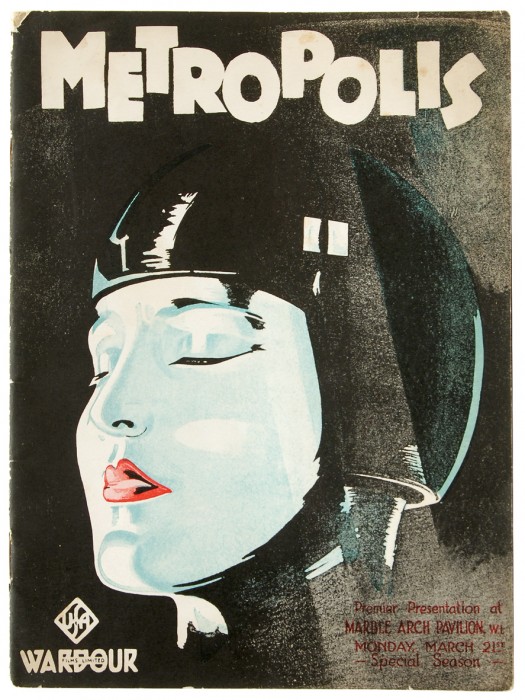
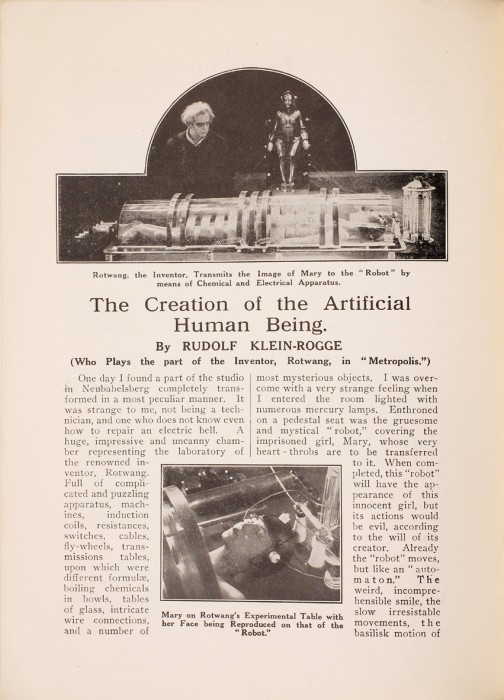
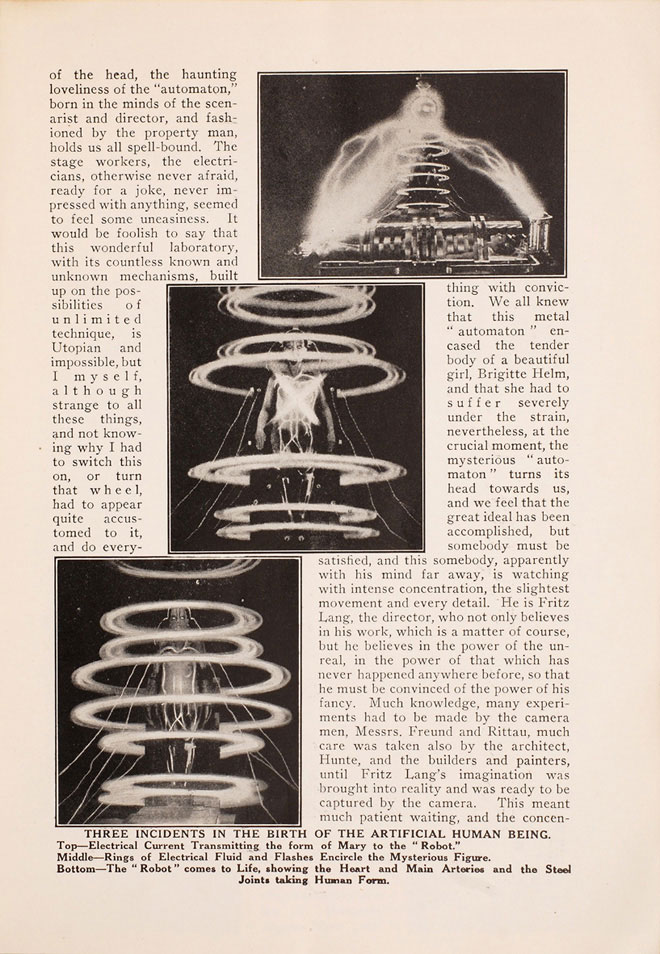
One of the very first feature-length sci-fi films ever made, Fritz Lang’s Metropolis took a daring visual approach for its time, incorporating Bauhaus and Futurist influences in thrillingly designed sets and costumes. Lang’s visual language resonated strongly in later decades. The film’s rather stunning alchemical-electric transference of a woman’s physical traits onto the body of a destructive android—the so-called Maschinenmensch—for example, began a very long trend of female robots in film and television, most of them as dangerous and inscrutable as Lang’s. And yet, for all its many imitators, Metropolis continues to deliver surprises. Here, we bring you a new find: a 32-page program distributed at the film’s 1927 premier in London and recently re-discovered.
In addition to underwriting almost one hundred years of science fiction film and television tropes, Metropolis has had a very long life in other ways: Inspiring an all-star soundtrack produced by Giorgio Moroder in 1984,with Freddie Mercury, Loverboy, and Adam Ant, and a Kraftwerk album. In 2001, a reconstructed version received a screening at the Berlin Film Festival, and UNESCO’s Memory of the World Register added it to their roster. 2002 saw the release of an exceptional Metropolis-inspired anime with the same title. And in 2010 an almost fully restored print of the long-incomplete film—recut from footage found in Argentina in 2008—appeared, adding a little more sophistication and coherence to the simplistic story line.
Even at the film’s initial reception, without any missing footage, critics did not warm to its story. For all its intense visual futurism, it has always seemed like a very quaint, naïve tale, struck through with earnest religiosity and inexplicable archaisms. Contemporary reviewers found its narrative of generational and class conflict unconvincing. H.G. Wells—“something of an authority on science fiction”—pronounced it “the silliest film” full of “every possible foolishness, cliché, platitude, and muddlement about mechanical progress and progress in general served up with a sauce of sentimentality that is all its own.” Few were kinder when it came to the story, and despite its overt religious themes, many saw it as Communist propaganda.
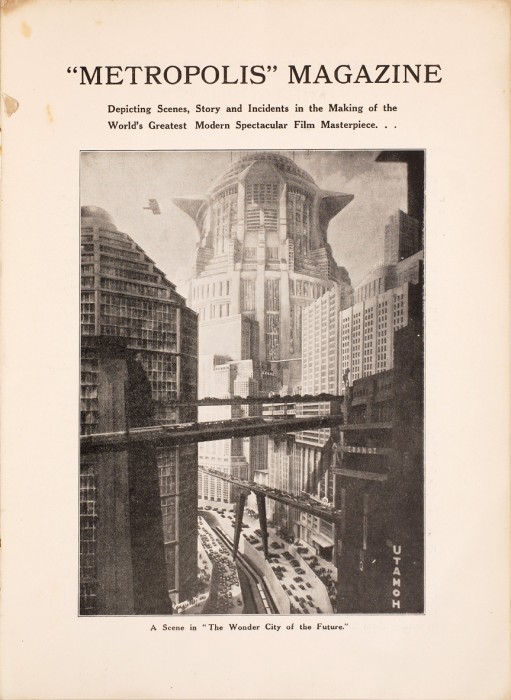
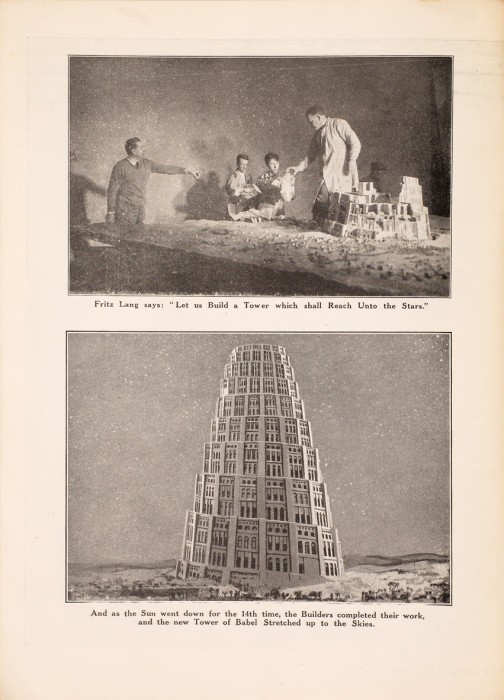
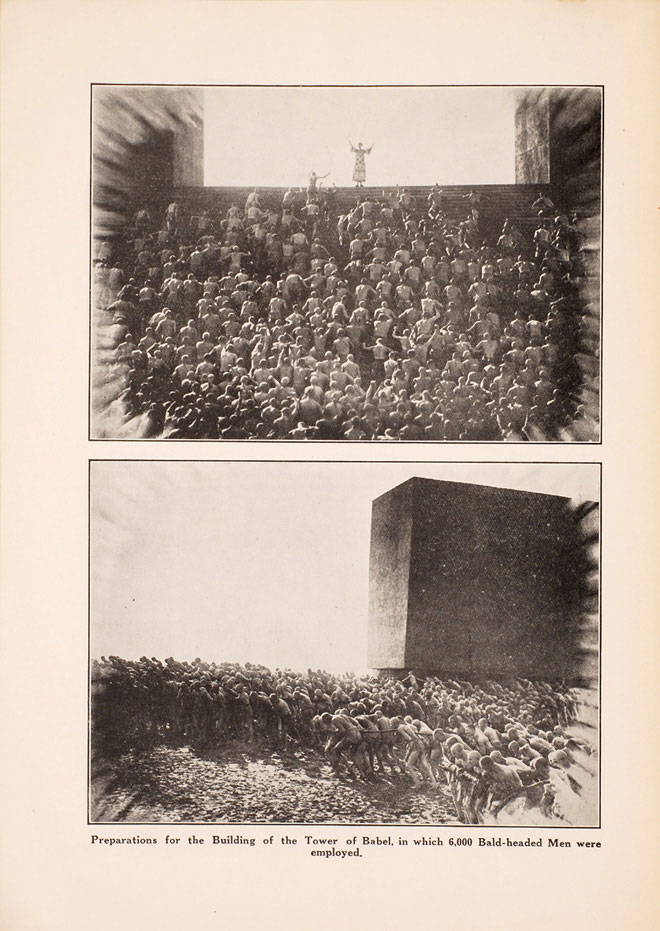
Viewed after subsequent events in 20th century Germany, many of the film’s scenes appear “disturbingly prescient,” writes the Unaffiliated Critic, such as the vision of a huge industrial machine as Moloch, in which “bald, underfed humans are led in chains to a furnace.” Lang and his wife Thea von Harbou—who wrote the novel, then screenplay—were of course commenting on industrialization, labor conditions, and poverty in Weimar Germany. Metropolis’s “clear message of classism,” as io9 writes, comes through most clearly in its arresting imagery, like that horrifying, monstrous furnace and the “looming symbol of wealth in the Tower of Babel.”
The visual effects and spectacular set pieces have worked their magic on almost everyone (Wells excluded) who has seen Metropolis. And they remain, for all its silliness, the primary reason for the movie’s cultural prevalence. Wired calls it “probably the most influential sci-fi movie in history,” remarking that “a single movie poster from the original release sold for $690,000 seven years ago, and is expected to fetch even more at an auction later this year.”
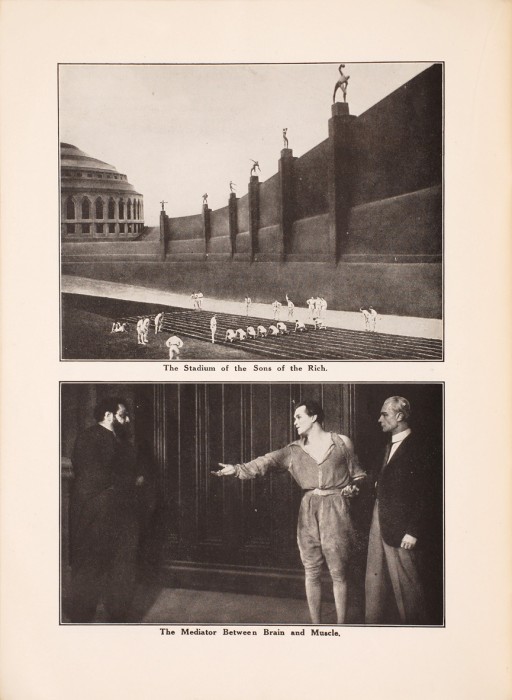
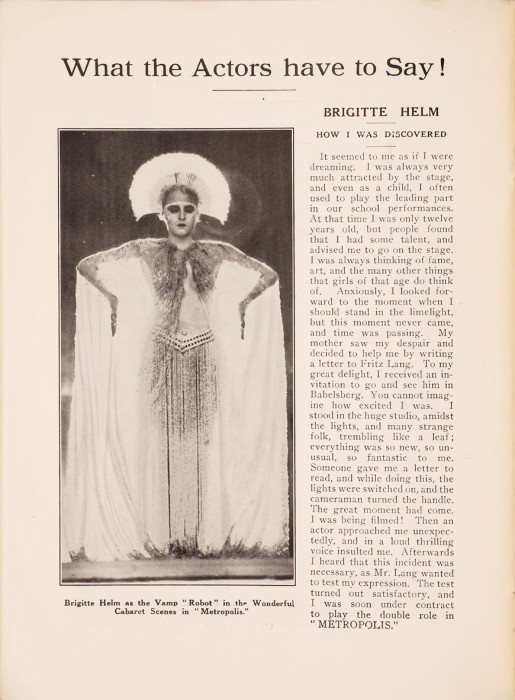
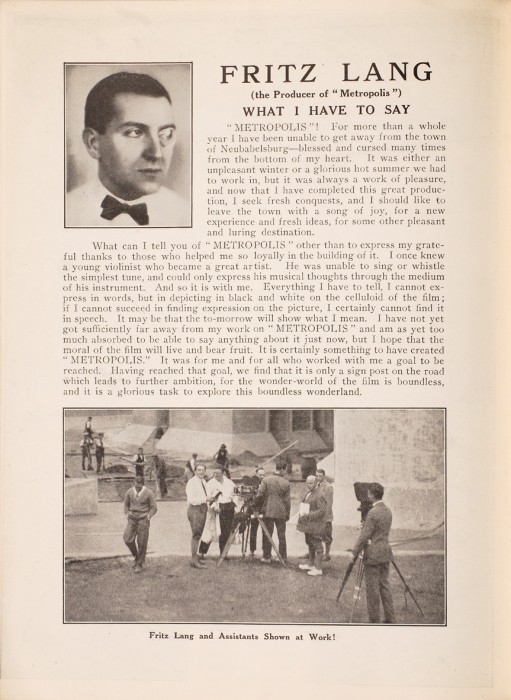
We now have another artifact from the movie’s premiere, this 32-page program, appropriately called “Metropolis” Magazine, that offers a rich feast for audiences, and text at times more interesting than the film’s script. (You can view the program in full here.) One imagines had they possessed backlit smart phones, those early moviegoers might have found themselves struggling not to browse their programs while the film screened. But, of course, Metropolis’s visual excesses would hold their attention as they still do ours. Its scenes of a futuristic city have always enthralled viewers, filmmakers, and (most) critics, such that Roger Ebert could write of “vast futuristic cities” as a staple of some of the best science fiction in his review of the 21st-century animated Metropolis—“visions… goofy and yet at the same time exhilarating.”
The program really is an astonishing document, a treasure for fans of the film and for scholars. Full of production stills, behind-the-scenes articles and photos, technical minutiae, short columns by the actors, a bio of Thea von Harbau, the “authoress,” excerpts from her novel and screenplay placed side-by-side, and a short article by her. There’s a page called “Figures that Speak” that tallies the production costs and cast and crew numbers (including very crude drawings and numbers of “Negroes” and “Chinese”). Lang himself weighs in, laconically, with a breezy introduction followed by a classic silent-era line: “if I cannot succeed in finding expression on the picture, I certainly cannot find it in speech.” Film history agrees, Lang found his expression “on the picture.”
“Only three surviving copies of this program are known to exist,” writes Wired, and one of them, from which these pages come, has gone on sale at the Peter Harrington rare book shop for 2,750 pounds ($4,244)—which seems rather low, given what an original Metropolis poster went for. But markets are fickle, and whatever its current or future price, ”Metropolis” Magazine is invaluable to cineastes. See all 32 pages of the program at Peter Harrington’s website.
When we hear the opening of Also Sprach Zarathustra, we instinctively steel ourselves for enormous leaps through space and time. We have since 1968, when Stanley Kubrick’s 2001: A Space Odyssey made Richard Strauss’ 1896 piece its theme music. (Kubrick, as we posted in 2014, did commission an original score, only to reject it as “completely inadequate for the film.”) If you saw and loved it during its original theatrical run, long before the advent of home video, you had only a limited set of ways to re-live it at will. The obvious choice included buying a copy of the soundtrack or Arthur C. Clarke’s eponymous novel (or, for the kids, to go eat at Howard Johnson’s), but in 1976, you could also buy a record that gave you a bit of both at once.
On this now out-of-print record, Clarke reads the final chapters of 2001 with the accompaniment of that most recognizable piece from the film score, all packaged in a sleeve featuring an image of Keir Dullea as Mission Commander David Bowman on one of the film’s immaculately crafted space-station sets. You can hear side one at the top, and side two below.
If all this strikes you as an unconscionable intermingling of book and movie, remember that Kubrick’s 2001 doesn’t straightforwardly adapt Clarke’s 2001. Both of those independent but complementary works grew from the seed of “The Sentinel,” Clarke’s 1948 short story about a dazzling and mystifying artifact left behind by an ancient alien civilization. Kubrick had originally tapped Clarke to write a whole new screenplay, but that collaboration ultimately turned into two parallel projects, with the novelist writing to his own sensibility and the filmmaker certainly directing to his. Some Clarke fans prefer the novel and some Kubrick fans prefer the film, but those who admire the virtues of both 2001s will appreciate the existence of this record, in its own way an impressive artifact of a distant era.
Let down by the X‑Files reboot? Maybe you never really dug the whole alien conspiracy thing with the bees and the black sludge in the first place. Maybe you didn’t need another convoluted, inscrutable, bonkers plotline. Maybe you wanted the truth. It’s out there. The CIA might know where it is.
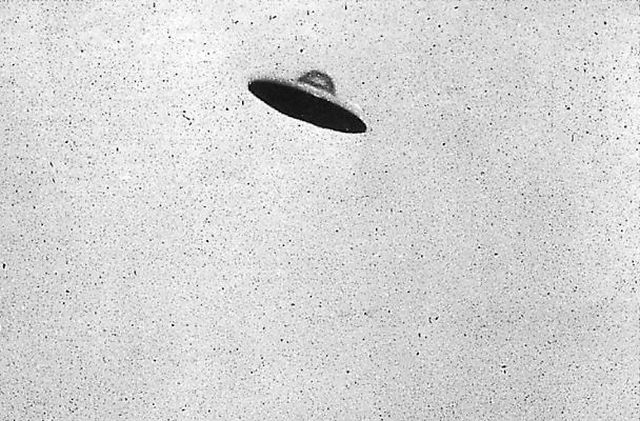
In 1978, the agency known in some circles for masterminding nearly every world event since its inception declassified a vast number of files, “hundreds of documents… detailing the Agency’s investigations into Unidentified Flying Objects (UFOS). The documents date primarily from the late 1940s and 1950s.”
Who do you think they picked for their model skeptic and believer? “The truth is out there,” as the CIA is apparently fond of saying, “click on the links to find it.”
The Mulder and Scully lists serve as lighthearted introductions to the sometimes bewildering array of documents in the CIA’s Freedom of Information Act (FOIA) Electronic Reading Room, which hosts those several hundred reports, memos, etc., sometimes redacted or written in Agency code.
Now, the side of the object on which the holes had been opened began to glitter. Its color seemed green but later turned to red. At the same time I began to hear a slight hum. While the brightness and hum increased, the conical tower began to slide down into the center of the object. The whole object then began to rise slowly from the ground and rotate like a top.
If you’re seeing a description from a classic sci-fi radio drama or pulp magazine, read on. The craft becomes “surrounded by a ring of flames,” rises, and flies away. And, of course, the man had earlier witnessed men “dressed in some shiny metallic clothing.” It all sounds very silly except that many other unrelated people in the small town reported seeing something very strange in the sky that night. One witnesses’ overactive imagination does not invalidate the testimony of the others.
Or does it?
We’ve had many sightings of UFOs from astronauts and pilots in the last few decades (mostly debunked), and ordinary people on the ground have never stopped seeing lights in the sky. So we might wonder why all of the CIA documents on the site come from the 1960s and before? Is this a sign of increased activity in the years after the supposed Roswell event? Perhaps the alien conspiracy’s feverish, devious start?
Or, as GeekWire writes, was the CIA “worried about the potential threat that UFOs posed to national security… they assumed that the UFOs might be part of a Soviet weapons test program.” With the gradual warming of relations, then glasnost, the spies lost interest… (Or…?) … but we might wonder why the Agency used the new X‑Files debut to draw attention to itself. Your conspiracy theory is probably as good as any other.
If CIA did stop investigating alien invasions, you don’t have to. The Agency has left it in your capable hands, publishing “10 Tips When Investigating a Flying Saucer” to guide you in your quest for the truth. Be warned: it’s a very skeptic-friendly set of guidelines; one that—were everyone to follow it—might virtually eliminate every reported UFO sighting. Curious that. What are they hiding?
Find the list below, and see the complete explanation of each tip (such times we live in) at the CIA’s website.
1. Establish a group to investigate and evaluate sightings
2. Determine the objectives of your investigation
3. Consult with experts
4. Create a reporting system to organize incoming cases
5. Eliminate false positives
6. Develop methodology to identify aircraft and other aerial phenomena often mistaken for UFOs
7. Examine witness documentation
8. Conduct controlled experiments
9. Gather and test physical and forensic evidence
10. Discourage false reporting
Again, to dig deeper into the CIA’s fascinating archive of UFO sightings, visit its FOIA UFO collection. True believers may want to know more, and they can, if they’re willing to follow the Byzantine research instructions on the UFO collection’s main page to find an Agency article about the “CIA’s Role in the Study of UFOs, 1947–1990.” Or they could just click here.
This past spring the streets of Seoul, where I live, felt more like a sci-fi movie than usual. Large overhead video screens kept the population posted on the progress of a series of Go matches between 18-time world champion Lee Sedol and AlphaGo, a piece of artificial intelligence developed by Google DeepMind. Computers have long had a special difficulty mastering that traditional game, but before long it became clear that this computer would win most of the matches, despite the human’s formerly unshakable prediction of the opposite outcome. What would artificial intelligence achieve next?
“In the wake of Google’s AI Go victory, filmmaker Oscar Sharp turned to his technologist collaborator Ross Goodwin to build a machine that could write screenplays,” say the video notes for the new short film Sunspring. They assembled hundreds of science fiction scripts, mostly from 1980s and 90s television shows and movies, and fed them into the artificial intelligence, which eventually named itself Benjamin, so as to teach it the mechanics of screenwriting. “Building a team including Thomas Middleditch, star of HBO’s Silicon Valley, they gave themselves 48 hours to shoot and edit whatever Benjamin decided to write.” Benjamin decided to write eight minutes’ worth of its own interpretation of the tropes of a certain kind of sci-fi entertainment.
It did come up with, fair to say, some dialogue a human screenwriter could only dream of — that is to say, words with the kind of unconscious logic that, delivered by living, breathing actors in physical spaces, take on weight, humor, and even an askew kind of meaning. (Middleditch’s despondent “I am not a bright light” will surely stay quotable for years to come.) You can learn more about the making of Sunspring from this Ars Technica piece by Annalee Newitz. Benjamin won’t put any sci-fi scribes out of work just yet, haunting though it may seem for a program to have come so close to doing something classically human as telling a story about the future. But remember, people had to write that program, just as people had to create AlphaGo; every achievement of artificial intelligence thus also counts as an achievement of humanity.
Philip K. Dick died in 1982. His distinctive, some say visionary brand of psychological sci-fi literature, however, has lived on, proving its endurance in part by taking new forms. Blade Runner, Ridley Scott’s hugely influential adaptation of Dick’s Do Androids Dream of Electric Sheep?, premiered just three months after the author’s departure. More films followed over the years, including Paul Verhoeven’s Total Recall (an adaptation of “We Can Remember It for You Wholesale”), Steven Spielberg’s Minority Report, Richard Linklater’s A Scanner Darkly, and many others.
Dick’s work has also provided the basis for radio dramas, television shows (most recently Netflix’s The Man in the High Castle, with an ambitious anthology series coming to Channel 4 this spring), and stage productions.
Typically, these adaptations use the stories and novels in which Dick wrote the setting, plot, and characters with relative straightforwardness. Other, later works found him plunging as deep into philosophy and autobiography as into science fiction. The change happened around the time he saw a mysterious pink light and met God in 1974, or claimed to, and it produced a final set of novels known as the VALIS trilogy.
The fractured tale of an authorial alter-ego named Horselover Fat, VALIS (short for “Vast Active Living Intelligence System”), the first book in the trilogy, involves an alien space probe, Watergate, the Messiah, lasers, and a range of references to religions like Christianity, Gnosticism, Buddhism, Gnosticism, Zoroastrianism, and the Red Cross Brotherhood; philosophy from the ancient Greeks to Plato, Pascal, and Schopenhauer; and cultural figures like Handel, Wagner, Goethe, and Frank Zappa. It would take an ambitious mind indeed to adapt such a thing: specifically, it took the mind of Tod Machover, composer and director of MIT’s Media Lab, who turned it into an opera in 1987.
“We live in a world that is becoming in fact more and more fragmented, more and more complex,” says Machover on the relevance of VALIS at an interview at the Philip K. Dick Fan Site. “You don’t have to have a pink light experience to realize that there is too much information to not only be aware of but to make any kind of sense out of.” He describes this “incredible feeling of the world being not only too complex for any one person to make sense out of but also dangerously complex, to the point where people will not only not understand each other but end up hating each other and being absolutely crushed under the burden of just trying to make sense with how much there is to know.”
In his VALIS opera, which premiered at Paris’ Centre Georges Pompidou with installations created by video artist Catherine Ikam, Machover tried to get that feeling artistically across, and you can hear it free on Spotify. (If you don’t have Spotify’s software, you can download it here. There’s a Youtube version right above.) Back then in the 80s, he says, it “seemed like through our media and communications there’d be a kind of facile way of connecting people, a sort of passivity and turning on your cable TV and seeing what’s going on today in Tokyo or in Europe and you sort of feel like you can take all this stuff in. But in fact I think what we’re seeing now is exactly what Dick predicted, which is that it ain’t that easy.” And it sure hasn’t got any easier.
The Internet has been abuzz and atwitter these past few months with stories about prophetic predictions of the rise of Trump, buried in ancient texts like Back to the Future II, and an episode of The Simpsons from 2000. Then there’s Mike Judge’s now ten-year-old satire Idiocracy. While not specifically modeled after a Trump presidency, its depiction of the country as a violent, backward dystopia, armed and corporate-branded to the teeth, sure does resemble the kind of place many imagine Trump and his supporters might build. These allusions and direct references don’t necessarily provide evidence of the writers’ clairvoyance; after all, Trump has threatened us with his candidacy since 1988, with mostly unserious statements. But they do show us that we’ve seen this version of the future coming for the last thirty years or so.
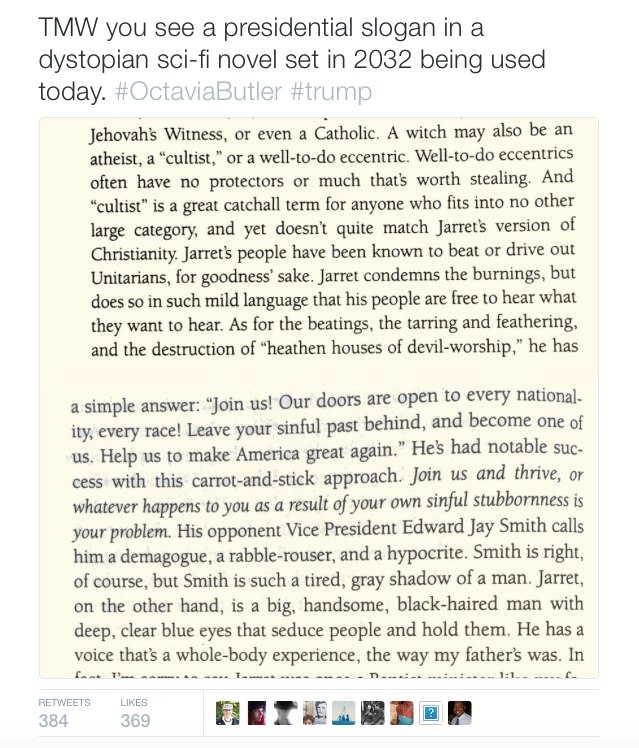
One prediction you may have missed, however, offers us a much more sober take on the rise of a frightening neo-fascist during a time of fear and civil unrest. As Twitter user @oligopistos pointed out, in the second book of her Earthseed series, The Parable of the Talents(1998), Hugo and Nebula-award winning science fiction writer Octavia Butler gave us Senator Andrew Steele Jarret, a violent autocrat in the year 2032 whose “supporters have been known… to form mobs.” Jarret’s political opponent, Vice President Edward Jay Smith, “calls him a demagogue, a rabble-rouser, and a hypocrite,” and—most presciently—Jarret rallies his crowds with the call to “make America great again.”
Though Trump has trademarked it, the slogan did not originate with him, nor even with Butler’s Jarret character—the 1980 Reagan-Bush campaign used it, as Matt Taibbi pointed out Rolling Stone last year. (Historians have even shown that another of Trump’s slogans, “America First,” was used by Charles Lindbergh and “Nazi-friendly Americans in the 1930s.”) Again, proto-Trumpism has been in the zeitgeist for a long time. While Butler may have used “Make American Great Again” from her memory of Reagan’s first campaign, the way her character employs it speaks to our moment for a number of reasons.
It’s true that Senator Jarret differs from Trump in some significant ways: “Jarret’s beef is with Canada instead of Mexico,” writes Fusion, and “instead of business acumen as his main credential, religion is Jarret’s stump. He’s the head of a group called Christian America, which is intolerant of other religious views, and whose supporters burn ‘witches’—meaning Muslims, Jews, Hindus and Buddhists—at the stake.” Our current candidate may have co-opted the religious right, but he doesn’t speak their language at all. Nonetheless, he has made promises that give secularists and non-Christians chills, and religious intolerance has formed the backbone of his campaign and of the rhetoric that has driven his party to the far right.
Jarret and the fanaticism he inspires become central the novel’s story, but the crucial background in Butler’s 1998 depiction of a post-apocalyptic 2032 are the conditions she identifies as giving rise to the Senator’s rule (and which she described in the first book, Parable of the Sower). In Talents, the narrator’s father Taylor Franklin Bankole writes,
I have read that the period of upheaval that journalists have begun to refer to as “the Apocalypse” or more commonly, more bitterly, “the Pox” lasted from 2015 through 2030—a decade and a half of chaos…. I have also read that the Pox was caused by accidentally coinciding climatic, economic, and sociological crises. It would be more honest to say that the Pox was caused by our own refusal to deal with obvious problems in those areas. We caused the problems: then we sat and watched as they grew into crises.
In Butler’s fiction, the rise of Senator Jarret and his mobs is an outcome of the same kinds of impending crises we face now, and that far too many of our leaders dutifully ignore as they stage increasingly acrimonious and bizarre forms of political theater. Butler’s indirect warning to us in Parable of the Talents may be less about the demagogic leader and his cult—though they pose the most dire existential threat in the book—than about the causes and conditions that created “the Pox,” the kind of social collapse that Kurt Vonnegut warned of ten years before Butler in his time-capsule letter to the people of 2088, vaguely identifying similar kinds of “climatic, economic, and sociological” crises to come. Would that we could abandon empty spectacle and heed these Cassandras of the near future.
We're hoping to rely on loyal readers, rather than erratic ads. Please click the Donate button and support Open Culture. You can use Paypal, Venmo, Patreon, even Crypto! We thank you!
Open Culture scours the web for the best educational media. We find the free courses and audio books you need, the language lessons & educational videos you want, and plenty of enlightenment in between.