Quick note: Earlier this year, J. K. Rowling began writing new stories about the 2014 Quidditch World Cup Finals for Pottermore, the website for all things Harry Potter. Today, she followed up with a story that takes the form of an article published in The Daily Prophet: “Dumbledore’s Army Reunites at Quidditch World Cup Final” by Rita Skeeter. Here, Rowling gives us the first glimpse of the adult Harry Potter.
About to turn 34, there are a couple of threads of silver in the famous Auror’s black hair, but he continues to wear the distinctive round glasses that some might say are better suited to a style-deficient twelve-year-old. The famous lightning scar has company: Potter is sporting a nasty cut over his right cheekbone. Requests for information as to its provenance merely produced the usual response from the Ministry of Magic: ‘We do not comment on the top secret work of the Auror department, as we have told you no less than 514 times, Ms. Skeeter.’ So what are they hiding? Is the Chosen One embroiled in fresh mysteries that will one day explode upon us all, plunging us into a new age of terror and mayhem?
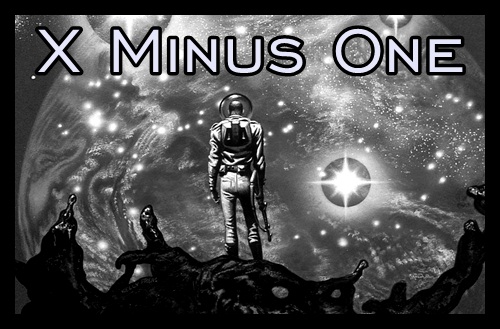
Though I seldom long for my native culture when abroad, when the need for a hit of Americana does arise (and I say this currently writing from Seoul, South Korea), I fill my iPod with old time radio. Many shows from America’s “Golden Age” of wireless broadcasting can fill this need, but one could do much worse than Dimension X, the early-1950s science-fiction program we featured earlier this month, or its late-1950s successor X Minus One, whose episodes you can also find at the Internet Archive. Both showcase American culture at its mid-20th-century finest: forward-looking, temperamentally bold, technologically adept, and saturated with earnestness but for the occasional surprisingly knowing irony or bleak edge of darkness. That last comes courtesy of these shows’ writing talent, a group which includes such canonical names as Philip K. Dick, Ray Bradbury, Isaac Asimov, and Robert Heinlein.
X Minus One’s run, which lasted from April 1955 to January 1958, included a heaping helping of the evidently highly radio-adaptable Ray Bradbury: his stories “And The Moon Be Still As Bright,” “Mars is Heaven,” “The Veldt,” “Dwellers in Silence,” “Zero Hour,” “To the Future,” and “Marionettes, Inc.,” all appeared as episodes. From Robert A. Heinlein’s harder-bitten body of work the show produced “Universe,” “Requiem,” and “The Roads Must Roll.” Isaac Asimov, one of the most scientific of that era’s science-fiction writers, wrote the source material for “Nightfall,” “C‑Chute,” and “Hostess.” The pen of Philip K. Dick, surely the most purely imaginative of the bunch, for its part produced “The Defenders” and “Colony.” America let fly all sorts of visions of the future back then, from the optimistic to the pessimistic, the utopian to the dystopian, the progressive to the regressive. The aforementioned writers did it best by mixing all those sensibilities into each of their visions, which you can hear, along with those of many others, in X Minus One’s robust archive. You can stream several of the episodes below.
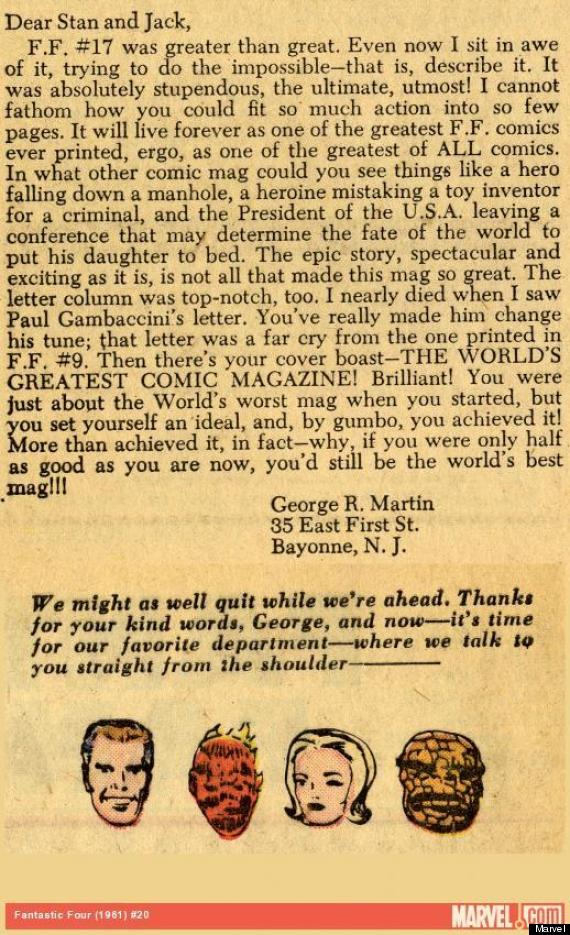
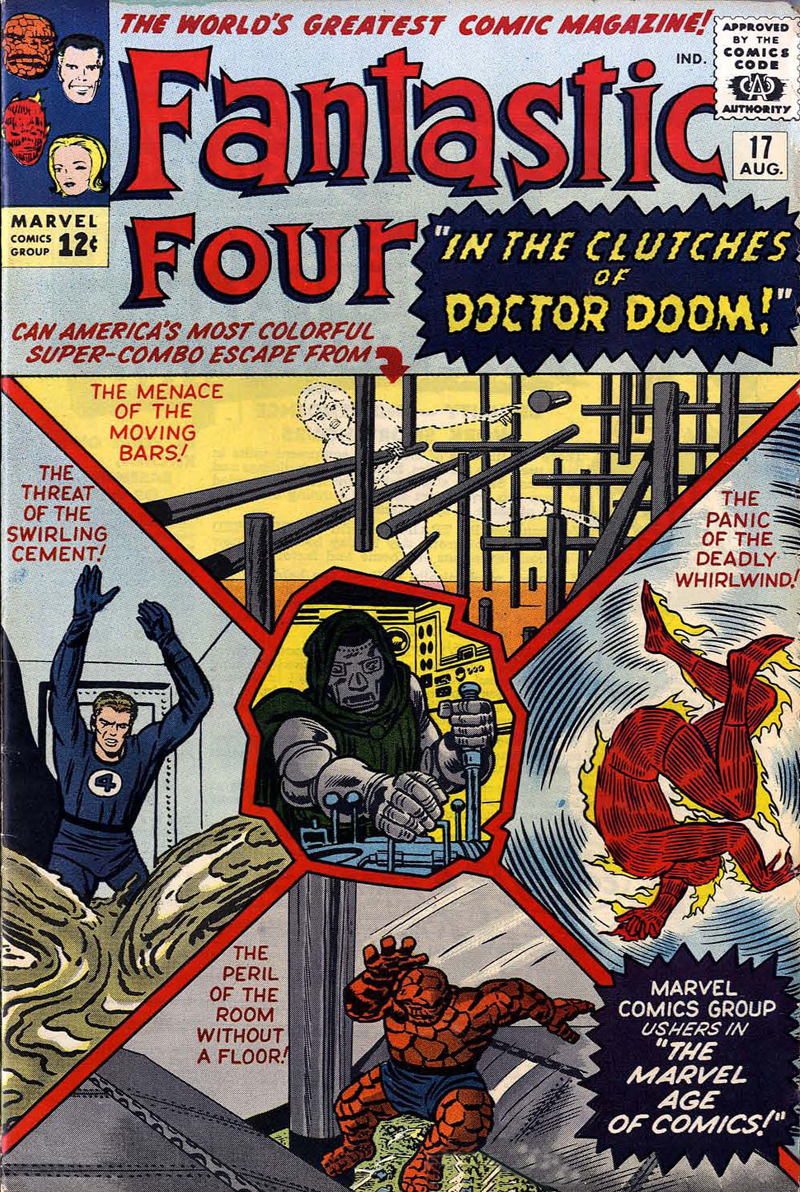
The letter above goes to show two things. George Raymond Richard Martin, otherwise known as George R.R. Martin, or simply as GRRM, had fantasy and writing in his blood from a young age. Decades before he wrote his fantasy novel series A Song of Ice and Fire, which HBO adapted intoGame of Thrones, a 15-year-old George R. Martin sent a fan letter to Stan Lee and Jack Kirby, the legendary creators of Spider-Man, the Hulk, Thor, the X‑Men and the Fantastic Four(called “F.F.” in the letter). When you read the note, you can immediately tell that young Martin was steeped in sci-fi and fantasy literature. He could also string together some fairly complex sentences during his teenage years — sentences that many adults would struggle to write. But here’s the cool part for me. Wunderkind Martin lived in good old Bayonne, NJ, the town where yours truly has deep family roots. You can find the cover of the much-praised F.F. #17 below.
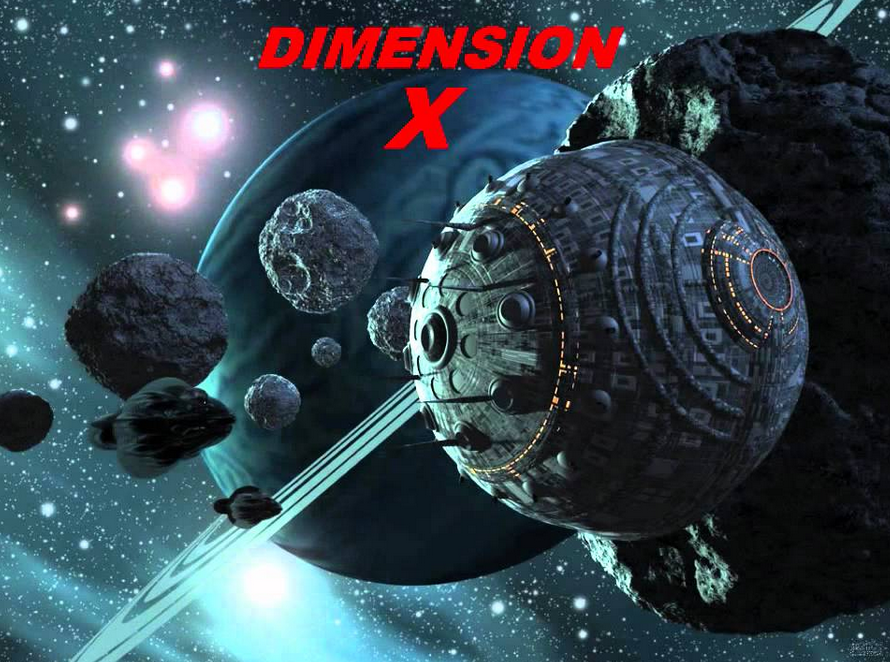
Enthusiasts of American radio drama usually place the form’s “Golden Age” as beginning in the 1920s and ending, almost at the stroke of television’s mass adoption, in the 1950s. NBC’s Dimension X, which ran in 1950 and 1951, came somewhat late to the game, but it did more than its part to give “old time radio” a strong last decade — indeed, perhaps its strongest. Other famous “serious” science-fiction programs had aired in the 20s, 30s, and 40s, but Dimension X made its mark by adapting short stories by acknowledged masters of the craft: Isaac Asimov, Ray Bradbury, Robert Heinlein, and even a non-genre-bound literary mind like Kurt Vonnegut. All of these world-creators knew well the value of imagination, and radio, in its way, stood then and remains today the most evocative, imagination-driven medium of them all. At the Internet Archive (certainly a more convenient old time radio source than the bootleg cassette tapes I used to have to buy) you can download all of Dimenson X’s “adventures in time and space, transcribed in future tense.”
If you don’t know where in this speculative field of time and space to begin, we’ve highlighted a few Dimension X episodes drawn from works of the most notable authors. June 10, 1950’s “The Green Hills of Earth”, based upon the Robert Heinlein story of the same name, relates the life of “Noisy” Rhysling, a blind space-age troubadour who realizes he must pay tribute to the planet he long ago left behind. The very next week’s “There Will Come Soft Rains”, one of Ray Bradbury’s many works adapted for the show, describes the apocalypse through the processes of the self-maintaining high-tech miracle house. June 17, 1951’s “Pebble in the Sky” takes its theme from the eponymous Isaac Asimov novel that thrusts a 20th-century everyman into a complex future of a galactic empire, a radioactive Earth, and mandatory euthanasia at age sixty. And in February 11, 1950’s “Report on the Barnhouse Effect”, only the show’sthird broadcast, we hear the testimony of a telekinetic — one who, given that Kurt Vonnegut wrote the original story, it won’t surprise you to hear the government immediately (and haplessly) tries to weaponize.
“The Green Hills of Earth” (Robert Heinlein)
“There Will Come Soft Rains” (Ray Bradbury)
“Pebble in the Sky” (Isaac Asimov)
“Report on the Barnhouse Effect” (Kurt Vonnegut)
What did Do Androids Dream of Electric Sheep? and A Scanner Darklyauthor Philip K. Dick, that visionary of our not-too-distant dystopian future, listen to while he crafted his descriptions of grim, psychologically (and sometimes psychedelically) harrowing times ahead? Mozart. Beethoven. Mahler. Wagner.
Yes, while looking textually forward, he listened backward, soundtracking the constant workings of his imagination with classical music, as he had done since his teenage years. As Lejla Kucukalic writes in Philip K. Dick: Canonical Writer of the Digital Age:
After graduating from high school in 1947, Dick moved out of his mother’s house and continued working as a clerk at a Berkeley music store, Art Music. “Now,” wrote Dick, “my longtime love of music rose to the surface, and I began to study and grasp huge areas of the map of music; by fourteen I could recognize virtually any symphony or opera” (“Self-Portrait” 13). Classical music, from Beethoven to Wagner, not only stayed Dick’s lifelong passion, but also found its way into many of his works: Wagner’s Goterdammerung in A Maze of Death, Parsifal in Valis, and Mozart’s Magic Flute in Do Androids Dream of Electric Sheep?
At his Forteana Blog, author Andrew May credits Dick with, given his pop-cultural status, “a decidedly uncool knowledge of classical music.” He cites not just Wagner’s Der Ring des Nibelungen in the introduction to A Maze of Death, Beethoven’s Missa Solemnis in Ubik, or the part of The Game-Players of Titan where “a teenaged kid forks out 125 dollars for a vintage recording of a Puccini aria,” but an entire early story which functions as “(in my opinion) a pure exercise in classical music criticism.” In 1953’s “The Preserving Machine,” as May retells it, an eccentric scientist, “worried that Western civilization is on the point of collapse, invents a machine to preserve musical works for future generations” by encoding it “in the form of living creatures. Unfortunately, as soon as the creatures are released into the environment, they start to adapt to it by evolving into different forms, and the music becomes distorted beyond recognition.”
Though no doubt an astute speculator, Dick seems not to have foreseen the fact that our era suffers not from too few means of music storage but, perhaps, too many. None of his visions presented him with, for example, the technology of the Spotify playlist, an example of which you’ll find at the bottom of this post. In it, we’ve assembled for your enjoyment some of Dick’s favorite pieces of classical music. The songs come scouted out by Galleycat’s Jason Boog, who links to them individually in his own post on Dick, classical music, and May’s writing on the intersection of those two cultural forces. Listen through it while reading some of Dick’s own work — don’t miss our collection of Free PKD — and you’ll understand that he cared about not just the anxieties of humanity’s future or the great works of its past, but what remains essential throughout the entire human experience. These composers will still appear on our playlists (or whatever technology we’ll use) a hundred years from now, and if we still read any sci-fi author a hundred years from now, we’ll surely read this one.
The 11 hour playlist (stream below or on the web here) includes Bach’s Goldberg Variations, Beethoven’s Missa Solemnis and Fidelio, Mozart’s The Magic Flute, Wagner’s Parsifal, and Mahler’s Symphony No. 2 (Resurrection). If you need to download Spotify, grab the software here.
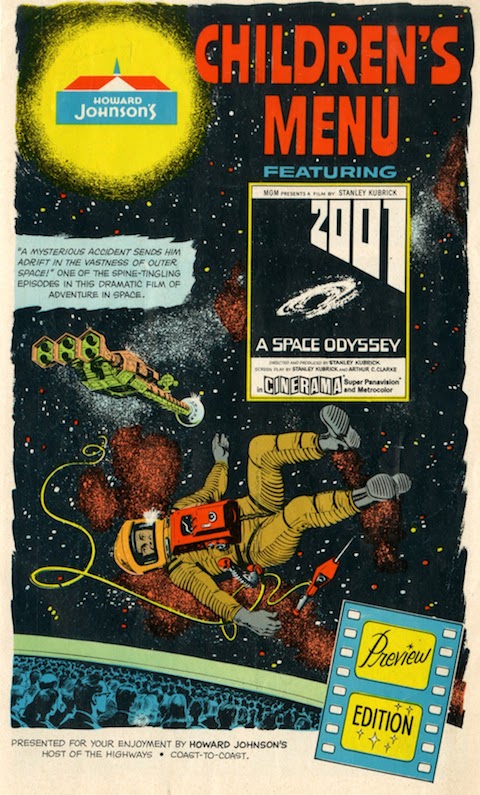
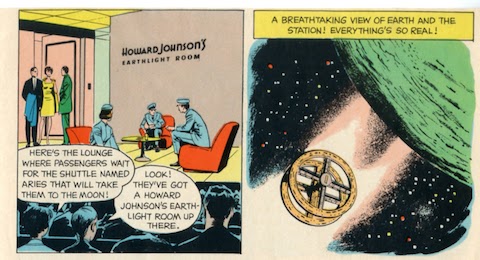
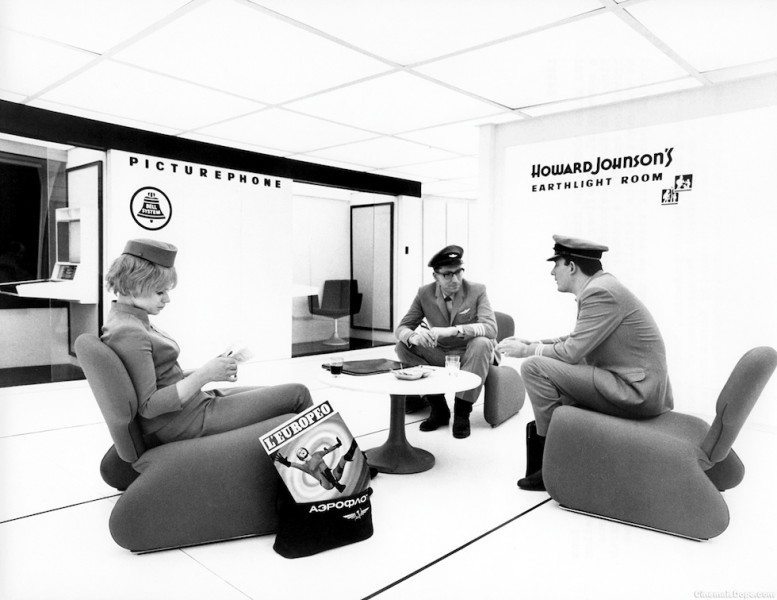
Rumor has it that prominent placement in a science-fiction movie can put a kind of “curse” on a brand: witness the fates, for instance, of Atari, Bell, and Pan American World Airways, all of which went south after appearing in Ridley Scott’s Blade Runner in 1982. (Even the apparently unstoppable Coca-Cola, its logo flashing so brightly on the future Los Angeles skyline, subsequently put the infamous New Coke to market.) Pan Am, then less than a decade from dissolution, had previously played a high-profile part in 2001: A Space Odyssey. Stanley Kubrick and Arthur C. Clarke’s vision of monoliths, Jupiter missions, and too-intelligent artificial intelligence came out in 1968, the tail end of America’s midcentury Space Age of the imagination. At that time, Pan Am enjoyed a reputation as the preferred airline of the new “jet-set” — the natural transportation provider, I suppose, for their seemingly inevitable (and inevitably glamorous) holidays in outer space. But who would provide the lodging so far from Earth? Why, Howard Johnson’s, of course.
The hotel-restaurant chain, America’s largest in the 1960s and 70s, lent its name to the “earthlight room” built into 2001’s space station. It also offered a special children’s menu (produced by the Amuse-a-Menu Company of Boston, Massachusetts) featuring a comic retelling not of the film itself, but of the experience of attending the film’s premiere. Many of its panels manage impressive recreations of 2001’s then-as-now-impressive visuals, though I suspect the writer and artist had to work with few plot details — they make no mention at all, for instance, of the iconically malevolent supercomputer (and arguably 2001’s star) HAL 9000.
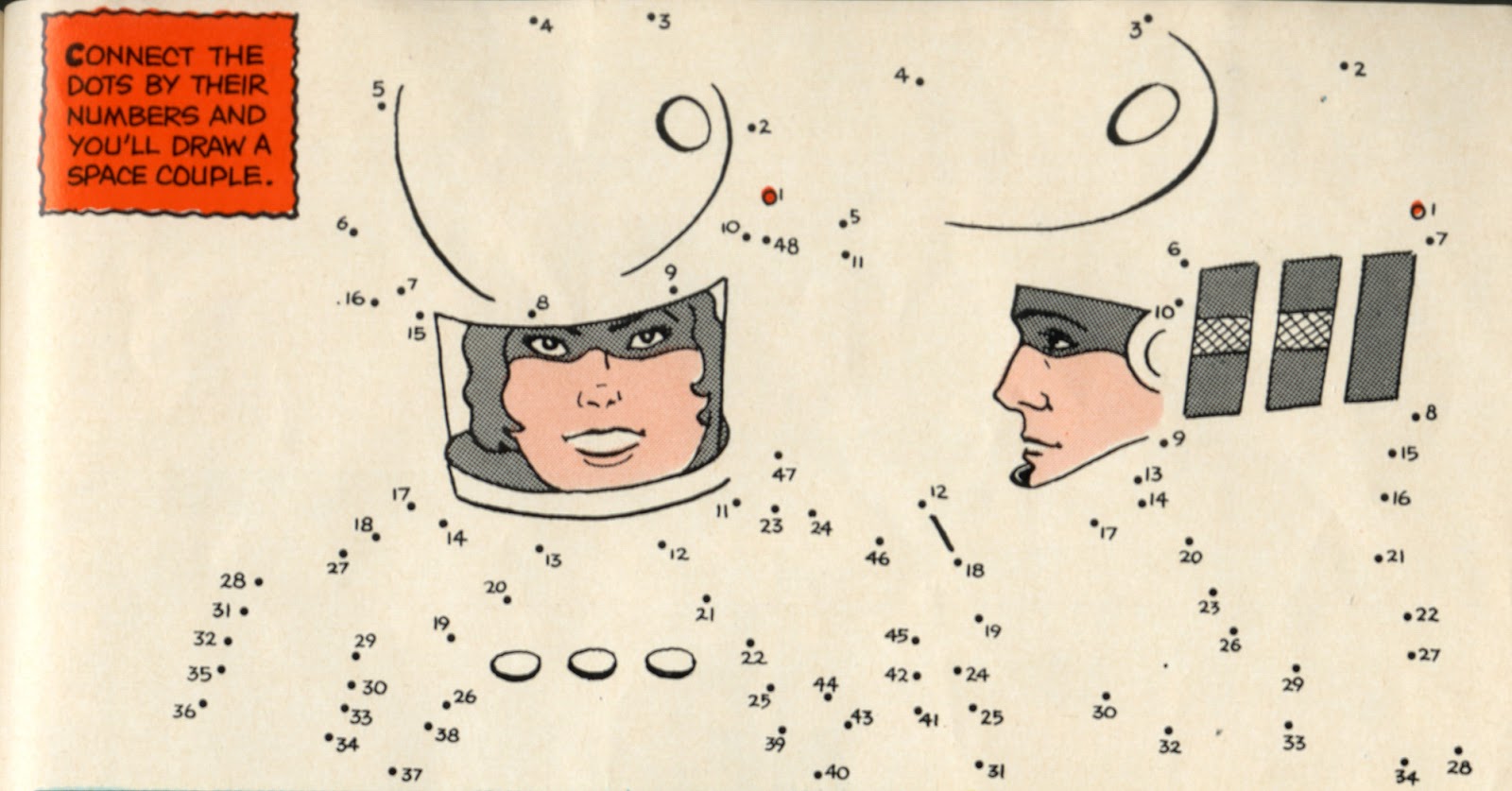
The full menu, which you can browse at Dreams of Space, offers the kids of 1968 an activity page, an opportunity to purchase a 50-cent birthday-themed 45-RPM record, and a host of bland dishes. Born well after 2001’s premiere — and indeed after Blade Runner’s, though I did hear when Pan Am went under — I nevertheless remember eating all these standards from children’s menus everywhere: spaghetti, hot dogs, peanut-butter-and-jelly sandwiches. While I rarely dream of a future where we’ve developed a spacefaring jet set, I often dream of the even less plausible one where we’ve come up with appetizing food for the under-ten set.
Though I am old with wandering
Through hollow lands and hilly lands,
I will find out where she has gone
And kiss her lips and take her hands;
And walk among long dappled grass,
And pluck till time and times are done
The silver apples of the moon,
The golden apples of the sun.
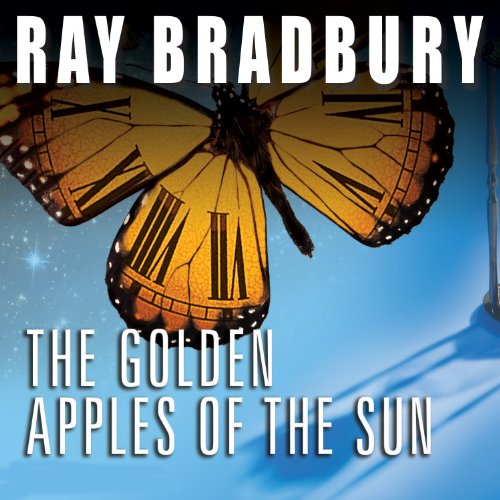
Some year later, in 1991, the BBC dramatized eight stories from Bradbury’s collection. Adapted by Lawrence Gilbert, the stories were performed by a full cast and aired on the radio. The audio, running almost two hours, can be streamed below thanks to Archive.org. It’s otherwise housed in our collection of 550 Free Audio Books. Enjoy.
Below we have some other radio dramatizations of sci-fi/dystopian classics.
The Church of Scientology has a number of fascinatingly distinctive characteristics, including but not limited to its foundation by a science-fiction novelist. That novelist, a certain L. Ron Hubbard, launched his religion in the America of the 1950s, a prosperous place in a Space Age decade when all things science-fictional enjoyed a perhaps unprecedented popularity. Another big mainstream sci-fi wave would wash over the country in the late 1970s and early 80s, when, as Nathan Rabin puts it at Slate, “thanks to the popularity of E.T., Close Encounters of the Third Kind, and theStar Wars and Star Trek franchises, space was the place and science fiction was the hottest genre around. Scientology wanted in, so an ambitious plan was hatched: Hubbard’s epic 1982 Battlefield Earth novel, to be followed by Space Jazz,” an album containing a “sonic space opera” based on the novel. At the top of post, you can hear the track “Earth, My Beautiful Home,” one of the project’s few un-bombastic numbers, and one performed by a genuinely more-than-credible jazz pianist, Chick Corea.
The Church of Scientology counts Corea as a member, as it then did another of Space Jazz’s guest players, bassist (and Corea’s Return to Forever bandmate) Stanley Clarke. This puts the album into the unusual class of works both written and performed by Scientologists, a group which also includes Battlefield Earth’s much later, John Travolta-starring cinematic adaptation, now known as one of the most notable flops in film history. Rabin, in his article, also covers several other albums credited to Hubbard, including 1986’s posthumous Mission Earth, recorded by multi-instrumentalist/Scientologist Edgar Winter, which he calls the only one “that could conceivably be played on the radio without prompting confused cries of, ‘Why?’ and ‘What?’ and ‘Is this even music?’ ” Some say science fiction has undergone another boom in recent years, but alas, we still await the great Scientological concept album of the 21st century.
We're hoping to rely on loyal readers, rather than erratic ads. Please click the Donate button and support Open Culture. You can use Paypal, Venmo, Patreon, even Crypto! We thank you!
Open Culture scours the web for the best educational media. We find the free courses and audio books you need, the language lessons & educational videos you want, and plenty of enlightenment in between.