And now for a good use of AI. The UK-based telecom company O2 has developed a chatbot (“named Daisy”) that performs a noble task. Impersonating an elderly grandmother, the chatbot engages with internet fraudsters and then systematically frustrates them and wastes their time. As part of a demo, notes The Guardian, Daisy wasted a series of fraudsters’ time for up to 40 minutes each–“when they could otherwise have been scamming real people.” The AI system was trained on real scam calls–according to Virgin Media O2’s marketing director, Simon Valcarcel–so it “knows exactly the tactics to look out for, exactly the type of information to give to keep the scammers online and waste time.” If you have three minutes to spare, you can listen to Daisy clown a scam artist above.
One would count neither Elon Musk nor Neil deGrasse Tyson among the most reserved public figures of the twenty-first century. Given the efforts Musk has been making to push into the business of outer space, which has long been Tyson’s intellectual domain, it’s only natural that the two would come into conflict. Not long ago, the media eagerly latched on to signs of a “feud” that seemed to erupt between them over Tyson’s remark that Musk — or rather, his company SpaceX — “hasn’t done anything that NASA hasn’t already done. The actual space frontier is still held by NASA.”
What this means is that SpaceX has yet to take humanity anywhere in outer space we haven’t been before. That’s not a condemnation, but in fact a description of business as usual. “The history of really expensive things ever happening in civilization has, in essentially every case, been led, geopolitically, by nations,” Tyson says in the StarTalk video above. “Nations lead expensive projects, and when the costs of these projects are understood, the risks are quantified, and the time frames are established, then private enterprise comes in later, to see if they can make a buck off of it.”
To go, boldly or otherwise, “where no one has gone before often involves risk that a company that has investors will not take, unless there’s a very clear return on investment. Governments don’t need a financial return on investment if they can get a geopolitical return on investment.” Though private enterprise may be doing more or less what NASA has been doing for 60 years, Tyson hastens to add, private enterprise does do it cheaper. In that sense, “SpaceX has been advancing the engineering frontier of space exploration,” not least by its development of reusable rockets. Still, that’s not exactly the Final Frontier.
Musk has made no secret of his aspirations to get to Mars, but Tyson doesn’t see that eventuality as being led by SpaceX per se. “The United States decides, ‘We need to send astronauts to Mars,’ ” he imagines. “Then NASA looks around and says, ‘We don’t have a rocket to do that.’ And then Elon says ‘I have a rocket!’ and rolls out his rocket to Mars. Then we ride in the SpaceX rocket to Mars.” That scenario will look even more possible if the unmanned Mars missions SpaceX has announced go according to plan. Whatever their differences, Tyson and Musk — and every true space enthusiast — surely agree that it doesn’t matter where the money comes from, just as long as we get out there one day soon.
Based in Seoul, Colin Marshall writes and broadcasts on cities, language, and culture. His projects include the Substack newsletterBooks on Cities and the book The Stateless City: a Walk through 21st-Century Los Angeles. Follow him on the social network formerly known as Twitter at @colinmarshall.
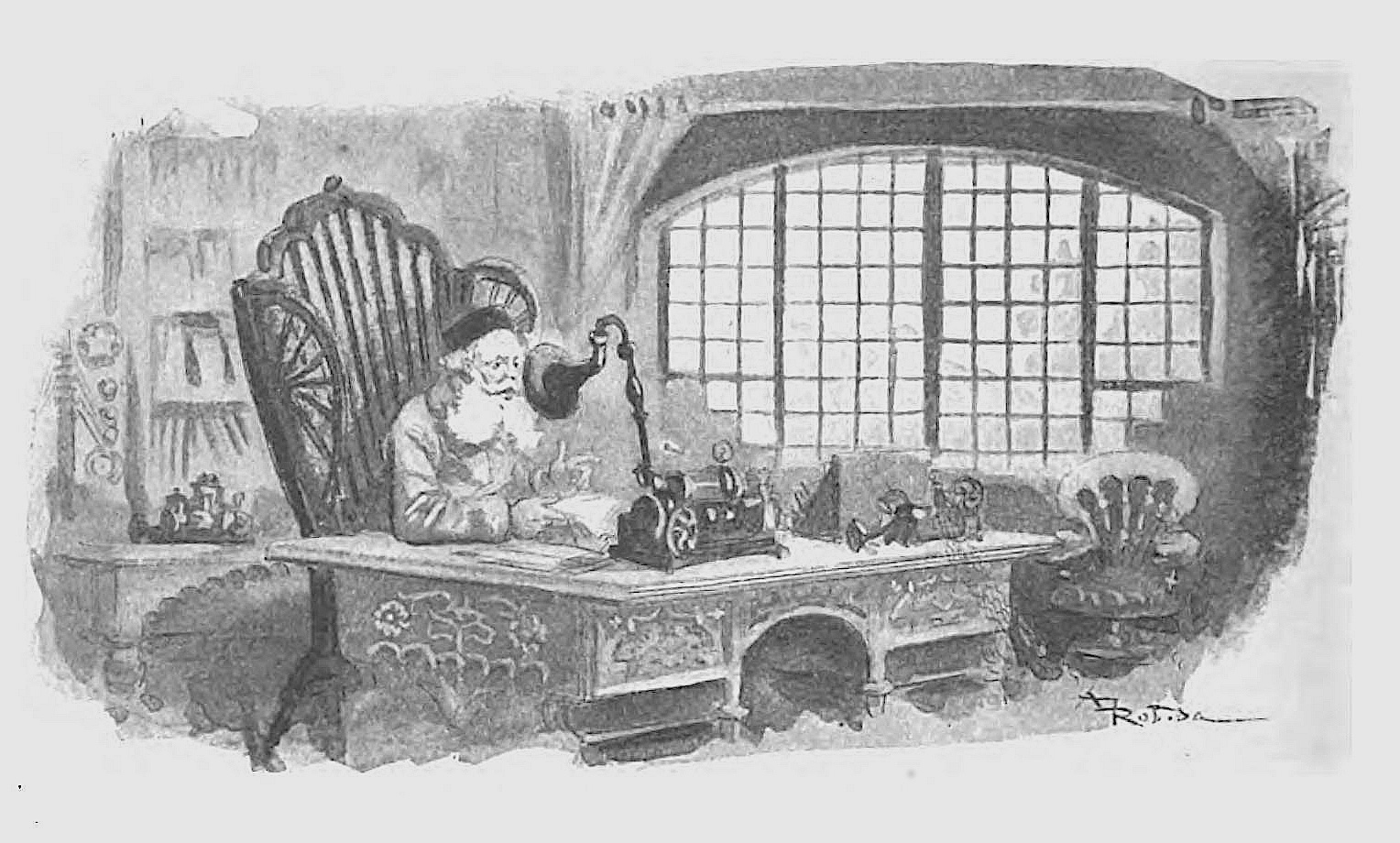
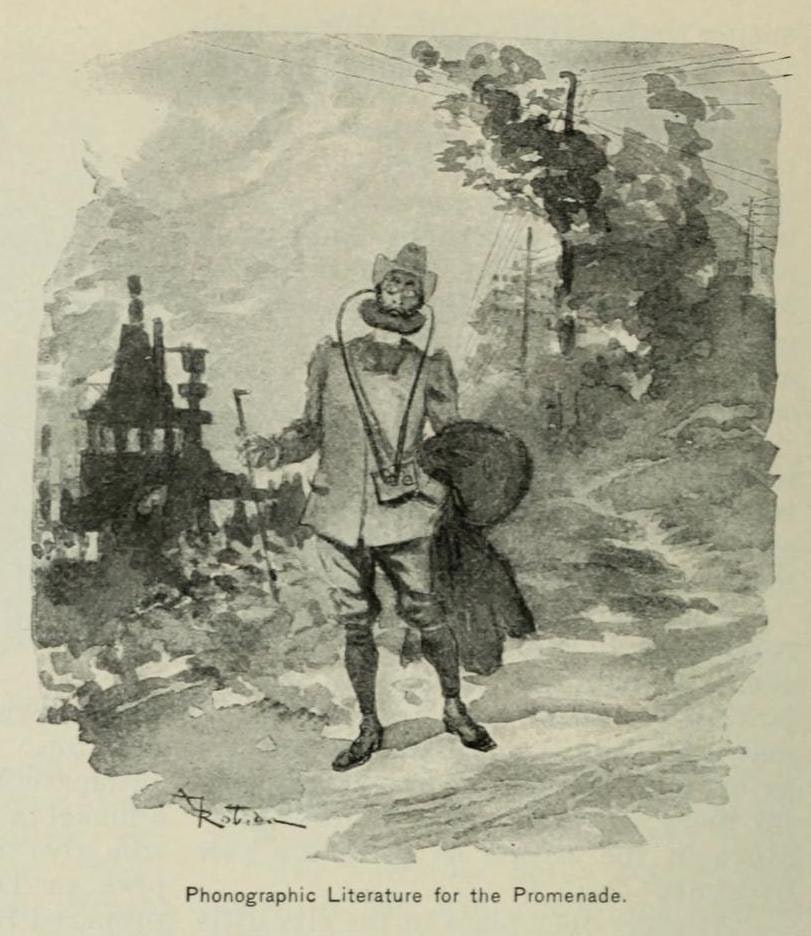
The end of the nineteenth century is still widely referred to as the fin de siècle, a French term that evokes great, looming cultural, social, and technological changes. According to at least one French mind active at the time, among those changes would be a fin deslivres as humanity then knew them. “I do not believe (and the progress of electricity and modern mechanism forbids me to believe) that Gutenberg’s invention can do otherwise than sooner or later fall into desuetude,” says the character at the center of the 1894 story “The End of Books.” “Printing, which since 1436 has reigned despotically over the mind of man, is, in my opinion, threatened with death by the various devices for registering sound which have lately been invented, and which little by little will go on to perfection.”
First published in an issue of Scribner’s Magazine (viewable at the Internet Archive or this web page), “The End of Books” relates a conversation among a group of men belonging to various disciplines, all of them fired up to speculate on the future after hearing it proclaimed at London’s Royal Institute that the end of the world was “mathematically certain to occur in precisely ten million years.” The participant foretelling the end of books is, somewhat ironically, called the Bibliophile; but then, the story’s author Octave Uzanne was famous for just such enthusiasms himself. Believing that “the success of everything which will favor and encourage the indolence and selfishness of men,” the Bibliophile asserts that sound recording will put an end to print just as “the elevator has done away with the toilsome climbing of stairs.”
These 130 or so years later, anyone who’s been to Paris knows that the elevator has yet to finish that job, but much of what the Bibliophile predicts has indeed come true in the form of audiobooks. “Certain Narrators will be sought out for their fine address, their contagious sympathy, their thrilling warmth, and the perfect accuracy, the fine punctuation of their voice,” he says. “Authors who are not sensitive to vocal harmonies, or who lack the flexibility of voice necessary to a fine utterance, will avail themselves of the services of hired actors or singers to warehouse their work in the accommodating cylinder.” We may no longer use cylinders, but Uzanne’s description of a “pocket apparatus” that can be “kept in a simple opera-glass case” will surely remind us of the Walkman, the iPod, or any other portable audio device we’ve used.
All this should also bring to mind another twenty-first century phenomenon: podcasts. “At home, walking, sightseeing,” says the Bibliophile, “fortunate hearers will experience the ineffable delight of reconciling hygiene with instruction; of nourishing their minds while exercising their muscles.” This will also transform journalism, for “in all newspaper offices there will be Speaking Halls where the editors will record in a clear voice the news received by telephonic despatch.” But how to satisfy man’s addiction to the image, well in evidence even then? “Upon large white screens in our own homes,” a “kinetograph” (which we today would call a television) will project scenes fictional and factual involving “famous men, criminals, beautiful women. It will not be art, it is true, but at least it will be life.” Yet however striking his prescience in other respects, the Bibliophile didn’t know – though Uzanne may have — that books would persist through it all.
Based in Seoul, Colin Marshall writes and broadcasts on cities, language, and culture. His projects include the Substack newsletterBooks on Cities and the book The Stateless City: a Walk through 21st-Century Los Angeles. Follow him on the social network formerly known as Twitter at @colinmarshall.
The video above from Sabins Civil Engineering promises to reveal “the MAGIC behind Da Vinci’s Self Supporting Bridge.” That sounds like a typical example of YouTube hyperbole, though on first glance, it isn’t at all obvious how the fragile-looking structure can stay up, much less support the weight of a crossing army. Not only does the design use no permanent joints, says the narrator, “the more weight on the bridge, the stronger it becomes.” The key is the distinctive manner in which the pieces interlock, and how it directs force to create a “friction lock” that ensures stability.
Remove just one piece of the bridge, however, and it all comes crashing down, which is more feature than bug: designed to facilitate troop movements, the structure could be dismantled to prevent use by the enemy even more easily than it was put up in the first place.
Just one of the various tools of war Leonardo came up with, this bridge was conceived under the patronage of the famous statesman Cesare Borgia (a chief inspiration for Niccolò Machiavelli’s The Prince), who employed him as an architect and military engineer in the early fifteen-hundreds.
Though Leonardo’s bridge designs have proven influential in the half-millennium since his death — think of him next time you cross the Galata Bridge in Istanbul — no evidence remains that he ever built one in his lifetime. But unlike most of his inventions, realized or theoretical, you can build it yourself today without much difficulty. The video presents an example large enough to walk across, which may make it feel rather less stable than it actually is. Luckily for students looking to understand the self-supporting bridge in a hands-on manner, the same engineering principles apply just as well on the more manageable scale of popsicle sticks — a modern building material at which Leonardo himself would surely have marveled.
Based in Seoul, Colin Marshall writes and broadcasts on cities, language, and culture. His projects include the Substack newsletterBooks on Cities and the book The Stateless City: a Walk through 21st-Century Los Angeles. Follow him on the social network formerly known as Twitter at @colinmarshall.
Life evolves, but machines are invented: this dichotomy hardly conflicts with what most of us have learned about biology and technology. But certain specimens roaming around in the world can blur that line — and in the curious case of the Strandbeesten, they really are roaming around. First assembled in 1990 by the Dutch artist Theo Jansen, a Strandbeest (Dutch for “beach beast”) is a kind of wind-powered kinetic sculpture designed to “walk” around the seaside in an organic-looking fashion. Jansen has made them not just ever larger and more elaborate over the decades, but also more stable and more resilient, with an eye toward their eventually outliving him.
Improving the Strandbeest has been a long process of trial and error, as explained in the Veritasium video above. Jansen’s process especially resembles biological evolution in that the changes he makes to his creations tend to be retained or discarded in accordance with the degree to which they assist in adaptation to their sandy, watery environment.
Getting them to walk upright in the sand was hard enough, and ultimately required computer modeling to determine just the right angles at which to connect their joints. But the joints themselves have also demanded improvement, given that the rigors of a Strandbeest’s “life” necessitate both flexibility and durability.
We’ve featured Jansen and his Strandbeesten more than once here on Open Culture, but this new video reveals another dimension of his lifelong project: to keep them from walking into the sea. This challenge has led him to build “brains” that detect when a Strandbeest has drawn too close to the water. Constructed with simple mechanical valves, these systems are reminiscent of not just the neurons in our own heads, but also of the collections of binary switches that, assembled in much greater numbers, have technologically evolved into the basis of the digital devices that we use every day. While a computer can theoretically last forever, a living creature can’t — and nor, so far, can a Strandbeest. But now that Jansen has discovered their “genetic code,” inventors all over the world have already begun their own work propagating this diverse, captivating species worldwide.
Based in Seoul, Colin Marshall writes and broadcasts on cities, language, and culture. His projects include the Substack newsletterBooks on Cities and the book The Stateless City: a Walk through 21st-Century Los Angeles. Follow him on the social network formerly known as Twitter at @colinmarshall.
We now live in the midst of an artificial-intelligence boom, but it’s hardly the first of its kind. In fact, the field has been subject to a boom-and-bust cycle since at least the early nineteen-fifties. Eventually, those busts — which occurred when realizable AI technology failed to live up to the hype of the boom — became so long and so thoroughgoing that each was declared an “AI winter” of scant research funding and public interest. Yet even deep into one such fallow season, AI could still inspire enough fascination to become the subject of the 1978 NOVA documentary “Mind Machines.”
The program includes interviews with figures now recognized as luminaries in the history of AI: John McCarthy, Marvin Minsky, Terry Winograd, ELIZA creator Joseph Weizenbaum. It also brings on no less a technological prophet than Arthur C. Clarke, who notes that the dubious attitudes toward the prospect of thinking machines expressed in the late seventies had much in common with those about the prospect of space travel during his youth in the thirties. In his view, we were already “creating our successors. We have seen the first, crude beginnings of artificial intelligence,” and we would “one day be able to design systems that can go on improving themselves.”
If computers were thereby to gain greater-than-human intelligence, it would, of course, “completely restructure society” — not that the society he already knew wouldn’t “collapse instantly” if its own relatively simple computers were taken away. Clarke not only asks the question now on many minds of what “the people who are only capable of low-grade computer-type work” will do when outstripped by AI, but more deeply underlying ones as well: “What is the purpose of life? What do we want to live for? That is a question which the intelligent computer will force us to pay attention to.”
Few viewers in 1978 would have spent much time pondering such matters before. But presented with footage of all this now-primitive proto-AI technology — the computer chess tournament, the simulated therapist, the medical-diagnosis assistant, the NASA Mars rover to be launched in the far-flung future of 1986 — they must at least have felt able to entertain the idea that they would live to see an age of machines that could not just think but, as the narrator puts it, possess “the most crucial aspect of common-sense intelligence: the ability to learn.” Perhaps another AI winter will forestall that age yet again — if it’s not already here.
Based in Seoul, Colin Marshall writes and broadcasts on cities, language, and culture. His projects include the Substack newsletterBooks on Cities and the book The Stateless City: a Walk through 21st-Century Los Angeles. Follow him on the social network formerly known as Twitter at @colinmarshall.
In 2023, Google launched several online certificate programs designed to help students land an entry-level job, without necessarily having a college degree. This includes a certificate program focused on Cybersecurity, a field that stands poised to grow as companies become more digital and face mounting cyberattacks.
Understand the importance of cybersecurity practices and their impact for organizations.
Identify common risks, threats, and vulnerabilities, as well as techniques to mitigate them.
Protect networks, devices, people, and data from unauthorized access and cyberattacks using Security Information and Event Management (SIEM) tools.
Gain hands-on experience with Python, Linux, and SQL.
The Cybersecurity Professional Certificate also now includes six new videos that explain how to use AI in cybersecurity. The videos cover everything from using artificial intelligence to help identify bugs and system vulnerabilities, to refining code and prioritizing alerts with AI.
Students can take individual courses in these professional certificate programs for free. (Above, you can watch a video from the first course in the cybersecurity certificate program, entitled “Foundations of Cybersecurity.”) However, if you would like to receive a certificate, Coursera will charge $49 per month (after an initial 7‑day free trial period). That means that the Cybersecurity Professional Certificate, designed to be completed in 6 months, will cost roughly $300 in total.
Once students complete the cybersecurity certificate, they can add the credential to their LinkedIn profile, resume, or CV. As a perk, students in the U.S. can also connect with 150+employers (e.g., American Express, Colgate-Palmolive, T‑Mobile, Walmart, and Google) who have pledged to consider certificate holders for open positions. According to Coursera, this certificate can prepare students to become an entry-level “cybersecurity analyst and SOC (security operations center) analyst.”
You can start a 7‑day free trial of the Cybersecurity Professional Certificatehere. Alternatively, if you sign up for Coursera Plus, whose price has been reduced by 40% until December 2, 2024, you can enroll in the cybersecurity certificate program at no charge. Find out more here.
Note: Open Culture has a partnership with Coursera. If readers enroll in certain Coursera courses and programs, it helps support Open Culture.
In the trailer below for the world’s first 3D replica of St. Peter’s Basilica, Yves Ubelmann speaks of using “AI for Good,” which isn’t just an ideal, but also the name of a lab at Microsoft. Microsoft and Ubelman’s digital-preservation company Iconem were two of the participants in that ambitious project, along with the Vatican itself. Pope Francis, writes AP’s Nicole Winfield, “has called for the ethical use of AI and used his annual World Message of Peace this year to urge an international treaty to regulate it, arguing that technology lacking human values of compassion, mercy, morality and forgiveness were too great.”
What better show of good faith in the technology than to allow AI to be used to bring the center of the faith Pope Francis represents to the world? In the nearly 400 years since its completion, of course, the world has always come to the current St. Peter’s Basilica, and will continue to do so.
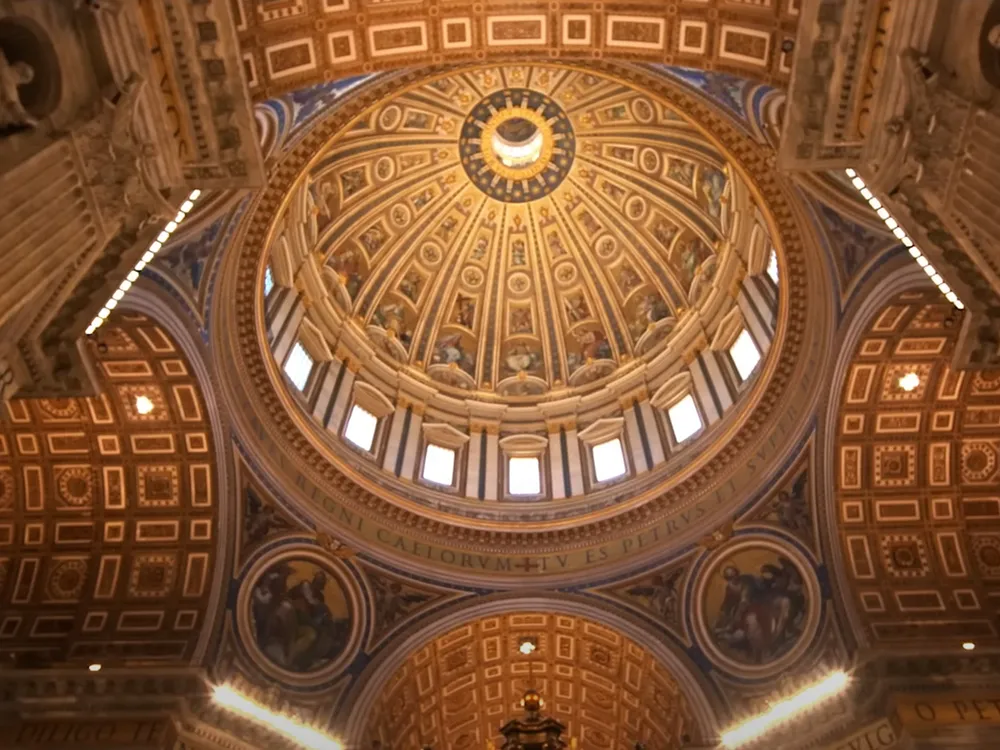
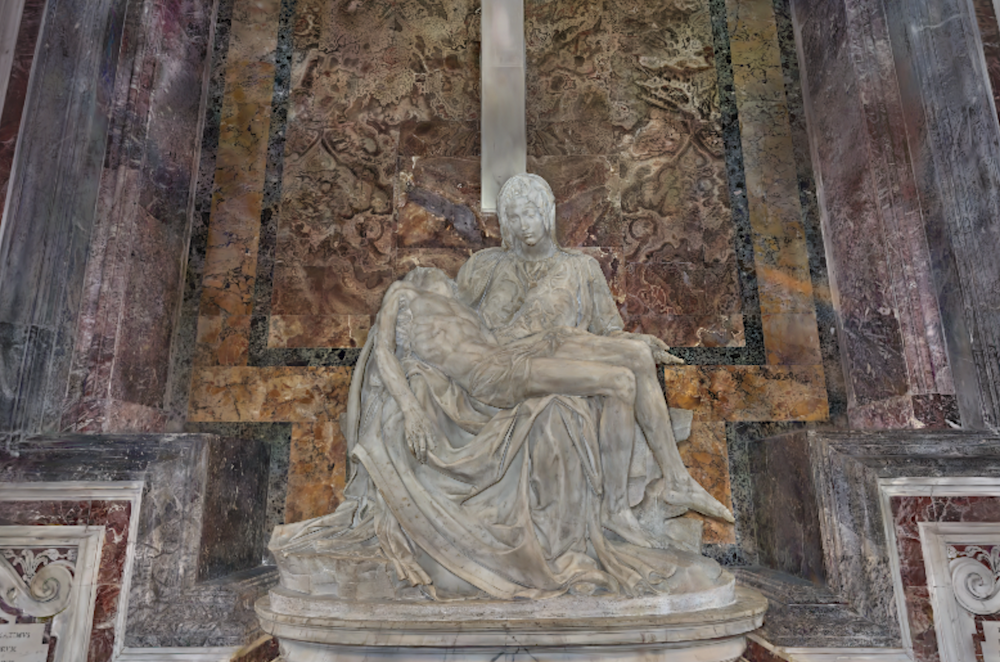
The 3D-replica project “has been launched ahead of the Vatican’s 2025 Jubilee, a holy year in which more than 30 million pilgrims are expected to pass through the basilica’s Holy Door, on top of the 50,000 who visit on a normal day,” Winfield writes. But no matter where in the world you happen to be, you can virtually enter St. Peter’s Basilica right now, and spend as long as you like, admiring the basilica itself, the cupola, Bernini’s St. Peter’s Baldachin, and Michelangelo’s Pietà, among other features.
However important (and attention-drawing) artificial intelligence was as a tool in the creation of this ultra-precise “digital twin” of St. Peter’s Basilica, the four-week process of capturing every detail of the real structure that could be captured also necessitated the use of drones, lasers, and cameras taking more than 400,000 digital photos. The “AI for Good Lab contributed advanced tools that refined the digital twin with millimeter-level accuracy, and used AI to help detect and map structural vulnerabilities like cracks and missing mosaic tiles,” says Microsoft’s site. “The Vatican oversaw the collaboration, ensuring the preservation of the Basilica as a cultural, spiritual, and historically significant site for years to come.”
It makes a certain sense to apply the highest technology of our time for the benefit of a building known as the greatest architectural marvel of its time. But in order to better appreciate the kind of knowledge that will be revealed by the 22 petabytes of information that went into the digital model (which offers its own guided tour) we’d do well to immerse ourselves first in what was already known about St. Peter’s Basilica. For a brief introduction to the conception and evolution of this grand church as it stands today, we could do much worse than architecture-and-history YouTuber Manuel Bravo’s video “St Peter’s Basilica Explained.” If you watch it, don’t be surprised if you find yourself tempted to engage in prolonged exploration of the model — or indeed, to book a visit to the real thing. Enter the digital St. Peter’s here.
Based in Seoul, Colin Marshall writes and broadcasts on cities, language, and culture. His projects include the Substack newsletterBooks on Cities and the book The Stateless City: a Walk through 21st-Century Los Angeles. Follow him on Twitter at @colinmarshall.
We're hoping to rely on loyal readers, rather than erratic ads. Please click the Donate button and support Open Culture. You can use Paypal, Venmo, Patreon, even Crypto! We thank you!
Open Culture scours the web for the best educational media. We find the free courses and audio books you need, the language lessons & educational videos you want, and plenty of enlightenment in between.