At the time of his death in 2018, Anthony Bourdain was quite possibly the most famous cook in the world. Without question he held the title of the most famous cook-traveler, a status resting primarily on No Reservations and Parts Unknown, the television shows he hosted on the Travel Chanel and CNN, respectively. But it all began with A Cook’s Tour, which the Food Network originally broadcast in 2002 and 2003. That series, Bourdain’s very first, took him from Japan to Morocco to Mexico to Australia to Thailand — and through many points in between — in search of the world’s most stimulating eating experiences.
During the launch phase of his rise to fame (after decades of restaurant work and years of writing, an effort that first produced a couple of food-themed murder-mystery novels), Bourdain managed to tap into a new wave of gastronomic interest then rising in America. He did so with a street-smart sense of humor that appealed even to viewers with no particular investment in the world of cooking and dining, as long as they had an interest in the world itself. With A Cook’s Tour, he took food television out of the kitchen — way out of the kitchen — and over the eighteen years since its conclusion, the series’ influence has become so pervasive as almost to be invisible. Anthony Bourdain may be gone, but parts of his personality live on in every high-profile traveler out there cooking, eating, and getting lost today.
Based in Seoul, Colin Marshall writes and broadcasts on cities, language, and culture. His projects include the Substack newsletterBooks on Cities, the book The Stateless City: a Walk through 21st-Century Los Angeles and the video series The City in Cinema. Follow him on Twitter at @colinmarshall or on Facebook.
Last year, when Turkish president Recep Tayyip Erdoğan announced that Hagia Sophia would be reconverted into a mosque, he assured a concerned UNESCO that changes to the 1,500-year-old former cathedral-turned-mosque would have “no negative impact” on its status as World Heritage Site. “A state must make sure that no modification undermines the outstanding universal value of a site listed on its territory,” the world body has said. Claims to the contrary notwithstanding, the “universal value” of the site does seem to have been undermined.
Designated a museum by the secular Turkish Republic in 1934, the site contains hundreds of years of history for both the Christian and Islamic worlds, and the shared heritage between them in the shifting mix of peoples who conquered, settled, and moved through the city first called Byzantium, then Constantinople, then Istanbul.
“The World Heritage site was at the centre of both the Christian Byzantine and Muslim Ottoman empires and is today one of Turkey’s most visited monuments,” Reuters noted last year.
The mosque is open to the public for prayers, and anyone can visit. What they’ll find — as you can see in this recent tour video — is ugly green carpeting covering the floor, and screens, panels, and plywood obscuring the Byzantine Christian art. (The same thing was done in the smaller Hagia Sophia in the city of Trabzon.) These changes are not only distressing for UNESCO, but also for lovers of art and history around the world, myself included, who had hoped to one day see the millennia-and-a-half of blended religious and aesthetic traditions for themselves.
It’s possible Turkish politics will allow Hagia Sophia to return to its status as a museum in the future, restoring its “universal value” for world history and culture. If not, we can still visit the space virtually — as it was until last year — in the 360 degree video views above, both of which allow you to look around in any direction as they play. You can also swivel around a spherical panoramic image at 360 cities.
The BBC video at the top narrates some of the significant features of the incredible building, once the largest church in the world, including its “colored marble from around the Roman Empire” and “10,000 square meters of gold mosaic.” Learn much more about Hagia Sophia history in the video above from Khan Academy’s executive directors (and former deans of art and history), Dr. Steven Zucker and Dr. Beth Harris.
“We’re all going on a summer holiday / no more working for a week or two,” sings Cliff Richard in one of his most famous songs. “Fun and laughter on a summer holiday / no more worries for me or you.” Like The Beatles’ ultra-northern “When I’m Sixty-Four,” with its cottage rentals on the Isle of Wight (“if it’s not too dear”), Richard’s “Summer Holiday” dates from a time in Britain when tourism was, as a rule, domestic. And so it has become again over the past couple of years, what with the coronavirus pandemic and its severe curtailment of international travel. Ever tuned in to current events, the pseudonymous graffiti artist Banksy has taken the opportunity to go on a “Great British Spraycation.”
This was a busman’s holiday for Banksy, who appears to have had a detailed plan of exactly which east-coast resort towns to visit, and exactly where in each of them to surreptitiously create another of his signature pieces of high-contrast satirical art.
“The stenciled pieces are often integrated with repurposed objects from the area, highlighting the pre-planned and perfectly positioned nature of the work,” writes Designboom’s Kat Barandy. “In Lowestoft, a massive seagull dines on a box of ‘chips’ rendered by a dumpster filled with insulation material. Nearby a child is depicted building a sandcastle with a crowbar, fronted by a mound of sand on the pavement.”
That work, Arts University Bournemouth professor Paul Gough tells the BBC for its guide to the Great British Spraycation, may be a reference to the 1968 Paris student uprising and its slogan “Sous les pavés, la plage!” You can see these and other fresh works documented in the video at the top of the post, which also catches the reactions of passing locals and tourists. “That looks all like mindless vandalism, that,” says one woman, articulating a common assessment of Banksy’s artistic statements. “It looks a lot better from far away than it does when you get this close,” says another. But the most telling comment, in a variety of respects, comes from a man regarding Banksy’s addition of a cartoonish tongue and ice cream cone to the statue of 19th-century mayor Frederick Savage in King’s Lynn: “Yeah, someone’s done that, ain’t they?”
Based in Seoul, Colin Marshall writes and broadcasts on cities, language, and culture. His projects include the Substack newsletterBooks on Cities, the book The Stateless City: a Walk through 21st-Century Los Angeles and the video series The City in Cinema. Follow him on Twitter at @colinmarshall or on Facebook.
Anyone who’s taken the train into the city from Bushwick or Williamsburg two or three times, you should be able to chant along with no trouble.
“Mind the gap!” is a sentimental favorite of both native Londoners and first time visitors navigating The Tube with freshly purchased Oyster Cards.
Civil engineer Ted Green has been documenting the mass transit sounds that cue passengers that the subway doors are about to close since 2004, when he logged 26 seconds on the Piccadilly Line in London’s Russell Square Station:
In 2003 I used the Russell Square station daily for a week and it’s the first announcement that caught my attention… Back then the Piccadilly Line did not have on-train station and door closing announcements, it had the beeps, but the stations in central London had automatic announcements from platform speakers aimed at the open train door. Once the Piccadilly Line received on-train announcements a few years later, this announcement was phased out.
Over the course of a decade, the project has expanded to encompass announcements on suburban rail, railways, trams, and light rail.
His travels have taken him to Asia, Australia, Europe, and North America, where curiosity compels him to document what happens during “dwell time,” the brief period when a train is disgorging some riders and taking on others.
Whether the canned recording is verbal or non-verbal, the intent is to keep things moving smoothly, and prevent injuries, though passengers can become blasé, attempting to force their way on or off by thrusting a limb between closing doors at the absolute last minute.
Green’s incredibly popular video compilations aren’t nearly so harrowing.
I think the appeal is the simplicity. You wonder, how can there be so many different variations of beeps? And then you listen, and they’re all so different.
The pandemic only increased his audience, as locked down commuters found themselves longing for the soundtrack of normal life.
And Brooklyn-based Metropolitan Transit Authority worker Fred Argoff’s zine Watch the Closing Doors ushered civilians behind the scenes, sometimes exploring other cities’ subway systems or, in the case of Cincinnati, lack thereof.
Readers, do you have a fondness for a particular underground sound? Tell us what and why in the comments.
As Chris Hedges discovered as a battle-hardened reporter, war is a force that gives us meaning. Whether we sublimate violence in entertainment, have paid professionals and state agents do it for us, or carry it out ourselves, human beings cannot seem to give up their most ancient vice; “we demonize the enemy,” Hedges wrote, “so that our opponent is no longer human,” and “we view ourselves, our people, as the embodiment of absolute goodness…. Each side reduces the other to objects — eventually in the form of corpses.” Each new generation inherits old hatreds, and so forth.…
Maybe one way to break cycles of violence is with controlled violence — using bare fists to settle scores, and walking away with only bruises, a little hurt pride, but no lasting wounds? That’s the idea behind Takanakuy, an Andean festival that takes place each year at Christmas in the province of Chumbivilcas, in the mountains of Peru. The region has a police force made up of around three officers, the nearest courthouse is “a stomach-wrecking 10-hour drive through the mountains,” notes Vice, who bring us the video above. Potentially explosive disputes naturally arise, and must be settled outside the law.
Rather than rely on state intervention, residents wait to slug it out on Takanakuy. The name of the festival come from Quechua — the region’s indigenous language — and means “to hit each other” or, more idiomatically, “when the blood is boiling.” But combatants have had upwards of twelve months to cool before they step into a ring of cheering spectators and go hand-to-hand with an opponent. Fights are also officiated by referees, who do crowd control with short rope whips and call a fight as soon as someone goes down. Takanakuy is ritualized combat, not bloodsport. Although traditionally dominated by men, women, and children also participate in fights, which usually only last a couple minutes or so.
“Some traditionalists disapprove of female participation in Takanakuy,” writes photojournalist Mike Kai Chen at The New York Times, but “an increasing number of women in Chumbivilcas are defying convention and stepping up to fight in front of their community.” Male fighters wear boots, flashy leather chaps, and elaborate, hand-sewn masks with taxidermied birds on top. Women wear elegant dresses with fine embroidery, and wrap their wrists in colorful embroidered cloth. “The ultimate aim is to begin the new year in peace. For this reason every fight… begins and ends with a hug”… or, at the very least, a handshake.
The festival also involves much dancing, eating, drinking, craft sales, and Christmas celebrations. Suemedha Sood at BBC Travel compares Takanakuy to Seinfeld’s “Festivus,” the alt-winter holiday for the airing of grievances and feats of strength. But it’s no joke. “The festival seeks to resolve conflict, strengthen community bonds and hopefully, arrive at a greater peace.” Libertarian economists Edwar Escalante and Raymond March frame Takanakuy as “a credible mechanism of law enforcement in an orderly fashion with social acceptance.” For indigenous teacher and author and participant Victor Laime Mantilla, it’s something more, part of “the fight to reclaim the rights of indigenous people.”
“In the cities,” says Mantilla, “the Chumbivilcas are still seen as a savage culture.” But they have kept the peace amongst themselves with no need for Peruvian authorities, fusing an indigenous music called Huaylia with other traditions that date back even before the Incas. Takanakuy arose as a response to systems of colonial oppression. When “justice in Chumbivilcas was solely administered by powerful people,” Mantilla says, “people from the community always lost their case. What can I do with a justice like that? I’d rather have my own justice in public.”
Both authors had a connection to Bath, a popular tourist destination since 43 CE, as evidenced by the ruins of the Roman thermal spa that give the city its name and UNESCO World Heritage Site status.
Bath has long mined its connection to Austen, but in embracing Shelley, it stands to diversify the sort of literary pilgrims it appeals to.
Visitors to the Jane Austen Centre can try on bonnets, exchange witty repartee with one of her characters, nibble scones with Dorset clotted cream in the tea room, and participate in an annual costume promenade.
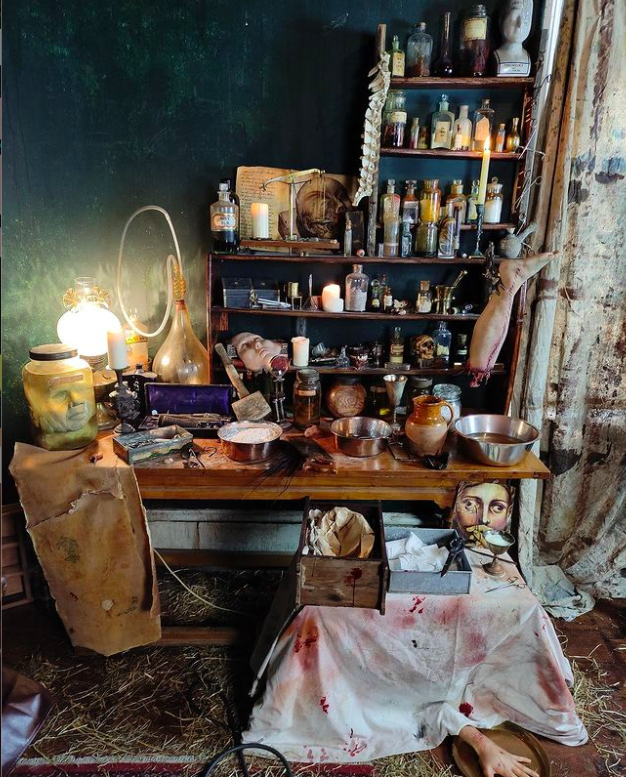
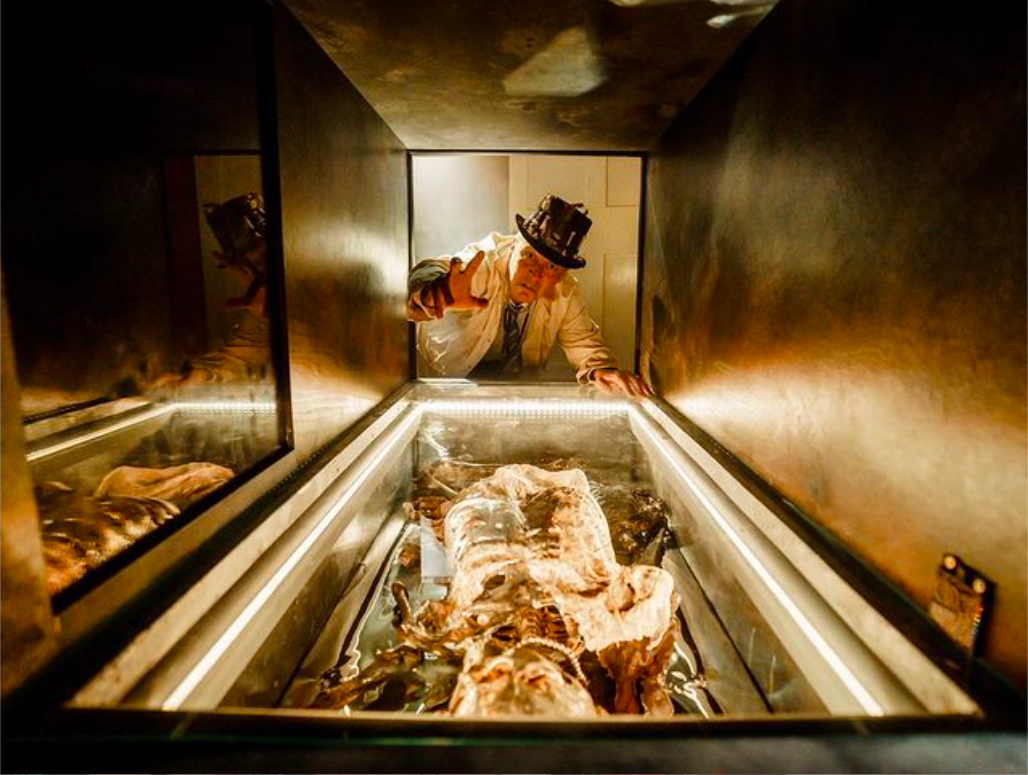
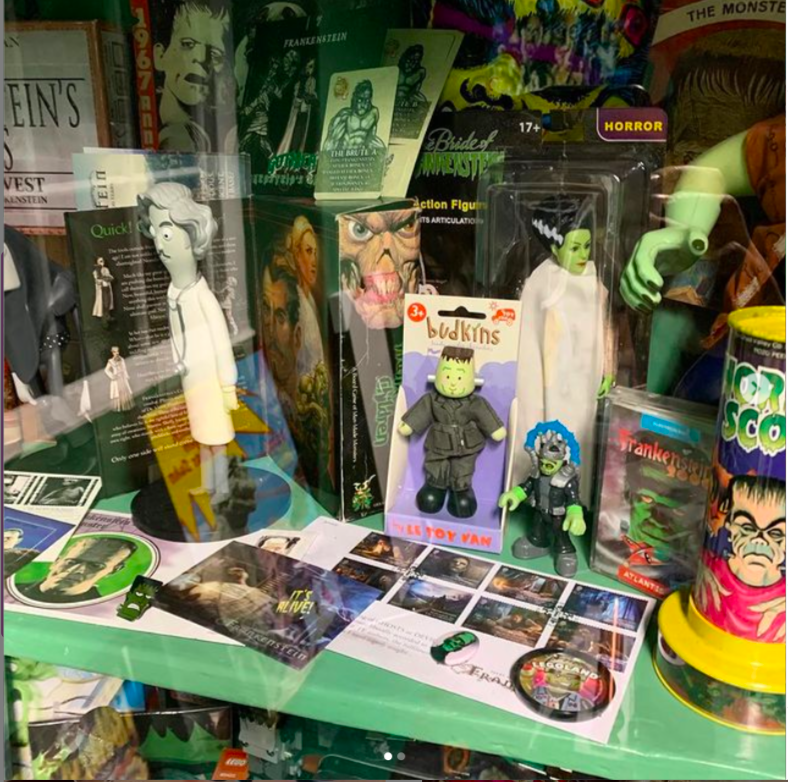
Meanwhile, over at the House of Frankenstein, expect ominous, unsettling soundscapes, shocking special effects, ghoulish interpreters in blood-spattered aprons, “bespoke scents,” a “dank, foreboding basement experience” and an 8‑foot automaton of you-know-who.
(No, not Mary Shelley!)
Coming soon — Victor Frankenstein’s “miserable attic quarters” repackaged as an escape room “strewn with insane equations, strange artefacts, and miscellaneous body parts.”
Co-founder Chris Harris explains the creators’ immersive philosophy:
We are trying to play on people’s fears, but we’re not taking ourselves massively seriously. With Mary Shelley’s House of Frankenstein, we are creating an experience that, hopefully, people will really enjoy in a visceral way. We want them to come out feeling that the experience was unnerving, but also feeling happy. That’s the ultimate aim.
The BBC reports that the attraction also promises to explore Shelley’s “tragic personal life, literary career and the novel’s continuing relevance today in regards to popular culture, politics, and science.”
May not be suitable for children (or timorous Austen fans) as it contains “ominous and foreboding audio and visual effects, darkened environments and some scenes and depictions of a disturbing nature.”
The Venus de Milo is one of art’s most widely recognized female forms.
The Mona Lisa may be the first stop on many Louvre visitors’ agendas, but Venus, by virtue of being unclothed, sculptural, and prominently displayed, lends herself beautifully to all manner of souvenirs, both respectful and profane.
Renoir is that rare bird who was impervious to her 6’7” charms, describing her as the “big gendarme.” His own Venus, sculpted with the help of an assistant nearly 100 years after the Venus de Milo joined the Louvre’s collection, appears much meatier throughout the hip and thigh region. Her celebrity cannot hold a candle to that of her armless sister.
In the Vox Almanac episode above, host Phil Edwards delves into the Venus de Milo’s appeal, taking a less delirious approach than sculptor Auguste Rodin, who rhapsodized:
…thou, thou art alive, and thy thoughts are the thoughts of a woman, not of some strange, superior being, artificial and imaginary. Thou art made of truth alone, outside of which there is neither strength nor beauty. It is thy sincerity to nature which makes thee all powerful, because nature appeals to all men. Thou art the familiar companion, the woman that each believes he knows, but that no man has ever understood, the wisest not more than the simple. Who understands the trees? Who can comprehend the light?
Edwards opts instead for a Sharpie and a tiny 3‑D printed model, which he marks up like a plastic surgeon, drawing viewers’ attention to the missing bits.
The arms, we know.
Also her earlobes, most likely removed by looters eager to make off with her jewelry.
One of her massive marble feet (a man’s size 15) is missing.
Interestingly, the plinth was among the items discovered by accident on the Greek island of Milos in 1820, along with two pillars topped with busts of Hercules and Hermes, the bisected Venus, and assorted marble fragments, including — maybe — an upper arm and hand holding a round object (a golden apple, mayhaps?)
What he’s most interested in is that plinth, which would have given the lie to the long-standing assertion that the Venus de Milo was created in the Classical era.
This incorrect designation made the Louvre’s newest resident a most welcome replacement for the loot France had been compelled to return to the Vatican in the wake of Napoleon’s first abdication.
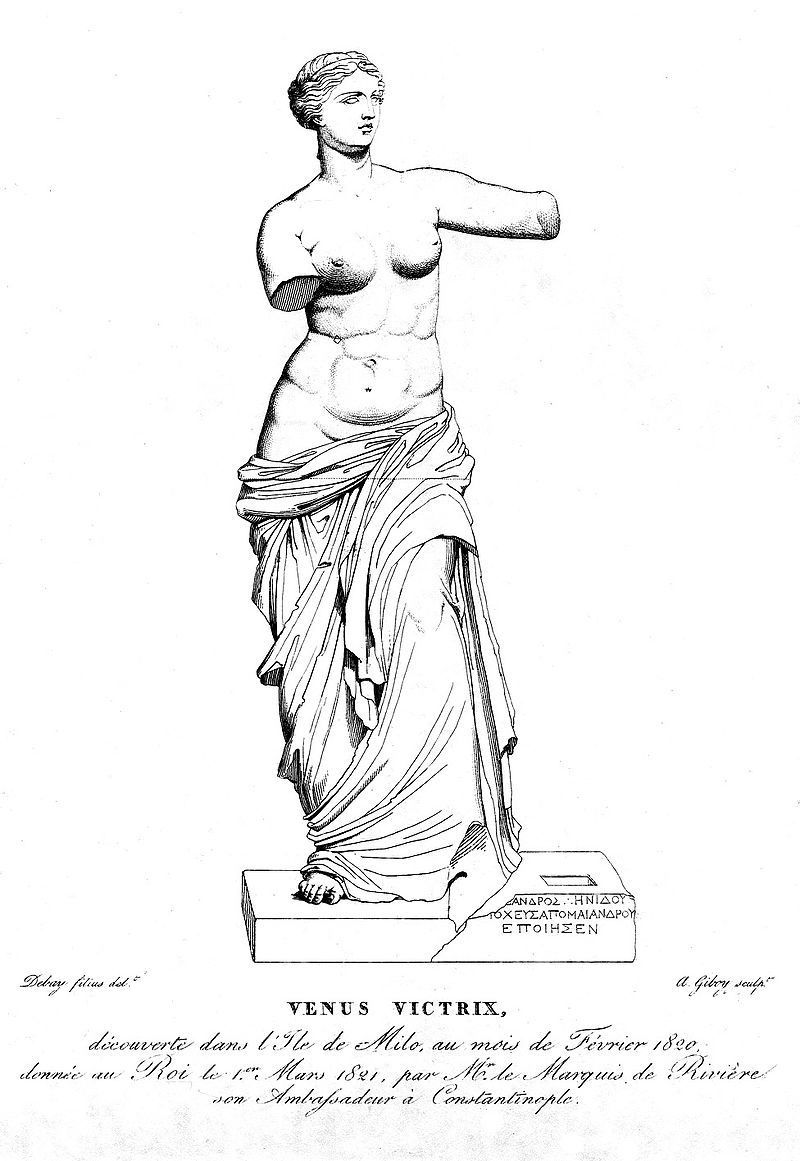
The plinth may have been “lost” under mysterious circumstances, but its inscription was preserved in a sketch by A. Debay, whose father had been a student of Jacques-Louis David, Napoleon’s now-banished First Painter, a Neo-Classicist.
(David’s final painting, Mars Disarmed by Venus and the Three Graces, completed a couple of years after Venus de Milo was installed in the Louvre, was considered a bust.)
Debay’s faithful recreation of the plinth’s inscription as part of his study of the Venus de Milo offers clues as to her creator — “ …andros son of …enides citizen of …ioch at Meander made.”
It also dates her creation to 150–50 BCE, corroborating notes French naval officer Jules d’Urville had made in Greece weeks after the discovery.
The birth of this Venus should have been attributed to the Hellenistic, not Classical period.
Had her true author been known, she likely would’ve been locked away in the museum’s archive, if not sold off. Hellenistic art had by then been denigrated by Renaissance scholars who re-conceived it in anti-classical terms, finding in its expressive, experimental form and emotional content a provocative realism that defied everything their era stood for: modesty, intellect, and equanimity…It helped that the Venus de Milo possessed several classical attributes. Her strong profile, short upper lip, and smooth features, for example, were in keeping with Classical figural conventions, as was the continuous line connecting her nose and forehead. The partially-draped figure with its attenuated silhouette – which the Regency fashion of the day imitated with its empire bust-line – also recalled classical sculptures of Aphrodite, and her Roman counterpart, Venus. Yet despite all these classical identifiers, the Venus de Milo flaunted a definitive Hellenistic influence in her provocatively low-slung drapery, high waist line, and curve-enhancing contrapposto—far more sensual and exaggerated than classical ideals allowed.
It took the Louvre over a hundred years to come clean as to its star sculpture’s true provenance.
What happened to the plinth remains anyone’s guess.
The only mystery the museum’s website seems concerned with is one of identity — is she Aphrodite, goddess of beauty, or Poseidon’s wife, Amphitrite, the sea goddess worshipped on the island on which she was discovered?
New Yorkers’ relationship to New York City community gardens is largely informed by how long we’ve lived here.
Do you remember the 60s, when a fiscal crisis and white flight resulted in thousands of vacant lots and abandoned buildings in low income neighborhoods?
Activists like Hattie Carthan and Liz Christy sprung from such soil, creating youth programs, hauling away debris, and putting constant pressure on elected officials to transform those urban wastelands into green oases.
Verdant sites like the Bowery Houston Community Farm and Garden (now known as the Liz Christy Garden) improved air quality, lowered temperatures, and offered a pleasant gathering place for neighbors of all ages.
In the ‘80s, the city boasted 1000 community gardens, mostly in neighborhoods considered blighted. School aged children learned how to plant, tend, and harvest vegetables. Immigrant members introduced seeds new to American-born gardeners, to help combat both homesickness and food insecurity. On site arts programs flourished. There were al fresco birthday parties, concerts, movie screenings, holiday celebrations, permaculture classes, community meetings…. Gardens became focal points for community engagement. Participants were understandably proud, and invested in what they’d built.
As Yonnette Fleming, founder of the community-led market at the Hattie Carthan Community Garden and Farmer’s Market, says in the above episode of Vox’sMissing Chapter: “Community gardens grow communities, for the people, to be run by the people, for the benefit of the people.”
Traditionally low-rise neighborhoods like the East Village and Brooklyn’s Bed-Stuyvesant would become increasingly fashionable during the early days of the new millennium. New arrivals with little interest in neighborhood history might assume that the sidewalks had always been lined with cute cafes and hipster bars, not to mention trees. (In reality, Carthan was 64 when she began her successful campaign to line Bed-Stuy with trees, and landmark a venerable Magnolia that was at risk of being torn down.)
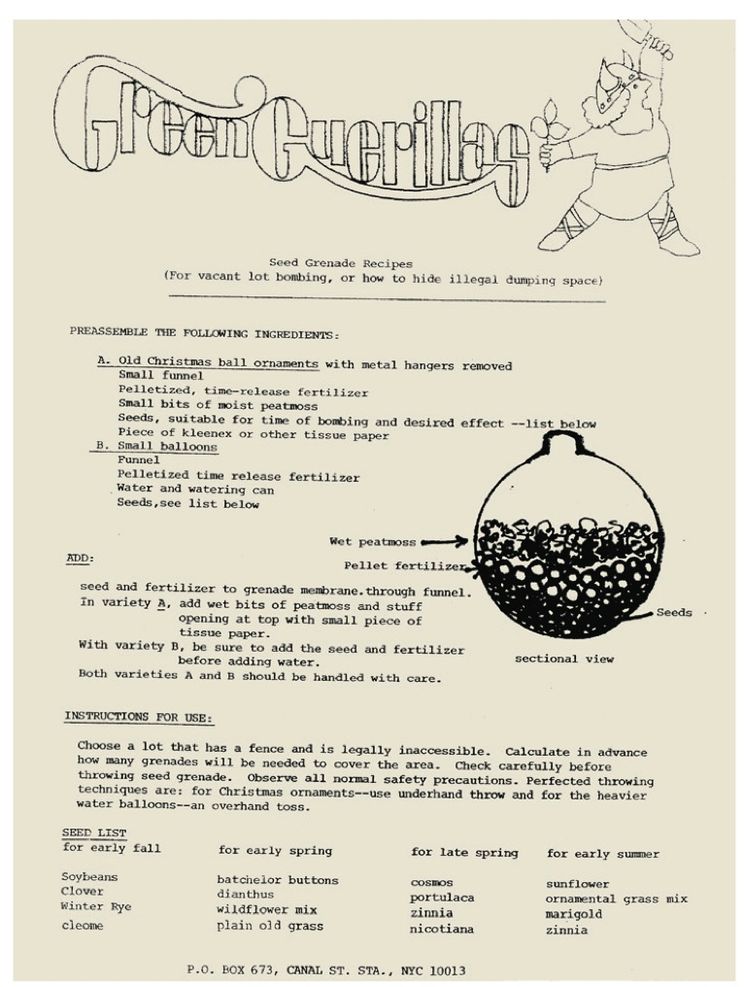
Perhaps hoping to command younger viewers’ attention, Vox’s Missing Chapter opens not with the rich history of New York City’s community gardens, but rather the many recipes for seed bombs on TikTok. The glass half full perspective on our 500-strong surviving gardens can ring a bit empty to those who lost the fight to preserve a number of East Harlem gardens just a few short years ago.
Don’t forget your roots! Christy’s typewritten, hand illustrated Green Guerillas recipe for seed bombs is below. (If you want to try it at home, please use seeds native to your area.)
We're hoping to rely on loyal readers, rather than erratic ads. Please click the Donate button and support Open Culture. You can use Paypal, Venmo, Patreon, even Crypto! We thank you!
Open Culture scours the web for the best educational media. We find the free courses and audio books you need, the language lessons & educational videos you want, and plenty of enlightenment in between.