We previously thought that the first use of the “F word” dated back to 1528 — to when a monk jotted the word in the margins of Cicero’s De Officiis. But it turns out that you can find traces of this colorful curse word in English court documents written in 1310.
Dr. Paul Booth, a former lecturer in medieval history at Keele University, was looking through court records from the age of Edward II when he accidentally stumbled upon the name “Roger Fuckebythenavele.” The name was apparently used three times in the documents, suggesting it was hardly a mistake. According to The Daily Mail, Booth believes “Roger Fuckebythenavele” was a nickname for a defendant in a criminal case. And, going further, he suggests the nickname could mean one of two things: ‘Either this refers to an inexperienced copulator, referring to someone trying to have sex with the navel, or it’s a rather extravagant explanation for a dimwit, someone so stupid they think this that is the way to have sex.’ Booth has notified the Oxford English Dictionary of his discovery.
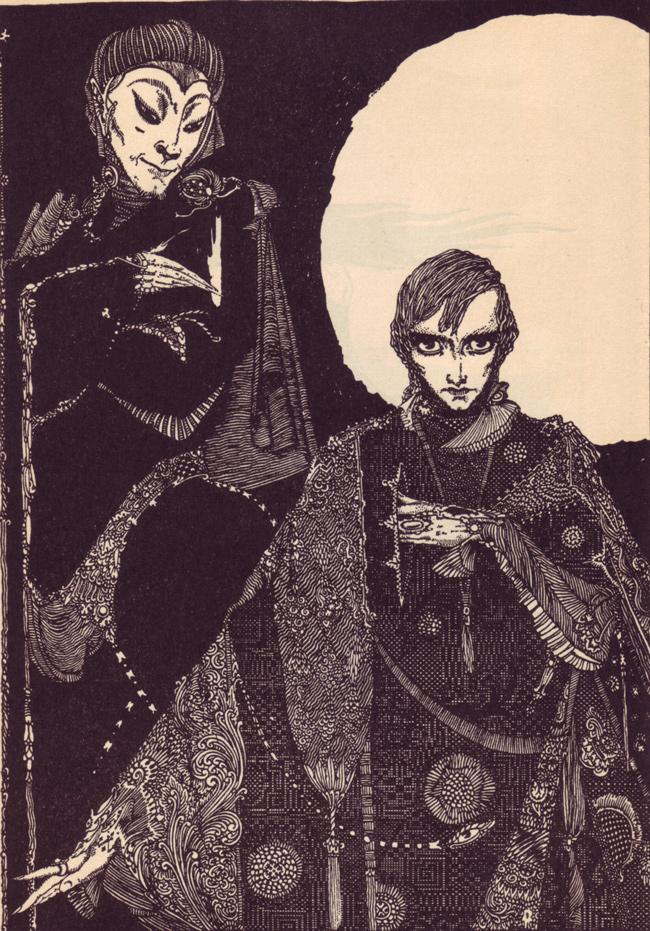
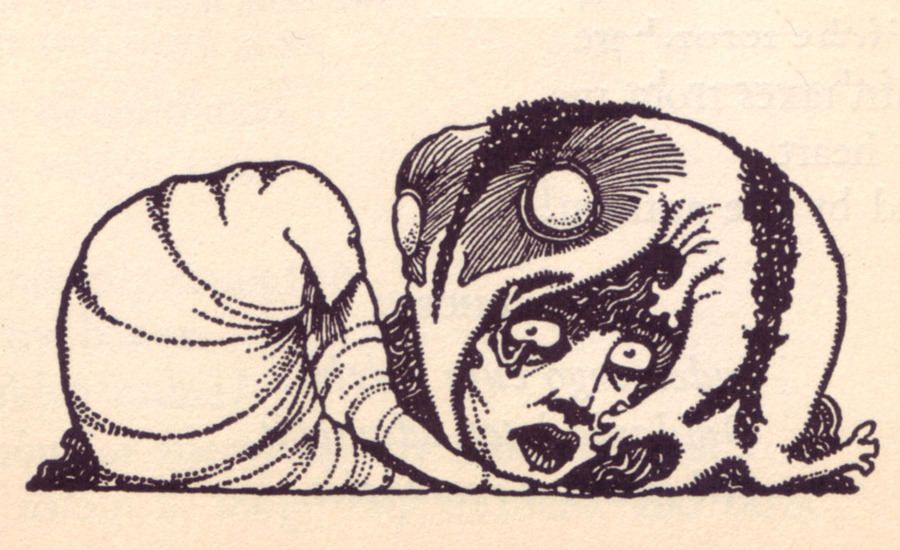
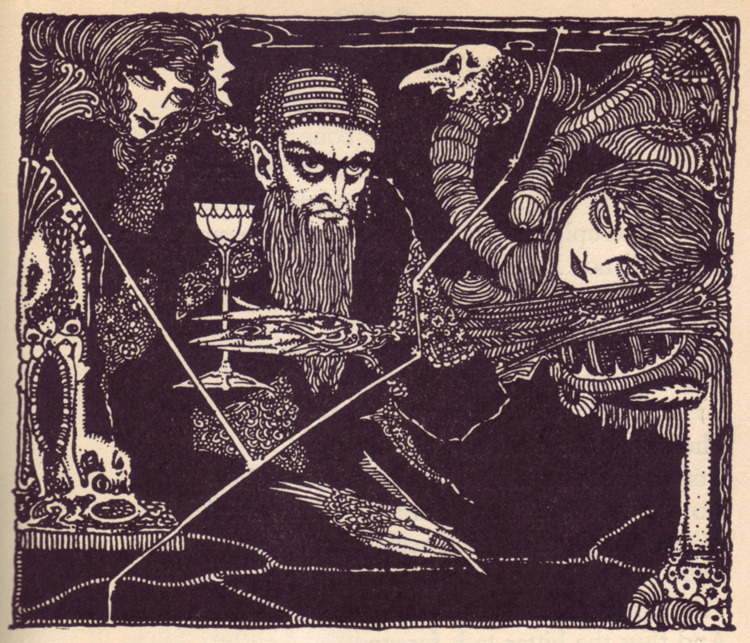
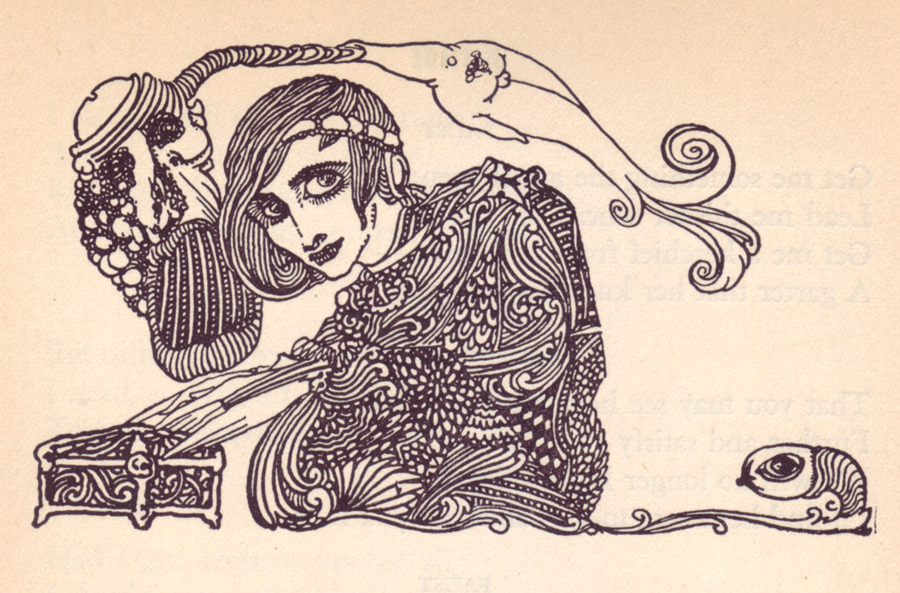
Evoking the playful grotesques of Shel Silverstein, the gothic gloom of Neil Gaiman’s Sandman comics, the occult beauty of the Rider-Waite tarot deck, and the hidden horrors of H.P. Lovecraft, Harry Clarke’s illustrations for a 1926 edition of Goethe’s Faustare said to have inspired the psychedelic imagery of the 60s. And one can easily see why Clarke’s disturbing yet elegant images would appeal to people seeking altered states of consciousness. Clarke, born in Dublin in 1889, came to prominence as an illustrator of imaginative literature—by Hans Christian Andersen, Edgar Allan Poe, and others—though he worked primarily as a designer, with his brother, of stained glass windows. Faust was the last book he illustrated, and the most fantastic.
Clarke (1889 — 1931) drew his inspiration from the Art Nouveau movement that began in the previous century with artists like Aubrey Beardsley and Gustav Klimt. We see the influence of both in Clarke’s gaunt, elongated figures and his interest in unusual, organic patterns and ornamentation. We can also see—mentions an online Tulane University exhibit of his work—the influence of his own stained glass work, “through use of heavy lines in his black and white illustrations.” The blog Garden of Unearthly Delights notes that “initially Harraps, the publisher, did not like the drawings (Clarke recalled that they thought the work was ‘full of steaming horrors’), and many of the illustrations were finished under pressure.”
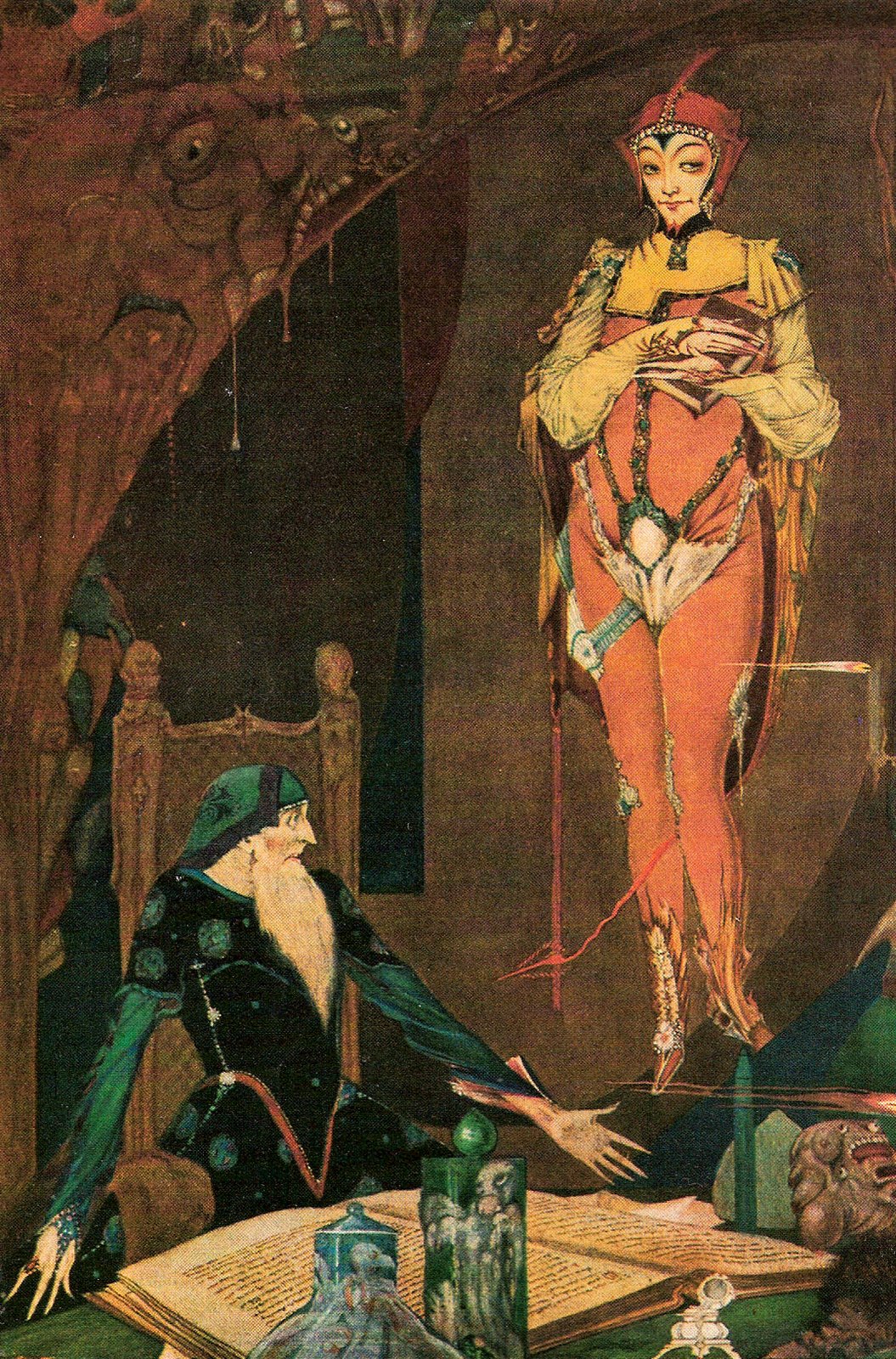
Despite the publisher’s reservations, reviews of the 2,000-copy limited edition were largely positive. Reviewers praised the drawings for their “distinctive charms” and “wealth of fantastic invention.” One critic for the Irish Statesman wrote, “Clarke’s fertility of invention is endless. It is shown in the multitude of designs less elaborate than the page plates, but no less intense.” The “page plates” referred to eight full-color, full-page illustrations like the painting of Faust and Mephistopheles above. Additionally, the book contains eight full-page ink wash illustrations, six full-page illustrations in black and white, and sixty-four smaller black and white vignettes.
You can read the Clarke-illustrated poem online here, with the illustrations reproduced, albeit badly. (Also download the text in various formats at Project Gutenberg.) To see many more higher-quality digital scans like the ones featured here, visit 50 Watts and The Garden of Unearthly Delights, which also brings us more quotations from reviewers, including “a negative review of the drawings” that sums up what we might—and what those 60s revivalists surely did—find most appealing about Clarke’s illustrations. They present, wrote a critic in the magazine Artwork,
A dream world of half-created fantasies; the powerless fancies of senile visions; misshapen bodies with wormlike heads; staring eyes of octopuses and reptiles gaze like ponderous saurian of the lost world, while half-finished homunculi change like “plasma” in forms unbound by reason.
That last phrase, “unbound by reason,” could also apply to the weird, nightmarish pilgrimage of Goethe’s hero, and to the shaking off of old strictures that artists like Clarke, his fin de siècle predecessors, and his psychedelic successors strove to achieve.
By the time she got the all clear, both of us had large portions of it committed to memory.
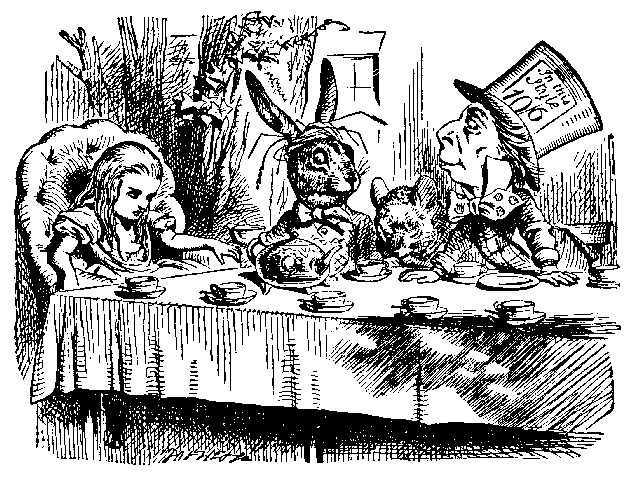
Christopher, I treasure the memories of those long hours spent together on cassette, but I’m afraid I’ll be spending the 150th anniversary of Alicewith Sir John Gielgud, below.
The celebrated dry wit that served him so well throughout his illustrious career keeps this 1989 Alice very easy on the ears. He takes the opposite approach from Plummer, underplaying the character voices. It’s rare to find a gentleman of 85 who can play a 7‑year-old girl so convincingly, and with so little fuss.
A bustling seaport city on the west coast of Canada, Vancouver is a big movie production town. In fact, it’s the third biggest film production city in North America, right behind LA and New York. And yet you wouldn’t know it. Because Vancouver never plays itself. It always masquerades in movies as other cities — New York, Seattle, Santa Barbara and beyond.
Zhou shows you just how this deception gets pulled off, again and again.
It is the year 2019. The world is overcrowded. Decaying. Mechanized. Android slaves, programmed to live for only four years, are technological marvels — strong, intelligent, physically indistinguishable from humans. Into this world comes a band of rebel androids. Desparate to find the mastermind who built them, bent on extending their life span, they will use all their superhuman strength and cunning to stop anything — or anyone — who gets in their way. Ordinary people are no match to them. Neither are the police. This is a job for one man only. Rick Deckard. Blade Runner.
Thus opens the novel Blade Runner: A Story of the Future. But even if you so enjoyed Ridley Scott’s Blade Runner that you went back and read the original novel that provided the film its source material, these words may sound unfamiliar to you, not least because you almost certainly would have gone back and read Philip K. Dick’s Do Androids Dream of Electric Sheep?, the real object of Blade Runner’s adaptation. When the movie came out in 1982, out came an edition of Do Androids Dream of Electric Sheep? re-branded as Blade Runner: Do Androids Dream of Electric Sheep? — and out as well, confusingly, came Blade Runner: A Story of the Future, the novelization of the adaptation.
Who would read such a thing? Movie novelizations have long since passed their 1970s and 80s pre-home-video prime, but in our retro-loving 21st century they’ve inspired a few true fans to impressive demonstrations of their enjoyment of this specialized form of literature. “They’re special to me because when I was younger there were a lot of films I desired to see but didn’t get to, and the novelizations were sold at the Scholastic Book Fairs,” says enthusiast Josh Olsen in an interview with Westword, who describes his books of choice as “adapted from films, or early drafts of films at least, locked with short deadlines and printed cheaply and perfunctorily and end up being part of the movie’s massive marketing universe. Basically, it’s the literary equivalent of the McDonald’s cup from back in the day.”
And so we have Audiobooks for the Damned, Olsen’s labor of love that has taken over thirty of these novelizations (all out of print) and adapted them yet one stage further. You can hear all of them on the project’s Youtube page, from Blade Runner: A Story of the Future(an easy starting place, since the novelization’s scant eighty pages make for a listening experience considerably shorter than the movie itself) to The Terminator to Videodrome. And if you’d like to spend your next cross-country drive with such cherished kitsch classics as Poltergeist, The Brood, Over the Edge, or The Lost Boys in unabridged (and unsubtle) prose form, you can get them on their featured audiobook page. This all delivers to us the obvious next question: which bold, nostalgic Millennial filmmaker will step forward to turn all these extremely minor masterworks back into movies again?
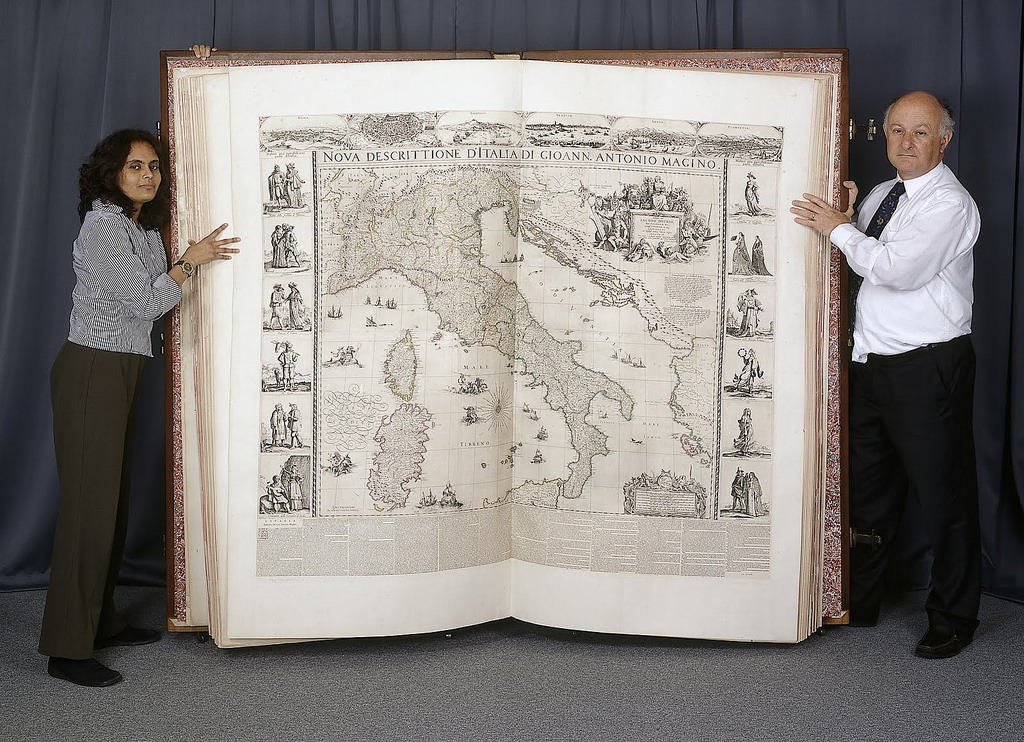
Last week, we featured the free digital edition of the The History of Cartography. Or what’s been called “the most ambitious overview of map making ever undertaken.” The three-volume series contains illustrations of countless maps, produced over hundreds of years. And it, of course, references this fine specimen: A gift given to England’s Charles II in 1660, The Klencke Atlas featured state-of-the-art maps of the continents and various European states. It was also notable for its size. Standing six feet tall and six feet wide (when opened), the volume remains 355 years later the largest atlas in the world. Learn more about it with the BBC clip below.
If you would like to support the mission of Open Culture, consider making a donation to our site. It’s hard to rely 100% on ads, and your contributions will help us continue providing the best free cultural and educational materials to learners everywhere. You can contribute through PayPal, Patreon, and Venmo (@openculture). Thanks!
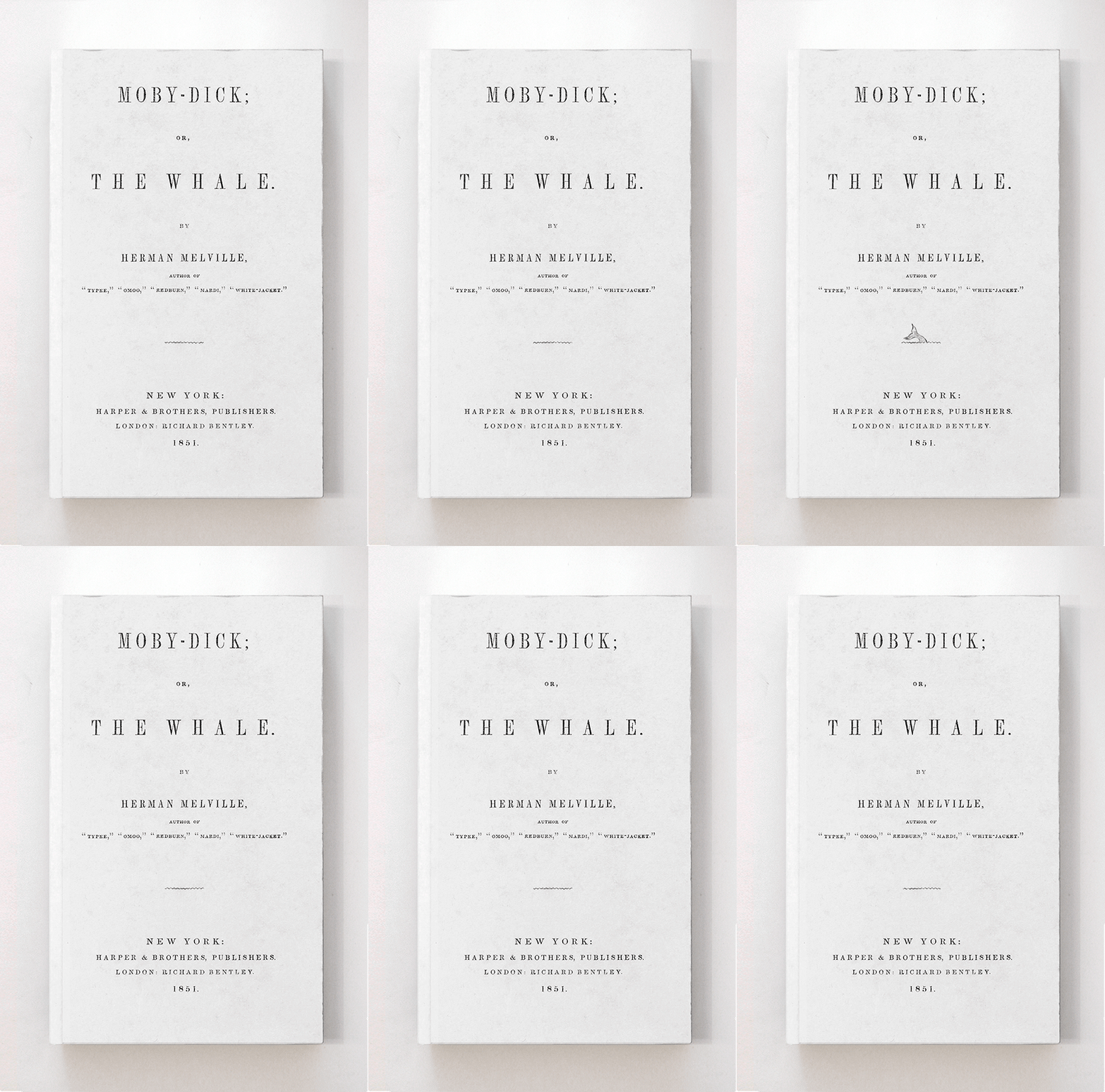
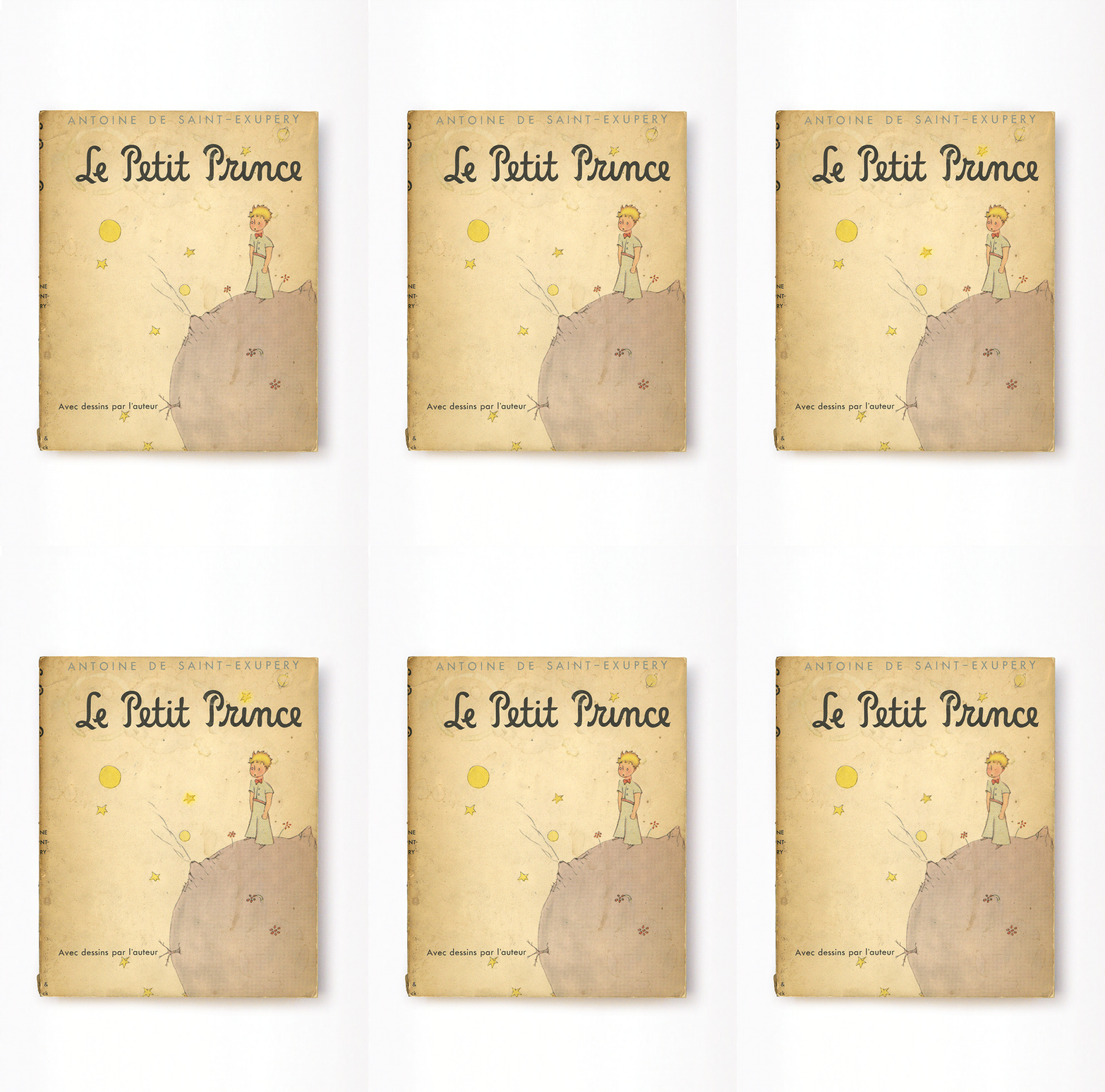
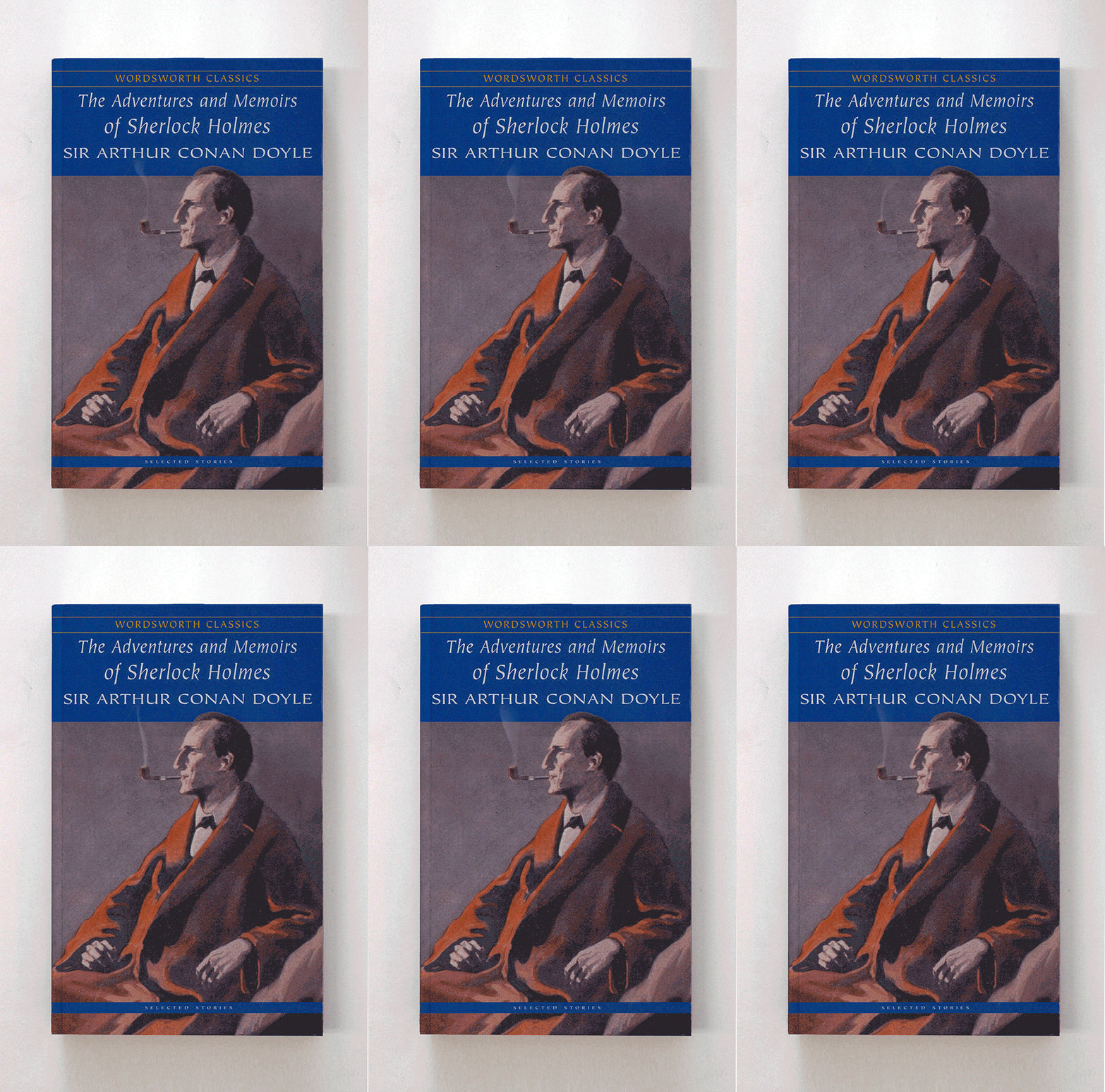
Javier Jensen, an artist living down in Santiago, Chile, has breathed a little life into some beloved book covers. And when I say little, I mean little. His animated touches are nicely understated, hardly distracting from the original cover designs.
“I used to be OBSESSED with Japanese culture,” wrote an uncommonly thoughtful Youtube commenter. “I miss that part of me. Trying to search for it again. That’s when I was the happiest.” Many of us westerners — or really, many of us non-Japanese — go through similar periods of affinity and avidity for all things Japanese. Some of us put it away with our childish things; some of us make Japanese culture a lifelong interest, or even the stuff of our professions. I myself got into Japan early, at some point found myself put off by the just slightly too obsessive Japanese pop-culture fan community in the West (though I admittedly read that comment below a music video with four million views), and later returned with a much more serious intent to understand.
But to understand what? The Japanese language, certainly, and Japanese film, Japanese cities, Japanese aesthetics, Japanese technology — all the fruits of the culture that stoke in the rest of the world both deep envy and, sometimes, faint suspicion. Why do they persist in using writing systems that, despite their considerable beauty, come with such aggravating difficulty? The comprehensive subway networks in metropolises like Tokyo and Osaka function day in and day out with astonishing reach and reliability, but why do their riders tolerate crowdedness even to the point of getting uncomplainingly crammed inside the cars by white-gloved attendants? And why, despite the Japanese love for elegant design and advanced consumer technology, do their web sites look so jumbled and confusing?
NHK World can put you on the road to understanding these and other questions with Japanology, their series of English-language documentaries exploring the things large and small, all surprising to the foreigner, that make up the fabric of Japanese life. BEGIN Japanology, their series for the Japan-intrigued but not necessarily Japan-experienced, has come to six seasons so far.
At the top of the post, you can see its episode on bento, those painstakingly prepared lunch boxes, simplified versions of which even those who know nothing of Japan have seen at grocery stores the world over. To learn more about bento’s place in Japanese culture, proceed on to the relevant episode of Japanology Plus, NHK’s series for the even more insatiably curious Japanophile. And couple with an episode on Ramen above.
Japanology Plus also dedicates one of its half-hour programs to the Shinkansen, commonly known as the “bullet train,” that quintessentially Japanese mode of transportation that, with its impeccable half-century record of speed, safety, and punctuality, has become the pride of the land. (I, for one, hold out hope that Obama will make The Onion’s “Ambitious Plan to Fly Americans to Japan to Use Their Trains” a reality.) But if you don’t feel quite ready yet to board a Shinkansen, much less learn about its inner workings, try the Begin Japanology Special Mini series, which offers five-minute distilled documentaries on such icons of Japan as tea gardens, hot springs, and Mount Fuji. Watching all these, I feel glad indeed that I’ve already got the tickets booked for my next flight over there. Do you have yours?
Living in New York, it’s not unusual to encounter ardent theater lovers who’ve carefully preserved decades worth of programs, tickets, and ephemera from every play they’ve ever seen. These collections can get a bit hoarder‑y, as anyone who’s ever sorted through the belongings of a recently departed lifelong audience member can attest.
If theater is dead — as gloomy Cassandras have been predicting since the advent of screens — these monoliths of Playbills and stubs constitute one hell of a tomb.
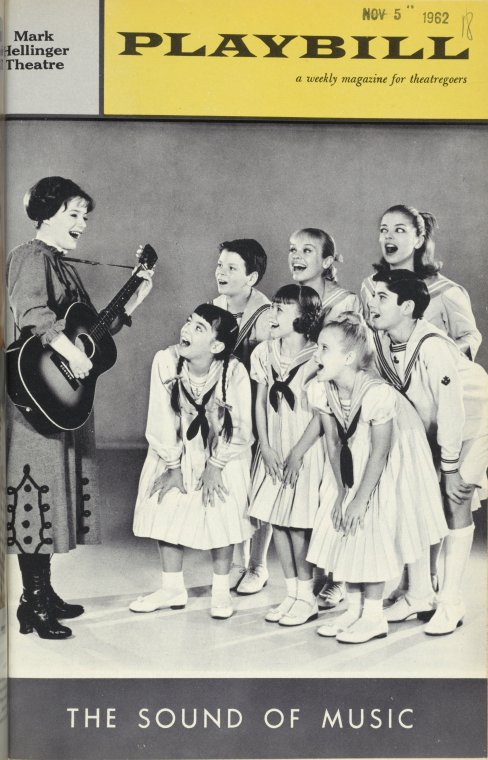
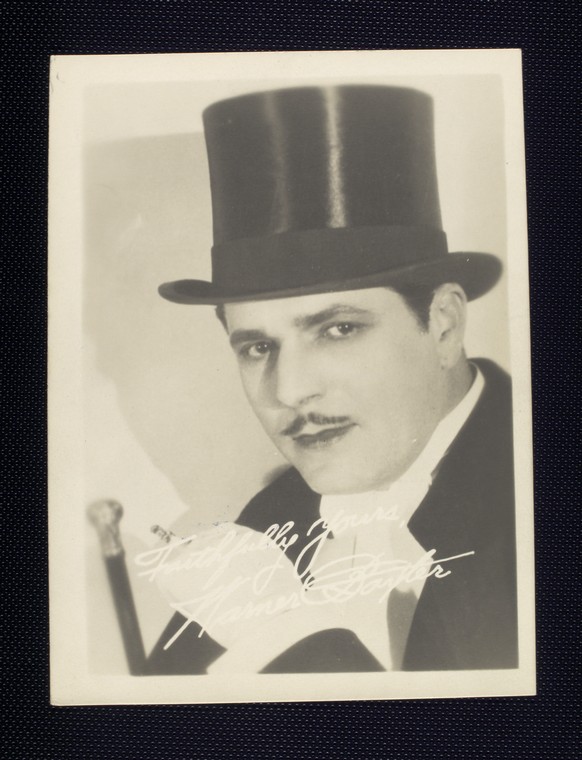
(Go ahead, toss that 1962 program to The Sound of Music…and why not drive a stake through poor Uncle Maurice’s cold, dead heart while you’re at it? All he ever wanted was to sit, eyes shining in the dark, and maybe hang around the stage door in hopes of scoring Academy Award winner, Warner Baxter’s autograph, below. )
For those of us who conceive of theatre as a still-living entity, the New York Public Library’s recent decision to start digitizing its Billy Rose Theatre Division archive is cause for celebration. Such grand scale commitment to this art form’s past ensures that it will enjoy a robust future. Hopefully someday all of the approximately 10 million items in the Billy Rose archive can be accessed from anywhere in the world. But, for now, you can start with over 100,000 items. The comparatively small percentage available now is still a boon to directors, designers, writers, and performers looking for inspiration.
It’s also wildly fun for those of us who never made it much past playing a poinsettia in the second grade holiday pageant.
Truly, there’s something for everyone. The library singles out a few tantalizing morsels on its website:
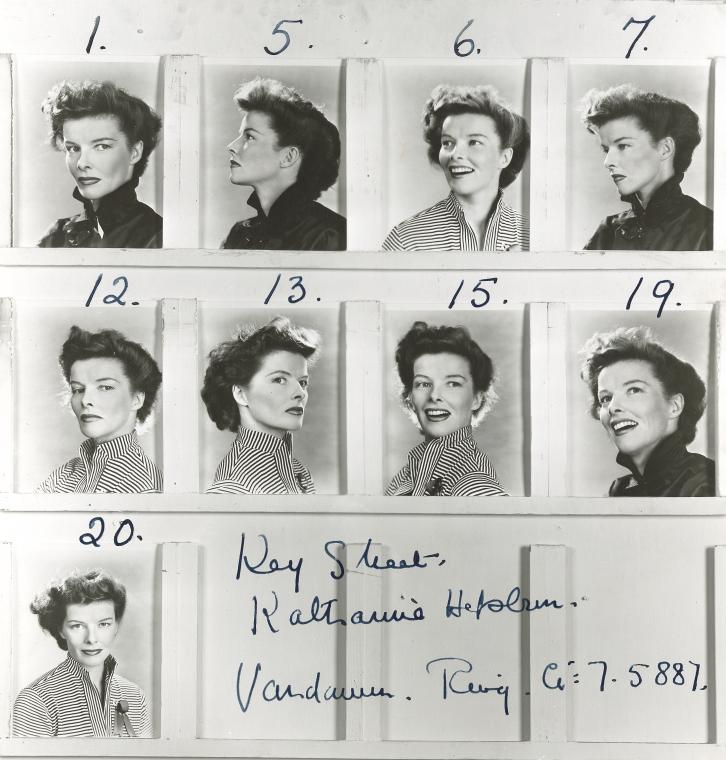
A researcher can examine a 1767 program for a performance of Romeo and Juliet in Philadelphia, study Katharine Hepburn’s personal papers (ed. note: witness the many moods of Kate, above), review Elia Kazan’s working script and notes for the original production of A Streetcar Named Desire, examine posters for Harry Houdini’s performances, read a script for an episode of Captain Kangaroo, view set designs for the original production of Guys & Dolls and costume designs for the Ziegfeld Follies, analyze a videotape of the original production of A Chorus Line, and find rich subject files and scrapbooks that document the most popular and obscure performances from across the centuries.
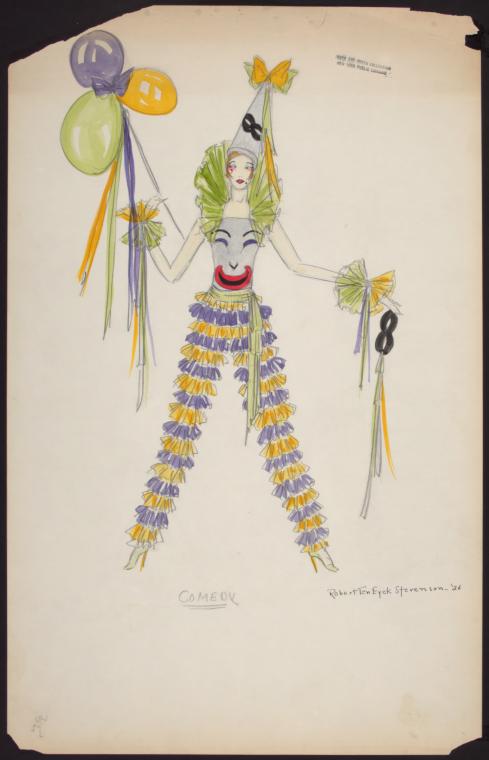
You might also prowl for Halloween costumes. What kid wouldn’t want to trick or treat as one of Robert Ten Eyck Stevenson’s 1926 designs for the Greenwich Village Follies?
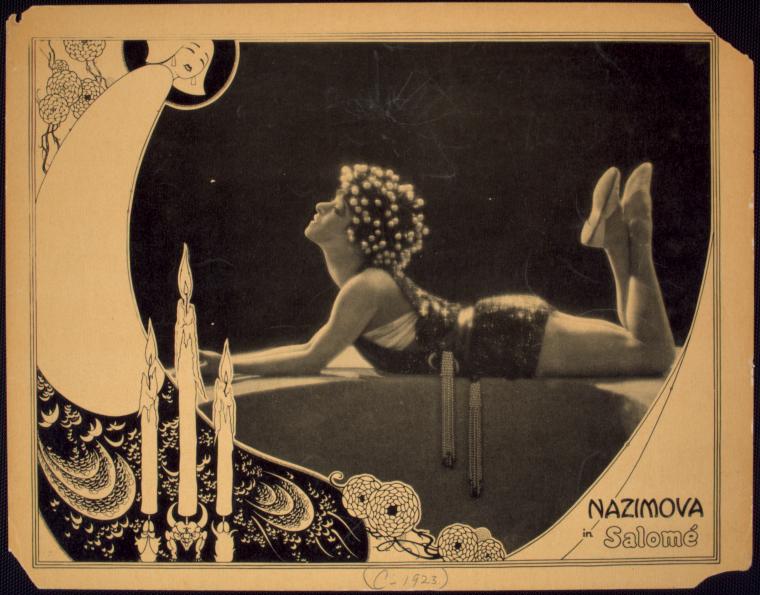
There’s certainly no shame in mooning over a forgotten star… for the record, the one above is Alla Nazimova in Salomé.
And there’s something galvanizing about seeing a familiar star escaping the confines of her best known role, the only one for which she is remembered, truth be told…
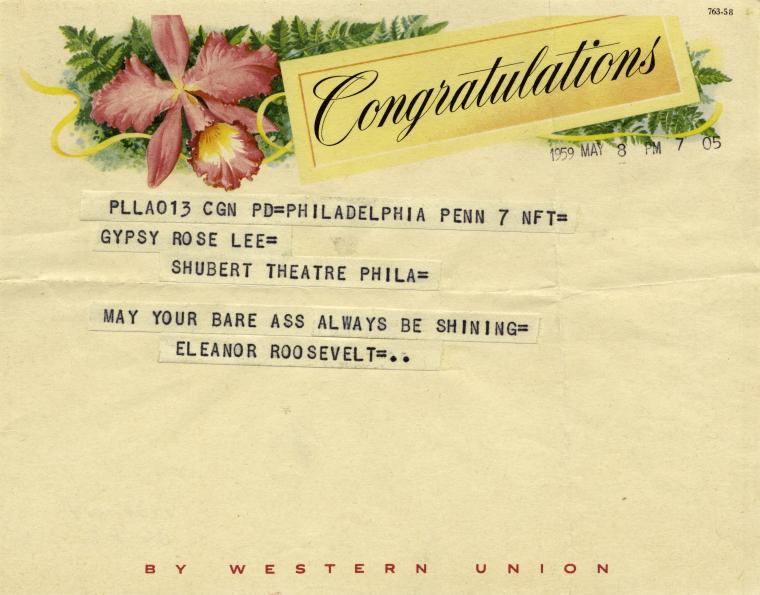
For me, the hands down pearl of the collection is the telegram at the top of the page. Former First Lady Eleanor Roosevelt sent it Gypsy Rose Lee to herald the re-opening of Gypsy, the musical based on her life.
For the uninitiated, telegrams were once an opening night tradition, as was staying up to read the review in the early edition, hot off the press.
More information on visiting the archive, online or in person, can be found here.
I first encountered bongo-playing physicist Richard Feynman in a college composition class geared toward science majors. I was not, mind you, a science major, but a disorganized sophomore who registered late and grabbed the last available seat in a required writing course. Skeptical, I thumbed through the reading in the college bookstore. As I browsed Surely You’re Joking, Mr. Feynman!—the first of many popular memoirs released by the affable contrarian scientist—the humanist in me perked up. Here was a guy who knew how to write; a theoretical physicist who spoke the language of everyday people.
Feynman cultivated his populist persona to appeal to those who might be otherwise turned off by abstract, abstruse scientific concepts. Like Carl Sagan and Neil deGrasse Tyson, his name has come to stand for the best examples of popular science communication. It is often through one of Feynman’s accessible, non-specialist books or presentations that people learn of his work with the Manhattan project, his contributions to quantum mechanics, and his Nobel Prize. But Feynman’s extracurricular pursuits—from safe-cracking to drumming to experimenting with LSD—were also genuine expressions of his idiosyncratic character, as was another of his passions for which he is not very well known: art.
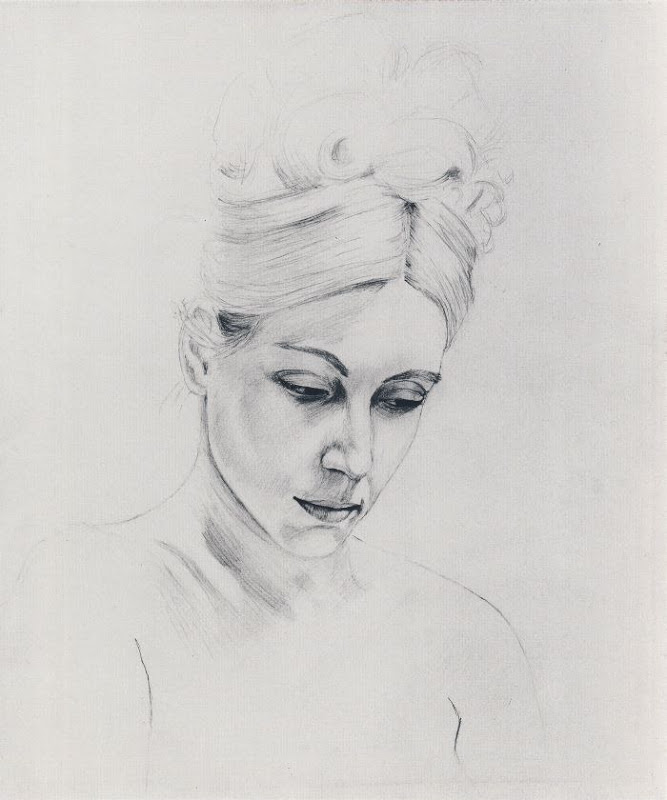
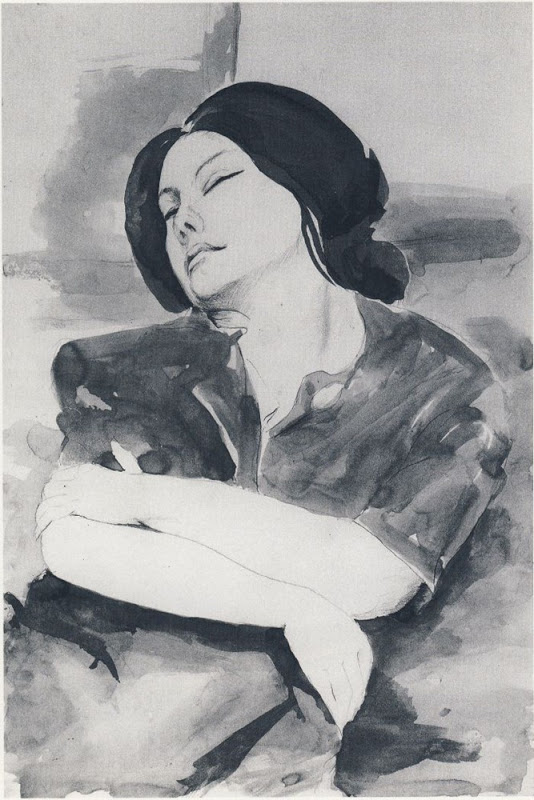
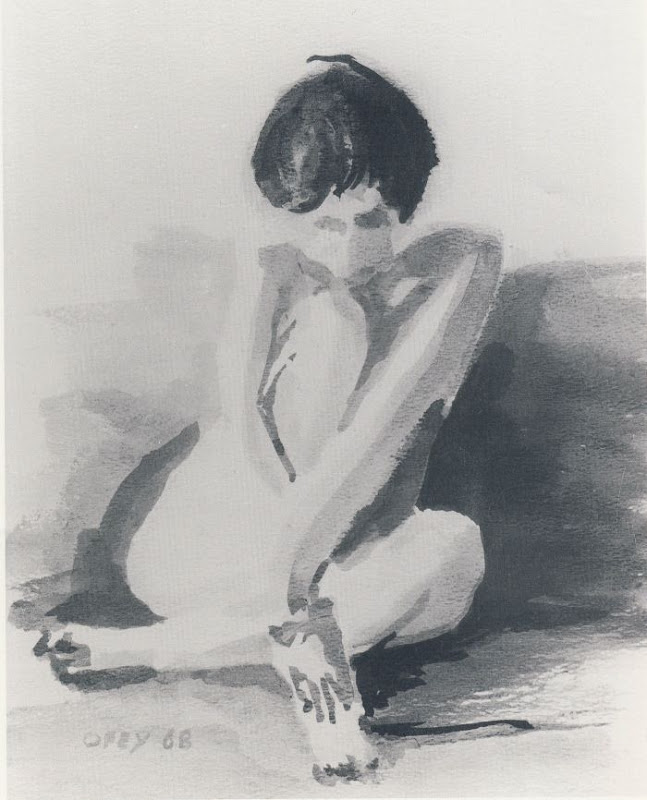
Feynman took up the pursuit at the age of 44, and continued to draw and paint for the rest of his life, signing his work “Ofey.” Many of his drawings display the awkward, off-kilter perspective of the beginner, and a great many others look very accomplished indeed. In an introductory essay to a published collection of his artwork, Feynman describes what motivated him to take up this particular avocation:
I wanted very much to learn to draw, for a reason that I kept to myself: I wanted to convey an emotion I have about the beauty of the world. It’s difficult to describe because it’s an emotion. It’s analogous to the feeling one has in religion that has to do with a god that controls everything in the universe: there’s a generality aspect that you feel when you think about how things that appear so different and behave so differently are all run ‘behind the scenes’ by the same organization, the same physical laws. It’s an appreciation of the mathematical beauty of nature, of how she works inside; a realization that the phenomena we see result from the complexity of the inner workings between atoms; a feeling of how dramatic and wonderful it is. It’s — of scientific awe — which I felt could be communicated through a drawing to someone who had also had that emotion. I could remind him, for a moment, of this feeling about the glories of the universe.
As you can see above, he took his work seriously. Most of his drawings consist of portraits and nudes, with the occasional landscape or still life. You can see more extensive galleries of Feynman’s art at AmusingPlanet, Museum Syndicate and Brain Pickings.
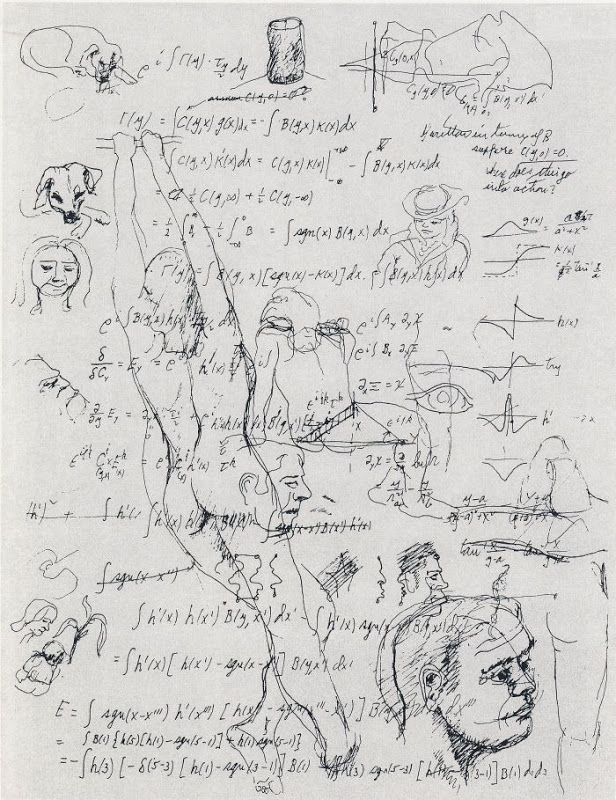
Feynman’s preoccupation—and full immersion—in the relationship between the arts and sciences marks him as a Renaissance man in perhaps the purest definition of the term: his approach closely resembles that of Leonardo da Vinci, a likeness that comes to the fore in the work below, which is either a collection of sketches doodled over with formulae, or a collection of formulae covered with doodles. Either way, it’s a perfect representation of the visionary mind of Feynman and his regard for ordinary language, people, and objects—and for “scientific awe.”
Most film-lovers must long for the next Stanley Kubrick, a new thematically adventurous, aesthetically rigorous, big budget-commanding, and take-after-take perfectionistic cinematic visionary for our time. But some film-lovers believe our time already has its own Stanley Kubrick in David Fincher, director of such highly acclaimed pictures as Fight Club, Zodiac, The Social Network, The Game, and Seven — excuse me, Se7en. And just like Kubrick, Fincher didn’t start off at that level of the game. No, his career first gathered momentum with commercials, a bunch of music videos for the likes of The Motels, Paula Abdul, and Rick Springfield, and of course, Alien 3 — excuse me,Alien3.
So what exactly went wrong with that critically savaged yet (we now realize) auteur-directed chapter of the Alien franchise? That question gets addressed in detail early on in the latest multi-part video essay from Cameron Beyl’s Directors Series.
You may remember that we featured the Directors Series’ previous essay in April, but if you don’t, it shouldn’t surprise you to learn that it examined the Kubrick oeuvre. Beyl ended it with a declaration of his own membership in the aforementioned Fincher-Is-Our-Kubrick club, and cinephiles all over the internet thrilled to his announcement of Fincher as his next object of analysis.
To date, five episodes of The Directors Series: David Fincher have come out, which deal with Fincher’s career as follows:
“Baptism By Fire” (Rick Springfield’s music videos and The Beat of the Life Drum, assorted music videos and commercials, Alien 3)
Even though the series hasn’t yet reached The Social Network, The Girl with the Dragon Tattoo, and Gone Girl, you won’t come away from the case Beyl has assembled so far unconvinced of Fincher’s influences, preferences, and obsessions: crime, decay, punk, obsolete technology, architecture, surveillance, corporate and personal wealth, unusual illustrative visual effects, colors like blue and orange in high contrast, nihilism, predecessors like Ridley and Tony Scott — the list goes on, and will go on as long as Fincher’s career does. It says a great deal about his filmmaking skill and style that his work has become so widely known for both its overwhelmingly “gritty, grimy” and overwhelmingly “cold, clinical” look and feel. But if any director can ever arrive at this sort of towering, contradictory reputation, Fincher can, and if any video essays can explain how he did, the Directors Series can.
We're hoping to rely on loyal readers, rather than erratic ads. Please click the Donate button and support Open Culture. You can use Paypal, Venmo, Patreon, even Crypto! We thank you!
Open Culture scours the web for the best educational media. We find the free courses and audio books you need, the language lessons & educational videos you want, and plenty of enlightenment in between.