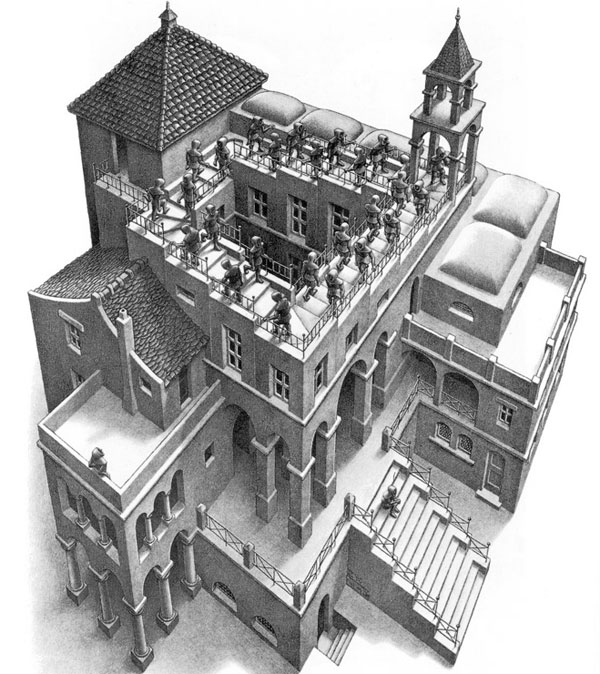
They say that Mussolini’s brand of fascism made Italy’s trains run on time. Meanwhile, it looks like Communists and Post-Communist autocrats made the morning subway ride in Russia something of a cultural experience.
As you can see below, the Soviets designed the Moscow subway stations as underground palaces, adorned with “high ceilings, stained glass, mosaics and chandeliers.” (Check out a gallery of photos here.) In more recent times, city planners openedthe Dostoyevskaya subway station, a more austere station where you can see black and white mosaics of scenes from Fyodor Dostoevsky’s novels — Crime and Punishment, The Idiot and The Brothers Karamazov. Somewhat controversially, the mosaics depict fairly violent scenes. On one wall, The Independent writes, “Raskolnikov from Crime and Punishment brandishes an axe over the elderly pawnbroker Alyona Ivanovna and her sister, his murder victims in the novel. Near by, a character from Demons holds a pistol to his temple.” Nothing like confronting murder and suicide on the morning commute.
If these gloomy scenes don’t sound familiar, don’t fret. Late last year, the Moscow subway system launched a pilot where Moscow subway commuters, carrying smartphones and tablets, can download over 100 classic Russian works, for free. As they shuttle from one station to another, riding on subway cars equipped with free wifi, straphangers can read texts by Dostoevsky, Tolstoy, Chekhov, Pushkin, Bulgakov, Lermontov, Gogol and more. Perhaps that takes the sting out of the soaring inflation.
There is a certain kind of thinking that the Buddha called “monkey mind,” a state in which our nervous habits become compulsions, hauling us around this way and that, forcing us to jump and shriek at every sound. It was exactly this neurotic state of mind that Leonard Cohen sought to quell when in 1994 he joined Mt. Baldy Zen Center in Los Angeles and became a monk: “I was interested in surrendering to that kind of routine,” Cohen told The Guardian in 2001, “If you surrender to the schedule, and get used to its demands, it is a great luxury not to have to think about what you are doing next.”
There at Mt. Baldy the journalist and cosmopolitan raconteur Pico Iyer met Cohen, unaware at first that it was even him. In his short Baccalaureate speech above to the 2015 graduating class of the University of Southern California, Iyer describes the meeting: After showing him fond hospitality and settling him into the community, Iyer says, Cohen told him that “just sitting still, being unplugged, looking after his friends was… the real deep entertainment that the world had to offer.”
At the time, Iyer was disappointed. He had admired Cohen for exactly the opposite qualities—for traveling the world, being plugged into the culture, and living a rock star life of self-indulgence. It was this outward manifestation of Cohen that Iyer found alluring, but the poet and songwriter’s inward life, what Iyer calls the “invisible ledger on which we tabulate our lives,” was given to something else, something that eventually brought Cohen out of a lifelong depression. Iyer’s thesis, drawn from his encounter with Leonard Cohen, Zen monk, is that “it is really on the mind that our happiness depends.”
Iyer refers not to that perpetually wheeling monkey mind but what Zen teacher Suzuki Roshi called “beginner’s mind” or “big mind.” In such a meditatively absorbed state, we forget ourselves, “which to me,” Iyer says, “is almost the definition of happiness.” Cohen said as much of his own personal enlightenment: “When you stop thinking about yourself all the time, a certain sense of repose overtakes you.” After his time at Mt. Baldy, he says, “there was just a certain sweetness to daily life that began asserting itself.” Iyer’s short speech, filled with example after example, gives us and his newly graduating audience several ways to think about how we might find that sense of repose—in the midst of busy, demanding lives—through little more than “just sitting still, being unplugged” and looking after each other.
In high school when I was trying to write surrealistic short stories in the vein of Richard Brautigan, despite not really understanding 90 percent of Richard Brautigan, my English teacher recommended I start reading Kurt Vonnegut, so later that day I went down to our city’s sci-fi book/comic book store and bought on her recommendation Breakfast of Champions. A comic novel, it was breezy and fun, and by gum, had cartoons in it! (One was of a cat’s butthole, the effect of which on a high schooler’s mind cannot be overstated.)
But, I admit, I haven’t read it since–the world and my tsundoku is too big for rereadings–and maybe you haven’t read it at all, or perhaps it’s your favorite book. It was the novel Vonnegut published four years after his best known work Slaughterhouse Five. When he graded his novels in his 1981 “Autobiographical Collage” Palm Sunday he gave Breakfast a C. It’s certainly one of his most rambling novels, where he brings back Slaughterhouse Five’s sci-fi author Kilgore Trout and pairs him with the delusional Dwayne Hoover, and unpacks all the dark parts of American history, from racism to capitalism to environmental degradation in passages both sober and bleakly comic.
John Malkovich doesn’t seem like the obvious choice to read Vonnegut for this audiobook, a short excerpt of which can be heard above. (Note: you can download the complete Malkovich reading for free via Audible’s Free Trial program.) But the passage is key in that it introduces the martini cocktail lounge origins of the book’s title, and Malkovich brings out the droll irony of Vonnegut’s writing, especially the way he rolls the word “schizophrenia” off his tongue. There’s a bit of the schizoid in every author, letting a world of characters speak through them like a medium.
For comparison, check out this earlier Open Culture post about Vonnegut reading a long section from Breakfast of Champions in 1970. The author chuckles at some of his more comic passages, and the audience roars along. The timing is that of a standup routine, but this opening—one assumes its the opening—would go on to be furiously rewritten, dropping the first person style. It’s an alternative universe Breakfast that can only leave one to wonder how the rest of the novel might have been handled.
Ted Mills is a freelance writer on the arts who currently hosts the FunkZone Podcast. You can also follow him on Twitter at @tedmills, read his other arts writing at tedmills.com and/or watch his films here.
Despite the Soviet Union’s suppression of a great many writers and filmmakers, the communist state nonetheless produced some of the finest film and literature of the 20th century. We are lucky, for example, to have Mikhail Bulgakov’s The Master and Margarita, which was never published during the author’s lifetime and was for many years thereafter censored or relegated to samizdat versions. A similar fate almost befell the first Russian science fiction film, Aelita: Queen of Mars, a silent from 1924 that inspired such indispensable classics as Flash Gordon and Fritz Lang’s Metropolis. The film—which tops a Guardian list of “Seven Soviet sci-fi films everyone should see”—contributed to a rich cinematic vocabulary without which it would be hard to imagine the aesthetics of much science fiction in general.
Directed by Yakov Protazanov in the theatrical, futuristic constructivist style that Fritz Lang borrowed, Aelita tells the story of Los, an Earth engineer who builds a spaceship and travels to Mars to meet and fall in love with its queen.
Further plot developments make clear that Lang may owe something to the film’s story as well, involving a tyrannical Martian ruler, Aelita’s father, who ruthlessly exploits his planet’s proletariat. Allmovie describesAelita as “the Marxist struggle reaches outer space” and indeed the film dramatizes an alien revolution very close to the one that took place back on Earth.
Part of the reason the film fell out of favor with the Soviet government in later decades—and irked critics at the time—is its ambivalence about revolutionary politics through its portrayal of Los as a disaffected intellectual. Alexei Tolstoy—author of the film’s source novel—had fewer reservations. The so-called “Comrade Count” won three Stalin prizes after his return from a brief European exile. Unlike the dissident critic Bulgakov, Tolstoy—a distant relative of both Leo Tolstoy and Ivan Turgenev—has been described by his enemies as cynical, opportunistic and, later, totally in thrall to Stalin. His friends probably described him as a loyal party man. (He is also credited with being the first to ascertain the Nazi’s use of gas vans.)
Aelita the film made a favorable impression on its first audiences (see an original poster above). One of the first full-length films about space travel, it enabled ordinary Russians to imagine what may have seemed to them like the near future of Soviet technology. And yet, writes Andrew Horton in a lengthy essay on Aelita, despite its reputation, the sci-fi classic is “neither science fiction nor a pro-revolutionary film.” Contemporary critics and filmmakers felt that Protazanov’s adaptation not only showed insufficient commitment to the revolution, but it also manifested “alleged continuity with the bourgeois cinema of the Tsarist age”—a serious charge in the age of socialist realism and disruptive cinematic experiments like those of Dziga Vertov.
In hindsight, however, Aelita turns out to have been a film before its time, and indeed a work of classic sci-fi, in its extremely imaginative use of technology, costuming, and set design. Without the fascination it has always held for film buffs, it might have disappeared, given its opposition to Party dogma: “The film praises domesticity and married life at a time when society was experimenting with the nature and meaning of relationships,” Horton writes, “It is a film that looks to rebuilding, consolidation, progress and the future and rejects revolution as an unachievable Utopian ideal open to hijack.” All of this context can seem a bit heavy, but we needn’t work too hard to untangle Aelita’s ideological strands. Simply enjoy the movie as an entertaining technical achievement from which we can draw a line to later sci-fi films like 1957’s Road to the Stars (above) and, from there, to modern masterpieces like Stanley Kubrick’s 2001.
I regularly meet up with speaking partners who help me learn their languages in exchange for my helping them learn English. Even though they usually speak much better English already than I speak Korean, Spanish, Japanese, or what have you, I often feel like I’ve got the heavier end of the job. Why? Because the English language, for all its advantages — its global reach, the ease with which it incorporates foreign terms and neologisms, its wealth of descriptive possibility — has the major disadvantage of seldom making immediate sense.
From English’s great flexibility flows great frustration: how many times have foreign friends put up a piece of text to me — often from respected, canonical works of English literature — and demanded an explanation? They’ve usually stumbled over some obscure usage that qualifies as at least unorthodox and perhaps downright ungrammatical, but nonetheless intuitively understandable — if only to a native speaker like me. Here we have one example of just such a linguistic invention refined by no less a respected, canonical writer than F. Scott Fitzgerald: the verb “to cocktail.”
“As ‘cocktail,’ so I gather, has become a verb, it ought to be conjugated at least once,” wrote the author of The Great Gatsby in a 1928 letter to Blanche Knopf, the wife of publisher Alfred A. Knopf. Who better to first lay out its full conjugation than the man who, as the University of Texas at Austin’s Harry Ransom Center puts it, “gave the Jazz Age its name”? Given that his fame “was for many years based less on his work than his personality—the society playboy, the speakeasy alcoholic whose career had ended in ‘crack-up,’ the brilliant young writer whose early literary success seemed to make his life something of a romantic idyll,” he found himself well placed to offer the language a new “taste of Roaring Twenties excess.”
And so Fitzgerald breaks it down:
Present: I cocktail, thou cocktail, we cocktail, you cocktail, they cocktail.
Imperfect: I was cocktailing.
Perfect or past definite: I cocktailed.
Past perfect: I have cocktailed.
Conditional: I might have cocktailed.
Pluperfect: I had cocktailed.
Subjunctive: I would have cocktailed.
Voluntary subjunctive: I should have cocktailed.
Preterit: I did cocktail.
If you, too, decide to teach this advanced verb to your English-learning friends, why not supplement the lesson with the audio clip just above, a reading of the letter from the Ransom Center? Language-learning, no matter the language, inevitably gets to be a grind from time to time, but varying the types of instructional media can help alleviate the inevitable headaches. And when the day’s studies end, of course, an actual cocktailing session couldn’t hurt. After all, they always say you speak a foreign language better after a drink or two.
Yesterday, Google’s official blog declared, “Today we’re launching our first-ever vertical Street View collection, giving you the opportunity to climb 3,000 feet up the world’s most famous rock wall: Yosemite’s El Capitan. To bring you this new imagery, we partnered with legendary climbers Lynn Hill, Alex Honnold and Tommy Caldwell.” Above, you can see this trio in action, talking about what makes El Cap a mecca for rock climbers everywhere.
To create this Street View of El Capitan, Hill, Honnold and Caldwell worked with Google engineers to figure out how to haul a camera up this sheer rock face. And what you ultimately get are some amazing 360-degree panoramic images. According to Caldwell, these “are the closest thing I’ve ever witnessed to actually being thousands of feet up a vertical rock face—better than any video or photo.” Which, hating heights, is good enough for me.
If you would like to sign up for Open Culture’s free email newsletter, please find it here. It’s a great way to see our new posts, all bundled in one email, each day.
If you would like to support the mission of Open Culture, consider making a donation to our site. It’s hard to rely 100% on ads, and your contributions will help us continue providing the best free cultural and educational materials to learners everywhere. You can contribute through PayPal, Patreon, and Venmo (@openculture). Thanks!
The Bureau “opened schools to educate the illiterate, managed hospitals, rationed food and clothing for the destitute, and even solemnized marriages.” And, along the way, the Bureau gathered handwritten records on roughly 4 million African Americans. Now, those documents are being digitized with the help of volunteers, and, by the end of 2016, they will be made available in a searchable database at discoverfreedmen.org.
According to Hollis Gentry, a Smithsonian genealogist, this archive “will give African Americans the ability to explore some of the earliest records detailing people who were formerly enslaved,” finally giving us a sense “of their voice, their dreams.”
Is sociology an art or a science? Is it philosophy? Social psychology? Economics and political theory? Surveying the great sociologists since the mid-19th century, one would have to answer “yes” to all of these questions. Sociologists like Karl Marx, Émile Durkheim, Max Weber, and Theodor Adorno conducted serious scholarly and social-scientific analyses, and wrote highly speculative theory. Though it may seem like we’re all sociologists now, making critical judgments about large groups of people, the sociologists who created and carried on the discipline generally did so with sound evidence and well-reasoned argument. Unlike so much current knee-jerk commentary, even when they’re wrong they’re still well worth reading.
Having already surveyed Marx in his series on Euro-American political philosophers, School of Life founder Alain de Botton now tackles the other three illustrious names on the list above, starting with Durkheim at the top, then Weber above, and Adorno below. The first two figures were contemporaries of Marx, the third a later interpreter. Like that bearded German scourge of capitalism, these three—in more measured or pessimistic ways—levied critiques against the dominant economic system. Durkheim took on the problem of suicide, Weber the anxious religious underpinnings of capitalist ideology, and Adorno the consumer culture of instant gratification.
That’s so far, at least, as de Botton’s very cursory introductions get us. As with his other series, this one more or less ropes the thinkers represented here into the School of Life’s program of promoting a very particular, middle class view of happiness. And, as with the other series, the thinkers surveyed here all seem to more or less agree with de Botton’s own views. Perhaps others who most certainly could have been included, like W.E.B. Dubois, Jane Addams, or Hannah Arendt, would offer some very different perspectives.
De Botton again makes his points with pithy generalizations, numbered lists, and quirky, cut-out animations, breezily reducing lifetimes of work to a few observations and moral lessons. I doubt Adorno would approach these less-than-rigorous methods charitably, but those new to the field of sociology or the work of its practitioners will find here some tantalizing ideas that will hopefully inspire them to dig deeper, and to perhaps improve their own sociological diagnoses.
“There is nothing intrinsically imaginative about the idea of ‘gold,’ nor the idea of ‘mountain,’” writes Will Self, citing an idea of the philosopher David Hume, “but join them together and you have a fantastically gleaming ‘gold mountain.’ And might not that gold mountain be the Laurenziberg in Prague? After all, it looms over contemporary Prague just as it loomed in the consciousness of Franz Kafka, whose earliest surviving narrative fragment, ‘Description of a Struggle,’ is in part an account of a phantasmagorical ascent of its slopes.”
This association comes from “Kafka’s Wound,” Will Self’s new essay in the London Review of Books — or rather, a new “digital essay” from the LRB on the BBC and Arts Council England’s new site The Space, one which takes full advantage of the multimedia future, much enthused over back in the 1990s, in which we now find ourselves. For some readers, myself included, the association of the author of TheMetamorphosis and The Trial with Hume, the author of so many volumes fictional, nonfictional, and psychogeographical (find some in our collection of Free Philosophy eBooks), constitutes reason enough to minimize all other windows and get reading.
But Self has taken on an even more ambitious project than that: the mind-mappish interface of “Kafka’s Wound” offers a wealth of audio, video, and other textual material to supplement the experience of the main text, all of which connects in some way to the essay’s subject: Will Self’s “personal relationship to Kafka’s work through the lens of the short story ‘A Country Doctor’ (1919), and in particular through the aperture of the wound described in that story.” Self’s own site describes the essay as “ ‘through composed’ with Will’s own thoughts, as he works, being responded to by digital-content providers,” with more of that content to come through July.
The environment internet, which facilitates our natural tendency to drift from subject to at least semi-related subject with an addictive vengeance, encourages associational thinking. But so do cities, as a psychogeographer like Will Self knows full well. And so part of this rich literary investigation takes the form of an hourlong documentary (click here or the image above to view), in which Self takes a walking tour of Kafka’s Prague, seeking out the writer’s “genius loci,” the sites that gave settings to the milestones of his life and shape to his artistic and intellectual sensibilities. He also takes the opportunity to do a Kafka reading right there in Kafka’s hometown. It’s one thing to read Kafka with the Laurenziberg in mind, but still quite another to do it with the Laurenziberg in sight.
You can read the story free online here (if you haven’t exceeded the monthly quota of The New Yorker’s paywall). Or, if you’re more visual, you can watch an animated adaptation of the story above. Directed by Gur Bentwich and animated by Ofra Kobliner, the video was produced by Storyvid, a nonprofit production company that aspires to create “the literary equivalent of a music video.”
If you would like to sign up for Open Culture’s free email newsletter, please find it here. It’s a great way to see our new posts, all bundled in one email, each day.
If you would like to support the mission of Open Culture, consider making a donation to our site. It’s hard to rely 100% on ads, and your contributions will help us continue providing the best free cultural and educational materials to learners everywhere. You can contribute through PayPal, Patreon, and Venmo (@openculture). Thanks!
So it turns out that my two-year old son might be qualified for a professorship at an elite university. No, he’s not some Doogie Howser-style savant. He just really likes Legos. And Cambridge University – the school of Isaac Newton, Charles Darwin and Stephen Hawking – has announced that it’s getting ready to create a Lego professorship this fall.
The position, which is slated to start in October 2015, came about following a £4 million donation from the Lego Foundation. The Denmark-based organization, which owns 25% of the Lego toy company, states that their mission is to “make children’s lives better — and communities stronger — by making sure the fundamental value of play is understood, embraced and acted upon.” The Foundation already has ties with MIT and Tsinghua University in China, among others.
Who ever lands the professorship will also head the Research Centre on Play in Education, Development and Learning and will explore the connection between learning and play.
The qualifications for the job seem remarkably broad. As the university says: “The candidature should be open to all those whose work falls within the general field of the title of the office.” They don’t, however, specifically mention that candidates have to be potty trained. I’m getting my son’s resume ready.
Jonathan Crow is a Los Angeles-based writer and filmmaker whose work has appeared in Yahoo!, The Hollywood Reporter, and other publications. You can follow him at @jonccrow. And check out his blog Veeptopus, featuring lots of pictures of vice presidents with octopuses on their heads. The Veeptopus store is here.
We're hoping to rely on loyal readers, rather than erratic ads. Please click the Donate button and support Open Culture. You can use Paypal, Venmo, Patreon, even Crypto! We thank you!
Open Culture scours the web for the best educational media. We find the free courses and audio books you need, the language lessons & educational videos you want, and plenty of enlightenment in between.