Burgess Meredith and Zero Mostel, both trying to salvage careers after being blacklisted in the McCarthy period, starred as Vladimir and Estragon, in WNTA-TV’s Play of the Week series’ no-frills production. In contrast to the recent Broadway revival starring grizzled, grubby knights of the realm, Ian McKellen and Patrick Stewart, Meredith and Mostel make a pretty harmless—and apparently unharmed—team. Vladimir’s prostate trouble was scrubbed from the shooting script, along with some 40 minutes of the stage version, five years after its disastrous American premiere.
Alan Schneider, who directed that production, returned to helm the Play of the Week, along with original American cast members Kurt Kaszner and Alvin Epstein, reprising their supporting turns as Pozzo and Lucky. Schneider appears to have had his hands full with the always-larger-than-life Mostel who chews plenty of scenery in addition to his carrot.
For his part, Mostel stated that he “wished to be re-blacklisted” if that would keep him from ever having to work with that director again.
Despite the tension, he and Meredith achieve a winsome Laurel and Hardy-like rapport as they plod up and down a painted road with choreographed aimlessness.
It’s still a bit hard for me to imagine American television audiences tuning-in in numbers sufficient to justify the effort.
To be fair, there were a lot fewer channels then. Play of the Week was a high brow project serving up serious theatrical work on the small screen. The first episode was Judith Anderson’s Medea. Compared to that, or Shakespeare, or Ibsen, a prostate-free Godot might be passed off as televised entertainment the whole family could tolerate for an hour and forty-nine minutes.
If you’re up for it, the entire production is yours for the viewing below.
In 1921, Franklin D. Roosevelt was sailing in the Bay of Fundy when he fell overboard into the cold waters. The next day, he felt weakness in his legs. The sensation intensified, and, soon enough, he could no longer walk. Once doctors sorted things out, F.D.R. discovered that he had contracted polio, a disease that typically afflicted children, not adults. A long and grueling period of rehabilitation followed, mostly in Warm Springs, Georgia. You can see footage of his rehab right below.
With a lot of hard work, F.D.R. learned to walk short distances, aided by leg braces, a cane, and someone’s shoulder to lean on. When he re-entered politics, the F.D.R. Presidential Library notes, he “requested that the press avoid photographing him walking, maneuvering, or being transferred from his car. The stipulation was accepted by most reporters and photographers but periodically someone would not comply. The Secret Service was assigned to purposely interfere with anyone who tried to snap a photo of FDR in a ‘disabled or weak’ state.” Above, you can see (according to CNN) only the second known clip that shows F.D.R. walking. (Watch around the 40 second mark.) Recorded in Washington, D.C., at the 1937 All-Star Game, the video was recently donated to the Pennsylvania Historical and Museum Commission. The other extant video appears right below.
In 2009, Neil Gaimanwon the Newbery Medal for The Graveyard Book, a prestigious prize given to “the author of the most distinguished contribution to American literature for children.” The American Library Association, the organization that bestows the award, called The Graveyard Book a “delicious mix of murder, fantasy, humor and human longing,” and cited its “magical, haunting prose.” You can savor that prose by watching the playlist of videos embedded above. During the book tour for The Graveyard Book, Gaiman read a different chapter at every stop, and his publisher, HarperCollins, recorded the readings and made them available online. If you have roughly eight hours of free time, you can watch the reading from start to finish.
For Sigmund Freud, a joke was never just a joke, but a window into the unconscious, laughter an anxious symptom of recognition that something lost has resurfaced, distorted into humor. For Slovenian psychoanalytic philosopher Slavoj Žižek, jokes function similarly. And yet, in keeping with his commitment to leftist politics, he uses jokes not to expose the hidden terrain of individual psyches but “to evoke binds of historical circumstances hard to indicate by other means.” So writes Kenneth Baker in a brief SFGate review of the recent Žižek’s Jokes, a book-length compilation of Žižekisms published by MIT Press. Baker also points out a defining feature of Žižek’s humor: “Many of Žižek’s jokes preserve or even amplify the vulgarity of their demotic or pop cultural origins.” Take the NSFW joke he tells above at the expense of a Montenegrin friend. Žižek explains the joke as part of his maybe dubious strategy of countering racism with “progressive racism” or the “solidarity” of “shared obscenity”—the use of potentially uncomfortable ethnic humor to expose uncomfortable political truths that get repressed or papered over by politeness.
Some of Žižek’s humor is more trigger-warning worthy, such as his retelling of this old Soviet dissident joke or this “very dirty joke” he reportedly heard from a Palestinian Christian acquaintance. On the other hand, some of his “dirty jokes” replace vulgarity with theory. For example, Žižek likes to tell a “truly obscene” version of the famously filthy joke “The Aristocrats,” which you’ll know if you’ve seen, or only read about, the film of the same name. And yet in his take, instead of a series of increasingly disgusting acts, the family performs “a short course in Hegelian thought, debating the true meaning of the negativity, of sublation, of absolute knowing, etc.” This is perhaps an example of what Baker refers to as Žižekian jokes that are “baffling to readers not conversant with the gnarly dialectics of his thought, which does not lend itself easily to sampling.” Be that as it may, much of Žižek’s humor works without the theoretical context, and some of it is even tame enough for water cooler interludes. Below are four examples of “safe” jokes, culled from website Critical Theory’s list of “The 10 Best Žižek Jokes to Get You Through Finals” (which itself culls from Žižek’s Jokes). “Some of the jokes [in Žižek’s book] provide hilarious insights into Hegelian dialectics, Lacanian psychoanalysis or ideology,” writes Critical Theory, “Others are just funny, and most are somewhat offensive—a characteristic Žižek admittedly doesn’t care to correct.”
#1 There is an old Jewish joke, loved by Derrida…
about a group of Jews in a synagogue publicly admitting their nullity in the eyes of God. First, a rabbi stands up and says: “O God, I know I am worthless. I am nothing!” After he has finished, a rich businessman stands up and says, beating himself on the chest: “O God, I am also worthless, obsessed with material wealth. I am nothing!” After this spectacle, a poor ordinary Jew also stands up and also proclaims: “O God, I am nothing.” The rich businessman kicks the rabbi and whispers in his ear with scorn: “What insolence! Who is that guy who dares to claim that he is nothing too!”
#4 When the Turkish Communist writer Panait Istrati visited the Soviet Union in the mid- 1930s, the time of the big purges…
and show trials, a Soviet apologist trying to convince him about the need for violence against the enemies evoked the proverb “You can’t make an omelet without breaking eggs,” to which Istrati tersely replied: “All right. I can see the broken eggs. Where’s this omelet of yours?”
We should say the same about the austerity measures imposed by IMF: the Greeks would have the full right to say, “OK, we are breaking our eggs for all of Europe, but where’s the omelet you are promising us?”
#7 This also makes meaningless the Christian joke…
according to which, when, in John 8:1–11, Christ says to those who want to stone the woman taken in adultery, “Let him who is without sin among you be the first to throw a stone!” he is immediately hit by a stone, and then shouts back: “Mother! I asked you to stay at home!”
#8 In an old joke from the defunct German Democratic Republic,…
a German worker gets a job in Siberia; aware of how all mail will be read by censors, he tells his friends: “Let’s establish a code: if a letter you will get from me is written in ordinary blue ink, it is true; if it is written in red ink, it is false.” After a month, his friends get the first letter, written in blue ink: “Everything is wonderful here: stores are full, food is abundant, apartments are large and properly heated, movie theaters show films from the West, there are many beautiful girls ready for an affair—the only thing unavailable is red ink.”
And is this not our situation till now? We have all the freedoms one wants—the only thing missing is the “red ink”: we “feel free” because we lack the very language to articulate our unfreedom. What this lack of red ink means is that, today, all the main terms we use to designate the present conflict —“war on terror,” “democracy and freedom,” “human rights,” etc.—are false terms, mystifying our perception of the situation instead of allowing us to think it. The task today is to give the protesters red ink.
For more of Slavoj Žižek’s witticism, vulgarity, and humorous critiques of ideological formations, political history, and Hegelian and Lacanian thought, pick up a copy ofŽižek’s Jokes, and see this Youtube compilation of the politically incorrect leftist philosopher’s humor caught on tape.
We’ve long known the internet’s power to facilitate access to the great books (see, for instance, our collection of 600 eBooks free online), but recent projects like the British Library’s Discovering Literature have shown us that it can also help us engage with those great books. The site, says a MetaFilter user who goes under Horace Rumpole, offers “a portal to digitized collections and supporting material. The first installment, Romantics and Victorians, includes work from Austen, the Brontës, Dickens, and Blake, and forthcoming modules will expand coverage of the site to encompass everything from Beowulf to the present day.” For now, if you enjoy classic English Romantic and Victorian novels, prepare to take that enjoyment to a higher level by immersing yourself in all manner of early manuscripts, authors’ papers and personal effects, and related pieces of contemporary media.
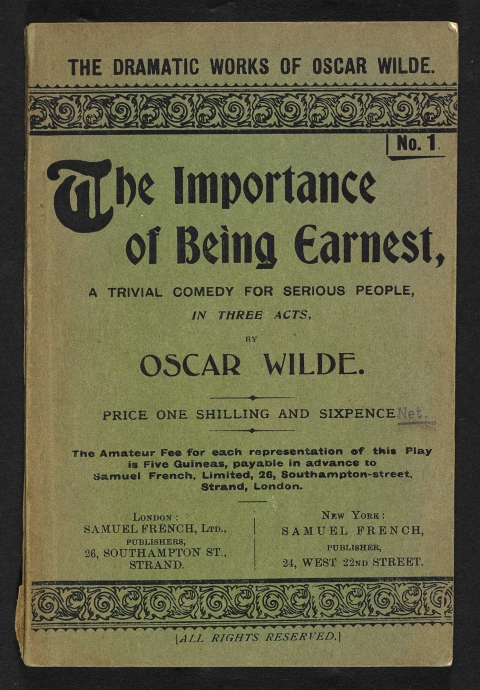
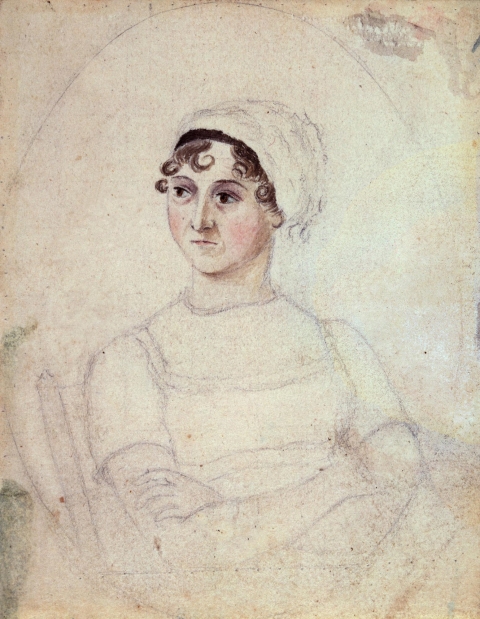
If you count yourself a Jane Austen fan, for instance, you can now scroll down her Discovering Literature author page and find “a host of texts” to do with her life, her work, and the intersection between them, “including the opinions — mostly positive — her friends and family had of her novels, copied out by the author (though ‘her immediate family is shown to have disagreed over which of her books was better’).” That comes from The Guardian’s Alison Flood, writing up the site’s collection of not just Austen accoutrements but items from writers like William Wordsworth, Oscar Wilde, and Mary Shelley, “as well as diaries, letters, newspaper clippings from the time and photographs, in an attempt to bring the period to life.”
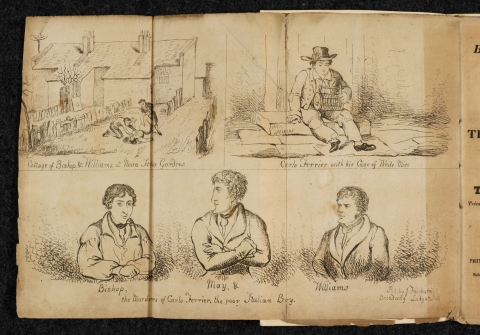
Flood cites “a survey of more than 500 English teachers, which found that 82% believe secondary school students ‘find it hard to identify’ with classic authors” on their classes’ syllabi. In response, Discovering Literature appears to have given special attention to oft-assigned writers like Charles Dickens, whose collection of materials on the site includes a literary sketch published at age 23, color illustrations for both an 1885 and 1911 edition of Oliver Twist (as well as the 1848 review that destroyed his relationship with the book’s previous illustrator), and “The Italian Boy,” an early work of journalism on “a brutal crime that occurred in London in 1831, a ‘copy-cat’ murder following upon those of the infamous Burke and Hare in Edinburgh.” The site’s archives also contain analytical essays on each writer’s body of work, like “Oliver Twist and the Workhouse” and “Status, Rank, and Class in Jane Austen’s Novels” — ideal for when these re-enthused students, previously unable to connect to the Romantic and Victorian eras’ most respected authors, reach grad school.
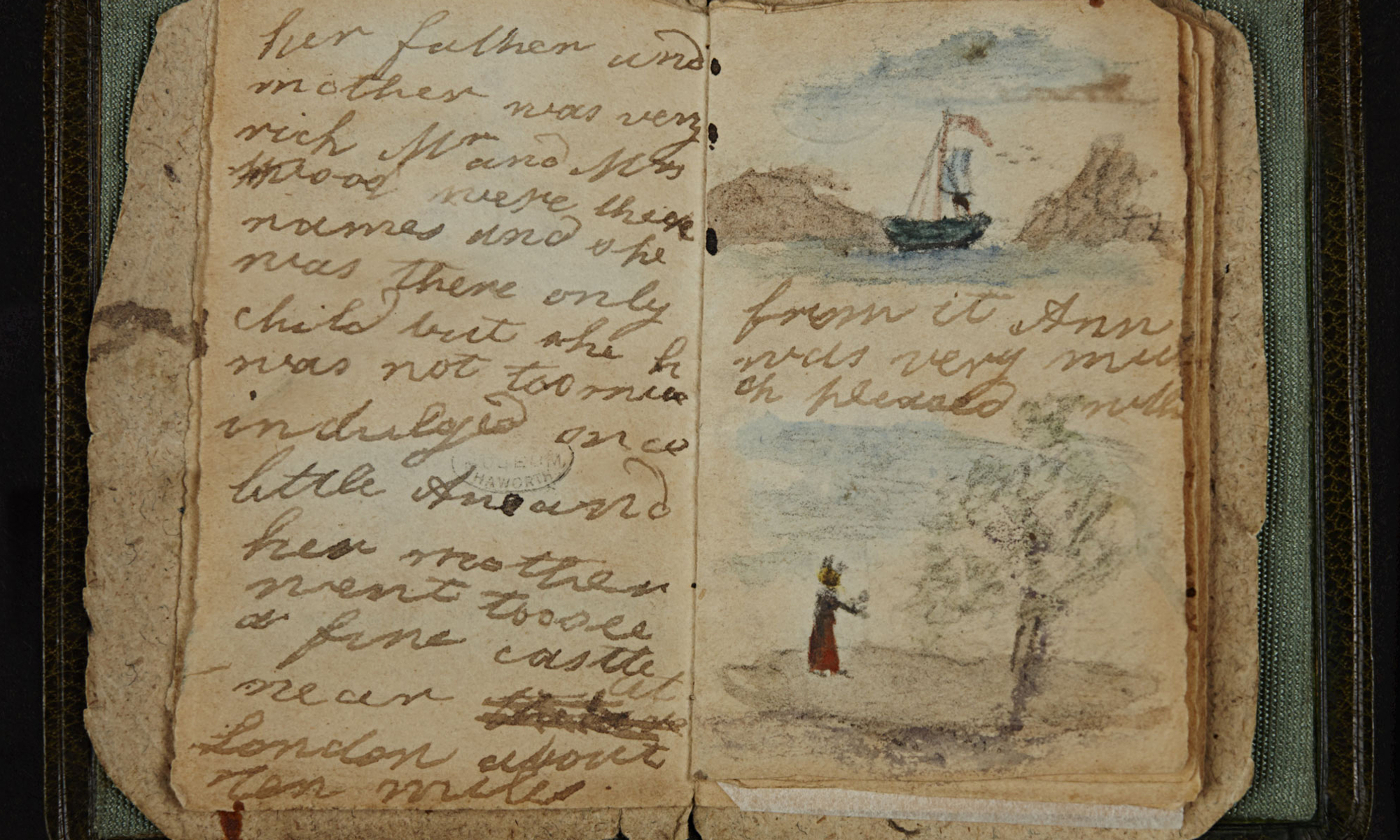
The image at the very top shows the earliest known writings of Charlotte Brontë.
It happened following surgery for an impacted wisdom tooth. While recovering, the author of Ubik and The Man in the High Castle, received a delivery of pain medication. The delivery girl wore a Jesus fish around her neck, which in Dick’s perception was emitting a pink beam. Soon after, Dick’s brain was invaded by… something. Dick never quite figured out what.
He later described the experience to interviewer Charles Platt as “an invasion of my mind by a transcendentally rational mind. It was almost as if I had been insane all of my life and suddenly I had become sane.”
The experience profoundly affected him and it made up the core of his book VALIS. The title is an acronym for Vast Active Living Intelligence System, which pretty much describes how Dick thought of this mind.
In 1979, Platt interviewed Dick in depth for his book Dream Makers. You can listen to an extended clip of Dick recounting his transcendental experience below:
“On Thursdays and Saturdays I’d think it was God,” he told Platt. “On Tuesdays and Wednesdays, I’d think it was extraterrestrials. Some times I’d think it was the Soviet Union Academy of Sciences trying out their psychotronic microwave telepathic transmissions.”
Whatever it was, this mind took control of Dick when he was at a low ebb and, like a loving parent or an exceptionally talented personal assistant, cleaned up his life. “I was a spectator,” said Dick. This mind, which Dick characterized as female, fired his agent, tracked down editors who were late sending checks and modified his diet.
She also revealed that his young son had an undiagnosed birth defect that was potentially fatal. And the revelation proved to be true. The child’s life was saved.
That said, he did have a couple minor complaints about the entity: she kept calling his baffled wife “Ma’am” and she had a tendency to lapse into Koine Greek. Nobody, even a God-like vision, is perfect. Above, we have a drawing by R. Crumb.
Jonathan Crow is a Los Angeles-based writer and filmmaker whose work has appeared in Yahoo!, The Hollywood Reporter, and other publications. You can follow him at @jonccrow.
Spend some time poking around on the Khan Academy, or this site for that matter, and your chances of running into mathemusician Vi Hart are extremely favorable.
I’ve tried—and failed—to keep up with her highly digressive, rapid fire, doodle-based explanations on such topics as net neutrality and the space-time continuum. I had better luck following her directions for turning squiggles into snakes, a math-based parlor trick that seems more like magic to me.
What I really wanted to know is how does she make those funny little videos of hers? Doubtless, any seven-year-old who’s logged two or three hours in an after-school program devoted to stop motion animation would have the chops to explain how to make simple drawings rendered in Sharpie on a spiral bound notebook come to life, but what if I still didn’t get it? I wouldn’t want to give the shorties the impression that the laymen and women of my generation are too dim to keep up with modern technology.
Then on a whim, I typed “how does Vi Hart make her videos” into a search engine and voila! The video above, in which the doyenne herself reveals exactly how she does just that.
Actually “exactly” might be overstating things a bit, given that she does so in her immediately recognizable style. If I understand correctly, she starts with a script, which she pares to the essentials, before shooting the segment with a team of interns, some of whom serve as body doubles for her hands, their arms encased in funky, detachable sleeves. Then she speeds things up by deleting the frames in which the moving hand obscures the page. I’m pretty sure she wings it when recording her voiceover narration, but I could be wrong.
She also seems to have a thing for pinning her long brown hair up with a turkey feather. Even so, I’ll bet the decision to give her adoring public a glimpse of something beyond mere hands cemented many a celebrity crush. She’s a Tina Fey for the geek set. (Not that Tina Fey isn’t already serving that function for the same demographic.)
As winsome as she is, I have to say, I preferred her 14-year-old intern Ethan Bresnick’s conscientious behind-the-scenes look at how these things come together. Have a look above if you’d like some straight dope on software, camera positions, and the like.
(Depending on how much work you’ve got to get done today, you may also enjoy the extremely informal, hour-plus interview Ethan conducted via Skype, during which Hart eats her dinner and invites fans to join them via Twitter.)
The only thing lacking is the nitty gritty on how and where Hart stores her enormous video files. Without a benevolent Khan Academy to oversee my work, such technical specs would definitely come in handy for a beginner such as myself. The Sharpies on spiral bound I can figure out on my own.
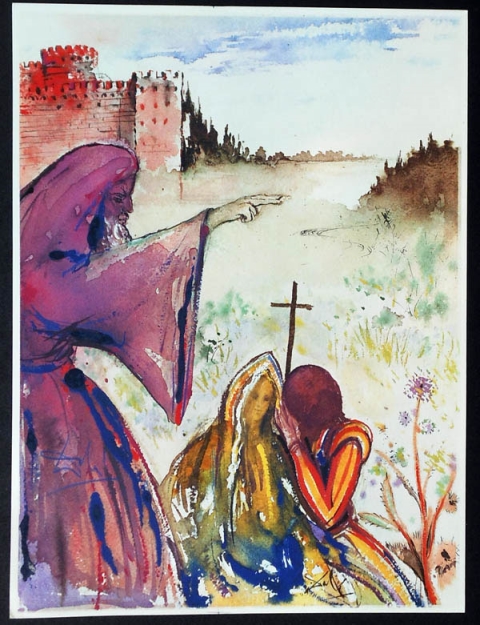
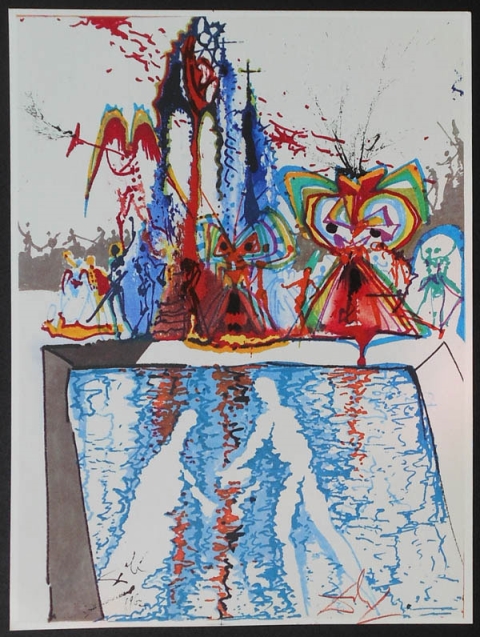
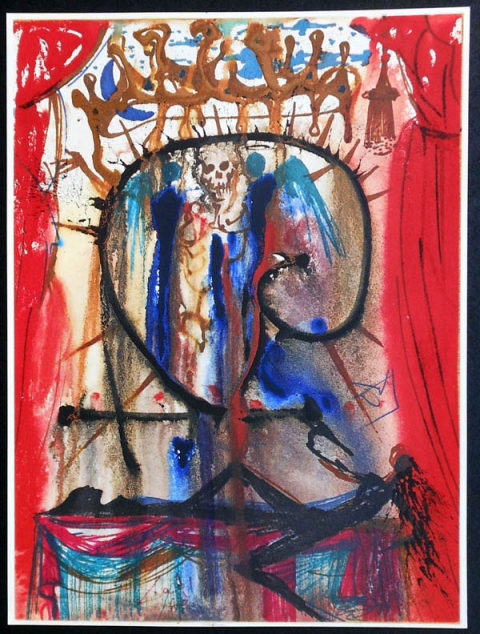
Even from just what we’ve posted about Salvador Dalí, you can tell he had a mission to spread his distinctive sensibility far and wide: he made films with Luis Buñuel, collaborated with Walt Disney and Alfred Hitchcock, showed up for Andy Warhol’s “screen tests,” and illustrated some of the best-known texts in western history, like Dante’s Divine Comedy, Lewis Carroll’sAlice’s Adventures in Wonderland, and Shakespeare’s Macbeth. All those projects might seem well suited to the Spanish surrealist’s famous skill at artistically rendering the torn edges of human consciousness, but what would he do when presented with something more psychologically straightforward — Romeo and Juliet, say? You can see the results of just such a project at Twisted Sifter, which presents ten notable illustrations from Dalí’s second Shakespearean project.
These images come from a 1975 Rizzoli and Rizzoli edition consisting of “ten off-set lithographs on heavy paper with 99 pages of bound text contained in a red/burgundy silk slipcase with the lithographs signed in the place.” You can find out more about this book at the site of Plainfield, Illinois’ Lockport Street Gallery, which offers the copy for sale and a warning against all the “fake prints” (inauthentic Dalí having long constituted a robust industry of its own) in circulation. Romeo and Juliet, perhaps due to its tendency to get assigned in high school, can come off as one of Shakespeare’s milder, more familiar plays, and modern interpretations of the material fall flat as often as they rise up to it. But Dalí’s contribution makes the old tale of star-crossed lovers strange and haunting again — exactly the specialty, I suppose, that would attract anybody to him with an offer of collaboration in the first place.
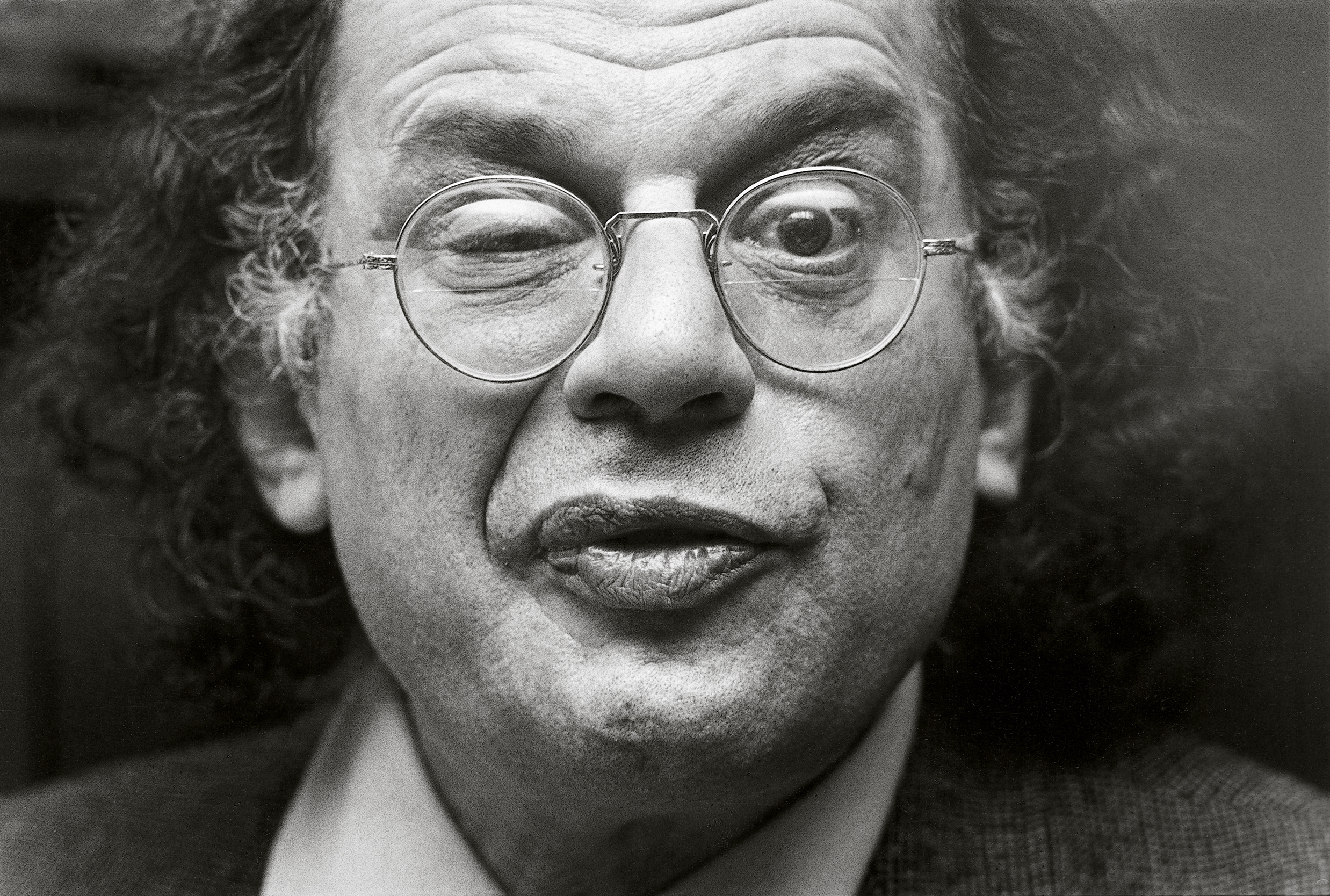
If you want to understand poetry, ask a poet. “What is this?” you ask, “some kind of Zen saying?” Obvious, but subtle? Maybe. What I mean to say is that I have found poetry one of those distinctive practices of which the practitioners themselves—rather than scholars and critics—make the best expositors, even in such seemingly academic subject areas as the history of poetry. Of course, poets, like critics, get things wrong, and not every poet is a natural teacher, but only poets understand poetry from the inside out, as a living, breathing exercise practiced the world over by every culture for all recorded history, linked by common insights into the nature of language and existence. Certainly Allen Ginsberg understood, and taught, poetry this way, in his summer lectures at the Jack Kerouac School of Disembodied poetics, which he co-founded with Anne Waldman at Chogyam Trungpa Rinpoche’s Naropa University in 1974.
We’ve previously featured some of Ginsberg’s Naropa lectures here at Open Culture, including his 1980 short course on Shakespeare’s The Tempest and his lecture on “Expansive Poetics” from 1981. Today, we bring you several selections from his lengthy series of lectures on the “History of Poetry,” which he delivered in 1975. Currently, thirteen of Ginsberg’s lectures in the series are available online through the Internet Archive, and they are each well worth an attentive listen. Actually, we should say there are twelve Ginsberg lectures available, since Ginsberg’s fellow Beat Gregory Corso led the first class in the series while Ginsberg was ill.
Corso taught the class in a “Socratic” style, allowing students to ask him any questions they liked and describing his own process and his relationships with other Beat poets. You can hear his lectures here. When Ginsberg took over the “History of Poetry” lectures, he began (above) with discussion of another natural poet-educator, the idiosyncratic scholar Ezra Pound, whose formally precise interpretation of the Anglo-Saxon poem “The Seafarer” introduced many modern readers to ancient alliterative Old English poetics. (Poet W.S. Merwin sits in on the lecture and offers occasional laconic commentary and correction.)
Ginsberg references Pound’s pithy text The ABC of Reading and discusses his penchant for “ransack[ing] the world’s literature, looking for usable verse forms.” Pound, says Ginsberg—“the most heroic poet of the century”—taught poetry in his own “cranky and personal” way, and Ginsberg, less cranky, does something similar, teaching “just the poems that I like (or the poems I found in my own ear,” though he is “much less systematic than Pound.” He goes on to discuss 18th and 19th century poetics and sound and rhythm in poetry. One of the personal quirks of Ginsberg’s style is his insistence that his students take meditation classes and his claim that “the English verse that was taught in high school” is very close to the “primary Buddhist understanding of transiency.” But one can leave aside Ginsberg’s Buddhist preoccupations—appropriate to his teaching at a Buddhist university, of course—and still profit greatly from his lectures. Below, find links to eleven more of Ginsberg’s “History of Poetry” lectures, with descriptions from the Internet Archive. Unfortunately, it appears that several of the lecture recordings have not been preserved, or at least haven’t made it to the archive, but there’s more than enough material here for a thorough immersion in Ginsberg’s historical poetics. Also, be sure to see AllenGinsberg.org for transcriptions of his “History of Poetry” lectures. You can find these lectures listed in our collection of Free Literature Courses, part of our larger list, 1,700 Free Online Courses from Top Universities.
Part 3: class on the history of poetry by Allen Ginsberg, in a series of classes in the Summer of 1975. Gregory Corso helps teach the class. Percy Bysshe Shelley and Thomas Hood are discussed extensively. The class reads from Shelley, and Ginsberg recites Shelley’s “Ode to the west wind.”
Part 10: A class on the history of poetry by Allen Ginsberg, in a series of classes from 1975. Ginsburg discusses William Shakespeare and Ben Johnson in detail. Putting poetry to music, and the poet James Shirley are also discussed.
Part 11: A class on the history of poetry by Allen Ginsberg, in a series of classes by Ginsberg in the summer of 1975. Ginsberg discusses the metaphysical poets during the seventeenth century, specifically John Donne and Andrew Marvell. Ginsberg reads and discusses several of Donne’s and Marvell’s poems. There is also a discussion of the metaphysical poets and Gnosticism.
Part 12: [Ginsberg continues his discussion of Gnosticism and talks about Milton and Wordsworth]
Part 14: Second half of a class on the history of poetry by Allen Ginsberg, from a series of classes during the summer of 1975. Ginsberg talks about the songs of the poet William Blake. He sings to the class accompanied with his harmonium, performing several selections from Blake’s “Songs of innocence” and “Songs of experience.”
Part 15: First half of a class on the history of poetry by Allen Ginsberg. from a series of classes during the summer of 1975. Ginsberg discusses the 19th century American poet, Walt Whitman, and a French poet of the same period, Arthur Rimbaud. He also discusses the poets’ biographies and their innovative approaches to style and poetics, followed by a reading by Ginsberg of a selection of Whitman’s and Rimbaud’s work.
Part 16: Second half of a class, and first half of the following class, on the history of poetry by Allen Ginsberg, from a class series during the summer of 1975. The first twenty minutes continues a class from the previous recording, on the work and innovation of the American poet Walt Whitman and the French poet Arthur Rimbaud. The remainder of the recording begins an introduction and analysis of the French poet Guillaume Apollinaire.
Part 17: A class on the history of poetry by Allen Ginsberg, from a series of classes during the summer of 1975. Ginsberg discusses the poets Guillaume Apollinaire, Vladimir Mayakovsky, and Federico Garcia Lorca. The New York School poet Frank O’Hara is also briefly discussed. Ginsberg reads a selection of poems from the their works, followed by a class discussion.
Part 18: First half of a class about the history of poetry by Allen Ginsberg, from a series of classes during the summer of 1975. Ginsberg discusses the American poet, and one of his mentors, William Carlos Williams. Ginsberg reads selections from Williams’ work, and discusses his style and background.
Part 19: Second half of a class on the history of poetry by Allen Ginsberg, from a series of classes during the summer of 1975. Ginsberg discusses the poets William Carlos Williams, Gregory Corso and Jack Kerouac. He includes several personal anecdotes about the poets and reads selections from their works. A class discussion follows.
Part 20: A snippet of material that may conclude a class on the history of poetry by Allen Ginsberg, from a class series during the summer of 1975. The recording includes three minutes and six seconds of Ginsberg talking about the morality of William Carlos Williams and the subject of poetry and perception
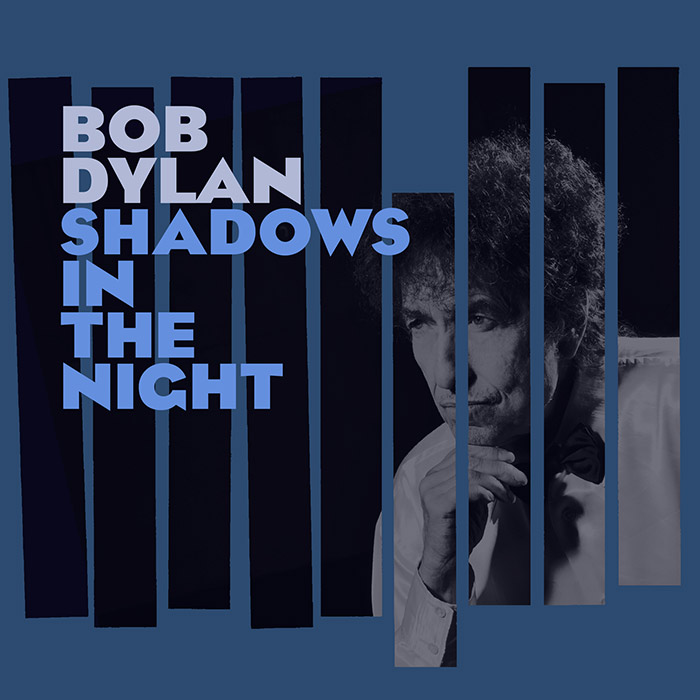
Yesterday, much to their delight, visitors to bobdylan.com discovered that the singer-songwriter had posted a new track — a cover of “Full Moon and Empty Arms,” a song recorded by Frank Sinatra back in 1946. Although details remains scarce, it looks as if the new track will appear on a forthcoming album called Shadows in the Night, for which you can already see some cover art. The new track appears below.
The Andy Warhol-masterminded avant-garde rock group The Velvet Underground brought Lou Reed to the attention of a generation — it and all of Reed’s artistically wide-ranging projects would draw notice from generations thereafter. But such a singular personality couldn’t have simply appeared, fully formed, along with the Velvets. What, then, had he done before that epochal band began playing together in 1965?
The answer, as you can hear in 1962’s “Merry Go Round” and “Your Love,” the pair of singles embedded at the top of the post: doo-wop. Though not released in their day, the songs find a certain “Lewis Reed” laying down his very first lead vocals. Years before, in 1958, the producer of those songs put out a 45 by the The Jades, the high-school band in which Reed had played but not sung. You can hear the doo-wop trio’s “So Blue” below:
“The Jades wasn’t a band, it was just one guitar and two other guys singing,” Reed later said. “I was in the background. I wrote the stuff, I didn’t sing it. We would play shopping malls and some really bad violent places. I was always, like, tremendously under age, which was pretty cool.” You can hear more reminiscences of The Jades’ heyday, such as they had, in this interview with lead singer (and Reed’s high-school classmate) Phil Harris. “One evening, at Lou’s house, we started fooling around with some lyrics and during that evening, both ‘So Blue’ and ‘Leave Her for Me’ were written. In those days, it didn’t take much imagination to come up with something. You just thought of an experience that you might have gone through and wrote it down.” Instead of continuing with music, Harris opted for the U.S. Navy and what he calls “a typical life in the work-a-day world.” His bandmate, on the other hand, went on to a long career that seemed to demand no small amount of imagination: being Lou Reed.
We're hoping to rely on loyal readers, rather than erratic ads. Please click the Donate button and support Open Culture. You can use Paypal, Venmo, Patreon, even Crypto! We thank you!
Open Culture scours the web for the best educational media. We find the free courses and audio books you need, the language lessons & educational videos you want, and plenty of enlightenment in between.