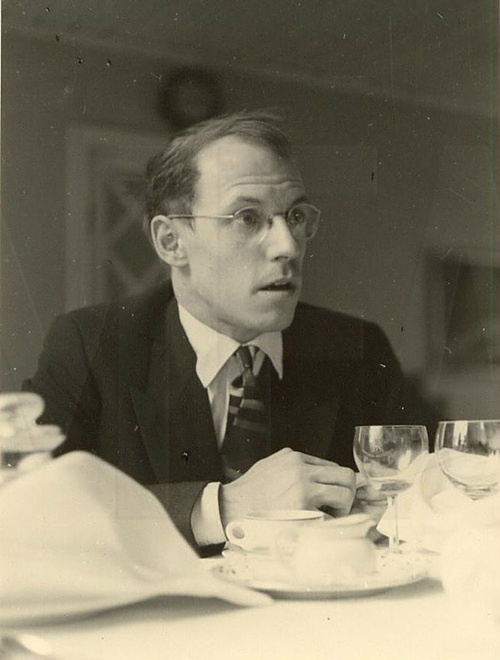
When you think of Michel Foucault, it’s hard not to think of the bald head that’s so part of his persona. Do a Google image search for Foucault, and you’ll find a “profusion of pictures of Foucault’s gleaming bald head” (as Jeffrey Weinstock calls it in an article entitled “This is Not Foucault’s Head”). But, among those many images, you will find one lonely photo of Foucault with a full(ish) head of hair. It’s hard to put a date on the picture. Very likely, it was taken during the mid 1950s, right around when Foucault was 30 years old. The look he’s sporting there is very different than what we see in 1965, when he sits down to talk with Alain Badiou. Or 1971, when he debates Noam Chomsky on Dutch TV. By those later dates, Foucault had the look that became so enduring.
A few months ago, we featured the increasingly abstract portraits drawn by an artist after periodic doses of LSD. It happened in the late 1950s, a time when you might well imagine such an activity going down in, say, a bohemian quarter of New York, but also a time when hallucinogenic drugs rode a wave of popularity among legitimate scientists. Those ostensibly straight-laced researchers (sometimes funded by CIA money) had a fascination not with the taking of hallucinogenic drugs — not necessarily, anyway — but with what, exactly, these hallucinogenic drugs did to those who do take them. Particularly artists drawing portraits. Those portraits drawn on LSD came out under the close watch of University of California, Irvine psychiatrist Oscar Janiger. Above, you can watch the fruit of another, much more verbal 1950s experiment conducted just down the coast by the University of Southern California’s Nicholas A. Bercel, M.D.: “Schizophrenic Model Psychosis Induced by LSD 25.”
Here we also have an artist examined: this time, a Los Angeles painter named Bill. As Bill floats through his altered state, Bercel asks him to describe, in as rigorous detail as possible, his perceptions of objects in the room, of items of food and drink brought in, and of their interactions themselves. This 24-minute film of the four-hour process, punctuated by electroencephalographic scans, comes as a production of Sandoz, the Swiss pharmaceutical company who originally isolated LSD and who apparently had an interest in bringing a form of it to market. (One proposed pharmacological designation: “Phantastium.”) Though that didn’t happen, the Hungarian-born Bercel went on throughout his long career to conduct more research of the kind that ultimately earned him a legacy as a pioneer in neurophysiology. He also, when not in the lab, wrote over a dozen novels and film treatments. Clearly he had an impressive creative streak, whether or not he ever personally had his doors of perception opened by the substances his subjects like Bill so enjoyed.
This weekend, Rubin “Hurricane” Carter passed away. He was 76. An American middleweight boxer, Carter was tried and convicted twice (once 1967, again in 1976) for homicides that took place in Paterson, New Jersey in 1966 — despite the fact that there were no finger prints or eyewitnesses connecting him to the crime. (Both convictions were later overturned when courts found that the trials were tainted by prosecutorial misconduct.) Before the second trial, Bob Dylan met with Carter in prison and then wrote “Hurricane,” a protest song that reached #33 on the Billboard chart. According to Jambase, Dylan brought a trio to Chicago’s WTTW Studios for a three-song performance where they played “Hurricane” on September 10, 1975. He’s backed by Scarlet Rivera on violin, Rob Stoner on bass, and Howie Wyeth on drums. It was apparently Dylan’s first live performance of the eight minute song.
PS Sorry for the ad that plays before the video. We have no control over that.
On the first episode of Orson Welles’ Sketch Book, the man who made Citizen Kane remembers an anxiety-inducing evening early in his career: having somehow already gained a reputation as an entertaining after-dinner speaker, he found himself standing before a roomful of what seemed like every movie star in the flesh that he’d ever seen on the screen. Desperate to impress all these celebrities who had so impressed him, he pulled out the only amusing story in his repertoire, only to realize halfway through the telling that he couldn’t remember how it ended. Luckily, one of California’s earthquakes struck just before he reached that forgotten ending, sending the whole Hollywood crowd out the door and letting him off the raconteur hook. By the time he tells the next tale, of his longer-ago, more stressful and much more formative debut onstage in front of a decidedly uncooperative Dublin audience, you’ll wonder why he couldn’t handle the after-dinner speaking; if anyone has a natural storyteller’s instinct, he does.
The BBC must have thought so, in any case, when they put together this series of television commentaries from Welles, none of which need more than his then slightly unfamiliar face (without, he underscores, the usual false nose he wears for roles), his unmistakable voice, and his illustrations — taken, literally, from his sketchbook. In these six fifteen-minute broadcasts, which originally aired in 1955, Welles talks about not just the inauspicious beginnings of his illustrious working life but his experiences with the critics, the police, John Barrymore and Harry Houdini, the infamous radio production of War of the Worlds (which you can hear in our post for its 75th anniversary), and bullfighting (see also our post on his friendship with Ernest Hemingway). Though interesting in and of themselves, he uses these subjects to tie together a variety of recollections and observations from his life and career: on the finer points of producing Shakespeare with voodoo witch-doctors, on media-induced gullibility, on the invasion of privacy, on the art of line prompting. Not settling for status as a creative genius in film, theater, and radio, it seems Welles also laid down the example for a form that wouldn’t actually arrive for another fifty years: vlogging.
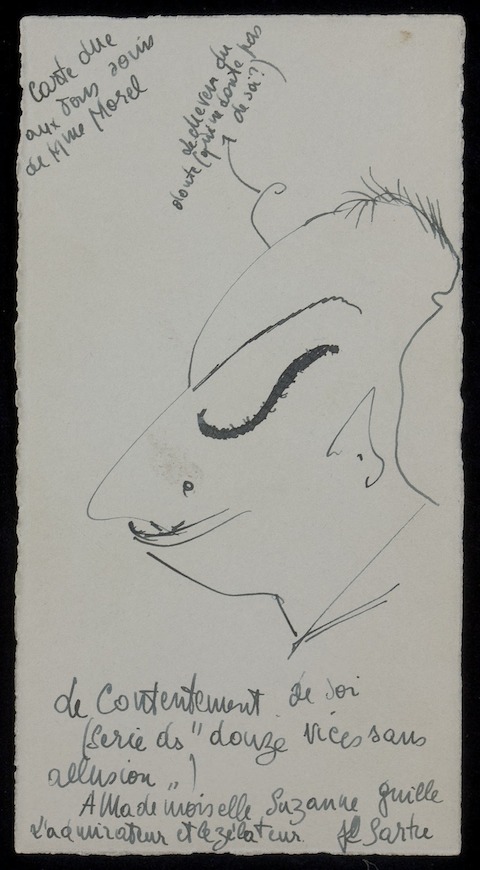
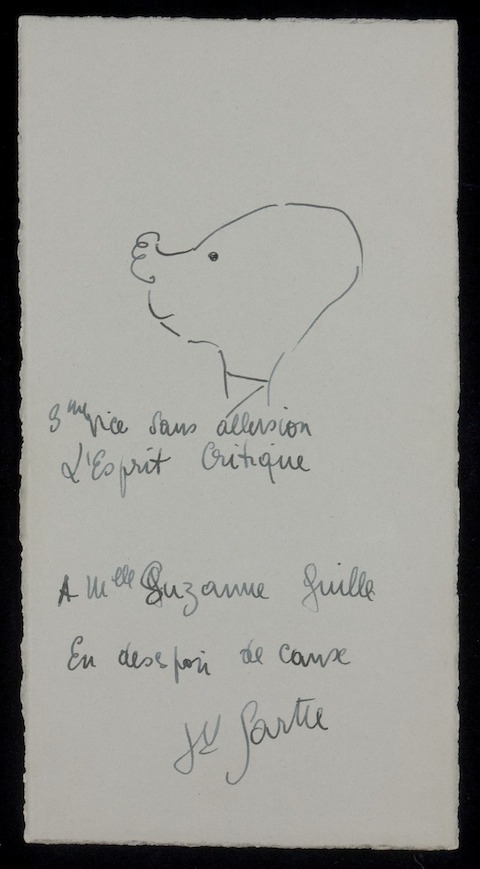
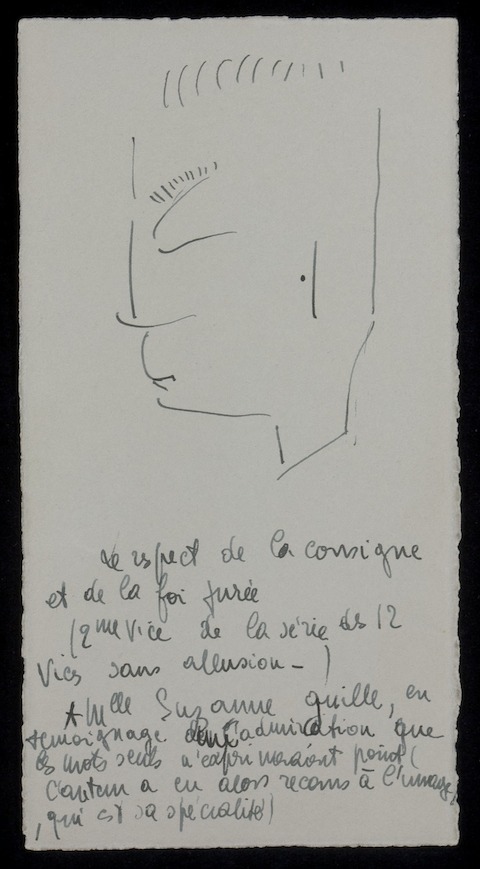
We’ve established something of a tradition here of featuring drawings by famous authors. It seems, unsurprisingly, that skill with the pen often goes hand-in-glove with a keen visual sense, though admittedly some writers are more talented draftsmen than others. William Faulkner, for example, created some very fine pen-and-ink illustrations for his college newspaper during his brief time at Ole Miss. Franz Kafka’s expressionistic sketches are quite striking, despite his anguished protestations to the contrary. And Jorge Luis Borges’ doodles are as quirky and playful as the author himself. Today we bring you the sketches of that great French existentialist philosopher, novelist, and playwright Jean-Paul Sartre—a collection of six rough, childlike caricatures that are, shall we say, rather less than accomplished. It’s certainly for the best—as the cliché goes—that Sartre never quit his day job for an art career.
But there is a certain wicked charm in Sartre’s visual satires of human moral failings, which he calls a “series de ‘douze vices sans allusion’”—roughly, “a series of twelve vices without reference.” Either Sartre only completed half the series, or—more likely—half have been lost, since the author assures the recipient of his handiwork, a Mademoiselle Suzanne Guille, that he presents to her a “série complete.” Who was Suzanne Guille? Your guess is as good as mine. Yale’s Beinecke Rare Book & Manuscript Library, which houses these sketches, gives us no indication. Perhaps she was a relative, perhaps the spouse, of Pierre Guille, Simon de Beauvoir’s last lover? Given the many complicated liaisons pursued by both Sartre and his partner, the possibilities are indeed intriguing. As for the drawings? Their subjects hold more interest than their execution, providing us with keys to Sartre’s moral universe.
The first caricature, at the top, is titled “Le Contentment de soi”—“Self-Satisfaction”—and the character’s pompous expression says as much. Below it, the curious little fellow with the curlicue nose is called “L’Esprit Critique”—“The Spirit of Criticism.” And above we have “Le respect de la consigne et de la jurée”—“Keeping a Sworn Oath.” You can see the remaining three drawings, and read Sartre’s letter (in French, of course) to Mademoiselle Guille in pdf form here.
Michael Jackson took one giant leap for pop history on March 25, 1983 when he gave an adoring public their first taste of his signature moonwalk in honor of Motown Records’ 25th birthday. (See below)
Novelty-wise, it wasn’t quite a Neil Armstrong moment. Like many artists, Jackson had many precedents from which he could and did draw. He can be credited with bringing a certain attitude to the proceedings. The expert practitioners in the video above are more ebullient, tapping, sliding and proto-moonwalking themselves into a state of rapture that feeds off the audience’s pleasure.
Lacking the Internet, however, it does seem unlikely that Jackson would’ve spent much time poring over the footwork of these masters. (He may have taken a sartorial cue from their socks.)
Instead, he invested a lot of time breaking down the street moves, what he referred to in his autobiography as “a ‘popping’ type of thing that black kids had created dancing on the street corners in the ghetto.”
Jackson’s sister, LaToya, identified former Soul Train and Solid Gold dancer Jeffrey Daniel, below, as her brother’s primary tutor in this endeavor. (He went on to co-choreograph Jackson’s videos for “Bad” and “Smooth Criminal”.) As to the story behind his moonwalk, or backslide as he called it before Jackson’s version obliterated the possibility of any other name, Daniel gave props to the same kids Jackson did.
For those of you who mentioned it on Twitter and in our comments, we’ve added Charlie Chaplin’s scene in Modern Times.
I’m gonna go out on a limb and guess that this is the first time two knighted cultural figures have played The Newlywed Game — a version of that wince (and nostalgia) ‑inducing game show that ran from the 1960s through the 1990s. Although Stewart and McKellen aren’t married, they know each other plenty well. They’ve worked together on stage (in a production of Waiting for Godot) and in film (they’ll be appearing together in an upcoming X‑Men movie.) And suffice it to say, they’ve formed a tight friendship. When Stewart married Sunny Ozell last year, McKellen officiated at the wedding ceremony.
This little bit took place at a BuzzFeed Brews event back in February. You can watch their full 48 minute appearance here. Also find the two in a deeper conversation recorded at the Screen Actors Guild Foundation just last month.
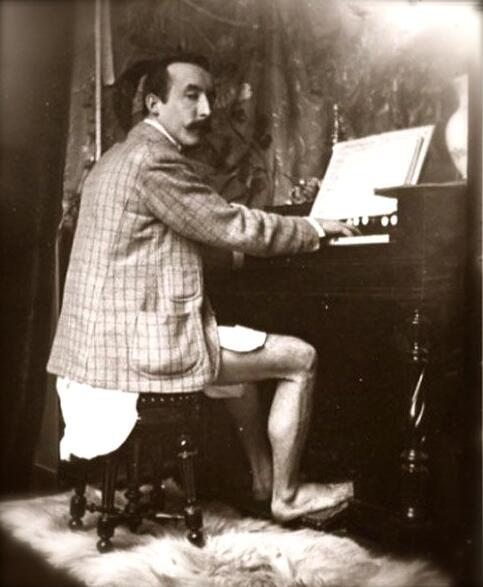
What do we have here? Painter Paul Gauguin playing a harmonium at the Paris studio of Alphonse Mucha, a Czech Art Nouveau painter, in or around 1895. How this came about — how Gauguin decided to strip off his pants and shoes and start playing that pump organ — we’ll probably never know. But we’re certainly glad that this light moment was saved for posterity.
If you would like to support the mission of Open Culture, consider making a donation to our site. It’s hard to rely 100% on ads, and your contributions will help us continue providing the best free cultural and educational materials to learners everywhere. You can contribute through PayPal, Patreon, and Venmo (@openculture). Thanks!
Dear Xavier High School, and Ms. Lockwood, and Messrs Perin, McFeely, Batten, Maurer and Congiusta:
I thank you for your friendly letters. You sure know how to cheer up a really old geezer (84) in his sunset years. I don’t make public appearances any more because I now resemble nothing so much as an iguana.
What I had to say to you, moreover, would not take long, to wit: Practice any art, music, singing, dancing, acting, drawing, painting, sculpting, poetry, fiction, essays, reportage, no matter how well or badly, not to get money and fame, but to experience becoming, to find out what’s inside you, to make your soul grow.
Seriously! I mean starting right now, do art and do it for the rest of your lives. Draw a funny or nice picture of Ms. Lockwood, and give it to her. Dance home after school, and sing in the shower and on and on. Make a face in your mashed potatoes. Pretend you’re Count Dracula.
Here’s an assignment for tonight, and I hope Ms. Lockwood will flunk you if you don’t do it: Write a six line poem, about anything, but rhymed. No fair tennis without a net. Make it as good as you possibly can. But don’t tell anybody what you’re doing. Don’t show it or recite it to anybody, not even your girlfriend or parents or whatever, or Ms. Lockwood. OK?
Tear it up into teeny-weeny pieces, and discard them into widely separated trash recepticals [sic]. You will find that you have already been gloriously rewarded for your poem. You have experienced becoming, learned a lot more about what’s inside you, and you have made your soul grow.
God bless you all!
Kurt Vonnegut
Vonnegut’s kind wishes and Yoko Ono-esque prompt have been widely disseminated on the Internet, which is no doubt where students at Hove Park School in Brighton, East Sussex caught the scent. Working with a professional production company that specializes in narrative-driven work, they literalized the assignment in the video above, and while I might have preferred a sneak peek at the poems and drawings such a task might yield, pre-shredding, I loved how they acknowledged that not everyone heeds the call. (The casting of that one could have gone either way…wouldn’t be surprised if you told me that that boy has a punk band that would’ve ripped Vonnegut’s ears off.)
“Our independence from Spanish domination did not put us beyond the reach of madness,” said Gabriel García Márquez in his 1982 Nobel Prize acceptance speech. García Márquez, who died yesterday at the age of 87, refers of course to all of Spain’s former colonies in Latin America and the Caribbean, from his own Colombia to Cuba, the island nation whose artistic struggle to come to terms with its history contributed so much to that art form generally known as “magical realism,” a syncretism of European modernism and indigenous art and folklore, Catholicism and the remnants of Amerindian and African religions.
While the term has perhaps been overused to the point of banality in critical and popular appraisals of Latin-American writers (some prefer Cuban novelist Alejo Carpentier’s lo real maravilloso, “the marvelous real”), in Marquez’s case, it’s hard to think of a better way to describe the dense interweaving of fact and fiction in his life’s work as a writer of both fantastic stories and unflinching journalistic accounts, both of which grappled with the gross horrors of colonial plunder and exploitation and the subsequent rule of bloodthirsty dictators, incompetent patriarchs, venal oligarchs, and corporate gangsters in much of the Southern Hemisphere.
Nevertheless, it’s a description that sometimes seems to obscure García Marquez’s great purpose, marginalizing his literary vision as trendy exotica or a “postcolonial hangover.” Once asked in a Paris Review interview the year before his Nobel win about the difference between the novel and journalism, García Márquez replied, “Nothing. I don’t think there is any difference. The sources are the same, the material is the same, the resources and the language are the same.”
In journalism just one fact that is false prejudices the entire work. In contrast, in fiction one single fact that is true gives legitimacy to the entire work. That’s the only difference, and it lies in the commitment of the writer. A novelist can do anything he wants so long as he makes people believe in it.
García Márquez made us believe. One would be hard-pressed to find a 20th century writer more committed to the truth, whether expressed in dense mythology and baroque metaphor or in the dry rationalist discourse of the Western episteme. For its multitude of incredible elements, the 1967 novel for which García Márquez is best known—One Hundred Years of Solitude—captures the almost unbelievable human history of the region with more emotional and moral fidelity than any strictly factual account: “However bizarre or grotesque some particulars may be,” wrote a New York Times reviewer in 1970, “Macondo is no never-never land.” In fact, García Márquez’s novel helped dismantle the very real and brutal South American empire of banana company United Fruit, a “great irony,” writes Rich Cohen, of one mythology laying bare another: “In college, they call it ‘magical realism,’ but, if you know history, you understand it’s less magical than just plain real, the stuff of newspapers returned as lived experience.”
Edith Grossman, translator of several of García Márquez’s works—including Love in the Time of Cholera and his 2004 autobiography Living to Tell the Tale (Vivir para Cotarla)—agrees. “He doesn’t use that term at all, as far as I know,” she said in a 2005 interview with Guernica’s Joel Whitney: “It’s always struck me as an easy, empty kind of remark.” Instead, García Márquez’s style, says Grossman, “seemed like a way of writing about the exceptionalness of so much of Latin America.”
Today, in honor and with tremendous gratitude for that indefatigable chronicler of exceptional lived experience, we offer several online texts of Gabriel García Márquez’s short works at the links below.
HarperCollins’ online preview of García Marquez’s Collected Stories includes the full text of “The Third Resignation,” “The Other Side of Death,” “Eva Is Inside Her Cat,” “Bitterness for Three Sleepwalkers,” and “Dialogue with the Mirror,” all from the author’s 1972 collection Eyes of a Blue Dog (Ojos de perro azul).
Finally, we should also mention that you can download Love in the Time of Cholera or Hundred Years of Solitude for free (as audio books) if you join Audible.com’s 30-day program. We have details on it here.
As we say farewell to one of the world’s greatest writers, we can remember him not only as a writer of “magical realism,” whatever that phrase may mean, but as a teller of complicated, wondrous, and sometimes painful truths, in whatever form he happened to find them.
British Pathé was one of the leading producers of newsreels and documentaries during the 20th Century. This week, the company, now an archive, is turning over its entire collection — over 85,000 historical films – to YouTube.
But the really intriguing part of the archive is seeing all the ephemera from the 20th Century, the stuff that really makes the past feel like a foreign country – the weird hairstyles, the way a city street looked, the breathtakingly casual sexism and racism. There’s a rush in seeing history come alive. Case in point, this documentary from 1967 about the wonders to be found in a surprisingly monochrome Virginia.
Here’s a film about a technological innovation that curiously didn’t take off — an amphibious scooter. The look of regal dignity on the driver’s face as his vehicle moves down the Thames is priceless.
In an early example of a political blooper, there’s this footage from 1942 of Bess Truman trying valiantly to smash an unyielding bottle of champagne against the fuselage of a brand new bomber.
And then there’s this newsreel from 1938 on the wedding between Billy Curtis, a 3’7” nightclub bouncer and his 6’4” burlesque star bride. The jaunty, spectacularly un-PC voiceover should probably be filed under “things were different then.”
Jonathan Crow is a Los Angeles-based writer and filmmaker whose work has appeared in Yahoo!, The Hollywood Reporter, and other publications. You can follow him at @jonccrow.
We're hoping to rely on loyal readers, rather than erratic ads. Please click the Donate button and support Open Culture. You can use Paypal, Venmo, Patreon, even Crypto! We thank you!
Open Culture scours the web for the best educational media. We find the free courses and audio books you need, the language lessons & educational videos you want, and plenty of enlightenment in between.