Philip K. Dick Theorizes The Matrix in 1977, Declares That We Live in “A Computer-Programmed Reality”
In 1963, Philip K. Dick won the coveted Hugo Award for his novel The Man in the High Castle, beating out such sci-fi luminaries as Marion Zimmer Bradley and Arthur C. Clarke. Of the novel, The Guardian writes, “Nothing in the book is as it seems. Most characters are not what they say they are, most objects are fake.” The plot—an alternate history in which the Axis Powers have won World War II—turns on a popular but contraband novel called The Grasshopper Lies Heavy. Written by the titular character, the book describes the world of an Allied victory, and—in the vein of his worlds-within-worlds thematic—Dick’s novel suggests that this book-within-a-book may in fact describe the “real” world of the novel, or one glimpsed through the novel’s reality as at least highly possible.
The Man in the High Castle may be Dick’s most straightforwardly compelling illustration of the experience of alternate realities, but it is only one among very many. In an interview Dick gave while at the high profile Metz science fiction conference in France in 1977, he said that like David Hume’s description of the “intuitive type of person,” he lived “in terms of possibilities rather than in terms of actualities.” Dick also tells a parable of an ancient, complicated, and temperamental automated record player called the “Capard,” which reverted to varying states of destructive chaos. “This Capard,” Dick says, “epitomized an inscrutable ultra-sophisticated universe which was in the habit of doing unexpected things.”
In the interview, Dick roams over so many of his personal theories about what these “unexpected things” signify that it’s difficult to keep track. However, at that same conference, he delivered a talk titled “If You Find This World Bad, You Should See Some of the Others” (in edited form above), that settles on one particular theory—that the universe is a highly-advanced computer simulation. (The talk has circulated on the internet as “Did Philip K. Dick disclose the real Matrix in 1977?”).
The subject of this speech is a topic which has been discovered recently, and which may not exist all. I may be talking about something that does not exist. Therefore I’m free to say everything and nothing. I in my stories and novels sometimes write about counterfeit worlds. Semi-real worlds as well as deranged private worlds, inhabited often by just one person…. At no time did I have a theoretical or conscious explanation for my preoccupation with these pluriform pseudo-worlds, but now I think I understand. What I was sensing was the manifold of partially actualized realities lying tangent to what evidently is the most actualized one—the one that the majority of us, by consensus gentium, agree on.
Dick goes on to describe the visionary, mystical experiences he had in 1974 after dental surgery, which he chronicled in his extensive journal entries (published in abridged form as The Exegesis of Philip K. Dick) and in works like VALIS and The Divine Invasion. As a result of his visions, Dick came to believe that “some of my fictional works were in a literal sense true,” citing in particular The Man in the High Castle and Flow My Tears, The Policeman Said, a 1974 novel about the U.S. as a police state—both novels written, he says, “based on fragmentary, residual memories of such a horrid slave state world.” He claims to remember not past lives but a “different, very different, present life.”
Finally, Dick makes his Matrix point, and makes it very clearly: “we are living in a computer-programmed reality, and the only clue we have to it is when some variable is changed, and some alteration in our reality occurs.” These alterations feel just like déjà vu, says Dick, a sensation that proves that “a variable has been changed” (by whom—note the passive voice—he does not say) and “an alternative world branched off.”
Dick, who had the capacity for a very oblique kind of humor, assures his audience several times that he is deadly serious. (The looks on many of their faces betray incredulity at the very least.) And yet, maybe Dick’s crazy hypothesis has been validated after all, and not simply by the success of the PKD-esque The Matrix and the ubiquity of Matrix analogies. For several years now, theoretical physicists and philosophers have entertained the theory that we do in fact live in a computer-generated simulation and, what’s more, that “we may even be able to detect it.”
Related Content:
Robert Crumb Illustrates Philip K. Dick’s Infamous, Hallucinatory Meeting with God (1974)
The Simulation Theory Explained In Three Animated Videos
Josh Jones is a writer and musician based in Durham, NC. Follow him at @jdmagness
Read More...Fritz Lang First Depicted Artificial Intelligence on Film in Metropolis (1927), and It Frightened People Even Then
Artificial intelligence seems to have become, as Michael Lewis labeled a previous chapter in the recent history of technology, the new new thing. But human anxieties about it are, if not an old old thing, then at least part of a tradition longer than we may expect. For vivid evidence, look no further than Fritz Lang’s Metropolis, which brought the very first cinematic depiction of artificial intelligence to theaters in 1927. It “imagines a future cleaved in two, where the affluent from lofty skyscrapers rule over a subterranean caste of laborers,” writes Synapse Analytics’ Omar Abo Mosallam. “The class tension is so palpable that the invention of a Maschinenmensch (a robot capable of work) upends the social order.”
The sheer tirelessness of the Maschinenmensch “sows havoc in the city”; later, after it takes on the form of a young woman called Maria — a transformation you can watch in the clip above — it “incites workers to rise up and destroy the machines that keep the city functioning. Here, there is a suggestion to associate this new invention with an unraveling of the social order.” This robot, which Guardian film critic Peter Bradshaw describes as “a brilliant eroticization and fetishization of modern technology,” has long been Metropolis’ signature figure, more iconic than HAL, Data, and WALL‑E put together.
Still, those characters all rate mentions of their own in the articles reviewing the history of AI in the movies recently published by the BFI, RTÉ, Pictory, and other outlets besides. The Day the Earth Stood Still, Alien, Blade Runner (and even more so its sequel Blade Runner 2049), Ghost in the Shell, The Matrix, and Ex Machina. Not all of these pictures present their artificially intelligent characters primarily as existential threats to the existing order; the BFI’s Georgina Guthrie highlights video essayist-turned-auteur Kogonada’s After Yang as an example that treats the role of AI could assume in society as a much more complex — indeed, much more human — matter.
From Metropolis to After Yang, as RTÉ’s Alan Smeaton points out, “AI is usually portrayed in movies in a robotic or humanoid-like fashion, presumably because we can easily relate to humanoid and robotic forms.” But as the public has come to understand over the past few years, we can perceive a technology as potentially or actually intelligent even it doesn’t resemble a human being. Perhaps the age of the fearsome mechanical Art Deco gynoid will never come to pass, but we now feel more keenly than ever both the seductiveness and the threat of Metropolis’ Maschinenmensch — or, as it was named in the original on which the film was based, Futura.
Related content:
Metropolis: Watch Fritz Lang’s 1927 Masterpiece
Amazon Offers Free AI Courses, Aiming to Help 2 Million People Build AI Skills by 2025
Based in Seoul, Colin Marshall writes and broadcasts on cities, language, and culture. His projects include the Substack newsletter Books on Cities, the book The Stateless City: a Walk through 21st-Century Los Angeles and the video series The City in Cinema. Follow him on Twitter at @colinmarshall or on Facebook.
Read More...Why Medieval Bologna Was Full of Tall Towers, and What Happened to Them

Image by Toni Pecoraro, via Wikimedia Commons
Go to practically any major city today, and you’ll notice that the buildings in certain areas are much taller than in others. That may sound trivially true, but what’s less obvious is that the height of those buildings tends to correspond to the value of the land on which they stand, which itself reflects the potential economic productivity to be realized by using as much vertical space as possible. To put it crudely, the taller the buildings in a part of town, the greater the wealth being generated (or, at times, destroyed). This is a modern phenomenon, but it also held true, in a different way, in the Bologna of 800 years ago.
There exists a work of art, much circulated online, that depicts what looks like the capital of Emilia-Romagna in the twelfth or thirteenth century. But the city bristles with what look like skyscrapers, creating an incongruous but enchanting medieval Blade Runner effect. Bologna really does have towers like that, but only about 22 of them still stand today. Whether it ever had the nearly 180 depicted in this particular image, and what happened to them if it did, is the question Jochem Boodt investigates in the Present Past video below.
In the era these towers were built, Bologna had become “one of the largest cities in Europe. It’s a time of huge, ambitious projects. Cities built cathedrals, town halls, and public squares — and some people built towers.” Those people included noble families who held to aristocratic traditions, not least violent feuding. Given that “the city is no place to build castles,” they instead inhabited urban complexes whose townhouses surrounded towers, which were “more like panic rooms” than actual living spaces. References to these prominent structures appear in subsequent works of art and literature: Dante, for instance, wrote of a leaning “tower called Garisenda.”
The etching that set Boodt on this journey to Bologna in the first place turns out to be the relatively recent work of an Italian artist called Toni Pecoraro, who heightened — in every sense — images of a 1917 model of the city by the shoemaker and “strange self-taught artist-scientist” Angelo Finelli. Finelli, in turn, drew his inspiration from a study by the nineteenth-century archaeologist Giovanni Gozzadini, himself a scion of one of those very families who competed to have the tallest tower, then got bored and pursued other status symbols instead. Perhaps Bologna is no longer the center of aristocratic and mercantile intrigue it used to be, judging by the sparseness of its current skyline, but then, there’s something to be said for not needing a fortified tower in which to hide at a moment’s notice.
Related content:
Why Europe Has So Few Skyscrapers
Why the Leaning Tower of Pisa Still Hasn’t Fallen Over, Even After 650 Years
Venice Explained: Its Architecture, Its Streets, Its Canals, and How Best to Experience Them All
Based in Seoul, Colin Marshall writes and broadcasts on cities, language, and culture. His projects include the Substack newsletter Books on Cities, the book The Stateless City: a Walk through 21st-Century Los Angeles and the video series The City in Cinema. Follow him on Twitter at @colinmarshall or on Facebook.
Read More...Hannah Arendt Explains How Totalitarian Regimes Arise–and How We Can Prevent Them
“Adolf Eichmann went to the gallows with great dignity,” wrote the political philosopher Hannah Arendt, describing the scene leading up to the prominent Holocaust-organizer’s execution. After drinking half a bottle of wine, turning down the offer of religious assistance, and even refusing the black hood offered him at the gallows, he gave a brief, strangely high-spirited speech before the hanging. “It was as though in those last minutes he was summing up the lesson that this long course in human wickedness had taught us — the lesson of the fearsome word-and-thought-defying banality of evil.”
These lines come from Eichmann in Jerusalem: A Report on the Banality of Evil, originally published in 1963 as a five-part series in the New Yorker. Eichmann “was popularly described as an evil mastermind who orchestrated atrocities from a cushy German office, and many were eager to see the so-called ‘desk murderer’ tried for his crimes,” explains the narrator of the animated TED-Ed lesson above, written by University College Dublin political theory professor Joseph Lacey. “But the squeamish man who took the stand seemed more like a dull bureaucrat than a sadistic killer,” and this “disparity between Eichmann’s nature and his actions” inspired Arendt’s famous summation.
A German Jew who fled her homeland in 1933, as Hitler rose to power, Arendt “dedicated herself to understanding how the Nazi regime came to power.” Against the common notion that “the Third Reich was a historical oddity, a perfect storm of uniquely evil leaders, supported by German citizens, looking for revenge after their defeat in World War I,” she argued that “the true conditions behind this unprecedented rise of totalitarianism weren’t specific to Germany.” Rather, in modernity, “individuals mainly appear in the social world to produce and consume goods and services,” which fosters ideologies “in which individuals were seen only for their economic value, rather than their moral and political capacities.”
In such isolating conditions, she thought, “participating in the regime becomes the only way to recover a sense of identity and community. While condemning Eichmann’s “monstrous actions, Arendt saw no evidence that Eichmann himself was uniquely evil. She saw him as a distinctly ordinary man who considered obedience the highest form of civic duty — and for Arendt, it was exactly this ordinariness that was most terrifying.” According to her theory, there was nothing particularly German about all of this: any sufficiently modernized culture could produce an Eichmann, a citizen who defines himself by participation in his society regardless of that society’s larger aims. This led her to the conclusion that “thinking is our greatest weapon against the threats of modernity,” some of which have become only more threatening over the past six decades.
Related content:
Take Hannah Arendt’s Final Exam for Her 1961 Course “On Revolution”
Watch Hannah Arendt’s Final Interview (1973)
Based in Seoul, Colin Marshall writes and broadcasts on cities, language, and culture. His projects include the Substack newsletter Books on Cities, the book The Stateless City: a Walk through 21st-Century Los Angeles and the video series The City in Cinema. Follow him on Twitter at @colinmarshall or on Facebook.
Read More...Leonard Bernstein Introduces the Moog Synthesizer to the World in 1969, Playing an Electrified Version of Bach’s “Little Fugue in G”
When Wendy Carlos released Switched-On Bach in 1968, her “greatest hits” compilation of the Baroque composer’s music, played entirely on the Moog analog synthesizer, the album became an immediate hit with both classical and pop audiences. Not only was it “acclaimed as real music by musicians and the listening public alike,” as Bob Moog himself has written, but “as a result, the Moog Synthesizer was suddenly accepted with open arms by the music business community.” There’s some exaggeration here. Stars like the Doors, the Monkees, and the Byrds had already recorded with Moogs the year before. And some classical purists (and classical Luddites) did not, in fact, hail Switched-On Bach as “real music.”
But on the whole, Carlos’s innovative demonstration of the electronic instrument’s capabilities (and her own) marks a milestone in music history as the first classical album to go Platinum, and as the first introduction of both Baroque music and the Moog synthesizer to millions of people unfamiliar with either.
Were it not for Carlos’s “use of the Moog’s oscillations, squeaks, drones, chirps, and other sounds,” as Bruce Eder writes at Allmusic, it’s unlikely we would have the video clip above, of Leonard Bernstein giving his own demonstration of the Moog (dig his hip “HAL” reference from the prior year’s 2001: A Space Odyssey), during one of his popular televised “Young People’s Concerts.”
Having just begun moving out of the studio, the Moog was still a collection of modular boxes and patch cables—an engineer’s instrument—and it takes four men to wheel it out on stage. (The easily portable, self-contained Minimoog wouldn’t appear until 1970.) Most people had no idea what a Moog actually looked like. But, its forbidding appearance aside, the sounds of the Moog were everywhere.
Bernstein mentions Carlos, and those stuffy purists, and makes a few more sci-fi jokes, then, instead of sitting at the keyboard, hits play on a reel-to-reel tape recorder. This pre-recorded version of Bach’s “Little Fugue in G” was actually arranged by Walter Sear, and the recording lacks some of the panache of Carlos’s playing while the tinny playback system makes it sound like 8‑bit video game music. But for this audience, the musical wizardly was still decidedly fresh.
The choice of Bach as Moog material was not just a matter of taste—his music was uniquely suited for Moog adaptation. As Carlos explains, “it was contrapuntal (not chords but musical lines, like the Moog produced), it used clean, Baroque lines, not demanding great ‘expressivo’ (a weakness in the Moog at the time), and it was neutral as to orchestration.” The Moog could also, it seems, make Bach’s fugues fly at almost superhuman speeds. Hear the “Little Fugue” played at a much more stately tempo, on a traditional pipe organ, further up.
Organs and harpsichords, strings and horns, these are still of course the instruments we think of when we think of Bach. Despite Carlos’s inventive foray—and its follow-up, The Well-Tempered Synthesizer—the synthesizer did not radicalize the classical music world, though its avant-garde offspring made much use of it. But it sure changed the sound of pop music, and wowed the kids who saw Bernstein’s program, some of whom may have gone on to popularize both electronic instruments and classical themes in prog-rock, disco, and yes, even video game music.
Related Content:
How the Moog Synthesizer Changed the Sound of Music
A BBC Science Show Introduces the Moog Synthesizer in 1969
Bob Moog Demonstrates His Revolutionary Moog Model D Synthesizer
Josh Jones is a writer and musician based in Durham, NC. Follow him at @jdmagness
Read More...Artist Draws 9 Portraits on LSD During 1950s Research Experiment
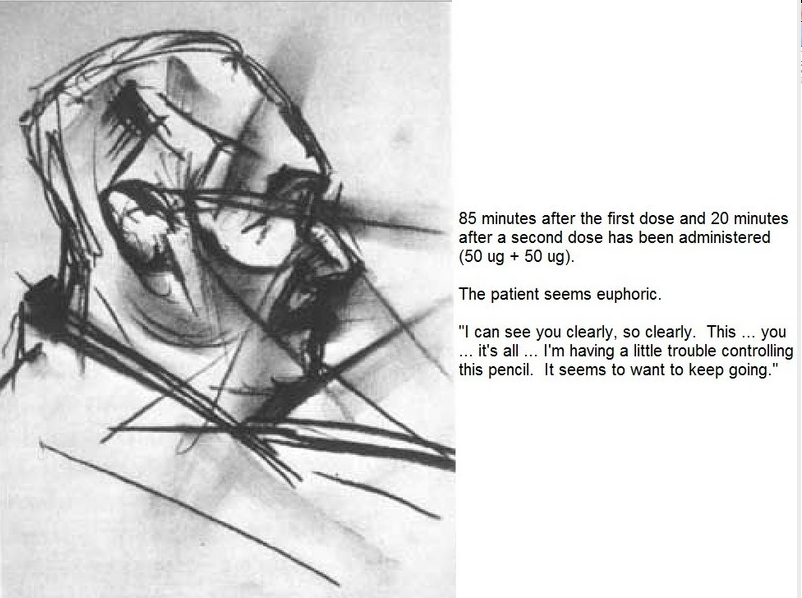
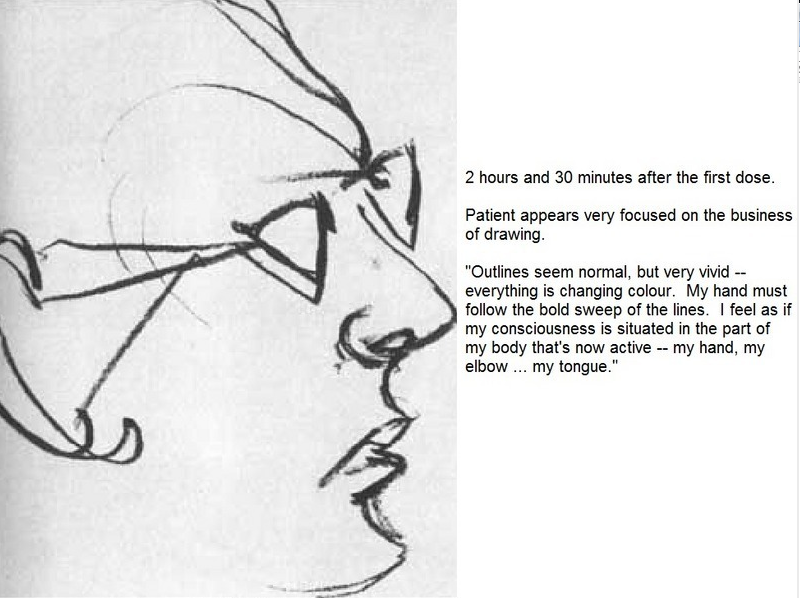
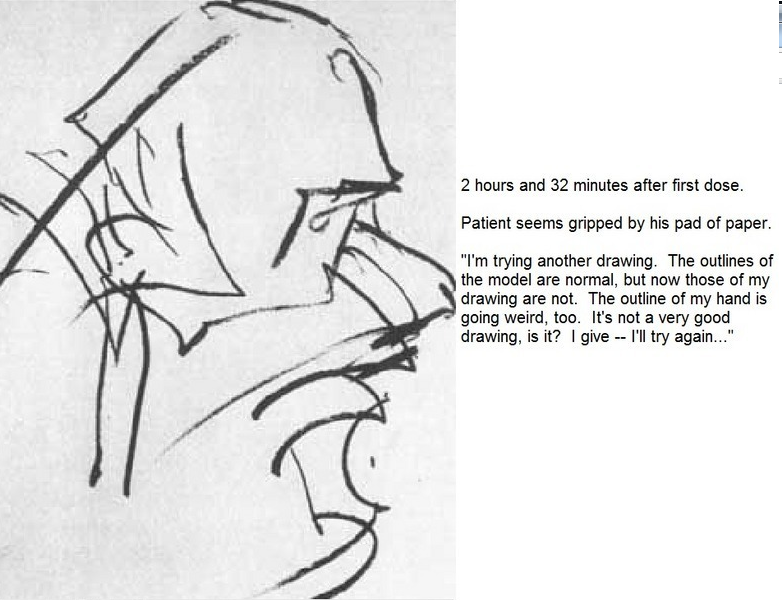
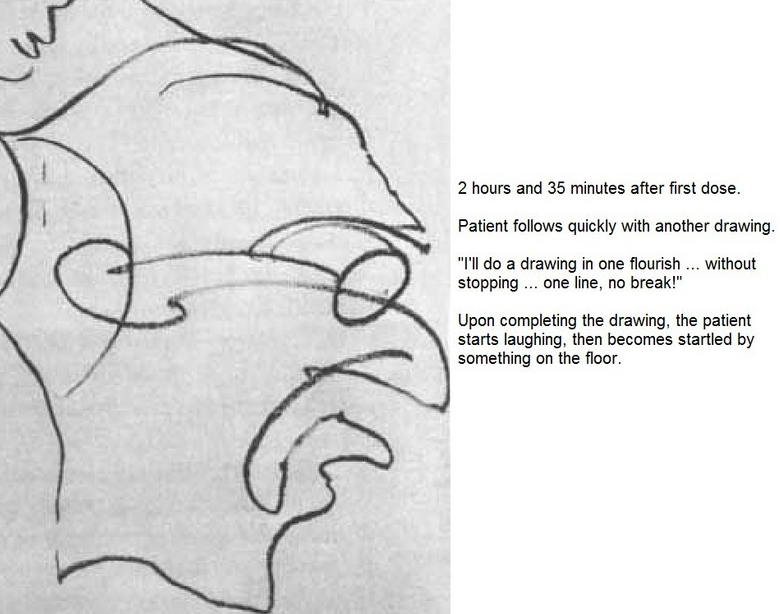
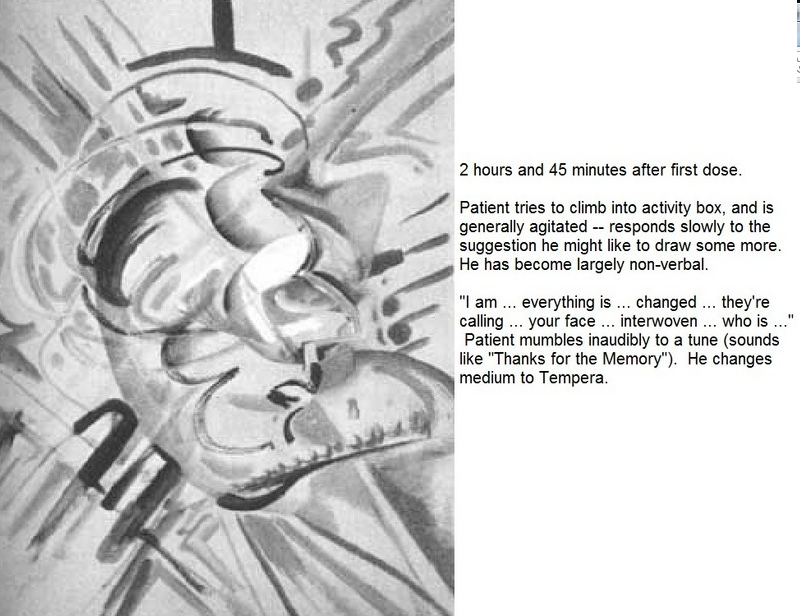
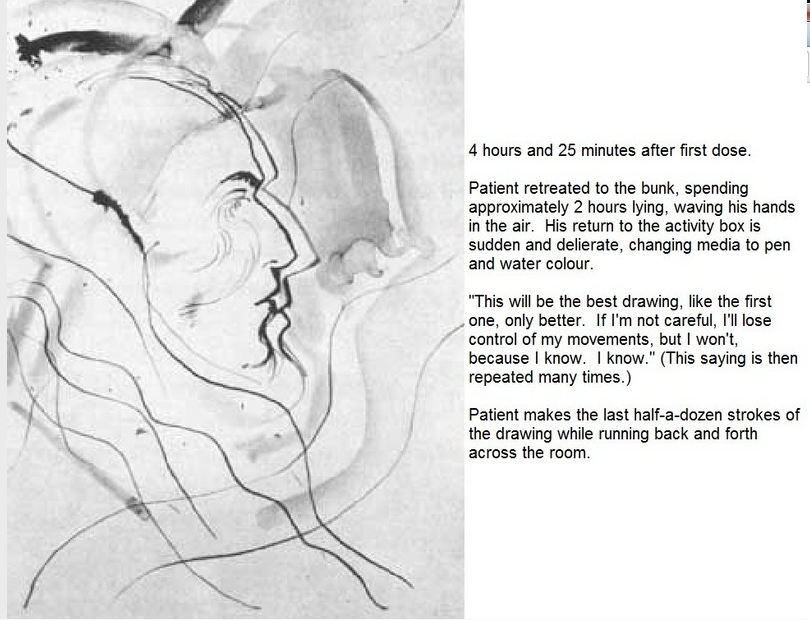
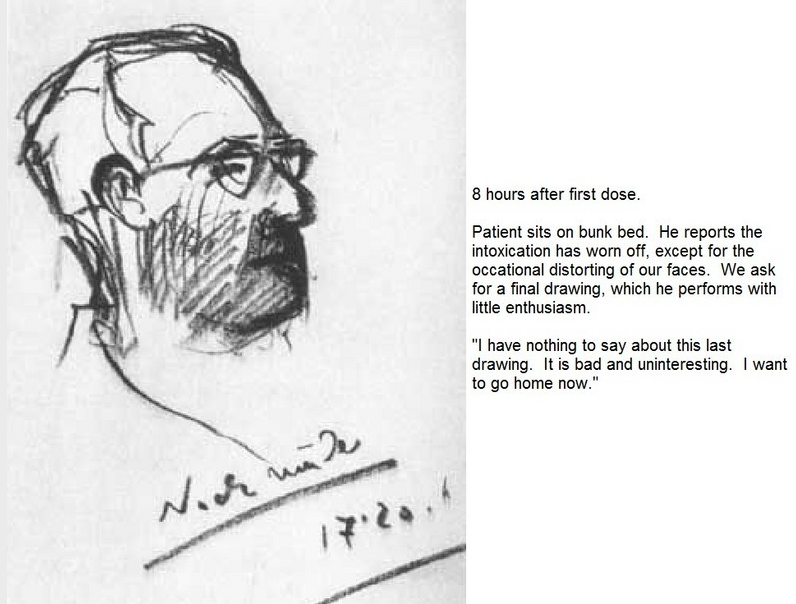
During the 1950s, a researcher gave an artist two 50-microgram doses of LSD (each dose separated by about an hour), and then the artist was encouraged to draw pictures of the doctor who administered the drugs. Nine portraits were drawn over the space of eight hours. We still don’t know the identity of the artist. But it’s surmised that the researcher was Oscar Janiger, a University of California-Irvine psychiatrist known for his work on LSD.
The web site Live Science has Andrew Sewell, a Yale Psychiatry professor (until his recent death), on record saying: “I believe the pictures are from an experiment conducted by the psychiatrist Oscar Janiger starting in 1954 and continuing for seven years, during which time he gave LSD to over 100 professional artists and measured its effects on their artistic output and creative ability. Over 250 drawings and paintings were produced.” The goal, of course, was to investigate what happens to subjects under the influence of psychedelic drugs. During the experiment, the artist explained how he felt as he worked on each sketch. You can watch how things unfolded below (or above):
20 Minutes After First Dose. Artist Claims to Feel Normal

85 Minutes After First Dose: Artist Says “I can see you clearly. I’m having a little trouble controlling this pencil.”
2 hours 30 minutes after first dose. “I feel as if my consciousness is situated in the part of my body that’s now active — my hand, my elbow… my tongue.”
2 hours 32 minutes: ‘I’m trying another drawing… The outline of my hand is going weird too. It’s not a very good drawing is it?”
2 hours 35 minutes: Patient follows quickly with another drawing. ‘I’ll do a drawing in one flourish… without stopping… one line, no break!”
2 hours 45 minutes: Agitated patient says “I am… everything is… changed… they’re calling… your face… interwoven… who is…” He changes medium to Tempera.
4 hours 25 minutes: After taking a break, the patient changes to pen and water color. “This will be the best drawing, like the first one, only better.”
5 hours 45 minutes. “I think it’s starting to wear off. This pencil is mighty hard to hold.” (He is holding a crayon).
8 hours later: The intoxication has worn off. Patient offers up a final drawing.
Related Content:
R. Crumb Describes How He Dropped LSD in the 60s & Instantly Discovered His Artistic Style
Algerian Cave Paintings Suggest Humans Did Magic Mushrooms 9,000 Years Ago
Read More...A 5‑Hour Journey Through North Korean Entertainment: Propaganda Films, Kids’ Cartoons, Sketch Comedy & More
Over the second half of the twentieth century, South Korea became rich, and in the first decades of the twenty-first, it’s become a global cultural superpower. The same can’t be said for North Korea: after a relatively strong start in the nineteen-fifties and sixties, its economy foundered, and in the famine-stricken mid-nineties it practically collapsed. For that and other reasons, the country has never been in a position to send forth its own BTS, Squid Game, Parasite, or “Gangnam Style.” But whatever the difficulties at home, the Democratic People’s Republic of Korea has always managed to produce entertainment for consumption by its own people: movies, animation, television shows, music, and more besides.
Then again, “entertainment” may be too strong a word. A few years ago, attending a North-South cultural exchange group in Seoul, where I live, I had the chance to watch a recent movie called 우리집 이야기, or The Story of Our Home. It told its simple tale of a family of orphans trying to survive on their own with surprising technical competence — at least compared to what I’d expected — albeit with what I remember as occasional jarring lapses into flat propaganda shots, stern national anthem, flapping red-starred flag and all. According to “Entertainment Made By North Korea,” the new five-and-a-half-hour analysis from Youtuber Paper Will, that sort of thing is par for the course.
In order to put North Korean entertainment in its proper context, the video begins before there was a North Korea, describing the films made on the Japanese-occupied Korean peninsula between 1910 and the end of the Second World War. Though the expulsion of the defeated Japan ended colonial rule in Korea, many more hardships would visit both sides of the newly divided country. But even during their struggles to develop, the rulers of both the developing North and South Korea understood the potential of cinema to influence their peoples’ attitudes and perceptions. Watched today, these pictures reveal a great deal about the countries’ priorities. For the DPRK, those priorities included the encouragement of unstinting hard work and allegiance to the state, embodied by its founder Kim Il Sung.
Later, in the seventies and eighties, came some diversification of both media and message, as serial dramas and children’s cartoons, some of them crafted with genuine skill and charm, discouraged individualistic attitudes, sympathy for foreigners, and thoughts of defection. Under Kim Il Sung’s movie-loving Kim Jong Il, North Korean films became more watchable, thanks in large part to his kidnapping and forcibly employing South Korean director Shin Sang-ok. Under his son Kim Jong Un, the country’s popular culture has flirted with the very outer reaches of cool, assembling the likes of instrument-playing girl-group Moranbong. Nevertheless, in North Korea, entertainment continues first and foremost to enforce the preferred ideology of the ruling class, something that — perish the thought — could surely never happen in the West.
Related content:
A‑ha’s “Take On Me” Performed by North Korean Kids with Accordions
How to Defeat the US with Math: An Animated North Korean Propaganda Film for Kids
North Korea’s Cinema of Dreams
Watch More Than 400 Classic Korean Films Free Online Thanks to the Korean Film Archive
Based in Seoul, Colin Marshall writes and broadcasts on cities, language, and culture. His projects include the Substack newsletter Books on Cities, the book The Stateless City: a Walk through 21st-Century Los Angeles and the video series The City in Cinema. Follow him on Twitter at @colinmarshall or on Facebook.
Read More...Google Launches a New Course Called “AI Essentials”: Learn How to Use Generative AI Tools to Increase Your Productivity
This week, Google announced the launch of Google AI Essentials, a new self-paced course designed to help people learn AI skills that can boost their productivity. Taught by Google’s AI experts, and assuming no prior knowledge of programming, the course ventures to show students how to “use AI in the real world,” with an emphasis on helping students:
- Develop ideas and content. If you’re stuck at the beginning of a project, use AI tools to help you brainstorm new ideas. In the course, you’ll use a conversational AI tool to generate concepts for a product and develop a presentation to pitch the product.
- Make more informed decisions. Let’s say you’re planning an event. AI tools can help you research the best location to host it based on your criteria. You can also use AI to help you come up with a tagline or slogan.
- Speed up daily work tasks. Clear out that inbox faster using AI to help you summarize emails and draft responses.
Google AI Essentials features five modules (the video above comes from Module 1) and takes about 9 hours to complete. The tuition is currently set at $49, and those who complete the course will earn a Google certificate that they can share with their professional network.
Google AI Essentials follows up on another course recently-featured here on OC, Generative AI for Educators. Find it here.
Note: Open Culture has a partnership with Coursera. If readers enroll in certain Coursera courses and programs, it helps support Open Culture.
Related Content
Google & MIT Offer a Free Course on Generative AI for Teachers and Educators
Read More...How Édouard Manet Became “the Father of Impressionism” with the Scandalous Panting, Le Déjeuner sur l’herbe (1863)
Édouard Manet’s Le Déjeuner sur l’herbe (1863) caused quite a stir when it made its public debut in 1863. Today, we might assume that the controversy surrounding the painting had to do with its containing a nude woman. But, in fact, it does not contain a nude woman — at least according to the analysis presented by gallerist-Youtuber James Payne in his new Great Art Explained video above. “The woman in this painting is not nude,” he explains. “She is naked.” Whereas “the nude is posed, perfect, idealized, the naked is just someone with no clothes on,” and, in this particular work, her faintly accusatory expression seems to be asking us, “What are you looking at?”
Here on Open Culture, we’ve previously featured Manet’s even more scandalous Olympia, which was first exhibited in 1865. In both that painting and Déjeuner, the woman is based on the same real person: Victorine Meurent, whom Manet used more frequently than any other model.
“A respected artist in her own right,” Meurent also “exhibited at the Paris Salon six times, and was inducted into the prestigious Société des Artistes Français in 1903.” That she got on that path after a working-class upbringing “shows a fortitude of mind and a strength of character that Manet needed for Déjeuner.” But whatever personality she exuded, her non-idealized nudity, or rather nakedness, couldn’t have changed art by itself.
Manet gave Meurent’s exposed body an artistic context, and a maximally provocative one at that, by putting it on a large canvas “normally reserved for historical, religious, and mythological subjects” and making choices — the visible brushstrokes, the stage-like background, the obvious classical allusions in a clearly modern setting — that deliberately emphasize “the artificial construction of the painting, and painting in general.” What underscores all this, of course, is that the men sitting with her all have their highly eighteen-sixties-looking clothes on. Manet may have changed the rules, opening the door for Impressionism, but he still reminds us how much of art’s power, whatever the period or movement, comes from sheer contrast.
Related Content:
The Museum of Modern Art (MoMA) Puts Online 90,000 Works of Modern Art
Based in Seoul, Colin Marshall writes and broadcasts on cities, language, and culture. His projects include the Substack newsletter Books on Cities, the book The Stateless City: a Walk through 21st-Century Los Angeles and the video series The City in Cinema. Follow him on Twitter at @colinmarshall or on Facebook.
Read More...Pink Floyd Plays in Venice on a Massive Floating Stage in 1989; Forces the Mayor & City Council to Resign
When Roger Waters left Pink Floyd after 1983’s The Final Cut, the remaining members had good reason to assume the band was truly, as Waters proclaimed, “a spent force.” After releasing solo projects in the next few years, David Gilmour, Nick Mason, and Richard Wright soon discovered they would never achieve as individuals what they did as a band, both musically and commercially. Gilmour got to work in 1986 on developing new solo material into the 13th Pink Floyd studio album, the first without Waters, A Momentary Lapse of Reason.
Whether the record is “misunderstood, or just bad” is a matter for fans and critics to hash out. At the time, as Ultimate Classic Rock writes, it “would make or break their future ability to tour and record without” Waters. Richard Wright, who could only contribute unofficially for legal reasons, later admitted that “it’s not a band album at all,” and mostly served as a showcase for Gilmour’s songs, supported in recording by several session players.
Still A Momentary Lapse of Reason “surpassed quadruple platinum status in the U.S.,” driven by the single “Learning to Fly.” The Russian crew of the Soyuz TM‑7 took the disc with them on their 1988 expedition, “making Pink Floyd the first rock band to be played in outer space,” and the album “spawned the year’s biggest tour and a companion live album.”
Uncertain whether the album would sell, the band only planned a small series of shows initially in 1987, but arena after arena filled up, and the tour extended into the following two years, with massive shows all over the world and the usual extravaganza of lights and props, including “a large disco ball which opens like a flower. Lasers and light effects. Flying hospital beds that crash in the stage, Telescan Pods and of course the 32-foot round screen.” As in the past, the over-stimulating stage shows seemed warranted by the huge, quadrophonic sound of the live band. When they arrived in Venice in 1989, they were met by over 200,000 Italian fans. And by a significant contingent of Venetians who had no desire to see the show happen at all.
This is because the free concert had been arranged to take place in St. Mark’s square, coinciding with the widely celebrated Feast of the Redeemer, and threatening the fragile historic art and architecture of the city. “A number of the city’s municipal administrators,” writes Lea-Catherine Szacka at The Architects’ Newspaper, “viewed the concert as an assault against Venice, something akin to a barbarian invasion of urban space.” The city’s superintendent for cultural heritage “vetoed the concert” three days before its July 15 date, “on the grounds that the amplified sound would damage the mosaics of St. Mark’s Basilica, while the whole piazza could very well sink under the weight of so many people.”
An accord was finally reached when the band offered to lower the decibel levels from 100 to 60 and perform on a floating stage 200 yards from the square, which would join “a long history… of floating ephemeral architectures” on the canals and lagoons of Venice. Filmed by state-run television RAI, the spectacle was broadcast “in over 20 countries with an estimated audience of almost 100 million.”
The show ended up becoming a major scandal, splitting traditionalists in the city government and progressives on the council—who believed Venice “must be open to new trends, including rock music” (deemed “new” in 1989). It drew over 150 thousand more people than even lived within the city limits, and while “it was reported that most of the fans were on their best behavior,” notes Dave Lifton, and only one group of statues sustained minor damage, officials claimed they “left behind 300 tons of garbage and 500 cubic meters of empty cans and bottles. And because the city didn’t provide portable bathrooms, concertgoers relieved themselves on the monuments and walls.”
Enraged afterward, residents shouted down the Mayor Antonio Casellati, who attempted a public rapprochement two days later, with cries of “resign, resign, you’ve turned Venice into a toilet.” Casellati did so, along with the entire city council who had brought him to power. Was the event—which you can see reported on in several Italian news broadcasts, above—worth such unsanitary inconvenience and political turbulence? The band may have taken down the city’s government, but they put on a hell of a show–one the Italian fans, and the millions of who watched from home, will never forget. See the front rows of the crowd queued up and restless on barges and boats in footage above. And, at the top of the post, see the band play their 14-song set, with bassist Guy Pratt subbing in for the departed Roger Waters. It’s apparently the original Italian broadcast of the event.
Related Content:
How Pink Floyd Built The Wall: The Album, Tour & Film
Pink Floyd’s Debut on American TV, Restored in Color (1967)
Josh Jones is a writer and musician based in Durham, NC. Follow him at @jdmagnessd
Read More...Support Us
We're hoping to rely on loyal readers, rather than erratic ads. Please click the Donate button and support Open Culture. You can use Paypal, Venmo, Patreon, even Crypto! We thank you!

About Us

Open Culture scours the web for the best educational media. We find the free courses and audio books you need, the language lessons & educational videos you want, and plenty of enlightenment in between.
Advertise With Us
FREE UPDATES!
GET OUR DAILY EMAIL
Get the best cultural and educational resources on the web curated for you in a daily email. We never spam. Unsubscribe at any time.
FOLLOW ON SOCIAL MEDIA
Open Culture editor Dan Colman scours the web for the best educational media. He finds the free courses and audio books you need, the language lessons & movies you want, and plenty of enlightenment in between.
Advertise With Us


