Judging by how certain American cities smell these days, you’d think cannabis was invented last week. But that spike in enthusiasm, as well as in public indulgence, comes as only a recent chapter in that substance’s very long history. In fact, says the presenter of the PBS Eons video above, humanity began cultivating it “in what’s now China around 12,000 years ago. This makes cannabis one of the single oldest known plants we domesticate,” even earlier than “staples like wheat, corn, and potatoes.” By that time scale, it wasn’t so long ago — four millennia or so — that the lineages used for hemp and for drugs genetically separated from each other.
The oldest evidence of cannabis smoking as we know it, also explored in the Science magazine video below, dates back 2,500 years. “The first known smokers were possibly Zoroastrian mourners along the ancient Silk Road who burned pot during funeral rituals,” a proposition supported by the analysis of the remains of ancient braziers found at the Jirzankal cemetery, at the foot of the Pamir mountains in western China. “Tests revealed chemical compounds from cannabis, including the non-psychoactive cannabidiol, also known as CBD” — itself reinvented in our time as a thoroughly modern product — and traces of a THC byproduct called cannabinol “more intense than in other ancient samples.”
What made the Jirzankal cemetery’s stash pack such a punch? “The region’s high altitude could have stressed the cannabis, creating plants naturally high in THC,” writes Science’s Andrew Lawler. “But humans may also have intervened to breed a more wicked weed.” As cannabis-users of the sixties and seventies who return to the fold today find out, the weed has grown wicked indeed over the past few decades. But even millennia ago and half a world away, civilizations that had incorporated it for ritualistic use — or as a medical treatment — may already have been agriculturally guiding it toward greater potency. Your neighborhood dispensary may not be the most sublime place on Earth, but at least, when next you pay it a visit, you’ll have a sound historical reason to cast your mind to the Central Asian steppe.
Based in Seoul, Colin Marshall writes and broadcasts on cities, language, and culture. His projects include the Substack newsletterBooks on Cities, the book The Stateless City: a Walk through 21st-Century Los Angeles and the video series The City in Cinema. Follow him on Twitter at @colinmarshall or on Facebook.
A week ago, Big Think released this video featuring philosopher Daniel Dennett talking about the four biggest ideas in philosophy. Today, we learned that he passed away at age 82. The New York Times obituary for Dennett reads: “Espousing his ideas in best sellers, he insisted that religion was an illusion, free will was a fantasy and evolution could only be explained by natural selection.” “Mr. Dennett combined a wide range of knowledge with an easy, often playful writing style to reach a lay public, avoiding the impenetrable concepts and turgid prose of many other contemporary philosophers. Beyond his more than 20 books and scores of essays, his writings even made their way into the theater and onto the concert stage.”
Above, Dennett, a long-time philosophy professor at Tufts University, outlines the “four eras he evolved through on his own journey as a philosopher: classical philosophy, evolutionary theory, memetic theory, and the intentional stance. Each stage added depth to his perspective and understanding… Dennett’s key takeaway is a request for philosophers to reevaluate their methodologies, urging modern-day thinkers to embrace the insights offered by new scientific discoveries. By combining the existential and theoretical viewpoints of philosophers with the analytical and evidential perspective of scientists, we can begin to fully and accurately interpret the world around us.”
To help you delve a little deeper into Daniel Dennett’s world, we’ve also posted below a vintage TED video where the philosopher discusses the illusion of consciousness. We would also encourage you to explore the Dennett items in the Relateds below.
Last fall, OpenAI started letting users create custom versions of ChatGPT–ones that would let people create AI assistants to complete tasks in their personal or professional lives. In the months that followed, some users created AI apps that could generate recipes and meals. Others developed GPTs to create logos for their businesses. You get the picture.
This cutting-edge course will guide you through the exciting journey of creating and deploying custom GPTs that cater to diverse industries and applications. Imagine having a virtual assistant that can tackle complex legal document analysis, streamline supply chain logistics, or even assist in scientific research and hypothesis generation. The possibilities are endless! Throughout the course, you’ll delve into the intricacies of building GPTs that can use your documents to answer questions, patterns to create amazing human and AI interaction, and methods for customizing the tone of your GPTs. You’ll learn how to design and implement rigorous testing scenarios to ensure your AI assistant’s accuracy, reliability, and human-like communication abilities. Prepare to be amazed as you explore real-world examples and case studies, such as:
1. GPT for Personalized Learning and Education: Craft a virtual tutor that adapts its teaching approach based on each student’s learning style, providing personalized lesson plans, interactive exercises, and real-time feedback, transforming the educational landscape.
2. Culinary GPT: Your Personal Recipe Vault and Meal Planning Maestro. Step into a world where your culinary creations come to life with the help of an AI assistant that knows your recipes like the back of its hand. The Culinary GPT is a custom-built language model designed to revolutionize your kitchen experience, serving as a personal recipe vault and meal planning and shopping maestro.
3. GPT for Travel and Business Expense Management: A GPT that can assist with all aspects of travel planning and business expense management. It could help users book flights, hotels, and transportation while adhering to company policies and budgets. Additionally, it could streamline expense reporting and reimbursement processes, ensuring compliance and accuracy.
4. GPT for Marketing and Advertising Campaign Management: Leverage the power of custom GPTs to analyze consumer data, market trends, and campaign performance, generating targeted marketing strategies, personalized messaging, and optimizing ad placement for maximum engagement and return on investment.
As a side note, Jules White (the professor) also designed another course previously featured here on OC. It focuses on prompt engineering for ChatPGPT.
FYI. Google and MIT RAISE have partnered to create a free course for teachers and educators, one designed to show teachers how they can use generative AI tools to save “time on everyday tasks, personaliz[e] instruction to meet student needs, and enhanc[e] lessons and activities in creative ways.” According to the course description, in this two-hour self-paced course, teachers can learn how to use generative AI tools to:
Create engaging lesson plans and materials. For example with generative AI, they can input their specific lesson plan and tailor it to student interests like explaining science using sports analogies.
Tailor instruction for different abilities. Imagine a teacher who has 25 or 30 kids in their classroom. With generative AI, that teacher can easily modify the same lesson for different reading levels in their class.
Save time on everyday tasks like drafting emails and other correspondence. For instance, if a student is out sick teachers can create summaries of that day’s lessons to help make sure the student doesn’t fall behind.
For those teachers who complete the course, they will “earn a certificate that they can present to their district for professional development (PD) credit, depending on district and state requirements.” Sign up for the course here.
When did you last send someone a photo? That question may sound odd, owing to the sheer commonness of the act in question; in the twenty-twenties, we take photographs and share them worldwide without giving it a second thought. But in the nineteen-thirties, almost everyone who sent a photo did so through the mail, if they did it at all. Not that there weren’t more efficient means of transmission, at least to professionals in the cutting-edge newspaper industry: as dramatized in the short 1937 documentary above, the visual accompaniment to a sufficiently important scoop could also be sent in mere minutes through the miracle of wire.
“Traveling almost as fast as the telephone story, wired photos now go across the continent with the speed of light,” declares the narrator in breathless newsreel-announcer style. “It’s not a matter of sending the whole picture at once, but of separating the picture into fine lines, sending those lines over a wire, and assembling them at the other end.”
Illustrating this process is a clever mechanical prop involving two spindles on a hand crank, and a length of rope printed with the image of a car that unwinds from one spindle onto the other. To ensure the viewer’s complete understanding, animated diagrams also reveal the inner workings of the actual scanning, sending, and receiving apparatus.
This process may now seem impossibly cumbersome, but at the time it represented a leap forward for mass visual media. In the decades after the Second World War, the same basic principle — that of disassembling an image into lines at one point in order to reassemble it at another — would be employed in the homes and offices of ordinary Americans by devices such as the television set and fax machine. We know, as the viewers of 1937 didn’t, just how those analog technologies would change the character of life and work in the twentieth century. As for what their digital descendants will do to the twenty-first century, as they continue to break down all existence into not lines but bits, we’ve only just begun to find out.
Based in Seoul, Colin Marshall writes and broadcasts on cities, language, and culture. His projects include the Substack newsletterBooks on Cities, the book The Stateless City: a Walk through 21st-Century Los Angeles and the video series The City in Cinema. Follow him on Twitter at @colinmarshall or on Facebook.
If we want to know the precise geographical location of, say, a particular church in Madrid, video arcade in Tokyo or coffee shop in Addis Ababa, we can figure it out in a matter of seconds. This is, in historical terms, a recent development indeed: many of us remember when the most detailed cartographical information we could get about distant lands (or for that matter, most of our own land) revealed to us only its cities and major roads — assuming we even had a world atlas at hand. Now, younger people take for granted the knowledge of not just where every place in the world is, but what it looks like, what its prices are, and what its visitors have said about it.
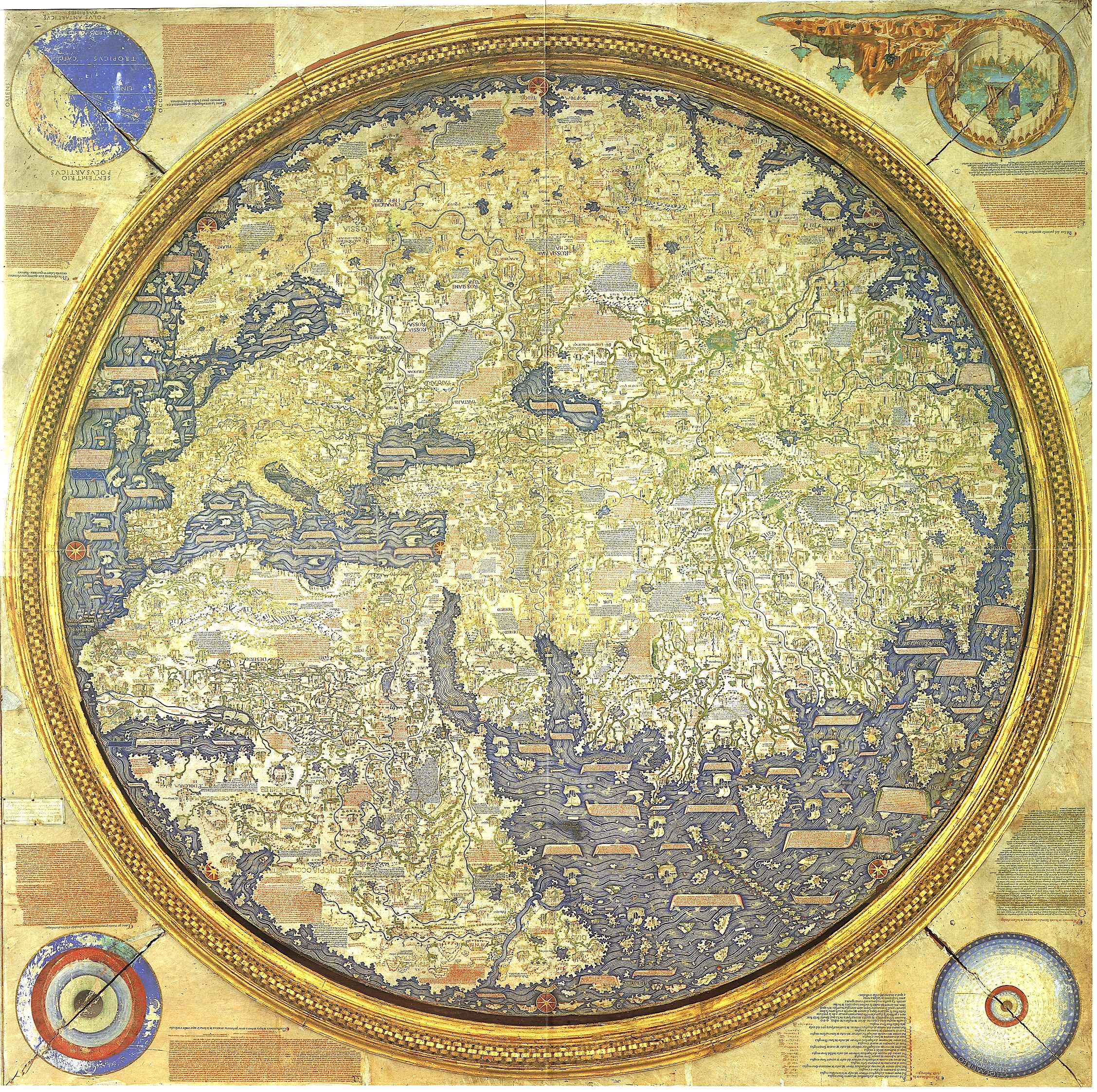
We live today, in other words, in the dream of Fra Mauro, the Venetian cartographer-monk of the late Middle Ages who created the most detailed and accurate world map to that point in human history. “As a young man, Fra Mauro had been a soldier and merchant of the famed Venice Merchant Fleet,” says the site of New World Cartographic. “His travels with the fleet around the Mediterranean and the Middle East resulted in his becoming interested in mapping, and he eventually settled in the monastery of San Michelle on the island of Murano, in the Venice Lagoon, where he became a lay brother.” In the early 1450s, “he was commissioned by King Afonso V of Portugal to create a map of the world.”
Portugal’s will to dominate world trade, which required the most detailed maps possible, was matched by Fra Mauro’s will to gather information about every corner of Earth, no matter how far-flung. And he could do that without leaving Venice: as Atlas Obscura’s Adam Kessler writes, “Arab traders and world explorers passed through the port, giving Fra Mauro an incomparable source of gossip and tall tales about the world. The fall of Constantinople, occurring a few years before the map was finished, would also have provided a rich source of well-traveled refugees, presumably willing to swap their stories for some bread or beer.” Not only did the map’s physical creation require a team of collaborators, the gathering of its contents relied upon the fifteenth-century equivalent of crowdsourcing.
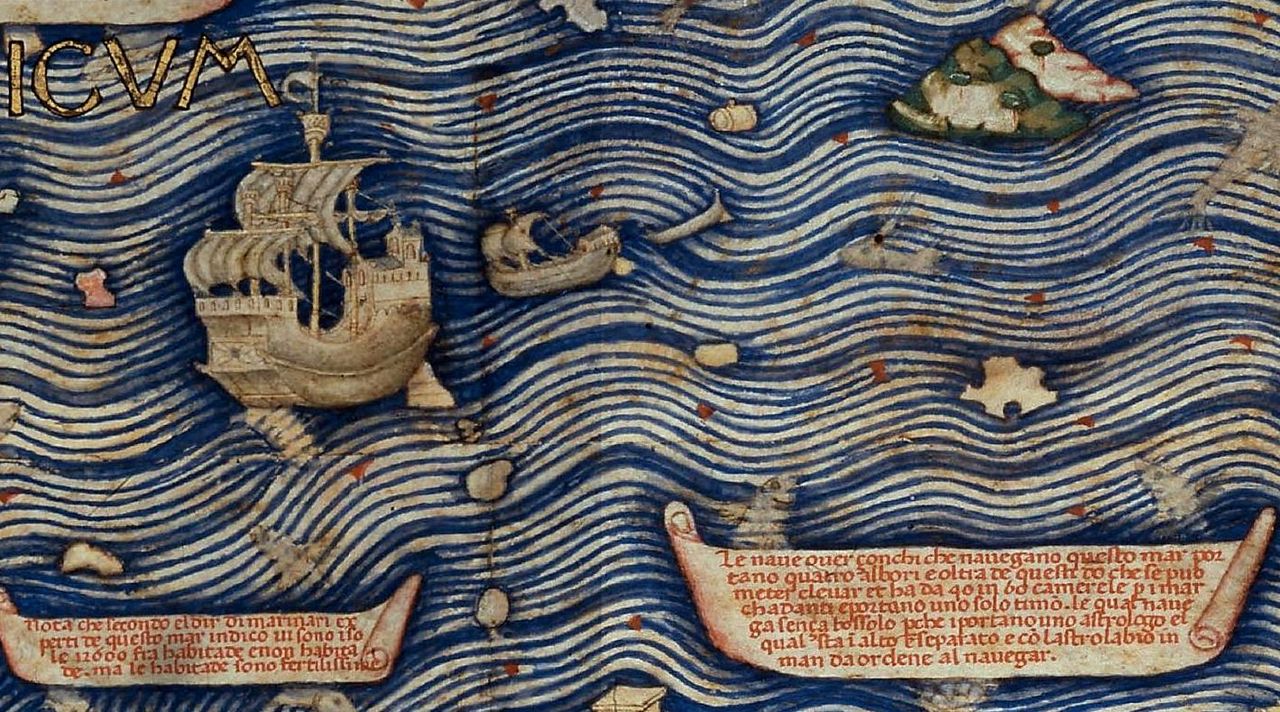
This chapter of cartographical history invites such technological analogies: Kessler calls Fra Mauro’s completed mappa mundi “the Google Earth of the 1450s.” Despite his religious affiliation with the monastery of San Michele, Fra Mauro’s efforts produced an unprecedentedly radical rendition of the world. Breaking with religious tradition, he didn’t put Jerusalem in the center; “the Garden of Eden was relegated to a sidebox, not shown in a real geographic location.” His scrupulousness made him the first cartographer “to depict Japan as an island, and the first European to show that you could sail all the way around Africa.” While his map was “the most accurate ever made at the time,” its more than 3,000 annotations do contain plenty of tall tales, often of literal giants. But are they really much less trustworthy than the average twenty-first-century user review?
Based in Seoul, Colin Marshall writes and broadcasts on cities, language, and culture. His projects include the Substack newsletterBooks on Cities, the book The Stateless City: a Walk through 21st-Century Los Angeles and the video series The City in Cinema. Follow him on Twitter at @colinmarshall or on Facebook.
This past week, the influential psychologist and economist Daniel Kahneman passed away at age 90. The winner of the 2002 Nobel Prize in Economic Sciences, Kahneman wrote the bestselling book Thinking, Fast and Slow where he explained the two systems of thinking that shape human decisions. These include “System 1,” which relies on fast, automatic and unconscious thinking, and then “System 2,” which requires attention and concentration and works more slowly. And it’s the interplay of these two systems that profoundly shapes the quality of our decisions in different parts of our lives, including investing.
In the interview above, Steve Forbes asks why individual investors persist in believing that they can pick stocks successfully over time, despite ample evidence to the contrary. Drawing on his research, Kahneman describes the “illusion of skill,” where investors “get the immediate feeling that [they] understand something,” which is much “more compelling than the knowledge of statistics that tells you that you don’t know anything.” Here, System 1 creates the “illusion of skill,” and it overwhelms the slower analytical thinking found in System 2—the System that could use data to determine that stock picking is a fool’s errand. When Forbes asks if investors should ultimately opt for index funds instead of individual stocks, Kahneman replies “I am a believer in index funds,” that is, unless you have very rare information that allows you to pick stocks successfully.
Later in the interview, Kahneman touches on another important subject. In his mind, the first question every investor should ask is not how much money should I plan to make, but rather, “How much can I afford to lose.” Every investor should assess their risk tolerance, in part so that you can handle turbulence in the market and stick with your initial investment plan. If you are not aware of your risk tolerance, “when things go bad, you will want to change what you are doing, and that’s the disaster in investing… Loss aversion can kill you.” He continues, “Emotions are indeed your enemy. The worst thing that could happen to you … is to make a decision and not stick with it, so that you bail out when things go badly, so that you sell low and buy high. That is not a recipe for doing well in the stock market, or anywhere.” Ideally, you should figure out upfront how much you want to put in the stock market, and how much you want to keep out, so that you can psychologically manage the ups and downs of investing.
From here, Kahneman comes to his most important piece of advice for investors: Know yourself in terms of what you could regret. If you are prone to regret, if investing makes you feel insecure and lose sleep at night, then you should adopt a “regret minimization strategy” and create a more conservative portfolio to match it. Read more about that here. Also see Chapters 31 (Risk Policies) and 32 (Keep Score) in Thinking, Fast and Slow where Kahneman talks more about investing.
This post originally appeared on our sister/side-project site, Open Personal Finance.
David Lynch has a variety of notions about what it takes to make art, but suffering is not among them. “This is part of the myth, I think,” he said in one interview. “Van Gogh did suffer. He suffered a lot. But I think he didn’t suffer while he was painting.” That is, “he didn’t need to be suffering to do those great paintings.” As Lynch sees it, “the more you suffer, the less you want to create. If you’re truly depressed, they say, you can’t even get out of bed, let alone create.” This relationship between mental state and creativity is a subject he’s addressed over and over again, and the video above assembles several of those instances from over the decades. It may come as a surprise that the auteur of Blue Velvet, Twin Peaks, and Mulholland Drive, recommends meditation as the solution.
In the video below, he lays out how his favorite kind of meditation, the Transcendental variety, has the potential to drive out not just depression, but also negativity, tension, stress, anxiety, sorrow, anger, hate, and fear. These are grand promises, but not without interest to the non-meditating Lynch fan curious about the mind behind his work, both of which were once widely assumed to be deeply troubled indeed.
“Do you think you’re a genius, or a really sick person?” CBC correspondent Valerie Pringle asks him in a Blue Velvet-era interview included in the compilation at the top of the post. “Well, Valerie,” he responds, “I don’t know.” He did not, at that time, speak publicly about his meditation practice, but by the late nineties he’d begun to discuss personal matters much more freely. In one Charlie Rose interview, a clip from which appears in the video, he even tells of the time he went to therapy. The beginning of this story makes it in, but not the end: Lynch asked his new therapist “straight out, right up front, ‘Could this process that we’re going to go through affect creativity?’ And he said, ‘David, I have to be honest with you, it could” — whereupon Lynch shook the man’s hand and walked right back out the door.
Based in Seoul, Colin Marshall writes and broadcasts on cities, language, and culture. His projects include the Substack newsletterBooks on Cities, the book The Stateless City: a Walk through 21st-Century Los Angeles and the video series The City in Cinema. Follow him on Twitter at @colinmarshall or on Facebook.
In less than a year and a half, the centenary of Antoni Gaudí’s death will be here. Faced with this fact, especially dedicated enthusiasts of Catalan architecture may already be planning their festivities. But we can be sure where the real pressure is felt: the Basílica i Temple Expiatori de la Sagrada Família, Gaudí’s most famous building, which — as of tomorrow — has been under construction for 142 years. When it first broke ground in 1882, Gaudí wasn’t involved at all, but when he took over the project the following year, he re-envisioned it in a distinctive combination of the Gothic and Art Nouveau styles. The rest, as they say, is history: a troubled, unpredictable history continuing to this day, explained by architecture-and-history Youtuber Manuel Bravo in the video above.
Though it isn’t yet complete, you can visit Sagrada Família; indeed, it’s long been the most popular tourist attraction in Barcelona. The experience of marveling at the basilica’s astonishing degree of detail and not-quite-of-this-Earth structure is worth the price of admission, which has helped to fund its ongoing construction. But you’ll appreciate it on a higher level if you go with someone who can explain its many unusual features, both architectural and religious — someone with as much knowledge ad enthusiasm as Bravo, whom we’ve previously featured here on Open Culture for his videos on Pompeii, Venice, the Great Pyramids of Giza, and the Duomo di Firenze.
With Sagrada Família’s pyramidal shape, Bravo explains, Gaudí “hoped to suggest a connection between the human and the divine.” Its three façades are dedicated to the birth, death, and eternal life of Jesus Christ, to whom the central and tallest of its planned eighteen towers will be dedicated. The cathedral’s exterior alone constitutes an “authentic Bible of stone,” but it can hardly prepare you to step into the interior, with its “beautiful play of space, light, and color.” As Bravo puts it, “the protagonist here is the space itself,” envisioned by Gaudí as “a huge forest” involving no un-nature-like straight lines. All of it showcases “the combination of aesthetics and efficiency” that defines the architect’s work.
Bravo’s video runs a bit over twenty minutes, but you could spend much, much longer appreciating every aspect of Sagrada Família, those completed in Gaudí’s lifetime as well as those completed by the many devoted artisans who have continued his work for almost 100 years now. The architect “knew quite well that he would not live to see the temple completed,” says Bravo, hence his having “left behind so many models and drawings” for his successors to go on. They’re working on a 2026 deadline, but as Bravo notes, given the interruptions inflicted by COVID-19, “that date seems unlikely.” But then, has there ever been as unlikely a building as Sagrada Família?
Based in Seoul, Colin Marshall writes and broadcasts on cities, language, and culture. His projects include the Substack newsletterBooks on Cities, the book The Stateless City: a Walk through 21st-Century Los Angeles and the video series The City in Cinema. Follow him on Twitter at @colinmarshall or on Facebook.
Asked to imagine the character of everyday life in the Middle Ages, a young student in the twenty-twenties might well reply, before getting around to any other details, that it involved no smartphones. But even the flashiest new technologies have long evolutionary histories, and, in certain notable respects, even the smartphone has a medieval ancestor. That would be the astrolabe, an especially fascinating eleventh-century example of which was recently discovered at the Fondazione Museo Miniscalchi-Erizzo in Verona. It was identified by University of Cambridge historian Federica Gigante, who’s been making the media rounds to explain the context and function of this striking and historic device.
“It’s basically the world’s earliest smartphone,” Gigante says in an NPR All Things Considered segment. “With one simple calculation, you can tell the time, but you can also do all sorts of other things.” In a visual New York Times feature, Franz Lidz and Clara Vannucci add that astrolabes, which resembled “large, old-fashioned vest pocket watches,” also allowed their users to determine “distances, heights, latitudes and even (with a horoscope) the future.”
Gigante tells them that, when she got the chance to pay the Miniscalchi-Erizzo astrolabe closer scrutiny, she could identify Arabic inscriptions, “faint Hebrew markings,” and Western numerals, which made this particular artifact “a powerful record of scientific exchange between Muslims, Jews and Christians over nearly a millennium.”
In the video above, Seb Falk, author of The Light Ages: The Surprising Story of Medieval Science, demonstrates how to use an astrolabe to calculate the time. It is, admittedly, a more complicated affair than glancing at the screen of your phone, analogies to which have become irresistible in these discussions. “Like the smartphone, the astrolabe came into being during times of economic prosperity — in that case, likely during the height of the Roman Empire,” writes Smithsonian ‘s Laura Poppick. Though functional astrolabes were made of ordinary wood or metals, the surviving examples tend to be ornately engraved brass, which provided status value to the high-end market. In that respect, too, the astrolabe resembles the “conceptual ancestor to the iPhone 7” — a device that, in the eyes of technophiles here in 2024, now looks fairly medieval itself.
Based in Seoul, Colin Marshall writes and broadcasts on cities, language, and culture. His projects include the Substack newsletterBooks on Cities, the book The Stateless City: a Walk through 21st-Century Los Angeles and the video series The City in Cinema. Follow him on Twitter at @colinmarshall or on Facebook.
We're hoping to rely on loyal readers, rather than erratic ads. Please click the Donate button and support Open Culture. You can use Paypal, Venmo, Patreon, even Crypto! We thank you!
Open Culture scours the web for the best educational media. We find the free courses and audio books you need, the language lessons & educational videos you want, and plenty of enlightenment in between.
Get the best cultural and educational resources on the web curated for you in a daily email. We never spam. Unsubscribe at any time.
FOLLOW ON SOCIAL MEDIA
Open Culture editor Dan Colman scours the web for the best educational media. He finds the free courses and audio books you need, the language lessons & movies you want, and plenty of enlightenment in between.