The Brilliant Engineering That Made Venice: How a City Was Built on Water
Many of us have put off a visit to Venice for fear of the hordes of tourists who roam its streets and boat down its canals day in and day out. To judge by the most visible of its economic activity, the once-mighty city-state now exists almost solely as an Instagramming destination. It wasn’t always this way. “Despite having no roads, no land, and no fresh water, the Venetians managed to turn a muddy swamp into the most powerful and wealthiest city of its time,” says the narration of the Primal Space video above. Its “unique layout of canals and bridges woven through hundreds of islands made Venice incredibly accessible, and it became the epicenter of all business.”
Venice, in other words, was at its height what world capitals like London or New York would become in later eras. But on a physical level, it faced challenges unknown in those cities, challenges that demanded a variety of ingenious medieval engineering solutions, most of which still function today. First, the builders of Venice had to bring timber from the forests of Croatia and drive it into the soft soil, creating a platform sturdy enough to bear the weight of an entire urban built environment. Construction of the buildings on top proved to be a trial-and-error affair, which came around to using bricks with lime mortar to ensure flexibility on the slowly shifting ground.
“Instead of expanding outwards like most cities,” Venice’s islands “expanded into each other.” Eventually, they had to be connected, though “there were no bridges for the first 500 years of Venice’s existence,” not until the Doge offered a prize for the best design that could link the financial center of Rialto to the rest of the city. But what really mattered was the test of time, one long since passed by the Ponte di Rialto, which has stood fundamentally unaltered since it was rebuilt in stone in 1591. The combination of bridges and canals, with what we would now call their separation of traffic, did its part to make Venice “the most powerful and richest city in Europe” by the fifteenth century.
Even the richest and most powerful cities need water, and Venice had an abundance of only the “extremely salty and undrinkable” kind. To meet the needs of the city’s fast-growing population, engineers built wells surrounded by sand-and-stone filtration systems into Venice’s characteristic squares, turning the city into “an enormous funnel.” The related problem of waste management necessitated the construction of “a network of underground tunnels” directed into canals, flushed out by the motion of the tides. Venice’s plumbing has since been brought up to modern standards, among other ambitious engineering projects. But on the whole, the city still works as it did in the days of the Doge, and that fact alone makes it a sight worth seeing.
Related Content:
Venice Explained: Its Architecture, Its Streets, Its Canals, and How Best to Experience Them All
How Venice Works: 124 Islands, 183 Canals & 438 Bridges
Watch Venice’s New $7 Billion Flood Defense System in Action
A Relaxing 3‑Hour Tour of Venice’s Canals
Venice’s Canals Have Run Dry During a Winter Drought, Leaving Gondolas Stuck in the Mud
Based in Seoul, Colin Marshall writes and broadcasts on cities, language, and culture. His projects include the Substack newsletter Books on Cities and the book The Stateless City: a Walk through 21st-Century Los Angeles. Follow him on Twitter at @colinmarshall or on Facebook.
Read More...Carl Jung Offers an Introduction to His Psychological Thought in a 3‑Hour Interview (1957)
In the 1950s, it was fashionable to drop Freud’s name — often as not in pseudo-intellectual sex jokes. Freud’s preoccupations had as much to do with his fame as the actual practice of psychotherapy, and it was assumed — and still is to a great degree — that Freud had “won” the debate with his former student and friend Carl Jung, who saw religion, psychedelic drugs, occult practices, etc. as valid forms of individualizing and integrating human selves — selves that were after all, he thought, connected by far more than biological drives for sex and death.
Now Jung’s insights permeate the culture, in increasingly popular fields like transpersonal psychology, for example, that see humans as “radically interconnected, not just isolated individuals,” psychologist Harris L. Friedman argues. Movements like these grew out of the “counterculture movements of the 1960s,” psychology lecturer and author Steve Taylor explains, “and the wave of psycho-experimentation it involved, through psychedelic substances, meditation and other consciousness-changing practices” — the very practices Jung explored in his work.
Indeed, Jung was the first “to legitimize a spiritual approach to the practice of depth psychology,” Mark Kasprow and Bruce Scotton point out, and “suggested that psychological development extends to include higher states of consciousness and can continue throughout life, rather than stop with the attainment of adult ego maturation.” Against Freud, who thought transcendence was regression, Jung “proposed that transcendent experience lies within and is accessible to everyone, and that the healing and growth stimulated by such experience often make use of the languages of symbolic imagery and nonverbal experience.”
Jung’s work became increasingly important after his death in 1961, leading to the publication of his collected works in 1969. These introduced readers to all of his “key concepts and ideas, from archetypal symbols to analytical psychology to UFOs,” notes a companion guide. Near the end of his life, Jung himself provided a verbal survey of his life’s work in the form of four one-hour interviews conducted in 1957 by University of Houston’s Dr. Richard Evans at the Eidgenossische Technische Hoschschule (Federal Institute of Technology) in Zurich.
“The conversations were filmed as part of an educational project designed for students of the psychology department. Evans is a poor interviewer, but Jung compensates well,” the Gnostic Society Library writes. The edited interviews begin with a question about Jung’s concept of persona (also, incidentally, the theme and title of Ingmar Bergman’s 1966 masterpiece). In response, Jung describes the persona in plain terms and with everyday examples as a fictional self “partially dictated by society and partially dictated by the expectations or the wishes one nurses oneself.”
The less we’re consciously aware of our public selves as performances in these terms, the more we’re prone, Jung says, to neuroses, as the pressure of our “shadow,” exerts itself. Jung and Evans’ discussion of persona only grazes the surface of their wide-ranging conversation about the unconscious and the many ways to access it. Throughout, Jung’s examples are clear and his explanations lucid. Above, you can see a transcribed video of the same interviews. Read a published transcript in the collection C.G. Jung Speaking, and see more Jung interviews and documentaries at the Gnostic Society Library.
Related Content:
How Carl Jung Inspired the Creation of Alcoholics Anonymous
Face to Face with Carl Jung: ‘Man Cannot Stand a Meaningless Life’ (1959)
The Visionary Mystical Art of Carl Jung: See Illustrated Pages from The Red Book
Josh Jones is a writer and musician based in Durham, NC. Follow him at @jdmagness
Read More...Face to Face with Carl Jung: ‘Man Cannot Stand a Meaningless Life’ (1959)
Carl Gustav Jung, founder of analytic psychology and explorer of the collective unconscious, was born on July 26, 1875 in the village of Kesswil, in the Thurgau canton of Switzerland. Above, we present a fascinating 39-minute interview of Jung by John Freeman for the BBC program Face to Face. It was filmed at Jung’s home at Küsnacht, on the shore of Lake Zürich, and broadcast on October 22, 1959, when Jung was 84 years old. He speaks on a range of subjects, from his childhood and education to his association with Sigmund Freud and his views on death, religion and the future of the human race. At one point Freeman asks Jung whether he believes in God, and Jung seems to hesitate. “It’s difficult to answer,” he says. “I know. I don’t need to believe. I know.”
If you would like to support the mission of Open Culture, consider making a donation to our site. It’s hard to rely 100% on ads, and your contributions will help us continue providing the best free cultural and educational materials to learners everywhere. You can contribute through PayPal, Patreon, and Venmo (@openculture). Thanks!
Related Content:
The Famous Break Up of Sigmund Freud & Carl Jung Explained in a New Animated Video
How Carl Jung Inspired the Creation of Alcoholics Anonymous
Take Carl Jung’s Word Association Test, a Quick Route Into the Subconscious (1910)
Carl Jung’s Hand-Drawn, Rarely-Seen Manuscript The Red Book
Read More...
Simone de Beauvoir Explains “Why I’m a Feminist” in a Rare TV Interview (1975)
In Simone de Beauvoir’s 1945 novel The Blood of Others, the narrator, Jean Blomart, reports on his childhood friend Marcel’s reaction to the word “revolution”:
It was senseless to try to change anything in the world or in life; things were bad enough even if one did not meddle with them. Everything that her heart and her mind condemned she rabidly defended—my father, marriage, capitalism. Because the wrong lay not in the institutions, but in the depths of our being. We must huddle in a corner and make ourselves as small as possible. Better to accept everything than to make an abortive effort, doomed in advance to failure.
Marcel’s fearful fatalism represents everything De Beauvoir condemned in her writing, most notably her groundbreaking 1949 study, The Second Sex, often credited as the foundational text of second-wave feminism. De Beauvoir rejected the idea that women’s historical subjection was in any way natural—“in the depths of our being.” Instead, her analysis faulted the very institutions Marcel defends: patriarchy, marriage, capitalist exploitation.
In the 1975 interview above with French journalist Jean-Louis Servan-Schreiber—“Why I’m a Feminist”—De Beauvoir picks up the ideas of The Second Sex, which Servan-Schreiber calls as important an “ideological reference” for feminists as Marx’s Capital is for communists. He asks De Beauvoir about one of her most quoted lines: “One is not born a woman, one becomes one.” Her reply shows how far in advance she was of post-modern anti-essentialism, and how much of a debt later feminist thinkers owe to her ideas:
Yes, that formula is the basis of all my theories…. Its meaning is very simple, that being a woman is not a natural fact. It’s the result of a certain history. There is no biological or psychological destiny that defines a woman as such…. Baby girls are manufactured to become women.”
Without denying the fact of biological difference, De Beauvoir debunks the notion that sex differences are sufficient to justify gender-based hierarchies of status and social power. Women’s second-class status, she argues, results from a long historical process; even if institutions no longer intentionally deprive women of power, they still intend to hold on to the power men have historically accrued.
Almost 50 years after this interview—and 75 years since The Second Sex—the debates De Beauvoir helped initiate rage on, with no sign of abating anytime soon. Although Servan-Schreiber calls feminism a “rising force” that promises “profound changes,” one wonders whether De Beauvoir, who died in 1986, would be dismayed by the plight of women in much of the world today. But then again, unlike her character Marcel, De Beauvoir was a fighter, not likely to “huddle in a corner” and give in. Servan-Schreiber states above that De Beauvoir “has always refused, until this year, to appear on TV,” but he is mistaken. In 1967, she appeared with her partner Jean-Paul Sartre on a French-Canadian program called Dossiers.
If you would like to support the mission of Open Culture, consider making a donation to our site. It’s hard to rely 100% on ads, and your contributions will help us continue providing the best free cultural and educational materials to learners everywhere. You can contribute through PayPal, Patreon, and Venmo (@openculture). Thanks!
Related Content:
An Animated Introduction to the Feminist Philosophy of Simone de Beauvoir
Simone de Beauvoir Speaks on American TV (in English) About Feminism, Abortion & More (1976)
Simone de Beauvoir Tells Studs Terkel How She Became an Intellectual and Feminist (1960)
Simone de Beauvoir’s Philosophy on Finding Meaning in Old Age
Josh Jones is a writer and musician based in Washington, DC. Follow him at @jdmagness
Read More...You Can Buy Historic Italian Houses for €1 — But What’s the Catch?
From Abruzzo to Vergemoli, small Italian towns and villages have recently been making their historic homes available for purchase for as low as €1. Given the picturesque nature of many of these places, such offers have proven practically irresistible to foreign buyers who’ve made their money and are looking to escape the big-city rat race, or even those simply prone to Under the Tuscan Sun-type fantasies. But this is, of course, more than just a matter of wiring a single Euro and jetting off to a life of rustic beauty and simplicity. As shown in these videos from Explained with Dom and Insider News, you’ve got to put much more money into the acquisition and rehabilitation of these houses, not to mention the sweat equity involved.
“As young Italians increasingly migrate to the city” — if not to other countries entirely — “and choose cosmopolitan jobs over rural and community vocations, many of Italy’s prettiest remote villages are becoming abandoned, with tiny, ageing populations that are beginning to die off,” write the Independent’s Lucy Thackray.
“Some elderly Italians have found themselves with no one to leave their house to, bequeathing it instead to the local authorities, who have to decide what to do with it, while some younger citizens have inherited properties in areas they have no intention of moving to.” And so “around 25 Italian municipalities are making prospective homeowners an offer they can’t refuse,” though certain conditions do apply.
Old and less than immaculately maintained on the whole, these houses tend to require renovations “in the region of €20,000–50,000 depending on the size of the property.” And the authorities do make sure you’ll actually perform the work: “new owners are required to submit details of a renovation project within two to 12 months of purchase (depending on the location), start work within one year, and complete it within the next three.” Add on all the additional (and often unexpected) fees, and even a best-case scenario starts to look pricey. Still, if you’re totally committed to rehabilitating a venerable Italian home — and not just to rent it out to vacationers, which some areas explicitly prohibit — it might sound like a fair enough deal.
One thing is certain: anyone looking to buy into one of Italy’s cheap-house schemes (at a price of €1 or otherwise) should go in with not just sufficient knowledge of domestic architecture and remodeling, but also a familiarity with Italian ways of doing business — which have done their part to contribute to the so-called “Italian disease” that has saddled the country with decades of economic stagnation, but aren’t likely to change any time soon. And above all, it should go without saying that the first step of acting on a desire to play a part in bringing one of Italy’s “ghost towns” back to life is learning the Italian language — a task you can start right here on Open Culture. Buona fortuna to you.
Related content:
Exploring the Greatest of Italy’s 6,000 Ghost Towns: Take a Tour of Craco, Italy
Venice Explained: Its Architecture, Its Streets, Its Canals, and How Best to Experience Them All
Based in Seoul, Colin Marshall writes and broadcasts on cities, language, and culture. His projects include the Substack newsletter Books on Cities and the book The Stateless City: a Walk through 21st-Century Los Angeles. Follow him on Twitter at @colinmarshall or on Facebook.
Read More...2000-Year-Old Bottle of White Wine Found in a Roman Burial Site
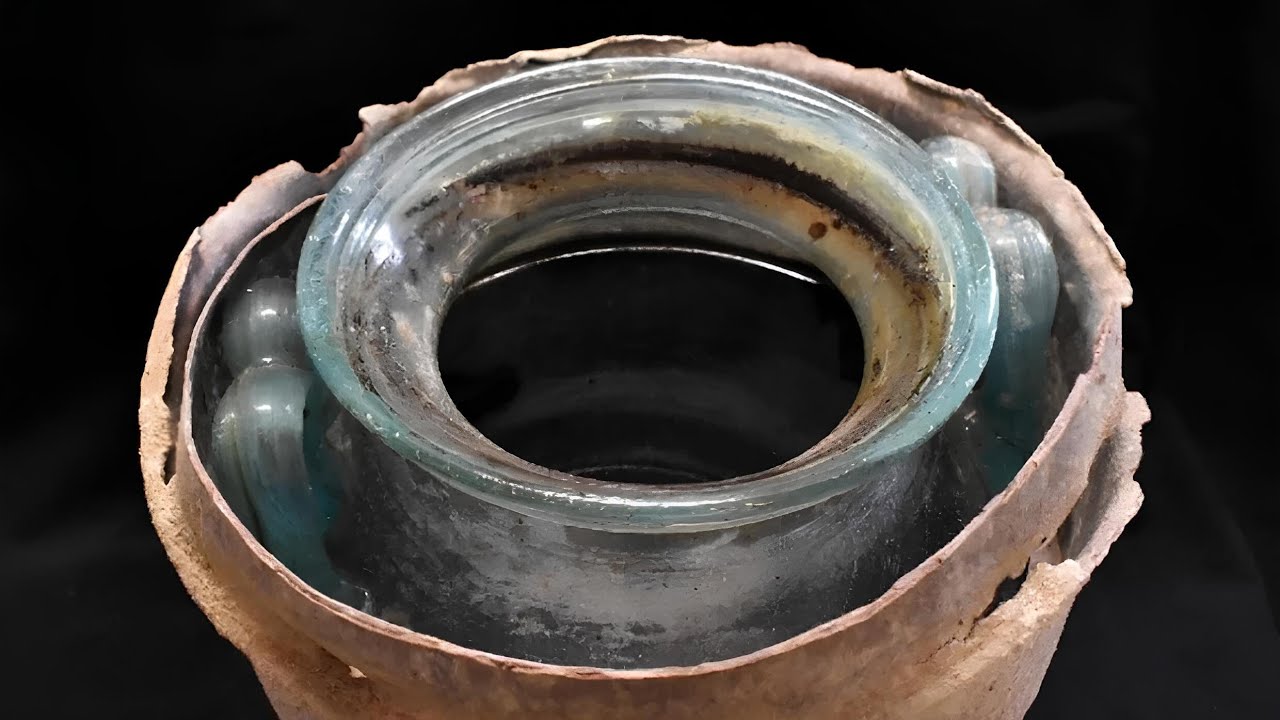
Image via Journal of Archaeological Science: Reports
Back in 2017, we featured the oldest unopened bottle of wine in the world here on Open Culture. Found in Speyer, Germany, in 1867, it dates from 350 AD, making it a venerable vintage indeed, but one recently outdone by a bottle first discovered five years ago in Carmona, near Seville, Spain. “At the bottom of a shaft found during construction work,” an excavation team “uncovered a sealed burial chamber from the early first century C.E. — untouched for 2,000 years,” writes Scientific American’s Lars Fischer. Inside was “a glass urn placed in a lead case was filled to the brim with a reddish liquid,” only recently determined to be wine — and therefore wine about three centuries older than the Speyer bottle.
You can read about the relevant research in this new paper published in the Journal of Archaeological Science: Reports by chemist José Rafael Ruiz Arrebola and his team. “The wine from the Carmona site was no longer suitable for drinking, and it had never been intended for that purpose,” writes Fischer.
“The experts found bone remains and a gold ring at the bottom of the glass vessel. The burial chamber was the final resting place for the remains of the deceased, who were cremated according to Roman custom.” Only through chemical analysis were the researchers finally able to determine that the liquid was, in fact, wine, and thus to put together evidence of the arrangement’s being an elaborate sendoff for a Roman-era oenophile.
Though the funerary ritual “involved two men and two women,” says CBS News, the remains in the wine came from only one of the men. This makes sense, as, “according to the study, women in ancient Rome were prohibited from drinking wine.” What a difference a couple of millennia make: today the cultural image slants somewhat female, especially in the case of white wine, which, despite having “acquired a reddish hue,” the liquid unearthed in Carmona was chemically determined to be. With the summer now getting into full swing, this story might inspire us to beat the heat by putting a bottle of our favorite Chardonnay, Riesling, or Pinot Grigio in the refrigerator — a convenience unimagined by even the wealthiest wine-loving citizens of the Roman Empire.
Related content:
Bars, Beer & Wine in Ancient Rome: An Introduction to Roman Nightlife and Spirits
Archaeologists Discover a 2,000-Year-Old Roman Glass Bowl in Perfect Condition
Archaeologists Discover an Ancient Roman Snack Bar in the Ruins of Pompeii
Explore the Roman Cookbook, De Re Coquinaria, the Oldest Known Cookbook in Existence
The Wine Windows of Renaissance Florence Dispense Wine Safely Again During COVID-19
The Oldest Unopened Bottle of Wine in the World (Circa 350 AD)
Based in Seoul, Colin Marshall writes and broadcasts on cities, language, and culture. His projects include the Substack newsletter Books on Cities and the book The Stateless City: a Walk through 21st-Century Los Angeles. Follow him on Twitter at @colinmarshall or on Facebook.
Read More...
Why You Do Your Best Thinking In The Shower: Creativity & the “Incubation Period”
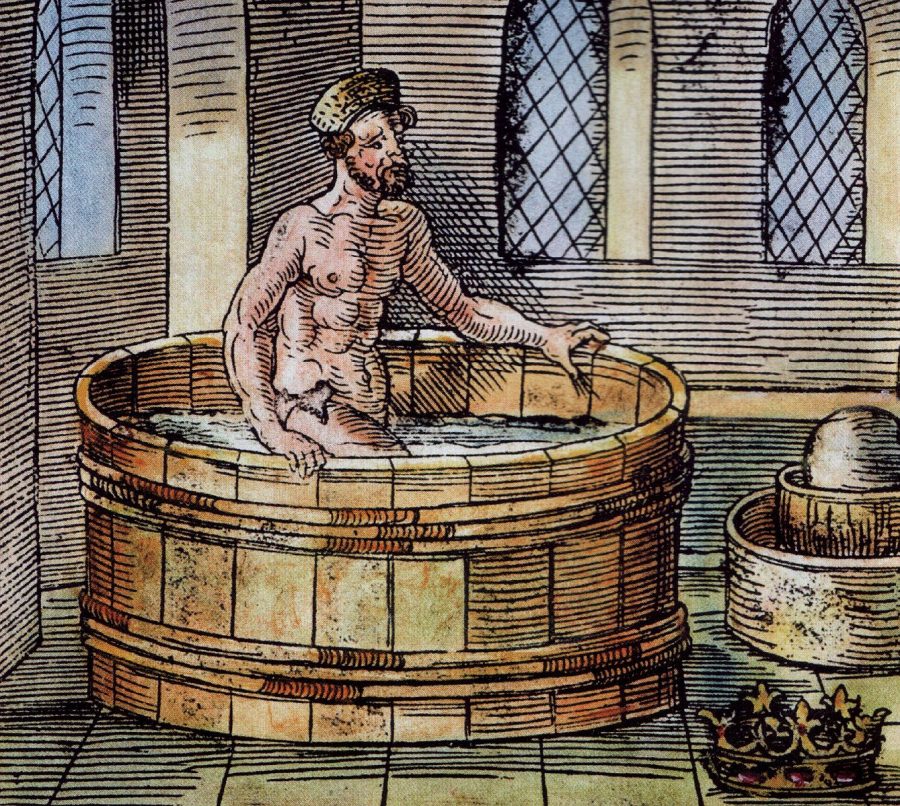
Image via Wikimedia Commons
“The great Tao fades away.”
So begins one translation of the Tao Te Ching’s 18th Chapter. The sentence captures the frustration that comes with a lost epiphany. Whether it’s a profound realization when you just wake up, or moment of clarity in the shower, by the time your mind’s gears start turning and you grope for pen and paper, the enlightenment has evaporated, replaced by muddle-headed, fumbling “what was that, again?”
“Intelligence comes forth. There is great deception.”
The sudden flashes of insight we have in states of meditative distraction—showering, pulling weeds in the garden, driving home from work—often elude our conscious mind precisely because they require its disengagement. When we’re too actively engaged in conscious thought—exercising our intelligence, so to speak—our creativity and inspiration suffer. “The great Tao fades away.”
The intuitive revelations we have while showering or performing other mindless tasks are what psychologists call “incubation.” As Mental Floss describes the phenomenon: “Since these routines don’t require much thought, you flip to autopilot. This frees up your unconscious to work on something else. Your mind goes wandering, leaving your brain to quietly play a no-holds-barred game of free association.”
Are we always doomed to lose the thread when we get self-conscious about what we’re doing? Not at all. In fact, some researchers, like Allen Braun and Siyuan Liu, have observed incubation at work in very creatively engaged individuals, like freestyle rappers. Theirs is a skill that must be honed and practiced exhaustively, but one that nonetheless relies on extemporaneous inspiration.
Renowned neuroscientist Alice Flaherty theorizes that the key biological ingredient in incubation is dopamine, the neurotransmitter released when we’re relaxed and comfortable. “People vary in terms of their level of creative drive,” writes Flaherty, “according to the activity of the dopamine pathways of the limbic system.” More relaxation, more dopamine. More dopamine, more creativity.
Other researchers, like Ut Na Sio and Thomas C. Ormerod at Lancaster University, have undertaken analysis of a more qualitative kind—of “anecdotal reports of the intellectual discovery processes of individuals hailed as geniuses.” Here we might think of Samuel Taylor Coleridge, whose poem “Kublai Khan”—“a vision in a dream”—he supposedly composed in the midst of a spontaneous revelation (or an opium haze)—before that annoying “person from Porlock” broke the spell.
Sio and Ormerod survey the literature of “incubation periods,” hoping to “allow us to make use of them effectively to promote creativity in areas such as individual problem solving, classroom learning, and work environments.” Their dense research suggests that we can exercise some degree of control over incubation, building unconscious work into our routines. But why is this necessary?
Psychologist John Kounios of Drexel University offers a straightforward explanation of the unconscious processes he refers to as “the default mode network.” Nick Stockton in Wired sums up Kounios’ theory:
Our brains typically catalog things by their context: Windows are parts of buildings, and the stars belong in the night sky. Ideas will always mingle to some degree, but when we’re focused on a specific task our thinking tends to be linear.
The task of showering—or bathing, in the case of Archimedes (above)—gives the mind a break, lets it mix things up and make the odd, random juxtapositions that are the essential basis of creativity. I’m tempted to think Wallace Stevens spent a good deal of time in the shower. Or maybe, like Stockton, he kept a “Poop Journal” (exactly what it sounds like).
Famous examples aside, what all of this research suggests is that peak creativity happens when we’re pleasantly absent-minded. Or, as psychologist Allen Braun writes, “We think what we see is a relaxation of ‘executive functions’ to allow more natural de-focused attention and uncensored processes to occur that might be the hallmark of creativity.”
None of this means that you’ll always be able to capture those brilliant ideas before they fade away. There’s no foolproof method involved in making use of creative distraction. But as Leo Widrich writes at Buffer, there are some tricks that may help. To increase your creative output and maximize the insights in incubation periods, he recommends that you:
- “Keep a notebook with you at all times, even in the shower.” (Widrich points us toward a waterproof notepad for that purpose.)
- “Plan disengagement and distraction.” Widrich calls this “the outer-inner technique.” John Cleese articulates another version of planned inspiration.
- “Overwhelm your brain: Make the task really hard.” This seems counterintuitive—the opposite of relaxation. But as Widrich explains, when you strain your brain with really difficult problems, others seem much easier by comparison.
It may seem like a lot of work getting your mind to relax, produce more dopamine, and get weird, circular, and inspired. But the work lies in making effective use of what’s already happening in your unconscious mind. Rather than groping blindly for that flash of brilliance you just had a moment ago, you can learn, writes Mental Floss, to “mind your mindless tasks.”
Note: An earlier version of this post appeared on our site in 2014.
Related Content:
Free Online Psychology Courses
How To Be Creative: PBS’ Off Book Series Explores the Secret Sauce of Great Ideas
Josh Jones is a writer and musician based in Durham, NC. Follow him at @jdmagness
Read More...How the Ancient Greeks & Romans Made Beautiful Purple Dye from Snail Glands
Much has been written about the loss of color in the twenty-first century. Our environments offered practically every color known to man not so very long ago — and in certain eras, granted, it got to be a bit much. But now, everything seems to have retreated to a narrow palette of grays and browns, not to mention stark black and white. We should consider the possibility that this time of “color loss” is a kind of ascetic repentance after a long feast. That analogy holds on more than one level: technology and industrialization made food abundant and thus inexpensive, and it did the very same thing with colors.
There was a time when colors didn’t come cheap. People had plenty of black, reds, and browns in their lives, but producing the pigments for hues not often seen in nature entailed going to the ends of the earth (or in the case of ultramarine blue, the bottom of the sea). We all know that, for a long time starting around the day of Julius Caesar, purple was the color of royalty. The choice wasn’t an accident: Caesar’s “Tyrian purple” of choice was extravagantly expensive, owing to the fact that it could be extracted only from the glands of a particular Mediterranean sea snail. You can learn more about this process from the Business Insider video above.
“Thousands of snails were required to produce a single ounce of purple dye,” writes Smithsonian.com’s Sonja Anderson, quoting Pliny the Elder. Though well understood for a few decades now, the world of ancient purple-dye production continues to yield scientific discoveries. “Archaeologists were excavating recently in the Bronze Age town of Kolonna, on the Greek island of Aegina, when they discovered two Mycenaean buildings,” Anderson writes. “As the researchers write in a study published in the journal PLOS ONE, the buildings date to the 16th century B.C.E., and the older one contained pigmented ceramics, grinding tools and heaps of broken mollusk shells: all indicative of a purple dye factory.”
Notably, these well-preserved 3,600-year-old ruins date from a time long before purple acquired its prestige. “There is no indication in the Bronze Age that purple was a symbol of power and that purple-colored textiles were only reserved for the elite or leaders, as in Roman or Byzantine times,” says archaeologist Lydia Berger, co-author of the study. And when the Byzantine Empire fell, the knowledge of Tyrian purple was lost with it, only to be recovered early in this century. These days, one does hear occasional rumors of a color comeback, and a rich purple leading the charge would bring with it a certain historical satisfaction. In any case, we all remember one cultural royal in particular who surely would have approved.
via Smithsonian
Related content:
Behold Ancient Egyptian, Greek & Roman Sculptures in Their Original Color
YInMn Blue, the First Shade of Blue Discovered in 200 Years, Is Now Available for Artists
Prince Gets an Official Purple Pantone Color
Based in Seoul, Colin Marshall writes and broadcasts on cities, language, and culture. His projects include the Substack newsletter Books on Cities and the book The Stateless City: a Walk through 21st-Century Los Angeles. Follow him on Twitter at @colinmarshall or on Facebook.
Read More...Download Issues of “Weird Tales” (1923–1954): The Pioneering Pulp Horror Magazine Features Original Stories by Lovecraft, Bradbury & Many More

We live in an era of genre. Browse through TV shows of the last decade to see what I mean: Horror, sci-fi, fantasy, superheroes, futuristic dystopias…. Take a casual glance at the burgeoning global film franchises or merchandising empires. Where in earlier decades, horror and fantasy inhabited the teenage domain of B‑movies and comic books, they’ve now become dominant forms of popular narrative for adults. Telling the story of how this came about might involve the kind of lengthy sociological analysis on which people stake academic careers. And finding a convenient beginning for that story wouldn’t be easy.
Do we start with The Castle of Otranto, the first Gothic novel, which opened the door for such books as Dracula and Frankenstein? Or do we open with Edgar Allan Poe, whose macabre short stories and poems captivated the public’s imagination and inspired a million imitators? Maybe. But if we really want to know when the most populist, mass-market horror and fantasy began—the kind that inspired television shows from the Twilight Zone to the X‑Files to Supernatural to The Walking Dead—we need to start with H.P. Lovecraft, and with the pulpy magazine that published his bizarre stories, Weird Tales.
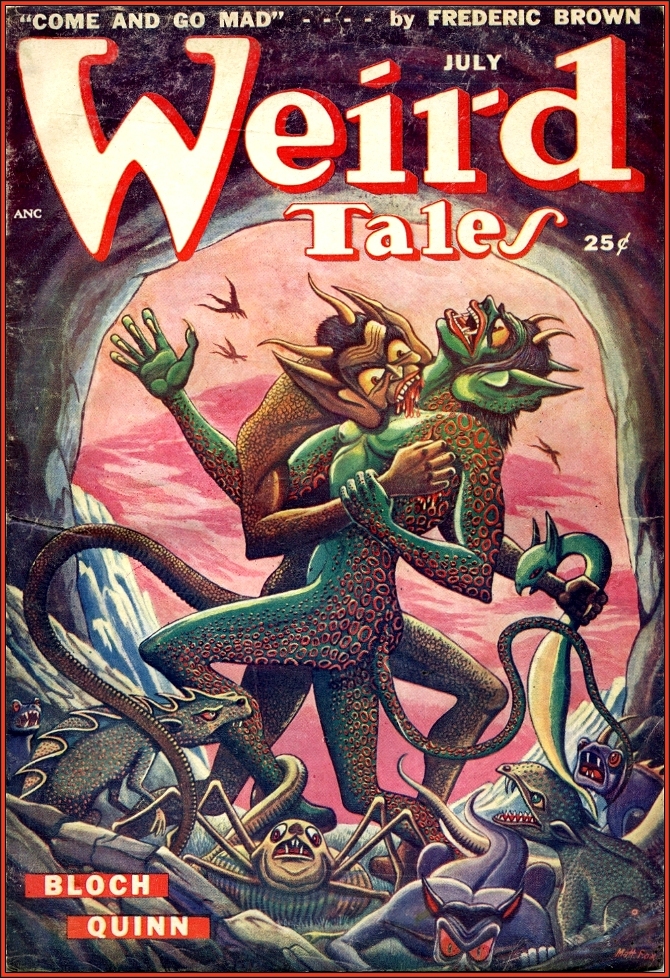
Debuting in 1923, Weird Tales, writes The Pulp Magazines Project, provided “a venue for fiction, poetry and non-fiction on topics ranging from ghost stories to alien invasions to the occult.” The magazine introduced its readers to past masters like Poe, Bram Stoker, and H.G. Wells, and to the latest weirdness from Lovecraft and contemporaries like August Derleth, Ashton Smith, Catherine L. Moore, Robert Bloch, and Robert E. Howard (creator of Conan the Barbarian).
In the magazine’s first few decades, you wouldn’t have thought it very influential. Founder Jacob Clark Hennenberger struggled to turn a profit, and the magazine “never had a large circulation.” But no magazine is perhaps better representative of the explosion of pulp genre fiction that swept through the early twentieth century and eventually gave birth to the juggernauts of Marvel and DC.
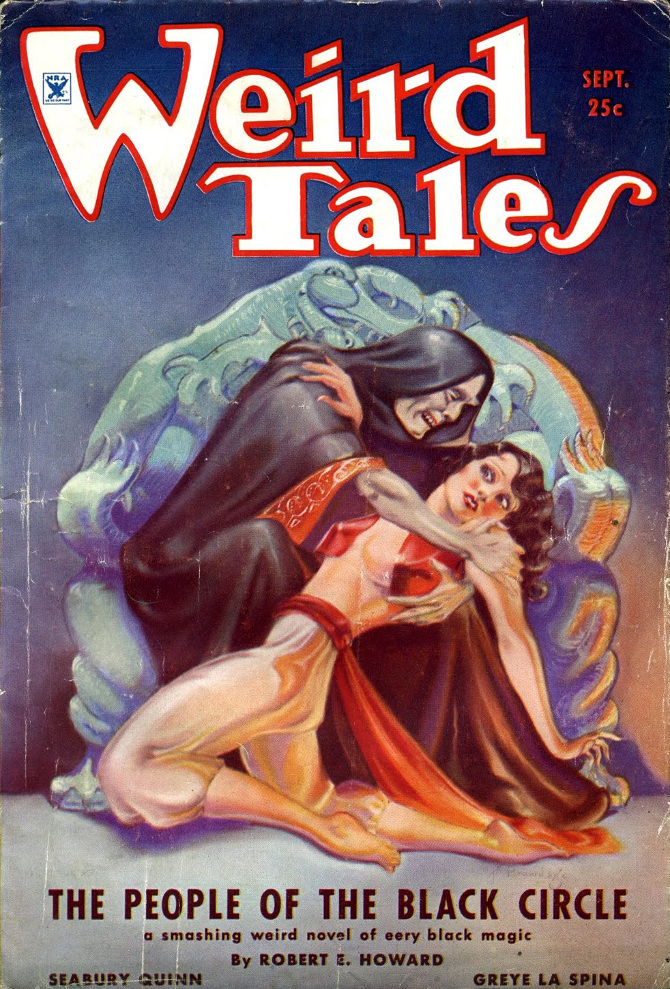
Weird Tales is widely accepted by cultural historians as “the first pulp magazine to specialize in supernatural and occult fiction,” points out The Encyclopedia of Science Fiction (though, as we noted before, an obscure German title, Der Orchideengarten, technically got there earlier). And while the magazine may not have been widely popular, as the Velvet Underground was to the rapid spread of various subgenera of rock in the seventies, so was Weird Tales to horror and fantasy fandom. Everyone who read it either started their own magazine or fanclub, or began writing their own “weird fiction”—Lovecraft’s term for the kind of supernatural horror he churned out for several decades.
Fans of Lovecraft can read and download scans of his stories and letters to the editor published in Weird Tales at the links below, brought to us by The Lovecraft eZine (via SFFaudio).
Letter to the editor of Weird Tales, September 1923 – September 1923
Letter to the editor of Weird Tales, October 1923 – October 1923
Letter to the editor of Weird Tales, January 1924 – January 1924
Letter to the editor of Weird Tales, March 1924 – March 1924
Imprisoned With The Pharaohs – May/June/July 1924
Hypnos – May/June/July 1924
The Tomb – January 1926
The Terrible Old Man – August 1926
Yule Horror – December 1926
The White Ship – March 1927
Letter to the editor of Weird Tales, February 1928 – February 1928
The Dunwich Horror – April 1929
The Tree – August 1938
Fungi From Yuggoth Part XIII: The Port – September 1946
Fungi From Yuggoth Part X: The Pigeon-Flyers – January 1947
Fungi From Yuggoth Part XXVI: The Familiars – January 1947
The City – July 1950
Hallowe’en In A Suburb – September 1952
Fans of early pulp horror and fantasy—–or grad students writing their thesis on the evolution of genre fiction—can view and download dozens of issues of Weird Tales, from the 20s to the 50s, at the links below:
The Internet Archive has digitized copies from the 1920s and 1930s.
The Pulp Magazine Project hosts HTML, FlipBook, and PDF versions of Weird Tales issues from 1936 to 1939
This site has PDF scans of individual Weird Tales stories from the 40s and 50s, including work by Lovecraft, Ray Bradbury, Dorothy Quick, Robert Bloch, and Theodor Sturgeon.
And to learn much more about the history of the magazine, you may wish to beg, borrow, or steal a copy of the pricy collection of essays, The Unique Legacy of Weird Tales: The Evolution of Modern Fantasy and Horror.

Related Content:
Download 15,000+ Free Golden Age Comics from the Digital Comic Museum
Josh Jones is a writer and musician based in Durham, NC. Follow him at @jdmagness
Read More...The Romans Stashed Hallucinogenic Seeds in a Vial Made From an Animal Bone

What’s popular in the metropolis sooner or later makes its way out into the provinces. This phenomenon has become more difficult to notice in recent years, not because it’s slowed down, but because it’s sped way up, owing to near-instantaneous cultural diffusion on the internet. Well within living memory, however, are the days when whatever was cool in, say, New York or Los Angeles would take time to catch on in the rest of the US. This went for fashions, movies, and bands, of course, but also for mind-altering substances: distant-future archaeologists are as likely to unearth a Velvet Underground album and the remains of its owner’s stash in the ruins of Cleveland as those of Chelsea.
A roughly analogous discovery from the ancient world was recently made by Dutch zooarchaeologists Maaike Groot and Martijn van Haasteren and archaeobotanist Laura I. Kooistra, who this past February published a paper in the journal Antiquity on “evidence of the intentional use of black henbane (Hyoscyamus niger) in the Roman Netherlands.” A member of the nightshade family, black henbane is “an extremely poisonous plant species that can also be used as a medicinal or psychoactive drug,” the researchers write. It may have been the latter purpose that encouraged the creation of a peculiar artifact: “a sheep/goat bone that had been hollowed out, sealed on one side by a plug of a black material and filled with hundreds of black henbane seeds.”
“Physiological reactions to black henbane were well documented throughout the Ancient Mediterranean world,” writes Hyperallergic’s Elaine Velie. She quotes Greek philosopher Plutarch as describing its effects as “not so properly called drunkenness” but rather “alienation of mind or madness.” Pliny the Elder “discussed the plant’s medicinal, hallucinatory, and potentially lethal effects, noting that although it could be taken to heal ailments ranging from coughs to fever, the drug could also cause insanity and derangement. The Greek and Roman physician Dioscorides wrote that black henbane and its close cousins could alleviate pain, but cause disorientation when boiled.”
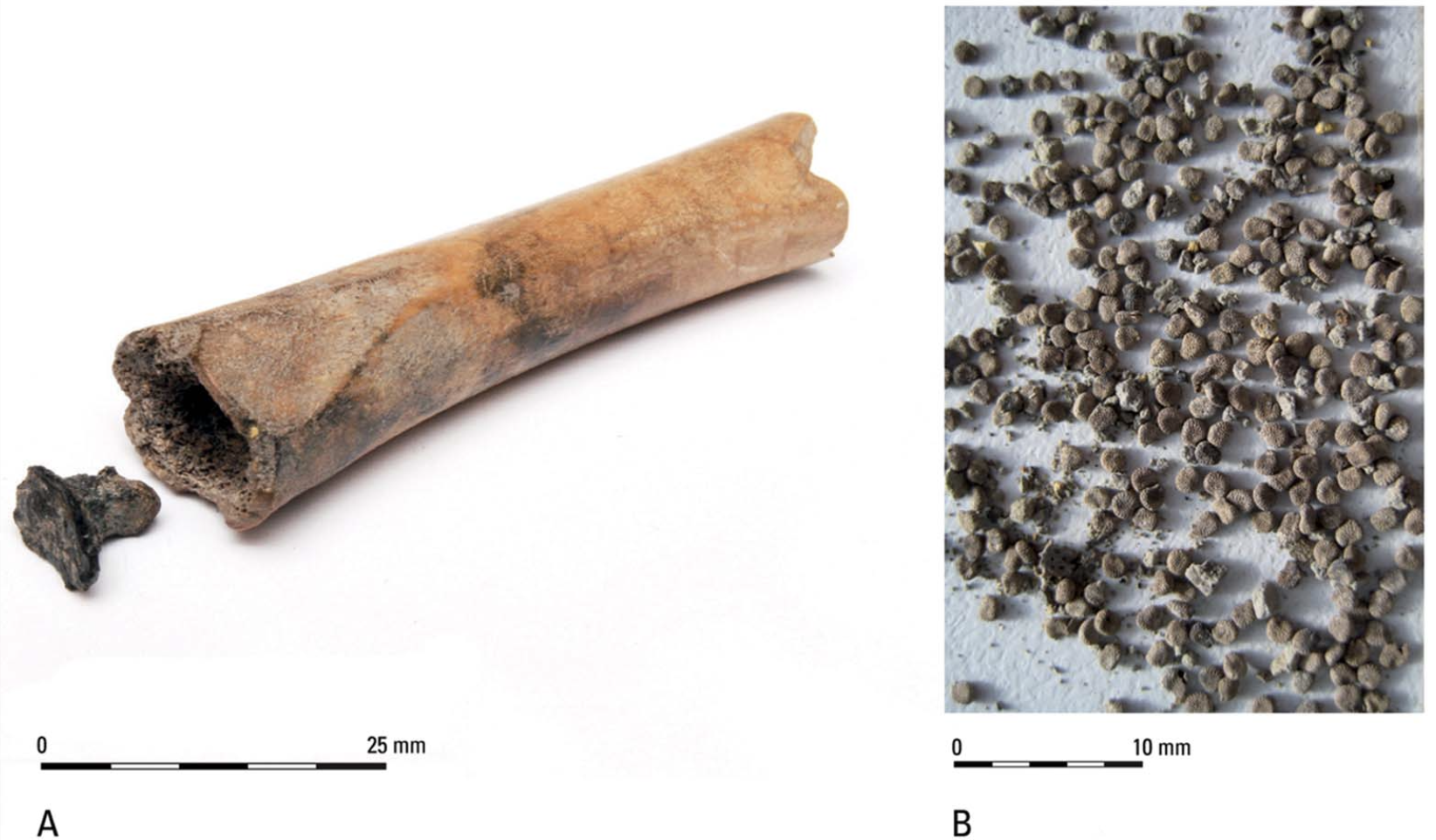
It would be natural to assume that this hollowed-out, plugged bone functioned as some kind of pipe for smoking henbane. Though Groot, van Haasteren, and Kooistra don’t find evidence for that, neither do they rule out the possibility that it was the stash box, if you like, of some resident of the Roman Netherlands two millennia ago. Groot points out to Velie the especially fascinating element of a “potential link between medicinal knowledge described by Roman authors in Roman Italy and people actually using the plant in a small village on the edge of the empire.” Though far from Rome itself, this henbane stash’s owner presumably used it however the Romans did. If it met with disapproval, this individual could have resorted to a still-familiar refrain: “Hey, it’s medicinal.”
via Hyperallergic
Related content:
The Drugs Used by the Ancient Greeks and Romans
Humans First Started Enjoying Cannabis in China Circa 2800 BC
1,000-Year-Old Illustrated Guide to the Medicinal Use of Plants Now Digitized & Put Online
Carl Sagan on the Virtues of Marijuana (1969)
Based in Seoul, Colin Marshall writes and broadcasts on cities, language, and culture. His projects include the Substack newsletter Books on Cities and the book The Stateless City: a Walk through 21st-Century Los Angeles. Follow him on Twitter at @colinmarshall or on Facebook.
Read More...Support Us
We're hoping to rely on loyal readers, rather than erratic ads. Please click the Donate button and support Open Culture. You can use Paypal, Venmo, Patreon, even Crypto! We thank you!

About Us

Open Culture scours the web for the best educational media. We find the free courses and audio books you need, the language lessons & educational videos you want, and plenty of enlightenment in between.
Advertise With Us
FREE UPDATES!
GET OUR DAILY EMAIL
Get the best cultural and educational resources on the web curated for you in a daily email. We never spam. Unsubscribe at any time.
FOLLOW ON SOCIAL MEDIA
Open Culture editor Dan Colman scours the web for the best educational media. He finds the free courses and audio books you need, the language lessons & movies you want, and plenty of enlightenment in between.
Advertise With Us


