Google Creates a Career Certificate That Prepares Students for Cybersecurity Jobs in 6 Months
In 2023, Google launched several online certificate programs designed to help students land an entry-level job, without necessarily having a college degree. This includes a certificate program focused on Cybersecurity, a field that stands poised to grow as companies become more digital and face mounting cyberattacks.
Offered on Coursera’s educational platform, the new Google Cybersecurity Professional Certificate features eight online courses, which will collectively help students learn how to:
- Understand the importance of cybersecurity practices and their impact for organizations.
- Identify common risks, threats, and vulnerabilities, as well as techniques to mitigate them.
- Protect networks, devices, people, and data from unauthorized access and cyberattacks using Security Information and Event Management (SIEM) tools.
- Gain hands-on experience with Python, Linux, and SQL.
The Cybersecurity Professional Certificate also now includes six new videos that explain how to use AI in cybersecurity. The videos cover everything from using artificial intelligence to help identify bugs and system vulnerabilities, to refining code and prioritizing alerts with AI.
Students can take individual courses in these professional certificate programs for free. (Above, you can watch a video from the first course in the cybersecurity certificate program, entitled “Foundations of Cybersecurity.”) However, if you would like to receive a certificate, Coursera will charge $49 per month (after an initial 7‑day free trial period). That means that the Cybersecurity Professional Certificate, designed to be completed in 6 months, will cost roughly $300 in total.
Once students complete the cybersecurity certificate, they can add the credential to their LinkedIn profile, resume, or CV. As a perk, students in the U.S. can also connect with 150+ employers (e.g., American Express, Colgate-Palmolive, T‑Mobile, Walmart, and Google) who have pledged to consider certificate holders for open positions. According to Coursera, this certificate can prepare students to become an entry-level “cybersecurity analyst and SOC (security operations center) analyst.”
You can start a 7‑day free trial of the Cybersecurity Professional Certificate here. Alternatively, if you sign up for Coursera Plus, whose price has been reduced by 40% until December 2, 2024, you can enroll in the cybersecurity certificate program at no charge. Find out more here.
Note: Open Culture has a partnership with Coursera. If readers enroll in certain Coursera courses and programs, it helps support Open Culture.
Read More...An Introduction to the Astonishing Book of Kells, the Iconic Illuminated Manuscript
Whatever set of religious or cultural traditions you come from, you’ve probably seen a Celtic cross before. Unlike a conventional cross, it has a circular ring, or “nimbus,” where its arms and stem intersect. The sole addition of that element gives it a highly distinctive look, and indeed makes it one of the representative examples of Insular iconography — that is, iconography created within Great Britain and Ireland in the time after the Roman Empire. Perhaps the most artistically impressive Celtic cross in existence is found on one of the pages of the ninth-century Book of Kells (view online here), which itself stands as the most celebrated of all Insular illuminated manuscripts.
On what’s called the “carpet page” of the Book of Kells, explains Smarthistory’s Steven Zucker in the video above, “we see a cross so elaborate that it almost ceases to be a cross.” It has “two crossbeams, and these delicate circles with intricate interlacing in each of them, but the circles are so large that they almost overwhelm the cross itself.”
That’s hardly the only image of note in the book, which contains the four Gospels of the New Testament, among other texts, as well as numerous and extravagant illustrations, all of them executed painstakingly by hand on its vellum pages back when it was created, circa 800, in the scriptorium of a medieval monastery. These illustrations include, as Zucker’s colleague Lauren Kilroy puts it, “the earliest representation of the Virgin and Child in a manuscript in Western Europe.”
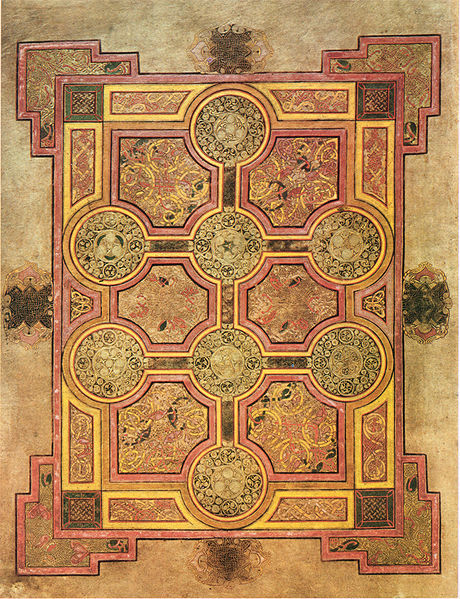
This is hardly a volume one approaches lightly — especially if one approaches it in person, as Zucker and Kilroy did on their visit to Trinity College Dublin. “When we were standing in front of the book,” says Kilroy, they “noticed how many folios formed the book itself” (which would have required the skin of more than 100 young calves). Coming to grips with the sheer quantity of material in the Book of Kells is one thing, but understanding how to interpret it is another still. Hence the free online course previously featured here on Open Culture, which can help you more fully appreciate the book in its digitized form available online. Even if the cross, Celtic or otherwise, stirs no particular religious feelings within you, the Book of Kells has much to say about the civilization that produced it: a civilization that, insular though it may once have been, would go on to change the shape of the world.
Related Content:
The Medieval Masterpiece the Book of Kells Is Now Digitized and Available Online
Take a Free Online Course on the Great Medieval Manuscript the Book of Kells
Based in Seoul, Colin Marshall writes and broadcasts on cities, language, and culture. His projects include the Substack newsletter Books on Cities and the book The Stateless City: a Walk through 21st-Century Los Angeles. Follow him on Twitter at @colinmarshall.
Read More...Learn Data Analytics & AI with Google, and Fast-Track Your Career
?si=azZbGLEr_9EFWypL
We’re living in the age of data and artificial intelligence (AI). Every second, vast amounts of data are being generated, processed, and analyzed. And increasingly AI plays a central role in how that data gets managed. For companies, governments, and individuals alike, understanding data is essential. This makes Data Analytics—especially when accompanied by AI skills—a valuable asset for most professionals.
Enter Google, which recently launched a professional certificate in Data Analytics–one that will “have you job-ready in less than 6 months.” Offered on the Coursera platform, the Data Analytics Professional Certificate consists of eight courses, including “Foundations: Data, Data, Everywhere,” “Prepare Data for Exploration,” “Data Analysis with R Programming,” and “Share Data Through the Art of Visualization.” And now the course sequence has incorporated videos exploring how to leverage artificial intelligence when working with data. Overall this program “includes over 180 hours of instruction and hundreds of practice-based assessments, which will help you simulate real-world data analytics scenarios that are critical for success in the workplace.”
Upon completion, students–even those who haven’t pursued a college degree–can directly apply for jobs (e.g., junior or associate data analyst, database administrator, etc.) with Google and over 150 U.S. employers, including Deloitte, Target, and Verizon. You can start a 7‑day free trial and explore the courses here. If you continue beyond the free trial, Google/Coursera will charge $49 per month. That translates to about $300 after 6 months, the time estimated to complete the certificate.
Finally, it’s worth mentioning that anyone who enrolls in this certificate before November 30, 2024 will get access to Google AI Essentials at no cost.
Explore the Data Analytics Certificate by watching the video above. Learn more about the overall Google career certificate initiative here. And find other Google professional certificates here.
Note: Open Culture has a partnership with Coursera. If readers enroll in certain Coursera courses and programs, it helps support Open Culture.
Read More...Free: Download Over 33,000 Sounds from the BBC Sound Effects Archive
There may be a few young people in Britain today who recognize the name Ludwig Koch, but in the nineteen-forties, he constituted something of a cultural phenomenon unto himself. He “started recording sounds and voices in the 1880s when he was still a child” in his native Germany, says the website of the BBC. After fleeing from the Nazis, he settled in England, which created the opportunity for the Beeb to acquire his collection of field recordings, using it to start building its own library of nature sounds. Soon, Koch “became a household name as a nature broadcaster,” and his “distinct German accent and eccentric location recordings became so well known that he was parodied by Peter Sellers.”
You can hear 168 of Koch’s field recordings at the online archive of BBC Sound Effects, whose digital holdings have in recent years grown to include over 33,000 different sounds from various sources, spanning more than a century.
“These include clips made by the BBC Radiophonic workshop, recordings from the Blitz in London, special effects made for BBC TV and Radio productions, as well as 15,000 recordings from the Natural History Unit archive,” says its About page. “You can explore sounds from every continent — from the college bells ringing in Oxford to a Patagonian waterfall — or listen to a submarine klaxon or the sound of a 1969 Ford Cortina door slamming shut.”
The BBC has made all these recordings free for your own non-commercial use, as long as you credit where they came from. To put them into a commercial project, you can license them by clicking “Show details,” and then the “Buy sound” button that appears right below. The archive also offers a “mixer mode,” which lets you “layer, edit and re-order clips from the archive to create your own sounds,” potentially mashing up a wide variety of times and places into a single soundscape. A chacma baboon wielding a laser in a Belgian café, for instance, or a laughing woman brewing a kettle of water at a bullfight in Spain: hardly the sort of aural scenes that would be introduced by Ludwig Koch, granted, but here in the twenty-first century, the only limit is your imagination. Enter the BBC Sound Effects Archive here.
Related content:
NASA Puts Online a Big Collection of Space Sounds, and They’re Free to Download and Use
How the Sound Effects on 1930s Radio Shows Were Made: An Inside Look
How the Sounds You Hear in Movies Are Really Made: Discover the Magic of “Foley Artists”
Based in Seoul, Colin Marshall writes and broadcasts on cities, language, and culture. His projects include the Substack newsletter Books on Cities and the book The Stateless City: a Walk through 21st-Century Los Angeles. Follow him on Twitter at @colinmarshall or on Facebook.
Read More...The Medieval Masterpiece, the Book of Kells, Is Now Digitized and Available Online
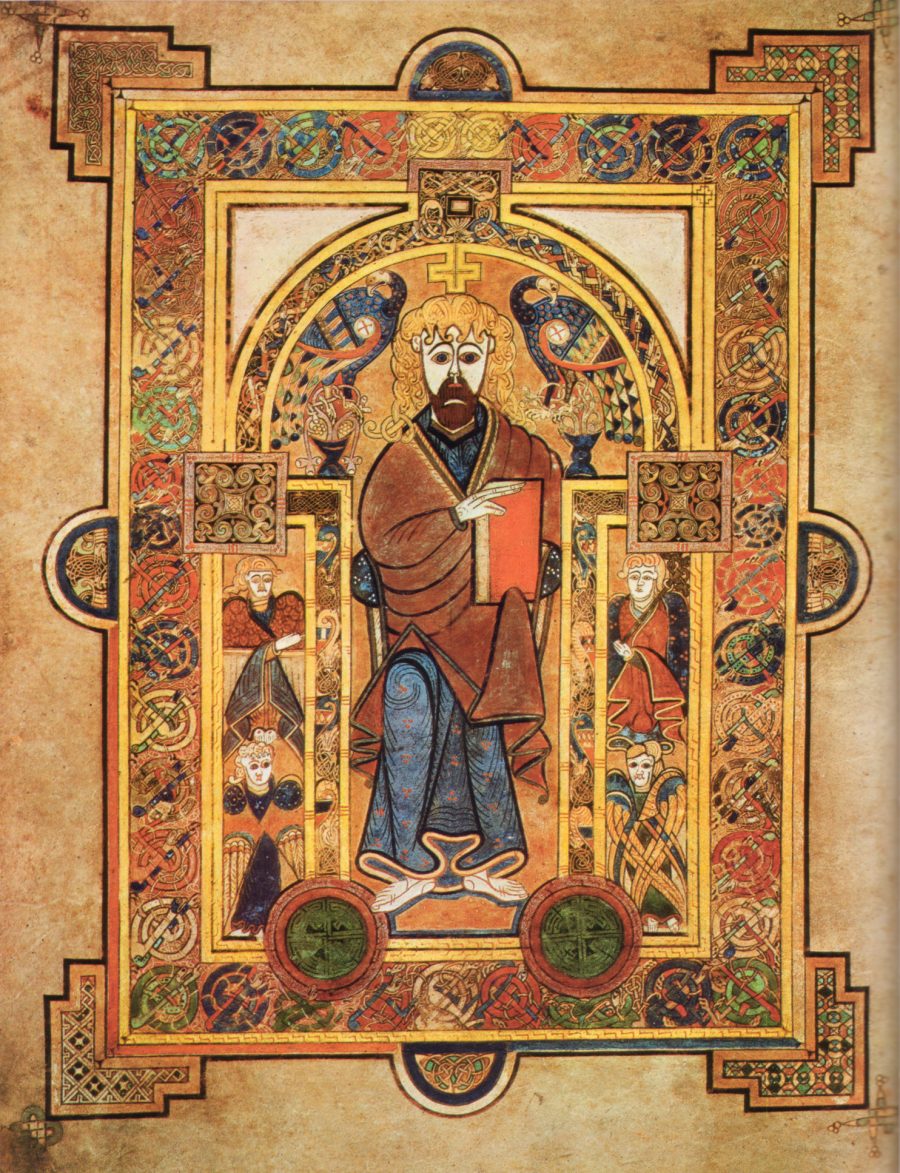
If you know nothing else about medieval European illuminated manuscripts, you surely know the Book of Kells. “One of Ireland’s greatest cultural treasures” comments Medievalists.net, “it is set apart from other manuscripts of the same period by the quality of its artwork and the sheer number of illustrations that run throughout the 680 pages of the book.” The work not only attracts scholars, but almost a million visitors to Dublin every year. “You simply can’t travel to the capital of Ireland,” writes Book Riot’s Erika Harlitz-Kern, “without the Book of Kells being mentioned. And rightfully so.”
The ancient masterpiece is a stunning example of Hiberno-Saxon style, thought to have been composed on the Scottish island of Iona in 806, then transferred to the monastery of Kells in County Meath after a Viking raid (a story told in the marvelous animated film The Secret of Kells). Consisting mainly of copies of the four gospels, as well as indexes called “canon tables,” the manuscript is believed to have been made primarily for display, not reading aloud, which is why “the images are elaborate and detailed while the text is carelessly copied with entire words missing or long passages being repeated.”
Its exquisite illuminations mark it as a ceremonial object, and its “intricacies,” argue Trinity College Dublin professors Rachel Moss and Fáinche Ryan, “lead the mind along pathways of the imagination…. You haven’t been to Ireland unless you’ve seen the Book of Kells.” This may be so, but thankfully, in our digital age, you need not go to Dublin to see this fabulous historical artifact, or a digitization of it at least, entirely viewable at the online collections of the Trinity College Library. (When you click on the previous link, make sure you scroll down the page.) The pages, originally captured in 1990, “have recently been rescanned,” Trinity College Library writes, using state-of-the-art imaging technology. These new digital images offer the most accurate high-resolution images to date, providing an experience second only to viewing the book in person.”
What makes the Book of Kells so special, reproduced “in such varied places as Irish national coinage and tattoos?” asks Professors Moss and Ryan. “There is no one answer to these questions.” In their free online course on the manuscript, these two scholars of art history and theology, respectively, do not attempt to “provide definitive answers to the many questions that surround it.” Instead, they illuminate its history and many meanings to different communities of people, including, of course, the people of Ireland. “For Irish people,” they explain in the course trailer above, “it represents a sense of pride, a tangible link to a positive time in Ireland’s past, reflected through its unique art.”
But while the Book of Kells is still a modern “symbol of Irishness,” it was made with materials and techniques that fell out of use several hundred years ago, and that were once spread far and wide across Europe, the Middle East, and North Africa. In the video above, Trinity College Library conservator John Gillis shows us how the manuscript was made using methods that date back to the “development of the codex, or the book form.” This includes the use of parchment, in this case calf skin, a material that remembers the anatomical features of the animals from which it came, with markings where tails, spines, and legs used to be.
The Book of Kells has weathered the centuries fairly well, thanks to careful preservation, but it’s also had perhaps five rebindings in its lifetime. “In its original form,” notes Harlitz-Kern, the manuscript “was both thicker and larger. Thirty folios of the original manuscript have been lost through the centuries and the edges of the existing manuscript were severely trimmed during a rebinding in the nineteenth century.” It remains, nonetheless, one of the most impressive artifacts to come from the age of the illuminated manuscript, “described by some,” says Moss and Ryan, “as the most famous manuscript in the world.” Find out why by seeing it (virtually) for yourself and learning about it from the experts above.
For anyone interested in getting a copy of The Book of Kells in a nice print format, see The Book of Kells: Reproductions from the manuscript in Trinity College, Dublin.
Related Content:
Take a Free Online Course on the Great Medieval Manuscript, the Book of Kells
Josh Jones is a writer and musician based in Durham, NC. Follow him at @jdmagness
Read More...Behold the First American Board Game, Travellers’ Tour Through the United States (1822)
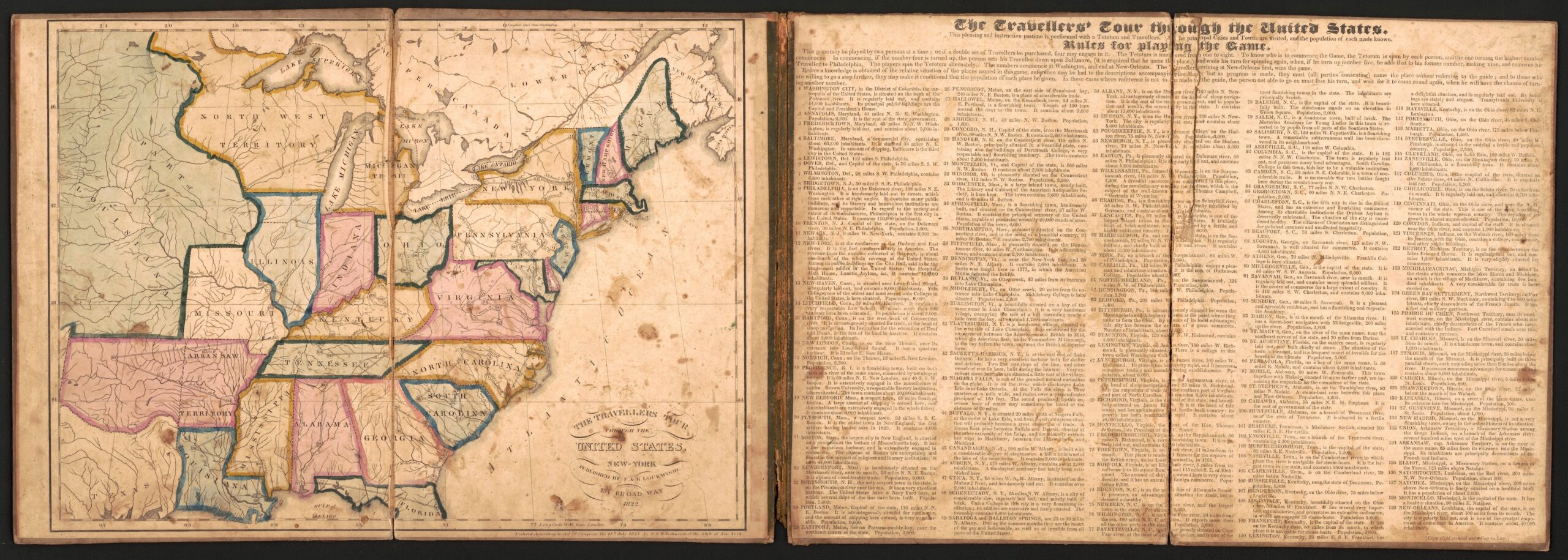
Asked to name a classic American board game, most of us would first think of Monopoly, whose imagery and verbiage — Park Place, Rich Uncle Pennybags, “Do not pass go” — has worked its way deep into the culture since Parker Brothers brought it to market in 1935. Despite that, it isn’t the oldest American board game: that honor goes to Travellers’ Tour Through the United States, which came out more than a century earlier, in 1822. Whereas Monopoly teaches its players about real-estate values in Depression-era Atlantic City (as well as a thing or two about capitalism), the older game took a larger subject for its educational ambitions: the whole of the United States of America.
Of course, that whole was a lot smaller back in 1822, the year after Missouri became the 24th state. Travellers’ Tour Through the United States presents its two-to-four players with the task of traversing the young country, beginning in Washington and ending in New Orleans. This is done by spinning something called a “teetotum,” a kind of hybrid between a top and a die, designed to hedge against the sinful associations of gambling. The player then moves ahead according to the distance shown on the teetotum, but must name the unlabeled city on which they’ve landed — and, in a more challenging variation, guess its population — in order to remain there.
As they move their pieces across the country, players can also read the included descriptions of each city, town, and region through which they pass. “Promoting the value of education, the game highlights institutions of learning,” writes Smithsonian.com’s Matthew Wynn Sivils. “Philadelphia’s ‘literary and benevolent institutions are numerous and respectable.’ Providence boasts ‘Brown University, a respectable literary institution.’ ” Making their way south, “players learn about Richmond’s ‘fertile backcountry’ and the ‘polished manners and unaffected hospitality’ of the citizens of Charleston. Savannah ‘contains many splendid edifices’ and Columbia’s ‘South Carolina College … bids fair to be a valuable institution.’ ”
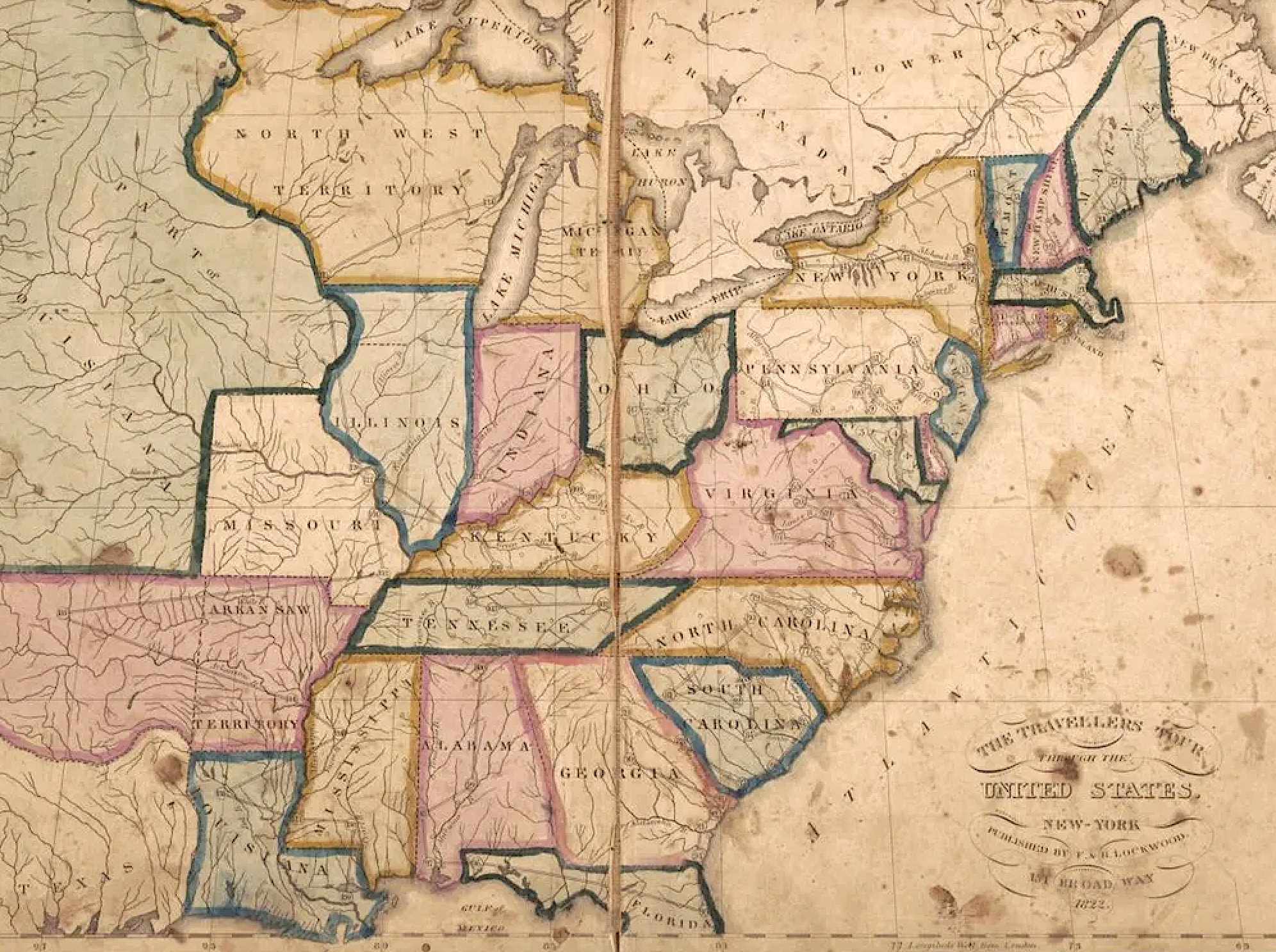
As clear-eyed descriptions of the United States in the early nineteenth century, these fall somewhat short of Tocqueville — but then, they were written almost a decade before Alexis de Tocqueville set foot in America. Not only did the country still have much expansion across the continent left to do, it had amassed but a fraction of the power and influence it would go on to do in the twentieth century. However compelling a spectacle the U.S. had become to foreign observers, it must have inspired among its own people an even stronger yearning to understand its nature, and therefore its future — a yearning the makers of Travellers’ Tour Through the United States clearly hoped would motivate sales. As a product, it seems not to have been successful, but as an idea, it lives on more than 200 years later in the form of the great American road trip.
via My Modern Met/Smithsonian
Related content:
The Fear and Loathing in Las Vegas Board Game, Inspired by Hunter S. Thompson’s Rollicking Novel
A Brief History of the Great American Road Trip
Based in Seoul, Colin Marshall writes and broadcasts on cities, language, and culture. His projects include the Substack newsletter Books on Cities and the book The Stateless City: a Walk through 21st-Century Los Angeles. Follow him on Twitter at @colinmarshall or on Facebook.
Read More...Roger Federer’s Dartmouth Commencement Address: “Effortless Is a Myth” & Other Life Lessons from Tennis
In 2006, David Foster Wallace published a piece in the New York Times Magazine headlined “Roger Federer as Religious Experience.” Even then, he could declare Federer, “at 25, the best tennis player currently alive. Maybe the best ever.” Much had already been written about “his old-school stoicism and mental toughness and good sportsmanship and evident overall decency and thoughtfulness and charitable largess.” Less easily commented upon — because much less easily described — was the aesthetic transcendence of his performance on the court, which Wallace thought best witnessed in person.
“If you’ve watched tennis only on television, you simply have no idea how hard these pros are hitting the ball, how fast the ball is moving, how little time the players have to get to it, and how quickly they’re able to move and rotate and strike and recover,” Wallace writes. “And none are faster, or more deceptively effortless about it, than Roger Federer.” Was that one of the observations the champion had in mind this past weekend, eighteen years later — and two years after his own retirement from the game — when he took the tree-stump lectern before Dartmouth’s class of 2024 and declared that “Effortless is a myth”?
That was one of three “tennis lessons” — that is, lessons for life derived from his long and hugely successful experience in tennis — that Federer lays out in the commencement address above. The second, “It’s only a point,” is a notion of which it’s all too easy to lose sight of amid the balletic intensity of a match. The third, “Life is bigger than the court,” is one Federer himself now must learn in the daily life after his own “graduation” that stretches out before him. For a man still considered one of the greatest players ever to pick up a racket, is there life after professional tennis?
Federer acknowledges the irony of his not having gone to college, but choosing instead to leave school at sixteen in order to devote himself to his sport. “In many ways, professional athletes are our culture’s holy men,” Wallace writes in another essay. “They give themselves over to a pursuit, endure great privation and pain to actualize themselves at it, and enjoy a relationship to perfection that we admire and reward.” But when their athletic careers inevitably end, they find themselves in a greatly heightened version of the situation we all do when we come to the end of our institutionalized education, wondering what could or should come next.
Clearly, Federer doesn’t suffer from the kind of inarticulacy and unreflectiveness that Wallace diagnosed over and over in other professional athletes about whom he wrote. In profiling player Michael Joyce, for instance, Wallace saw that Joyce and his colleagues lived in “a world that, like a child’s world, is very serious and very small” — but which Federer has long displayed an uncommon ability to see beyond. Still, as he must know, that guarantees him a satisfying second act no more than even world-beating success in any given field guarantees any of us general well-being in life. Wallace, too, knew that full well — and of course, he was no mean commencement speaker himself.
Related content:
Animations Revive Lost Interviews with David Foster Wallace, Jim Morrison & Dave Brubeck
Marcel Proust Plays Air Guitar on a Tennis Racket (1891)
30 Free Essays & Stories by David Foster Wallace on the Web
Bob Dylan and George Harrison Play Tennis, 1969
Medieval Tennis: A Short History and Demonstration
Based in Seoul, Colin Marshall writes and broadcasts on cities, language, and culture. His projects include the Substack newsletter Books on Cities and the book The Stateless City: a Walk through 21st-Century Los Angeles. Follow him on Twitter at @colinmarshall or on Facebook.
Read More...Hannah Arendt Explains How Totalitarian Regimes Arise–and How We Can Prevent Them
“Adolf Eichmann went to the gallows with great dignity,” wrote the political philosopher Hannah Arendt, describing the scene leading up to the prominent Holocaust-organizer’s execution. After drinking half a bottle of wine, turning down the offer of religious assistance, and even refusing the black hood offered him at the gallows, he gave a brief, strangely high-spirited speech before the hanging. “It was as though in those last minutes he was summing up the lesson that this long course in human wickedness had taught us — the lesson of the fearsome word-and-thought-defying banality of evil.”
These lines come from Eichmann in Jerusalem: A Report on the Banality of Evil, originally published in 1963 as a five-part series in the New Yorker. Eichmann “was popularly described as an evil mastermind who orchestrated atrocities from a cushy German office, and many were eager to see the so-called ‘desk murderer’ tried for his crimes,” explains the narrator of the animated TED-Ed lesson above, written by University College Dublin political theory professor Joseph Lacey. “But the squeamish man who took the stand seemed more like a dull bureaucrat than a sadistic killer,” and this “disparity between Eichmann’s nature and his actions” inspired Arendt’s famous summation.
A German Jew who fled her homeland in 1933, as Hitler rose to power, Arendt “dedicated herself to understanding how the Nazi regime came to power.” Against the common notion that “the Third Reich was a historical oddity, a perfect storm of uniquely evil leaders, supported by German citizens, looking for revenge after their defeat in World War I,” she argued that “the true conditions behind this unprecedented rise of totalitarianism weren’t specific to Germany.” Rather, in modernity, “individuals mainly appear in the social world to produce and consume goods and services,” which fosters ideologies “in which individuals were seen only for their economic value, rather than their moral and political capacities.”
In such isolating conditions, she thought, “participating in the regime becomes the only way to recover a sense of identity and community. While condemning Eichmann’s “monstrous actions, Arendt saw no evidence that Eichmann himself was uniquely evil. She saw him as a distinctly ordinary man who considered obedience the highest form of civic duty — and for Arendt, it was exactly this ordinariness that was most terrifying.” According to her theory, there was nothing particularly German about all of this: any sufficiently modernized culture could produce an Eichmann, a citizen who defines himself by participation in his society regardless of that society’s larger aims. This led her to the conclusion that “thinking is our greatest weapon against the threats of modernity,” some of which have become only more threatening over the past six decades.
Related content:
Take Hannah Arendt’s Final Exam for Her 1961 Course “On Revolution”
Watch Hannah Arendt’s Final Interview (1973)
Based in Seoul, Colin Marshall writes and broadcasts on cities, language, and culture. His projects include the Substack newsletter Books on Cities, the book The Stateless City: a Walk through 21st-Century Los Angeles and the video series The City in Cinema. Follow him on Twitter at @colinmarshall or on Facebook.
Read More...The First Recording of Allen Ginsberg Reading “Howl” (1956)
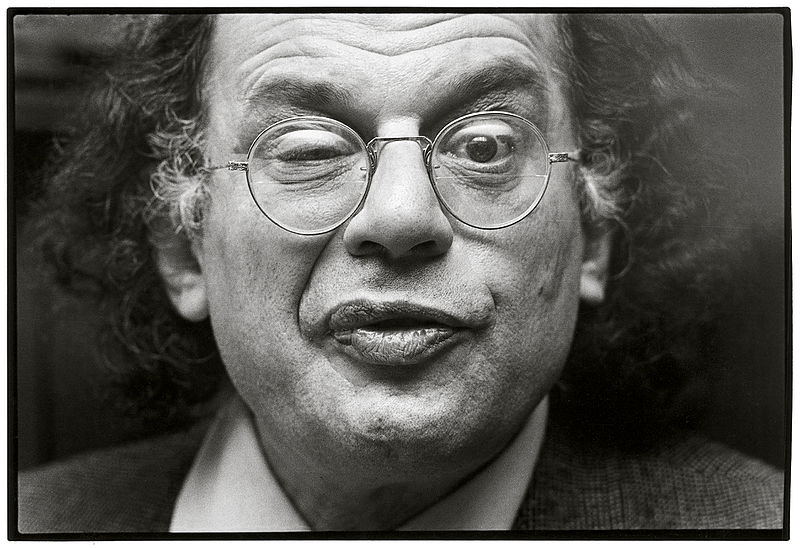
Image by Michiel Hendryckx, via Wikimedia Commons
Occasionally I slip into an ivory tower mentality in which the idea of a banned book seems quaint—associated with silly scandals over the tame sex scenes in James Joyce or D.H. Lawrence. After all, I think, we live in an age when bestseller lists are topped (no pun) by tawdry fan fiction like Fifty Shades of Grey. Nothing’s sacred. But this notion is a massive blind spot on my part; the whole awareness-raising mission of the annual Banned Books Week seeks to dispel such complacency. Books are challenged, suppressed, and banned all the time in public schools and libraries, even if we’ve moved past outright government censorship of the publishing industry.
It’s also easy to forget that Allen Ginsberg’s generation-defining poem “Howl” was once almost a casualty of censorship. The most likely successor to Walt Whitman’s vision, Ginsberg’s oracular utterances did not sit well with U.S. Customs, who in 1957 tried to seize every copy of the British second printing. When that failed, police arrested the poem’s publisher, Lawrence Ferlinghetti, and he and Ginsberg’s “Howl” were put on trial for obscenity. Apparently, phrases like “cock and endless balls” did not sit well with the authorities. But the court vindicated them all.
The story of Howl’s publication begins in 1955, when 29-year-old Ginsberg read part of the poem at the Six Gallery, where Ferlinghetti—owner of San Francisco’s City Lights bookstore—sat in attendance. Deciding that Ginsberg’s epic lament “knocked the sides out of things,” Ferlinghetti offered to publish “Howl” and brought out the first edition in 1956. Prior to this reading, “Howl” existed in the form of an earlier poem called “Dream Record, 1955,” which poet Kenneth Rexroth told Ginsberg sounded “too formal… like you’re wearing Columbia University Brooks Brothers ties.” Ginsberg’s rewrite jettisoned the ivy league decorum.
Unfortunately, no audio exists of that first reading, but above you can hear the first recorded reading of “Howl,” from February, 1956 at Portland’s Reed College. The recording sat dormant in Reed’s archives for over fifty years until scholar John Suiter rediscovered it in 2008. In it, Ginsberg reads his great prophetic work, not with the cadences of a street preacher or jazzman—both of which he had in his repertoire—but in an almost robotic monotone with an undertone of manic urgency. Ginsberg’s reading, before an intimate group of students in a dormitory lounge, took place only just before the first printing of the poem in the City Lights edition.
Note: This post originally appeared on our site in 2013. Over the years, the audio originally featured in the post, along with many of the links, went dead. So we gave everything a refresh and brought it back.
If you would like to support the mission of Open Culture, consider making a donation to our site. It’s hard to rely 100% on ads, and your contributions will help us continue providing the best free cultural and educational materials to learners everywhere. You can contribute through PayPal, Patreon, and Venmo (@openculture). Thanks!
Related Content:
Allen Ginsberg Recordings Brought to the Digital Age. Listen to Eight Full Tracks for Free
James Franco Reads a Dreamily Animated Version of Allen Ginsberg’s Epic Poem ‘Howl’
2,000+ Cassettes from the Allen Ginsberg Audio Collection Now Streaming Online
13 Lectures from Allen Ginsberg’s “History of Poetry” Course (1975)
Josh Jones is a writer and musician based in Washington, DC. Follow him at @jdmagness
Read More...Behold The Drawings of Franz Kafka (1907–1917)
Runner 1907–1908
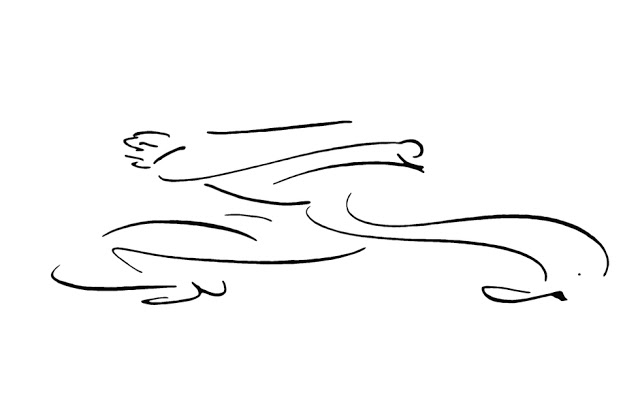
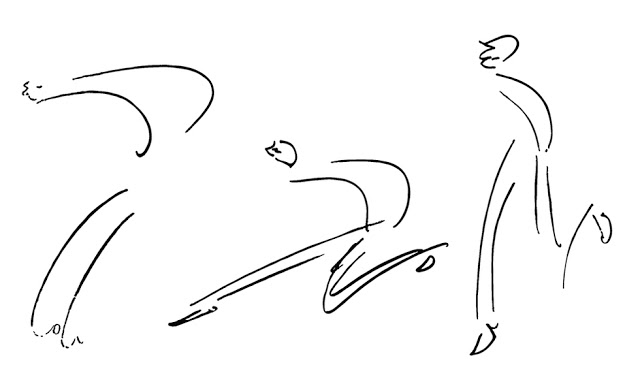
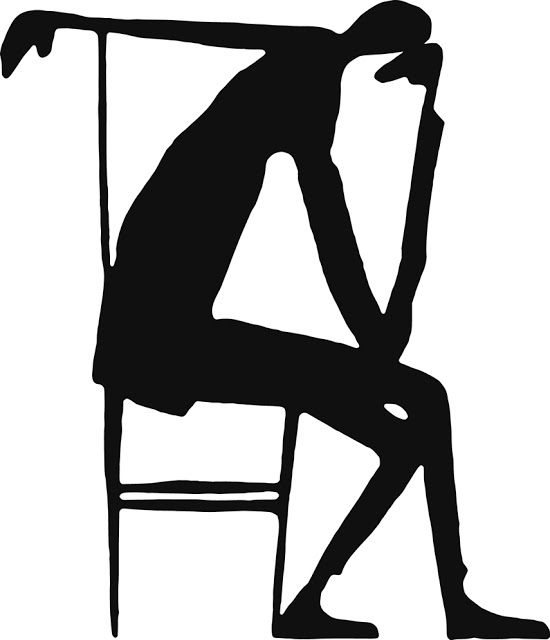
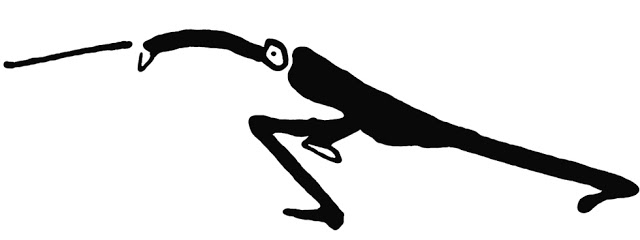
UK-born, Chicago-based artist Philip Hartigan has posted a brief video piece about Franz Kafka’s drawings. Kafka, of course, wrote a body of work, mostly never published during his lifetime, that captured the absurdity and the loneliness of the newly emerging modern world: In The Metamorphosis, Gregor transforms overnight into a giant cockroach; in The Trial, Josef K. is charged with an undefined crime by a maddeningly inaccessible court. In story after story, Kafka showed his protagonists getting crushed between the pincers of a faceless bureaucratic authority on the one hand and a deep sense of shame and guilt on the other.
On his deathbed, the famously tortured writer implored his friend Max Brod to burn his unpublished work. Brod ignored his friend’s plea and instead published them – novels, short stories and even his diaries. In those diaries, Kafka doodled incessantly – stark, graphic drawings infused with the same angst as his writing. In fact, many of these drawings have ended up gracing the covers of Kafka’s books.
“Quick, minimal movements that convey the typical despairing mood of his fiction” says Hartigan of Kafka’s art. “I am struck by how these simple gestures, these zigzags of the wrist, contain an economy of mark making that even the most experienced artist can learn something from.”
In his book Conversations with Kafka, Gustav Janouch describes what happened when he came upon Kafka in mid-doodle: the writer immediately ripped the drawing into little pieces rather than have it be seen by anyone. After this happened a couple times, Kafka relented and let him see his work. Janouch was astonished. “You really didn’t need to hide them from me,” he complained. “They’re perfectly harmless sketches.”
“Kafka slowly wagged his head to and fro – ‘Oh no! They are not as harmless as they look. These drawing are the remains of an old, deep-rooted passion. That’s why I tried to hide them from you…. It’s not on the paper. The passion is in me. I always wanted to be able to draw. I wanted to see, and to hold fast to what was seen. That was my passion.”
Check out some of Kafka’s drawings below. Or definitely see the recently-published edition, Franz Kafka: The Drawings. It’s the “first book to publish the entirety of Franz Kafka’s graphic output, including more than 100 newly discovered drawings.”
Horse and Rider 1909–1910
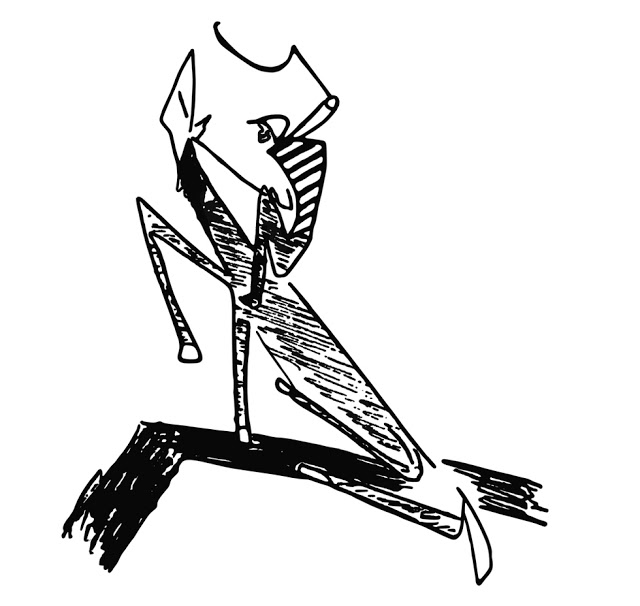
Three Runners 1912–1913
The Thinker 1913
Fencing 1917
If you would like to support the mission of Open Culture, consider making a donation to our site. It’s hard to rely 100% on ads, and your contributions will help us continue providing the best free cultural and educational materials to learners everywhere. You can contribute through PayPal, Patreon, and Venmo (@openculture). Thanks!
Related Content:
Vladimir Nabokov’s Delightful Butterfly Drawings
The Art of William Faulkner: Drawings from 1916–1925
The Drawings of Jean-Paul Sartre
Flannery O’Connor’s Satirical Cartoons: 1942–1945
Jonathan Crow is a Los Angeles-based writer and filmmaker whose work has appeared in Yahoo!, The Hollywood Reporter, and other publications. You can follow him at @jonccrow.
Read More...Support Us
We're hoping to rely on loyal readers, rather than erratic ads. Please click the Donate button and support Open Culture. You can use Paypal, Venmo, Patreon, even Crypto! We thank you!

About Us

Open Culture scours the web for the best educational media. We find the free courses and audio books you need, the language lessons & educational videos you want, and plenty of enlightenment in between.
Advertise With Us
FREE UPDATES!
GET OUR DAILY EMAIL
Get the best cultural and educational resources on the web curated for you in a daily email. We never spam. Unsubscribe at any time.
FOLLOW ON SOCIAL MEDIA
Open Culture editor Dan Colman scours the web for the best educational media. He finds the free courses and audio books you need, the language lessons & movies you want, and plenty of enlightenment in between.
Advertise With Us


