Albert Einstein’s Grades: A Fascinating Look at His Report Cards
Albert Einstein was a precocious child.
At the age of twelve, he followed his own line of reasoning to find a proof of the Pythagorean Theorem. At thirteen he read Kant, just for the fun of it. And before he was fifteen he had taught himself differential and integral calculus.
But while the young Einstein was engrossed in intellectual pursuits, he didn’t much care for school. He hated rote learning and despised authoritarian schoolmasters. His sense of intellectual superiority was resented by his teachers.
In Subtle is the Lord: The Science and Life of Albert Einstein, author Abraham Pais tells a funny story from Einstein’s days at the Luitpold Gymnasium, a secondary school in Munich now called the Albert-Einstein-Gymnasium:
At the Gymnasium a teacher once said to him that he, the teacher, would be much happier if the boy were not in his class. Einstein replied that he had done nothing wrong. The teacher answered, “Yes, that is true. But you sit there in the back row and smile, and that violates the feeling of respect that a teacher needs from his class.”
The same teacher famously said that Einstein “would never get anywhere in life.”
What bothered Einstein most about the Luitpold was its oppressive atmosphere. His sister Maja would later write:
“The military tone of the school, the systematic training in the worship of authority that was supposed to accustom pupils at an early age to military discipline, was also particularly unpleasant for the boy. He contemplated with dread that not-too-distant moment when he will have to don a soldier’s uniform in order to fulfill his military obligations.”
When he was sixteen, Einstein’s parents moved to Italy to pursue a business venture. They told him to stay behind and finish school. But Einstein was desperate to join them in Italy before his seventeenth birthday. “According to the German citizenship laws,” Maja explained, “a male citizen must not emigrate after his completed sixteenth year; otherwise, if he fails to report for military service, he is declared a deserter.”
So Einstein found a way to get a doctor’s permission to withdraw from the school on the pretext of “mental exhaustion,” and fled to Italy without a diploma. Years later, in 1944, during the final days of World War II, the Luitpold Gymnasium was obliterated by Allied bombing. So we don’t have a record of Einstein’s grades there. But there is a record of a principal at the school looking up Einstein’s grades in 1929 to fact check a press report that Einstein had been a very bad student. Walter Sullivan writes about it in a 1984 piece in The New York Times:
With 1 as the highest grade and 6 the lowest, the principal reported, Einstein’s marks in Greek, Latin and mathematics oscillated between 1 and 2 until, toward the end, he invariably scored 1 in math.
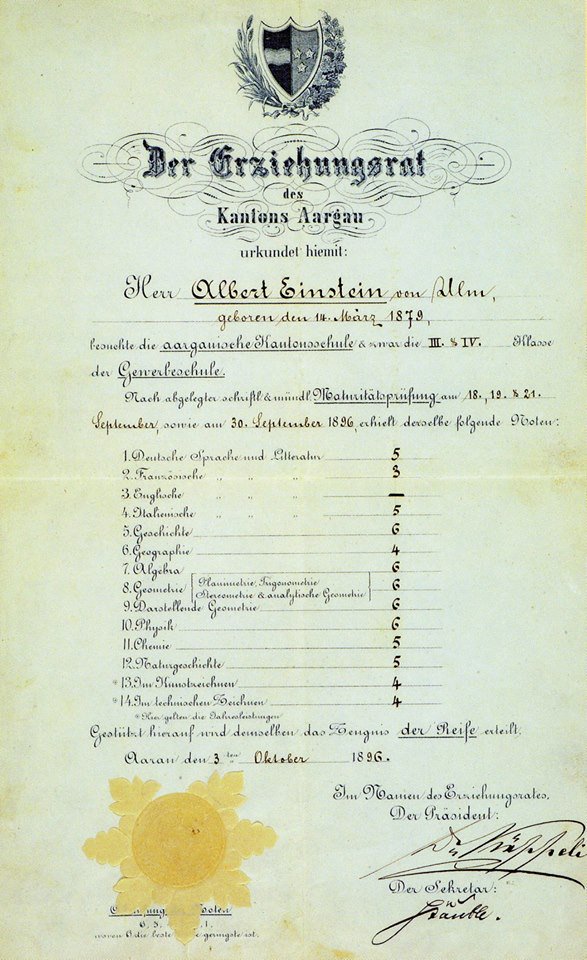
After he dropped out, Einstein’s family enlisted a well-connected friend to persuade the Swiss Federal Institute of Technology, or ETH, to let him take the entrance exam, even though he was only sixteen years old and had not graduated from high school. He scored brilliantly in physics and math, but poorly in other areas. The director of the ETH suggested he finish preparatory school in the town of Aarau, in the Swiss canton of Aargau. A diploma from the cantonal school would guarantee Einstein admission to the ETH.
At Aarau, Einstein was pleasantly surprised to find a liberal atmosphere in which independent thought was encouraged. “When compared to six years’ schooling at a German authoritarian gymnasium,” he later said, “it made me clearly realize how much superior an education based on free action and personal responsibility is to one relying on outward authority.”
In Einstein’s first semester at Aarau, the school still used the old method of scoring from 1 to 6, with 1 as the highest grade. In the second semester the system was reversed, with 6 becoming the highest grade. Barry R. Parker talks about Einstein’s first-semester grades in his book, Einstein: The Passions of a Scientist:
His grades over the first few months were: German, 2–3; French, 3–4; history, 1–2; mathematics, 1; physics, 1–2; natural history, 2–3; chemistry, 2–3; drawing, 2–3; and violin, 1. (The range is 1 to 6, with 1 being the highest.) Although none of the grades, with the exception of French, were considered poor, some of them were only average.
The school headmaster, Jost Winteler, who had welcomed Einstein into his home as a boarder and had become something of a surrogate father to him during his time at Aarau, was concerned that a young man as obviously brilliant as Albert was receiving average grades in so many courses. At Christmas in 1895, he mailed a report card to Einstein’s parents. Hermann Einstein replied with warm thanks, but said he was not too worried. As Parker writes, Einstein’s father said he was used to seeing a few “not-so-good grades along with very good ones.”
In the next semester Einstein’s grades improved, but were still mixed. As Toby Hendy of the YouTube channel Tibees shows in the video above, Einstein’s final grades were excellent in math and physics, but closer to average in other areas.
Einstein’s uneven academic performance continued at the ETH, as Hendy shows. By the third year his relationship with the head of the physics department, Heinrich Weber, began to deteriorate. Weber was offended by the young man’s arrogance. “You’re a clever boy, Einstein,” said Weber. “An extremely clever boy. But you have one great fault. You’ll never allow yourself to be told anything.” Einstein was particularly frustrated that Weber refused to teach the groundbreaking electromagnetic theory of James Clerk Maxwell. He began spending less time in the classroom and more time reading up on current physics at home and in the cafes of Zurich.
Einstein increasingly focused his attention on physics, and neglected mathematics. He came to regret this. “It was not clear to me as a student,” he later said, “that a more profound knowledge of the basic principles of physics was tied up with the most intricate mathematical methods.”
Einstein’s classmate Marcel Grossmann helped him by sharing his notes from the math lectures Einstein had skipped. When Einstein graduated, his conflict with Weber cost him the teaching job he had expected to receive. Grossmann eventually came to Einstein’s rescue again, urging his father to help him secure a well-paid job as a clerk in the Swiss patent office. Many years later, when Grossmann died, Einstein wrote a letter to his widow that conveyed not only his sadness at an old friend’s death, but also his bittersweet memories of life as a college student:
“Our days together come back to me. He a model student; I untidy and a daydreamer. He on excellent terms with the teachers and grasping everything easily; I aloof and discontented, not very popular. But we were good friends and our conversations over iced coffee at the Metropol every few weeks belong among my nicest memories.”
Note: An earlier version of this post appeared on our site in 2020.
Related Content:
Hear Albert Einstein Read “The Common Language of Science” (1941)
When Albert Einstein & Charlie Chaplin Met and Became Fast Famous Friends (1930)
Read More...1980s Metalhead Kids Are Alright: Scientific Study Shows That They Became Well-Adjusted Adults
In the 1980s, The Parents Music Resource Center (PMRC), an organization co-founded by Tipper Gore and the wives of several other Washington power brokers, launched a political campaign against pop music, hoping to put warning labels on records that promoted Sex, Violence, Drug and Alcohol Use. Along the way, the PMRC issued “the Filthy Fifteen,” a list of 15 particularly objectionable songs. Hits by Madonna, Prince and Cyndi Lauper made the list. But the list really took aim at heavy metal bands from the 80s — namely, Judas Priest, Mötley Crüe, Twisted Sister, W.A.S.P., Def Leppard, Black Sabbath, and Venom. (Interesting footnote: the Soviets separately created a list of blackballed rock bands, and it looked pretty much the same.)
Above, you can watch Twisted Sister’s Dee Snider appear before Congress in 1985 and accuse the PMRC of misinterpreting his band’s lyrics and waging a false war against metal music. The evidence 40 years later suggests that Snider perhaps had a point.
A study by psychology researchers at Humboldt State, Ohio State, UC Riverside and UT Austin “examined 1980s heavy metal groupies, musicians, and fans at middle age” — 377 participants in total — and found that, although metal enthusiasts certainly lived riskier lives as kids, they were nonetheless “significantly happier in their youth and better adjusted currently than either middle-aged or current college-age youth comparison groups.” This left the researchers to contemplate one possible conclusion: “participation in fringe style cultures may enhance identity development in troubled youth.” Not to mention that heavy metal lyrics don’t easily turn kids into damaged goods.
You can read the report, Three Decades Later: The Life Experiences and Mid-Life Functioning of 1980s Heavy Metal Groupies here. And, right above, listen to an interview with one of the researchers, Tasha Howe, a former headbanger herself, who spoke yesterday with Michael Krasny on KQED radio in San Francisco.
Note: An earlier version of this post appeared on our site in July 2015.
If you would like to support the mission of Open Culture, consider making a donation to our site. It’s hard to rely 100% on ads, and your contributions will help us continue providing the best free cultural and educational materials to learners everywhere. You can contribute through PayPal, Patreon, and Venmo (@openculture). Thanks!
Related Content:
A Bluegrass Version of Metallica’s Heavy Metal Hit, “Enter Sandman”
Read More...How Eyes Evolved: A Fascinating Tour Through the Animal Kingdom
Above, Lars Schmitz, a professor at Claremont McKenna College, guides us “through a giant tree of life mapping the evolution of eyes in the animal kingdom: how they work, why they’ve taken the form they have, and the evolutionary advantages they’ve unlocked across species.” The video comes courtesy of Wired. It’s 36 minutes and downright fascinating.
If you would like to support the mission of Open Culture, consider making a donation to our site. It’s hard to rely 100% on ads, and your contributions will help us continue providing the best free cultural and educational materials to learners everywhere. You can contribute through PayPal, Patreon, and Venmo (@openculture). Thanks!
Related Content
Animals Laugh Too: UCLA Study Finds Laughter in 65 Species, from Rats to Cows
16,000 Pages of Charles Darwin’s Writing on Evolution Now Digitized and Available Online
Carl Sagan Explains Evolution in an 8‑Minute Animation
Free Online Biology Courses
Read More...What Is Kafkaesque?: The Philosophy of Franz Kafka
It’s difficult to imagine that there was ever a time without the word “Kafkaesque.” Yet the term would have meant nothing at all to anyone alive at the same time as Franz Kafka — including, in all probability, Kafka himself. Born in Prague in 1883, he grew up under a stern, demanding, and perpetually disappointed father, then made his way through college and entered the workforce. He ended up at the Workers’ Accident Insurance Institute, where he was “subject to long hours, unpaid overtime, massive amounts of paperwork, and absurd, complex, bureaucratic systems,” says the narrator of the Pursuit of Wonder video above. But it was during that same period that he wrote The Trial, The Castle, and Amerika.
Of course, Kafka didn’t actually publish those eventually acclaimed books in his lifetime. After his death, that task would fall to Max Brod, the writer’s only real friend, and it entailed violating the author’s explicitly stated wishes. On his deathbed, Kafka “instructed Max Brod to burn all of his unpublished manuscripts”; instead, Brod “spent the following year or so working to organize and publish his notes and manuscripts.” Now that he’s been gone more than a century, Kafka’s reputation as one of the greatest literary figures of the twentieth century is more than secure, and it would take a dedicated contrarian indeed to argue that Brod did wrong not to toss his papers onto the bonfire.
Perhaps Kafka’s reputation would have found a way to grow one way or another, respond as his writing does to a psychological discomfort we’ve all felt to one degree or another, in one setting or another: doing our taxes, waiting in airport security lines, calling tech support. On such occasions, we reach for the term “Kafkaesque,” which “tends to refer to the bureaucratic nature of capitalistic, judiciary, and government systems, the sort of complex, unclear processes in which no one individual ever has a comprehensive grasp on what is going on, and the system doesn’t really care.” Typical Kafka protagonists are “faced with sudden, absurd circumstances. There are no explanations, and in the end, there is no real chance of overcoming them.”
These characters are “outmatched by the arbitrary, senseless obstacles they face, in part because they can’t understand or control any of what is happening.” They feel “the unyielding desire for answers in conquest over the existential problems of anxiety, guilt, absurdity, and suffering, paired with an inability to ever really understand or control the source of the problems and effectively overcome them.” Yet “even in the face of absurd, despairing circumstances, Kafka’s characters don’t give up. At least initially, they continue on and fight against their situations, trying to reason, understand, or work their way out of the senselessness, but in the end, it is ultimately to no avail.” To Kafka, it was all part of another day in modernity. Here in the twenty-first century, it seems we may need to start looking for an even more powerful adjective.
Related content:
What Does “Kafkaesque” Really Mean? A Short Animated Video Explains
Franz Kafka’s Kafkaesque Love Letters
Based in Seoul, Colin Marshall writes and broadcasts on cities, language, and culture. His projects include the Substack newsletter Books on Cities and the book The Stateless City: a Walk through 21st-Century Los Angeles. Follow him on the social network formerly known as Twitter at @colinmarshall.
Read More...How Dave Brubeck’s Time Out Changed Jazz
Music video essay maestro Polyphonic is back. What I dig about his videos is that he takes on some of the true warhorses of modern popular music and manages to find something new to say. Or at least he presents familiar stories in a new and modern way to an audience who may be hearing ELO, Queen, or Neil Young for the first time.
His upload explores Dave Brubeck’s groundbreaking jazz album Time Out. This is an album that regularly tops best-of lists, gets reissued constantly, and is so ubiquitous in some circles that it’s hard, like Led Zeppelin’s fourth album, to hear the album with fresh ears.
Polyphonic touches on something right at the beginning of the video that deserves a full video essay of its own–the State Department’s mission to send American jazz musicians around the world as cultural ambassadors. This is a part of history that has receded from memory, but had a major influence not just on Brubeck, but so many records at that time. Brubeck joined Benny Goodman, Louis Armstrong, and Dizzy Gillespie on a musical tour that reached many countries behind the Iron Curtain, and were able to critique America’s racist history while also promoting its musical culture. (PBS made a fine documentary on the mission in 2018.) But for the purposes of this video essay, and regarding Brubeck’s career, it was the polyrhythms and folk music that he heard while traveling through countries like Turkey (from which he developed “Blue Rondo a la Turk”) that remained with him on his return.
Time Out was Brubeck’s fourteenth album for Columbia Records, but his breakthrough. Up to that point he and his quartet had released a number of live albums recorded at colleges (which promoted a safe but hip studious kind of jazz) and several albums of jazz covers, such as Dave Digs Disney. But Time Out was a fully formed concept album of sorts: an exploration into time signatures that jazz hadn’t really touched yet.
As Polyphonic points out, Joe Morello, Brubeck’s drummer, was indeed well versed in complicated time signatures from his classical background as a violinist. It was Morello who experimented with a groove in 5/4 time that became the backbone of “Take Five.” Brubeck knew a good thing when he heard it and gives Morello one of the best solos of the entire LP.
Best of all, Time Out is one those classic albums because of how it mixes the experimental with the commercial, a hard feat in any era, but even more impressive in that best of all jazz years, 1959. Brubeck continued to explore time signatures on this album’s sequel Time Further Out, which is also recommended.
Note: An earlier version of this post appeared on our site in 2019.
Related Content:
Pakistani Musicians Play an Enchanting Version of Dave Brubeck’s Jazz Classic, “Take Five”
Louis Armstrong Plays Historic Cold War Concerts in East Berlin & Budapest (1965)
Dave Brubeck’s Surprise Duet: A Magical Moment at the Moscow Conservatory (1997)
Watch an Incredible Performance of “Take Five” by the Dave Brubeck Quartet (1964)
Ted Mills is a freelance writer on the arts.
Read More...Why “The Girl from Ipanema” Is a Richer & Weirder Song Than You Realized
Say what you want about YouTube’s negative effects (endless soy faces, influencers, its devious and fascist-leaning algorithms) but it has offered to creators a space in which to indulge. And that’s one of the reasons I’ve been a fan of Adam Neely’s work. A jazz musician and a former student at both the Berklee College of Music and the Manhattan School of Music, his YouTube channel is a must for those with an interest in the how and why of music theory. If not for Neely’s talent and YouTube’s platform we wouldn’t have the above: a 30 minute (!) exploration of the bossa nova standard, “The Girl from Ipanema.” And it is worth every single minute. (Even the composer Antonio Carlos Jobim himself could not have convinced traditional television execs to give him that long an indulgence.)
Seeing we haven’t featured Neely on Open Culture before, let this be a great introduction, because this is one of his better videos. It also helps that the subject matter just happens to be one of the most covered standards in pop history.
Its legacy is one of lounge lizards and kitsch. Neely shows it being used as a punchline in The Blues Brothers and as mood music in V for Vendetta. I remember it being hummed by two pepperpots (Graham Chapman and John Cleese) in a Monty Python skit. And Neely gives us the “tl;dw” (“too long, didn’t watch”) summary up front: the song’s history concerns blues music, American cultural hegemony, and the influence of the Berklee College’s “The Real Book.” There’s also loads of music theory thrown in too, so it helps to know just a little going in.
Neely first peels back decades of elevator music covers to get to the birth of the song, and its multiple parents: the Afro-Brazilian music called Samba, the hip nightclubs of Rio de Janeiro during the 1950s, the hit film Black Orpheus which brought both samba and bossa nova (the “new wave”) to an international audience, Jobim and other musicians’ interest in American blues and jazz chords, and American interest from musicians like Stan Getz. All this is a back and forth circuit of influences that results in this song, which borrows its structure from Tin Pan Alley composers like Cole Porter and Irving Berlin, and inserts a sad, self-pitying B‑section after two A‑section lyrics about a young woman passing by on a beach (lyrics by Vinicius de Moraes, who also wrote the screenplay to Black Orpheus).
The key in which you play the song also reveals the cultural divide. Play it in F and you are taking sides with the Americans; play it in Db and you are keeping it real, Brazilian style. Neely breaks apart the melody and the chord sequences, pointing out its repetition (which makes it so catchy) but also its ambiguity, which explains endless YouTube videos of musicians getting the chord sequence wrong. And, what exactly *is* the true chord sequence? And how is it a riff on, of all things, Duke Ellington’s “Take the A Train”? Neely also shows the progression of various covers of the song, and what’s been added and what’s been deleted. Leaving things out, as he illustrates with a clip from Leonard Bernstein’s 1973 Harvard lectures, is what gives art its magic.
There’s so much more to this 30 minute clip, but you really should watch the whole thing (and then hit subscribe to his channel). This essay is exactly what YouTube does best, and Neely is the best of teachers, a smart, self-deprecating guy who mixes intellect with humor. Plus, you’ll be humming the song for the rest of the day, just a bit more aware of the reason behind the ear worm.
Note: An earlier version of this post appeared on our site in 2020.
Related Content:
Getz and Gilberto Perform ‘The Girl from Ipanema’ (and the Woman Who Inspired the Song)
Ted Mills is a freelance writer on the arts who currently hosts the Notes from the Shed podcast and is the producer of KCRW’s Curious Coast. You can also follow him on Twitter at @tedmills, and/or watch his films here.
Read More...Historian Answers Burning Questions About The Renaissance
Courtesy of Wired, historian Alexander Bevilacqua (Williams College) answers the internet’s burning questions about the cultural rebirth that came to be known as The Renaissance. In 30+ minutes, Bevilacqua covers an array of questions, including: When did The Renaissance begin? What exactly was the Renaissance? Why do paintings like the Mona Lisa and The Birth of Venus remain so famous centuries later? What did people’s diets consist of during The Renaissance? How was their hygiene? How did Brunelleschi build a dome in Florence that defied gravity? What is inside Leonardo da Vinci’s notebooks? And the questions go on…
If you would like to support the mission of Open Culture, consider making a donation to our site. It’s hard to rely 100% on ads, and your contributions will help us continue providing the best free cultural and educational materials to learners everywhere. You can contribute through PayPal, Patreon, and Venmo (@openculture). Thanks!
Related Content
Michelangelo’s David: The Fascinating Story Behind the Renaissance Marble Creation
What Makes Leonardo’s Mona Lisa a Great Painting?: An Explanation in 15 Minutes
Machiavelli’s The Prince Explained in an Illustrated Film
Read More...The 48 Laws of Power Explained in 30 Minutes: “Never Outshine the Master,” “Re-Create Yourself,” and More
Robert Greene’s The 48 Laws of Power has been a popular book since its first publication over a quarter-century ago. Judging by the discussion that continues among its fervent (and often proselytizing) fans, it’s easy to forget that its title isn’t How to Become Powerful. Granted, it may sometimes get filed in the self-help section, and certain of the laws it contains — “Never outshine the master,” “Always say less than necessary,” “Enter action with boldness” — read like straightforward recommendations. Yet like Machiavelli, one of the book’s many historical sources, it’s much more interesting to read as a study of power itself.
In the video above from Greene’s official YouTube channel, you can hear all 48 laws accompanied by brief explanations in less than 30 minutes. Some of them may give you pause: are “Get others to do the work for you, but always take the credit,” “Pose as a friend, work as a spy,” and “Crush your enemy totally” really meant to be taken straightforwardly?
Perhaps they both are and aren’t. Descriptive of the ways in which individuals have accrued power over the course of human history (images of whom provide visual accompaniment), they can also be metaphorically transposed into a variety of personal and professional situations without turning you into some kind of evil mastermind.
When The 48 Laws of Power came out in 1999, we didn’t live on the internet in the way we do now. Re-read today, its laws apply with an uncanny aptness to a social-mediated world in which we’ve all become public personalities online. We may not always say less than necessary, but we do know how important it can be to “court attention at all costs.” Some of us “cultivate an air of unpredictability”; others “play to people’s fantasies,” in some cases going as far as to “create a cult-like following.” The most adept put in work to “create compelling spectacles” in accordance with “the art of timing,” taking care to “never appear too perfect.” Though Machiavelli himself would understand practically nothing about our technology, he would surely understand our world.
Related content:
Machiavelli’s The Prince Explained in an Illustrated Film
What Does “Machiavellian” Really Mean?: An Animated Lesson
Salman Rushdie: Machiavelli’s Bad Rap
Allan Bloom’s Lectures on Machiavelli (Boston College, 1983)
The Nature of Human Stupidity Explained by The 48 Laws of Power Author Robert Greene
Based in Seoul, Colin Marshall writes and broadcasts on cities, language, and culture. His projects include the Substack newsletter Books on Cities and the book The Stateless City: a Walk through 21st-Century Los Angeles. Follow him on the social network formerly known as Twitter at @colinmarshall.
Read More...Flannery O’Connor: Friends Don’t Let Friends Read Ayn Rand
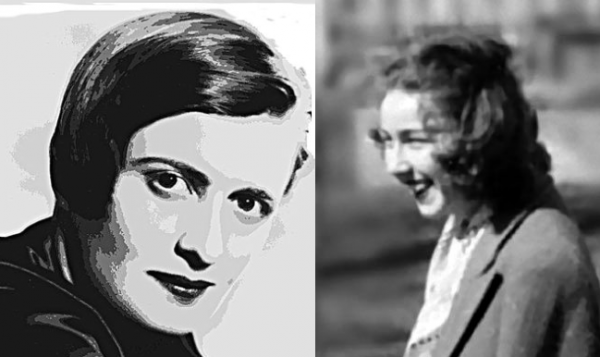
In a letter dated May 31, 1960, Flannery O’Connor, the author best known for her classic story, “A Good Man is Hard to Find” (listen to her read the story here) penned a letter to her friend, the playwright Maryat Lee. It begins rather abruptly, likely because it’s responding to something Maryat said in a previous letter:
I hope you don’t have friends who recommend Ayn Rand to you. The fiction of Ayn Rand is as low as you can get re fiction. I hope you picked it up off the floor of the subway and threw it in the nearest garbage pail. She makes Mickey Spillane look like Dostoevsky.
The letter, which you can read online or find in the book The Habit of Being, then turns to other matters.
O’Connor’s critical appraisal of Ayn Rand’s books is pretty straightforward. But here’s one factoid worth knowing. Mickey Spillane (referenced in O’Connor’s letter) was a hugely popular mystery writer, who sold some 225 million books during his lifetime. According to his Washington Post obit, “his specialty was tight-fisted, sadistic revenge stories, often featuring his alcoholic gumshoe Mike Hammer and a cast of evildoers.” Critics, appalled by the sex and violence in his books, dismissed his writing. But Ayn Rand defended him. In public, she said that Spillane was underrated. In her book The Romantic Manifesto, Rand put Spillane in some unexpected company when she wrote: “[Victor] Hugo gives me the feeling of entering a cathedral–Dostoevsky gives me the feeling of entering a chamber of horrors, but with a powerful guide–Spillane gives me the feeling of listening to a military band in a public park–Tolstoy gives me the feeling of an unsanitary backyard which I do not care to enter.”
All of this goes to show that _____. We’ll let you fill in the blank.
If you would like to support the mission of Open Culture, consider making a donation to our site. It’s hard to rely 100% on ads, and your contributions will help us continue providing the best free cultural and educational materials to learners everywhere. You can contribute through PayPal, Patreon, and Venmo (@openculture). Thanks!
Related Content:
Why Should We Read Flannery O’Connor? An Animated Video Makes the Case
When Ayn Rand Collected Social Security & Medicare, After Years of Opposing Benefit Programs
Ayn Rand Helped the FBI Identify It’s A Wonderful Life as Communist Propaganda
Hear Flannery O’Connor Read “A Good Man is Hard to Find” (1959)
Ayn Rand Issues 13 Commandments to Filmmakers for Making Good Capitalist Movies (1947)
Flannery O’Connor’s Satirical Cartoons: 1942–1945
Read More...Édouard Manet Illustrates Edgar Allan Poe’s The Raven, in a French Edition Translated by Stephane Mallarmé (1875)
Edgar Allan Poe achieved almost instant fame during his lifetime after the publication of The Raven (1845), but he never felt that he received the recognition he deserved. In some respects, he was right. He was, after all, paid only nine dollars for the poem, and he struggled before and after its publication to make a living from his writing.
Poe was one of the first American writers to do so without independent means. His work largely met with mixed reviews and he was fired from job after job, partly because of his drinking. After his death, however, Poe’s influence dominated emerging modernist movements like that of the decadent poetry of Charles Baudelaire (who called Poe his “twin soul”) and his symbolist disciple Stéphane Mallarmé.
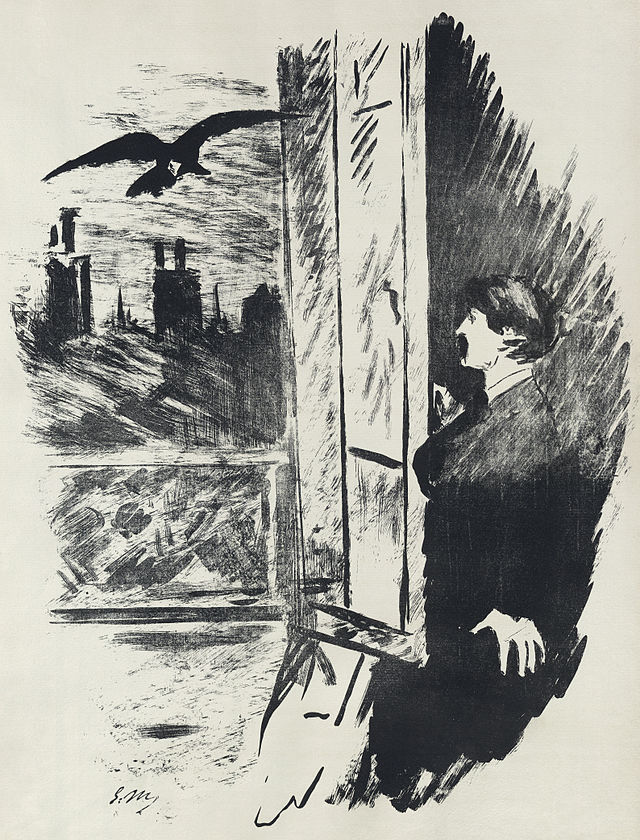
Mallarmé would write of Poe, “His century appalled at never having heard / That in this voice triumphant death had sung its hymn.” To bring that hymn of death, the raven’s cry of “Nevermore,” to French readers, he made a translation of The Raven, Le Corbeau, in 1875 at age 33.
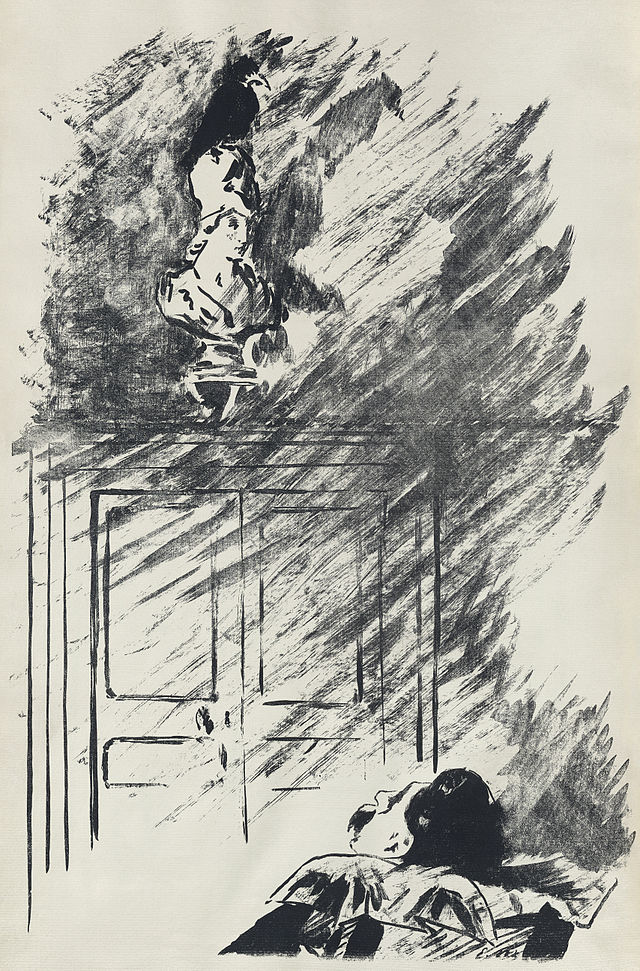
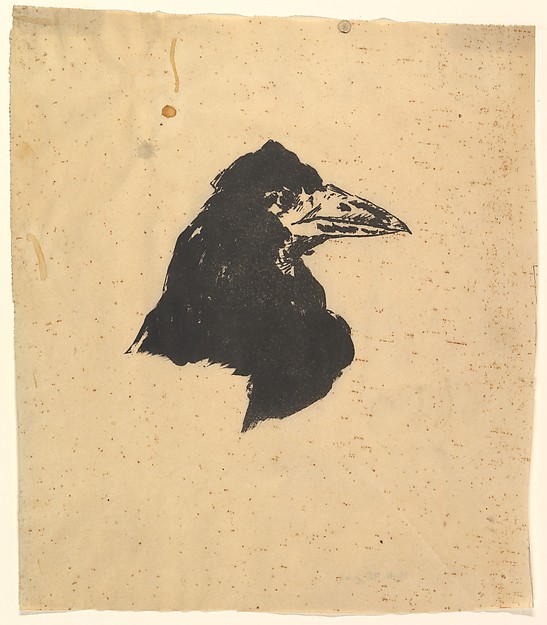
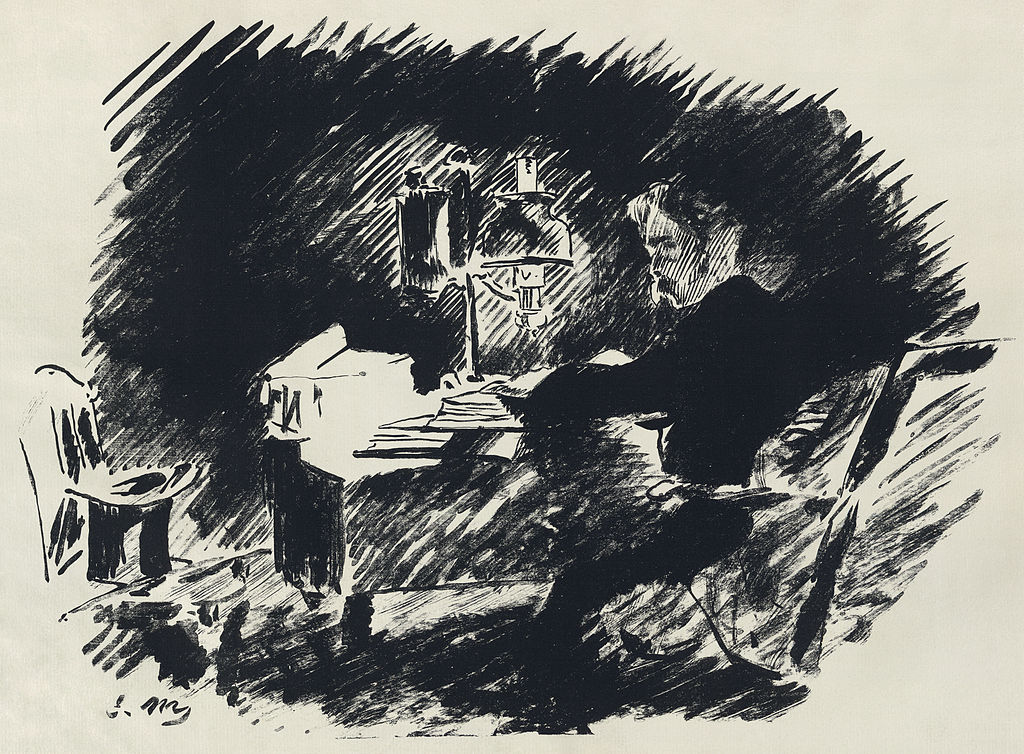
Poe also had a tremendous influence on the visual arts in France. Illustrating the text was none other than Édouard Manet, the painter credited with the genesis of impressionism. The resulting engravings, rendered in dark, heavy smudges, give us the poem’s unnamed, bereaved speaker as the young Mallarmé, unmistakable with his pushbroom mustache.
Sadly, the New York Public Library tells us, “the publication was not a commercial success.” (See Manet’s design for a poster and the book cover at the top of the post.)
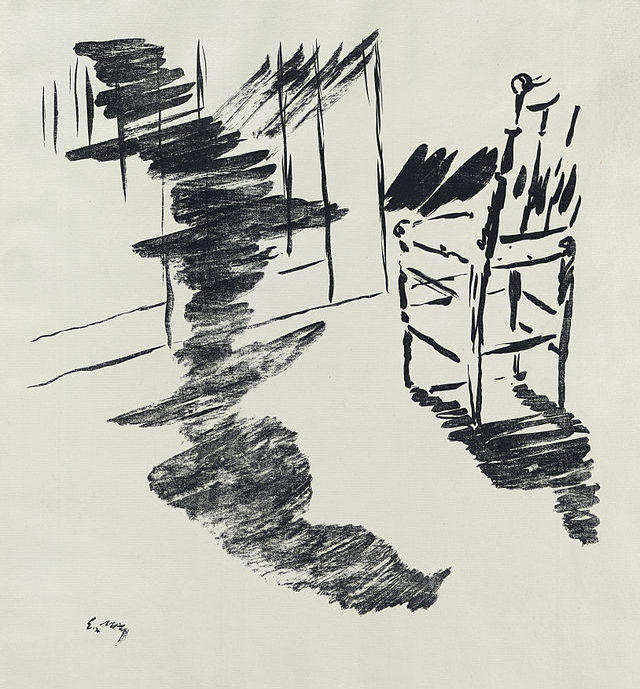
The book also illustrates the reciprocal relationship between Poe and French art and literature. Chris Semtner, curator of a Richmond, Virginia exhibit on this mutual influence, remarks that Poe “read Voltaire among other French authors”—such as Alexandre Dumas—“in college” and found them highly influential. Likewise, Poe left his mark not only on Baudelaire, Mallarmé, and Manet, but also Paul Gauguin, Odilon Redon, and Henri Matisse.
You can read Le Corbeau here in a dual language edition, with all the original illustrations. View and download high-res scans of the engravings here. And just above, listen to The Raven read aloud in Mallarmé’s French, courtesy of the Internet Archive.
Related Content:
Gustave Doré’s Splendid Illustrations of Edgar Allan Poe’s “The Raven” (1884)
Aubrey Beardsley’s Macabre Illustrations of Edgar Allan Poe’s Short Stories (1894)
Harry Clarke’s Hallucinatory Illustrations for Edgar Allan Poe’s Stories (1923)
Josh Jones is a writer and musician based in Durham, NC. Follow him at @jdmagness
Read More...
Support Us
We're hoping to rely on loyal readers, rather than erratic ads. Please click the Donate button and support Open Culture. You can use Paypal, Venmo, Patreon, even Crypto! We thank you!

About Us

Open Culture scours the web for the best educational media. We find the free courses and audio books you need, the language lessons & educational videos you want, and plenty of enlightenment in between.
Advertise With Us
FREE UPDATES!
GET OUR DAILY EMAIL
Get the best cultural and educational resources on the web curated for you in a daily email. We never spam. Unsubscribe at any time.
FOLLOW ON SOCIAL MEDIA
Open Culture editor Dan Colman scours the web for the best educational media. He finds the free courses and audio books you need, the language lessons & movies you want, and plenty of enlightenment in between.
Advertise With Us


