The Groundbreaking Animation That Defined Pink Floyd’s Psychedelic Visual Style: Watch “French Windows” (1972)
You could argue that, of all rock bands, that Pink Floyd had the least need for visual accompaniment. Sonically rich and evocatively structured, their albums evolved to offer listening experiences that verge on the cinematic in themselves. Yet from fairly early in the Floyd’s history, their artistic ambitions extended to that which could not be heard. Can you really understand their enterprise, it’s fair to ask, if you remain merely one of their listeners, never entering the visual dimension — not just their album covers, reproductions of which still grace many a dorm room wall, but also their elaborate stage shows, music videos (which they were making before that form had a name), and films? One man had more responsibility for the development of the Floyd’s visual style than any other: Ian Emes.
In 1972, Emes took it upon himself to animate their song “One of These Days” from the previous year’s album Meddle. When the finished work, “French Windows,” aired on the BBC music show The Old Grey Whistle Test, it caught the eye of the Floyd’s keyboard player Rick Wright. The group then got in touch with Emes, asking to use “French Windows” as a projection behind their concerts.
They went on to commission further work from him, for songs like “Speak to Me,” Time,” and “On the Run” from The Dark Side of the Moon. This professional connection endured for decades. When Roger Waters put on his own performances of The Wall — including the enormously scaled show in Berlin in 1990 — he had Emes direct its animated sequences. The post-Waters version of Pink Floyd even called up Emes in 2015 to ask him to make a film to accompany their final album The Endless River.
It was, in a way, the completion of a circle: “One of These Days” is a mostly instrumental song, and The Endless River is a mostly instrumental album; “French Windows” uses rotoscoping, which involves tracing over live action footage to make more realistically smooth animation, and the Endless River film presents its own live action footage in a manner that sometimes verges on the abstract. Both works create their own visual environments, which dovetails with what Emes, who died two years ago, once described as the appeal for him of the Floyd: “They went to architecture college and so I think their music creates spaces. It creates environments of sound and I was so stimulated that my mind would soar, and so I would see images that were stimulated by the music.” Their music takes a different form before the mind’s eye of each fan, but it was Emes who made his visions a part of their legacy.
Related Content:
Psychedelic Scenes of Pink Floyd’s Early Days with Syd Barrett, 1967
Download Pink Floyd’s 1975 Comic Book Program for The Dark Side of the Moon Tour
How Pink Floyd Built The Wall: The Album, Tour & Film
Based in Seoul, Colin Marshall writes and broadcasts on cities, language, and culture. His projects include the Substack newsletter Books on Cities and the book The Stateless City: a Walk through 21st-Century Los Angeles. Follow him on the social network formerly known as Twitter at @colinmarshall.
Read More...Dozens of M.C. Escher Prints Have Been Digitized & Put Online by the Boston Public Library

In addition to the iconic scene in Jim Henson’s Labyrinth, or appearances in animated TV shows and video games, M.C. Escher’s work has adorned the covers of albums like Mott the Hoople’s 1969 debut and the speculative fiction of Italo Calvino and Jorge Luis Borges. A big hit with hippies and 1960s college students, writes Heavy Music Artwork, his mind-bending prints became associated with “questioning accepted views of normal experience and testing the limits of perception with hallucinogenic drugs.” While he appreciated his cult following, Escher “did not encourage their mystical interpretations of his images.” Replying to one enthusiastic fan of his print Reptiles, who claimed to see in it an image of reincarnation, Escher replied, “Madame, if that’s the way you see it, so be it.”
Rather than illustrate higher states of consciousness or metaphysical entities, Bruno Ernst writes in The Magic Mirror of M.C. Escher, the artist intended to create practical, “pictorial representation of intellectual understanding.” Illustrations, that is, of philosophical and scientific thought experiments. The son of a civil engineer, Escher began his studies in architecture before moving to drawing and printmaking.
The challenge of creating built environments—even seemingly impossible ones—always seemed to occupy his mind. Along with themes from the natural world, a high percentage of his works center on buildings—inspired by formative early years in Rome and his admiration for Islamic art and Spanish architecture.

In the 50s and 60s Escher’s art piqued the interest of academics and mathematicians, an audience he found more congenial to his vision. He corresponded with scientists and incorporated their ideas into his work, meanwhile claiming to be “absolutely innocent of training or knowledge in the exact sciences.” In the 50s, Escher “dazzled” the likes of mathematicians like Roger Penrose and HSM Coxeter. In turn, notes Maev Kennedy, he “was inspired by Penrose’s perspectival triangle and Coxeter’s work on crystal symmetry.”
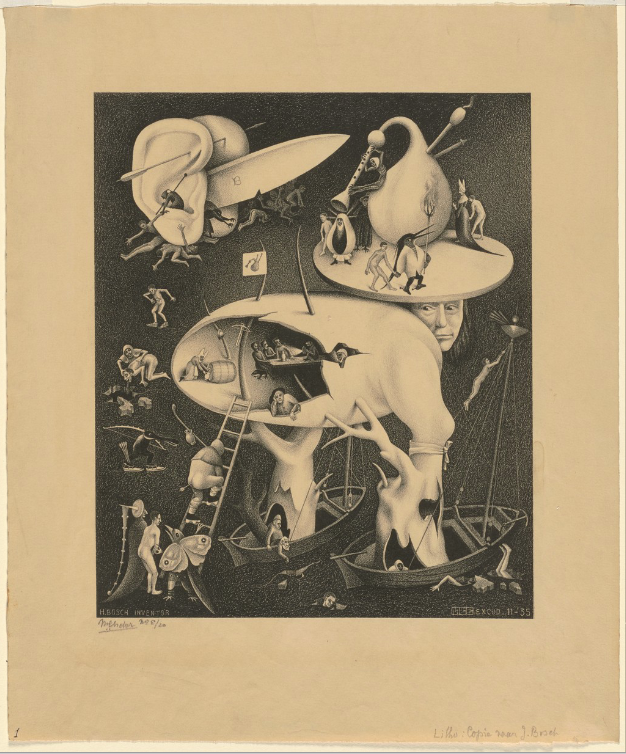
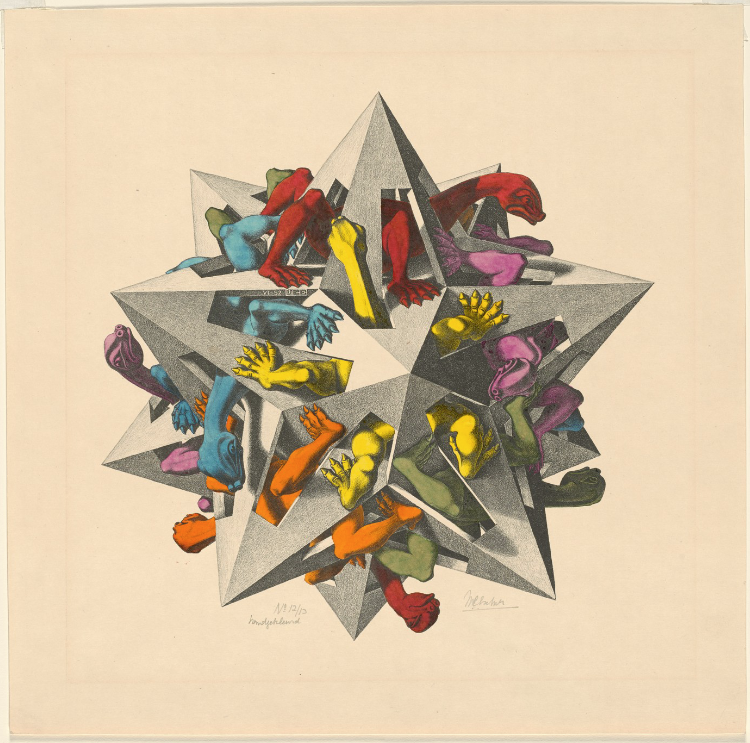
For all the excitement he created among mathematicians, it took a bit longer for Escher to get noticed in the art world. When Penrose’s uncle showed Escher’s version of the perspectival triangle to Picasso, “Picasso had heard of the British mathematician but not of the Dutch artist.” Escher’s fame spread outside of the sciences in part through the interests of the counterculture. He may have shrugged off mystical and psychedelic readings of his prints, but he had an innate penchant for the marvelously weird (see his copy of a scene, for example, from Hieronymus Bosch, above, or his surreal print Gravity, below).
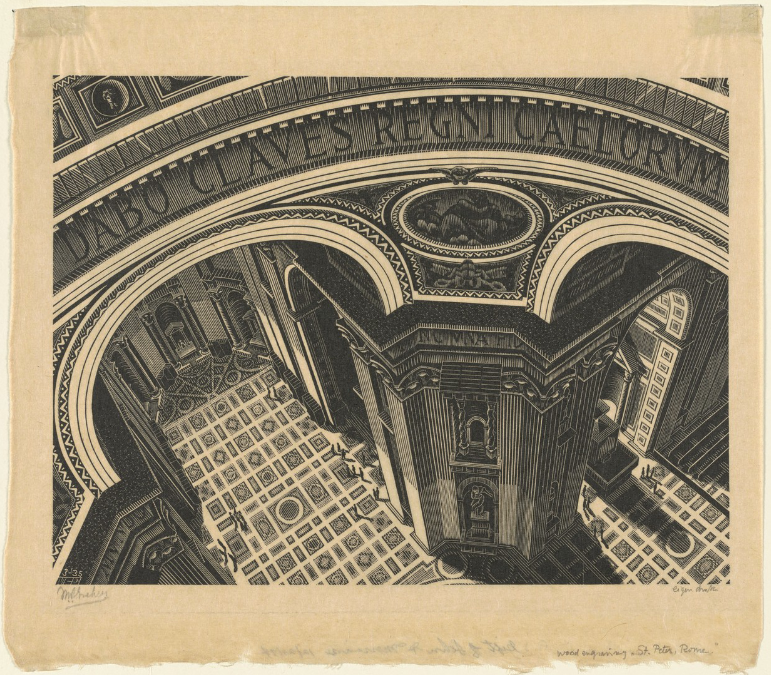
See the prints pictured here and a few dozen more digitized in high resolution at Digital Commonwealth, courtesy of Boston Public Library, who scanned their Escher collection and made it available to the public. Zoom into the fine details of prints like Inside Saint Peter’s, further up—a finely rendered but otherwise not-especially-Escher-like work—and the labyrinthine Ascending and Descending at the top. Whether—as Harvard Library curator John Overholt confesses—you’re a “nerd who loves M.C. Escher” for his mathematical mind, an artist with a mystical bent who loves him for his hallucinatory qualities, or some measure of both, you’ll find exactly the Escher you’re looking for in this digital gallery.

Note: An earlier version of this post appeared on our site in 2018.
Related Content:
M.C. Escher Cover Art for Great Books by Italo Calvino, George Orwell & Jorge Luis Borges
Josh Jones is a writer and musician based in Durham, NC.
Read More...74 Ways Characters Die in Shakespeare’s Plays Shown in a Handy Infographic: From Snakebites to Lack of Sleep
In the graduate department where I once taught freshmen and sophomores the rudiments of college English, it became common practice to include Shakespeare’s Titus Andronicus on many an Intro to Lit syllabus, along with a viewing of Julie Taymor’s flamboyant film adaptation. The early work is thought to be Shakespeare’s first tragedy, cobbled together from popular Roman histories and Elizabethan revenge plays. And it is a truly bizarre play, swinging wildly in tone from classical tragedy, to satirical dark humor, to comic farce, and back to tragedy again. Critic Harold Bloom called Titus “an exploitative parody” of the very popular revenge tragedies of the time—its murders, maimings, rapes, and mutilations pile up, scene upon scene, and leave characters and readers/audiences reeling in grief and disbelief from the shocking body count.
Part of the fun of teaching Titus is in watching students’ jaws drop as they realize just how bloody-minded the Bard is. While Taymor’s adaptation takes many modern liberties in costuming, music, and set design, its horror-show depiction of Titus’ unrelenting mayhem is faithful to the text. Later, more mature plays rein in the excessive black comedy and shock factor, but the bodies still stack up. As accustomed as we are to thinking of contemporary entertainments like Game of Thrones as especially gratuitous, the whole of Shakespeare’s corpus, writes Alice Vincent at The Telegraph, is “more gory” than even HBO’s squirm-worthy fantasy epic, featuring a total of 74 deaths in 37 plays to Game of Thrones’ 61 in 50 episodes.
All of those various demises came together in a 2016 compendium staged at The Globe (in London) called The Complete Deaths. It included everything “from early rapier thrusts to the more elaborate viper-breast application adopted by Cleopatra.” The only death director Tim Crouch excluded is “that of a fly that meets a sticky end in Titus Andronicus.” In the infographic above, see all of the causes of those deaths, including Antony and Cleopatra’s snakebite and Titus Andronicus’ piece-de-resistance, “baked in a pie.”
Part of the reason so many of my former undergraduate students found Shakespeare’s brutality shocking and unexpected has to do with the way his work was tamed by later 17th and 18th century critics, who “didn’t approve of the on-stage gore.” The Telegraph quotes director of the Shakespeare Institute Michael Dobson, who points out that Elizabethan drama was especially gruesome; “the English drama was notorious for on-stage deaths,” and all of Shakespeare’s contemporaries, including Christopher Marlowe and Ben Jonson, wrote violent scenes that can still turn our stomachs.
More recent productions like a bloody staging of Titus at The Globe have restored the gore in Shakespeare’s work, and The Complete Deaths left audiences with little doubt that Shakespeare’s culture was as permeated with representations of violence as our own—and it was as much, if not more so, plagued by the real thing.
Note: An earlier version of this post appeared on our site in 2016.
Related Content:
Take a Virtual Tour of Shakespeare’s Globe Theatre in London
Hear What Shakespeare Sounded Like in the Original Pronunciation
Josh Jones is a writer and musician based in Durham, NC.
Read More...Aldous Huxley to George Orwell: My Hellish Vision of the Future is Better Than Yours (1949)
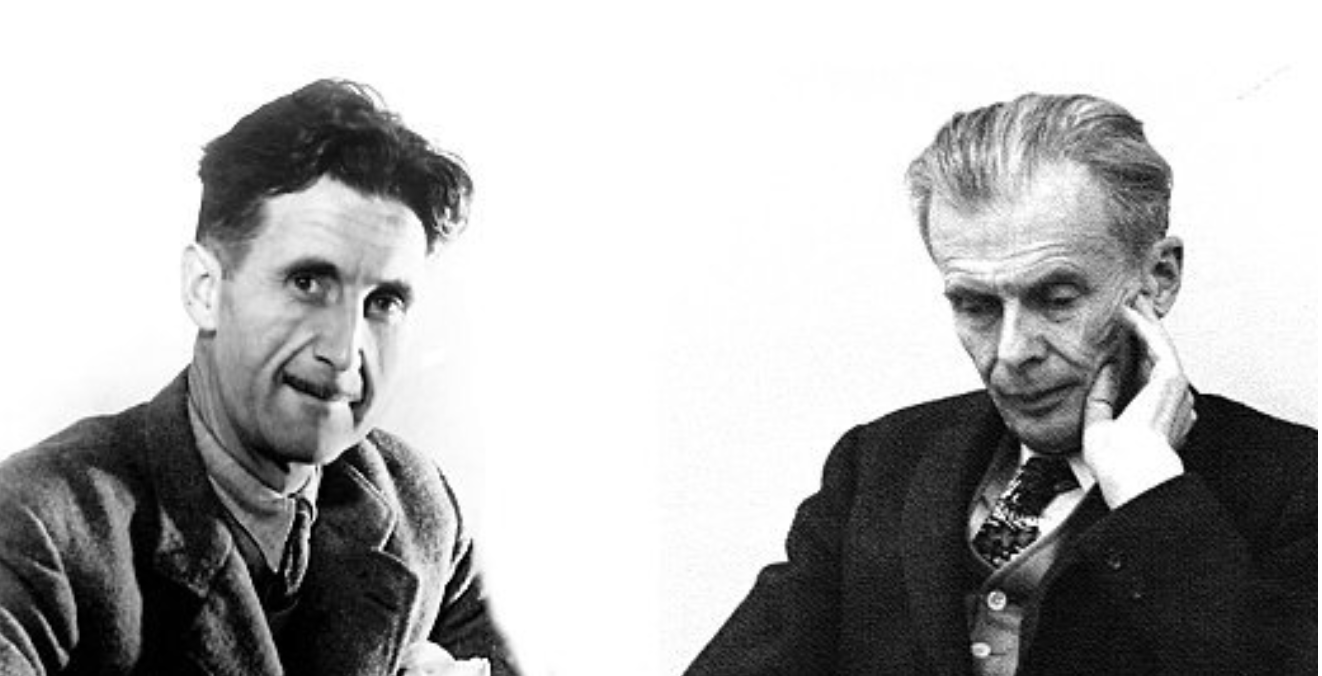
In 1949, George Orwell received a curious letter from his former high school French teacher.
Orwell had just published his groundbreaking book Nineteen Eighty-Four, which received glowing reviews from just about every corner of the English-speaking world. His French teacher, as it happens, was none other than Aldous Huxley, who taught at Eton for a spell before writing Brave New World (1931), the other great 20th-century dystopian novel.
Huxley starts off the letter praising the book, describing it as “profoundly important.” He continues, “The philosophy of the ruling minority in Nineteen Eighty-Four is a sadism which has been carried to its logical conclusion by going beyond sex and denying it.”
Then Huxley switches gears and criticizes the book, writing, “Whether in actual fact the policy of the boot-on-the-face can go on indefinitely seems doubtful. My own belief is that the ruling oligarchy will find less arduous and wasteful ways of governing and of satisfying its lust for power, and these ways will resemble those which I described in Brave New World.” (Listen to him read a dramatized version of the book here.)
Basically, while praising Nineteen Eighty-Four, Huxley argues that his version of the future was more likely to come to pass.
In Huxley’s seemingly dystopian World State, the elite amuse the masses into submission with a mind-numbing drug called Soma and an endless buffet of casual sex. Orwell’s Oceania, on the other hand, keeps the masses in check with fear thanks to an endless war and a hyper-competent surveillance state. At first blush, they might seem like they are diametrically opposed but, in fact, an Orwellian world and a Huxleyan one are simply two different modes of oppression.
While we haven’t quite arrived at either dystopian vision, the power of both books is that they tap into our fears of the state. While Huxley might make you look askance at The Bachelor or Facebook, Orwell makes you recoil in horror at the government throwing around phrases like “enhanced interrogation” and “surgical drone strikes.”
You can read Huxley’s full letter below.
Wrightwood. Cal.
21 October, 1949
Dear Mr. Orwell,
It was very kind of you to tell your publishers to send me a copy of your book. It arrived as I was in the midst of a piece of work that required much reading and consulting of references; and since poor sight makes it necessary for me to ration my reading, I had to wait a long time before being able to embark on Nineteen Eighty-Four.
Agreeing with all that the critics have written of it, I need not tell you, yet once more, how fine and how profoundly important the book is. May I speak instead of the thing with which the book deals — the ultimate revolution? The first hints of a philosophy of the ultimate revolution — the revolution which lies beyond politics and economics, and which aims at total subversion of the individual’s psychology and physiology — are to be found in the Marquis de Sade, who regarded himself as the continuator, the consummator, of Robespierre and Babeuf. The philosophy of the ruling minority in Nineteen Eighty-Four is a sadism which has been carried to its logical conclusion by going beyond sex and denying it. Whether in actual fact the policy of the boot-on-the-face can go on indefinitely seems doubtful. My own belief is that the ruling oligarchy will find less arduous and wasteful ways of governing and of satisfying its lust for power, and these ways will resemble those which I described in Brave New World. I have had occasion recently to look into the history of animal magnetism and hypnotism, and have been greatly struck by the way in which, for a hundred and fifty years, the world has refused to take serious cognizance of the discoveries of Mesmer, Braid, Esdaile, and the rest.
Partly because of the prevailing materialism and partly because of prevailing respectability, nineteenth-century philosophers and men of science were not willing to investigate the odder facts of psychology for practical men, such as politicians, soldiers and policemen, to apply in the field of government. Thanks to the voluntary ignorance of our fathers, the advent of the ultimate revolution was delayed for five or six generations. Another lucky accident was Freud’s inability to hypnotize successfully and his consequent disparagement of hypnotism. This delayed the general application of hypnotism to psychiatry for at least forty years. But now psycho-analysis is being combined with hypnosis; and hypnosis has been made easy and indefinitely extensible through the use of barbiturates, which induce a hypnoid and suggestible state in even the most recalcitrant subjects.
Within the next generation I believe that the world’s rulers will discover that infant conditioning and narco-hypnosis are more efficient, as instruments of government, than clubs and prisons, and that the lust for power can be just as completely satisfied by suggesting people into loving their servitude as by flogging and kicking them into obedience. In other words, I feel that the nightmare of Nineteen Eighty-Four is destined to modulate into the nightmare of a world having more resemblance to that which I imagined in Brave New World. The change will be brought about as a result of a felt need for increased efficiency. Meanwhile, of course, there may be a large scale biological and atomic war — in which case we shall have nightmares of other and scarcely imaginable kinds.
Thank you once again for the book.
Yours sincerely,
Aldous Huxley
Note: An earlier version of this post appeared on our site in 2015.
Related Content:
Hear Aldous Huxley Narrate His Dystopian Masterpiece, Brave New World
George Orwell Explains in a Revealing 1944 Letter Why He’d Write 1984
Aldous Huxley to George Orwell: My Hellish Vision of the Future is Better Than Yours (1949)
Aldous Huxley’s Most Beautiful, LSD-Assisted Death: A Letter from His Widow
Jonathan Crow is a writer and filmmaker whose work has appeared in Yahoo!, The Hollywood Reporter, and other publications.
Read More...The Night When Bob Dylan Went Electric: Watch Him Play “Maggie’s Farm” at the Newport Folk Festival in 1965
The phrase “when Dylan went electric” once carried as much weight in pop culture history as “the fall of the Berlin Wall” carries in, well, history. Both events have receded into what feels like the distant past, but in the early 1960s, they likely seemed equally unlikely to many a serious Bob Dylan fan in the folk scene. They also seemed equally consequential. To understand the culture of the decade, we must understand the import of Dylan’s appearance at the Newport Folk Festival in 1965, backed by Mike Bloomfield and other members of the Paul Butterfield Blues Band.
The death of rock and roll in the 50s is often told through the lens of tragedy, but there was also anger, disgust, and mass disaffection. The Payola scandal had an impact, as did Elvis joining the army and Little Richard’s return to religion. Rock and roll was broken, tamed, and turned into commercial fodder. Simply put, it wasn’t cool at all, man, and even the Beatles couldn’t save it singlehandedly. Their arrival on U.S. shores is mythologized as music history Normandy—and has been credited with inspiring countless numbers of musicians—but without Dylan and the blues artists he imitated, things would very much have gone otherwise.
In the early 60s, Dylan and the Beatles’ “respective musical constituencies were indeed perceived as inhabiting two separate subcultural worlds,” writes Jonathan Gould in Can’t Buy Me Love: The Beatles, Britain, and America. “Dylan’s core audience was comprised of young people emerging from adolescence—college kids with artistic or intellectual leanings, a dawning political and social idealism, and a mildly bohemian style…. The Beatles’ core audience, by contrast, was comprised of veritable ‘teenyboppers’—kids in high school or grade school whose lives were totally wrapped up in the commercialized popular culture of television, radio, pop records, fan magazines, and teen fashion. They were seen as idolaters, not idealists.”
To evoke anything resembling the commercial pablum of Beatlemania, and at Newport, no less, spoke of treason to folk authenticity. Some called out “Where’s Ringo?” Others called him “Judas.” Dylan’s set “would go down as one of the most divisive concerts ever”—(and that’s saying a lot)—“putting the worlds of both folk and rock in temporary identity crisis,” Michael Madden writes at Consequence of Sound. The former folk hero accomplished this in all of three songs, “Maggie’s Farm,” “Like a Rolling Stone,” and “Phantom Engineer,” an early take on “It Takes a Lot to Laugh, It Takes a Train to Cry.” Pete Seeger famously “threw a furious tantrum” upon hearing the first few bars of “Maggie’s Farm,” above, though he’s since said he was upset at the sound quality.
The moment was defining—and Dylan apparently decided to do it on a whim after hearing Alan Lomax insult the Paul Butterfield Band, who were giving a workshop at the festival. He came back onstage afterward to play two acoustic songs for the appreciative audience who remained, unfazed by the vehemence of half the crowd’s reaction to his earlier set. Yet the revolution to return rock to its folk and blues roots was already underway. Within six months of meeting Dylan in 1964, Gould writes, “John Lennon would be making records on which he openly imitated Dylan’s nasal drone, brittle strum, and introspective vocal persona.” (Dylan also introduced him to cannabis.)
In 1965, “the distinctions between the folk and rock audiences would have nearly evaporated.” The two met in the middle. “The Beatles’ audience, in keeping with the way of the world, would be showing signs of growing up,” while Dylan’s fans showed signs of “growing down, as hundreds of thousands of folkies in their late teens and early twenties” rediscovered “the ethos of their adolescent years.” They also discovered electric blues. Newport shows Dylan accelerating the transition, and also signified the arrival of the great electric blues-rock guitarists, in the form of the inimitable Mike Bloomfield, an invading force all his own, who inspired a generation with his licks on “Like a Rolling Stone” and on the absolute classic Paul Butterfield Blues Band debut album, released in The Year Dylan Went Electric.
Note: An earlier version of this post appeared on our site in 2020.
Related Content:
Watch Bob Dylan Play “Mr. Tambourine Man” in Color at the 1964 Newport Folk Festival
Bob Dylan Explains Why Music Has Been Getting Worse
Tangled Up in Blue: Deciphering a Bob Dylan Masterpiece
How Bob Dylan Kept Reinventing His Songwriting Process, Breathing New Life Into His Music
Josh Jones is a writer and musician based in Durham, NC.
Read More...Did Paul McCartney Really Die in 1966? How the Biggest Beatles Conspiracy Theory Spread
No pop music can have inspired more scrutiny than that of the Beatles. Of course, intense and sustained attention has been paid to every aspect of the band’s existence — and, in the case of Paul McCartney, his purported non-existence as well. The theory that he actually died in the nineteen-sixties and was thereafter secretly played by a double has demonstrated such pop-cultural staying power that even those who barely know the Beatles’ music make reference to it. The phrase “Turn me on, dead man” now floats free of its origin, an act of creative listening applied to “Revolution 9” played backwards.
The idea, as explained in the Vinyl Rewind video above, is that “after an argument during a Beatles recording session on November 9th, 1966, Paul McCartney sped off in his car, only to be decapitated in an auto accident when he lost control of his vehicle. The U.K. security service MI5 advised the band to find a replacement, for they feared that if the news of Paul’s death got out, mass hysteria would spread among Beatles fans, leading to civil unrest and, possibly, mass suicide.” The hunt for a Paul lookalike turned up “a Scottish orphan named William Shears Campbell, also known as Billy Shears.”
That name will sound familiar to even casual Beatles listeners, announced as it is so prominently, and so early, on Sgt. Pepper’s Lonely Hearts Club Band. The album’s cover, too, proved to be a fount of imagery suggesting that the rumor of Paul’s death, which had been referenced in an official Beatles publication in 1967 specifically to dispel it, was actually true. A couple of years later, a Detroit radio DJ and a University of Michigan student-journalist got the story into wide circulation. No one clue — the recurring shoelessness of Paul or his impersonator, the death-of-Oswald lines from King Lear incorporated into “I Am the Walrus,” the car wreck described in “A Day in the Life,” the license-plate of the VW on Abbey Road’s cover — was dispositive, but eventually, they added up.
They added up if you were expressly looking for evidence of Paul’s death and substitution: engaging in pareidolia, in other words, the tendency to perceive meaningful patterns in random noise, or in this case a range of minor, non-orchestrated details across pieces of media. Given the Beatles’ personalities, nobody would put it past them to make cheeky hidden references to exactly what they weren’t supposed to talk about, but anyone familiar with the music business would also suspect that Capitol Records had no interest in putting a stop to a false rumor that was generating a profit. It’s certainly a stretch to imagine that someone who just happens to look like Paul McCartney would also be willing and able to carry on the man’s solo career for decade after decade. But then, the history of popular music is full of lucky men, and maybe — just maybe — Billy Shears was among the luckiest.
Related content:
The Paul McCartney is Dead Conspiracy Theory, Explained
Hear The Beatles’ Abbey Road with Only Paul McCartney’s Bass: You Won’t Believe How Good It Sounds
Based in Seoul, Colin Marshall writes and broadcasts on cities, language, and culture. His projects include the Substack newsletter Books on Cities and the book The Stateless City: a Walk through 21st-Century Los Angeles. Follow him on the social network formerly known as Twitter at @colinmarshall.
Read More...A Man Read 3,599 Books Over 60 Years, and Now His Family Has Shared the Entire List Online
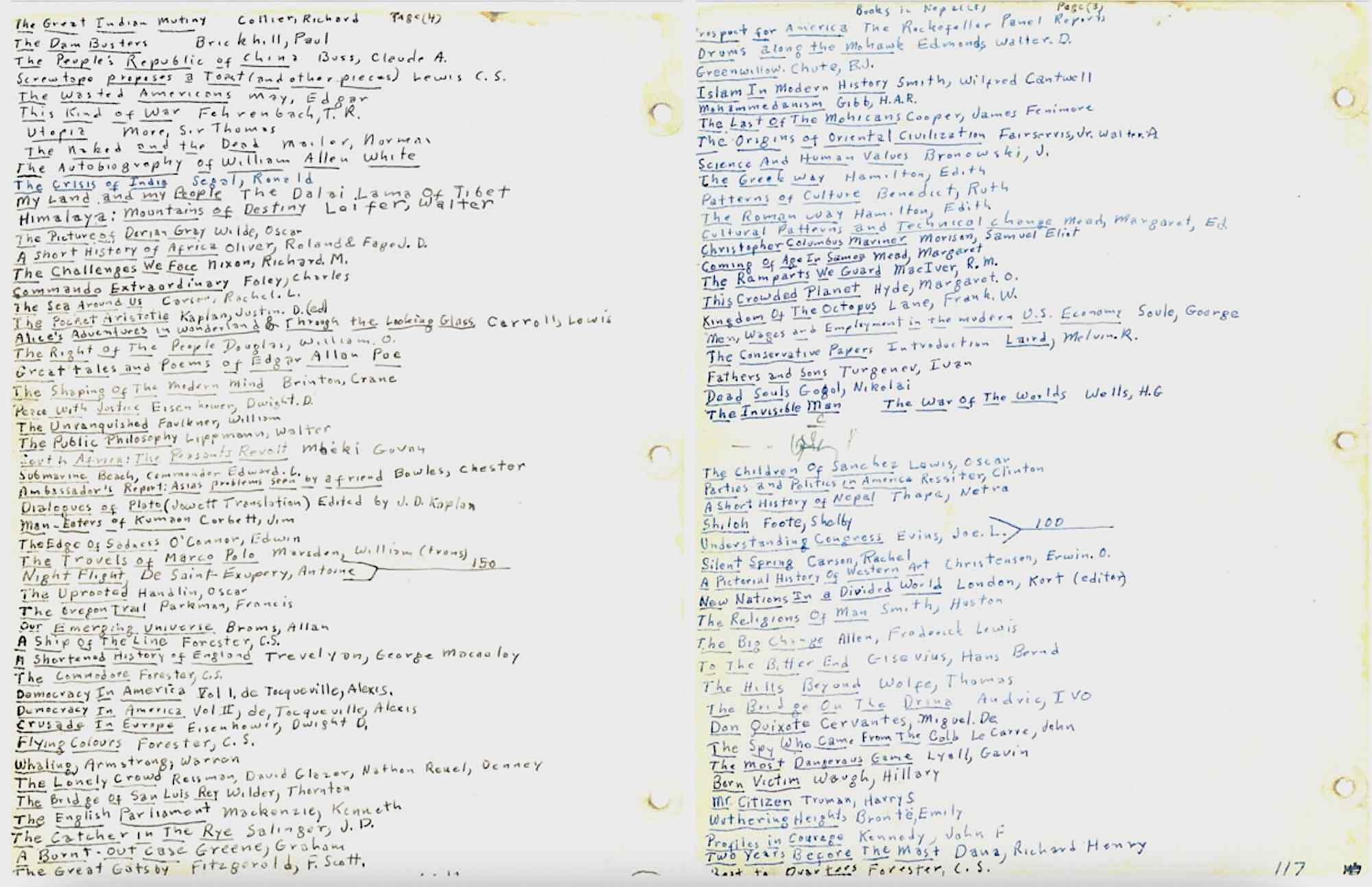
Dan Pelzer died earlier this year at the age of 92, leaving behind a handwritten list of all the books he’d read since 1962. His family had it digitized, put it online, and now it’s gone viral, somewhat to the surprise of those of us who’d never heard of him before. But that, it seems, is how the unprepossessing Pelzer himself would have wanted it, according to the impression given by his grown children when interviewed about the popularity of their father’s more than 100-page-long reading list. He began keeping it when he was stationed in Nepal as a Peace Corps volunteer, and kept it up until the end of his reading days in 2023, long after he retired from his job as a social worker at an Ohio juvenile correctional facility.
Examined together, whether in the form of a complete scan or a searchable PDF, the 3,599 books, most of them checked out from the library, that Pelzer recorded having read constitute a personal cultural history of the past six decades. Described as a devout Catholic, he certainly seems to have been consistent in his pursuit of an interest in not just the history of Christianity in particular, but the history of western civilization in general.
It comes as no surprise to see him dig into Will and Ariel Durant’s The Story of Civilization series in the early nineteen-eighties, slightly startling though it is that he read its eleven volumes in an apparently random order. This habit turns out to be characteristic: though reputed to finish every book he started, he only got around to six volumes of Anthony Powell’s A Dance to the Music of Time, starting with the eleventh and ending with the tenth.
Interspersed with the books of The Story of Civilization are the likes of Philip Caputo’s A Rumor of War, John Irving’s The World According to Garp, and three novels by Ken Follett. Though abidingly concerned with the story of mankind, Pelzer appears also to have had a weakness for genre thrillers (he’s remembered as a big John Grisham fan) and topical books-of-the-moment. But whether reading at high‑, low‑, or middlebrow level, he seems to have been willing to give all major religions and political philosophies, as well as some minor ones, a fair hearing — or rather, a fair reading. This makes for striking juxtapositions in his list: Ayn Rand followed by L. Ron Hubbard, Ta-Nehisi Coates by Jonathan Haidt. In that respect, he was, perhaps, the ideal of the engaged, “democratic” common reader one imagines populating America while somehow never encountering. If his list raises the question of why he didn’t go into a more intellectually ambitious line of work, it also, in a way, answers it: what time would that have left him to read?
Related content:
Joseph Brodsky’s List of 83 Books You Should Read to Have an Intelligent Conversation
David Foster Wallace’s Surprising List of His 10 Favorite Books, from C. S. Lewis to Tom Clancy
100 Books to Read in a Lifetime
Based in Seoul, Colin Marshall writes and broadcasts on cities, language, and culture. His projects include the Substack newsletter Books on Cities and the book The Stateless City: a Walk through 21st-Century Los Angeles. Follow him on the social network formerly known as Twitter at @colinmarshall.
Read More...Tom Lehrer, RIP: Hear All of His Witty, Satirical Songs in One Playlist
Tom Lehrer died last weekend, more than four decades after rumors of his death had first gone into circulation. He didn’t bother to contradict them, publicly claiming that he figured they would “cut down on the junk mail.” That quip proved not just that he was still alive, but that his wit was intact. And it was his wit, combined with a facility on the piano, that made him famous: mercilessly satirizing everything from the Boy Scouts to Harvard, his alma mater, to New Math to Vatican II to World War III, his lively show-tune pastiches became defining pieces of Cold War-era comedy — or in any case, defining pieces of early Cold War-era comedy.
A professor of mathematics for most of his career, he performed and recorded music mostly in the nineteen-fifties and sixties, beginning with his first concert, given as a graduate student in 1950, and ending with another in Copenhagen in 1967.
There was also an early-seventies coda in the form of a few songs written for PBS’ children’s show The Electric Company and a performance at a George S. McGovern rally. But by then, the frame of American culture had shifted. “The Vietnam War is what changed it,” Lehrer said in 1981. “Everybody got earnest. My purpose was to make people laugh and not applaud. If the audience applauds, they’re just showing they agree with me”: an observation today’s would-be satirists would do well to bear in mind.
Whether or not you have any aspirations of your own in that tradition, you can listen through the entirety of Lehrer’s recorded work in the YouTube playlist above and understand why his comic star burned so brightly — and, through the nearly sixty years that have followed, never quite burned out. Though clearly written in the spirit of Eisenhower-era liberalism, these songs (released by their author into the public domain a few years ago) don’t shy away from the absurdities of what Lehrer himself would not, with a straight face, be able to call the human condition. First tested out on campus, they also developed an early form of what we’ve come to think of as the “college” sensibility in popular music. In some sense, Lehrer never left that way of seeing the world behind — nor, like a true student, did he ever get around to finishing his Ph.D.
Related content:
Tom Lehrer Releases His All of Catchy and Savage Musical Satire Into the Public Domain
Hear Tom Lehrer Sing the Names of 102 Chemical Elements to the Tune of Gilbert & Sullivan
Based in Seoul, Colin Marshall writes and broadcasts on cities, language, and culture. His projects include the Substack newsletter Books on Cities and the book The Stateless City: a Walk through 21st-Century Los Angeles. Follow him on the social network formerly known as Twitter at @colinmarshall.
Read More...W.H. Auden’s 1941 Syllabus Asked Students to Read 32 Great Literary Works, Totaling 6,000 Pages
Whether willed, involuntary, or a mix of both, the declining literacy of college students is by now so often lamented that reports of it should no longer come as a surprise. And yet, on some level, they still do: English majors in regional Kansas universities find the opening to Bleak House virtually unintelligible; even students at “highly selective, elite colleges” struggle to read, let alone comprehend, books in their entirety. Things were different in 1941, and very different indeed if you happened to be taking English 135 at the University of Michigan, a class titled “Fate and the Individual in European Literature.” The instructor: a certain W. H. Auden.
In his capacity as an educator, the poet threw down the gauntlet of an “infamously difficult” syllabus, as literary academic and YouTuber Adam Walker explains in his new video above, that “asked undergraduates to read about 6,000 pages of classic literature.”
Not that the course was out of touch with current events: in its historical moment, “Nazi Germany had invaded the Soviet Union and expanded into Eastern Europe. Systematic extermination begins with mass shootings, and the machinery of genocide is accelerating. It’s no accident that Auden takes an interest in fate and the individual in European literature” — a theme that, as he frames it, begins with Dante. After the entirety of The Divine Comedy, Auden’s students had their free choice between Aeschylus’ Agamemnon or Sophocles’ Antigone.
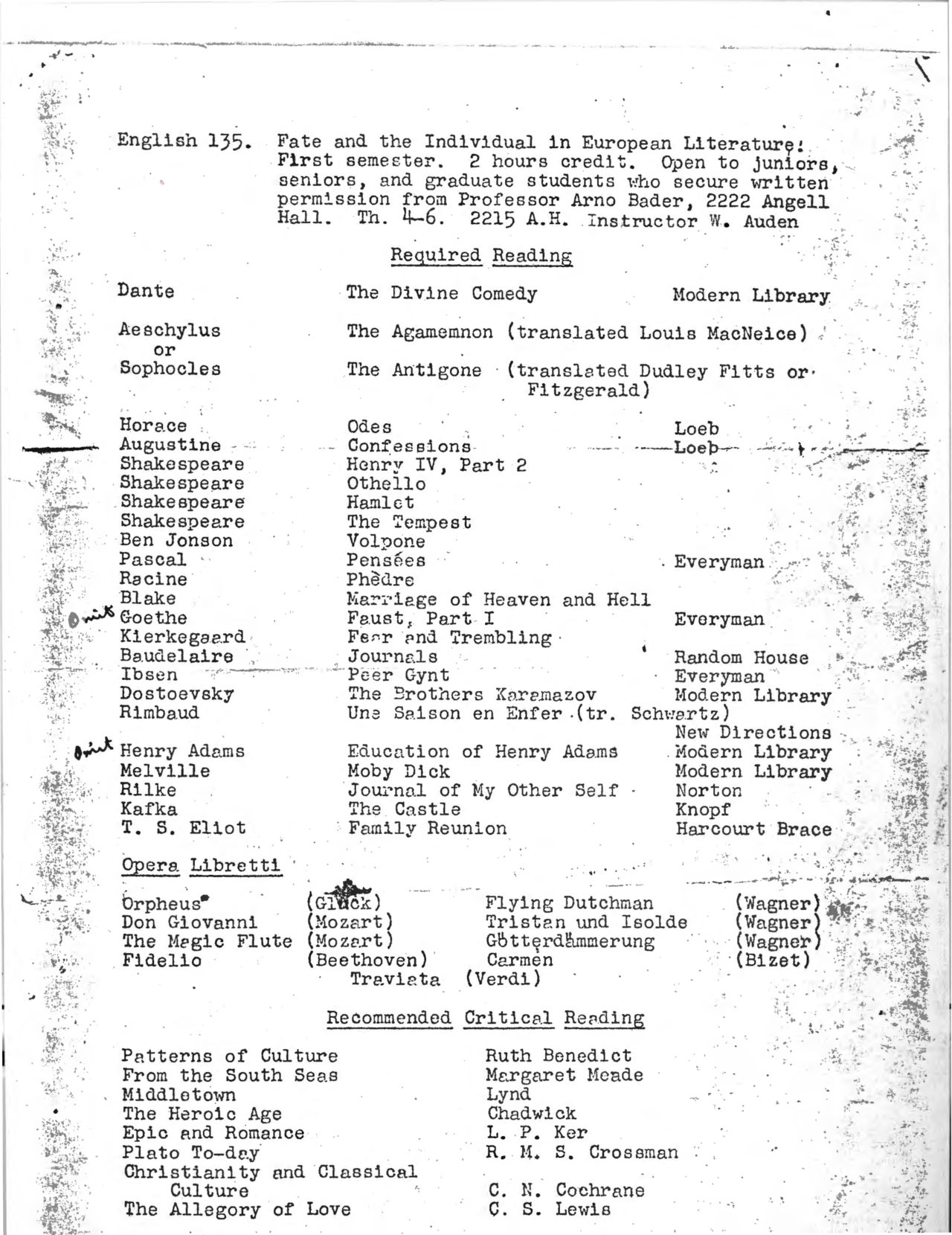
From there, the required reading plunged into Horace’s Odes and Augustine’s Confessions, four Shakespeare plays, Pascal’s Pensées, Goethe’s Faust (but only Part I), and Dostoevsky’s The Brothers Karamazov, to name just a few texts. Not everyone would consider Dostoevsky European, of course, but then, nobody would consider Herman Melville European, which for Auden was hardly a reason to leave Moby-Dick off the syllabus. Walker describes that novel as relevant to the course’s themes of “obsession and cosmic struggle,” evident in all these works and their treatments of “passion and historical forces, and how individuals navigate those forces”: ideas that transcend national and cultural boundaries by definition. Whether they would come across to the kind of twenty-first-century students who’d balk at being assigned even a full-length Auden poem is another question entirely.
View the syllabus in a larger format here.
Related content:
W. H. Auden Recites His 1937 Poem “As I Walked Out One Evening”
Discover Hannah Arendt’s Syllabus for Her 1974 Course on “Thinking”
David Foster Wallace’s 1994 Syllabus: How to Teach Serious Literature with Lightweight Books
Donald Barthelme’s Syllabus Highlights 81 Books Essential for a Literary Education
Carl Sagan’s Syllabus & Final Exam for His Course on Critical Thinking (Cornell, 1986)
Based in Seoul, Colin Marshall writes and broadcasts on cities, language, and culture. His projects include the Substack newsletter Books on Cities and the book The Stateless City: a Walk through 21st-Century Los Angeles. Follow him on the social network formerly known as Twitter at @colinmarshall.
Read More...Stephen King’s Top 10 All-Time Favorite Books

Image by The USO, via Flickr Commons
So you might think that if Stephen King – the guy who wrote such horror classics like Carrie and The Stand – were to rattle off his top ten favorite books, it would feature works by the likes of Edgar Allan Poe, H. P. Lovecraft or maybe J. R. R. Tolkien — authors who have, like King, created enduring dark, Gothic worlds filled with supernatural events and malevolent forces. But you’d be wrong. Author J. Peder Zane asked scores of writers about their favorite novels for his 2007 book The Top Ten: Writers Pick Their Favorite Books. The list King submitted in reply appears below. When possible, we’ve added links to the texts that you can read for free online.
1. The Golden Argosy, The Most Celebrated Short Stories in the English Language – edited by Van Cartmell and Charles Grayson
2. The Adventures of Huckleberry Finn – Mark Twain
3. The Satanic Verses – Salman Rushdie
4. McTeague – Frank Norris
5. Lord of the Flies – William Golding
6. Bleak House – Charles Dickens
7. 1984 – George Orwell
8. The Raj Quartet – Paul Scott
9. Light in August – William Faulkner
10. Blood Meridian – Cormac McCarthy
King, it seems, prefers books that explore basic defects in the human character to spooky tales of fantasy. In other words, he’s interested in stories that are actually terrifying. Orwell’s portrait of a man breaking under the pressure of totalitarianism or William Golding’s parable about a group of boys devolving into beasts are downright troubling. Frank Norris’s saga about the mendacious McTeague isn’t exactly comforting either. And McCarthy’s grim and spectacularly violent masterpiece Blood Meridian might make you crawl into a fetal position and weep for humanity. (That was my reaction, anyway.)
The most striking thing about the list, however, is how uniformly highbrow it is. All books would fit right in on the syllabus of an upper level English college course. On the other hand, David Foster Wallace, when asked for his top ten, filled his list with such mass market crowd pleasers as The Silence of the Lambs by Thomas Harris, The Sum of All Fears by Tom Clancy and, at number two, King’s The Stand.
If you would like to support the mission of Open Culture, consider making a donation to our site. It’s hard to rely 100% on ads, and your contributions will help us continue providing the best free cultural and educational materials to learners everywhere. You can contribute through PayPal, Patreon, and Venmo (@openculture). Thanks!
Note: An earlier version of this post appeared on our site in 2014.
Related Content:
Stephen King Recommends 96 Books for Aspiring Writers to Read
How Stephen King Predicted the Rise of Trump in a 1979 Novel
Stephen King’s 20 Rules for Writers
Jonathan Crow is a Los Angeles-based writer and filmmaker whose work has appeared in Yahoo!, The Hollywood Reporter, and other publications. You can follow him at @jonccrow. And check out his blog Veeptopus, featuring lots of pictures of vice presidents with octopuses on their heads. The Veeptopus store is here.
Read More...Support Us
We're hoping to rely on loyal readers, rather than erratic ads. Please click the Donate button and support Open Culture. You can use Paypal, Venmo, Patreon, even Crypto! We thank you!

About Us

Open Culture scours the web for the best educational media. We find the free courses and audio books you need, the language lessons & educational videos you want, and plenty of enlightenment in between.
Advertise With Us
FREE UPDATES!
GET OUR DAILY EMAIL
Get the best cultural and educational resources on the web curated for you in a daily email. We never spam. Unsubscribe at any time.
FOLLOW ON SOCIAL MEDIA
Open Culture editor Dan Colman scours the web for the best educational media. He finds the free courses and audio books you need, the language lessons & movies you want, and plenty of enlightenment in between.
Advertise With Us


#/media/File:Mottthehoople1969.jpg)