Watch the Completely Unsafe, Vertigo-Inducing Footage of Workers Building New York’s Iconic Skyscrapers
Would anyone in their right mind sign up for a job that had a high risk of mortality/disability? Or a job where red hot metal is being hurled directly at your face? Back in the 1920s this was the lot of the men who built New York’s skyline, the men who constructed the Chrysler Building and the Empire State, giant phallic symbols of America’s burgeoning wealth and power.
In this short clip (remastered and quite decently colorized) from the Smithsonian Channel, we get a brief glimpse of the perils encountered daily on the building site. Nicknamed “roughnecks,” the narrator points out that they work without harnesses, safety ropes, or hard hats. Red hot rivets are thrown at men on the metal beams higher up and they are meant to catch them with what looks like a tin funnel. You can see the thinnest of ropes used to lift the now-iconic stainless steel art-deco eagles into place by men wearing felt hats and no gloves.
The workers came from Europe, many who had trained on ships. Some came from Montreal’s Kahnawake reservation. The latter, known as Iron Walkers, were Mohawk, known for working fearlessly at great heights.
“A lot of people think Mohawks aren’t afraid of heights; that’s not true,” Kyle Karonhiaktatie Beauvais said in 2002. “We have as much fear as the next guy. The difference is that we deal with it better.”
Much of this work was documented by photographer Lewis Hine, who captured a mix of brute strength and gravity-defying courage along with private moments of rest, catching a smoke or taking lunch. You can see many of his famous photos in this clip:
The Chrysler Building was completed in 1930, and reached a height of 1,046 feet (319 m), featuring 77 floors. It held its fame as the world’s tallest building for only 11 months. In 1931 workers completed the Empire State Building, standing at 1,454 feet (443.2 m) and housing 102 floors. (That’s dinky compared to the current record-holder: Dubai’s Burj Khalifa, which stands at 2,722 feet (829.8 m)).
Heads up: The Smithsonian Channel clip has some of the worst examples of YouTube comments among the videos we’ve highlighted over the years, as if people still don’t work in terrible and unsafe conditions in order to feed their families and pay rent. And look! Here’s a guy who walks out onto the Chrysler eagle just for fun. Don’t say we didn’t warn you:
Note: An earlier version of this post appeared on our site in 2019.
Related Content:
Paris, New York & Havana Come to Life in Colorized Films Shot Between 1890 and 1931
Famous Architects Dress as Their Famous New York City Buildings (1931)
Ted Mills is a freelance writer on the arts.
Read More...When Roald Dahl Wrote a Story Predicting the Rise of ChatGPT and Other AI Large Language Models (1954)
Most of us who know the work of Roald Dahl grew up with it, eventually coming to consider the man a master of imaginative, often grotesque tales for children. A bit later on, when we heard that he’d also written books for adults, with titles like Kiss Kiss and Switch Bitch, some of us sought them out as a kind of forbidden literary fruit. What tends to escape notice is that he also wrote for teenagers — or, in any case, that certain of his stories were packaged for teenagers into the posthumous volume The Great Automatic Grammatizator, whose title story has gained a new relevance in our age of ChatGPT, as explained in the new Tibees video above.
First published in 1954, “The Great Automatic Grammatizator” concerns an enormously complex, wholly analog machine that can generate page after page of text at a then-unimaginable clip. Its inventor, a beaten-down young corporate employee called Adolph Knipe, designs it based on the same principles he’d used to create an electric calculator that pleased his boss, Mr. Bohlen. A frustrated writer of fiction by night, Knipe conceives of the Grammatizator as a tool of revenge against the magazine industry that spurned him. With the company’s backing to build the thing, he tells Bohlen, they could dominate the market for short stories almost without effort — and make their own prestigious names as authors to boot.
“It stands to reason that an engine built along the lines of the electric computer could be adjusted to arrange words (instead of numbers) in their right order according to the rules of grammar,” Dahl writes. “Give it the verbs, the nouns, the adjectives, the pronouns, store them in the memory section as a vocabulary, and arrange for them to be extracted as required. Then feed it with plots and leave it to write the sentences.” Though Bohlen accepts the technical proposition, he at first doubts the commercial one, at least until his employee informs him that magazines like the Saturday Evening Post, Collier’s, and Ladies’ Home Journal will pay for a story “anything up to twenty-five hundred dollars”: nearly $40,000 today.
Of course, 1954 was a different time. Today, the Saturday Evening Post, Collier’s, and Ladies’ Home Journal have all gone, as has the prospect of earning even a meager living through short stories. And a computer of this kind, as Dahl describes it, would have been an enormous, noisy device laden with buttons, dials, pedals, and stops, each of which the “writer” would use to control such variables as theme, style, tension, humor, and passion. “The quality may be inferior,” an increasingly power-mad Knipe admits of the machine’s output, “but that doesn’t matter. It’s the cost of production that counts.” All of us now possess Grammatizators of our own, far faster, cheaper, more versatile, and easier to use than anything Roald Dahl could have imagined. Yet how many of us can hope to be read more than 70 years in the future?
via Metafilter
Related content:
How George Orwell Predicted the Rise of “AI Slop” in Nineteen Eighty-Four (1949)
Based in Seoul, Colin Marshall writes and broadcasts on cities, language, and culture. He’s the author of the newsletter Books on Cities as well as the books 한국 요약 금지 (No Summarizing Korea) and Korean Newtro. Follow him on the social network formerly known as Twitter at @colinmarshall.
Read More...How William S. Burroughs Used the Cut-Up Technique to Shut Down London’s First Espresso Bar (1972)
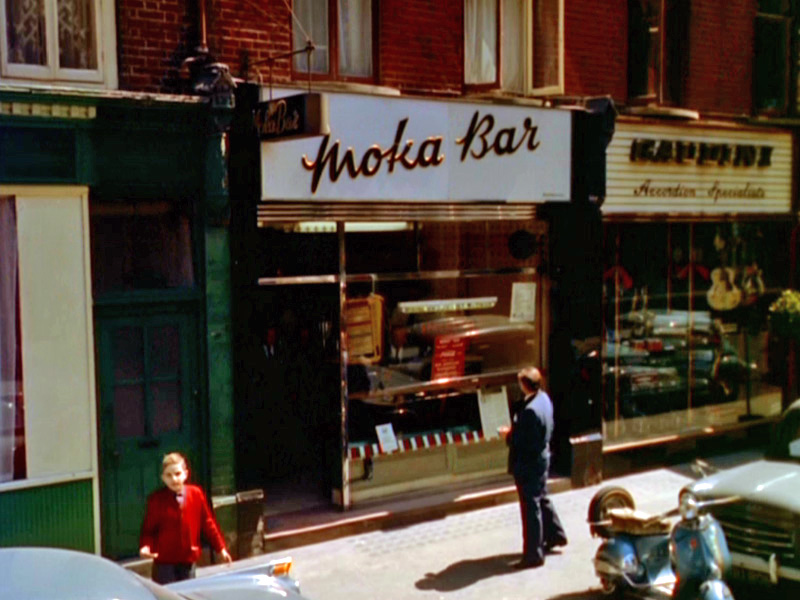
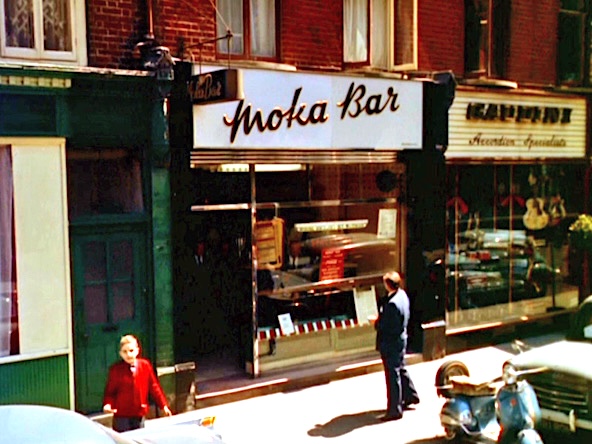
As we’ve noted before, the English coffeehouse has served as a staging ground for radical, sometimes revolutionary social change. Certainly this was the case during the Enlightenment, as it was with the salons in France. And yet, by the early 20th century it seems, coffee shops in London had grown scarcer and more humdrum. That is until 1953 when the Moka Bar, the UK’s first Italian espresso bar, opened in Soho. On his blog The Great Wen, Peter Watts describes its arrival as “a momentous event”:
London’s first proper coffee shop—one equipped with a Gaggia coffee machine—opened at 29 Frith Street. This was a place where teenagers too young for pubs could come and gather, and it is said by some that the introduction of this coffee bar prompted the youth culture explosion that soon changed social life in Britain forever.
“By 1972,” Watts writes, “coffee bars were everywhere and the teenage revolution was firmly established.” Places like the Moka Bar might seem like the ideal place for countercultural maven William S. Burroughs—a London resident from the late sixties to early seventies—to hobnob with young dissidents and outsiders. Burroughs, who so approvingly refers to the possibly apocryphal anarchist pirate colony of Libertatia in his Cities of the Red Night, would, one might think, appreciate the budding anarchism of British youth culture, which would flower into punk soon enough.
But rather than joining the coffee bar scene, the cantankerous Burroughs had taken to frequenting “plush gentlemen’s shops of the area, not to mention the ‘Dilly Boys,’ young male prostitutes who hustled for clients outside the Regent Palace Hotel.”
And he had grown increasingly disillusioned with London, fuming, writes Ted Morgan in Burroughs’ biography Literary Outlaw, “at what he was paying for his hole-in-the-wall apartment with a closet for a kitchen” and at the rising price of utilities. “Burroughs,” Morgan tells us, “began to feel that he was in enemy territory.” And he thought the Moka coffee bar should pay the price for his indignities.
There, “on several occasions a snarling counterman had treated him with outrageous and unprovoked discourtesy, and served him poisonous cheesecake that made him sick.” Burroughs “decided to retaliate by putting a curse on the place.” He chose a means of attack that he’d earlier employed against the Church of Scientology, “turning up… every day,” writes Watts, “taking photographs and making sound recordings.” Then he would play them back a day or so later on the street outside the Moka. “The idea,” writes Morgan, “was to place the Moka Bar out of time. You played back a tape that had taken place two days ago and you superimposed it on what was happening now, which pulled them out of their time position.”
Burroughs also connected the method to the Watergate recordings, the Garden of Eden, and the theories of Alfred Korzybski. The trigger for the magical operation was, in his words, “playback.” In a very strange essay called “Feedback from Watergate to the Garden of Eden,” from his collection Electronic Revolution, Burroughs described his operation in detail, a disruption, he wrote, of a “control system.”
Now to apply the 3 tape recorder analogy to this simple operation. Tape recorder 1 is the Moka Bar itself it is in pristine condition. Tape recorder 2 is my recordings of the Moka Bar vicinity. These recordings are access. Tape recorder 2 in the Garden of Eden was Eve made from Adam. So a recording made from the Moka Bar is a piece of the Moka Bar. The recording once made, this piece becomes autonomous and out of their control. Tape recorder 3 is playback. Adam experiences shame when his discgraceful behavior is played back to him by tape recorder 3 which is God. By playing back my recordings to the Moka Bar when I want and with any changes I wish to make in the recordings, I become God for this local. I effect them. They cannot affect me.
The theory made perfect sense to Burroughs, who believed in a Magical Universe ruled by occult forces and who experimented heavily with Scientology, Crowley-an Magick, and the orgone energy of Wilhelm Reich. The attack on the Moka worked, or at least Burroughs believed it did. “They are seething in there,” he wrote, “I have them and they know it.” On October 30th, 1972 the establishment closed its doors—perhaps a consequence of those rising rents that so irked the Beat writer—and the location became the Queens Snack Bar.
The audio-visual cut-up technique Burroughs used in his attack against the Moka Bar was a method derived by Burroughs and Brion Gysin from their experiments with written “cut-ups,” and Burroughs applied it to film as well. At the top of the post, see an interpretive “meditation” based on Burroughs’ use of audio/visual “magical weapons” and incorporating his recordings. On YouTube, you can watch “The Cut Ups,” a short film Burroughs himself made in 1966 with cinematographer Antony Balch, a disorienting illustration of the cut up technique.
Not limited to attacking annoying London coffeehouse owners, Burroughs’ supposedly magical interventions in reality were in fact the fullest expression of his creativity. As Ted Morgan writes, “the single most important thing about Burroughs was his belief in the magical universe. The same impulse that led him to put out curses was, as he saw it, the source of his writing.” Read much more about Burroughs’ theory and practice in Matthew Levi Stevens’ essay “The Magical Universe of William S. Burroughs,” and hear the author himself discourse on the paranormal, tape cut-ups, and much more in the lecture below from a writing class he gave in June, 1986.
Note: An earlier version of this post appeared on our site in 2014.
Related Content:
How David Bowie, Kurt Cobain & Thom Yorke Write Songs With William Burroughs’ Cut-Up Technique
When William S. Burroughs Joined Scientology (and His 1971 Book Denouncing It)
How to Jumpstart Your Creative Process with William S. Burroughs’ Cut-Up Technique
Josh Jones is a writer and musician based in Durham, NC.
Read More...Watch Led Zeppelin’s Jimmy Page Rock the Theremin, the Early Soviet Electronic Instrument
It can be frustrating for Led Zeppelin fans to hear the band reduced to plagiarism lawsuits or the quintessence of sexually-aggressive rock-star entitlement (though much of that is deserved). For one thing, Zeppelin’s occult songwriting tendencies, courtesy of both Page and Plant, play just as prominent a role as their blues-rock come-ons (as several generations of fantasy metal bands can attest). For another, their studio productions and live shows are renowned for pioneering mash-ups of modern rock, folk, and classical instrumentation, courtesy of both Page and Jones. And finally, the band’s recording techniques were—for the time—demonstrations of technical wizardry.
Thus it should come as no surprise that technical wizard Jimmy Page would play the Theremin, though he does play on it the kind of screaming, feedback-laden bends he unleashed from his Les Paul. Introduced to the world by Soviet inventor Leon Theremin in 1919, the early electronic instrument emits high-pitched singing when a player’s hands come within range of its invisible electrical fields. “It hasn’t got six strings,” Page says in his demonstration at the top of the post, from the 2009 film It Might Get Loud, “but it’s a lot of fun.”
Page used a Sonic Wave Theremin in his Zeppelin days in a very guitar-like way—running it through a Maestro Echoplex and Orange amps and cabinets. (Watch him revive the technique in a 1995 French TV broadcast above.) For several months in 1971, writes fansite Achilles Last Stand, Page “used a double-stacked Theremin” for twice the sonic assault.
Though he seems to have gone back to just the one Theremin in the solo above, the effect is no less electrifying, if you’ll excuse the pun, as he sends echoes of ray-gun noise cascading around the theater. Well over five minutes into the hypnotic affair, Page takes to his Les Paul, creating more ragged patterns with violin bow and Echoplex. Even if you aren’t in a dazed and confused state, you’ll feel like you are if you give yourself over to this piece of performance art. Heroics? Yes, and indeed the bowed guitar act has its phallic overtones. But it begins and ends with long stretches of the kind of droning experimental noise one would expect to find onstage at an early Kraftwerk show.
Those in the know will know that Page put the theremin to use on one of the band’s most technically experimental recordings (though it also happens to be an appropriated blues stomper), “Whole Lotta Love” from 1969’s Led Zeppelin II. “I always envisioned the middle to be quite avant-garde,” Page told Guitar World, “The Theremin generates most of the higher pitches and my Les Paul makes the lower sounds.” Watch him rip out a theremin-and-guitar solo above in the live performance from 1973. Taken with the psychedelic video effects, the performance reaches mystical planes of rhythmic abstraction.
Note: An earlier version of this post appeared on our site in 2016.
Related Content:
Learn How to Play the Theremin: A Free Short Video Course
Josh Jones is a writer and musician based in Durham, NC.
Read More...The Lost Scenes of Orson Welles’ The Magnificent Ambersons Are Being Controversially Restored with AI
When television mogul Ted Turner died earlier this month, it gave cinephiles occasion to remember his brief but high-profile foray into colorization. In the mid-nineteen-eighties, he commissioned for broadcast colorized versions of more than 100 classic movies, from The Treasure of the Sierra Madre to It’s a Wonderful Life to Casablanca. It was only thanks to a clause specifying a black-and-white picture in Orson Welles’ contract with RKO that Citizen Kane never got the full Turner treatment. That blessedly failed project is now being invoked again in comparison with the startup Fable Studio’s enterprise, underway even now, of using artificial intelligence to restore Welles’ sophomore feature The Magnificent Ambersons, which was notoriously mutilated by the studio before its release in 1942.
The recut happened in Welles’ absence. After the attack on Pearl Harbor, he received what sounds like something more than a request from Nelson Rockefeller, then the government’s Coordinator of Inter-American Affairs, to go to Brazil and shoot a documentary about Carnival in the interest of “Pan-American unity.” Due to a disastrous test screening, as Welles explains in the clip from a 1982 Arena broadcast above, “it was thought by everyone in Hollywood, while I was in South America, that it was too ‘downbeat,’ a famous Hollywood word at the time.” Yet the entire film, to his mind, was about the downfall of the titular family, who lose their wealth and prestige as the society they knew slips out from underneath them during the transformations of the early automobile age: not a widely resonant theme, it seems, in mid-twentieth-century America.
“They destroyed Ambersons,” Welles says of the RKO’s recut, “and the picture itself destroyed me.” Yet even the Bowdlerized version has more than a few admirers. Among them is Edward Saatchi, the movie-loving advertising-company scion behind this AI restoration and/or reconstruction project. “His Amazon-backed generative‑A.I. platform, Showrunner, would feed off the data from the extant version of the film to prompt entire new scenes, based on voluminous production materials that survived, including scripts, photographs, and detailed notes,” writes the New Yorker’s Michael Schulman. “For emotional authenticity, Fable would first shoot live actors, then overlay the footage with the digitized voices and likenesses of the long-dead cast members.” The result has the potential to be unsettling on several levels at once.
As Schulman emphasizes, the film’s concern with the human cost of a technological revolution is hardly lost on Saatchi. “With all their speed forward, they may be a step backward in civilization,” says Joseph Cotten’s character, an early automobile investor, in a scene from the studio cut. “It may be that they won’t add to the beauty of the world or the life of men’s souls — I’m not sure. But automobiles have come, and almost all outward things are going to be different because of what they bring.” Even the human mind, he speculates, will be “changed in subtle ways,” a process clearly in effect by the forties. As far as the consequences of AI, we can already see how it’s begun changing the thinking of its early adopters. Saatchi himself displays an ambivalence about the technology, describing it as “potentially the end of human creativity” but also going full-speed-ahead with his unauthorized work on The Magnificent Ambersons — which, at the very least, he’s keeping in black-and-white.
Related content:
AI “Completes” Keith Haring’s Unfinished Painting and Controversy Erupts
Discover the Lost Films of Orson Welles
Based in Seoul, Colin Marshall writes and broadcasts on cities, language, and culture. He’s the author of the newsletter Books on Cities as well as the books 한국 요약 금지 (No Summarizing Korea) and Korean Newtro. Follow him on the social network formerly known as Twitter at @colinmarshall.
Read More...Hear Seven Hours of Women Making Electronic Music (1938–2014)
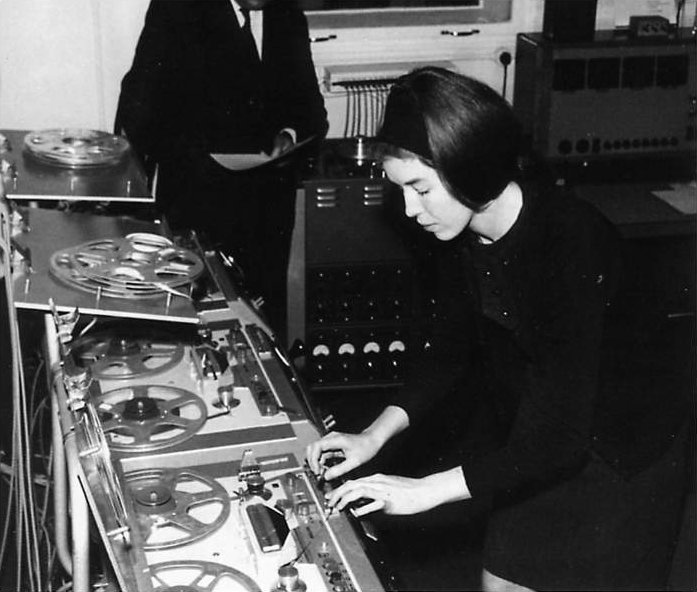
Image via Wikimedia Commons
A number of years ago, in a post on the pioneering composer of the original Doctor Who theme, we wrote that “the early era of experimental electronic music belonged to Delia Derbyshire.” Derbyshire—who almost gave Paul McCartney a version of “Yesterday” with an electronic backing in place of strings—helped invent the early electronic music of the sixties through her work with the Radiophonic Workshop, the sound effects laboratory of the BBC. She went on to form one of the most influential, if largely obscure, electronic acts of the decade, White Noise. And yet, calling the early eras of electronic music hers is an exaggeration. Of course her many collaborators deserve mention, as well as musicians like Bruce Haack, Pierre Henry, Kraftwerk, Brian Eno, and so many others. But what gets almost completely left out of many histories of electronic music, as with so many other histories, is the prominent role so many women besides Derbyshire played in the development of the sounds we now hear around us all the time.
In recognition of this fact, musician, DJ, and “escaped housewife/schoolteacher” Barbara Golden devoted two episodes of her KPFA radio program “Crack o’ Dawn” to women in electronic music, once in 2010 and again in 2013. She shares each broadcast with co-host Jon Leidecker (“Wobbly”), and in each segment, the two banter in casual radio show style, offering history and context for each musician and composer. Highlighted on Ubu’s former Twitter stream, the first show, “Women in Electronic Music 1938–1982 Part 1” (above) gives Derbyshire her due, with three tracks from her, including the Doctor Who theme.
It also includes music from twenty one other composers, beginning with Clara Rockmore, a refiner and popularizer of the theremin, that weird instrument designed to simulate a high, tremulous human voice. Also featured is Wendy Carlos’s “Timesteps,” an original piece from her A Clockwork Orange score.
The second show, above, fills in several gaps in the original broadcast and “could easily be six hours” says co-host Leidecker, given the sheer amount of electronic music out there composed and recorded by women over the past seventy years. This show includes one of our host Golden’s own compositions, “Melody Sumner Carnahan,” as well as music from Laurie Anderson and musique concrete composer Doris Hays. These two broadcasts alone cover an enormous range of stylistic and technological ground, but for even more discographical history of women in electronic music, see the playlist below, compiled by “Nerdgirl” Antye Greie-Ripatti. Commissioned by Club Transmediale Berlin, the mix includes such well-known names as Yoko Ono, Bjork, and M.I.A., as well as foremothers Derbyshire and Carlos, and dozens more.
In lieu of the radio-show chatter of Golden and Leidecker, we have Greie-Ripatti’s post detailing each artist’s time period, country of origin, and contributions to electronic music history. Many of the composers represented here worked for major radio and film studios, scored feature films (like 1956’s Forbidden Planet), invented and innovated new instruments and techniques, wrote for orchestras, and passed on their knowledge as educators and producers. Greie-Ripatti’s page quotes a Danish electronic producer and performer saying “there is a lot of women in electronic music… invisible women.” Thanks to efforts like hers and Golden’s, these pioneering creators need no longer go unseen or, more importantly, unheard.
Note: An earlier version of this post appeared on our site in 2015.
Related Content:
Watch Composer Wendy Carlos Demo an Original Moog Synthesizer (1989)
Thomas Dolby Explains How a Synthesizer Works on a Jim Henson Kids Show (1989)
Josh Jones is a writer and musician based in Durham, NC.
Read More...The Futurist Cookbook (1930) Tried to Turn Italian Cuisine into Modern Art
With the savage cuts in arts funding, perhaps we’ll return to a system of noblesse oblige familiar to students of The Gilded Age, when artists needed independent wealth or patronage, and wealthy industrialists often decided what was art, and what wasn’t. Unlike fine art, however, haute cuisine has always relied on the patronage of wealthy donors—or diners. It can be marketed in premade pieces, sold in cookbooks, and made to look easy on TV, but for reasons both cultural and practical, given the nature of food, an exquisitely-prepared dish can only be made accessible to a select few.
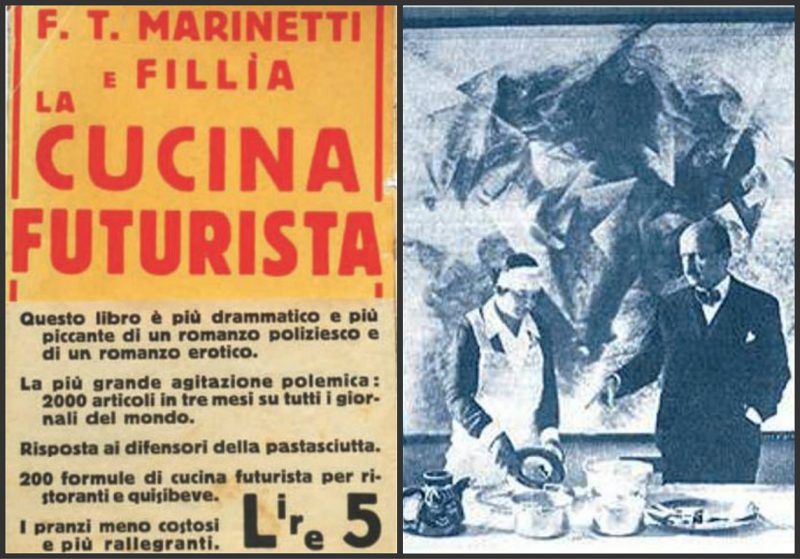
Still, we would be mistaken, suggested Futurist poet and theorist F.T. Marinetti (1876–1944), should we neglect to see cooking as an art form akin to all the others in its moral and intellectual influence on us. While hardly the first or the last artist to publish a cookbook, Marinetti’s Futurist Cookbook seems at first glance deadly, even aggressively, serious, lacking the whimsy, impractical weirdness, and surrealist art of Salvador Dali’s Les Diners de Gala, for example, or the eclectic wistfulness of the MoMA’s Artist’s Cookbook.
Just as he had sought with his earlier Futurist Manifesto to revolutionize art, Marinetti intended his cookbook to foment a “revolution of cuisine,” as Alex Revelli Sorini and Susanna Cutini point out. You might even call it an act of war when it came to certain staples of Italian eating, like pasta, which he thought responsible for “sluggishness, pessimism, nostalgic inactivity, and neutralism” (anticipating scads of low and no-carb diets to come).
Believing that people “think, dream and act according to what they eat and drink,” Marinetti formulated strict rules not only for the preparation of food, but also the serving and eating of it, going so far as to call for abolishing the knife and fork. A short excerpt from his introduction shows him applying to food the techno-romanticism of his Futurist theory—an ethos taken up by Benito Mussolini, whom Marinetti supported:
The Futurist culinary revolution … has the lofty, noble and universally expedient aim of changing radically the eating habits of our race, strengthening it, dynamizing it and spiritualizing it with brand-new food combinations in which experiment, intelligence and imagination will economically take the place of quantity, banality, repetition and expense.
In hindsight, the fascist overtones in Marinetti’s language seem glaring. In 1932, when the Futurist Cookbook was published, his Futurism seemed like a much-needed “jolt to all the practical and intellectual activities,” note Sorini and Cutini. “The subject [of cooking] needed a good shake to reawaken its spirit.” And that’s just what it got. The Futurist Cookbook acted as “a preview of Italian-style Nouvelle Cuisine,” with such innovations as “additives and preservatives added to food, or using technological tools in the kitchen to mince, pulverize, and emulsify.”
Yet, for all the high seriousness with which Marinetti seems to treat his subject, “what the media missed” at the time, writes Maria Popova, “was that the cookbook was arguably the greatest artistic prank of the twentieth century.” In an introduction to the 1989 edition, British journalist and historian Lesley Chamberlain called the Futurist Cookbook “a serious joke, revolutionary in the first instance because it overturned with ribald laughter everything ‘food’ and ‘cookbooks’ held sacred.” Marinetti first swept away tradition in favor of creative dining events the Futurists called “aerobanquets,” such as one in Bologna in 1931 with a table shaped like an airplane and dishes called “spicy airport” (Olivier salad) and “rising thunder” (orange risotto). Lambrusco wine was served in gas cans.
It’s performance art worthy of Dali’s bizarre costumed dinner parties, but fueled by a genuine desire to revolutionize food, if not the actual eating of it, by “bringing together elements separated by biases that have no true foundation.” So remarked French chef Jules Maincave, a 1914 convert to Futurism and inspiration for what Marinetti calls “flexible flavorful combinations.” See several such recipes excerpted from the Futurist Cookbook at Brain Pickings, read the full book in Italian here, and, just below, see Marinetti’s rules for the perfect meal, first published in 1930 as the “Manifesto of Futurist Cuisine.”
Futurist cuisine and rules for the perfect lunch
1. An original harmony of the table (crystal ware, crockery and glassware, decoration) with the flavors and colors of the dishes.
2. Utter originality in the dishes.
3. The invention of flexible flavorful combinations (edible plastic complex), whose original harmony of form and color feeds the eyes and awakens the imagination before tempting the lips.
4. The abolition of knife and fork in favor of flexible combinations that can deliver prelabial tactile enjoyment.
5. The use of the art of perfumery to enhance taste. Each dish must be preceded by a perfume that will be removed from the table using fans.
6. A limited use of music in the intervals between one dish and the next, so as not to distract the sensitivity of the tongue and the palate and serves to eliminate the flavor enjoyed, restoring a clean slate for tasting.
7. Abolition of oratory and politics at the table.
8. Measured use of poetry and music as unexpected ingredients to awaken the flavors of a given dish with their sensual intensity.
9. Rapid presentation between one dish and the next, before the nostrils and the eyes of the dinner guests, of the few dishes that they will eat, and others that they will not, to facilitate curiosity, surprise, and imagination.
10. The creation of simultaneous and changing morsels that contain ten, twenty flavors to be tasted in a few moments. These morsels will also serve the analog function […] of summarizing an entire area of life, the course of a love affair, or an entire voyage to the Far East.
11. A supply of scientific tools in the kitchen: ozone machines that will impart the scent of ozone to liquids and dishes; lamps to emit ultraviolet rays; electrolyzers to decompose extracted juices etc. in order to use a known product to achieve a new product with new properties; colloidal mills that can be used to pulverize flours, dried fruit and nuts, spices, etc.; distilling devices using ordinary pressure or a vacuum, centrifuge autoclaves, dialysis machines.
The use of this equipment must be scientific, avoiding the error of allowing dishes to cook in steam pressure cookers, which leads to the destruction of active substances (vitamins, etc.) due to the high temperatures. Chemical indicators will check if the sauce is acidic or basic and will serve to correct any errors that may occur: lack of salt, too much vinegar, too much pepper, too sweet.”
Note: An earlier version of this post appeared on our site in 2017.
Related Content
When Italian Futurists Declared War on Pasta (1930)
Salvador Dalí’s 1973 Cookbook Gets Reissued: Surrealist Art Meets Haute Cuisine
Josh Jones is a writer and musician based in Durham, NC.
Read More...RIP Gladys Mae West, the Pioneering Black Mathematician Who Helped Lay the Foundation for GPS
Gladys Mae West was born in rural Virginia in 1930, grew up working on a tobacco farm, and died earlier this month a celebrated mathematician whose work made possible the GPS technology most of us use each and every day. Hers was a distinctively American life, in more ways than one. Seeking an escape from the agricultural labor she’d already gotten to know all too well, she won a scholarship to Virginia State College by becoming her high school class valedictorian; after earning her bachelor’s and master’s degrees in mathematics, she taught for a time and then applied for a job at the naval base up in Dahlgren. She first distinguished herself there by verifying the accuracy of bombing tables with a hand calculator, and from there moved on up to the computer programming team.
This was the early nineteen-sixties, when programming a computer meant not coding, but laboriously feeding punch cards into an enormous mainframe. West and her colleagues used IBM’s first transistorized machine, the 7030 (or “Stretch”), which was for a few years the fastest computer in the world.
It cost an equivalent of $81,860,000 in today’s dollars, but no other computer had the power to handle the project of calculating the precise shape of Earth as affected by gravity and the nature of the oceans. About a decade later, another team of government scientists made use of those very same calculations when putting together the model employed by the World Geodetic System, which GPS satellites still use today. Hence the tendency of celebratory obituaries to underscore the point that without West’s work, GPS wouldn’t be possible.
Nor do any of them neglect to point out the fact that West was black, one of just four such mathematicians working for the Navy at Dahlgren. Stories like hers have drawn much greater public interest since the success of Hidden Figures, the Hollywood adaptation of Margot Lee Shetterly’s book about the black female mathematicians at NASA during the Space Race. When that movie came out, in 2016, even West’s own children didn’t know the importance of the once-classified work she’d done. Only in 2018, when she provided that information on a biographical form she filled out for an event hosted by her college sorority, did it become public. She thus spent the last years of her long life as a celebrity, sought out by academics and journalists eager to understand the contributions of another no-longer-hidden figure. But to their questions about her own GPS use, she reportedly answered that she preferred a good old-fashioned paper map.
Related content:
Black History in Two Minutes: Watch 93 Videos Written & Narrated by Henry Louis Gates Jr.
Based in Seoul, Colin Marshall writes and broadcasts on cities, language, and culture. He’s the author of the newsletter Books on Cities as well as the books 한국 요약 금지 (No Summarizing Korea) and Korean Newtro. Follow him on the social network formerly known as Twitter at @colinmarshall.
Read More...Can Genius Be Taught? The Polgár Sisters and the Experiment That Put the Question to the Test
As any new parent soon finds out, there exists a robust market for products, services, and media that promise to boost a child’s intelligence. Some of these offerings come as close as legally possible to holding out the promise of putting any tot on the path to genius, brazenly begging the question of whether it’s possible to raise a genius in the first place. Still, the efforts parents have deliberately made in that direction have occasionally produced notable results, from epochal figures like Mozart or John Stuart Mill to the promising-mathematician-turned-streetcar-transfer-obsessed-recluse William Sidis. More recently came the Polgár sisters, who were successfully raised to become some of the greatest female chess players in history.
Having studied the nature of intelligence at university, their father László got it in his head that, since most geniuses started learning their subjects intensively and early, parents could cultivate genius-level performance in their children by directing that learning process themselves. He sought out a wife both intellectually promising and willing to devote herself to testing this hypothesis. Together they went on to father three daughters, putting them through a rigorous, custom-made education oriented toward chess mastery. Chess became the project’s central subject in large part because of its sheer objectivity, all the better for László Polgár to measure the results of this domestic experiment.
Nor could it have hurt, given the importance of retaining the interest of children, that chess was a game — and one with evocative toy-like pieces — that offers immediate feedback and feelings of accomplishment. For his daughters, Polgár has emphasized, learning involved none of the drudgery and busywork of school. “A child does not like only play: for them it is also enjoyable to acquire information and solve problems,” he writes in his book Raise a Genius! “A child’s work can also be enjoyable; so can learning, if it is sufficiently motivating, and if it means a constant supply of problems to solve that are appropriate for the level of the child’s needs. A child does not need play separate from work, but meaningful action.”
The proof of Polgár’s theories is in the pudding — or at any rate, in the ratings. All three of his daughters became elite chess players. Sofia, the middle one, became the sixth-strongest female player in the world; Susan, the eldest, the top-ranked female player in the world; Judit, the youngest, the strongest female chess player of all time. This despite the fact that their father was an unexceptional chess player, and their mother not a chess player at all. Some eagerly take the story of the Polgár sisters as a vindication of nurture over nature; others, scientific researchers included, argue that it only shows that practice is a necessary condition for this kind of genius, not a sufficient one. For my part, having kept an eye on a pair of infant twins while writing this, I’d be happy if my own kids could just master holding on to their bottles.
Related content:
Learn How to Play Chess Online: Free Chess Lessons for Beginners, Intermediate Players & Beyond
Meet Alma Deutscher, the Classical Music Prodigy: Watch Her Performances from Age 6 to 14
Hear the Pieces Mozart Composed When He Was Only 5 Years Old
Read an 18th-Century Eyewitness Account of 8‑Year-Old Mozart’s Extraordinary Musical Skills
Based in Seoul, Colin Marshall writes and broadcasts on cities, language, and culture. He’s the author of the newsletter Books on Cities as well as the books 한국 요약 금지 (No Summarizing Korea) and Korean Newtro. Follow him on the social network formerly known as Twitter at @colinmarshall.
Read More...What’s Entering the Public Domain in 2026: Faulkner’s As I Lay Dying, All Quiet on the Western Front, Betty Boop & More
Though it isn’t the kind of thing one hears discussed every day, serious Disney fans do tend to know that Goofy’s original name was Dippy Dawg. But how many of the non-obsessive know that Mickey’s faithful pet Pluto was first called Rover? (We pass over in dignified silence the quasi-philosophical question of why the former dog is humanoid and the latter isn’t.) It is Rover, as distinct from Pluto, who passes into the public domain this new year, one of a cast of now-liberated characters including Blondie and Dagwood as well as Betty Boop — who, upon making her debut in Fleischer Studios’ Dizzy Dishes of 1930, has a somewhat canoid appearance herself. You can see them all in the video above from Duke University’s Center for the Study of the Public Domain, with much more information available in their blog post marking this year’s “Public Domain Day.”
The year 1930, write the Center’s Jennifer Jenkins and James Boyle, was one “of detectives, jazz, speakeasies, and iconic characters stepping onto the cultural stage — many of whom have been locked behind copyright for nearly a century.”
Novels that come available this year include William Faulkner’s As I Lay Dying, Dashiell Hammett’s The Maltese Falcon, and Agatha Christie’s The Murder at the Vicarage; among the films are Lewis Milestone’s Best Picture-winning All Quiet on the Western Front, Victor Heerman’s Marx Brothers picture Animal Crackers, and Luis Buñuel and Salvador Dalí’s L’Âge d’Or. In music, compositions like “I Got Rhythm” and “Embraceable You” by the Gershwin Brothers as well as recordings like “Nobody Knows the Trouble I’ve Seen” by Marian Anderson and “Sweet Georgia Brown” by Ben Bernie and His Hotel Roosevelt Orchestra have also, at long last, gone public.
Reflection on some of these works themselves suggests something about the importance of the public domain. With the title of Cakes and Ale, another book in this year’s crop, Somerset Maugham makes reference to “a classic public domain work, in this case Shakespeare’s Twelfth Night”; so, for that matter, does Faulkner, given that the line “as I lay dying” comes from the Odyssey. “To tell new stories, we draw from older ones,” write Jenkins and Boyle. “One work of art inspires another — that is how the public domain feeds creativity.” Today, we’re free to take explicit inspiration for our own work from Nancy Drew, “Just a Gigolo,” Blondie, Mondrian’s Composition with Red, Blue, and Yellow, Hitchcock’s Murder!, and much else besides. And by all means use Rover, but if you also want to bring in Dippy Dawg, you’re going to have to wait until 2028.
Related Content:
The Harlem Jazz Singer Who Inspired Betty Boop: Meet the Original Boop-Oop-a-Doop, “Baby Esther”
Cartoonists Draw Their Famous Cartoon Characters While Blindfolded (1947)
Vintage Audio: William Faulkner Reads From As I Lay Dying
16 Free Hitchcock Movies Online
Based in Seoul, Colin Marshall writes and broadcasts on cities, language, and culture. His projects include the Substack newsletter Books on Cities and the book The Stateless City: a Walk through 21st-Century Los Angeles. Follow him on the social network formerly known as Twitter at @colinmarshall.
Read More...Support Us
We're hoping to rely on loyal readers, rather than erratic ads. Please click the Donate button and support Open Culture. You can use Paypal, Venmo, Patreon, even Crypto! We thank you!

About Us

Open Culture scours the web for the best educational media. We find the free courses and audio books you need, the language lessons & educational videos you want, and plenty of enlightenment in between.
Advertise With Us
FREE UPDATES!
GET OUR DAILY EMAIL
Get the best cultural and educational resources on the web curated for you in a daily email. We never spam. Unsubscribe at any time.
FOLLOW ON SOCIAL MEDIA
Open Culture editor Dan Colman scours the web for the best educational media. He finds the free courses and audio books you need, the language lessons & movies you want, and plenty of enlightenment in between.
Advertise With Us