Visit Great Cities in the 1920s in Restored Color Film: New York City, London, Berlin, Paris, Venice & More
Woody Allen’s Midnight in Paris stars Owen Wilson as a Hollywood screenwriter on vacation in the French capital. Alas, the City of Lights as it is in the twenty-first century doesn’t satisfy him. When he walks his streets he thinks only of the nineteen-twenties, when a traveler in Paris could easily cross paths with the likes of Paul Gauguin, Henri Matisse, and Edgar Degas — as well as expatriates from Pablo Picasso and Djuna Barnes to F. Scott Fitzgerald and Ernest Hemingway. Or so he imagines, at any rate, and so he goes on to experience when he finds himself transported back in time to the city of the “Lost Generation” at each stroke of midnight.
With the video above, you, too, can take a trip to nineteen-twenties Paris — as well as nineteen-twenties New York, Chicago, San Francisco, London, Berlin, Stockholm, Copenhagen, Amsterdam, Nice, Geneva, Milan, and Venice. A compilation of period footage sourced from the Prelinger Archives, it lightly colorizes, adds ambient sound, and in other ways enhances its disparate materials to make them feel all of a piece.
And indeed, the clip plays almost as if shot by a single, and singularly ambitious, world traveler of one hundred years ago. That hypothetical traveler’s world is both ours — filled as it is with such recognizable and ever-photographable sites as the Eiffel Tower, the gondolas of Venice, and the non-latex-clad cyclists of Copenhagen — and not.
Whether traditional or modern, the dress of everyone on the street looks neater and more formal than that worn by urbanites in the main today. In some cities, horse-drawn carriages still make their way through the traffic of buses, trams, and waves of seemingly identical personal cars. (Ford manufactured more than two million Model Ts in 1923 alone.) The nineteen-twenties brought rapid urban development in both the New World and the Old, as well as rapid development in motion photography. Not for nothing was it the decade of the “city symphony” film; for equally good reason, it remains the decade of which many of us dream, even a century later, when we want to feel the exhilaration of modernity.
Related content:
Nerves of Steel!: Watch People Climb Tall Buildings During the 1920s.
Great New Archive Lets You Hear the Sounds of New York City During the Roaring Twenties
Footage of Cities Around the World in the 1890s: London, Tokyo, New York, Venice, Moscow & More
Download 6600 Free Films from The Prelinger Archives and Use Them However You Like
Based in Seoul, Colin Marshall writes and broadcasts on cities, language, and culture. His projects include the Substack newsletter Books on Cities, the book The Stateless City: a Walk through 21st-Century Los Angeles and the video series The City in Cinema. Follow him on Twitter at @colinmarshall, on Facebook, or on Instagram.
Read More...Joni Mitchell Sings “Both Sides Now” at the Newport Folk Festival: Watch Clips from Her First Full Concert Since 2002
This weekend, the Newport Folk Festival made headlines when it brought out of retirement two music legends. Paul Simon returned to the stage and performed “Graceland,” “The Boxer” and “other classics.” But Joni Mitchell stole the show when she performed (with a little help from Brandi Carlile) “Both Sides Now,” “Big Yellow Taxi,” “Just Like This Train” and 10 other songs. Mitchell suffered a brain aneurysm in 2015, and hadn’t performed a full concert since 2002. Hence why the show was a big deal.
Get the full backstory on the Newport performance over at NPR.
Just Like This Train
Summertime
Circle Game
If you would like to support the mission of Open Culture, consider making a donation to our site. It’s hard to rely 100% on ads, and your contributions will help us continue providing the best free cultural and educational materials to learners everywhere. You can contribute through PayPal, Patreon, and Venmo (@openculture). Thanks!
Related Content
Joni Mitchell Publishes a Book of Her Rarely Seen Paintings & Poetry
Songs by Joni Mitchell Re-Imagined as Pulp Fiction Book Covers & Vintage Movie Posters
Read More...Behold a Book of Color Shades Depicted with Feathers (Circa 1915)
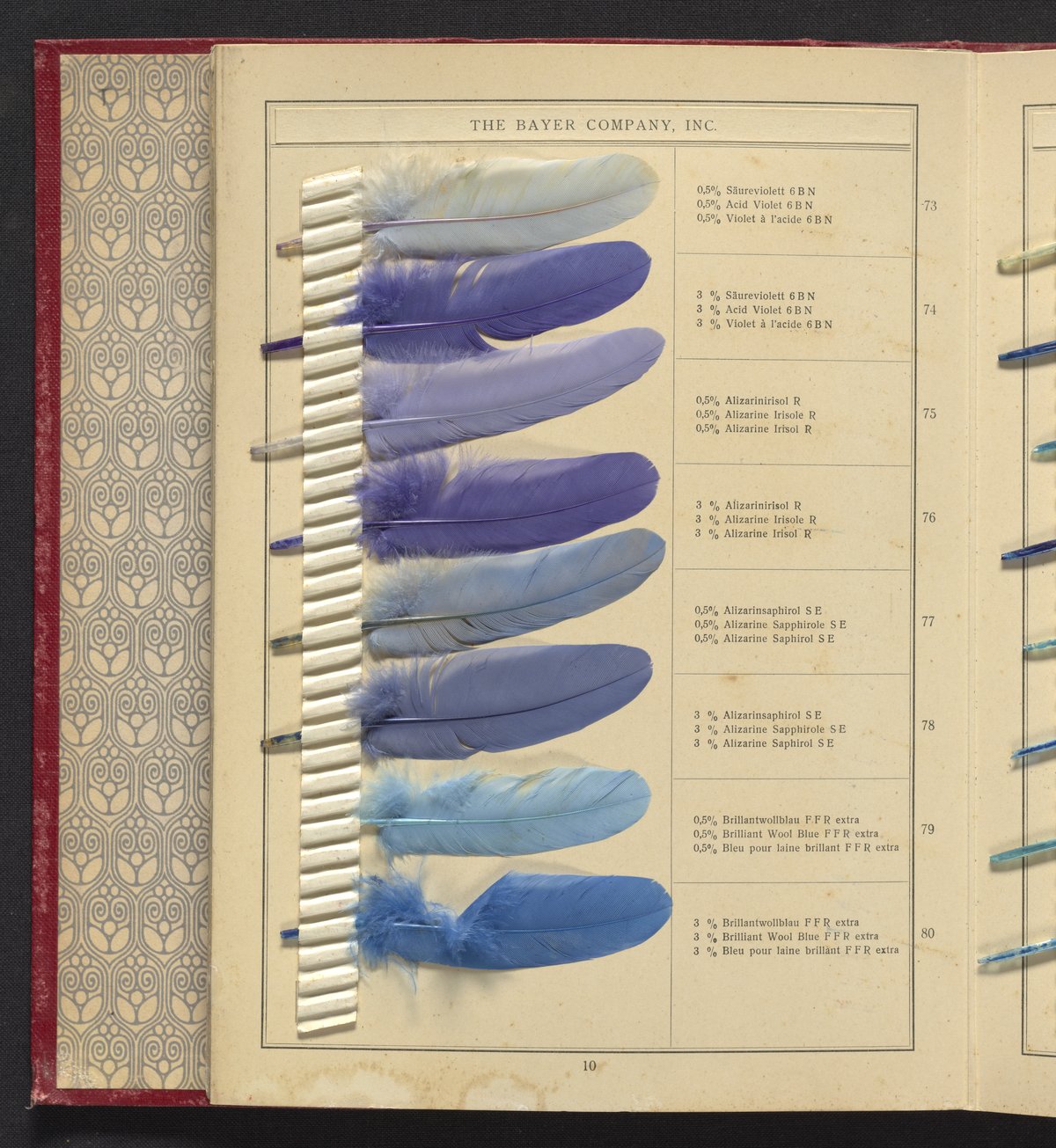
Perhaps the 143 colors showcased in The Bayer Company’s early 20th-century sample book, Shades on Feathers, could be collected in the field, but it would involve a lot of travel and patience, and the stalking of several endangered if not downright extinct avian species.
Far easier, and much less expensive, for milliners, designers and decorators to dye plain white feathers exotic shades, following the instructions in the sample book.
Such artificially obtained rainbows owe a lot to William Henry Perkin, a teenage student of German chemist August Wilhelm von Hofmann, who spent Easter vacation of 1856 experimenting with aniline, an organic base his teacher had earlier discovered in coal tar. Hoping to hit on a synthetic form of quinine, he accidentally hit on a solution that colored silk a lovely purple shade — an inadvertent eureka moment that ranks right up there with penicillin and the pretzel.
A Science Museum Group profile details what happened next:
Perkin named the colour mauve and the dye mauveine. He decided to try to market his discovery instead of returning to college.
On 26 August 1856, the Patent Office granted Perkin a patent for ‘a new colouring matter for dyeing with a lilac or purple colour stuffs of silk, cotton, wool, or other materials’.
Perkin’s next step was to interest cloth dyers and printers in his discovery. He had no experience of the textile trade and little knowledge of large-scale chemical manufacture. He corresponded with Robert and John Pullar in Glasgow, who offered him support. Perkin’s luck changed towards the end of 1857 when the Empress Eugénie, wife of Napoleon III, decided that mauve was the colour to wear. In January 1858, Queen Victoria followed suit, wearing mauve to her daughter’s wedding.
Cue an explosion of dye manufacturers across Great Britain and Europe, including Bayer, producer of the feather sample book. The survival of this artifact is somewhat miraculous given how vulnerable antique feathers are to environmental factors, pests, and improper storage.
(The sample book recommends cleaning the feathers prior to dying in a lukewarm solution of small amounts of olive oil soap and ammonia.)
The Science History Institute, owner of this unusual object, estimates that the undated book was produced between 1913 and 1918, the year the Migratory Bird Act Treaty outlawed the hunting of birds whose feathers humans deemed particularly fashionable.
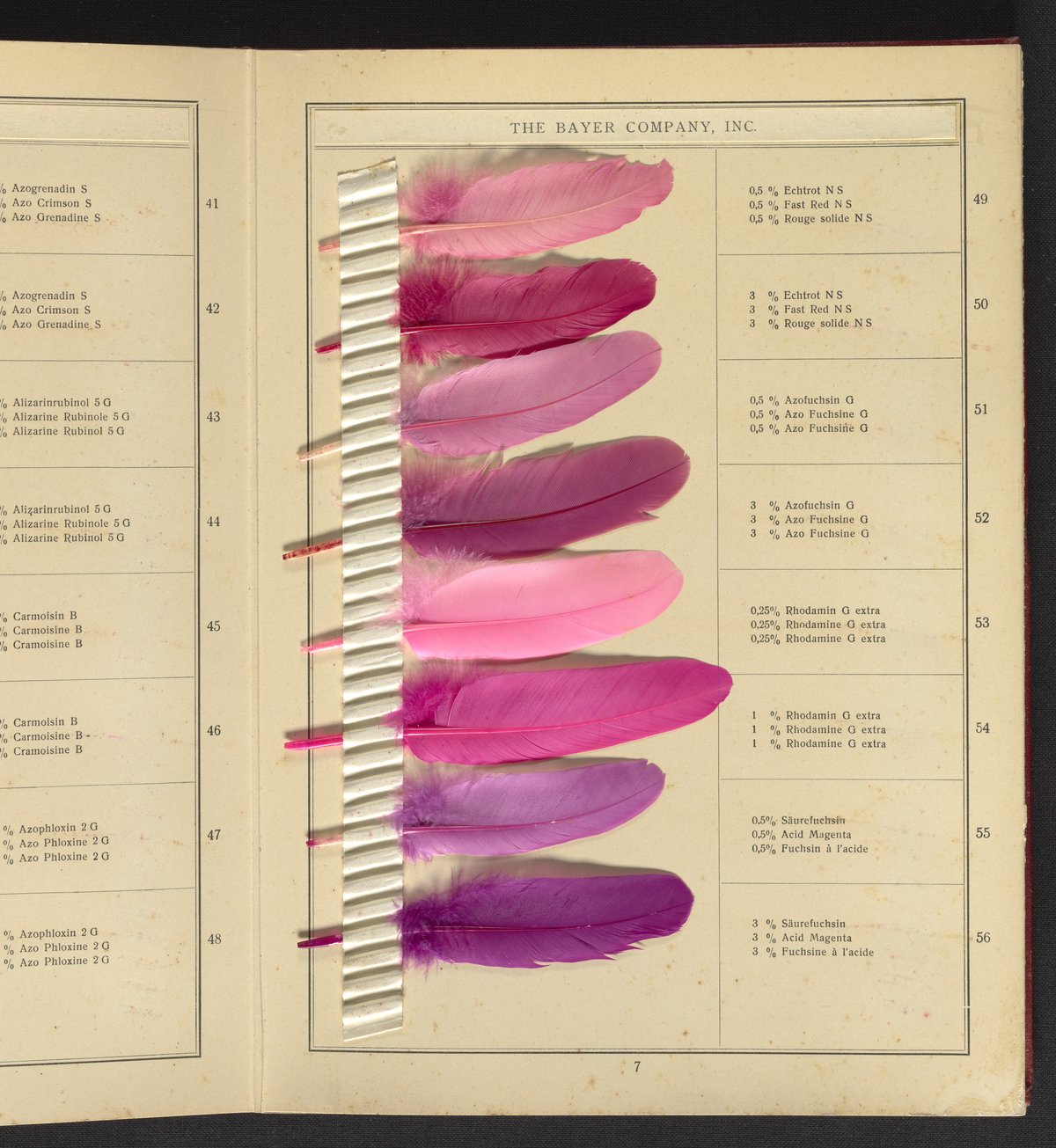
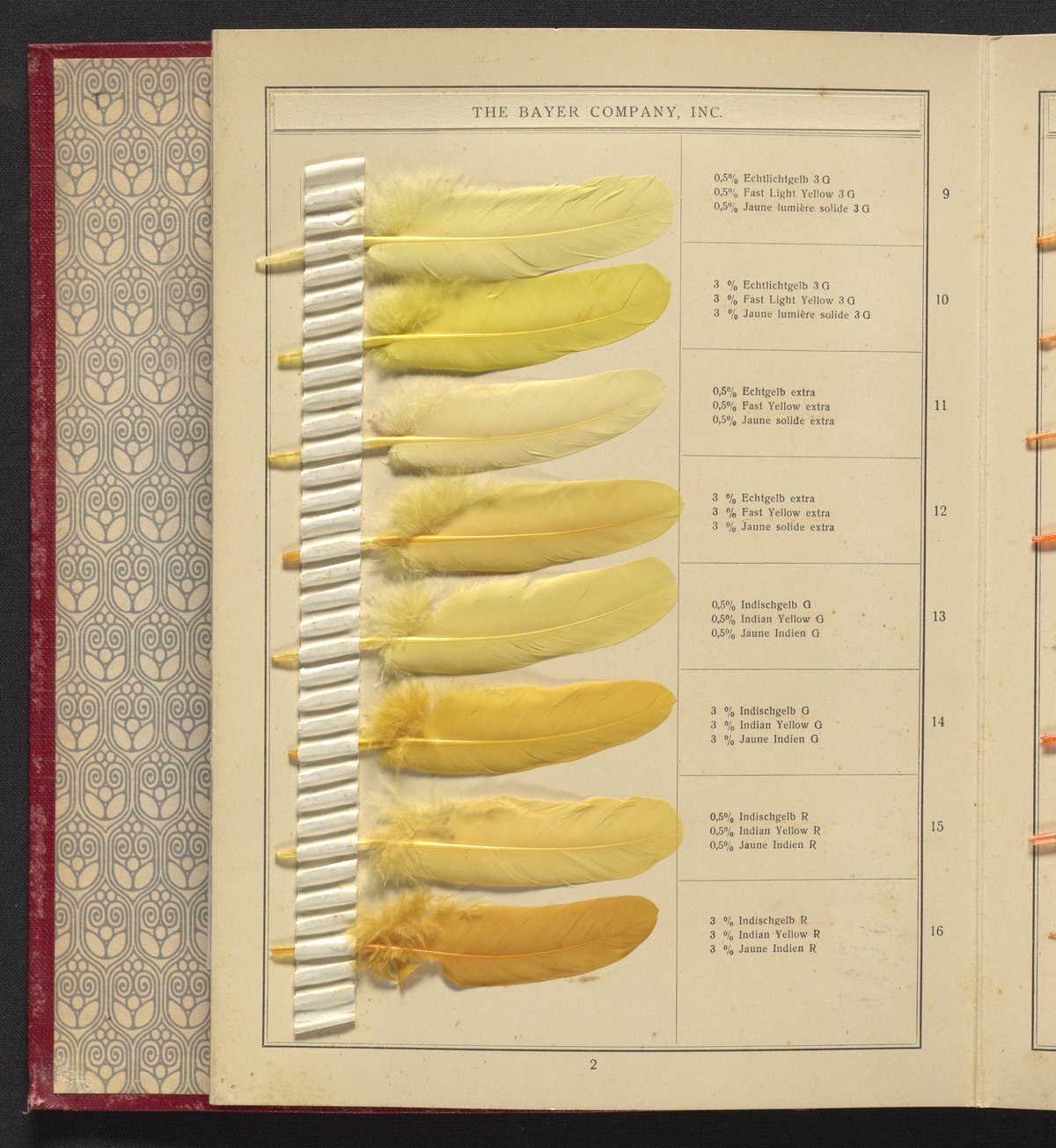
Peruse the Science History Institute of Philadelphia’s digitized copy of the Shades on Feathers sample book here.
Related Content
Download 435 High Resolution Images from John J. Audubon’s The Birds of America
The Bird Library: A Library Built Especially for Our Fine Feathered Friends
- Ayun Halliday is the Chief Primatologist of the East Village Inky zine and author, most recently, of Creative, Not Famous: The Small Potato Manifesto. Follow her @AyunHalliday.
Read More...Give Duke Ellington the Pulitzer Prize He Was Denied in 1965
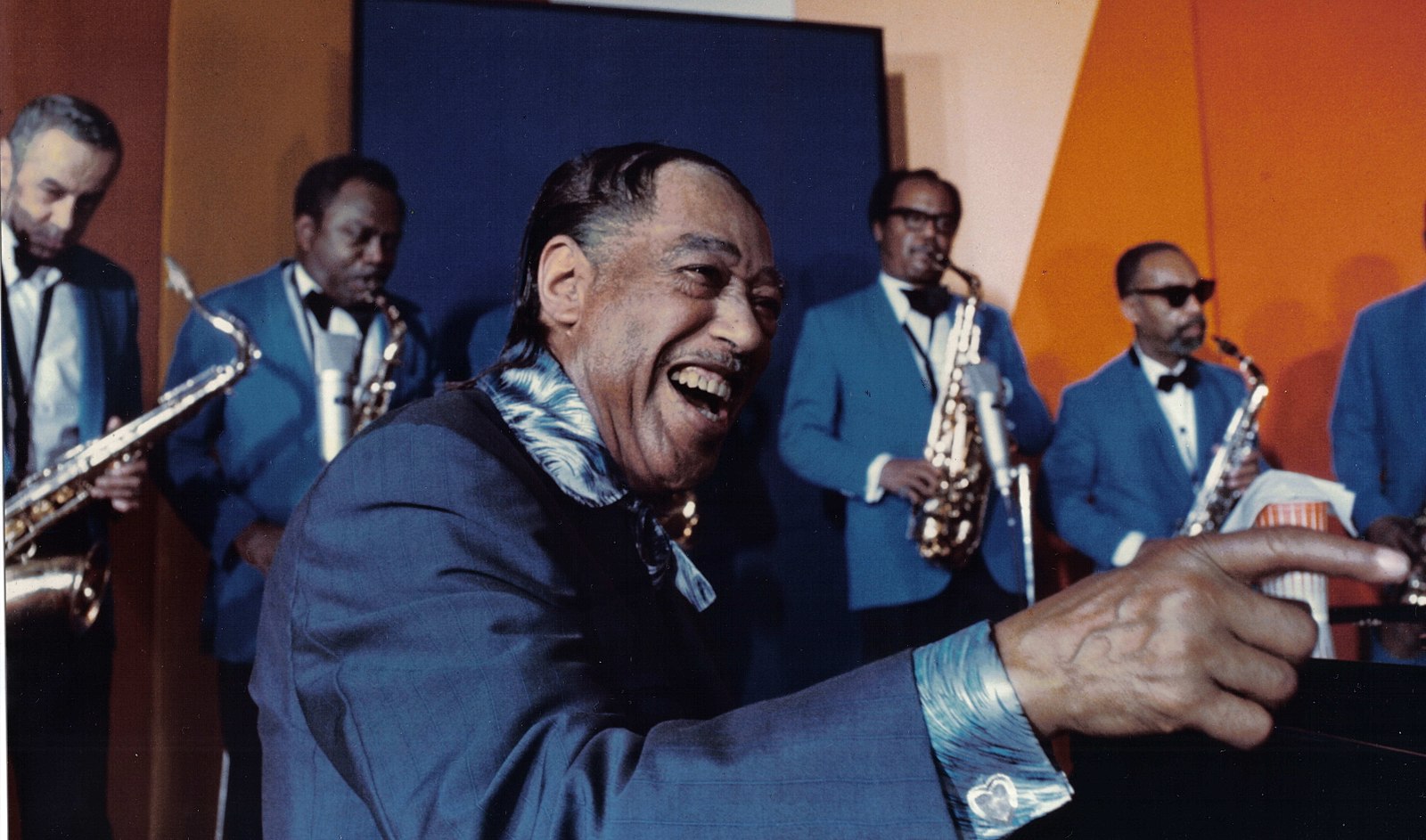
Image by Louis Panassié, via Wikimedia Commons
Duke Ellington has been commemorated in a variety of forms: statues, murals, schools, and even United States commemorative stamps and coins. In his lifetime he received a star on the Hollywood Walk of Fame, a Grammy Lifetime Achievement, a Presidential Medal of Freedom, and a Légion d’honneur. His posthumous honors even include a Special Pulitzer Prize awarded in 1999, the centennial year of his birth. 34 years earlier, in 1965, he’d been named for–but ultimately denied–a regular Pulitzer Prize for Music, a decision his appreciators are now trying to reverse.
“The jury that judged the entrants that year decided to do something different,” writes jazz critic Ted Gioia. “They recommended giving the honor to Duke Ellington for the ‘vitality and originality of his total productivity’ over the course of more than forty years.” This broke from tradition in that the Pulitzer Prize for Music usually honors a single work: in 1945 it went to Aaron Copland for his ballet Appalachian Spring; in 1958 it went to Samuel Barber for his opera Vanessa; in 1960 it went to Elliott Carter for his Second String Quartet.
Alas, “the Pulitzer Board refused to accept the decision of the jury, and decided it would be better to give out no award, rather than honor Duke Ellington. Two members of the three-person judging panel, Winthrop Sargeant and Robert Eyer, resigned in the aftermath.” Ellington, for his part, reacted to this unfortunate development with characteristic equanimity: “Fate is being kind to me,” he told the press. “Fate doesn’t want me to be famous too young” — to which Gioia adds that “he was 66 years old at the time, and in the final decade of his life.”
In an effort to retroactively award Ellington his Pulitzer Prize for Music, Gioia has has launched an online petition. If you sign it, you’ll join the likes of John Adams, Michael Dirda, Steve Reich, and Gene Weingarten, all Pulitzer winners themselves, as well as other luminaries and enthusiasts who’ve voiced their support — nearly 9,000 of them as of this writing. “We assume that Pulitzers are awarded to work that qualifies as for the ages, that pushes the envelope, that suggests not just cleverness but genius,” writes the New York Times’ John McWhorter. “There can be no doubt that Ellington’s corpus fits that definition.”
Reversing the committee decision of 1965, Gioia writes, would enhance “the prestige and legitimacy of the Pulitzer — and every award needs that nowadays, when many have grown skeptical about our leading prizes.” What’s more, “it’s the proper thing for the music — because every time genuine artistry is recognized it sets an example for the present generation, and lays a foundation for the future.” In recent decades, the aesthetic range of Pulitzer-honored music has widened considerably: McWhorter points as an example to 2018’s winner, Kendrick Lamar’s album Damn. It could be that, as far as Ellington is concerned, it’s taken the rest of us 57 years to catch up with him. Sign the petition here.
Related content:
Such Sweet Thunder: Duke Ellington & Billy Strayhorn’s Musical Tribute to Shakespeare (1957)
How Old School Records Were Made, From Start to Finish: A 1937 Video Featuring Duke Ellington
Based in Seoul, Colin Marshall writes and broadcasts on cities, language, and culture. His projects include the Substack newsletter Books on Cities, the book The Stateless City: a Walk through 21st-Century Los Angeles and the video series The City in Cinema. Follow him on Twitter at @colinmarshall, on Facebook, or on Instagram.
Read More...The First Surviving Photograph of the Moon (1840)
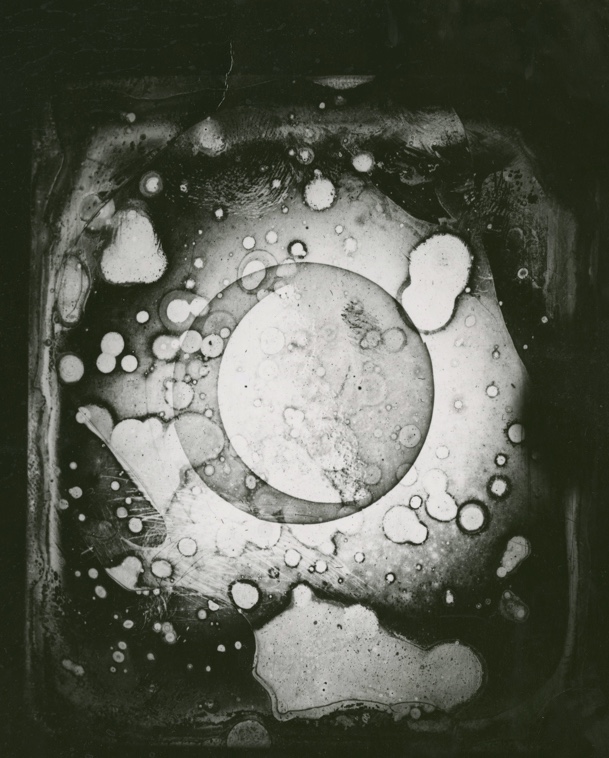
Everyone has been agog over the first photos from the James Webb telescope, and for good reason. “These images,” Rivka Galchin writes at The New Yorker, “carry news about the early universe, the birth and death of stars, the collision of galaxies, and the atmosphere of exoplanets.” They’re also “very, very pretty,” she writes, comparing them to Vermeer.
The clarity and levels of detailed information about the earliest galaxies have even astonished astronomers, whose work has advanced rapidly alongside the growth of the photographic medium. It was an astronomer, in fact – Johann Heinrich von Madler – who first coined the word “photography” in 1839. “Astronomers quickly embraced the use of photographic plates because of their good resolution and the ability to make much larger images,” APS Physics News notes.
Astrophotography properly began in 1840, when John William Draper, a British-born chemist and doctor, took the image above from the roof of the New York University observatory, credited as the first daguerreotype of the Moon. Daguerre himself might have taken an 1839 image, but it was likely destroyed in a fire, as were Draper’s attempts of the previous year, which burned up in a NYU blaze in 1865.
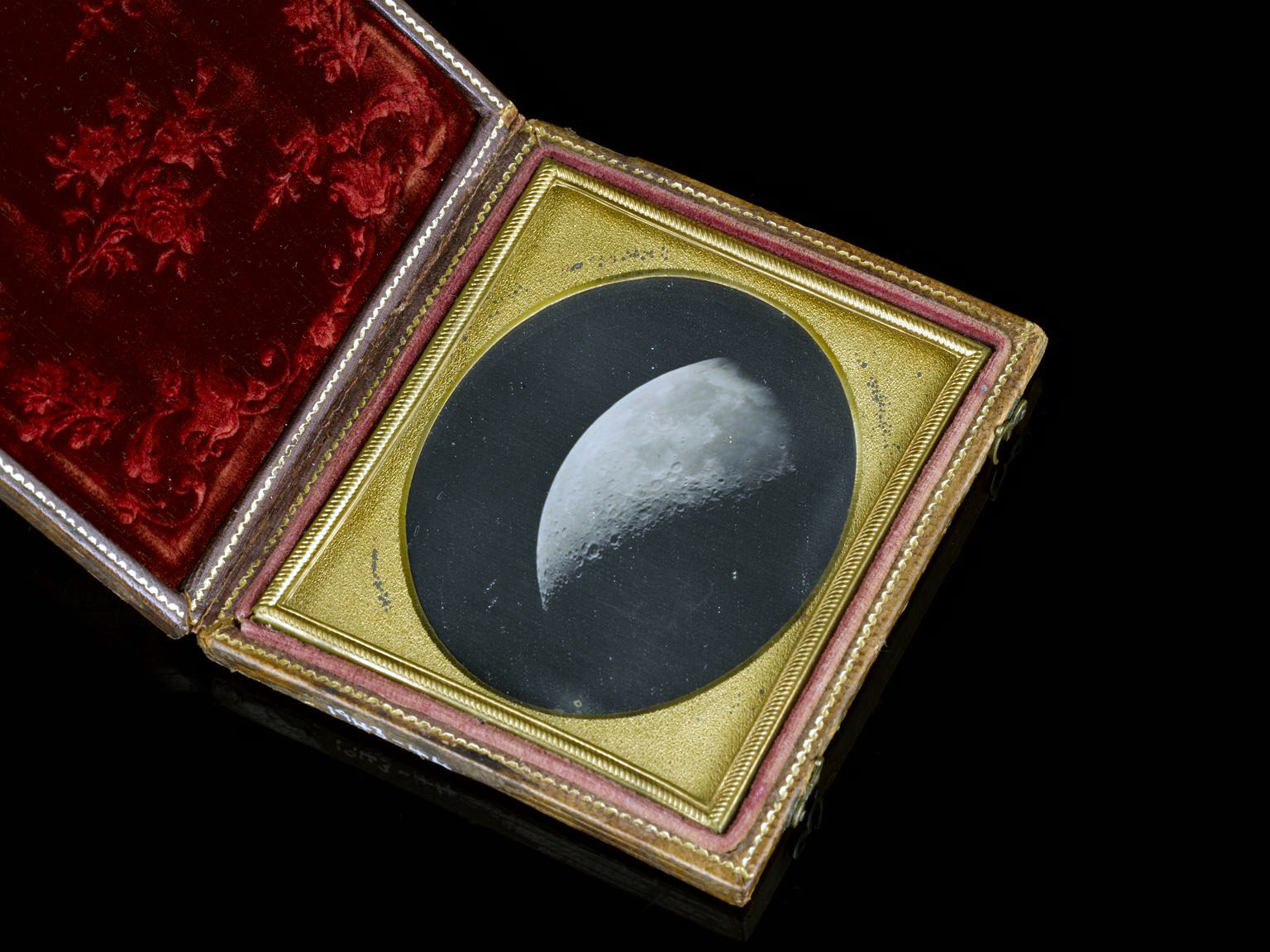
By all accounts, however, these earlier attempts at Moon photography were blurry and unfocused, showing little detail of the Earth’s satellite. Draper’s lunar “portrait,” from 1840, at the top, is largely considered “the world’s first true astrophoto,” writes Jason Major at Lights in the Dark, for its levels of detail and high contrast, comparatively speaking. As Scott Walker writes:
Draper set out to try and improve on Daguerre’s breakthrough by increasing plate sensitivity and reducing exposure times.… His advancement in the technique allowed visualization of craters, mountains and valleys on the moon’s surface which previously couldn’t be captured.
Splotched, spotted, and heavily degraded, the image may not look like much now, but a contemporary of Draper described it then as “the first time that anything like a distinct representation of the moon’s surface has been obtained.”
The achievement was inspirational, and many better attempts soon followed in rapid succession as the medium evolved. In 1851, photographer John Whipple and father-and-son astronomers William and George Bond improved on Draper’s process and made the Moon daguerreotype further up through the Great Refractor Equatorial Mount Telescope at the Harvard College Observatory. (The year previous, Draper himself collaborated with Bond père to make an image of the star Vega). The image caused a “veritable furor,” Smart History notes, at the Great Exhibition of 1851.
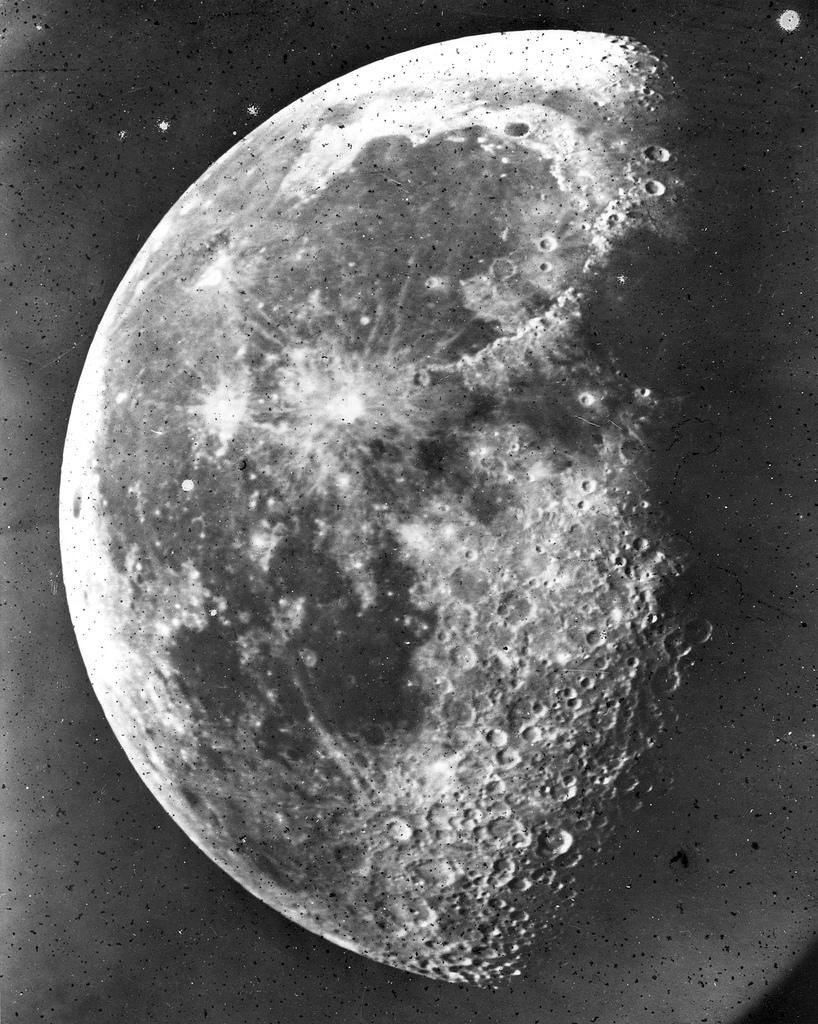
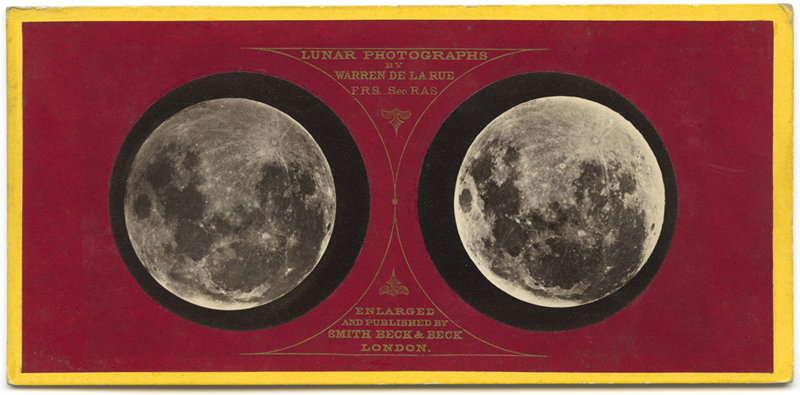
Between 1857 and 1862, astrophotographer and amateur astronomer Warren De La Rue made a series of stereoscopic Moon images (lovingly preserved online by astrophysicist and Queen guitarist Brian May), one of which you can see further up. De La Rue had seen Whipple’s daguerreotype at the Great Exhibition and began innovating his own process for creating stereoscopic astrophotographs. At the same time, Draper’s son, Henry, “an accomplished astrophotographer and one of the most famous American astronomers of his day,” Kiona Smith writes at Forbes, had taken over his father’s Moon photography project. See an 1863 image taken by the younger Draper just above.
“Before the invention of photography,” notes APS News, “astronomers had to sketch what they saw in their telescopes by hand, often missing crucial details.” Daguerre and Draper’s innovations, and those that came soon afterward, “showed them a far superior method was possible.” It is astonishing that these results could be achieved only a few decades after the first photograph, taken in 1826 by Nicéphore Niépce. It is maybe even more astonishing that only a century and a half or so later — a meaningless drop in the cosmic timescale — astrophotography would look beyond the moon to the very origins of the universe itself.
via Smart History
Related Content:
The First Photograph Ever Taken (1826)
The Full Rotation of the Moon: A Beautiful, High Resolution Time Lapse Film
Josh Jones is a writer and musician based in Durham, NC. Follow him at @jdmagness
Read More...Brian Eno’s Ambient Album Music for Airports Performed by Musicians in an Airport
Ambient Music must be able to accommodate many levels of listening attention without enforcing one in particular; it must be as ignorable as it is interesting.
In the original liner notes to Brian Eno’s founding document of Ambient music — 1978’s Ambient 1: Music for Airports — the artist explains that he named his genre after “an atmosphere, or a surrounding influence: a tint. My intention is to produce original pieces ostensibly (but not exclusively) for particular times and situations with a view to building up a small but versatile catalogue of environmental music suited to a wide variety of moods and atmospheres.”
In defining “environmental music,” Eno takes great pains to distinguish his new work from the makers of Muzak. Rather than recreating the familiar with instrumental schmaltz, and “stripping away all sense of doubt and uncertainty,” Ambient should stimulate listeners’ minds without disturbing or distracting them, inducing “calm and a space to think.” Rolling Stone at the time coined the derisive, but not wholly inaccurate, phrase “aesthetic white noise.”
Reverb Machine painstakingly shows in a deconstruction how Eno himself introduced as much uncertainty into the compositional process as possible. Music for Airports is not, that is to say, a composition, but layers of tape loops with snippets of recorded music. These loops he set running and “let them configure in whichever way they wanted to.” Acting as initial selector of sounds and engineer, Eno’s role as composer and player of the piece involved “hardly interfering at all,” he’s said.
How could such a composition translate to a traditional performance setting, in which musicians, elevated on a stage, play instruments for audience members who face them, listening intently? The situation seems antithetical to Eno’s design. And yet, somehow, the musicians who make up the Bang on a Can All Stars ensemble have made it work beautifully, performing Music for Airports’s first track, the nondescriptly named “1/1,” in an arrangement by the group’s Michael Gordon, above, for an appreciative audience at the San Diego Airport Terminal.
Bang on a Can is a group committed, like Eno, to “making music new.” Since 1987, they have (unlike Eno) done so in a live performance-based way, holding 12-hour marathon concerts, for example. These performances have included their rendition of Music for Airports in full. The Village Voice described a 2007 performance in New York City for hundreds of attentive fans as “beautiful,” a word that often gets applied to Eno’s masterwork of randomness. Eno himself described the results as “very, very nice,” and he’s maybe the last person to be surprised that a live performance of the first so-called Ambient record works so well.
“The interesting thing is that it doesn’t sound at all mechanical as you would imagine,” he wrote of these early tape loop experiments. “It sounds like some guy is sitting there playing the piano with quite intense feeling. The spacing and dynamics of ‘his’ playing sound very well organized.” See a quintet of “guys” just above — on cello, bass, keyboard, percussion, and guitar — recreate the mildly disjointed mood of standing around in the liminal space of an airport, for a crowd of people who, presumably, came there for the express purpose of hearing background music.
Related Content:
Brian Eno Explains the Origins of Ambient Music
A Six-Hour Time-Stretched Version of Brian Eno’s Music For Airports: Meditate, Relax, Study
Discover the Ambient Music of Hiroshi Yoshimura, the Pioneering Japanese Composer
Josh Jones is a writer and musician based in Durham, NC. Follow him at @jdmagness.
Read More...Listen to Earth.fm, a Free Archive of Natural Soundscapes That Can Re-Connect You with Nature & Improve Your Wellbeing
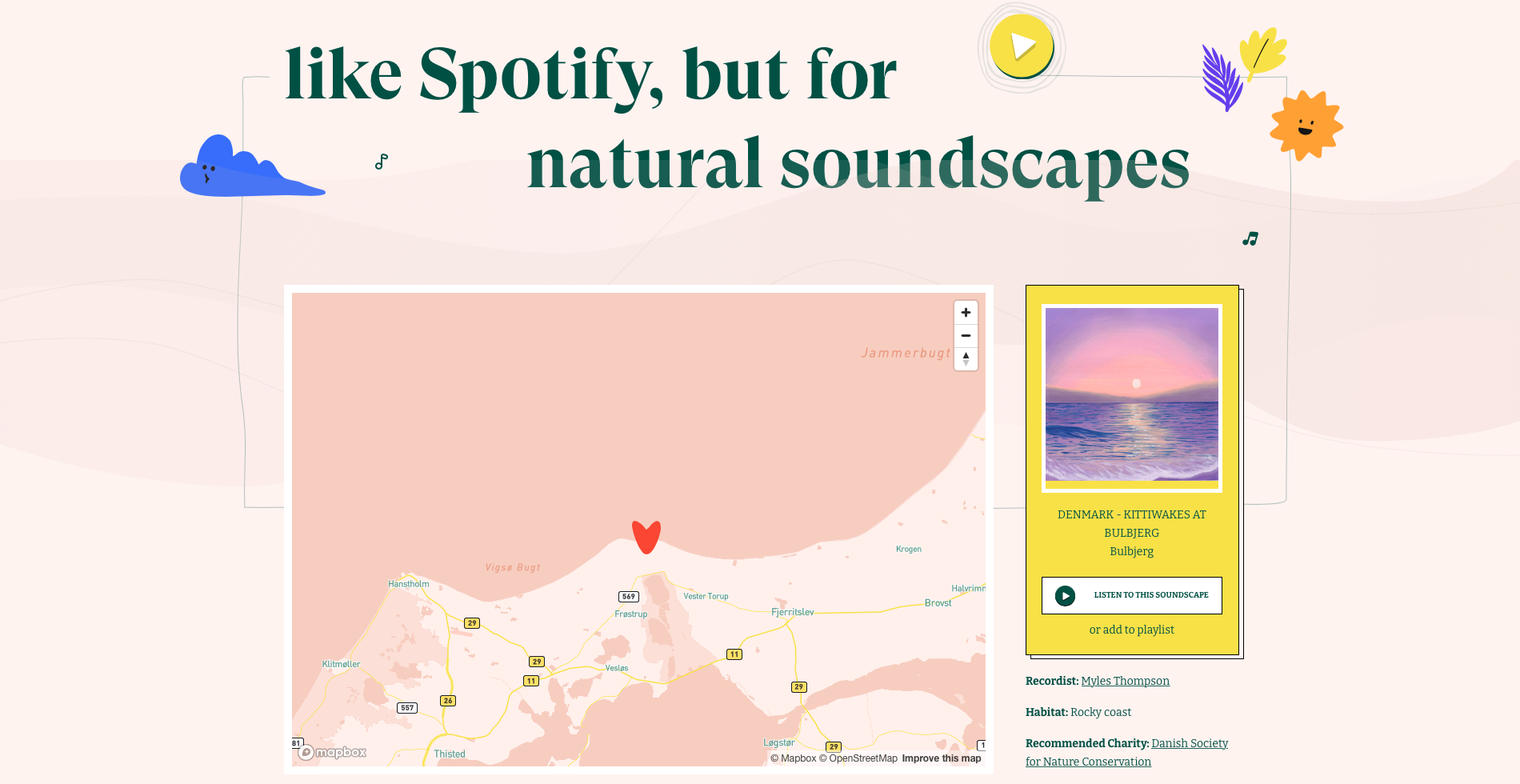
“Just listen. Silence is the poetics of space. What it means to be in a place…. Silence isn’t the absence of something, but the presence of everything.” – acoustic ecologist Gordon Hempton
The study of acoustic ecology doesn’t get much mainstream attention. But if you’ve been a reader of Open Culture, you’ve likely come across a post about preserving natural sounds by streaming recordings of the world’s many environments. These projects all, in one way or another, contribute to goals articulated by Canadian composer and writer R. Murray Schafer, the “self-declared father” of acoustic ecology, which involves the study, conservation, and appreciation of environmental sound.
As Neil Clarke notes at Earth.fm, Schaffer’s complex discipline can seem difficult to grasp, as it “straddles ‘acoustics, architecture, linguistics, music, psychology, sociology and urban planning.’ ” Maybe all we need to know to appreciate the goals of Earth.fm — another excellent entry in a growing list of natural-sound streaming sites – comes through in Clarke’s description of Schaffer’s World Soundscape Project (WSP):
It was hoped that, eventually, the WSP would be able to create a balance “between the human community and its sonic environment.” To this end, listening and “ear-cleaning” practices, including “soundwalks” – a walking meditation where a high sonic awareness is maintained – were designed to increase individuals’ consciousness of the sounds around them. By prompting engagement with the realities of contemporary soundscapes, listeners were intended to gain awareness of their part in these soundscapes’ creation, and therefore appreciate their responsibility towards them.
Schaffer began recording soundscapes (a word he coined) in Vancouver in the early 70s. Since then, his work has inspired and complemented that of other field recordists/acoustic theorists/sound archivists like Bernie Krauss and Gordon Hempton. Although the early acoustic ecologists could not have foreseen streaming media, it has without a doubt become for many of us a dominant vehicle for sound in our daily lives, including sounds of the natural world.
Without an appreciation for the sounds of natural silence (which we know, since John Cage, does not mean absolute quiet), our understanding of rainforests, deserts, and oceans as living, breathing realities can become dulled, just as much as we lose touch with the green spaces outside our windows. Reconnecting through sound has the dual effect of calming our inner states and attuning us more closely to the outer world as it is, without the distractions of recorded music and video laid overtop.
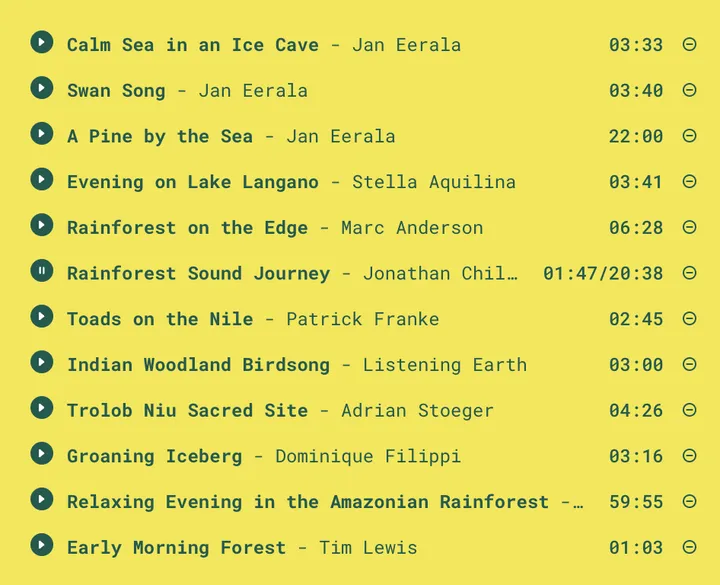
Billing itself as “like Spotify, but for natural soundscapes,” Earth.fm, offers not a rival streaming service, but an alternative in which users can make their own playlists, The Verge explains, “zipping from Brazil to Egypt in a matter of minutes.” New sounds are added every three days. “You can listen to bird species in Malaysia or India or forest sounds in Ghana. The sounds are gathered from numerous contributors who have experience recording the natural world in places including Brazil, Spain, Norway, New Zealand, and the United Kingdom.”
We can intuit Earth.fm’s mission not only as therapeutic and preservationist but also as an ethical attempt to approach the crisis streaming media has introduced in the arts. Human-made sounds (or “anthropophy”) are just as much a part of our environment as those made by frogs, rivers, and antelope. Our constant, often mindless streaming, however — made possible by infinite digital repositories and cheap (for now) energy — can be seen as a form of noise pollution, and a significant contributor to energy overconsumption.
The ethics of streaming must account for the impact on the beings (in this case, us) who make these sounds. Big Tech commodification of music requires a “vast conversation,” argues an essay on the Earth.fm site, that includes “the format’s impact on those at the heart of this whole undertaking: those who create music.” By implication, Earth.fm and other sites that stream acoustic recordings of natural sounds (like those in the links below), offer an ethical alternative to music streaming — one that reconnects us, Elizabeth Waddington writes on the site, to “the music of a changing world.” Learn more about Earth.fm’s activities here.
Related Content:
Free: Download the Sublime Sights & Sounds of Yellowstone National Park
Sounds of the Forest: A Free Audio Archive Gathers the Sounds of Forests from All Over the World
Josh Jones is a writer and musician based in Durham, NC. Follow him at @jdmagness
Read More...Watch the Titanic Sink in Real-Time
Minute by minute timelines have become a staple of disaster reporting.
Knowing how the story ends puts the public in the position of helpless bystander, especially at those critical junctures when someone in a position of authority exercised poor judgment, resulting in a larger loss of life.
Youtuber Phillip W, creator of Titanic Animations, allows us to experience the famed luxury liner’s final two and half hours as a timestamped horror show, above, without resorting to theatrics, or a crowd pleasing fictional romance.
Verified crew orders, CQD reports, and vacant lifeboat seats provide ample drama alongside mesmerizing CGI recreations of the doomed luxury liner, its lighted portholes reflected in the dark water.
It took around 2 and a half hours for the Titanic to sink, just four days into her maiden voyage, after striking an iceberg around 11:40 pm.
As the Smithsonian National Museum of American History recounts:
The berg scraped along the starboard or right side of the hull below the waterline, slicing open the hull between five of the adjacent watertight compartments. If only one or two of the compartments had been opened, Titanic might have stayed afloat, but when so many were sliced open, the watertight integrity of the entire forward section of the hull was fatally breached.
Titanic Animations tracks myriad crew members from this moment on, using factual titles, lightly supplemented with sound effects of ocean noises, alarm bells, and period tunes that would’ve been in the repertoire of the band that famously did (or didn’t) play on. The head baker directs staff to carry armloads of bread to provision the lifeboats. These morsels of information and the relatively placid views affords our imagination free rein to fill in the confusion, panic and mounting desperation of those aboard.
This real time sinking animation is rendered without human figures, but Titanic Animation’s Twitter indicates that Phillip W has been hard at work on a new project that places crew and passengers on deck, a — forgive us — titanic undertaking that also finds him striving to recreate every rivet and ripple. A status update from earlier this spring reads, “2.5 months in. 52,035 frames completed.178,364 left to go.”
The original animation, above, took multiple years to complete:
A friend and I started working on the first version back in 2012/2013 and it was released in 2015. It’s been updated over the years, and now I’m the only one left after my friend departed after losing interest. So around 8–9 years, give or take, and about $8000 in research and renderfarms to complete.
If you’re inclined to mess around with your own Titanic animations, Philip W. has shared a Cinematic Filming Model of the Titanic’s exterior, featuring accurate porthole placements, telegraphs, funnels, rigging, ventilation equipment placements, lifeboats, and approximately 95,000 rivets.
Subscribe to Titanic Animations here. Those with an interest in 3D animation will appreciate archived livestreams that give a peek at the process.
Navigate to key moments in real time sinking animation using the links below.
00:00:00 — Intro
00:05:00 — Iceberg Collision
00:10:00 — 10 Degree List to Starboard
00:11:00 — Steam begins to escape the Funnels
00:15:45 — Mail Room begins to flood
00:25:00 — Midnight
00:30:00 — Squash Court begins to flood
00:37:15 — Lifeboats ordered to be readied
00:42:00 — Band Begins Playing
00:49:40 — Thomas Andrews relays news to Capt. Smith
00:51:40 — First Distress Call is Sent
01:01:18 — Distress Coordinates are Corrected
01:01:38 — Carpathia Makes Contact
01:04:00 — Boat 7 (First Boat) is Launched
01:06:00 — The Straus’ Refuse Entry to Boat 8
01:07:00 — Grand Staircase F‑Deck Begins Flooding
01:08:10 — Boat 5 is Launched
01:10:00 — Boxhall & Smith spot Carpathia
01:12:10 — 1st Distress Rocket Fired
01:15:00 — Grand Staircase E‑Deck Begins Flooding
01:20:00 — Boat 3 is Launched
01:21:00 — Titanic Begins Sending SOS
01:25:00 — 1AM Boat 8 is Launched
01:30:00 — Boat 1 is Launched
01:35:00 — Boat 6 is Launched
01:35:15 — Boiler Room 5 Floods
01:40:00 — Water Climbs Grand Staircase
01:44:30 — Boiler Room 4 is Abandoned
01:45:00 — Boat 16 is Launched
01:50:00 — Boat 14 is Launched
01:55:15 — Boats 9 and 12 are Launched
02:00:00 — Boat 11 is Launched
02:04:00 — Titanic lists to Port
02:05:00 — Boat 13 is Launched
02:06:00 — Boat 15 is Launched
02:09:00 — D‑deck Reception Room Floods
02:10:00 — Boat 2 is Launched
02:12:00 — Well Deck is Awash
02:14:00 — D‑Deck Reception Room Goes
02:15:00 — Boat 10 is Launched
02:15:10 — Boat 4 is Launched
02:25:00 — 2AM Boat C is Launched
02:26:10 - Power Begins to Fade
02:29:00 — Boat D is Launched
02:37:15 — Nearer My God to Thee
02:40:00 — Final Plunge
02:42:00 — Breakup
Related Content
Titanic Survivor Interviews: What It Was Like to Flee the Sinking Luxury Liner
The Titanic: Rare Footage of the Ship Before Disaster Strikes (1911–1912)
How the Titanic Sank: James Cameron’s New CGI Animation
- Ayun Halliday is the Chief Primatologist of the East Village Inky zine and author, most recently, of Creative, Not Famous: The Small Potato Manifesto. Follow her @AyunHalliday.
Read More...Watch an 8‑Part Film Adaptation of Tolstoy’s Anna Karenina Free Online
Earlier this week we featured Sergei Bondarchuk’s four-part film adaptation of Leo Tolstoy’s War and Peace. You can watch that most ambitious of all filmed versions of War and Peace free online on the Youtube channel of Mosfilm, the Soviet Union’s national studio. Though the U.S.S.R. may have gone, Mosfilm hasn’t. Under the direction of filmmaker Karen Shakhnazarov, the studio has soldiered on as a quasi-private production company and put out a variety of films, many of them rooted in Russian history and literature. Five years ago, Shakhnazarov himself directed an eight-part adaptation of another beloved Tolstoy novel, Anna Karenina.
War and Peace (watch here) has been made into four different films. But that’s nothing beside the at least seventeen Anna Karenina movies in existence, not counting Shakhnazarov’s. It was first released in a relatively short cut, its runtime truncated to a bit over two and a half hours, as Anna Karenina: Vronsky’s Story.
That version’s narrative focused, as you may have guessed, on the life of Anna’s irresistible aristocratic lover. Later, Russia‑1 television broadcast Shakhnazarov’s work in full as an eight-episode series simply titled Anna Karenina, which you can now watch free online, in full, at Mosfilm’s Youtube channel. Stream all parts above.
In a sense, this serial format is well suited to Tolstoy’s novel, originally published as it was in installments between 1875 and 1877. But even those who’ve read Anna Karenina’s thousand pages over and over again will have reasons to be surprised by Shakhnazarov’s version, which takes the story of family, class, infidelity, faith, and feudalism in directions of its own. It also incorporates material from outside Tolstoy’s oeuvre, such as “During the Japanese War” and “Stories About the Japanese War” by Vikenty Veresaev, a doctor, writer, and Tolstoy scholar who participated in the Russo-Japanese War of 1904. Like any “free adaptation,” Shakhnazarov’s version of Anna Karenina, will send its viewers back to the book — and ensure that they never read it quite the same way again.
Related content:
Watch the Hugely Ambitious Soviet Film Adaptation of War and Peace Free Online (1966–67)
The Art of Leo Tolstoy: See His Drawings in the War & Peace Manuscript & Other Literary Texts
Free Online: Watch Stalker, Mirror, and Other Masterworks by Soviet Auteur Andrei Tarkovsky
Based in Seoul, Colin Marshall writes and broadcasts on cities, language, and culture. His projects include the Substack newsletter Books on Cities, the book The Stateless City: a Walk through 21st-Century Los Angeles and the video series The City in Cinema. Follow him on Twitter at @colinmarshall, on Facebook, or on Instagram.
Read More...The Earliest Known Footage of New Orleans Discovered: See a Mardi Gras Parade in 1898
“America has only three great cities: New York, San Francisco, and New Orleans. Everywhere else is Cleveland.” This quotation has been repeated for decades — not least, unsurprisingly, in New Orleans. I saw and heard it often on my last trip there, and though attributions varied, most credited the remark to either Mark Twain or Tennessee Williams. According to Quote Investigator, no historical evidence points to either man as the line’s originator, though “the notion that only three cities in the U.S. were commendable or distinctive has a very long history.”
In 1895, for instance, the then-popular comedienne Vernona Jarbeau said that “there are only three cities in the United States that I would care to live in, and one of them is San Francisco.” But she said it, one should note, to a San Francisco newspaper; who’s to say the crowd-pleasing instinct wouldn’t have motivated a transposition of her preference elsewhere in America? New Orleans, then in existence for more than half a century, possessed an even longer-established distinctiveness. The embellished galleries of the French Colonial buildings in the 1898 film clip above, identify the city at a glance.
Even more New Orleanian, of course, is what’s going on in the street: the city’s signature festivity, the Mardi Gras parade. “The film is not only the oldest moving picture of a New Orleans Mardi Gras; it’s the oldest film of New Orleans,” writes Smithsonian.com’s Jane Recker. Recently rediscovered in Amsterdam’s Eye Filmmuseum, the two-minute clip shows us — on detail-absorbing 68-millimeter film — that “one float is pineapple-themed, with riders wearing hats shaped like pieces of pineapple and vests resembling pineapple skin. Another features the Rex, the ‘King of the Carnival,’ sitting atop a float decorated with tasseled globes.”
“Contemporary viewers will surely recognize the film’s parade as a Mardi Gras celebration, though the event features some distinct differences from the one that takes over the Big Easy’s streets today,” writes Artnet’s Sarah Cascone. “There are, for example, no beads, no barricades, no police. Onlookers don suits and top hats and parasols, a far more formal approach than that taken by 21st-century revelers.” Here in the 2020s their revelry has been interrupted by the COVID-19 pandemic, and only this year did New Orleans’ Mardi Gras parade tradition resume. Perhaps it’s too much to hope that the dress sense of spectators 124 years ago will make a comeback as well.
Related content:
Louis Armstrong Remembers How He Survived the 1918 Flu Epidemic in New Orleans
The Serial Killer Who Loved Jazz: The Infamous Story of the Axeman of New Orleans (1919)
Based in Seoul, Colin Marshall writes and broadcasts on cities, language, and culture. His projects include the Substack newsletter Books on Cities, the book The Stateless City: a Walk through 21st-Century Los Angeles and the video series The City in Cinema. Follow him on Twitter at @colinmarshall, on Facebook, or on Instagram.
Read More...Support Us
We're hoping to rely on loyal readers, rather than erratic ads. Please click the Donate button and support Open Culture. You can use Paypal, Venmo, Patreon, even Crypto! We thank you!

About Us

Open Culture scours the web for the best educational media. We find the free courses and audio books you need, the language lessons & educational videos you want, and plenty of enlightenment in between.
Advertise With Us
FREE UPDATES!
GET OUR DAILY EMAIL
Get the best cultural and educational resources on the web curated for you in a daily email. We never spam. Unsubscribe at any time.
FOLLOW ON SOCIAL MEDIA
Open Culture editor Dan Colman scours the web for the best educational media. He finds the free courses and audio books you need, the language lessons & movies you want, and plenty of enlightenment in between.
Advertise With Us


