Simone de Beauvoir’s Philosophy on Finding Meaning in Old Age
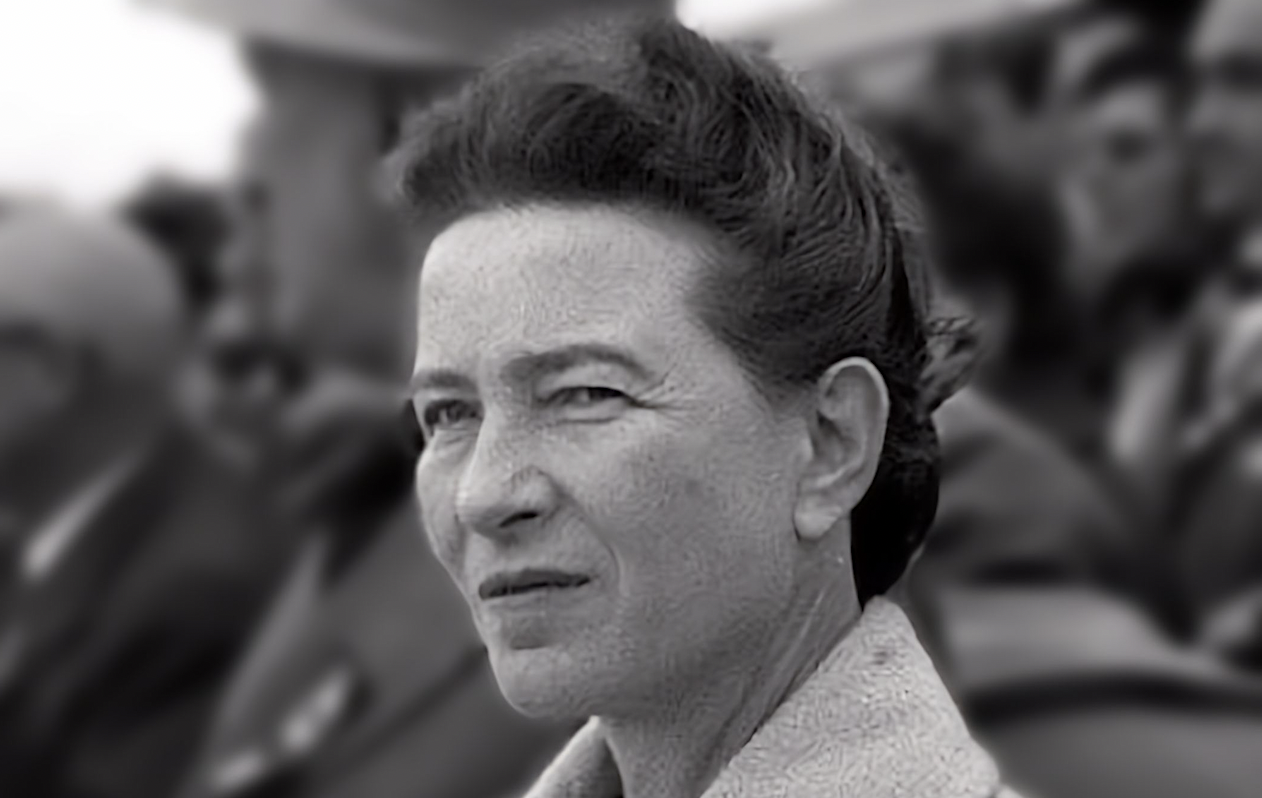
Image via Wikimedia Commons
In the legend of the Buddha, prince Siddhartha encounters the poor souls outside his palace walls and sees, for the first time, the human condition: debilitating illness, aging, death. He is shocked. As Simone de Beauvoir paraphrases in The Coming of Age, her groundbreaking study of the depredations of growing old, Siddhartha wonders, “What is the use of pleasures and delights, since I myself am the future dwelling-place of old age?”
Rather than deny his knowledge of suffering, the Buddha followed its logic to the end. “In this,” de Beauvoir writes ironically, “he differed from the rest of mankind… being born to save humanity.” We are mostly out to save ourselves – or our stubborn ideas of who we should be. The more wealth and power we have, the easier it may be to fight the transformations of age…. Until we cannot, since “growing, ripening, aging, dying – the passing of time is predestined.”
When she began to write about her own aging, de Beauvoir was besieged, she says, by “great numbers of people, particularly old people [who] told me, kindly or angrily but always at great length and again and again, that old age simply did not exist!” The hundreds and thousands of dollars spent to fight nature’s effect on our appearance only serves to “prolong,” she writes, our “dying youth.”
Obsessions with cosmetics and cosmetic surgery come from an ageism imposed from without by what scholar Kathleen Woodward calls “the youthful structure of the look” — a harsh gaze that turns the old into “The Other.” The aged are subject to a “stigmatizing social judgment, made worse by our internalization of it.” Ram Dass summarized the condition in 2019 by saying we live in “a very cruel culture” — an “aging society… with a youth mythology.”
The contradictions can be stark. Many of Ram Dass’ generation have become valuable fodder in marketing and politics for their reliability as voters or consumers, a major shift since 1972. But, for all the focus on baby boomers as a hated or a useful demographic, they are largely invisible outside of a certain wealthy class. Old age in the West is no less fraught with economic and social precarity than when de Beauvoir wrote.
De Beauvoir movingly describes conditions that were briefly evident in the media during the worst of the pandemic – the isolation, fear, and marginalization that older people face, especially those without means. “The presence of money cannot always alleviate” the pains of aging, wrote Elizabeth Hardwick in her 1972 review of de Beauvoir’s book in translation. “Its absence is a certain catastrophe.”
The problem, de Beauvoir pointed out, is that old age is almost synonymous with poverty. The elderly are deemed unproductive, unprofitable, a burden on the state and family. She quotes a Cambridge anthropologist, Dr. Leach, who stated at a conference, “in effect, ‘In a changing world, where machines have a very short run of life, men must not be used too long. Everyone over fifty-five should be scrapped.’”
The sentiment, expressed in 1968, sounds not unlike a phrase bandied around by business analysts thanks to Erik Brynjolkfsson’s call for human beings to “race with the machines.” It is, eventually, a race everyone loses. And the push for profitability over human flourishing comes back to haunt us all.
We carry this ostracism so far that we even reach the point of turning it against ourselves: for in the old person that we must become, we refuse to recognize ourselves.”
De Beauvoir’s response to the widespread cultural denial of aging was to write the first full-length philosophical study of aging in existence, “to break the conspiracy of silence,” she proclaimed. First published as La vieillesse in 1970, the book dared tread where no scholar or thinker had, as Woodward writes in a 2016 re-appraisal:
The Coming of Age is the inaugural and inimitable study of the scandalous treatment of aging and the elderly in today’s capitalist societies…. There was no established method or model for the study of aging. Beauvoir had to invent a way to pursue this enormous subject. What did she do? …. She surveyed and synthesized what she had found in multiple domains, including biology, anthropology, philosophy, and the historical and cultural record, drawing it all together to argue with no holds barred that the elderly are not only marginalized in contemporary capitalist societies, they are dehumanized.
The book is just as relevant in its major points, argues professor of philosophy Tove Pettersen, despite some sweeping generalizations that may not hold up now or didn’t then. But the exclusions suffered by aging women in capitalist societies are still especially cruel, as the philosopher argued. Women are still stigmatized for their desires after menopause and ceaselessly judged on their appearance at all times.
De Beauvoir’s study has been compared to the exhaustive work of Michel Foucault, who excavated such human conditions as madness, sexuality, and punishment. And like his studies, it can feel claustrophobic. Is there any way out of being Othered, pushed aside, and ignored by the next generation as we age? “Beauvoir claims that the oppressed are not always just passive victims,” says Pettersen, “and that not all oppression is total.”
We may be conditioned to see aging people as no longer useful or desirable, and to see ourselves that way as we age. But to wholly accept the logic of this judgment is to allow old age to become a “parody” of youth, writes de Beauvoir, as we chase after the past in misguided efforts to reclaim lost social status. We must resist the backward look that a youth-obsessed culture encourages by allowing ourselves to become something else, with a focus turned outward toward a future we won’t see.
As an old Zen master once pointed out, the leaves don’t go back on the tree. The leaves in fall and the tree in winter, however, are things of beauty and promise:
There is only one solution if old age is not to be an absurd parody of our former life, and that is to go on pursuing ends that give our existence a meaning — devotion to individuals, to groups or to causes, social, political, intellectual or creative work… In old age we should wish still to have passions strong enough to prevent us turning in on ourselves. One’s life has value so long as one attributes value to the life of others, by means of love, friendship, indignation, compassion.
Borrow de Beauvoir’s The Coming of Age from the Internet Archive and read it online for free. Or purchase a copy of your own.
Related Content:
Ram Dass (RIP) Offers Wisdom on Confronting Aging and Dying
Life Lessons From 100-Year-Olds: Timeless Advice in a Short Film
Josh Jones is a writer and musician based in Durham, NC. Follow him at @jdmagness
Read More...
The Only Written Eye-Witness Account of Pompeii’s Destruction: Hear Pliny the Younger’s Letters on the Mount Vesuvius Eruption
Though my shocked soul recoils, my tongue shall tell. — Pliny the Younger
A great deal of what we know — or think we know — about the destruction of Pompeii and Herculaneum in 79 AD comes filtered through modern mythologies like the 1834 novel The Last Days of Pompeii. Written by Edward Bulwer-Lytton (the first novelist to start a tale with “It was a dark and stormy night”), the book’s Romantic fascination with civilizational decay was one stream of thinking that blames Pompeiians themselves, in part, for their destruction. That blame manifests as explicit, or more subtle, suggestions of divine punishment. Or it can look like chiding impractical residents who didn’t get out in time or took the wrong route out of town to avoid the heavy downpour of molten rock and ash, as though a volcanic eruption were a traffic jam in a thunderstorm.…
Blame is a reflexive defense against the horrifying possibility that the screaming figures frozen in ash could be us. There’s little to counter our certainty from Pompeiians themselves. Somewhere between 10,000 to 12,000 people got out in time (approximately 2,000 were killed), but there are no existing accounts from the city’s former residents-turned- refugees. If they had anything to say about it later, we’ll never know. We do, however, have an eyewitness account of the destruction. Its author, Pliny the Younger, watched from a vantage point above the immediate scenes of panic and death: his villa across the bay of Naples in Misenum. He also happened to be nephew to the great Roman naturalist and military campaigner Pliny the Elder, and an adept writer and keen observer of nature himself.
Pliny the Younger’s letters — published in 9 volumes during his lifetime, 10 afterward — hold more interest for historians than their descriptions of Vesuvius. In his long life, “he was a poet, a senator, a public official,” Joan Acocella writes at The New Yorker. He had firsthand knowledge of “celebrated crimes” among the Roman elite. But the destruction of Pompeii was formative: his uncle died in an attempted evacuation of the city by sea, a major event for Pliny and for Roman arms and letters. While the Younger had been at leisure in Misenum, the Elder had been at work, “in active command of the fleet,” his nephew writes in a letter to his friend, fellow lawyer, and later famed historian Publius Cornelius Tacitus. Pliny begins with an explanation, more or less, for why he’s still alive.
When his uncle saw the “cloud of unusual size and appearance” rising over the bay, he “ordered a boat made ready, telling me I could come with him if I wished.” Had the cautious nephew accepted his invitation, Pliny the Younger would probably have died at the age of 18, something he surely meditated upon from time to time in later life. In the letter, he styles his uncle as a “hero” for his rescue attempts. Pliny wasn’t there himself to see these events, but he imagines what his uncle said and did. He even describes Pliny the Elder’s dramatic collapse and death in Stabiae, several miles away across the Bay. It’s hard to sift the facts from literary embellishment, but Pliny’s descriptions of Vesuvius itself are vivid and terrifying. The mountain, he writes, was covered in “broad sheets of fire and leaping flames… their bright glare emphasized by the darkness of night.”
His observations of the initial eruption seem highly credible given his actual location:
It was not clear at that distance from which mountain the cloud was rising (it was afterwards known to be Vesuvius); its general appearance can best be expressed as being like an umbrella pine, for it rose to a great height on a sort of trunk and then split off into branches, I imagine because it was thrust upwards by the first blast and then left unsupported as the pressure subsided, or else it was borne down by its own weight so that it spread out and gradually dispersed. In places it looked white, elsewhere blotched and dirty, according to the amount of soil and ashes it carried with it.
Pliny seems to want to write more about what he saw, but he obliges Tacitus’ request to tell the story of his uncle’s death. “You will pick out of this narrative whatever is most important,” he concludes. “For a letter is one thing, a history another; it is one thing writing as a friend, another thing writing to the public.” You can hear the letter read in full in the YouTube video above from Voices of the Past.
The line between public history and private correspondence may not be so clear as Pliny imagined, especially when his letters are the only eyewitness sources we have. In a second missive to Tacitus, per his friend’s request, Pliny describes the scene back in Misenum on the second day of the eruption. He and his mother had debated what to do, and finally decided to evacuate. Here, writing about events he experienced firsthand, he strays from the narrative conventions of his first letter, conveying the chaotic atmosphere of terror all around him as they left. The letter is harrowing, and worth quoting at length.
Though Pliny himself, at the end of the letter, pronounces it unworthy of inclusion in Tacitus’ history, it remains the one firsthand account to which we can turn when imagining the experience.
Ashes were already falling, not as yet very thickly. I looked round: a dense black cloud was coming up behind us, spreading over the earth like a flood. ‘Let us leave the road while we can still see,’ I said, ‘or we shall be knocked down and trampled underfoot in the dark by the crowd behind.’ We had scarcely sat down to rest when darkness fell, not the dark of a moonless or cloudy night, but as if the lamp had been put out in a closed room.
You could hear the shrieks of women, the wailing of infants, and the shouting of men; some were calling their parents, others their children or their wives, trying to recognize them by their voices. People bewailed their own fate or that of their relatives, and there were some who prayed for death in their terror of dying. Many besought the aid of the gods, but still more imagined there were no gods left, and that the universe was plunged into eternal darkness for evermore.
There were people, too, who added to the real perils by inventing fictitious dangers: some reported that part of Misenum had collapsed or another part was on fire, and though their tales were false they found others to believe them. A gleam of light returned, but we took this to be a warning of the approaching flames rather than daylight. However, the flames remained some distance off; then darkness came on once more and ashes began to fall again, this time in heavy showers. We rose from time to time and shook them off, otherwise we should have been buried and crushed beneath their weight. I could boast that not a groan or cry of fear escaped me in these perils, but I admit that I derived some poor consolation in my mortal lot from the belief that the whole world was dying with me and I with it.
Related Content:
Pompeii Rebuilt: A Tour of the Ancient City Before It Was Entombed by Mount Vesuvius
Josh Jones is a writer and musician based in Durham, NC. Follow him at @jdmagness
Read More...How a Dutch “Dementia Village” Improves Quality of Life with Intentional Design
People suffering from dementia lose their ability to take an active part in conversations, everyday activities, and their own physical upkeep.
They are prone to sudden mood swings, irritability, depression, and anxiety.
They may be stricken with delusions and wild hallucinations.
All of these things can be understandably upsetting to friends and families. There’s a lot of stigma surrounding this situation.
Taking care of a spouse or parent with dementia can be an overwhelmingly isolating experience, though no one is more isolated than the person experiencing severe cognitive decline firsthand.
While many of us would do anything to stay out of them, the sad fact is residential memory care facilities are often the end-of-the-line reality for those living with extreme dementia.
During the first summer of the COVID-19 pandemic, nursing home deaths attributed to Alzheimer’s disease and dementia increased by more than 20 percent, owing to such factors as chronic staffing shortages and a ban on outside visitors.
As DeAnn Walters, director of clinical affairs for the California Association of Health Facilities, told Politico:
We’re trying to be supporter, social worker, caregiver, friend and housekeeping for the resident. It’s putting a lot of pressure on the caregivers and the operation of the facility to make sure everyone has what they need. Before the pandemic we couldn’t even get socks on people and you’d see them walking around barefoot.
Not the vision any of us would choose for our parent’s golden years, or our own.
The Hogeweyk, a planned village just outside of Amsterdam, offers a different sort of future for those with severe dementia.
The above episode of By Design, Vox’s series about the intersection of design and technology, explores the innovations that contribute to the Hogeweyk’s residents overall happiness and wellbeing.
Rather than grouping residents together in a single institutional setting, they are placed in groups of six, with everyone inhabiting a private room and sharing common spaces as they see fit.
The common spaces open onto outdoor areas that can be freely enjoyed by all housed in that “neighborhood”. No need to wait until a staff member grants permission or finishes some task.
Those wishing to venture further afield can avail themselves of such pleasant quotidian destinations as a grocery, a restaurant, a barbershop, or a theater.
These locations are designed in accordance with certain things proven to work well in institutional settings — for instance, avoiding dark floor tiles, which some people with dementia perceive as holes.
But other design elements reflect the choice to err on the side of quality of life. Hand rails may help in preventing falls, but so do rollators and walkers, which the residents use on their jaunts to the town squares, gardens and public amenities.
The designers believe that equipping residents with a high level of freedom not only promotes physical activity, it minimizes issues associated with dementia like aggression, confusion, and wandering.
Co-founders Eloy van Hal and Jannette Spiering write that the Hogeweyk’s critics compare it to the Truman Show, the 1998 film in which Jim Carrey’s title character realizes that his wholesome small town life, and his every interaction with his purported friends, neighbors, and loved ones, have been a set up for a highly rated, hidden camera reality TV show.
They describe The Hogeweyk as a stage for, “the reminiscence world”, in which actors help the residents live in a fictitious world. Many Alzheimer’s experts have, however, valued The Hogeweyk for what it really is: a familiar and safe environment in which people with dementia live while retaining their own identity and autonomy as much as possible. They live in a social community with real streets and squares, a real restaurant with real customers, a supermarket for groceries and a theatre that hosts real performances. There is no fake bus stop or post office, there are no fake façades and sets. The restaurant employee, the handyman, the caretaker, the nurse, the hairdresser, etc.—in short: everyone who works at The Hogeweyk uses their professional skills to actually support the residents and are, therefore, certainly not actors.
Professional care and support goes on around the clock, but rarely takes centerstage. Normal life is prioritized.
A visitor describes a stroll through some of the Hogeweyk’s public areas:
In the shade of one of the large trees, a married couple gazes happily at the activity in the theatre square. An elderly gentleman, together with a young lady, intently study the large chess board and take turns moving the pieces. At the fountain, a group of women chat loudly on colourful garden chairs. The story is clearly audible—it is about a memory of a visit to a park in Paris which had the same chairs. Passers-by, old and young, greet the women enthusiastically. A little further on, a woman is talking to a man opposite her. She is gesturing wildly. After a while, another woman joins the conversation. The two women then walk through the open front door of Boulevard 15.
The covered passage smells of freshly-baked cookies. The scent is coming from De Bonte Hof. Amusing conversations can be heard that pause for a moment when the oven beeps in the kitchen that has been decorated in an old-fashioned style. A tray of fresh cookies is removed from the oven. Two women, one in a wheelchair, enter the venue, obviously seduced by the smell. They sample the cookies.
The supermarket across the street is very busy. Shopping trolleys loaded with groceries are pushed out of the shop. The rattle of a shopping trolley dissipates into the distance as it disappears from view towards Grote Plein. A man reluctantly pushes the full trolley while two women follow behind him arm in arm. The trio disappear behind the front door of Grote Plein 5.
A staffer’s account of a typical morning in one of Hogeweyk’s houses reveals more about the hands-on care that allows residents to continue enjoying their carefully designed home, and the autonomous lifestyle it makes possible:
Mr Hendricks wakes up on the sofa. He unzips his fly. I jump up and escort him to the toilet just in time. I grab a roll of medication for him from the medication trolley. He is now walking to his room. We pick out clothes together and I lay them out on his bed. He washes himself at the sink. I watch briefly before leaving. Fifteen minutes later, I poke my head through the door. That’s not how electric shaving works! I offer to help, but Mr. Hendricks is clearly a bit irritated and grumbles. He’ll be a little less shaven today. We’ll try again after breakfast…
We help Mrs Stijnen into the shower chair with the hoist. She is clearly not used to it. Discussing her extensive Swarovski collection, displayed in the glass case in her room, turns out to be an excellent distraction. She proudly talks about the latest piece she acquired this year. On to the shower. The two other residents are still sleeping. Great, that gives me the chance to devote some extra time to Mrs Stijnen today.
The doorbell rings again and my colleague, Yasmin, walks in. She’s the familiar face that everyone can rely on. Always present at 8 a.m., 5 days a week. What a relief for residents and family. She, too, puts her coat and bag in the locker. The washing machine is ready, and Yasmin loads up the dryer. The table in the dining room is then set. Yasmin puts a floral tablecloth from the cupboard on the table. Mr Hendricks lends a hand and, with some guidance, puts two plates in their place, but then walks away to the sofa and sits down. A Dutch breakfast with bread, cheese, cold cuts, jam, coffee, tea and milk is served. Yasmin is making porridge for Mrs Smit. As always, she has breakfast in bed. Yasmin helps Mrs Smit. It is now 08:45 and Mr Hendricks and Mrs Stijnen are sitting at the dining table. Yasmin pushes the chairs in and sits down herself. They chat about the weather, and Yasmin lends a helping hand when needed.
Mr Hendricks is really grumpy today and is currently grumbling at Mrs Jansen. I’m wondering if we’re overlooking something?
Learn more about the Hogeweyk, the world’s first dementia village here.
Watch a playlist of Vox By Design episodes here.
Related Content
How Music Can Awaken Patients with Alzheimer’s and Dementia
Dementia Patients Find Some Eternal Youth in the Sounds of AC/DC
- Ayun Halliday is the Chief Primatologist of the East Village Inky zine and author, most recently, of Creative, Not Famous: The Small Potato Manifesto. Follow her @AyunHalliday.
Read More...Pink Lady and Jeff: Japan’s Biggest Pop Musicians Star in One of America’s Worst-Reviewed TV Shows (1980)
In 1963, Kyu Sakamoto’s “Sukiyaki” proved that a song sung in Japanese could top the charts in the United States. Not that the American recording industry was quick to internalize it: another Japanese single wouldn’t break the Billboard Top 40 for sixteen years, and even then it did so in English. The song was “Kiss in the Dark” by Pink Lady, a pop duo consisting of Mitsuyo Nemoto and Keiko Masuda, better known as Mie and Kei. In 1978 they’d been the biggest pop-cultural phenomenon in their native country, but the following year their star had begun unmistakably to fall. And so, like many passé Western acts who become “big in Japan,” Pink Lady attempted to cross the Pacific.
Mie and Kei made their American television debut performing “Kiss in the Dark” on Leif Garrett’s CBS special in May 1979. Accounts differ about what happened next, but less than a year later they had their own primetime variety show on NBC. Officially titled Pink Lady, it tends to be referred to these four decades later as Pink Lady and Jeff. This owes to the role of its host, rising (and NBC-contracted) young comedian Jeff Altman, who brought to the table not just his comic timing and skill with impressions, but also his command of the English language. That last happened not to be possessed to any significant degree by Mie or Kei, who had to deliver both their songs and their jokes phonetically.
In the video at the top of the post, you can see a compilation of the highlights of Pink Lady and Jeff’s entire run. Then again, “highlights” may not be quite the word for a TV show now remembered as one of the worst ever aired. “Pink Lady and Jeff represents an unpalatable combination of institutions that were on their way out, like variety shows, disco, and the television empire of creators and puppeteers Sid and Marty Krofft,” writes the AV Club’s Nathan Rabin. The Krofft brothers, creators of H.R. Pufnstuf and Land of the Lost, tell of having been tapped to develop a program around Mie and Kei by NBC president Fred Silverman, who’d happened to see footage of one of their stadium-filling Tokyo concerts on the news.
Sid Krofft remembers declaring his ambition to make Pink Lady “the strangest thing that’s ever been on television.” The startled Silverman’s response: “Let’s do Donny and Marie.” Donny Osmond himself ended up being one of the show’s high-profile guest stars, a lineup that also included Blondie, Alice Cooper, Sid Caesar, Teddy Pendergrass, Roy Orbison, Jerry Lewis, and even Larry Hagman just a week before the epochal shooting of his character on Dallas. None of them helped Pink Lady find enough of an audience to survive beyond its initial six episodes (all available to watch on Youtube), a discomfiting mélange of generic comedy sketches, unsuitable musical performances (with precious few exceptions, Mie and Kei weren’t permitted to sing their own Japanese songs), and broad references to sushi, samurai, and sumo.
The main problem, Altman said in a more recent interview, was that “the variety show had run the gauntlet already, and really was not a format that was going to live in the hearts and homes of people across America anymore.” Not only had that long and earnest television tradition come to its ignominious end, it would soon be replaced by the ironic, ultra-satirical sensibility of Altman’s colleague in comedy David Letterman. But here in the twenty-first century, Altman guesses, the time may be ripe “for a variety-type show to come back.” We live in an era, after all, when a piece of forgotten eighties Japanese pop can become a global phenomenon. And however dim the prospects of the variety show as a form, Mie and Kie themselves have since managed more comebacks than all but their most die-hard fans can count.
Related content:
David Bowie and Cher Sing Duet of “Young Americans” and Other Songs on 1975 Variety Show
Famed Art Critic Robert Hughes Hosts the Premiere of 20/20, Where Tabloid TV News Began (1978)
Based in Seoul, Colin Marshall writes and broadcasts on cities, language, and culture. His projects include the Substack newsletter Books on Cities, the book The Stateless City: a Walk through 21st-Century Los Angeles and the video series The City in Cinema. Follow him on Twitter at @colinmarshall, on Facebook, or on Instagram.
Read More...What Made Better Call Saul a Master Class in Visual Storytelling: A Video Essay
A decade ago, nobody interested in prestige dramatic television could have ignored Breaking Bad, Vince Gilligan’s AMC series about a downtrodden high-school chemistry teacher who becomes a calculating and savage crystal-meth dealer. Such was the critical and popular success of the show that, less than two years after it ended, it was resumed in the form of Better Call Saul. The title character Saul Goodman had been the aforementioned teacher-turned-dealer’s lawyer in Breaking Bad, and the later series, a prequel, traces the half-decade journey that brought him to that point: a journey that began when he was a Chicago con man named Jimmy McGill.
Better Call Saul’s six-season run (one episode longer than Breaking Bad) came to an end this week. During that time, the show has received even stronger accolades than the one that spun it off. To get a sense of what makes it such an achievement in a field crowded with some of the most ambitious creators of popular culture today, watch the video essay above by Youtuber Thomas Flight.
Here on Open Culture, we’ve previously featured his visual analyses of auteurs like Wes Anderson and Bong Joon-ho as well as shows like The Wire and Chernobyl. Five years ago, he uploaded a video explaining “why Better Call Saul is brilliant”; now he argues that it’s a “master class in visual storytelling.”
“ ‘Show, don’t tell’ is such common advice in filmmaking and screenwriting that it’s basically a cliché at this point,” says Flight, “but it’s also much easier said than done.” He goes on to draw from Better Call Saul a host of prime examples of showing-not-telling, organized into four categories of its special strengths: “props as symbolic objects,” “visual performances,” “characters in process,” and “storytelling with cinematography.” Better Call Saul’s creators make rich use of objects, gestures, expressions, places, angles, and much else besides to tell — or rather, show — the story of Jimmy/Saul’s transformation, as well as the transformations of those around him. But which of those characters will star in Gilligan’s next, surely even more ambitious series?
Related content:
How Breaking Bad Crafted the Perfect TV Pilot: A Video Essay
Watch the Pilot of Breaking Bad with a Chemistry Professor: How Sound Was the Science?
The Science of Breaking Bad: Professor Donna Nelson Explains How the Show Gets it Right
Watch the Original Audition Tapes for Breaking Bad Before the Final Season Debuts
Breaking Bad Illustrated by Gonzo Artist Ralph Steadman
Based in Seoul, Colin Marshall writes and broadcasts on cities, language, and culture. His projects include the Substack newsletter Books on Cities, the book The Stateless City: a Walk through 21st-Century Los Angeles and the video series The City in Cinema. Follow him on Twitter at @colinmarshall, on Facebook, or on Instagram.
Read More...Orson Welles Reads the Abolitionist John Brown’s Final Speech After Being Sentenced to Death
Orson Welles was only 25 years old when he directed and starred in Citizen Kane, a film still widely considered the best ever made. Even then, he’d already been a household name for at least three years, since his controversially realistic radio adaptation of H. G. Wells’ The War of the Worlds. But Welles’ high profile at a young age came as a result of serious work at an even younger one. His earlier efforts include Marching Song, a never-produced stage play about the abolitionist John Brown, which he co-wrote with his former schoolmaster Roger Hill when he was just seventeen years old.
Published only in 2019, Marching Song proves that Welles had been working in the fragmented-biography narrative form well before Citizen Kane. It also shows the depth of his fascination with the figure of John Brown. As research, Welles and Hill visited historical sites including Harper’s Ferry, the Virginia town in which Brown, in October of 1859, led the raid on a federal armory meant as the first blow in a large-scale slave-liberation movement. As every American learns in school, Brown’s rebellion did not go as planned — not only did he lose more men than he’d expected to, he also gained the cooperation of fewer slaves than he’d expected to — and brought the country closer to civil war.
About two months later, Brown became the first person executed for treason in the history of the United States. That the verdict didn’t take him by surprise is evidenced by the eloquence of his last speech, delivered extemporaneously after his conviction. Devoutly religious, he used it to make a final appeal to a higher authority. “This court acknowledges, as I suppose, the validity of the law of God,” he said. “I see a book kissed here which I suppose to be the Bible, or at least the New Testament. That teaches me that ‘all things whatsoever I would that men should do to me, I should do even so to them.’ It teaches me, further, to ‘remember them that are in bonds, as bound with them.’ I endeavored to act up to that instruction.”
He then added, “I am yet too young to understand that God is any respecter of persons” — with the clear irony that he was at that point 59 years old, not to mention intimately familiar with the Bible. The gravity of the occasion, and of Brown’s demeanor, might have been too much for the teenage Welles to embody. But when he got older he did well indeed by the text of Brown’s last speech, a performance captured in the video above. He’d also managed, writes Mass Live’s Ray Kelly, to “stage Macbeth with an all-black cast in Harlem in 1936,” produce “the controversial Native Son on Broadway,” and use radio “to seek justice for blinded African-American veteran Isaac Woodard Jr.” Welles never had to face the gallows for his convictions, but could certainly channel the spirit of a man who was prepared to.
Related content:
The Anti-Slavery Alphabet: 1846 Book Teaches Kids the ABCs of Slavery’s Evils
How Karl Marx Influenced Abraham Lincoln and His Position on Slavery & Labor
When Orson Welles Became a Speech & Joke Writer for Franklin Delano Roosevelt
Based in Seoul, Colin Marshall writes and broadcasts on cities, language, and culture. His projects include the Substack newsletter Books on Cities, the book The Stateless City: a Walk through 21st-Century Los Angeles and the video series The City in Cinema. Follow him on Twitter at @colinmarshall, on Facebook, or on Instagram.
Read More...Three Female Artists Who Helped Create Abstract Expressionism: Lee Krasner, Elaine de Kooning & Helen Frankenthaler.
The three artists that gallerists James Payne and Joanne Shurvell have chosen to represent New York City in their series Great Art Cities Explained are as refreshing as they are surprising.
Andy Warhol?
Nope.
No.
Uh-uh.
These gents would be the obvious choice, though only one of the three — Basquiat was a native New Yorker.
Instead, Payne and Shurvell aim their spotlight at three NYC-born Abstract Expressionists.
Three female NYC-born Abstract Expressionists — Lee Krasner, Elaine de Kooning, and Helen Frankenthaler.
These women’s contributions to the movement were considerable, but Krasner and deKooning spent much of their careers overshadowed by celebrated husbands — fellow Abstract Expressionists Jackson Pollock and Willem de Kooning.
The New York-based Abstract Expressionism deposed Paris as the center of the art world, and was the most macho of movements. Krasner, Frankenthaler, and Elaine de Kooning often heard their work described as “feminine”, “lyrical”, or “delicate”, the implication being that it was somehow less than.
Hans Hofmann, an Abstract Expressionist who ran the 8th Street atelier where Krasner studied after training at Cooper Union, the Art Students League, and the National Academy of Design, and working for the WPA’s Federal Art Project, once praised one of her canvases by saying, “This is so good you would not believe it was done by a woman.”
Payne and Shurvell detail how the sociable Krasner, already established in the NYC art scene, shared important contacts with Pollock, with whom she became romantically entangled shortly after their work was shown alongside Picasso’s, Matisse’s , and Georges Braque’s in the pivotal 1942 French and American Painting exhibition at the McMillen Gallery.
She was an energetic promoter of his work, and a cheerleader when he flagged.
They married and moved to Long Island in an unsuccessful bid to put the kibosh on his drinking and extracurricular affairs. He commandeered a barn on the property for his studio, while she made do with a bedroom.
While Pollock ranged around large canvases laid on the barn floor, famously splattering, Krasner produced a Little Image series on a table, sometimes applying paint straight from the tube.
MoMA’s description of an untitled Little Image in their collection states:
Krasner likened these symbols to Hebrew letters, which she had studied as a child but could no longer read or write. In any case, she said, she was interested in creating a language of private symbols that did not communicate any one specific meaning.”
After Pollock died in a car crash while driving under the influence — his mistress survived — Krasner claimed the barn studio for her own practice.
It was a transformative move. Her work not only grew larger, it was informed by the full-body gestures that went into its creation.
Ten years later, she got her first solo show in New York, and MoMA gave her a retrospective in 1984, six months before her death.
In a wildly entertaining 1978 interview on Inside New York’s Art World, below, Krasner recalls how early on, her gender didn’t factor into how her work was received.
I start in high school, and it’s only women artists, all women. Then I’m at Cooper Union, woman’s art school, all women artists and even when I’m on WPA later on, there’s no — you know, there’s nothing unusual about being a woman and being an artist. It’s considerably later that all this begins to happen, specifically when the seat moves from Paris, which was the center, and shifts into New York, and I think that period is known as Abstract Expressionism, where we now have galleries, price, money, attention. Up ’til then it’s a pretty quiet scene. That’s when I’m first aware of being a woman and “a situation” is there.
Elaine de Kooning was an abstract portraitist, an art critic, a political activist, a teacher, and “the fastest brush in town”, but these accomplishments were all too often viewed as less of an achievement than being Mrs. Willem de Kooning, the female half of an Abstract Expressionist “it couple.”
Great Art Cities Explained suggests that the twenty year period in which she and Willem were estranged — they reconciled when she was in her late 50s — was one of personal and artistic growth. She took inspiration from the bullfights she witnessed on her travels, turned a lusty female gaze on male subjects, and was commissioned to paint President Kennedy’s official portrait:
All my sketches from life as he talked on the phone, jotted down notes, read papers, held conferences, had to be made very quickly, catching features and gestures, half for memory, even as I looked, because he never sat still. It was not so much that he seemed restless, rather, he sat like an athlete or college boy, constantly shifting in his chair. At first this impression of youthfulness was a hurdle, as was the fact that he never sat still.

Like Krasner and Elaine de Kooning, Helen Frankenthaler was also part of an Abstract Expressionist golden couple, but fortune decreed she would not play a distant second fiddle to husband Robert Motherwell .
This surely owes something to her pioneering development of the “soak-stain” technique, wherein she poured turpentine-thinned oil paint directly onto unprimed canvas, laid flat.
Soak-stain pre-dated her marriage.

After a visit to Frankenthaler’s studio, where they viewed her landmark Mountains and Sea, above, abstract painters Kenneth Noland and Morris Louis also adopted the technique, as well as her penchant for broad, flat expanses of color — what became known as Color Field Painting.
Like Pollock, Frankenthaler scored a LIFE Magazine spread, though as Art She Says observes, not all LIFE artist profiles were created equal:
The dialogue between these two spreads appears to be a tale of socially-determined masculine energy and feminine composure. Though Pollock’s dominant stance is a key part of his artistic praxis, the issue is not that he is standing while she is sitting. Rather, it is that, with Pollock, we are allowed to glimpse into the intimate sides of his tortured and groundbreaking practice. In stark opposition, Parks’ images of Frankenthaler reinforce our need to see women artists as highly curated, polished figures who are as complete as the masterpieces that they produce. Even if those works appear highly abstracted and visceral, each stroke is perceived, at some level, to represent a calculated, perfected moment of visual enlightenment.
We’re intrigued by Frankenthaler’s 1989 remark to the New York Times:
There are three subjects I don’t like discussing: my former marriage, women artists, and what I think of my contemporaries.
For those who’d like to learn more about these three abstract painters, Payne and Shurvell offer the following book recommendations:
Women of Abstract Expressionism by Irving Sandler
Abstract Expressionism by David Anfam
Three Women Artists: Expanding Abstract Expressionism in the American West by Amy Von Lintel, Bonnie Roos, et al.
Lee Krasner: A Biography by Gail Levin
Fierce Poise: Helen Frankenthaler and 1950s New York by Alexander Nemerov
A Generous Vision: The Creative Life of Elaine de Kooning by Cathy Curtis
Elaine de Kooning: Portraits by Brandon Brame Fortune
Watch a playlist of other Great Art Cities Explained here.
Related Content
The Forgotten Women of Surrealism: A Magical, Short Animated Film
How the CIA Secretly Funded Abstract Expressionism During the Cold War
The Nazi’s Philistine Grudge Against Abstract Art and The “Degenerate Art Exhibition” of 1937
- Ayun Halliday is the Chief Primatologist of the East Village Inky zine and author, most recently, of Creative, Not Famous: The Small Potato Manifesto. Follow her @AyunHalliday.
Read More...The Women of the Bauhaus: See Hip, Avant-Garde Photographs of Female Students & Instructors at the Famous Art School

Take a look at photos of Bush Tetras — a three-girl-one-guy No Wave/Post-Punk band from the early 1980s downtown Manhattan scene. Now, look at the photograph above, “Marcel Breuer and His Harem,” by Bauhaus photographer Erich Consemüller, taken sometime around 1927. Except for the fact that Breuer looks more like Ron Mael of Sparks sans mustache than drummer Dee Pop, one might mistake this for a photo of the punk band. This raises a few questions: did art students Bush Tetras look to the women of the Bauhaus for their style? Or did the women of the Bauhaus look to the future and see punk? The second scenario seems more likely since the women of Bauhaus have not, until recently, been terribly well-known.
I personally feel cheated after studying art and art history in college many years ago and only now getting introduced to several significant artists of the radical German art school founded by Walter Gropius. All of its famous exponents and art stars are men, but it seems the gender ratio of the Bauhaus was closer to that of the general population (as was, in many cases, that of the early punk and post-punk scenes).
But we don’t tend to learn the names or see the work of these artists, and, in some cases, their work has been posthumously attributed to their male colleagues. Nor are we familiar with their progressive personal style, essential in Bauhaus’s total approach to revolutionizing the arts, including fashion, as a way to liberate humanity from the dogmas of the past.
How unfortunate that the memory of Bauhaus, like the memory of punk, replicated the same old rules its artists broke. The school’s gender equality was radical, hence the photograph’s satirical title, which “expresses the precise opposite of what the photo itself shows,” notes the site Bauhaus Kooperation: “the modernity, emancipation, equality, or even superiority, of the women in it.” The “junior master” of the carpentry workshop, Breuer looks at the three artists to his left “skeptically, with his arms crossed,” as if to say, “ ‘These are ‘my’ women?!’ ” The artists of the “harem,” from left to right, are Breuer’s wife Martha Erps, Katt Both, and the photographer’s wife, Ruth Hollós, who “seems to be suppressing laughter as she looks towards the photographer (her husband).”

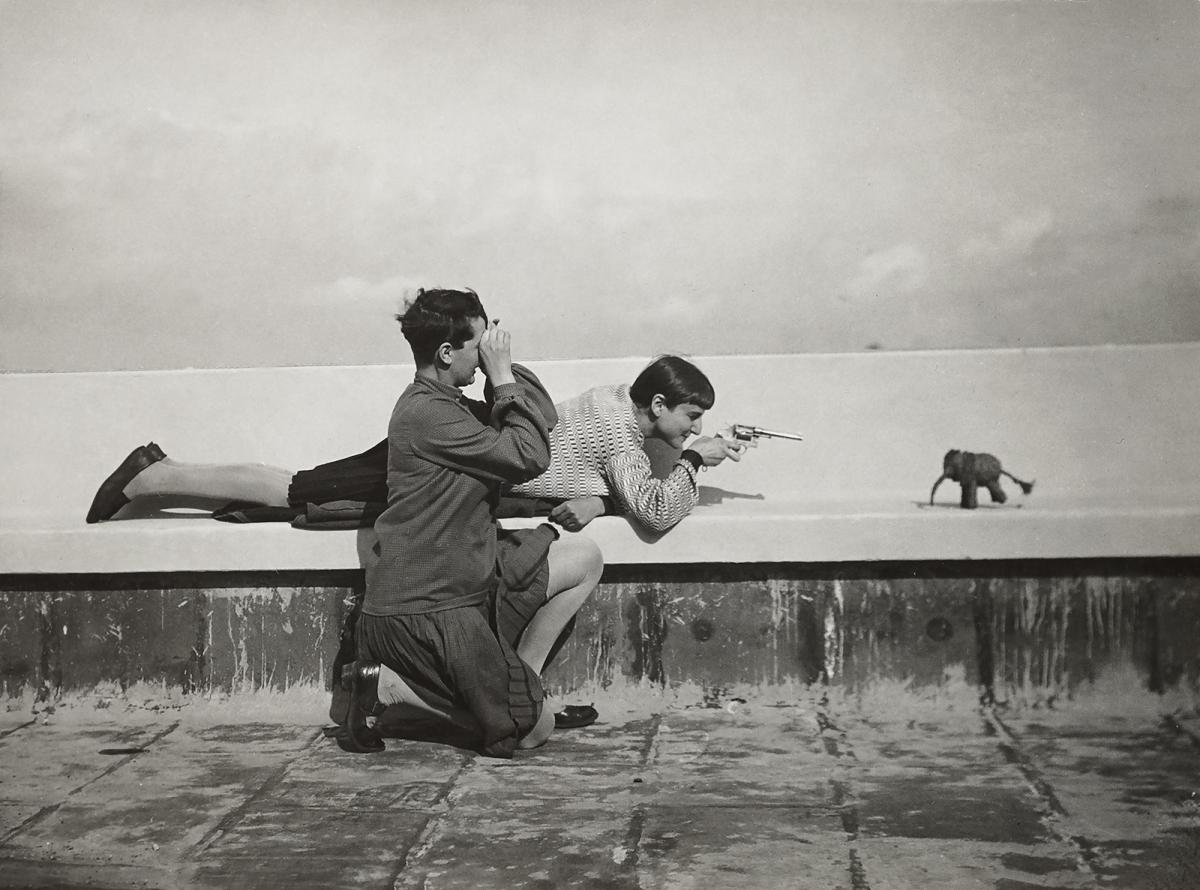
Erich Consemüller, who taught architecture at the Bauhaus, had been tasked by Gropius with documenting the school and its life. Gropius partnered him with photographer Lucia Moholy, wife of László Moholy-Nagy (see a photo of her above, taken by her husband sometime between 1924–28). Moholy took mostly exterior shots like the photograph by her further up of Erps and Hollós on the roof of the Atelierhaus in Dessau in the mid 1920s. Consemüller mainly focused on interiors in his work, with experimental exceptions like the “Mechanical Fantasy” series seen here, which uses clothing, poses, and double exposures to visually emphasize a kind of uniformity of purpose, placing and joining male and female Bauhaus artists in almost typographical arrangements.
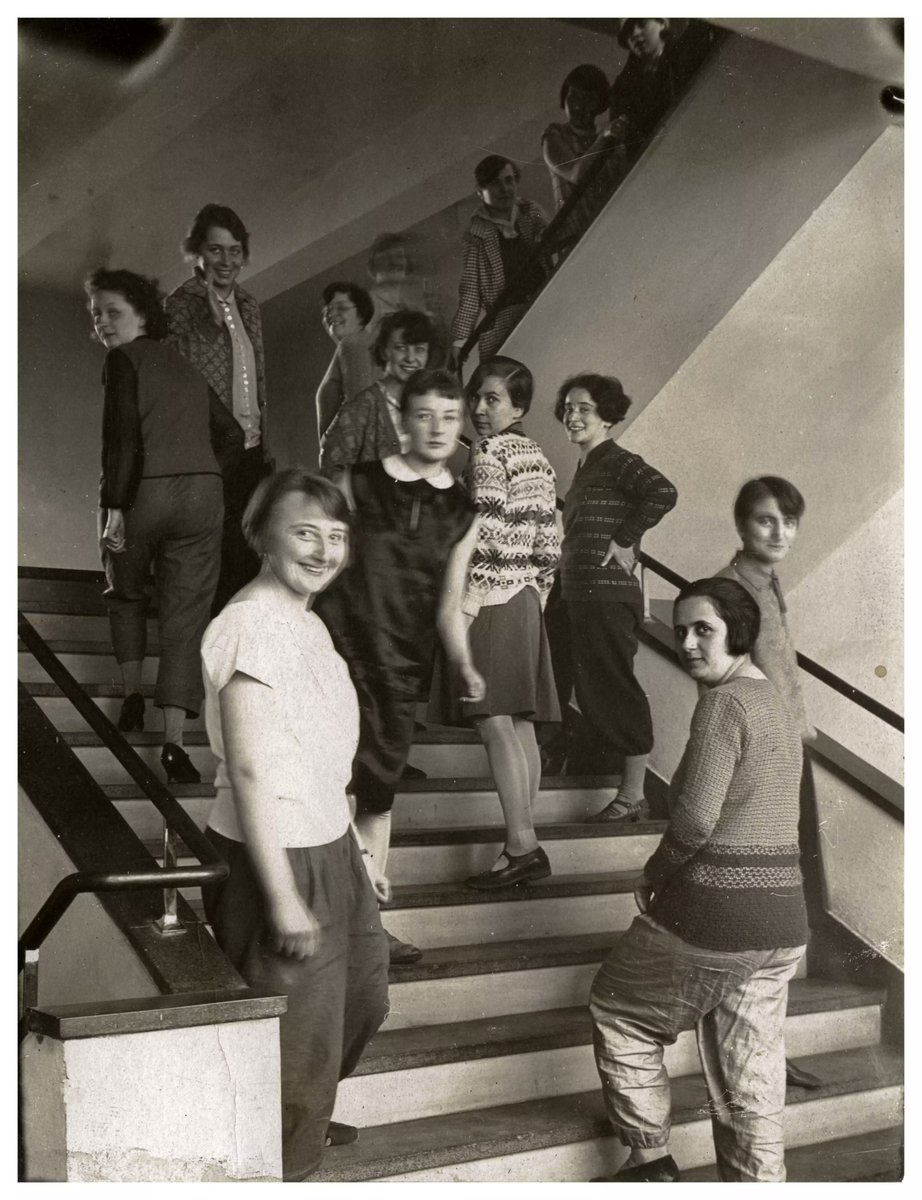
Indeed, nearly all of the artists of the Bauhaus — as was the school’s practice — tried their hand at photography, and many used the medium to document, in ways both casual and deliberate, the Bauhaus’ commitment to gender equity and the full inclusion of women artists in its programs, a statement painter and photographer T. Lux Feininger seems to underline in the group photograph below of the school’s weavers on the steps of the new Bauhaus building in 1927. (Artists in the shot: Léna Bergner, Gunta Stölzl, Ljuba Monastirsky, Otti Berger, Lis Beyer, Elisabeth Mueller, Rosa Berger, Ruth Hollós, and Lisbeth Oestreicher.)
Bauhaus artists, both men and women, were very much like early punks in some ways, inventing new ways to shake up the establishment and break out of prescribed roles. But instead of a downtown alternative to the status quo, they offered a recipe for its full transformation through art. Who can say how far that movement would have progressed had it not been splintered by the Nazis. “Together,” as Gropius wrote, “let us call for, devise, and create the construction of the future, comprising everything in one form, architecture, sculpture and painting,” and most everything else in the built and visual environments, he might have added.
Related Content:
The Politics & Philosophy of the Bauhaus Design Movement: A Short Introduction
Josh Jones is a writer and musician based in Durham, NC. Follow him at @jdmagness.
Read More...The Inventive Artwork of Pink Floyd’s Syd Barrett
We’ve had fun at the expense of the multi-hyphenate: i.e. “I’m an actor-slash-drummer-slash-makeup-artist-slash-brand-ambassador,” etc…. And, fair enough. Few people are good enough at their one job to reasonably excel at two or three, right? But then again, we live in the kind of hyperspecialized world Henry Ford could only dream of, and consider ourselves highly favored if we’re allowed to be just the one thing long enough to retire and do nothing.
What if we could have multiple identities without being thought of as unserious, eccentric, or mentally ill?
Discussions of Syd Barrett, Pink Floyd’s founding singer and guitarist, never pass without reference to his mental illness and abrupt disappearance from the stage. But they also rarely engage with Barrett as an artist post-Pink Floyd: namely, his two underrated solo albums; and his output as a painter, the medium in which he began his career and to which he returned for the last thirty years of his life.
If Barrett were allowed a role other than crazy diamond (a role, we must allow, assigned to him by his former bandmates), we might see more of his work in gallery collections and exhibitions. One cannot say this about every famous musician who paints. For Barrett, art was not a hobby, and it called to him before music. It was in his student days at Cambridgeshire College of Arts and Technology that he met David Gilmour. From Cambridge he moved to Camberwell College of Arts in London and began to produce and exhibit mature student work (see here).
Barrett’s work “shows some of the advantages of an art school training,” wrote a reviewer of a 1964 exhibition. “He is already showing himself a sensitive handler of oil paint who wisely limits his palette to gain richness and density.” (Barrett had displayed a prodigious early talent for achieving these qualities in watercolor — see, for example, an impressive, impressionistic still-life of orange dahlias, auctioned off in 2021, made when the artist was only 15.)
His training gave him the confidence to break away from formal exercises during this period and experiment with different styles and subjects, from the disturbing, primitivist Lions to the hollow-eyed, Munch-like Portrait of a Girl. Barrett’s first student period ended in the mid-sixties, as Pink Floyd began to take off and Barrett “turned into a songwriter” (then-manager Andrew King later wrote) “it seemed like overnight.”
After his spell with Pink Floyd and brief solo recording career came to an end, Barrett moved back to Cambridge with his mother in 1978, dropped the nickname “Syd” and began painting again as Roger Barrett, avoiding any mention of life in music. From that year until he died, he worked in several styles and different media, painting striking abstractions and landscapes and even making his own furniture designs.
While he burned many canvases, many from this time survive. See a selected chronology of his work in the video above and in the photos here. Try to put aside the story of Syd Barrett the tragic Pink Floyd frontman, and let the work of Roger Barrett the artist inspire you.
Related Content:
Syd Barrett’s “Effervescing Elephant” Comes to Life in a New Retro-Style Animation
Understanding Pink Floyd’s Wish You Were Here, Their Tribute to Departed Bandmate Syd Barrett
Watch David Gilmour Play the Songs of Syd Barrett, with the Help of David Bowie & Richard Wright
Josh Jones is a writer and musician based in Durham, NC. Follow him at @jdmagness.
Read More...Quentin Tarantino & Roger Avary Rewatch Cult-Classic Movies on Their New Video Archives Podcast
Quentin Tarantino has countless fans all around the world, increasingly many of whom are too young to ever have rented a tape from a video store. But when those twenty-something cinephiles learn his origin story as a filmmaker, they must suspect they missed out on a valuable experience in the VHS era, whatever its inconveniences. When Tarantino broke out in the nineteen-nineties with Reservoir Dogs and Pulp Fiction, he was publicly celebrated not just for those films, but for his having made them as a video-store-clerk-turned-auteur.
Indeed, it really does seem true that Tarantino’s cinematic sensibility owes something to the years he’d spent exercising his movie expertise behind the counter at Video Archives in Manhattan Beach. When the store closed in 1995, the freshly ascendant Tarantino seized the opportunity to buy up its thousands of VHS tapes. Roger Avary, his fellow Archives alumnus and collaborator on the screenplay for Pulp Fiction, bought the Laserdiscs. Though much of Avary’s collection has succumbed to the “disc rot” that notoriously afflicts that format, Tarantino’s collection has held up for more than a quarter-century.
Now Tarantino’s private tape stash provides the material for his and Avary’s latest collaboration: The Video Archives Podcast, to which you can listen on platforms like Apple Podcasts and Stitcher. On it, the two of them aim to re-create the vehemently cinephile environment of Video Archives by discussing the movies from its stock — after watching them on the actual VHS tapes the store once rented out. As Tarantino explains it, each episode of The Video Archives Podcast will feature three titles. But the conversations will go well beyond the films themselves, involving details of the particular home-video releases popped into the VCR as well as the history of the distributors that put them out.
Naturally, the hosts also get into their personal histories with these movies — which in some cases go back nearly 50 years — as film-lovers and filmmakers. Owing to the need to introduce the show itself, in the first episode they discuss only two pictures, both from the nineteen-seventies: John Carpenter and Dan O’Bannon’s anti-establishment sci-fi comedy Dark Star, followed by Ulli Lommel’s rock-Mafia drama Cocaine Cowboys, which features a cameo from Andy Warhol. Representing a younger generation is Avary’s daughter Gala, producer of the podcast, who in a mid-show segment (and her own after-show) offers another perspective on the movies of the week. She clearly knows how to appreciate a cult classic, even if she’s never paid a late fee in her life.
Related content:
Quentin Tarantino Explains How to Write & Direct Movies
An Analysis of Quentin Tarantino’s Films Narrated (Mostly) by Quentin Tarantino
Based in Seoul, Colin Marshall writes and broadcasts on cities, language, and culture. His projects include the Substack newsletter Books on Cities, the book The Stateless City: a Walk through 21st-Century Los Angeles and the video series The City in Cinema. Follow him on Twitter at @colinmarshall, on Facebook, or on Instagram.
Read More...Support Us
We're hoping to rely on loyal readers, rather than erratic ads. Please click the Donate button and support Open Culture. You can use Paypal, Venmo, Patreon, even Crypto! We thank you!

About Us

Open Culture scours the web for the best educational media. We find the free courses and audio books you need, the language lessons & educational videos you want, and plenty of enlightenment in between.
Advertise With Us
FREE UPDATES!
GET OUR DAILY EMAIL
Get the best cultural and educational resources on the web curated for you in a daily email. We never spam. Unsubscribe at any time.
FOLLOW ON SOCIAL MEDIA
Open Culture editor Dan Colman scours the web for the best educational media. He finds the free courses and audio books you need, the language lessons & movies you want, and plenty of enlightenment in between.
Advertise With Us


.jpg)