Bach Played Beautifully on the Baroque Lute, by Preeminent Lutenist Evangelina Mascardi
In the two videos here, see Argentine lutenist Evangelina Mascardi play passionate renditions of J.S. Bach compositions on the rich, resonant Baroque lute. In Bach’s time, lutenists were some of the most widely-admired instrumental players, and it’s easy to see why. The Baroque lute is not an easy instrument to play. Much less so were the theorbo and chitarrone, instruments like it but with longer necks for longer bass strings. We see Mascardi concentrate with utmost intensity on every note, a virtuoso on an instrument that Bach himself could not master.
Indeed, there has been significant debate over whether Bach actually composed his four pieces for solo lute for that instrument and not another. For one thing, he seems to have had a “weak grasp” of the instrument, guitarist and lutenist Cameron O’Connor writes in an examination of the evidence.
“The lute may have been an intimidating subject even for Bach.” There are several problems with authenticating existing copies of the music, and “none of the pieces in staff notation is playable on the standard Baroque lute without some transposition of the basses and changes in chord positions.”
Classical guitarist Clive Titmuss notes, “as student guitarists, we learned that J.S. Bach wrote four suites and a number of miscellaneous pieces for the lute, now played on the guitar.” However, recent scholarship seems to show that Bach, that most revered of Baroque composers, “did not write any music specifically intended for solo lute.” As O’Connor speculates, it was “the Lautenwerck, or lute harpsichord… which Bach most likely had in mind while composing many of his ‘lute’ works.” You can see it in action here.
What does this debate add to our appreciation of Mascardi’s playing? Very little, perhaps. British lutenist and Bach scholar Nigel North writes in his Linn Records Bach on the Lute set, “Instead of labouring over perpetuating the idea that the so-called lute pieces of Bach are proper lute pieces I prefer to take the works for unaccompanied Violin or Cello and make them into new works for lute, keeping (as much as possible) to the original text, musical intention, phrasing and articulation, yet transforming them in a way particular to the lute so that they are satisfying to play and to hear.”
A lutenist with the skill of North or Mascardi can transform solo Bach pieces — whether originally written for violin, cello, or lautenwerck — into the idiom of their chosen instrument. In Mascardi’s transformations here, these works sound positively transporting.
Related Content:
How a Bach Canon Works. Brilliant.
Hear Bach’s Brandenburg Concertos Played on Original Baroque Instruments
Hear J.S. Bach’s Music Performed on the Lautenwerck, Bach’s Favorite Lost Baroque Instrument
Josh Jones is a writer and musician based in Durham, NC. Follow him at @jdmagness
Read More...How Korean Things Are Made: Watch Mesmerizing Videos Showing the Making of Traditional Clothes, Teapots, Buddhist Instruments & More
It would be awfully clichéd to call Seoul, where I live, a place of contrasts between old and new. And yet that texture really does manifest everywhere in Korean life, most palpably on the streets of the capital. In my favorite neighborhoods, one passes through a variety of different eras walking down a single alley. “Third-wave” coffee shops and “newtro” bars coexist with family restaurants unchanged for decades and even small industrial workshops. Those workshops produce clothing, plumbing fixtures, printed matter, electronics, and much else besides, in many cases late into the night. For all its reputation as a high-tech “Asian Tiger,” this remains, clearly and presently, a country that makes things.
You can see just how Korea makes things on the Youtube channel All Process of World, which has drawn tens of millions of views with its videos of factories: factories making forks, bricks, sliced tuna, sheepskin jackets, bowling balls, humanoid robots. The scale of these Korean industrial operations ranges from the massive to the artisanal; some products are unique to twenty-first century life, and others have been in use for centuries.
On the traditional side, All Process of World has provided close-up views of the making of ceramic teapots, wooden window frames (as you would see in a classical Korean hanok), handheld percussive moktak to aid Buddhist monks in their chants, and even jeogori, the distinctive jackets worn with hanbok dresses.
Judging by the comments, All Process of World’s many viewers hail from around the globe. This shouldn’t come as a surprise, given Korea’s newfound worldwide popularity. But that so-called “Korean wave” owes less to the appeal of Korea’s traditional culture than its modern one, less to its rustic yet elegant pottery and brilliantly colorful formalwear than to BTS and “Gangnam Style,” Parasite and Squid Game — whose “robot girl” appears on a rug made in one All Process of World video. Another shows us the production of an equally modern item, the face masks seen everywhere in Korea during the past two years. Just a few weeks ago, the government gave us the okay to take those masks off outdoors. While hoping for the arrival of fully post-COVID era, we’d do well to keep in mind how the past always seems to find its way into the present.
Related content:
Watch a Korean Master Craftsman Make a Kimchi Pot by Hand, All According to Ancient Tradition
How Japanese Things Are Made in 309 Videos: Bamboo Tea Whisks, Hina Dolls, Steel Balls & More
Modern Artists Show How the Ancient Greeks & Romans Made Coins, Vases & Artisanal Glass
Based in Seoul, Colin Marshall writes and broadcasts on cities, language, and culture. His projects include the Substack newsletter Books on Cities, the book The Stateless City: a Walk through 21st-Century Los Angeles and the video series The City in Cinema. Follow him on Twitter at @colinmarshall, on Facebook, or on Instagram.
Read More...William Blake: The Remarkable Printing Process of the English Poet, Artist & Visionary
Few artists have anticipated, or precipitated, the fragmented, heroically individualist, and purposefully oppositional art of modernity like William Blake, a man to whom the cliché ahead of his time can be applied with perfect accuracy. Blake strenuously opposed the rationalist Deism and Neoclassical artistic values of his contemporaries, not only in principle, but in nearly every part of his artistic practice. His politics were correspondingly radical: in opposition to empire, racism, poverty, patriarchy, Christian dogma, and the emerging global capitalism of his time.
Nowhere do we see Blake’s visual radicalism more in evidence, argues Julia M. Wright in a 2000 essay for the journal Mosaic, than in his Laocoön, a work that not only seems to presage the modernist collaging of text and image, from Braque to Rauschenberg, but also looks toward hypertext with its nonlinearity, fragmentation, and intertextuality: “By combining as many as four different media in Laocoön — drawing, writing, engraving, and sculpture [in his depiction of the classical original] — Blake puts into play their different properties, engaging the debate in theory as well as practice.”
Through an art of visual pastiche, Blake resists the Neoclassical idea that visual art and poetry were mutually exclusive formal pursuits that could not coexist. (View a larger image here to read the poems and slogans that surround the image.)
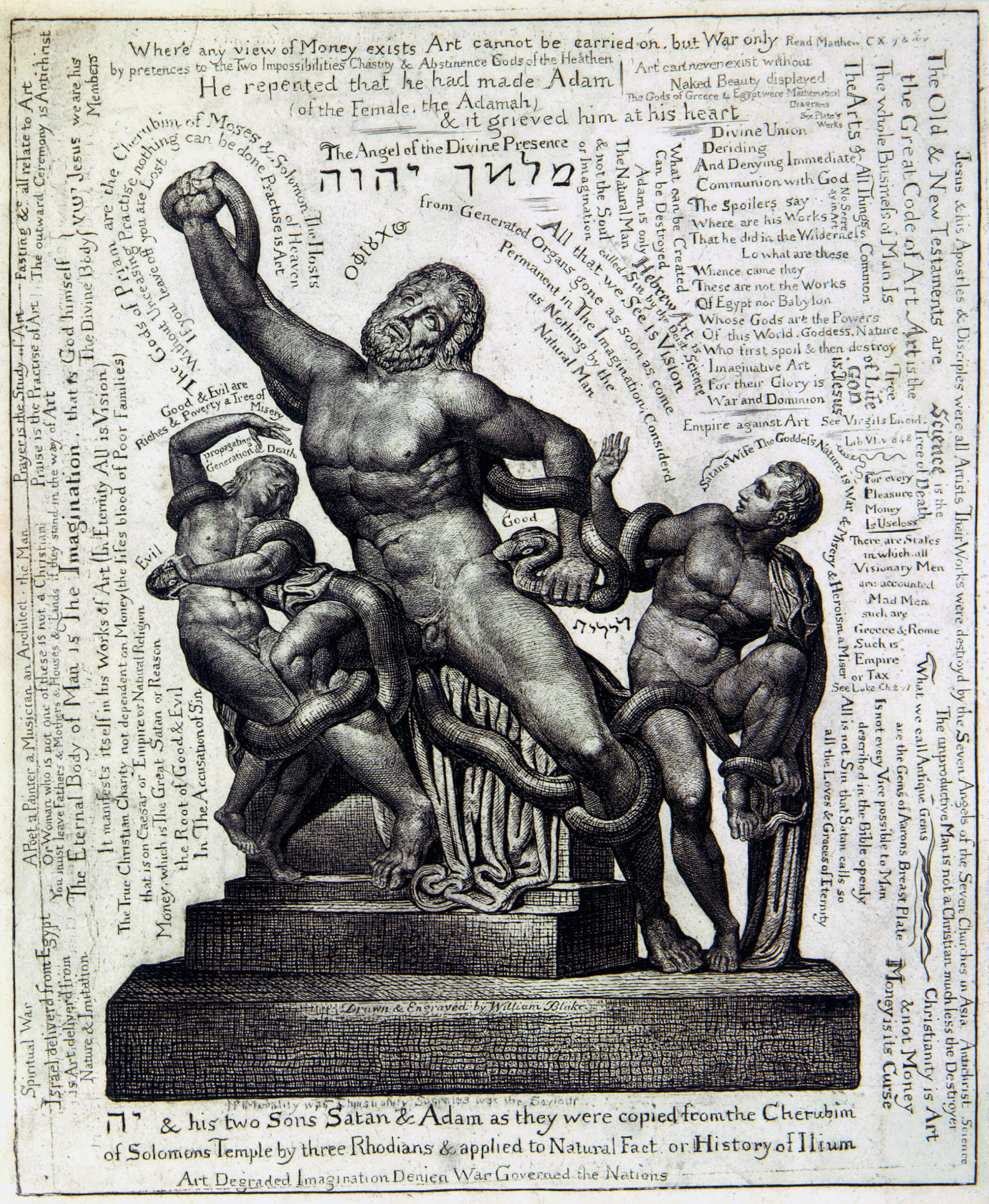
We can see the influence of Blake’s radicalism everywhere, from zine art to the Blakes reproduced on the skin of special edition Doc Martens (the artist was also an enthusiastic defender of the Gothic over the Classical, Wright points out). An art like Blake’s demanded a radical process, and he conceived one through his professional skills as an engraver, an art he began learning at the age of twelve. “Right from his earliest childhood,” notes the British Library video at the top, “Blake was driven by two extraordinary and powerful aspirations. On the one hand as a poet, on the other as a painter… so how was he going to bring these two together in a form that would enable him to publish his own images in illustration of his own poems?”
The video demonstrates “Blake’s innovation” as an engraver and printer. The printing process at that point involved a number of different specialized workers, some responsible for setting text, and others for separately printing images in blank spaces left on the pages. Blake’s process “enabled him, with the exception of the paper, to be responsible for every stage in the production process, from writing the poems, making the drawings, using the stop-out varnish to write his text, etching and printing the impressions.”
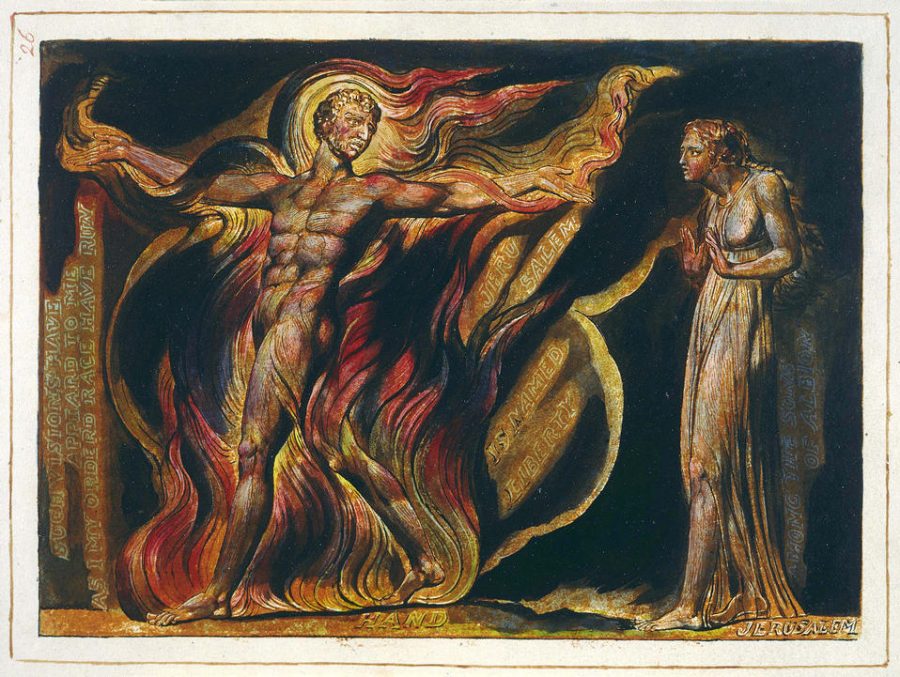
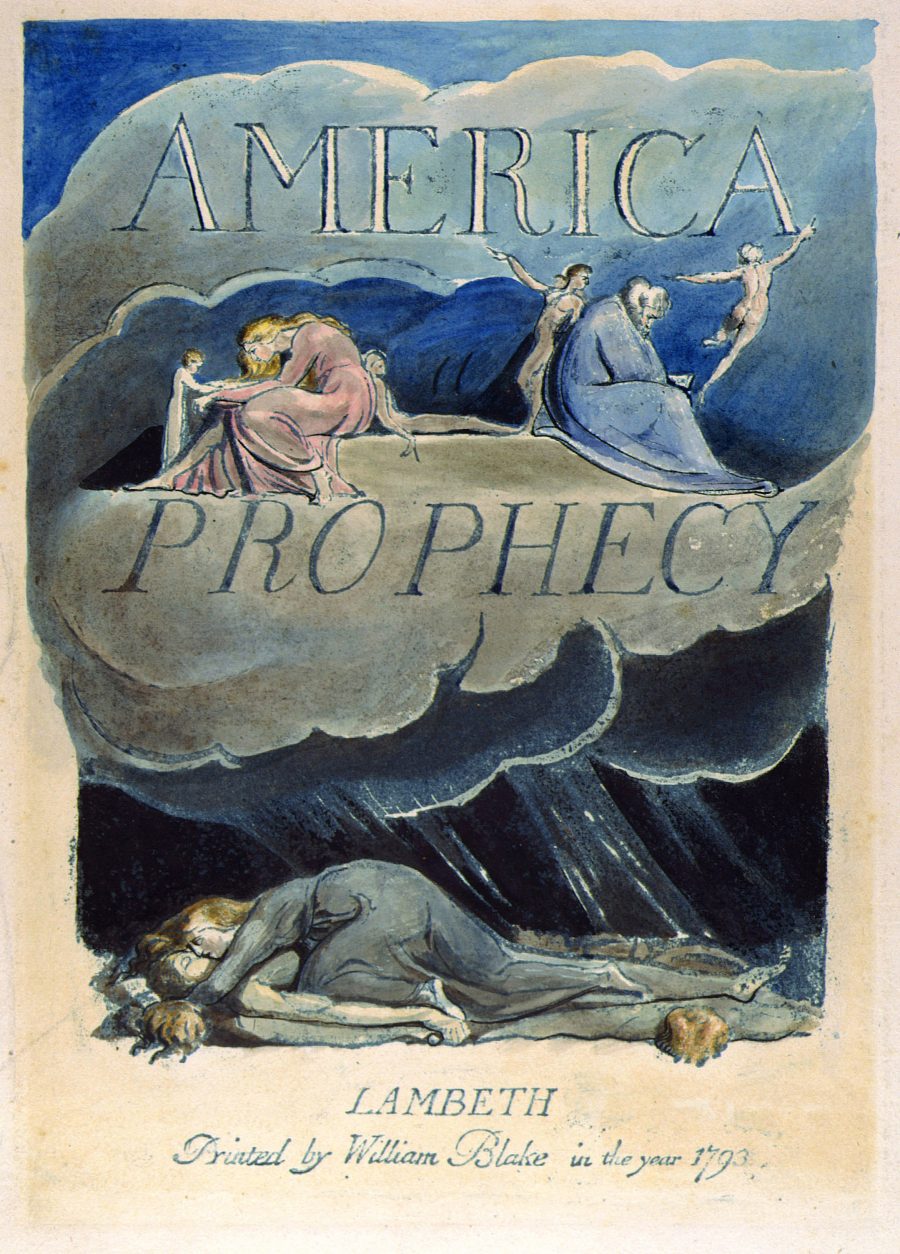
He began working out his methods as a teenager, and they allowed tremendous creative freedom throughout his life to create personal works of art like the “Illuminated Books” (from which the other two images here come): containers of his complex mythology and some of his most passionate engravings. You can learn even more about Blake’s DIY printing process in the video further up from Ashmolean Museum. Blake’s futuristic art drew heavily from the past — from Renaissance masters like Michelangelo, for example — as a means of creating an alternate art history, one that opposed the values of domination and oppressive systems of order.
His formal and political radicalism is perhaps one reason Blake became one of the first artists to populate an online archive, with the launch of the Blake Archive all the way back in 1996, “conceived as an international [free] public resource that would provide unified access to major works of visual and literary art that are highly disparate, widely dispersed, and more and more often severely restricted as a result of their value, rarity, and extreme fragility.” Visit the Blake Archive here to see high resolution scans of hundreds of Blake’s prophetic works, all created from start to finish by his own hand, and learn more about his personal and commercial illustrations at the links below.
Related Content:
William Blake’s Hallucinatory Illustrations of John Milton’s Paradise Lost
Josh Jones is a writer and musician based in Durham, NC. Follow him at @jdmagness
Read More...What’s It Like Drumming For Prince?: Drummer Hannah Welton Describes the Genius of His Musicianship
Testimonials to Prince’s mind-blowing musicianship flooded the media after his death, from celebrated stars and not-so-famous musicians who played in the artist’s backing bands over the decades. In the former category, we have Prince’s own musical hero, Stevie Wonder — no slouch as a multi-instrumentalist — whose Songs in the Key of Life stood as a “perfect album” for the Purple One. Wonder describes their jam sessions as “amazing” for the variety of people and cultures Prince could bring together, and for the incredible range of his talent.
“He could play classical music if he wanted to,” said Wonder, in tears after Prince’s death. “He could play jazz if he wanted to, he could play country if he wanted to. He played rock, you know, he played blues. He played pop. He played everything.…” He played all 27 instruments on his debut album, from electric guitar, bass, and piano to “mini-Moog, poly-Moog, Arp string ensemble, Arp Pro Soloist, Oberheim four-voice, clavinet, drums, syndrums, water drums, slapsticks, bongos, congas, finger cymbals, wind chimes, orchestral bells, woodblocks, brush trap, tree bell, hand claps and finger snaps.”
He did all of this with little to no formal training, teaching himself to compose in nearly any idiom and to switch up genres and styles with ease. In short, Prince was a “genius,” says drummer Hannah Welton in the Drumeo video above. Welton joined the New Power Generation in 2012, then helped form his new backing band, 3rdeyegirl. In the video above, the hard-working drummer makes it clear that she does not use this word frivolously. “I don’t know that I ever heard an off note,” she says. “Piano, guitar, drums, nobody touched any of those instruments the way that he did.”
Welton also talks about what she learned from Prince — after their first meeting when he asked her to play ping pong. “One thing,” she says, is that “the space between the notes is just a funky as the notes themselves.” In the hour-long lesson, Welton shows off her own drum skills in songs like “Women’s Intuition” (which she wrote with her husband Joshua Welton, one of Prince’s producers) and talks more about her time with the untouchable musician, including how he recruited her after seeing her on YouTube and what it’s like to have a “drum-off/bass-off” with him. As for whether she ever beat Prince in ping pong, you’ll have to watch to find out.…
Related Content:
Prince’s First Television Interview (1985)
The Little Prince: Footage Gets Unearthed Of the Pop Star at Age 11
Josh Jones is a writer and musician based in Durham, NC. Follow him at @jdmagness
Read More...The Rolling Stones Play a Gig in Communist Warsaw and a Riot Ensues (1967)
My Name is called Disturbance.… – “Street Fighting Man”
More than two decades before German band the Scorpions blew their allegedly CIA-penned “Wind of Change” over the end of the Cold War; before the “hard rock Woodstock” in Moscow; before Bruce Springsteen rocked East Berlin and rang the “Chimes of Freedom,” another band took the stage behind the Iron Curtain: one not particularly well-known at the time for making geopolitical statements.
In 1967, the Rolling Stones recorded and released Between the Buttons and major hits “Ruby Tuesday” and “Let’s Spend the Night Together.” They tried to compete with the Beatles with stabs at psychedelia on Their Satanic Majesties Request. They didn’t record what is sometimes considered their most political song, “Street Fighting Man,” for another two years, and that song — with its options of street fighting or singing for a rock and roll band — has never been mistaken for a peace anthem.
It wasn’t peace the band courted in their original plan to play Moscow. “They started toying with the idea of performing in Moscow and becoming the most controversial rock band to play on the other side of the Iron Curtain,” writes Wojciech Oleksiak at Culture.pl. “Both the Soviet Union and the UK denied their requests. How is it, Oleksiak asks, “that in 1967 — the middle of the Cold War — Mick, Keith, Brian, Bill, and Charlie came to Poland and performed in Warsaw, at a huge hall known for being traditionally used for the Communist Party’s plenary congresses?” You’ll find the answer in the video at the top from Bandsplaining.
Just above, see footage of the concert itself, culled from newsreel footage and TV broadcasts. The uploader has done us the kindness of putting timestamps in the video for the three songs shown here:
00:00 — Paint It Black
00:43 — 19th Nervous Breakdown
01:06 — (I Can’t Get No) Satisfaction
The Stones were “by no means the first western group to play in communist Poland,” writes Polish musician and journalist Paweł Brodowsky, who was in the audience. “By that time I had already seen The Animals, The Hollies, Lulu, and Cliff Richard and the Shadows.” It didn’t hurt that Władysław Jakubowski, the deputy director of Pagart — “a state-owned concert agency,” writes Sam Kemp at Far Out — “had some sympathy for Poland’s young music fans” (just as Gorbachev would in the time of glasnost). None of the other acts caused anything like the chaos that would ensue when the Stones came to Warsaw.
Bands allowed into the country came from a list of names Jakubowski collected from young Polish journalists. How Jakubowski achieved the required permissions from his higher-ups is something of a mystery, Oleksiek writes. Why the deputy director let the Stones into the country even more so. Their reputation for destruction preceded them: “He must have heard about The Rolling Stones’ wrecking of the Olympia, the most famous concert hall in Paris. He was a close friend of Bruno Coquatrix, its director.” At any rate, the Warsaw concert turned into a riot. The band could not be blamed, entirely.
Hearing about the Stones’ arrival, thousands of young fans lined up for tickets. “What most of them didn’t know,” Kemp writes, “was that the bulk of them had already been reserved for communist party members and their families.” The hall was also packed beyond capacity, “with fans hanging off the edge of balconies.” Police fought to keep fans away from the stage and the seated crowds of dour bureaucrats. Richards and Jagger antagonized the cops with obscenities, making ticketless fans who’d breached the doors even more rabid.
Outside, as you can see in the short Polish documentary above, a full-blown riot with tear gas and dogs had broken out. This was a time when riots seemed to break out everywhere. (Mick Jagger has cited the Paris uprisings of 1968 as a source for “Street Fighting Man.”) But at the end of the sixties, few other bands could boast not only of playing the communist Eastern Bloc, but of inspiring mayhem from the stage on both sides of the Cold War lines.
And yet, this is not the end of the story. The Stones returned to Warsaw over fifty years later, in 2018, this time with a pointed political statement made at the behest of Lech Wałęsa, in opposition to a rule limiting the age of judges to 65. “I am too old to be a judge but not too old to sing,” Jagger shouted in Polish from the stage. He then launched into the band’s first song on the setlist. And, yes, it was my favorite and maybe yours too: “Street Fighting Man.”
Related Content:
Josh Jones is a writer and musician based in Durham, NC. Follow him at @jdmagness
Read More...This Is Spinal Tap Will Get a Sequel 40 Years Later, Reuniting Rob Reiner, Michael McKean, Christopher Guest & Harry Shearer
Fans of James Cameron’s Avatar are expressing astonishment that its long-expected sequel, Avatar: The Way of Water, will have taken thirteen years to get to theaters. That delay, of course, is nothing next to the 35 years that separated Blade Runner and Blade Runner 2049, or the 36 between Top Gun and Top Gun: Maverick, which comes out next month. But the recently announced sequel to This Is Spinal Tap tops them all: “Spinal Tap II will see Rob Reiner return as both film-maker on and off the screen along with Michael McKean, Harry Shearer, and Christopher Guest,” writes the Guardian’s Benjamin Lee. “The film will be released in 2024 on the 1984 original’s 40th anniversary.”
Critics praised This Is Spinal Tap back in 1984, but it took time to become a revered classic of the improvised-mockumentary genre. In fact that genre hadn’t exist at all, which resulted in some viewers not quite getting the joke. “When the film first came out, we showed it in Dallas and people came up to me and said, why would you make a movie about a band nobody’s ever heard of?” says director Rob Reiner. “And one that’s so bad?”
Or as Christopher Guest remembers a couple girls at the concession counter observing: “These guys are so stupid.” The befuddlement extended even to collaborators in the filmmaking process: “I don’t understand this,” said cinematographer Peter Smokler, who’d worked on the Altamont documentary Gimme Shelter. “This isn’t funny. This is exactly what they do.”
Such reactions pay indirect but great tribute to the painstaking craft and observatory wit of Spinal Tap’s creators. Those creators — Reiner, Guest, Michael McKean, and Harry Shearer — tell these stories in the Today interview above, conducted in 2019 to mark This Is Spinal Tap’s 35th anniversary. In that time they’d occasionally reunited as Spinal Tap for live performances and real albums, the last of which came out in 2009. Perhaps that’s kept them ready to get back into character, pitch-perfect English accents and all, and put on — as they’ll be forced to in a plot shaped by realistic-sounding music-industry vagaries — one last concert. But like any belated sequel, it brings proportionally inflated fan expectations: specifically, about whether they’ll be able to go up to twelve.
Related content:
The Spinal Tap Stonehenge Debacle
Spinal Tap’s Nigel Tufnel Promotes World’s Largest Online Guitar Lesson
Ian Rubbish (aka Fred Armisen) Interviews the Clash in Spinal Tap-Inspired Mockumentary
Based in Seoul, Colin Marshall writes and broadcasts on cities, language, and culture. His projects include the Substack newsletter Books on Cities, the book The Stateless City: a Walk through 21st-Century Los Angeles and the video series The City in Cinema. Follow him on Twitter at @colinmarshall, on Facebook, or on Instagram.
Read More...Google Unveils a Digital Marketing & E‑Commerce Certificate: 7 Courses Will Help Prepare Students for an Entry-Level Job in 6 Months

During the pandemic, Google launched a series of Career Certificates that will “prepare learners for an entry-level role in under six months.” Their first certificates focused on Project Management, Data Analytics, User Experience (UX) Design, IT Support and IT Automation. Now comes their latest–a certificate dedicated to Digital Marketing & E‑commerce.
Offered on the Coursera platform, the Digital Marketing & E‑commerce Professional Certificate consists of seven courses, all collectively designed to help students “develop digital marketing and e‑commerce strategies; attract and engage customers through digital marketing channels like search and email; measure marketing analytics and share insights; build e‑commerce stores, analyze e‑commerce performance, and build customer loyalty.” The courses include:
- Foundations of Digital Marketing and E‑commerce
- Attract and Engage Customers with Digital Marketing
- From Likes to Leads: Interact with Customers Online
- Think Outside the Inbox: Email Marketing
- Assess for Success: Marketing Analytics and Measurement
- Make the Sale: Build, Launch, and Manage E‑commerce Stores
- Satisfaction Guaranteed: Develop Customer Loyalty Online
In total, this program “includes over 190 hours of instruction and practice-based assessments, which simulate real-world digital marketing and e‑commerce scenarios that are critical for success in the workplace.” Along the way, students will learn how to use tools and platforms like Canva, Constant Contact, Google Ads, Google Analytics, Hootsuite, HubSpot, Mailchimp, Shopify, and Twitter. You can start a 7‑day free trial and explore the courses. If you continue beyond that, Google/Coursera will charge $39 USD per month. That translates to about $235 after 6 months.
If you don’t want to pay, you can audit each course for free, without ultimately receiving the certificate.
Explore the Digital Marketing & E‑commerce Professional Certificate.
Note: Open Culture has a partnership with Coursera. If readers enroll in certain Coursera courses and programs, it helps support Open Culture.
Related Content
Read More...Quentin Tarantino Names His 20 Favorite Movies, Covering Two Decades
Quentin Tarantino’s filmmaking career began thirty years ago — at least if you place its starting point at his first feature Reservoir Dogs in 1992. But even then he had been working toward auteurhood for quite some time, a period characterized by projects like My Best Friend’s Birthday, previously featured here on Open Culture. Throughout the three decades since he hit it big, there can be no doubt that Tarantino has consistently made just the films he himself has most wanted to see. But he’s also remained a sufficiently honest cinephile to admit that other directors have made films he would have wanted to make: Fukasaku Kinji, for instance, whose Battle Royale he praises in just such personal terms in the video above.
In six minutes Tarantino runs down the list of his twenty favorite movies between 1992, when he became a director, and 2009. After giving pride of place to Battle Royale — a Japanese comedic thriller of high-school ultraviolence that set off a wave of transgressive thrill through a worldwide “cult” audience — he presents his choices in alphabetical rather than preferential order. The complete list runs as follows:
- Fukasaku Kinji, Battle Royale
- Woody Allen, Anything Else (“the Jason Biggs one”)
- Miike Takashi, Audition
- Tsui Hark, The Blade
- Paul Thomas Anderson, Boogie Nights
- Richard Linklater, Dazed and Confused (“the greatest hangout movie ever made”)
- Lars von Trier, Dogville
- David Fincher, Fight Club
- F. Gary Gray, Friday
- Bong Joon-ho, The Host
- Michael Mann, The Insider
- Park Chan-wook, Joint Security Area
- Sofia Coppola, Lost in Translation
- The Wachowskis, The Matrix (though its sequels “ruined the mythology for me”)
- Bong Joon-ho, Memories of Murder
- Stanley Tong, Police Story 3/Supercop (contains “the greatest stunts ever filmed in any movie”)
- Edgar Wright, Shaun of the Dead
- Jan de Bont, Speed (there have been “few exhilaration movies quite like it”)
- Trey Parker and Matt Stone, Team America: World Police
- M. Night Shyamalan, Unbreakable
Tarantino may refer to Shyamalan as “M. Night Shamalamadingdong,” but he clearly has a good deal of respect for the man’s films. And he seems to have even more for Bruce Willis’ work in Unbreakable, which contains his “best performance on film” — better, evidently, than the not-inconsiderable one he gave in a nineteen-nineties hit called Pulp Fiction.
It comes as no surprise that Tarantino names movies by his peers in the “Indiewood” generation like Anderson, Linklater, and Coppola. But watched thirteen years later, this video also suggests a certain cinematic prescience on his part. Speed, for example, once seemed like a brain-dead blockbuster but now stands as a classic of Los Angeles cinema. And we’d do well to remember how far ahead of his peers Tarantino was in his consciousness of Asian cinema. That we all watch films from Japan, Hong Kong, and Korea today owes something to Tarantino’s advocacy. More than a decade before Bong Joon-ho’s Parasite dominated the Academy Awards, Tarantino gave him alone not one but two entries on this top-twenty list — which surely makes up for his obviously having forgotten Bong’s name.
Related content:
Quentin Tarantino Picks the 12 Best Films of All Time; Watch Two of His Favorites Free Online
Quentin Tarantino Lists His 20 Favorite Spaghetti Westerns
Quentin Tarantino’s Handwritten List of the 11 “Greatest Movies”
Based in Seoul, Colin Marshall writes and broadcasts on cities, language, and culture. His projects include the Substack newsletter Books on Cities, the book The Stateless City: a Walk through 21st-Century Los Angeles and the video series The City in Cinema. Follow him on Twitter at @colinmarshall, on Facebook, or on Instagram.
Read More...Two Decades of Fire Island DJ Sets Get Unearthed, Digitized & Put Online: Stream 232 Mixtapes Online (1979–1999)
“I was the young, lonely gay boy in the Midwest who had no idea paradise existed. Everything about the Pines was new, the very idea of a place where you could play on the beach and hold hands with a guy and be with like-minded people and dance all night with a man.” — photographer Tom Bianchi
Disco did not get demolished at Comiskey Park in 1979. It may have disappeared from popular culture after jumping the duck, but it never left the New York nightclubs that had nurtured its exuberant sound — Studio 54, Paradise Garage, The Sanctuary.… Four on the floor beats pounded all night in the dawning decade of the 80s, only the beat soon became house music, an electrified disco derivative — without the horns and string sections — first played in clubs by DJs like Larry Levan, who ruled the Paradise Garage for a decade and “changed dance music forever.”
The sounds of Manhattan nightlife at the turn of the 80s have gone mainstream, but stories about the early, underground days of house tend to leave out another scene just miles away, led by DJs as beloved as Levan.
For LGBTQ New Yorkers, the party moved every summer to Fire Island, where artists, vacationers, celebrities, and DJs crowded clubs like The Pavilion and the Ice Palace to hear DJs Robbie Leslie, Michael Jorba, Richie Bernier, Giancarlo, Teri Beaudoin, Michael Fierman, and Roy Thode, “whose performance at the Ice Palace showed how shimmery, guitar-driven disco slowly gave way to the driving bass of house music,” The New York Times notes.
Thode became a legend not only in the Fire Island summer scene but during his residency at Studio 54, at the personal invitation of club owner Steve Rubell. Fire Island DJs played records they heard in the off season at the island’s clubs, or debuted newly-released tracks. (Donna Summer’s “MacArthur Park” made its debut on the island, for example.) “Fire Island’s infamous bacchanals have gone on to become the stuff of gay myth and legend,” write Matt Moen at Paper. The island has also long been “an iconic refuge and safe haven for New York City’s queer community dating back well over half a century.” One resident calls it a “gay Shangri La.” Another compares it to Israel, a “spiritual homeland.”
Split between two towns, Cherry Grove and the Pines, the summer retreat has especially “been a haven for the creative,” says Bobby Bonnano, founder and president of the Fire Island Pines Historical Preservation Society. It has also been a hideaway for celebrities like Marilyn Monroe, Calvin Klein, and Perry Ellis. Bonnano’s extensive online history of the island documents its 20th century origins as a place for gay artists who built houses in a distinctive architectural style that defines the island to this day, and who partied hard at clubs like The Pavillion. The mixes here from Fire Island’s best DJs come from one such beach house, bought by Peter Kriss and Nate Pinsley, who discovered a box of tapes left behind by a previous owner.
The couple gave the box of tapes to their friend Joe D’Espinosa. A software engineer and DJ, D’Espinoza has spent “countless hours” digitizing, remastering, and uploading the collection to Mixcloud. The resulting archive represents a “treasure trove of recorded DJ sets,” spanning “two decades worth of parties,” Moen writes, from 1979 through 1999. The Pine Walk collection features more than 200 tapes (some from gigs in Manhattan),“taken from from Memorial Day weekenders, Labor Day parties, season openings and recurring club nights.” These are solid sets of vintage disco and classic house, many of them documenting the transition from one to the other. Browse and stream the full collection on Mixcloud.
Related Content:
Disco Saves Lives: Give CPR to the The Beat of Bee Gees “Stayin’ Alive”
Josh Jones is a writer and musician based in Durham, NC. Follow him at @jdmagness
Read More...The Polish Artist Stanisław Witkiewicz Made Portraits While On Different Psychoactive Drugs, and Noted the Drugs on Each Painting
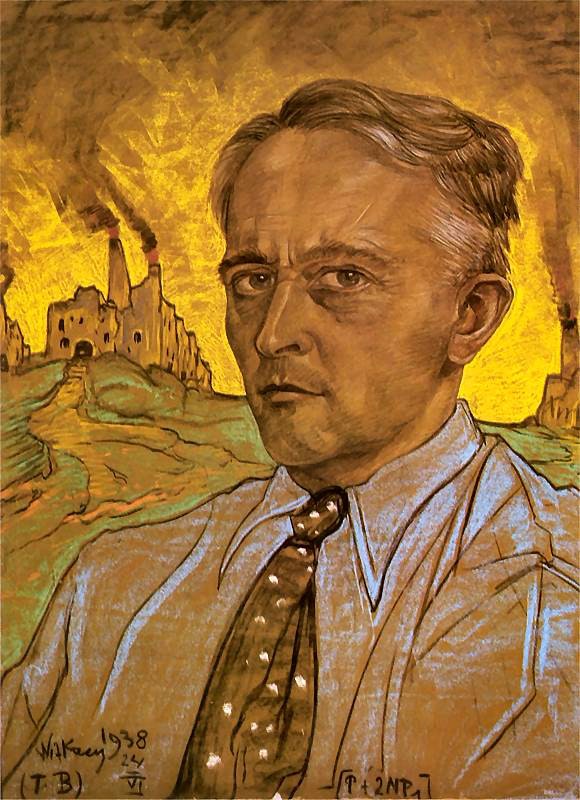
Much of the information in this post comes from Juliette Breton at the Public Domain Review. See her post for more.
At least once a day, staff at art museums and galleries worldwide must hear someone say, “the artist must have been on drugs.” It’s the easiest explanation for art that disturbs, unsettles, confounds our expectations of what art should be. Maybe sometimes artists are on drugs. (R. Crumb tells the story of discovering his inimitable style while on acid.) But maybe it’s not the drugs that make their art seem otherworldly. Maybe mind-altering substances make them more receptive to the source of creativity.…
In any case, artists have long used psychoactive substances to reach higher states of consciousness and cope with a world that doesn’t get their vision. In the early days of LSD experimentation, one psychiatrist even tested the phenomenon. UC Irvine’s Oscar Janiger dosed volunteer subjects at a rented L.A. house, then had them draw or otherwise record their experiences. He ultimately aimed to make a “creativity pill,” testing hundreds of willing subjects between 1954 and 1962.
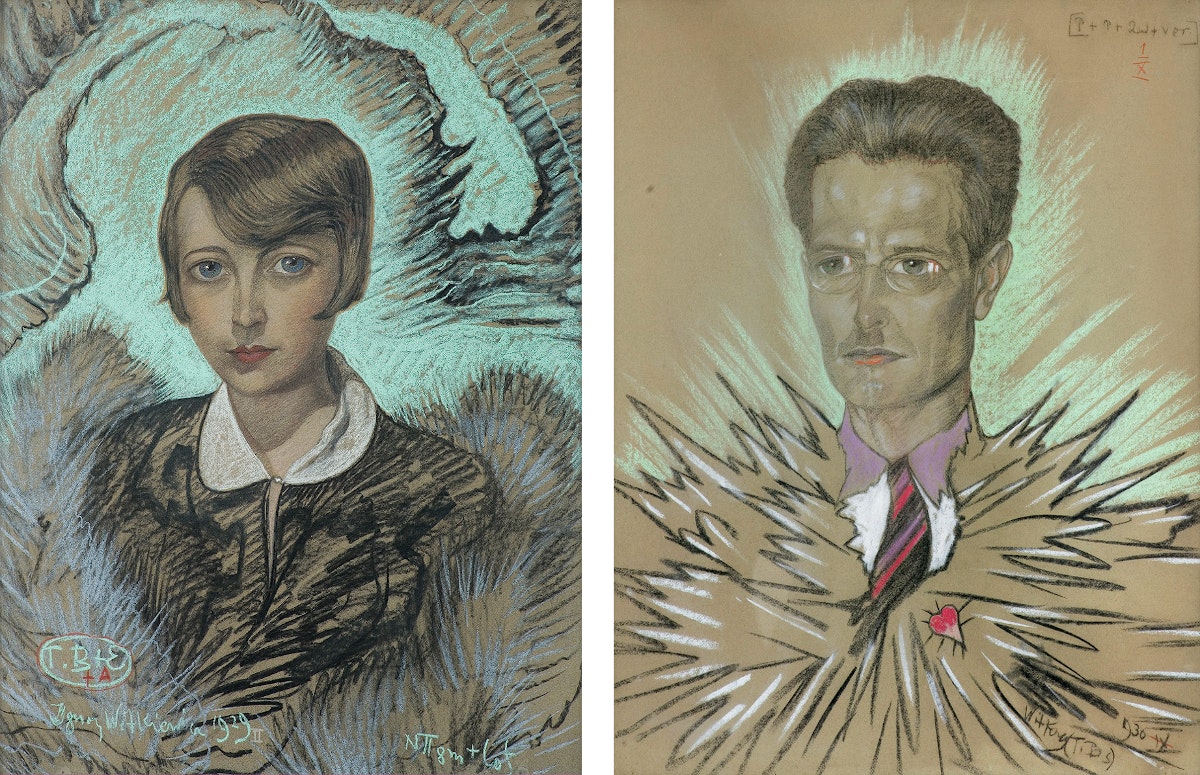
Had Polish artist Stanisław Ignacy Witkiewicz (1885–1939) — who went by “Witkacy” — lived to see the spread of LSD, he would have signed up for every trial. More likely, he would have conducted his own experiments, with himself as the sole test subject. The Warsaw-born artist, writer, philosopher, novelist, and photographer died in 1939, the year after Swiss chemist Albert Hoffman accidentally synthesized acid. Throughout his career, however, Witkacy experimented with just about every other psychoactive substance, anticipating Janiger by decades with his portraits — painted while… yes… he was on lots of drugs.
Unlike his contemporary Dalí, Witkacy did not claim to be drugs. But he was hardly coy about their use. He made notes on each painting to indicate his state of intoxication. “Under the influence of cocaine, mescaline, alcohol, and other narcotic cocktails,” Juliette Bretan writes at the Public Domain Review, “Witkacy prepared numerous studies of clients and friends for his portrait painting company, founded in the mid-1920s.” The drugs induced “different approaches to colour, technique, and composition. The resulting images are surreal — and occasionally horrific.” Sometimes the drugs in question were limited to caffeine, a daily staple of artists everywhere. He also made portraits while abstaining from other addictive substances like nicotine and alcohol.
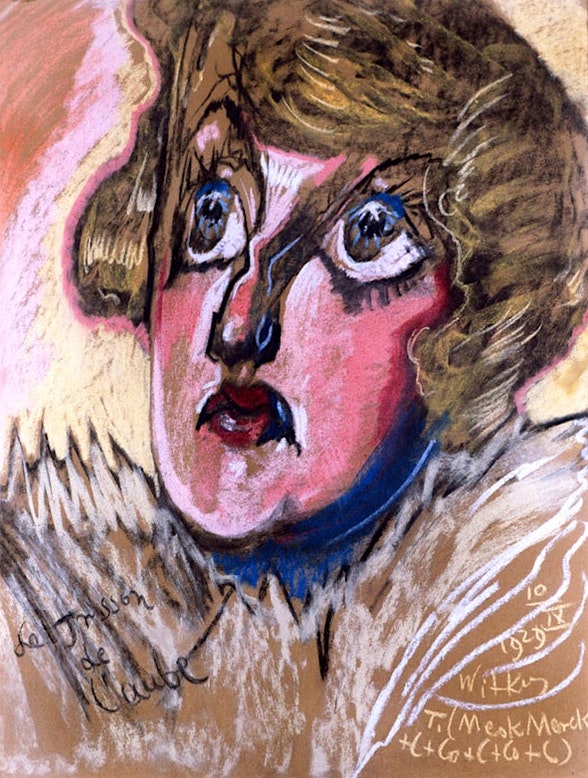
At other times, Witkacy’s notes — written in a kind of code — specified more pronounced usage. He made the portrait above, of Nina Starchurska, in 1929 while on “narcotics of a superior grade,” including mescaline synthesized by Merck and “cocaine + caffeine + cocaine + caffeine + cocaine.” Another portrait of Starchurska (below) made in that same year involved some heavy doses of peyote, among other things.
Witkacy’s investigations were literary as well, culminating in a 1932 book of essays called Narcotics: Nicotine, Alcohol, Cocaine, Peyote, Morphone, Ether + Appendices. The book “owes much to the experimental works of other European psychonauts throughout the nineteenth and twentieth centuries.” Invoking the decadent moralism of Thomas De Quincey and Baudelaire, and it anticipates the utopian, psychedelic prose of Aldous Huxley and Carlos Castaneda.
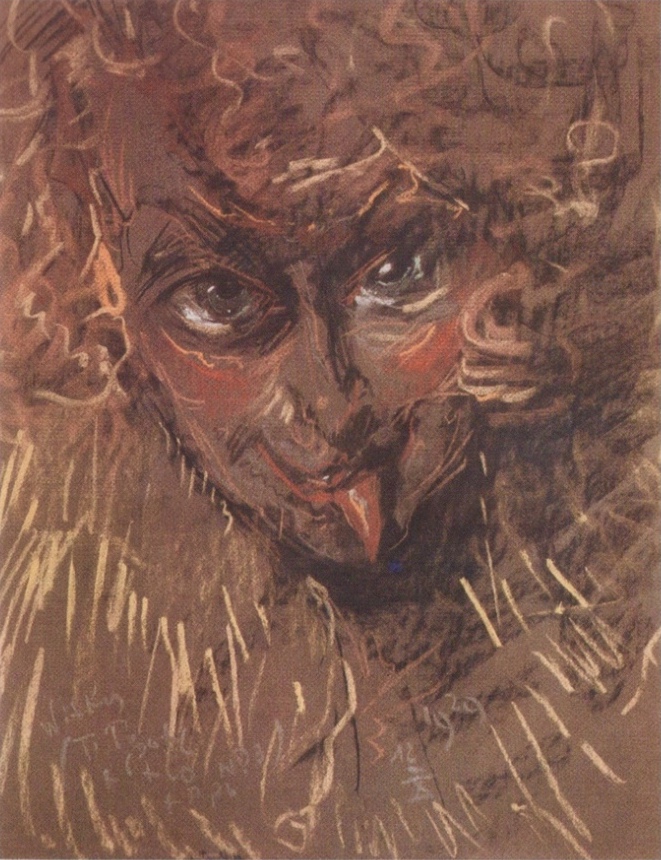
Where he might fulminate, with satirical edge, against the use of drugs, Witkacy also joyously records their liberating effects on his creative consciousness. His chapter on peyote “most closely approximates the spirit” of his paintings, notes Bibiliokept in a review of the recently republished volume:
“Peyote” begins with Witkiewicz taking his first of seven (!) peyote doses at six in the evening and culminating around eight the following morning with “Straggling visions of iridescent wires.” In increments of about 15 minutes, Witkiewicz notes each of his surreal visions. The wild hallucinations are rendered in equally surreal language: “Mundane disumbilicalment on a cone to the barking of flying canine dragons” here, “The birth of a diamond goldfinch” there.
Elsewhere he writes of “elves on a seesaw (Comedic number)” and “a battle of centaurs turned into a battle between fantastical genitalia,” all of which lead him to conclude, “Goya must have known about peyote.”
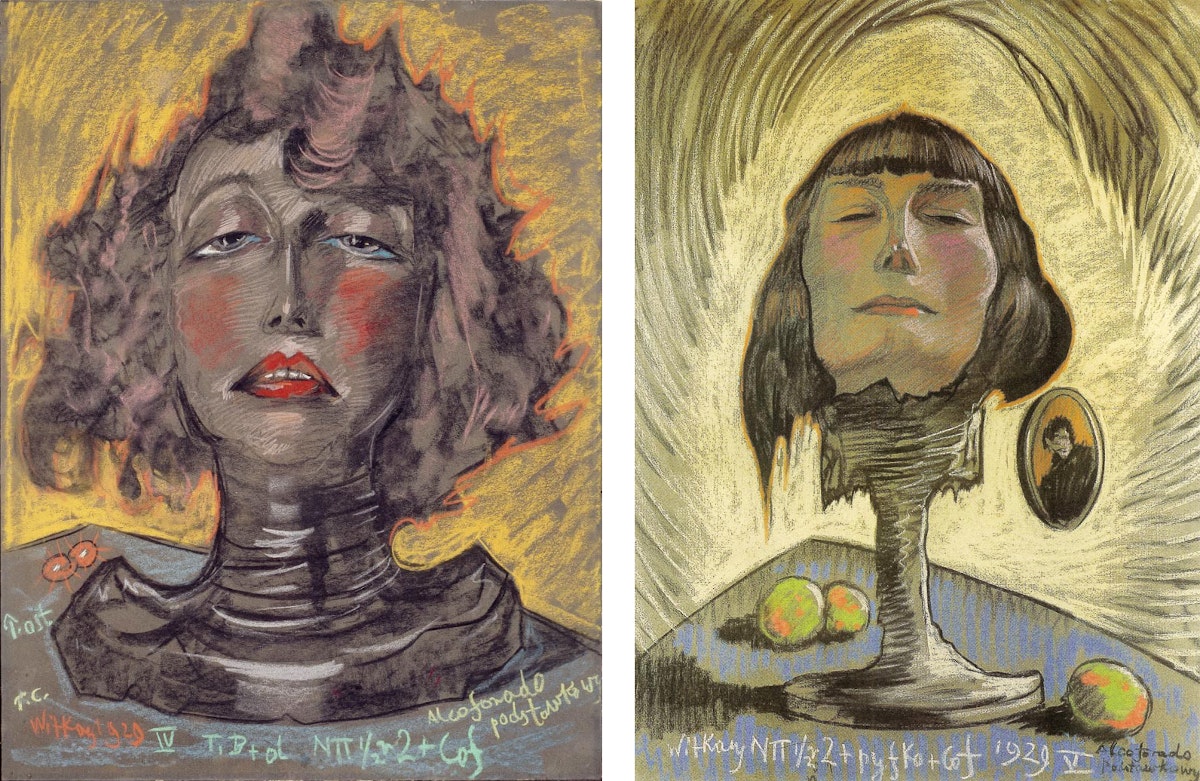
Narcotics functions as a kind of key to Witkacy’s thinking as he made the portraits; part drug diary, part artistic statement of purpose, it includes a “List of Symbols” to help decode his shorthand. The artist committed suicide in 1939 when the Red Army invaded Poland. Had he lived to connect with the psychedelic revolution to come, perhaps he would have been the artist to make psychotropic drug use a respectable form of fine art. Then we might imagine conversations in galleries going something like this: “Excuse me, was this artist on drugs?” “Why yes, in fact. She took large doses of psylocybin when she made this. It’s right here in her manifesto.….”
See many more Witkacy portraits by visiting Juliette Bretan’s post at the Public Domain Review.
Related Content:
R. Crumb Describes How He Dropped LSD in the 60s & Instantly Discovered His Artistic Style
Take a Trip to the LSD Museum, the Largest Collection of “Blotter Art” in the World
Josh Jones is a writer and musician based in Durham, NC. Follow him at @jdmagness
Read More...Support Us
We're hoping to rely on loyal readers, rather than erratic ads. Please click the Donate button and support Open Culture. You can use Paypal, Venmo, Patreon, even Crypto! We thank you!

About Us

Open Culture scours the web for the best educational media. We find the free courses and audio books you need, the language lessons & educational videos you want, and plenty of enlightenment in between.
Advertise With Us
FREE UPDATES!
GET OUR DAILY EMAIL
Get the best cultural and educational resources on the web curated for you in a daily email. We never spam. Unsubscribe at any time.
FOLLOW ON SOCIAL MEDIA
Open Culture editor Dan Colman scours the web for the best educational media. He finds the free courses and audio books you need, the language lessons & movies you want, and plenty of enlightenment in between.
Advertise With Us


