The Ghosts and Monsters of Hokusai: See the Famed Woodblock Artist’s Fearsome & Amusing Visions of Strange Apparitions
When Halloween comes around this year, consider playing a round of hyakumonogatari. You’ll need to assemble a hundred candles beforehand, but that’s the easy part; you and your friends will also need to know just as many ghost stories. In early nineteenth-century Japan, “participants would sit in a candlelit room and take turns telling frightening tales. After each one was shared, a candle would be extinguished until there was no light left, in the room. It was then that the yōkai [“strange apparitions”) would appear.” So says Youtuber Hochelaga (who’s previously covered the Biblical apocalypse and long-ago predictions of the future) in the video above, “The Ghosts of Hokusai.”
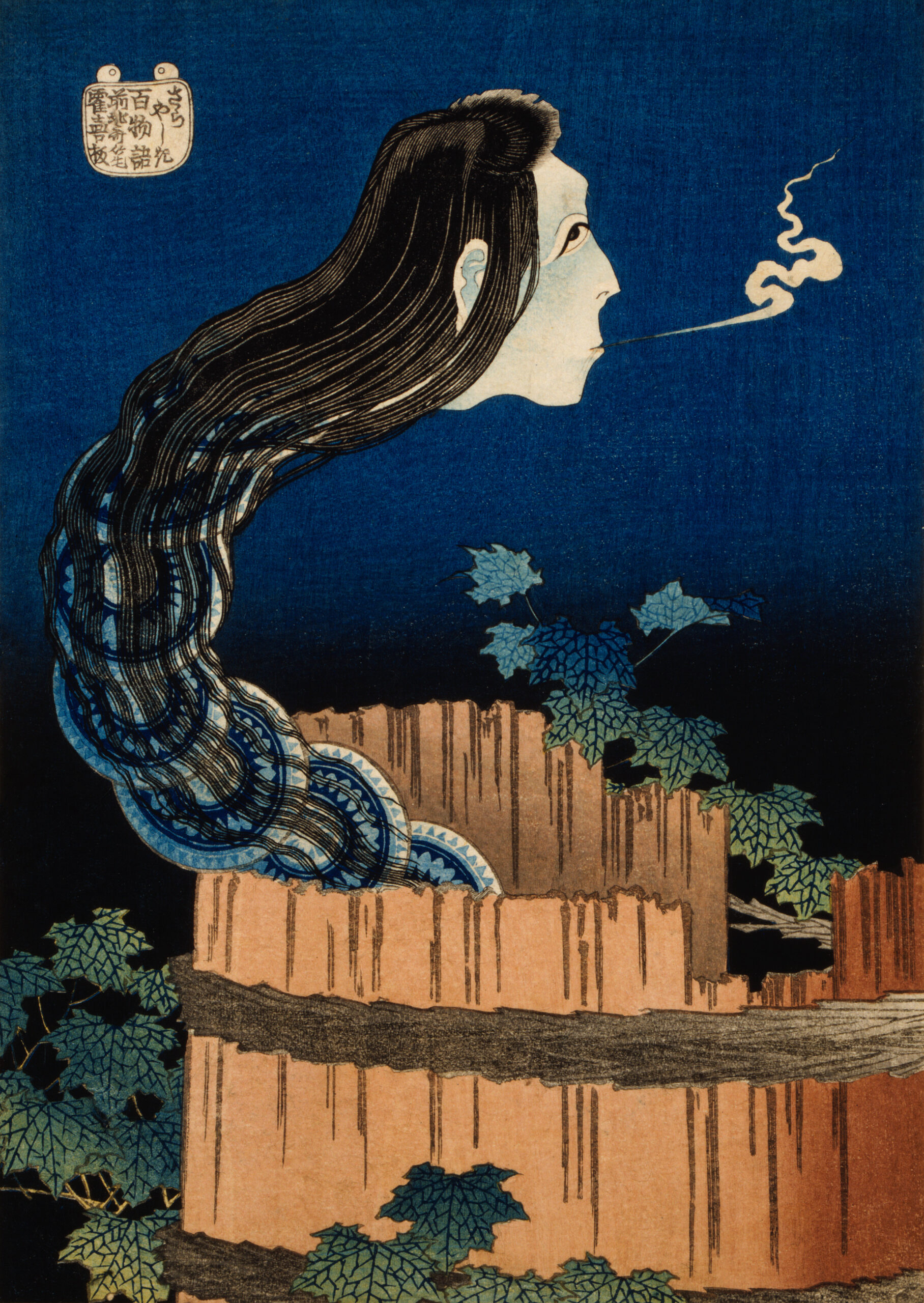
We all know the name of Katsushika Hokusai, the most widely renowned master of the traditional Japanese woodblock-print art called ukiyo‑e. In a lifetime spanning the mid-eighteenth to the mid-nineteenth century, Hochelaga notes, Hokusai created around 30,000 unique pieces of art, including The Great Wave off Kanagawa, part of Thirty-Six Views of Mount Fuji.
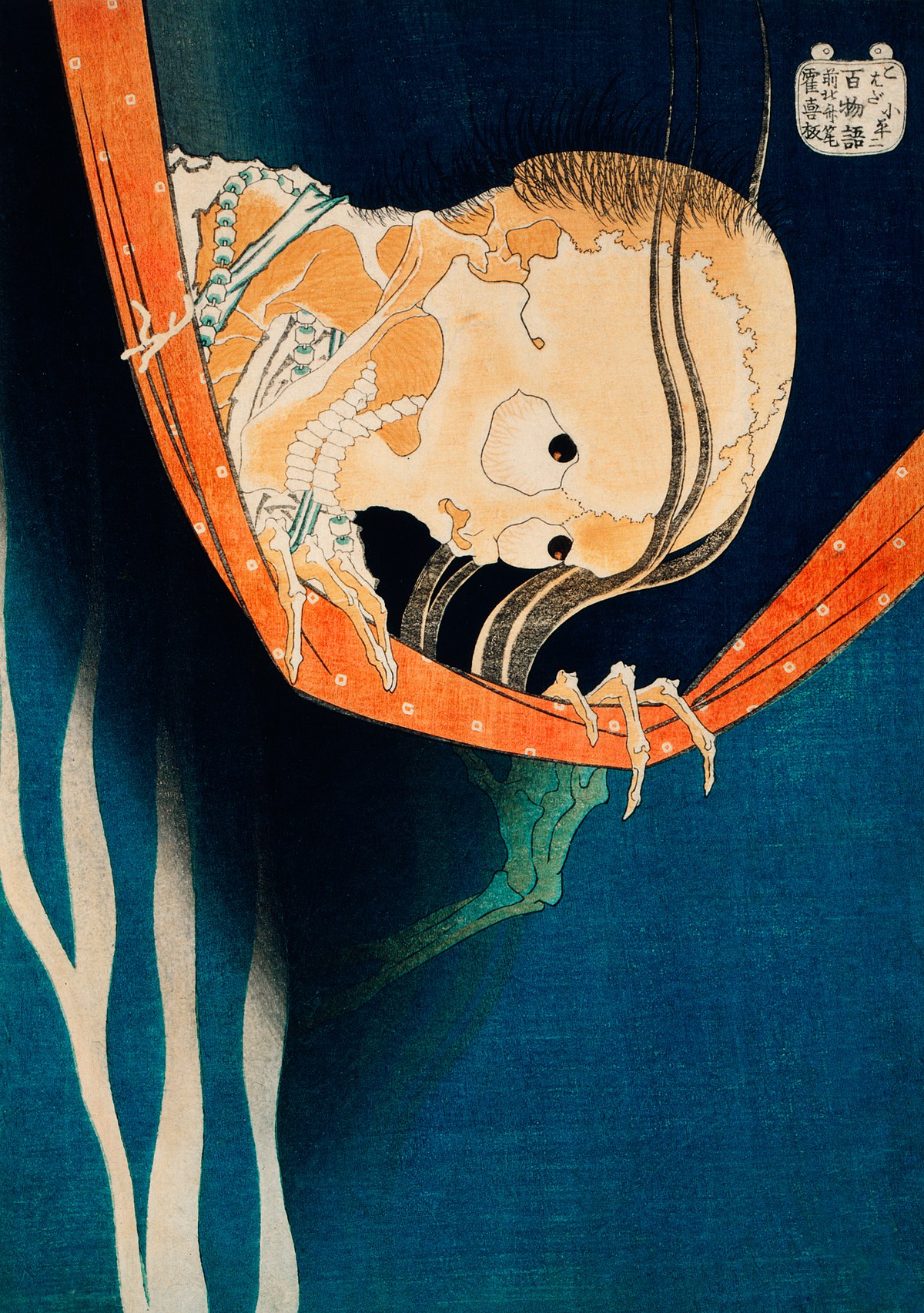
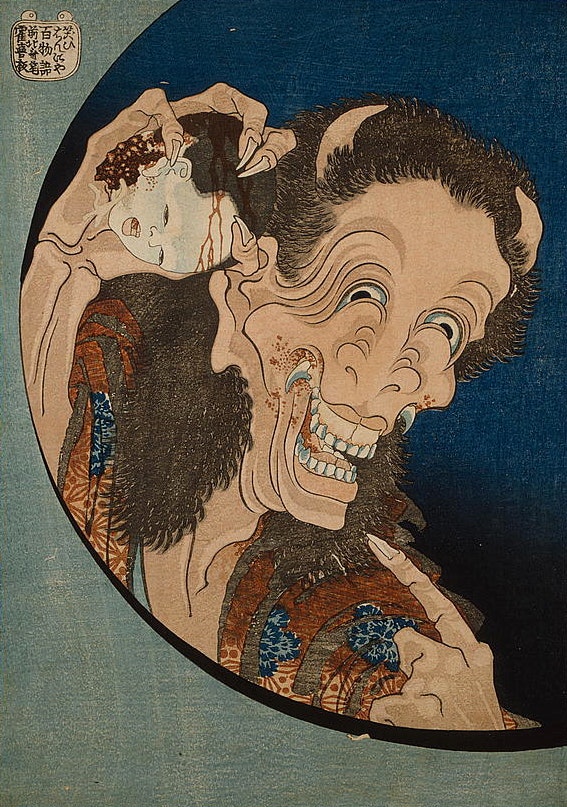
But before executing that triumphant late series, Hokusai made his own Hyakumonogatari (literally, “hundred tales”) — or rather, he rendered in his distinctive style five of those traditional ghost stories’ tragic, grotesque, and often humorous protagonists.
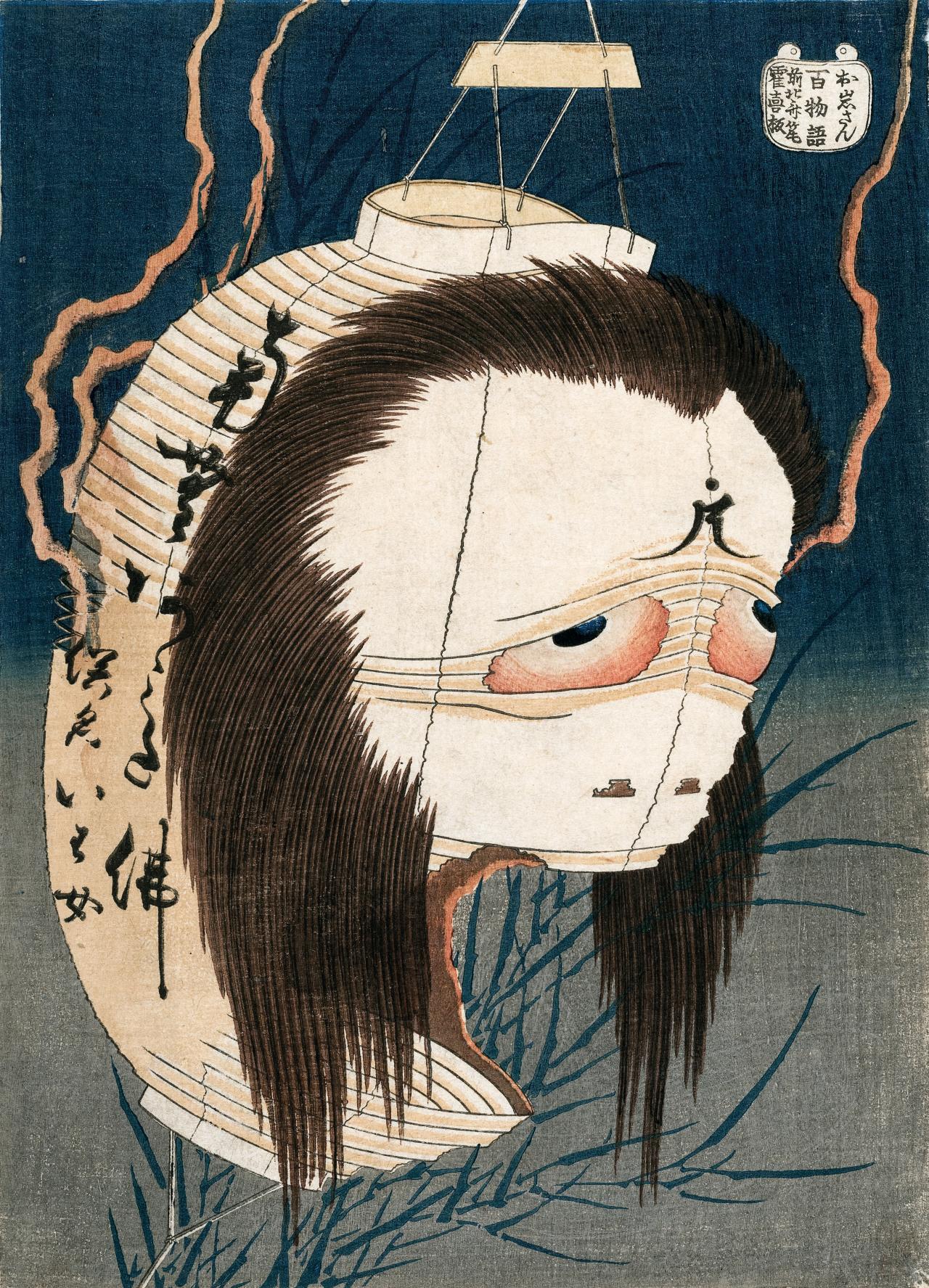
These characters are yōkai, those “weird and mysterious beings” that “inhabit supernatural Japan.” They “come in all shapes and sizes, from friendly household spirits to fierce demons,” including the Oyajirome, who literally has an eye in the back of his head, and the Ushi-oni, “one part bull, one part crab, and the rest nightmare fuel.” Hokusai’s interest tended toward yōkai who had once been normal humans: the neglected wife of a samurai whose spirit became trapped in a lantern, the murdered kabuki actor whose skeletal remains emerged from a swamp to hunt down his killers.
You can read more about these yōkai, and take a look at Hokusai’s depictions of them, at the Public Domain Review and Thoughts on Papyrus. Soon after Hokusai’s death Japan opened to the world, beginning its transformation into a state of hypermodernity. But tales of yōkai still have a certain influence on the Japanese cultural imagination, as evidenced by the Miyoshi Mononoke Museum in Hiroshima. Japan has been more or less closed once again these past couple of years, but once it re-opens, why not make a trip to collect a few scary monogatari for yourself?
Related content:
The First Museum Dedicated to Japanese Folklore Monsters Is Now Open
View 103 Discovered Drawings by Famed Japanese Woodcut Artist Katsushika Hokusai
Based in Seoul, Colin Marshall writes and broadcasts on cities, language, and culture. His projects include the Substack newsletter Books on Cities, the book The Stateless City: a Walk through 21st-Century Los Angeles and the video series The City in Cinema. Follow him on Twitter at @colinmarshall, on Facebook, or on Instagram.
Read More...The Red Hot Chili Peppers’ Flea Presents a Bass Lesson, and Essential Advice That Every Bass Player Should Know
“What do you call someone who hangs out with musicians?” goes the hoary old musicians’ joke. Answer: “a bass player.” Hahaha. Very funny. And just plain untrue. Maybe the bass has fewer strings to master than the guitar, but it requires better timing, and — most importantly — more listening than any other instrument in a band setting. Or so says Flea of the Red Hot Chili Peppers, a band I sometimes think of as a bunch of guys who hang out with a bass player.
All musicians need to listen carefully to other players on stage, but the bass player’s role is special, Flea says in the video above, excerpted from the hour-long bass lesson you can watch in full below. Bassists need to listen to melody players and soloists, supporting their parts with subtlety and nuance, without (says Flea of all people) doing the kind of showboating that pulls focus from the leads. Bass players also need to lock in with the drummer, listening so intently they can fit their notes right in the center of each drum hit.
This hardly sounds like unskilled musical labor, even if most bassists can’t — and don’t need to — play with the speed and ferocity as our instructor above. But Flea as teacher isn’t trying to teach others how to play the way he does, a style inspired by legends like slap bass pioneer Larry Graham and Motown stalwart James Jamerson. He’s giving students his take on the basics — first learn to walk, then learn to walk really, really well, with lots of practice. These basics include going over the parts of a bass guitar, talking about tuning, and learning different ways of hitting the strings, from plucking to picking to, yes, slapping, within reason.
Coming from a player who so commands the spotlight with his bass theatrics, Flea’s advice to aspiring players might seem oddly conservative. But it’s the bass player’s job, he says, to make everyone else in the band sound good. And the better a bassist is at helping other players shine, the more they stand out as a great musician in their own right.
See timestamps for the different topics in Flea’s lesson just below:
0:01 Flea Bass
7:27 Restring and Tuning
12:51 Plucking
16:36 Slapping
22:53 Picking
23:53 Finger Practice
30:24 Major Scale
44:34 Final Thoughts
Related Content:
Flea Rocks “The Star Spangled Banner” on the Bass
What Makes Flea Such an Amazing Bass Player? A Video Essay Breaks Down His Style
Josh Jones is a writer and musician based in Durham, NC. Follow him at @jdmagness
Read More...Experience Seinfeld’s Famous “Soup Nazi” Scenes With & Without Laugh Tracks
For a twenty-first-century television fan, watching old network sitcoms can take some getting used to. Nothing about them takes more getting used to than their laugh tracks, which must strike anyone who didn’t grow up hearing them as utterly bizarre. But was it really so long ago that we took for granted — nay, expected — an eruption of pre-recorded laughter after each and every punch line? As late as the nineteen-nineties, even sitcoms well-regarded for their sophistication and subversiveness added “canned laughter” to their soundtracks. Take Seinfeld, the show famously “about nothing,” scenes from one of whose episodes you can watch without a laugh track in the video above.
The episode in question is one of Seinfeld’s best-known: “The Soup Nazi,” originally broadcast on NBC on November 2, 1995. These scenes portray Jerry, George and Elaine’s encounters with the title figure, a harsh soup-restaurant proprietor based on Ali “Al” Yeganeh, owner of Soup Kitchen International in New York. (Unaware of the character’s real-life counterpart, actor Larry Thomas based his performance on that of Omar Sharif in Lawrence of Arabia.)
With the laugh track cut out, the main characters’ interactions with each other reach heights of near-surreal awkwardness, to say nothing of their confrontations with the Soup Nazi and his rigid ordering rules.
The resultant tension, unbroken by the transplanted guffaws heard in the original scenes above, would become the stock in trade of later sitcoms like the improvisation-based Curb Your Enthusiasm, starring Seinfeld co-creator Larry David. But that show could only have existed under the permissiveness of a premium cable channel like HBO; on NBC, the legacy of the laugh track would be upheld for some years. After all, laugh tracks had been in use since the early nineteen-fifties, during television’s transition away from all-live broadcasting to the methods of pre-production used for practically all drama and comedy still today. Even then, live studio audiences were becoming a thing of the past — but the exploitation of television’s power to generate artificial feelings of community had only just begun.
Related content:
Seinfeld & Nothingness: A Supercut of the Show’s Emptiest Moments
Jacques Derrida on Seinfeld: “Deconstruction Doesn’t Produce Any Sitcom”
David Lynch’s Twin Peaks Theme Song Gets the Seinfeld Treatment
Based in Seoul, Colin Marshall writes and broadcasts on cities, language, and culture. His projects include the Substack newsletter Books on Cities, the book The Stateless City: a Walk through 21st-Century Los Angeles and the video series The City in Cinema. Follow him on Twitter at @colinmarshall, on Facebook, or on Instagram.
Read More...Watch Sir Ian McKellen’s 1979 Master Class on Macbeth’s Final Monologue
If only we could have had a teacher as insightful as Sir Ian McKellen explain some Shakespeare to us at an impressionable age.
Above, a 38-year-old McKellen breaks down Macbeth’s famous final soliloquy as part of a 1978 master class in Acting Shakespeare.
He makes it clear early on that relying on Iambic pentameter to convey the meaning of the verse will not cut it.
Instead, he calls upon actors to apply the power of their intellect to every line, analyzing metaphors and imagery, while also noting punctuation, word choice, and of course, the events leading up to the speech.
In this way, he says, “the actor is the playwright and the character simultaneously.”
McKellen was, at the time, deeply immersed in Macbeth, playing the title role opposite Judi Dench in a bare bones Royal Shakespeare Company production that opened in the company’s Stratford studio before transferring to the West End. As McKellen recalled in a longer meditation on the trickiness of staging this particular tragedy:
It was beautifully done on the cheap in The Other Place, the old tin hut along from the main theatre. John Napier’s entire set cost £200 and the costumes were a ragbag of second-hand clothes. My uniform jacket had buttons embossed with ‘Birmingham Fire Service’; my long, leather coat didn’t fit, nor did Banquo’s so we had to wear them slung over the shoulder; Judi Dench, as Lady Macbeth, wore a dyed tea-towel on her head. Somehow it was magic: and black magic, too. A priest used to sit on the front row, whenever he could scrounge a ticket, holding out his crucifix to protect the cast from the evil we were raising.
The New York Times raved about the production, declaring McKellen “the best equipped British actor of his generations:”
Mr. McKellen’s Macbeth is witty; not merely the horror but the absurdity of his actions strikes him from the outset, and he can regard his downfall as an inexorable joke. His wife pulls him along a road that he would travel anyway and he can allow himself scruples, knowing that she will be there to mop them up. Once her prosaic, limited ambition is achieved, she is of no more use to him and he shrugs her off; “she would have died hereafter” is a moment of exasperation that dares our laughter.
What fuels him most is envy, reaching incredulously forward (“The seed of Banquo kings?”) and backward to color the despair of “Duncan is in his grave.” The words, and the mind behind them, are rancid, and it is this mood that takes possession of his last scenes. Everything disgusts him, and his only reason for fighting to the death is that the thought of subjection is the most disgusting of all.
McKellen begins his examination of the text by noting how “she would have died hereafter” sets up the final soliloquy’s preoccupation with time, and its passage.
Tomorrow, and tomorrow, and tomorrow,
Creeps in this petty pace from day to day,
To the last syllable of recorded time;
And all our yesterdays have lighted fools
The way to dusty death. Out, out, brief candle!
Life’s but a walking shadow, a poor player,
That struts and frets his hour upon the stage,
And then is heard no more. It is a tale
Told by an idiot, full of sound and fury,
Signifying nothing.
McKellen makes a true meal of “out, out, brief candle”, relating it to Lady Macbeth’s final appearance, the fools proceeding to their dusty death earlier in the monologue, and Elizabethan stage lighting.
He speculates that Shakespeare’s description of life as a “poor player” was a deliberate attempt by the playwright to give the actor an interpretive hook they could relate to. In performance, the theatrical metaphor should remind the audience that they’re watching a pretense even as they’re invested in the character’s fate.
The production’s success inspired director Trevor Nunn to film it. McKellen recalled that everyone was already so well acquainted with the material, it took just two weeks to get it in the can:
The claustrophobia of the stage production was exactly captured. Trevor had used a similar technique with Antony and Cleopatra on the box. No one else should ever be allowed to televise Shakespeare…There is so much I was proud of: discovering how to play a soliloquy direct into the eyes of everyone in the audience; making them laugh at Macbeth’s gallows humor; working alongside Judi Dench’s finest performance.
For more expert advice from McKellen, Patrick Stewart, Ben Kingsley and other notables, watch the RSC’s 9‑part Playing Shakespeare series here.
– Ayun Halliday is the Chief Primatologist of the East Village Inky zine and creator, most recently of Creative, Not Famous: The Small Potato Manifesto. Follow her @AyunHalliday.
Read More...Jon Kabat-Zinn Presents an Introduction to Mindfulness (and Explains Why Our Lives Just Might Depend on It)
The practice of cultivating mindfulness through meditation first took root in Europe and the U.S. in the 1960s, when Buddhist teachers from Japan, Tibet, Vietnam, and elsewhere left home, often under great duress, and taught Western students hungry for alternative forms of spirituality. Though popularized by countercultural figures like Alan Watts and Allen Ginsberg, the practice didn’t seem at first like it might reach those who seemed to need it most — stressed out denizens of the corporate world and military industrial complex who hadn’t changed their consciousness with mind-altering drugs, or left the culture to become monastics.
Then professor of medicine Jon Kabat-Zinn came along, stripped away religious and new age contexts, and began redesigning mindfulness for the masses in 1979 with his mindfulness-based stress reduction (MBSR) program. Now everyone knows, or thinks they know, what mindfulness is. As meditation teacher Lokadhi Lloyd tells The Guardian, Kabat-Zinn is “Mr Mindfulness in relation to our secular strand. Without him, I don’t think mindfulness would have risen to the prominence it has.”
His secularization of mindfulness, however, has not, in practical terms, taken it very far from its roots, which explains why Kabat-Zinn’s groundbreaking 1990 book Full Catastrophe Living receives high praise from Buddhist teachers like Joseph Goldstein, Sharon Salzburg, and Kabat-Zinn’s own former Zen teacher, Thich Nhat Hanh.
While Kabat-Zinn says he himself is not (or is no longer) a Buddhist, his definitions of mindfulness might sound just close enough to those who study and practice the religion. As he says in the short segment at the top: “It’s paying attention, on purpose, in the present moment, non-judgmentally.” And then, “sometimes,” he says, “I like to add, as if your life depended on it.” The quality of our lives, the clarity of our lives, and the depth and richness of our lives depend on our ability to be aware of what’s happening around and inside us. This ability, Kabat-Zinn insists, is the inheritance of all human beings. It can be found in spiritual practices around the world. No one owns a patent on awareness.
Nevertheless, Kabat-Zinn is particularly leery of what he calls McMindfulness, the commodity-driven industry selling coloring books, apps, puzzles, t‑shirts, and novelties touting mindful benefits. Mindfulness based stress reduction is “not a trick,” he says. It isn’t something we buy and try out here and there. “MBSR is exceedingly challenging,” Kabat-Zinn writes in Full Catastrophe Living. “In many ways, being in the present moment with a spacious orientation toward what is happening may really be the hardest work in the world for us humans. At the same time, it is also infinitely doable.” It can also be highly unpleasant, forcing us to sit with the things we’d rather ignore about ourselves. Why should we do it? We might consider the alternatives.
MBSR began (“in the basement of the University of Massachusetts Medical Center,” notes NPR) helping patients with chronic pain recover. It proved so effective, Kabat-Zinn applied the insight more globally — “using the wisdom of your body and mind to face stress, pain, and illness.” This is not a cure-all, but a way of living that reduces unnecessary suffering caused by overactive discursive thinking, which traps us in patterns of blame, shame, fear, regret, judgment, and self-criticism (illustrated in Scottish psychologist R.D. Laing’s book of neurotic narratives, Knots) — traps us, that is, in stories about the past and future, which affect our physical and mental health, our work, and our relationships.
The medical evidence for mindfulness has only begun to catch up with Kabat-Zinn’s work, yet it weighs heavily on the side of the outcomes he has seen for over 40 years. MBSR also comes highly recommended by Harvard neuroscientist Sara Lazar and trauma expert Bessel Van Der Kok, among so many others who have done the research. The evidence is why, as you can see in the longer presentations above at Dartmouth and Google, Kabat-Zinn has become something of an evangelist for mindfulness. “If this is another fad, I don’t want to have any part of it,” he says. “If in the past 50 years I had found something more meaningful, more healing, more transformative and with more potential social impact, I would be doing that.”
As Kabat-Zinn’s 2005 book, Wherever You Go, There You Are, shows, we can bring what happens in meditation into our everyday life, letting assumptions go, and “letting life become both the meditation teacher and the practice, moment by moment, no matter what arises,” he tells Mindful magazine. This isn’t about escaping into blissed out moments of Zen. It’s fostering “deep connections,” over and over again, with ourselves, families, friends, communities, the planet we live on, and, in turn, “the future that we’re bequeathing to our future generations.”
Related Content:
Daily Meditation Boosts & Revitalizes the Brain and Reduces Stress, Harvard Study Finds
De-Mystifying Mindfulness: A Free Online Course by Leiden University
Stream 18 Hours of Free Guided Meditations
Josh Jones is a writer and musician based in Durham, NC. Follow him at @jdmagness
Read More...An Online Archive of Beautiful, Early 20th Century Japanese Postcards
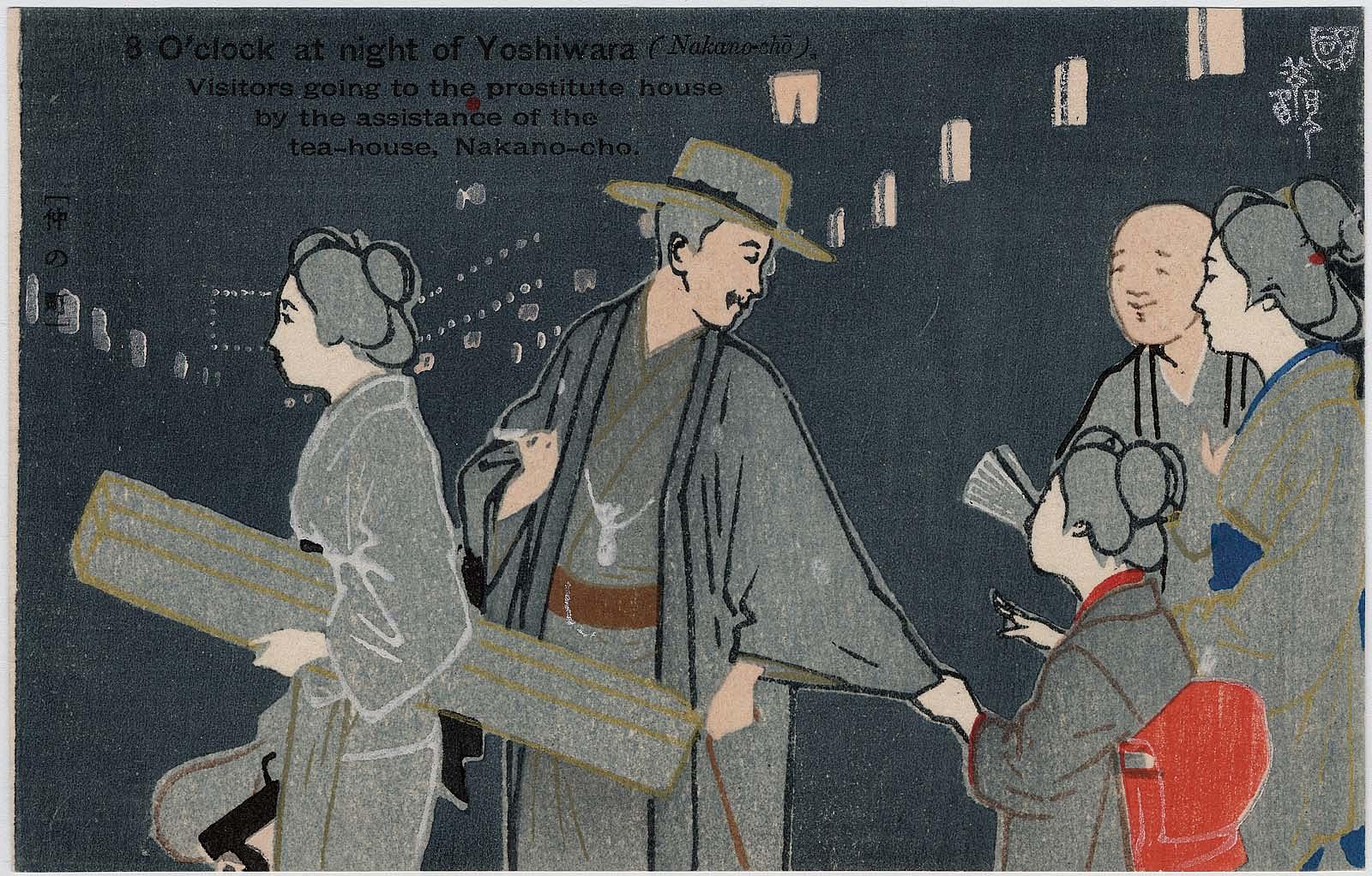
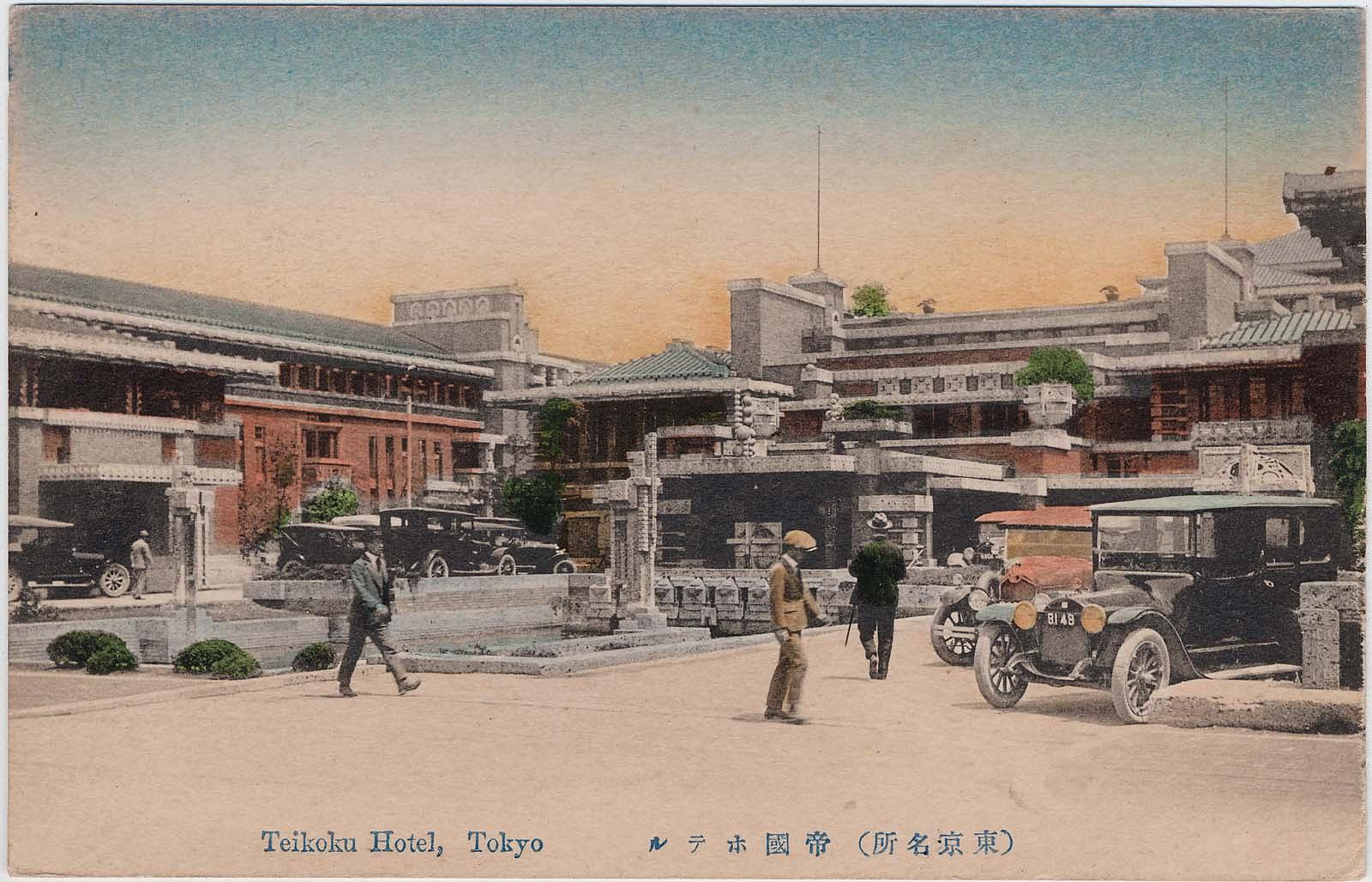
The world thinks of Japan as having transformed itself utterly after its defeat in the Second World War. And indeed it did, into what by the nineteen-eighties looked like a gleaming, technology-saturated condition of ultra-modernity. But the standard version of modernity, as conceived of in the early 20th century with its trains, telephones, and electricity, came to Japan long before the war did. “Between 1900 and 1940, Japan was transformed into an international, industrial, and urban society,” writes Museum of Fine Arts Boston curator Anne Nishimura Morse. “Postcards — both a fresh form of visual expression and an important means of advertising — reveal much about the dramatically changing values of Japanese society at the time.”
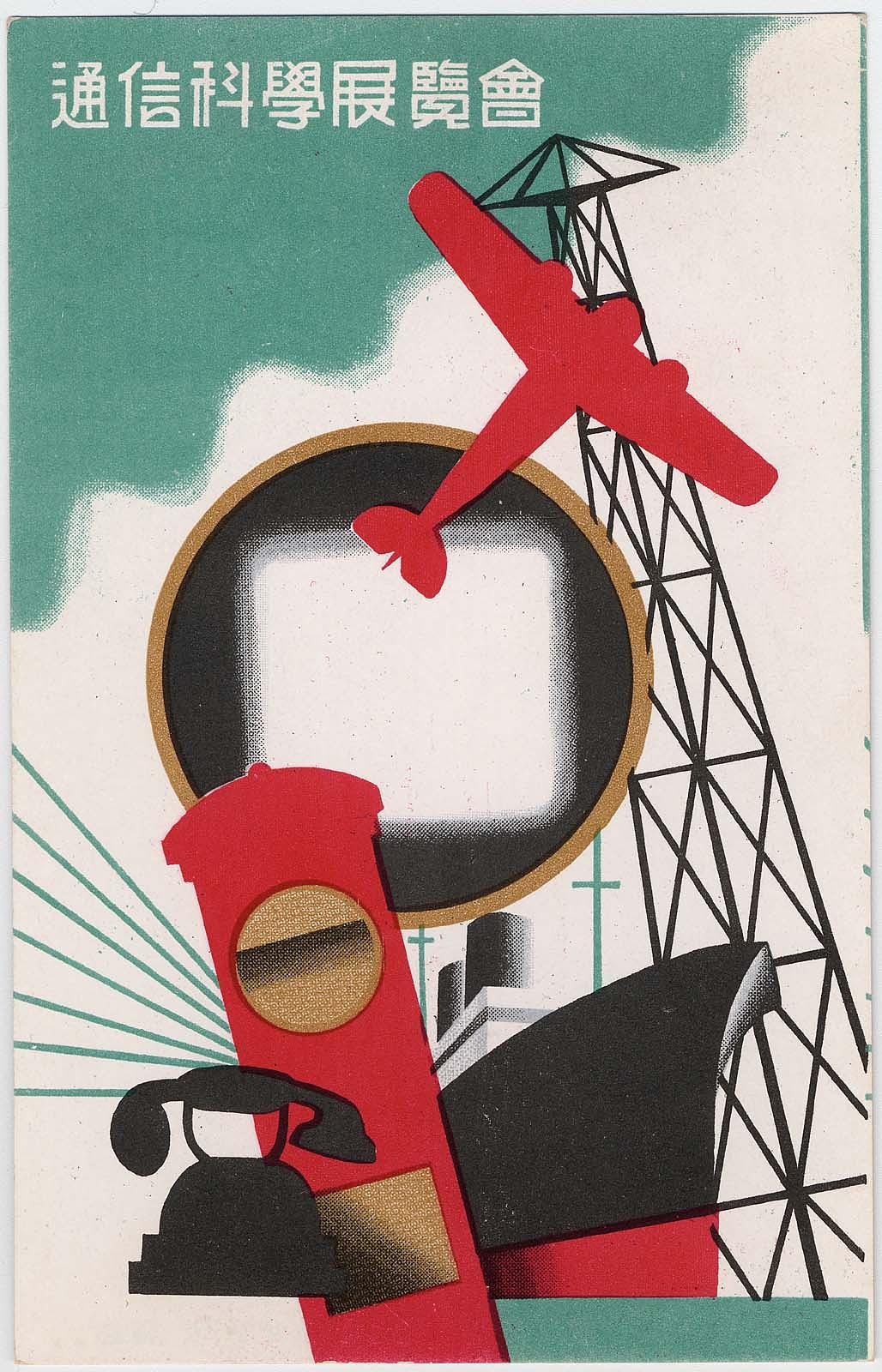
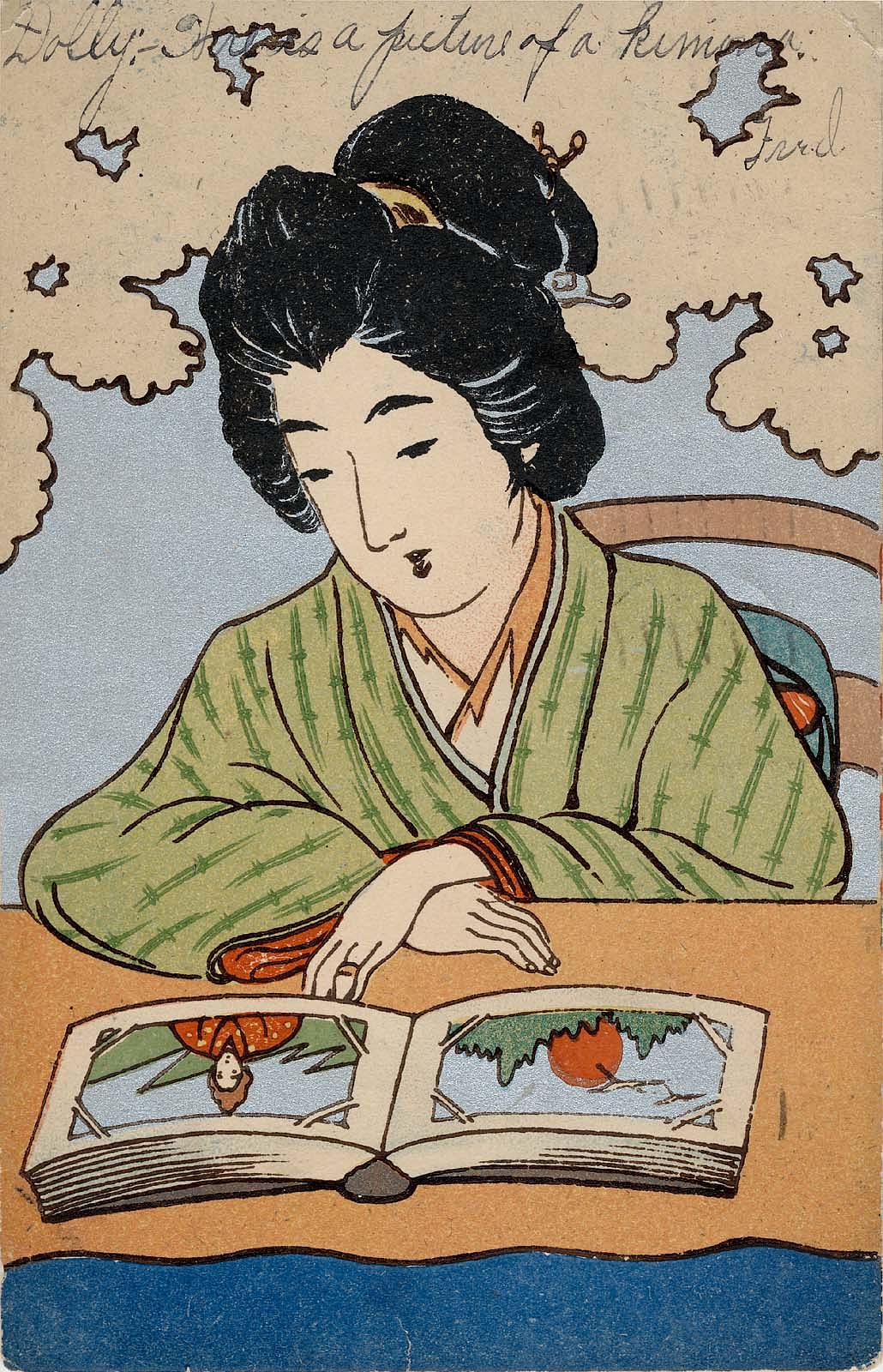
These words come from the introductory text to the MFA’s 2004 exhibition “Art of the Japanese Postcard,” curated from an archive you can visit online today. (The MFA has also published it in book form.) You can browse the vintage Japanese postcards in the MFA’s digital collections in themed sections like architecture, women, advertising, New Year’s, Art Deco, and Art Nouveau.
These represent only a tiny fraction of the postcards produced in Japan in the first decades of the twentieth century, when that new medium “quickly replaced the traditional woodblock print as the favored tableau for contemporary Japanese images. Hundreds of millions of postcards were produced to meet the demands of a public eager to acquire pictures of their rapidly modernizing nation.”
The earliest Japanese postcards “were distributed by the government in connection with the Russo-Japanese War (1904–5), to promote the war effort. Almost immediately, however, many of Japan’s leading artists — attracted by the informality and intimacy of the postcard medium — began to create stunning designs.” The work of these artists is collected in a dedicated section of the online archive, where you’ll find postcards by the commercial graphic-design pioneer Suguira Hisui; the French-educated, highly Western-influenced Asai Chi; the multitalented Ota Saburo, known as the illustrator of Kawabata Yasunari’s The Scarlet Gang of Asakusa; and Nakazawa Hiromitsu, creator of the “diver girl” long well-known among Japanese-art collectors.
Surprisingly, Nakazawa’s diver girl (also known as the “mermaid,” but most correctly as “Heroine Matsuzake” of a popular play at the time) seems not to have been among the possessions of cosmetics billionaire and art collector Leonard A. Lauder, who donated more than 20,000 Japanese selections from his vast postcard collection to the MFA. “In 1938 or ’39, a boy of five or six, or maybe seven, was so enthralled by the beauty of a postcard of the Empire State Building that he took his entire five-cent allowance and bought five of them,” writes the New Yorker’s Judith H. Dobrzynski. The youngster thrilling to the paper image of a skyscraper was, of course, Lauder — who couldn’t have known how much, in that moment, he had in common with the equally modernity-intoxicated people on the other side of the world.
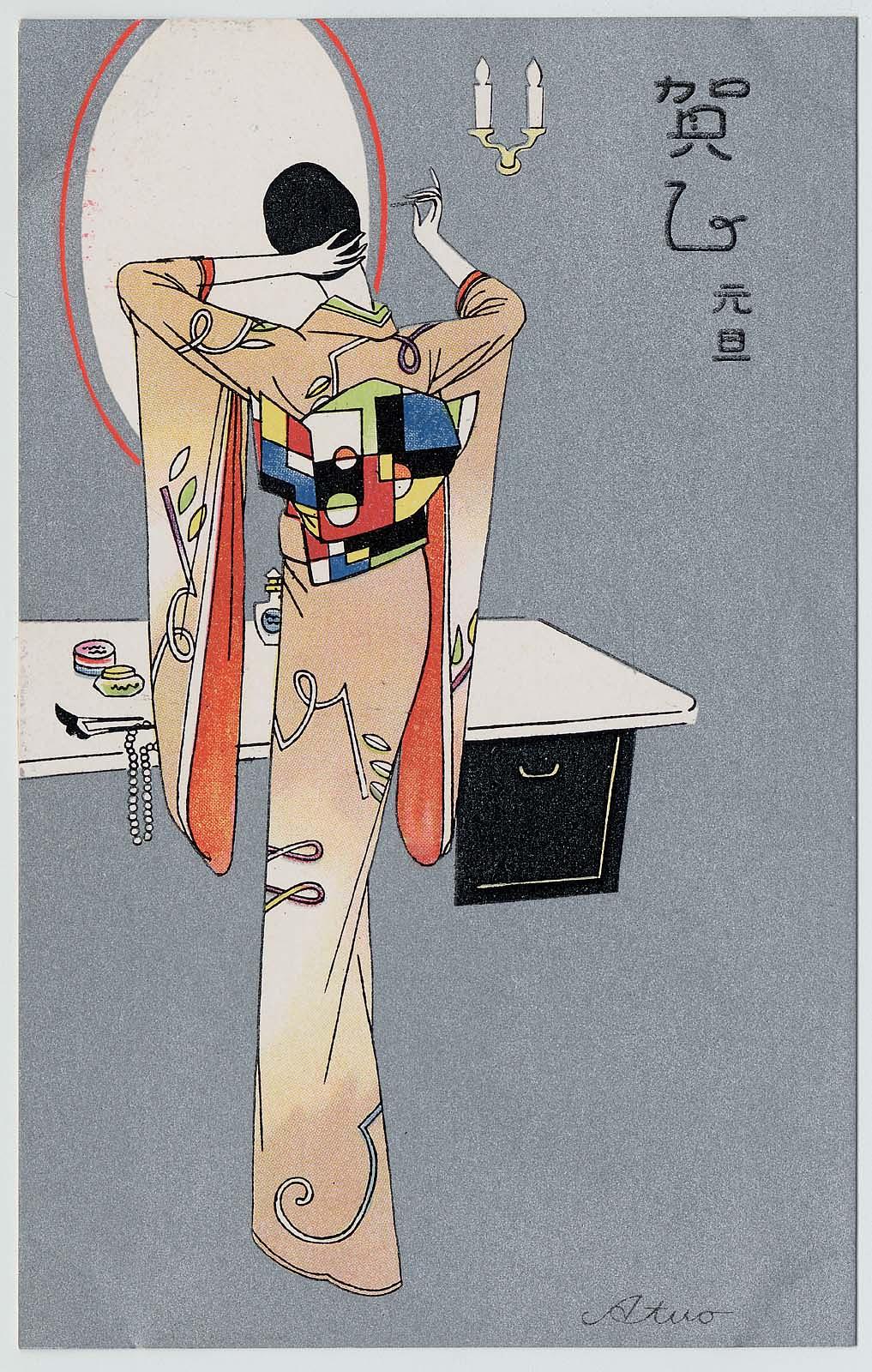
via Flashbak
Related content:
Advertisements from Japan’s Golden Age of Art Deco
Vintage 1930s Japanese Posters Artistically Market the Wonders of Travel
Glorious Early 20th-Century Japanese Ads for Beer, Smokes & Sake (1902–1954)
An Eye-Popping Collection of 400+ Japanese Matchbox Covers: From 1920 through the 1940s
View 103 Discovered Drawings by Famed Japanese Woodcut Artist Katsushika Hokusai
Download 2,500 Beautiful Woodblock Prints and Drawings by Japanese Masters (1600–1915)
Based in Seoul, Colin Marshall writes and broadcasts on cities, language, and culture. His projects include the Substack newsletter Books on Cities, the book The Stateless City: a Walk through 21st-Century Los Angeles and the video series The City in Cinema. Follow him on Twitter at @colinmarshall, on Facebook, or on Instagram.
Read More...A Whirlwind Architectural Tour of the New York Public Library–“Hidden Details” and All
The New York Public Library opened in 1911, an age of magnificence in American city-building. Eighteen years before that, writes architect-historian Witold Rybczynski, “Chicago’s Columbian Exposition provided a real and well-publicized demonstration of how the unruly American downtown could be tamed though a partnership of classical architecture, urban landscaping, and heroic public art.” Modeled after Europe’s urban civilization, the “White City” built on the ground of the Columbian Exposition inspired a generation of American architects and planners including John Nolen, Frederick Law Olmsted, Jr., and John Carrère, co-designer of the New York Public Library.
Carrère appears in the Architectural Digest tour video of the NYPL building above — or at least his bust does, prominently placed as it is on the landing of one of the grand staircases leading up from the main entrance. The staircases are marble, as is much of else; when the NYPL opened after nine years of construction, so the tour’s narration informs us, it did so as the largest marble-clad structure in the country.
On the soundtrack we have not just one guide, but three: NYPL visitor volunteer program manager Keith Glutting, design historian Judith Gura, and architectural historian Paul Ranogajec. Together they tell the story of this venerable American building, and also point out the “hidden details” that a visitor might not otherwise notice.
Take the terrace on which the whole building stands, a feature of the European villa and palace tradition. Or the murals depicting the history of the written word from Moses’ stone tablets on down. Or the pneumatic tubes, artifacts of the analog information-technology system in use before the NYPL computerized in the nineteen-seventies. Or the rendering of the world in the library’s formidable map room that mistakenly depicts California as an island (not that every New Yorker would disagree). The video also includes other, even lesser-seen wonders both old and new, from a 1455 Gutenberg Bible — the first in the New World — to the automated trolley system that brings books out of the stacks. But it is the building itself that inspires wonder, its extravagant solidity and detail that hark back to a time of consensus, however brief, that nothing was too good for ordinary people.
Related content:
The New York Public Library Announces the Top 10 Checked-Out Books of All Time
Watch 52,000 Books Getting Reshelved at The New York Public Library in a Short, Timelapse Film
The New York Public Library Unveils a Cutting-Edge Train That Delivers Books
The New York Public Library Creates a List of 125 Books That They Love
Based in Seoul, Colin Marshall writes and broadcasts on cities, language, and culture. His projects include the Substack newsletter Books on Cities, the book The Stateless City: a Walk through 21st-Century Los Angeles and the video series The City in Cinema. Follow him on Twitter at @colinmarshall, on Facebook, or on Instagram.
Read More...The History of Birth Control: From Alligator Dung to The Pill
The history of birth control is almost as old as the history of the wheel.
Pessaries dating to Mesopotamia and ancient Egypt provide the launching pad for documentarian Lindsay Holiday’s overview of birth control throughout the ages and around the world.
Holiday’s History Tea Time series frequently delves into women’s history, and her pledge to donate a portion of the above video’s ad revenue to Pathfinder International serves as reminder that there are parts of the world where women still lack access to affordable, effective, and safe means of contraception.
One goal of the World Health Organization’s Ending Preventable Maternal Mortality initiative is for 65% of women to be able to make informed and empowered decisions regarding sexual relations, contraceptive use, and their reproductive health by 2025.
As Holiday points out, expense, social stigma, and religious edicts have impacted ease of access to birth control for centuries.
The further back you go, you can be certain that some methods advocated by midwives and medicine women have been lost to history, owing to unrecorded oral tradition and the sensitive nature of the information.
Holiday still manages to truffle up a fascinating array of practices and products that were thought — often erroneously — to ward off unwanted pregnancy.
Some that worked and continue to work to varying degrees, include barrier methods, condoms, and more recently the IUD and The Pill.
Definitely NOT recommended: withdrawal, holding your breath during intercourse, a post-coital sneezing regimen, douching with Lysol or Coca-Cola, toxic cocktails of lead, mercury or copper salt, anything involving alligator dung, and slugging back water that’s been used to wash a corpse.
As for silphium, an herb that likely did have some sort of spermicidal properties, we’ll never know for sure. By 1 CE, demand outstripped supply of this remedy, eventually wiping it off the face of the earth despite increasingly astronomical prices. Fun fact: silphium was also used to treat sore throat, snakebite, scorpion stings, mange, gout, quinsy, epilepsy, and anal warts
The history of birth control can be considered a semi-secret part of the history of prostitution, feminism, the military, obscenity laws, sex education and attitudes toward public health.
From Margaret Sanger and the 60,000 women executed as witches in the 16th and 17th centuries, to economist Thomas Malthus’ 1798 Essay on the Principle of Population and legendary adventurer Giacomo Casanova’s satin ribbon-trimmed jimmy hat, this episode of History Tea Time with Lindsay Holiday touches on it all.
- Ayun Halliday is the Chief Primatologist of the East Village Inky zine and author, most recently, of Creative, Not Famous: The Small Potato Manifesto. Follow her @AyunHalliday.
Related Content
The Story Of Menstruation: Watch Walt Disney’s Sex Ed Film from 1946
Read More...A Master List of 1,700 Free Courses From Top Universities: A Lifetime of Learning on One Page

For the past 15 years, we’ve been busy rummaging around the internet and adding courses to an ever-growing list of Free Online Courses, which now features 1,700 courses from top universities. Let’s give you the quick overview: The list lets you download audio & video lectures from schools like Stanford, Yale, MIT, Oxford, Harvard and many other institutions. Generally, the courses can be accessed via YouTube, iTunes or university web sites, and you can listen to the lectures anytime, anywhere, on your computer or smart phone. We haven’t done a precise calculation, but there’s about 50,000 hours of free audio & video lectures here. Enough to keep you busy for a very long time–something that’s useful during these socially distant times.
Right now you’ll find 200 free philosophy courses, 105 free history courses, 170 free computer science courses, 85 free physics courses and 55 Free Literature Courses in the collection, and that’s just beginning to scratch the surface. You can peruse sections covering Astronomy, Biology, Business, Chemistry, Economics, Engineering, Math, Political Science, Psychology and Religion.
Here are some highlights from the complete list of Free Online Courses. We’ve added a few unconventional/vintage courses in the mix just to keep things interesting.
- A History of Philosophy in 81 Video Lectures: From Ancient Greece to Modern Times — Free Online Video — Arthur Holmes, Wheaton College
- A Romp Through Ethics for Complete Beginners - Various Formats – Marianne Talbot, Oxford University
- Ancient Greek History — Various Formats — Donald Kagan, Yale
- Creative Reading and Writing by William S. Burroughs — Free Online Audio — Naropa University
- Critical Reasoning for Beginners — Various Formats – Marianne Talbot, Oxford
- Deep Learning — Free Online Video — Vincent Vanhoucke, Google
- Edible Education 101 – Free Online Video – Michael Pollan, UC Berkeley
- Financial Markets — Various Formats — Robert Shiller, Yale
- Growing Up in the Universe – Free Online Video – Richard Dawkins, Oxford
- Harvard’s Introductory Computer Science Course - Free Online Course — David Malan, Harvard
- Hemingway, Fitzgerald, Faulkner – Various Formats – Wai Chee Dimock, Yale
- How to Listen to Music — Various Formats — Craig Wright, Yale
- Human Behavioral Biology – Various Formats – Robert Sapolsky, Stanford
- Introduction to the Old Testament (Hebrew Bible) – Free Online Video — Christine Hayes, Yale.
- Lectures on Digital Photography — Free Online Video — Marc Levoy, Stanford/Google
- Physics for Future Presidents – Free Online Video – Richard Muller, UC Berkeley
- Science and Cooking: From Haute Cuisine to the Science of Soft Matter — Various Formats — Team taught, Harvard
- Speak Italian with Your Mouth Full - Various Formats — MIT, Dr. Paola Rebusco
- The American Novel Since 1945 – Various Formats – Amy Hungerford, Yale
- The Central Philosophy of Tibet — Free Online Audio – Robert Thurman, Columbia University
- The Character of Physical Law (1964) - Free Online Video — Richard Feynman, Cornell
- The Tempest - Free Online Audio — Allen Ginsberg, Naropa
- Walter Kaufmann Lectures on Nietzsche, Kierkegaard and Sartre — Free Online Audio
The complete list of courses can be accessed here: 1,700 Free Online Courses from Top Universities. For more enriching material, see our other collections below.
Related Content:
1,000 Free Audio Books: Download Great Books for Free.
4,000+ Free Movies Online: Great Classics, Indies, Noir, Westerns, Documentaries & More.
Learn 45+ Languages Online for Free: Spanish, Chinese, English & More.
200 Online Certificate & Microcredential Programs from Leading Universities & Companies.
Read More...
Explore a Big Archive of Vintage Early Comics: 1700–1929
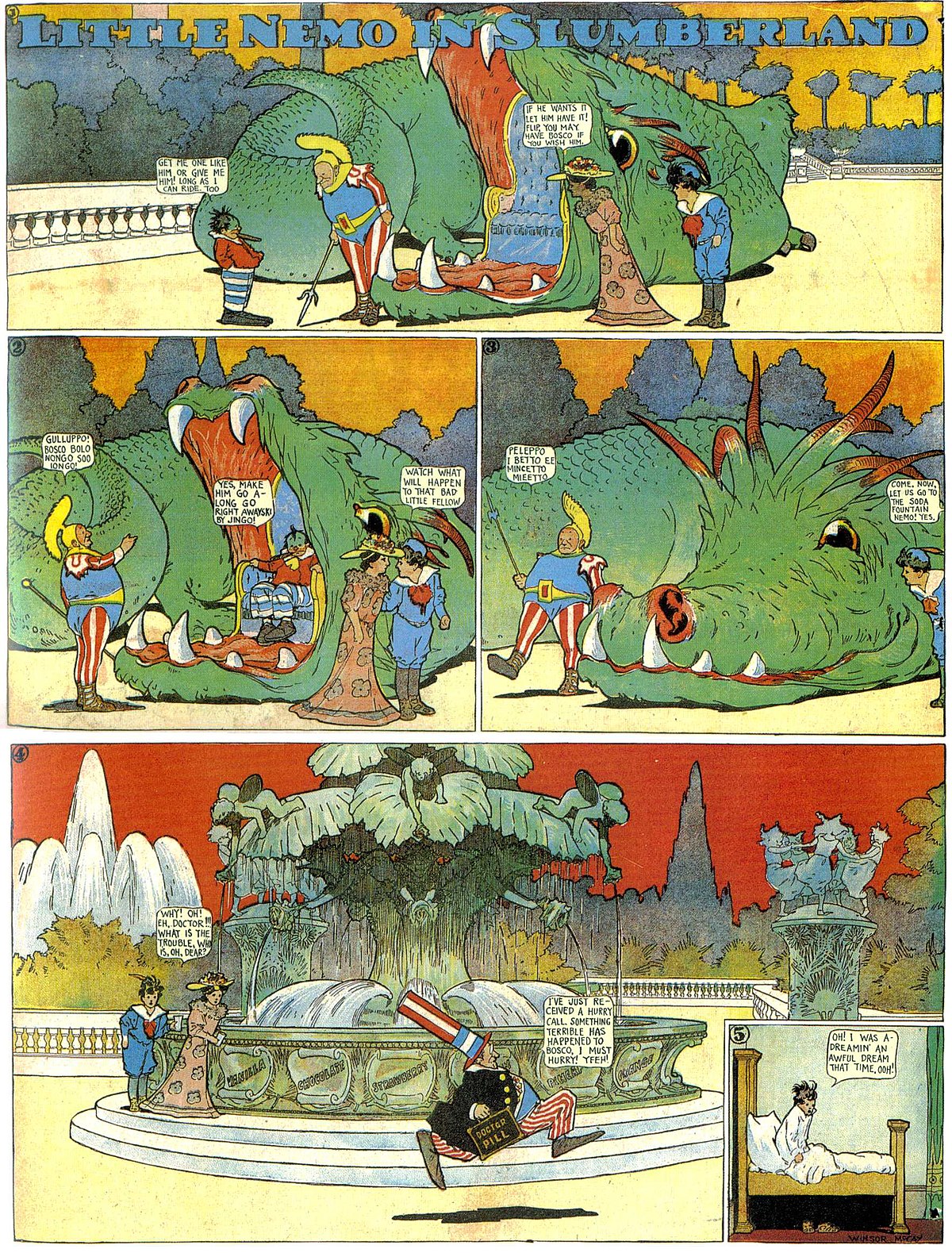
The popularity of graphic novels (and more than a few extremely lucrative superhero movie franchises) have conferred respectability on comics.
Handsome reissues of such stunning early works as Winsor McKay’s Little Nemo in Slumberland, George Herriman’s Krazy Kat, and Frank King’s Walt and Skeezix suggest that readers’ appetite for vintage comics extends deeper and further back than mere nostalgia for the Sunday funnies of their youth.
Artist Andy Bleck’s Andy’s Early Comics Archive is an excellent resource for those seeking to discover early examples of the form that have yet to be reissued in a collected edition. (Fair warning: reflecting the attitudes of the time, the collection does inevitably contains some racist imagery. Such imagery won’t be on display in this post.)
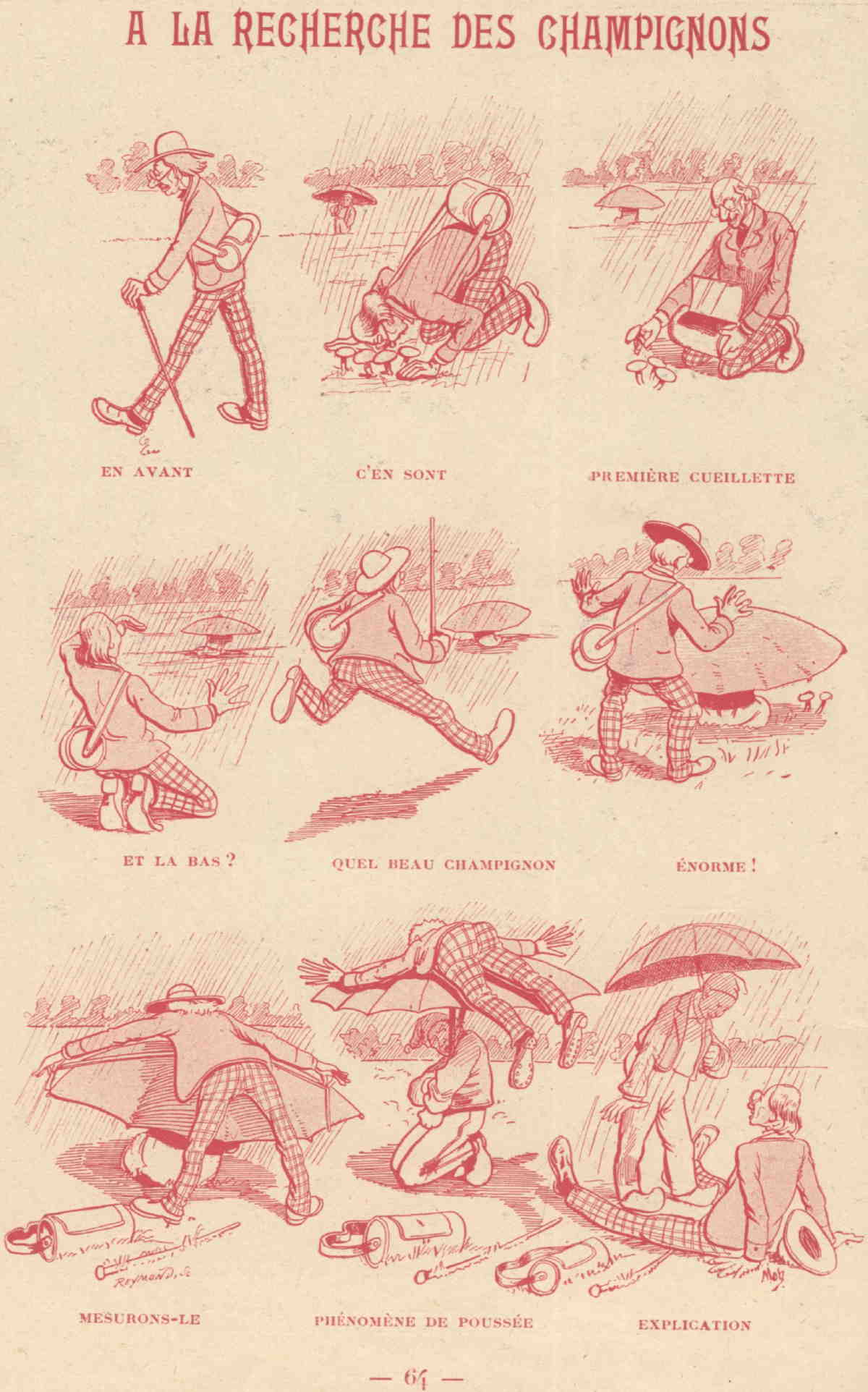
Bleck, the creator of Konky Kru, a beautifully simple, wordless series, as well as several self-published mini comics, takes a historian’s interest in his subject, beginning with the William Hogarth engravings A Harlot’s Progress from 1730:
The famous ‘progressions’ by Hogarth were not actually comics. The images don’t lead into and don’t interact with each other. Each shows a distinct, separate stage of a longer story. However, because of their great popularity, they established the very notion of telling entertaining stories with a series of pictures and so became a highly influential stepping stone for future developments.
He also cites the influence of British political cartoons, Chinese woodcuts, illustrated fairy tales and nursery rhymes, and Heinrich Hoffmann’s Struwwelpeter, a book that terrified children into behaving by depicting the monstrous consequences befalling those who failed to do so.
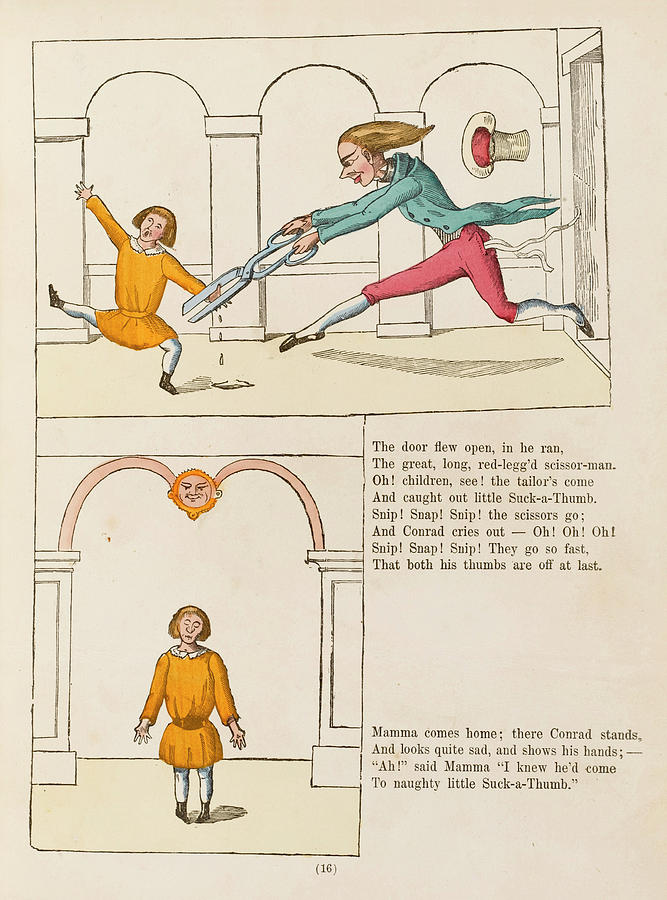
Ironically, Franz Joseph Goez’s Lenardo und Blandine, an actual graphic novelette from 1783, “probably had little influence:”
It was too ahead of its time as far as the comic structure is concerned. In content, it was delightfully very much of its time, full of outrageous melodrama.
Things continued to evolve in the second half of the 19th-century, with picture broadsheets for children, such as the ones starring Wilhelm Busch’s wildly popular Max and Moritz. (See an English translation here.)
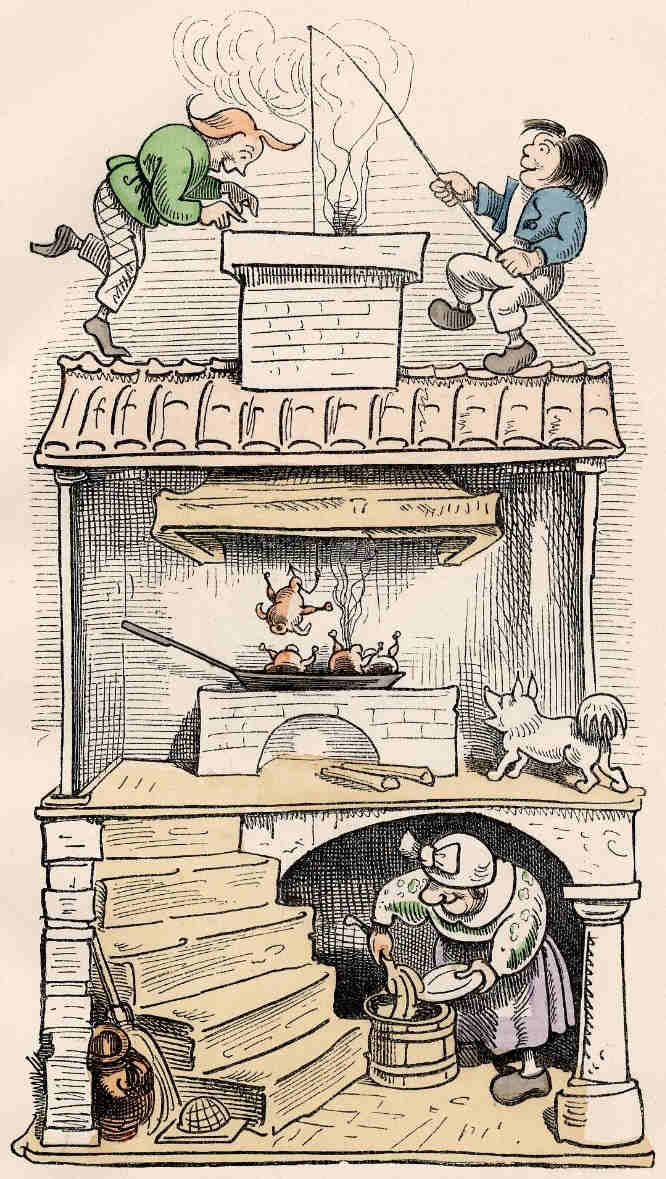
Bleck traces the birth of modern comics, whose storytelling vocabulary continues today, to the beginning of the 20th century, with American newspaper strips and particularly, the Sunday funnies:
The newspaper format was much larger and cheaper, providing a lot more empty space to fill. The audience was less sophisticated, but (possibly because of this) more open to a particular type of experimentation, despite the dumb and lowbrow humor… these American Sunday pages became the breeding ground for something new. Weirder, rougher, slapdashier. Also easier, for children, but not childish. More popular. More … somethingier.
Maybe it was that new type of human being, the urban immigrant, who was most prepared and eager to pay for all this new visual goings on.
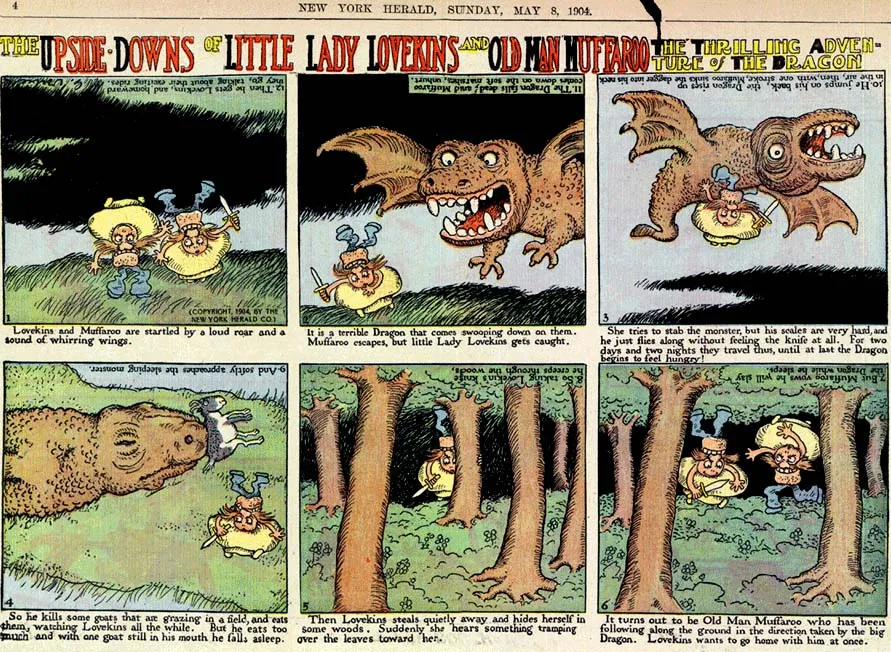
Andy’s Early Comics Archive can be searched chronologically, or alphabetically by artist’s name. Enter here.
Related Content
Read The Very First Comic Book: The Adventures of Obadiah Oldbuck (1837)
Download Over 22,000 Golden & Silver Age Comic Books from the Comic Book Plus Archive
Download 15,000+ Free Golden Age Comics from the Digital Comic Museum
- Ayun Halliday is the Chief Primatologist of the East Village Inky zine and author, most recently, of Creative, Not Famous: The Small Potato Manifesto. Follow her @AyunHalliday.
Read More...
Support Us
We're hoping to rely on loyal readers, rather than erratic ads. Please click the Donate button and support Open Culture. You can use Paypal, Venmo, Patreon, even Crypto! We thank you!

About Us

Open Culture scours the web for the best educational media. We find the free courses and audio books you need, the language lessons & educational videos you want, and plenty of enlightenment in between.
Advertise With Us
FREE UPDATES!
GET OUR DAILY EMAIL
Get the best cultural and educational resources on the web curated for you in a daily email. We never spam. Unsubscribe at any time.
FOLLOW ON SOCIAL MEDIA
Open Culture editor Dan Colman scours the web for the best educational media. He finds the free courses and audio books you need, the language lessons & movies you want, and plenty of enlightenment in between.
Advertise With Us

