100-Year-Old Music Recordings Can Now Be Heard for the First Time, Thanks to New Digital Technology
If you were listening to recorded music around the turn of the twentieth century, you listened to it on cylinders. Not that anyone alive today was listening to recorded music back then, and much of it has since been lost. Invented by Alexander Graham Bell (better known for his work on an even more popular device known as the telephone), the recording cylinder marked a considerable improvement on Thomas Edison’s earlier tinfoil phonograph. Never hesitant to capitalize on an innovation — no matter who did the innovating — Edison then began marketing cylinders of his own, soon turning his own name into the format’s most popular and recognizable brand.
“Edison set up coin-operated phonograph machines that would play pre-recorded wax cylinders in train stations, hotel lobbies, and other public places throughout the United States,” writes Atlas Obscura’s Sarah Durn. They also became the medium choice for hobbyists. “One of the most famous is Lionel Mapleson,” says Jennifer Vanasco in an NPR story from earlier this month.
“He recorded his family,” but “he was also the librarian for the Metropolitan Opera. And in the early 1900s, he recorded dozens of rehearsals and performances. Listening to his work is the only way you can hear pre-World War I opera singers with a full orchestra”: German soprano Frieda Hempel, singing “Evviva la Francia!” above.
The “Mapleson Cylinders” constitute just part of the New York Public Library’s collection of about 2,700 recordings in that format. “Only a small portion of those cylinders, around 175, have ever been digitized,” writes Durn. “The vast majority of the cylinders have never even been played in the generations since the library acquired them.” Most have become too fragile to withstand the needles of traditional players. Enter Endpoint Audio Labs’ $50,000 Cylinder and Dictabelt Machine, which uses a combination of needle and laser to read and digitize even already-damaged cylinders without harm. Only seven of Endpoint’s machines exist in the world, one of them a recent acquisition of the NYPL’s, which will now be able to play many of its cylinders for the first time in more than a century.
Some of these cylinders are unlabeled, their contents unknown. Curator Jessica Wood, as Velasco says, is hoping to “hear a birthday party or something that tells us more about the social history at the time, even someone shouting their name and explaining they’re testing the machine, which is a pretty common thing to hear on these recordings.” She knows that the NYPL’s collection has “about eight cylinders from Portugal, which may be some of the oldest recordings ever made in the country,” as well as “five Argentinian cylinders that have preserved the sound of century-old tango music.” In the event, from the first cylinder she puts on for NPR’s microphone issue familiar words: “Hello, my baby. Hello, my honey. Hello, my ragtime gal.” This listening experience perhaps felt like something less than time travel. But then, were you really to go back to 1899, what song would you be more likely to hear?
Related content:
Hear Singers from the Metropolitan Opera Record Their Voices on Traditional Wax Cylinders
A Beer Bottle Gets Turned Into a 19th Century Edison Cylinder and Plays Fine Music
400,000+ Sound Recordings Made Before 1923 Have Entered the Public Domain
Based in Seoul, Colin Marshall writes and broadcasts on cities, language, and culture. His projects include the Substack newsletter Books on Cities, the book The Stateless City: a Walk through 21st-Century Los Angeles and the video series The City in Cinema. Follow him on Twitter at @colinmarshall or on Facebook.
Read More...The Birth of the Blues Brothers: How Dan Aykroyd & John Belushi Started Introducing a New Generation to the Blues
What were the Blues Brothers? A comedy sketch? A parody act? A real band? A celebrity soul artist tribute? All of the above, yes. The musical-comedic duo of Dan Aykroyd and John Belushi turned a ludicrous beginning in bumble bee costumes — not dark suits, fedoras, and Ray-Bans — into a musical act that “exposed a generation to the brilliance of blues and soul legends like John Lee Hooker and Aretha Franklin,” as Darren Weale writes at Loudersound.
That’s quite an accomplishment for a couple of improv comedians on a fledgling late-night comedy show that did not seem, in its first year, like it would stick around long. It was during that anarchic period when the Killer Bees became recurring characters on the show, appearing 11 times (despite the studio note, “Cut the bees,” which Lorne Michaels pointedly ignored).
The bees were the first incarnation of the Blues Brothers, two years before their actual debut in Season 4. (See a later appearance from that season, introduced by Garrett Morris, just above).
A January 17, 1976 appearance of the bees featured “Howard Shore and his All Bee Band,” consisting of “Aykroyd on the harmonica and Belushi on vocals belting out a blues classic very much in the style of the future Elwood and ‘Joliet’ Jake Blues,” notes History.com. They had the beginnings of an act, but the look and the personas would come later, “during the hiatus between SNL seasons two and three” in 1977, while Belushi filmed Animal House in Eugene, Oregon and fell under the spell of local bluesman Curtis Salgado, future harmonica player for Robert Cray.
Salgado “sure turned John on to blues music,” says Aykroyd. “He steeped him in blues culture.” Salgado himself describes how Belushi won him over on their first meeting: “I’m packing up my harps, trying to break free, when he says, ‘I’m going to have Ray Charles on the show.’ ” Salgado also gave Belushi a lesson in playing it straight, even when he played the blues for laughs. When the comic performed the song “Hey Bartender” to a packed house one night, in character as Joe Cocker, his mentor gave him a post-show dressing down.
“He asks me, ‘What did you think?’”
“I say, ‘John, it’s Joe Cocker.’”
‘Yes, I do Joe on Saturday Night Live.’
“I punch his chest and say, ‘You need to do this from here [pointing at his heart] and be yourself.’ After that he didn’t mimic any more. He was himself.”
Taking the look of Jake and Elwood from Salgado, but developing the character as his swaggering self, Belushi “came back from Oregon with a lust for the blues,” his widow, Judith, recalls. “He had tapes in his pockets and went to clubs.” (See the duo play “Hey Bartender” at the Universal Amphitheater in 1978, below.)
The name was the brainchild of SNL musical director Howard Shore (who would go on to write the Lord of the Rings film scores), who happened to be present when the two conceived the characters at a bar. Their 1978 debut — made over the protests of Lorne Michaels (who didn’t get it) — made them instant stars.
Paul Shaffer spun their origin story in his introduction, “claiming that they had been discovered in 1969 by the fictional ‘Marshall Checker,” writes Mental Floss. He went on:
Today they are no longer an authentic blues act, but have managed to become a viable commercial product. So now, let’s join “Joliet” Jake and his silent brother Elwood — the Blues Brothers.
With that, the never-authentic blues act did, indeed, become a viable commercial product. “Things started to move quickly,” Weale writes. “Record executive Michael Klenfner took John and Dan to see Ahmet Ertegün at Atlantic Records. He signed the Blues Brothers up.” They were a real act, and two years later, real movie stars with the release of John Landis’ The Blues Brothers, a film that fully delivered on the duo’s comic promises, while gleefully giving the spotlight away to its huge cast of soul and blues legends
Related Content:
Saturday Night Live’s Very First Sketch: Watch John Belushi Launch SNL in October, 1975
Josh Jones is a writer and musician based in Durham, NC. Follow him at @jdmagness
Read More...Make Your Own Medieval Memes with a New Tool from the Dutch National Library

As much joy as internet memes have given you over the years, you may have struggled to explain them to those unfamiliar with the concept. But if you’ve found it a tall order to articulate the power of found images crudely overlaid with text to, say, your parents, imagine attempting to do the same to an ancestor from the fourteenth century. Introducing memes to a medieval person, the best strategy would presumably be to begin not with sardonic Willy Wonka, the guy distracted by another girl, or The Most Interesting Man in the World, but memes with familiar medieval imagery. Thanks to KB, the national library of the Netherlands, you can now make some of you own with ease.

“On www.medievalmemes.org visitors can use images taken from the Dutch national library’s medieval collection and turn them into memes,” says Medievalists.net. “When using the meme generator, people actively create new contexts for these historic images by adding current captions. The available images are accompanied by explanatory videos, providing viewers with background information and showing them that, much like today, people in the Middle Ages used images to comment on their surroundings and current affairs.” You might repurpose these lively pieces of medieval art for such twenty-first-century topics as clubbing, online shopping, or the COVID-19 pandemic.
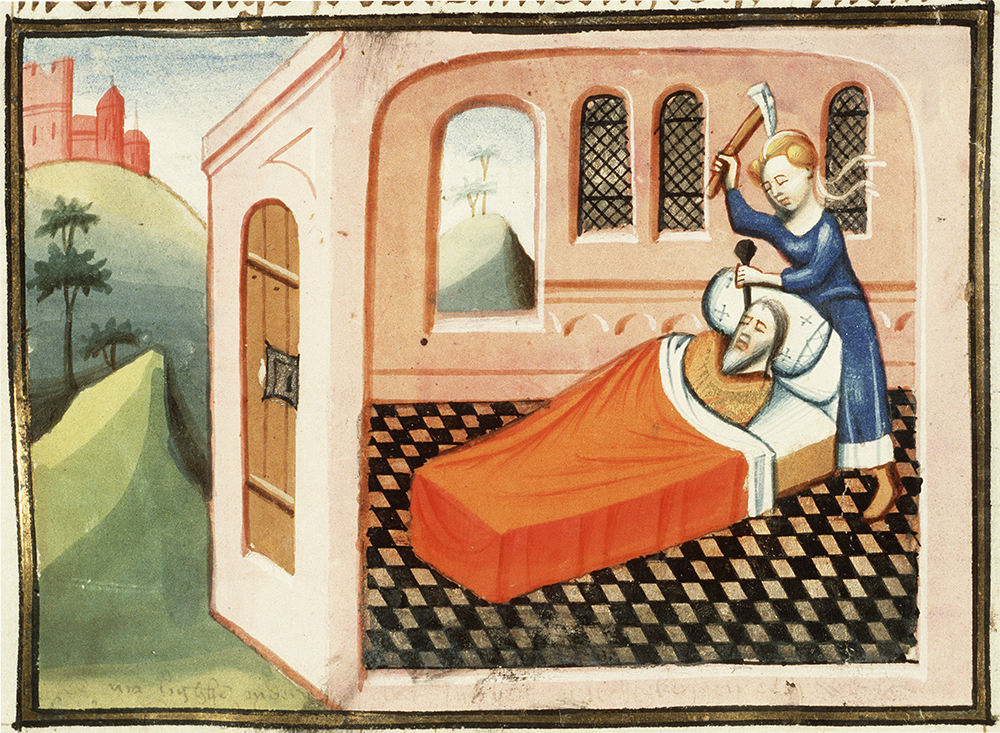
At the top of this post appears an image from 1327, originally created for a book of miracles King Charles IV ordered for his queen. As KB explains, it offers “a warning of what can happen if you don’t learn your prayers properly.” Below that is “a sort of Mediaeval cartoon” from 1183 about the techniques involved in properly slaughtering a pig. And just above, we see what happened when “the Kenite Jael lured the leader of the army, Sisera, into her tent. Sisera had been violently oppressing the Kenites for 20 years. While he slept, she whacked a tent peg straight through his head.” Though created for a picture Bible 592 years ago, this picture surely has potential for transposition into commentary on the very different perils of life in the twenty-twenties. But when you deploy it as a meme, you can do so in the knowledge that even your medieval forebears would have known that feel.
Related content:
Why Butt Trumpets & Other Bizarre Images Appeared in Illuminated Medieval Manuscripts
Why Knights Fought Snails in Illuminated Medieval Manuscripts
Based in Seoul, Colin Marshall writes and broadcasts on cities, language, and culture. His projects include the Substack newsletter Books on Cities, the book The Stateless City: a Walk through 21st-Century Los Angeles and the video series The City in Cinema. Follow him on Twitter at @colinmarshall or on Facebook.
Read More...Watch Stevie Wonder’s Amazing Drum Solo, and See Why He May Be the “Greatest Drummer of Our Time”
When Prince passed away, many a non-Prince fan suddenly found out that the man was not only a brilliant songwriter, singer, dancer, guitarist, pianist, stylist, and superstar, but that he was also a virtual one-man band in the studio, able to play almost any instrument, in exactly the way he wanted it played. Prince fans knew this, as do fans of the musician who made Songs in the Key of Life — or what Prince called the greatest album ever recorded. And if Prince were here, he would agree: Stevie Wonder deserves more appreciation for his multi-musicianship while he’s still with us.
Yes, of course, we know him for his “staggering songwriting and vocal skills,” writes PC Muñoz at Drum! magazine, for his “prowess as a formidable, inventive keyboardist (and pop music synthesizer pioneer)” and “his virtuoso-level skills on harmonica.”
But do we know Stevie Wonder as a drummer? Well, “newsflash for those who didn’t know,” Muñoz announces: “Stevie Wonder also happens to be one badass drummer.” (In fact, his very first gig, at 8 years old, was on the drums.) Not that he hasn’t received his just due from fellow musicians, far from it.
Eric Clapton called Wonder “the greatest drummer of our time” in 1974 — “hefty praise” (and maybe a bit of a swipe), wrote music journalist Eric Sandler, “coming from a man who played with Ginger Baker.” See a demonstration of Wonder’s formidable feel and groove behind the kit in the drum solo at the top of the post. But, of course, you’ve already heard his drumming — all, or most, of your life perhaps — on his albums, including most every track on Talking Book, Songs in the Key of Life, and Innervisions — songs like “Superstition,” “Higher Ground,” “Living for the City” … all Stevie.
“I grew up practicing to Stevie Wonder’s music,” drummer Eric Carnes tells Muñoz, “but I actually didn’t know he was often the drummer on his own stuff. Until I was in my twenties.” Carnes goes on to describe the hallmarks of Wonder’s style: “very relaxed – not so crisp and not so metronomic. He’s using different parts of the stick at different times, and his hi-hat parts change throughout the song. A lot of times, each chorus in a given song is played slightly differently, too. He escalates a song over a long period of time, really growing the whole piece, instead of topping out early; it gives the music somewhere to go.”
Bill Janovitz of the band Buffalo Tom — in a very thorough paean to Songs in the Key of Life – points to the “innate sense of groove in his drumming.… There is a musical inventiveness that might stem from being a well-rounded multi-instrumentalist, as opposed to someone who strictly defines themselves as a drummer.”
In his appreciation of Wonder’s drumming at Slate, Seth Stevenson also highlights Wonder’s “expressiveness.… No two measures sound the same.” He offers a mini best-of roundup of Wonder’s recorded drumming moments:
My favorite Wonder drum track comes on ‘Too High,’ the first song on Innervisions. Subtle snare rolls, sudden tom-tom tumbles, jazzy ride-cymbal swings – they’re all scrumptious and all in the greater service of the song. This is not the approach of a hired drummer attempting to carve out his own terrain. It’s the work of a multi-instrumentalist composer who fits his vision for each part into an interlocking whole.
Stevenson and Janovitz speak to a thread in so many discussions of “virtuoso” musicians: composers who are also musical prodigies have ways of playing instruments in an idiom only they can understand. One imagines that if we had recordings of Mozart or Bach – both prodigious multi-instrumentalists from very young ages – we would hear classical instruments played in ways we’ve never heard them played before. The magic of recording — and Stevie Wonder’s recordings especially — means we can hear the drums on his songs exactly as he heard, and played, them, and exactly as he wanted them played.
Related Content:
Catch Stevie Wonder, Ages 12–16, in His Earliest TV Performances
See Stevie Wonder Play “Superstition” and Banter with Grover on Sesame Street in 1973
Josh Jones is a writer and musician based in Durham, NC. Follow him at @jdmagness
Read More...Why Algorithms Are Called Algorithms, and How It All Goes Back to the Medieval Persian Mathematician Muhammad al-Khwarizmi
In recent decades, a medieval Persian word has come to prominence in English and other major world languages. Many of use it on a daily basis, often while regarding the concept to which it refers as essentially mysterious. The word is algorithm, whose roots go back to the ninth century in modern-day Greater Iran. There lived a polymath by the name of Muhammad ibn Musa al-Khwarizmi, whom we now remember for his achievements in geography, astronomy, and mathematics. In that last field, he was the first to define the principles of “reducing” and “balancing” equations, a subject all of us came to know in school as algebra (a name itself descended from the Arabic al-jabr, or “completion”).
Today, a good few of us have come to resent algorithms even more than algebra. This is perhaps because algorithms are most popularly associated with the deep, unseen workings of the internet, a system with ever increasing influence over the things we do, the information we receive, and even the people with whom we associate.
Provided sufficient data about us and the lives we lead, so we’re given to understand, these algorithms can make better decisions for us than we can make for ourselves. But what exactly are they? You can get one answer from “Why Algorithms Are Called Algorithms,” the BBC Ideas video at the top of the post.
For Western civilization, al-Khwarizmi’s most important book was Concerning the Hindu Art of Reckoning, which was translated into Latin three centuries after its composition. Al-Khwarizmi’s Latinized name “Algoritmi” gave rise to the word algorismus, which at first referred to the decimal number system and much later came to mean “a set of step-by-step rules for solving a problem.” It was Enigma codebreaker Alan Turing who “worked out how, in theory, a machine could follow algorithmic instructions and solve complex mathematics. This was the birth of the computer age.” Now, much further into the computer age, algorithms “are helping us to get from A to B, driving internet searches, making recommendations of things for us to buy, watch, or share.”
The algorithm giveth, but the algorithm also taketh away — or so it sometimes feels as we make our way deeper into the twenty-first century. In the other BBC Ideas video just above, Jon Stroud makes an investigation into both the nature and the current uses of this mathematical concept. The essential job of an algorithm, as the experts explain to him, is that of processing data, these days often in large quantities and of various kinds, and increasingly with the aid of sophisticated machine-learning processes. In making or influencing choices humans would once have handled themselves, algorithms do present a risk of “de-skilling” as we come to rely on their services. We all occasionally feel gratitude for the blessings those services send our way, just as we all occasionally blame them for our dissatisfactions — making the algorithm, in other words, into a thoroughly modern deity.
Related content:
Algorithms for Big Data: A Free Course from Harvard
Advanced Algorithms: A Free Course from Harvard University
The Problem with Facebook: “It’s Keeping Things From You”
The Complex Geometry of Islamic Art & Design: A Short Introduction
Based in Seoul, Colin Marshall writes and broadcasts on cities, language, and culture. His projects include the Substack newsletter Books on Cities, the book The Stateless City: a Walk through 21st-Century Los Angeles and the video series The City in Cinema. Follow him on Twitter at @colinmarshall or on Facebook.
Read More...Pink Floyd Releases Its First New Song in 28 Years to Help Support Ukraine
“I rang Nick up and said: ‘listen, I want to do this thing for Ukraine. I’d be really happy if you played on it and I’d also be really happy if you’d agree to us putting it out as Pink Floyd.’ And he was absolutely on for that.
In 2015, David Gilmour was scheduled to play a concert in London with the Ukrainian band BoomBox. As he explained in a recent statement, the band’s lead singer Andriy Khlyvnyuk had trouble with his visa, leaving the rest of the Boombox to back Gilmour on a version of “Wish You Were Here.” That song’s sentiments took on an entirely different kind of urgency last month after Russia invaded Ukraine.
“Recently I read that Andriy had left his American tour with BoomBox, had gone back to Ukraine, and joined up with the Territorial Defense,” said Gilmour. “Then I saw this incredible video on Instagram, where he stands in a square in Kyiv with this beautiful gold-domed church and sings in the silence of a city with no traffic or background noise because of the war. It was a powerful moment that made me want to put it to music.”
The song Khlyvnyuk sings is “Oh, the Red Viburnum in the Meadow,” a “1914 protest song,” The Guardian reports, “written in honor of the Sich Riflemen who fought both in the first world war and the Ukrainian war of independence.” Gilmour decided to go further and use the “big platform” of Pink Floyd to release a single by the band – their first original song in 28 years. He called drummer Nick Mason and they recorded the track in Gilmour’s barn with bassist Guy Pratt and keyboardist Nitin Sawhney.
Released as “Hey, Hey, Rise Up” – with Khlyvnyuk’s approval (Gilmour says it took some doing to track him down) – the track’s proceeds will be donated to the Ukraine Humanitarian Relief Fund. It’s probably safe to say that this is not a Pink Floyd reunion. Gilmour insisted the band was done when keyboardist Richard Wright died in 2008. “This is the end,” he told the BBC, and there’s little reason to think he’s gearing up for a tour or a new Pink Floyd album now.
Instead, “Hey, Hey, Rise Up” is part of a larger protest by Gilmour, who writes of his Ukrainian daughter-in-law Janina, his grandchildren, and his “extended Ukrainian family” as a very personal connection to the news of the invasion. But he also wants to give young Ukrainians like Khlyvnyuk – who had no idea the world was watching – a larger voice and give voice to the shock and horror felt the world over as civilian deaths and atrocities mount. As he wrote in his statement:
We, like so many, have been feeling the fury and the frustration of this vile act of an independent, peaceful democratic country being invaded and having its people murdered by one of the world’s major powers… We want to express our support for Ukraine and in that way, show that most of the world thinks that it is totally wrong for a superpower to invade the independent democratic country that Ukraine has become.
Gilmour has pulled all his solo records and Pink Floyd’s catalogue post-1987 from streaming services in Russia. As for speculation that Roger Waters blocked the removal of earlier Pink Floyd material, or controversies over Waters’ statements to Russia Today and other outlets – “Let’s just say I was disappointed and let’s move on,” says Gilmour.
He’s more interested in talking about the war and Khlyvnyuk’s experiences. “He said he had the most hellish day you could imagine,” when Gilmour spoke to him and sent him the song — a day spent “picking up bodies of Ukrainians, Ukrainian children, helping with the clearing up. You know, our little problems become pathetic and tiny,” he says, “in the context of what you see him doing.”
See the English translation of the song just below:
In the meadow a red viburnum has bent down low
Our glorious Ukraine has been troubled so
And we’ll take that red viburnum and we will raise it up
And we, our glorious Ukraine shall, hey—hey, rise up—and rejoice!
And we’ll take that red viburnum and we will raise it up
And we, our glorious Ukraine shall, hey—hey, rise up and rejoice!
Related Content:
Josh Jones is a writer and musician based in Durham, NC. Follow him at @jdmagness
Read More...Why Dutch & Japanese Cities Are Insanely Well Designed (and American Cities Are Terribly Designed)
Pity the United States of America: despite its economic, cultural, and military dominance of so much of the world, it struggles to build cities that measure up with the capitals of Europe and Asia. The likes of New York, Los Angeles, and Chicago offer abundant urban life to enjoy, but also equally abundant problems. Apart from the crime rates for which American cities have become fairly or unfairly notorious, there’s also the matter of urban design. Simply put, they don’t feel as if they were built very well, which any American will feel after returning from a trip to Amsterdam or Tokyo — or after watching the videos on those cities by Danish Youtuber OBF.
In Amsterdam, OBF says, “commuters will use their bikes to get to and enter transit stations, where they simply park their bikes in these enormous bike-parking garages. Then they’ll travel on either a bus, tram, or train to their final destination, but most of the time, the fastest and most convenient option is simply taking the bike to the final destination.”
Near-impossible to imagine in the United States, this prevalence of cycling is a reality in not just the Dutch capital but also in other cities across the country, which boasts 32,000 kilometers of bike lanes in total. And those count as only one of the infrastructural glories covered in OBF’s video “Why the Netherlands Is Insanely Well Designed.”
Tokyo, too, has its fair share of cyclists. Whenever I’m over there, I take note of all the well-dressed moms biking their young children to school in the morning, who cut figures in the starkest possible contrast to their American equivalents. But what really underlies the Japanese capital’s distinctively intense urbanism, literally as well as figuratively, is its network of subway trains. OBF takes the precision-engineered efficiency and the impeccable maintenance of this system as his main subject in “Why Tokyo Is Insanely Well Designed.” But enough about good city design; what accounts for bad city design, especially in a rich country like the U.S.?
OMF has an answer in one word: parking. Philadelphia, for example, supplies its 1.6 million people with 2.2 million parking spaces. The consequent deformation of the city’s built environment, clearly visible in aerial footage, both symbolizes and perpetuates the hegemony of the automobile. That same condition once afflicted the European and Asian cities that have since designed their way out of it and then some. While “some people might think it’s nearly impossible to implement these methods into other countries,” says OBF, they “can be replicated any place in the world if the people and leadership are willing to collaborate and listen to one another, and invest in infrastructure that is people‑, environment‑, and future-centered.” As an American living in a non-American city, I hereby invite him to come have a ride on the Seoul Metro.
Related content:
Why Public Transit Sucks in the United States: Four Videos Tell the Story
Why Europe Has So Few Skyscrapers
Leonardo da Vinci Designs the Ideal City: See 3D Models of His Radical Design
The Utopian, Socialist Designs of Soviet Cities
Based in Seoul, Colin Marshall writes and broadcasts on cities, language, and culture. His projects include the Substack newsletter Books on Cities, the book The Stateless City: a Walk through 21st-Century Los Angeles and the video series The City in Cinema. Follow him on Twitter at @colinmarshall or on Facebook.
Read More...Jim Morrison Accurately Predicts the Future of Electronic Music in 1969
Jim Morrison didn’t fare particularly well, health-wise, in the last years of his life. Alcoholism took a heavy toll, as we know. “Images of him with the shaggy beard, hair receding at the temples, and excess flesh gathering around the armpits,” writes Rob Fischer at Rolling Stone, “can resemble, in retrospect, T.J. Miller more than Father John Misty. This is the out-to-seed drunkard that Val Kilmer portrays in Oliver Stone’s iconic film The Doors.” It is also an unfortunate caricature that leaves out the creative and intellectual energy still left in the artist once called “the first major male sex symbol since James Dean died and Marlon Brando got a paunch.”
There was always more to Morrison than that, and in the 1969 interview above, filmed over a week in L.A. with Rolling Stone’s Jerry Hopkins, he is still “remarkably sharp,” Fischer writes.
Even though the conversations included many rounds of whiskey, scotch and beer, his responses give the impression of a thoughtful and engaged artist struggling to realize the full extent of his already colossal powers of expression. He was reading widely, writing poetry, gravitating more towards filmmaking, all while longing to reconnect with the explosive energy that comes with playing small venues and clubs like the Whiskey a Go Go.
Morrison and the Doors were experimental artists, taking musical risks and selling them with sex. The Doors were the first rock band, for example, to use the new Moog synthesizer on an album. Even before Wendy Carlos’ Switched-On Bach introduced popular audiences to the technology of audio synthesis in 1968, the band brought jazz musician Paul Beaver into the 1967 recordings sessions for Strange Days to use Moog for effects on several tracks and to distort Morrison’s voice.
Beaver, an early adopter of the synthesizer, produced two seminal Moog records in the late sixties: The Zodiac: Cosmic Sounds (1967) with Mort Garson and double album The Nonesuch Guide to Electronic Music (1968) with Bernie Krause.
Therefore, when Morrison, in his astute analysis of American music, “predicts” the future of electronic music in 1969 during the course of his interview with Hopkins, he knows of what he speaks. He’s already seen it, and being the hip guy that he was, he had likely heard the work of electronic pioneers Silver Apples and maybe even of the band White Noise, a side project of BBC Radiophonic Workshop composer Delia Derbyshire that produced music far ahead of its time that very year — music made almost exactly the way he describes:
I can kind of envision one person with a lot of machines, tapes and electronics set up, singing or speaking while using machines.…
At the end of the brief clip at the top, we hear Hopkins ignore this idea and move Morrison back to talking about rock. But Jim had already moved on — and so had the culture, he knew. The music he describes was happening all around him, and we might imagine he was a little frustrated that other people couldn’t hear it. What Morrison brought to it, however — or might have, had he lived — was the lyrical, the sensual, the performative, the melodramatic, and the truly frightening, all qualities it would take new wave and goth acts like Echo and Bunnymen, Depeche Mode, and a host of Doors-influenced dark wave bands to bring to fruition in the electronic music of future past.
Related Content:
How the Moog Synthesizer Changed the Sound of Music
This Is “The End”: A Video Exploration of The Doors’ Existential Epic
Josh Jones is a writer and musician based in Durham, NC. Follow him at @jdmagness
Read More...Flea Rocks “The Star Spangled Banner” on the Bass
It’s apparently a tradition–Flea performing “The Star Spangled Banner” before the start of an LA Lakers game, accompanied by the bass, and only the bass. The recording above took place over the past weekend. You can also watch other performances from 2016 and 2014. Somewhere, Jimi is smiling.
If you would like to support the mission of Open Culture, consider making a donation to our site. It’s hard to rely 100% on ads, and your contributions will help us continue providing the best free cultural and educational materials to learners everywhere. You can contribute through PayPal, Patreon, and Venmo (@openculture). Thanks!
Related Content
The Grateful Dead Rock the National Anthem at Candlestick Park: Opening Day, 1993
Read More...All Espresso Drinks Explained: Cappuccino, Latte, Macchiato & Beyond
What separates the Cappuccino from the Latte, and the Macchiato from the Double Espresso? These are some important questions–questions that demand answers. And European Coffee Trip–a YouTube channel run by two Czech guys with a love for specialty coffee–has answers. Above, they break it all down for you. Find timestamps for the different variations below.
0:58 Single Espresso
1:35 Double Espresso
1:55 Americano
2:18 Lungo
2:37 Filter coffee (no espresso!)
3:16 Cappuccino
3:46 Espresso Macchiato
4:07 Cortado/Piccolo
4:30 Flat White
4:54 Caffé Latte
To delve deeper, you can also watch James Hoffman’s always informative video. It covers similar ground, but also touches on some other variations of espresso drinks.
If you would like to support the mission of Open Culture, consider making a donation to our site. It’s hard to rely 100% on ads, and your contributions will help us continue providing the best free cultural and educational materials to learners everywhere. You can contribute through PayPal, Patreon, and Venmo (@openculture). Thanks!
Related Content
The Birth of Espresso: The Story Behind the Coffee Shots That Fuel Modern Life
The Life & Death of an Espresso Shot in Super Slow Motion
Read More...
Support Us
We're hoping to rely on loyal readers, rather than erratic ads. Please click the Donate button and support Open Culture. You can use Paypal, Venmo, Patreon, even Crypto! We thank you!

About Us

Open Culture scours the web for the best educational media. We find the free courses and audio books you need, the language lessons & educational videos you want, and plenty of enlightenment in between.
Advertise With Us
FREE UPDATES!
GET OUR DAILY EMAIL
Get the best cultural and educational resources on the web curated for you in a daily email. We never spam. Unsubscribe at any time.
FOLLOW ON SOCIAL MEDIA
Open Culture editor Dan Colman scours the web for the best educational media. He finds the free courses and audio books you need, the language lessons & movies you want, and plenty of enlightenment in between.
Advertise With Us