Are We All Getting More Depressed?: A New Study Analyzing 14 Million Books, Written Over 160 Years, Finds the Language of Depression Steadily Rising
The relations between thought, language, and mood have become subjects of study for several scientific fields of late. Some of the conclusions seem to echo religious notions from millennia ago. “As a man thinketh, so he is,” for example, proclaims a famous verse in Proverbs (one that helped spawn a self-help movement in 1903). Positive psychology might agree. “All that we are is the result of what we have thought,” says one translation of the Buddhist Dhammapada, a sentiment that cognitive behavioral therapy might endorse.
But the insights of these traditions — and of social psychology — also show that we’re embedded in webs of connection: we don’t only think alone; we think — and talk and write and read — with others. External circumstances influence mood as well as internal states of mind. Approaching these questions differently, researchers at the Luddy School of Informatics, Computing, and Engineering at Indiana University asked, “Can entire societies become more or less depressed over time?,” and is it possible to read collective changes in mood in the written languages of the past century or so?
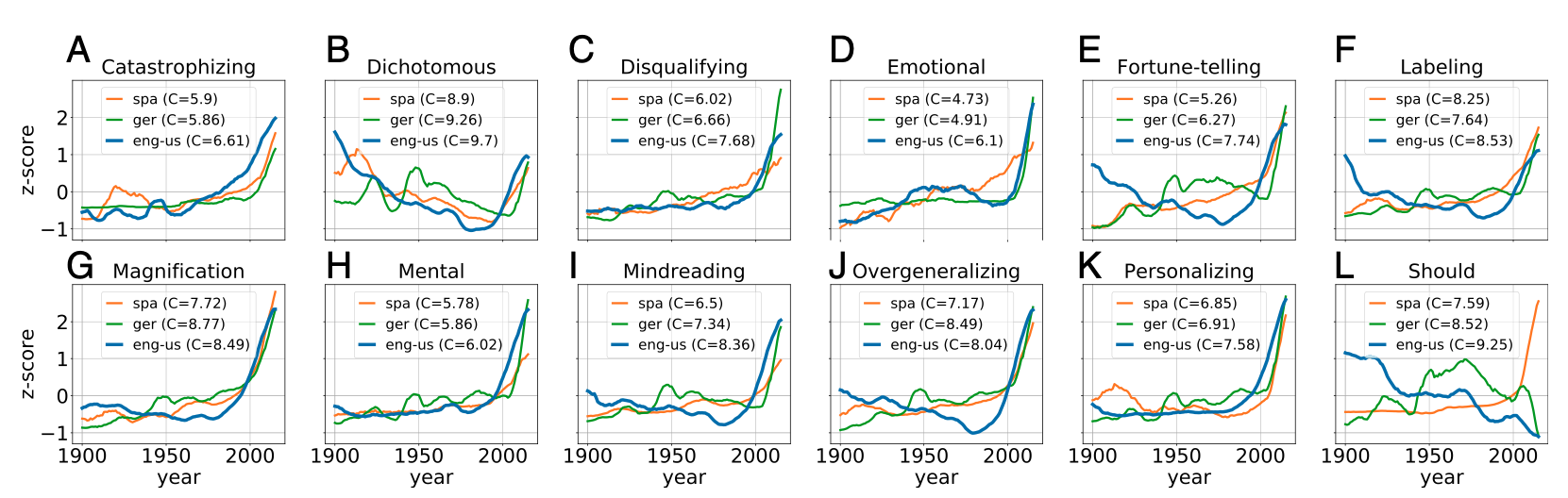
The team of scientists, led by Johan Bollen, Indiana University professor of informatics and computing, took a novel approach that brings together tools from at least two fields: large-scale data analysis and cognitive-behavioral therapy (CBT). Since diagnostic criteria for measuring depression have only been around for the past 40 years, the question seemed to resist longitudinal study. But CBT provided a means of analyzing language for markers of “cognitive distortions” — thinking that skews in overly negative ways. “Language is closely intertwined with this dynamic” of thought and mood, the researchers write in their study, “Historical language records reveal a surge of cognitive distortions in recent decades,” published just last month in PNAS.
Choosing three languages, English (US), German, and Spanish, the team looked for “short sequences of one to five words (n‑grams), labeled cognitive distortion schemata (CDS).” These words and phrases express negative thought processes like “catastrophizing,” “dichotomous reasoning,” “disqualifying the positive,” etc. Then, the researchers identified the prevalence of such language in a collection of over 14 million books published between 1855 and 2019 and uploaded to Google Books. The study controlled for language and syntax changes during that time and accounted for the increase in technical and non-fiction books published (though it did not distinguish between literary genres).
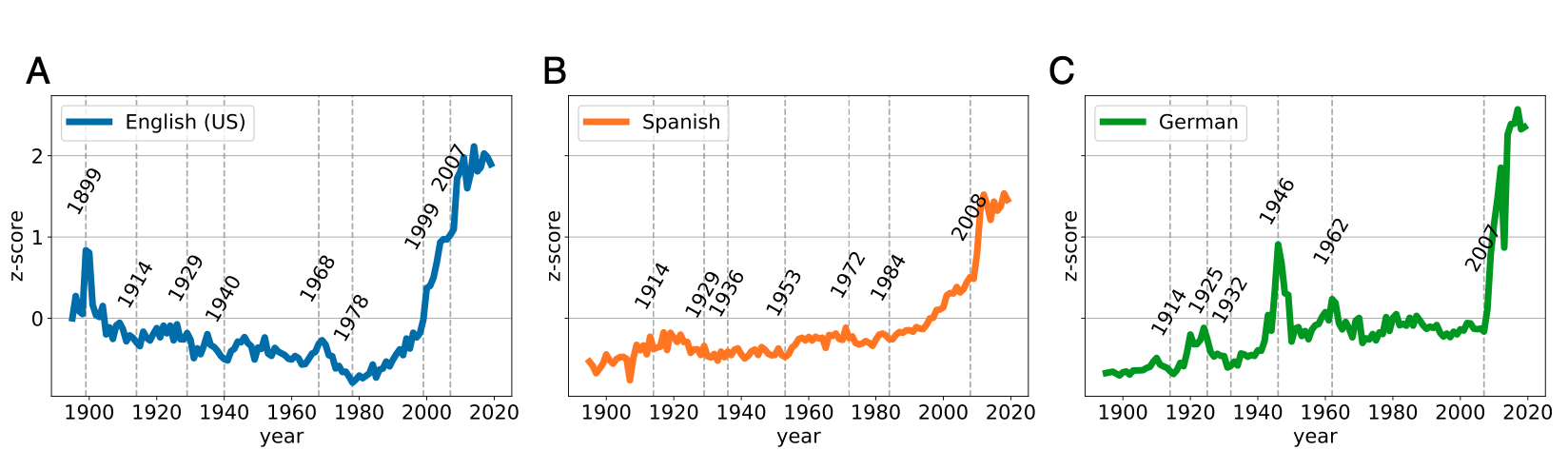
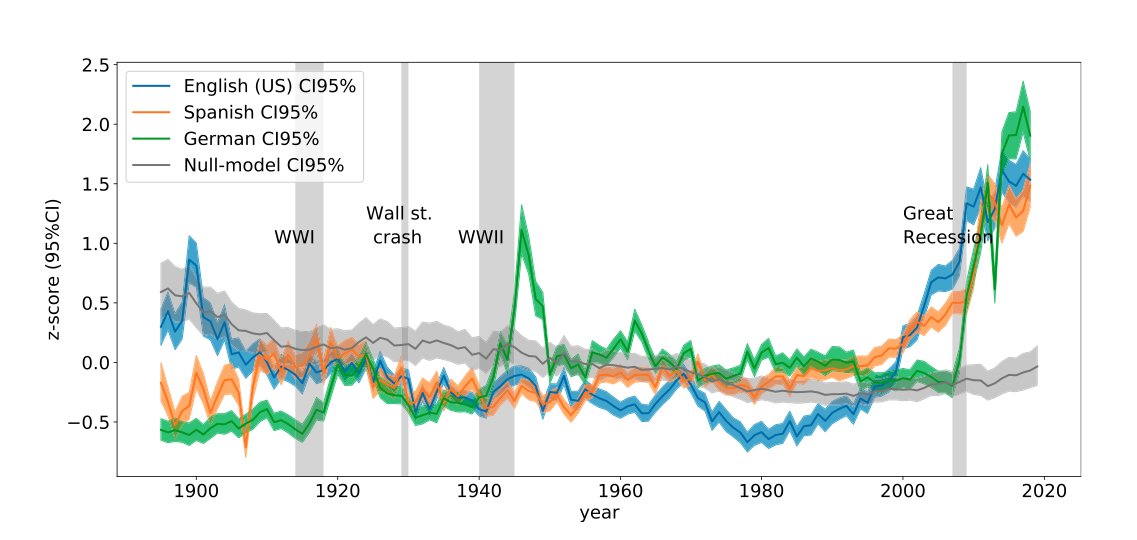
What the scientists found in all three languages was a distinctive “‘hockey stick’ pattern” — a sharp uptick in the language of depression after 1980 and into the present time. The only spikes that come close on the timeline occur in English language books during the Gilded Age and books published in German during and immediately after World War II. (Highly interesting, if unsurprising, findings.) Why the sudden, steep climb in language signifying depressive thinking? Does it actually mark a collective shift in mood, or show how historically oppressed groups have had more access to publishing in the past forty years, and have expressed less satisfaction with the status quo?
While they are careful to emphasize that they “make no causal claims” in the study, the researchers have some ideas about what’s happened, observing for example:
The US surge in CDS prevalence coincides with the late 1970s when wages stopped tracking increasing work productivity. This trend was associated with rises in income inequality to recent levels not seen since the 1930s. This phenomenon has been observed for most developed economies, including Germany, Spain and Latin America.
Other factors cited include the development of the World Wide Web and its facilitation of political polarization, “in particular us-vs.-them thinking… dichotomous reasoning,” and other maladaptive thought patterns that accompany depression. The scale of these developments might be enough to explain a major collective rise in depression, but one commenter offers an additional gloss:
The globe is *Literally* on fire, or historically flooding — Multiple economic crashes barely decades apart — a ghost town of a housing market — a multi-year global pandemic — wealth concentration at the .01% level — terrible pay/COL equations — blocking unionization/workers rights — abusive militarized police, without the restraint or training of actual military — You can’t afford X for a monthly mortgage payment! Pay 1.5x for rent instead! — endless wars for the last… 30…years? 50 if we include stuff like Korea, Cold War, Vietnam… How far has the IMC been milking the gov for funds to make the rich richer? Oh, and a billionaire 3‑way space race to determine who’s got the biggest “rocket”
These sound like reasons for global depression indeed, but the arrow could also go the other way: maybe catastrophic reasoning produced actual catastrophes; black and white thinking led to endless wars, etc…. More study is needed, says Bollen and his colleagues, yet it seems probable, given the data, that “large populations are increasingly stressed by pervasive cultural, economic, and social changes” — changes occurring more rapidly, frequently, and with greater impact on our daily lives than ever before. Read the full study at PNAS.
Related Content:
Josh Jones is a writer and musician based in Durham, NC. Follow him at @jdmagness
Read More...How ABBA Won Eurovision and Became International Pop Stars (1974)
Eurovision, the flashy original song contest that captivates Europeans, tends to get roundly mocked in the U.S., where we choose our stars by having them sing other people’s songs on TV in ridiculous costumes. Nonetheless, Americans have fallen in love with many a contest winner, and that’s no more true than in the case of ABBA, the Swedish pop-disco juggernaut who broke through to international stardom when they won in 1974 with “Waterloo,” chosen twice as the greatest song in the competition’s history.
The two couples — Agnetha Fältskog and Björn Ulvaus; Benny Andersson and Anni-Frid Lyngstad — first formed as Festfolket (“Party People”) in 1970, and Ulvaus and Andersson began submitting songs to Swedish national contest Melodifestivalen. In 1973, they submitted “Ring Ring,” finally placed third, then released an album called Ring Ring as Björn & Benny, Agnetha & Frida. They had taken on a new glam rock look and sound, and the album was a hit in parts of Europe and South Africa, but didn’t break the UK and US charts.
It was time for another name change, an anagram formed from the first letters of their first names. (They were obliged to ask permission from a local fish cannery called Abba, who agreed on condition the band didn’t make the canners “feel ashamed for what you’re doing.”) The name, producer Stig Anderson thought, would translate internationally, and the band would sing in English for their next single, the song that would launch their rapid ascent into seemingly eternal relevance.
How did “Waterloo” not only break ABBA into stardom but also “reinvent pop music” as we know it? As the Polyphonic video at the top explains, it did far more than raise the bar for every Eurovision performance since. ABBA brought glam, glitter, and theatrical bombast into pop, using Phil Spector’s “wall of sound” studio techniques to coax an enormous, enveloping sound from their vocal harmonies, guitars, pianos, horns, drums, etc., and taking heavy inspiration from English band Wizzard’s song “See My Baby Jive,” while “pulling back on the rock” and leaning into cleaner, more dance-floor-friendly production.
ABBA wisely put Agnetha and Anni-Frid’s vocal harmonies in the center, and they took a decidedly quirky turn from glam rock’s love of sleazy come-ons and songs about aliens. Originally called “Honey Pie,” the band’s breakout hit became “Waterloo” when Stig Anderson turned it into an odd reference to Napoleon’s surrender, “such a novel conceit for a song that it’s hard to forget.” ABBA continued this tradition in short story-songs like “Fernando,” first written with different lyrics in Swedish for Lyngstad, then rewritten in English by Ulvaeus as a tale about two old campaigners from the Mexican-American War.
Smart songwriting, catchy hooks, impeccable vocal harmonies, and flashy beauty — once the world saw and heard ABBA, few could resist them. But it took their uniquely theatrical (at the time) Eurovision performance to break them out, as Ulvaeus says. “We knew that the Eurovision Song Contest was the only route for a Swedish group to make it outside Sweden.” The win was huge, but the contest was a means to an end. True validation came with hit after hit, as ABBA proved themselves indispensable to wedding dance floors everywhere and “completely transformed what it meant to be a pop star.” See their original Eurovision performance of “Waterloo” just above.
Related Content:
Listen to ABBA’s “Dancing Queen” Played on a 1914 Fairground Organ
This Man Flew to Japan to Sing ABBA’s “Mamma Mia” in a Big Cold River
Josh Jones is a writer and musician based in Durham, NC. Follow him at @jdmagness
Read More...When David Bowie Played Andy Warhol in Julian Schnabel’s Film, Basquiat
Many actors have played Andy Warhol over the years, but not as many as you might think. Crispin Glover played him in The Doors, Jared Harris played him in I Shot Andy Warhol, Guy Pearce played him in Factory Girl, and Bill Hader played him in Men in Black III, but with a twist: he is actually an agent who is so bad as his cover role as an artist, he’s “painting soup cans and bananas, for Christ sakes!” On television John Cameron Mitchell has acted the Warhol role in Vinyl, and Evan Peters briefly portrayed him in American Horror Story: Cult.
But you might suspect our favorite Warhol would be the one acted by David Bowie in Julian Schnabel’s 1996 Basquiat, the biopic of the Black street artist who was taken into the art world fold by Warhol, and wound up collaborating with him in last works by both artists. Jeffrey Wright plays Basquiat in one of his earliest roles.
Now, you might watch this scene from Basquiat above (and another below) and say, well, that’s just mostly Bowie. But I would say, yes, that’s kind of the point. Andy Warhol is an enigmatic figure, a legend to many, a man who hid behind a constructed persona; David Bowie is too. When one plays the other, a weird sort of magic happens. Fame leaks into fame. Many actors might do better with the mannerisms or the voice, but the charisma…that is all Bowie. After singing about the painter back in 1972, Bowie finally collapsed their visions together in the art of film, where reality and fantasy meet and meld.
Around this time in the mid 1990s, Bowie was very much a part of the New York/London art scene. He was on the editorial board of Modern Painters magazine and interviewed Basquiat director (and artist) Julian Schnabel, Tracey Emin, Damien Hirst, and Balthus. A conceptual artist-slash-serial killer became one of the main characters of his overlooked 1995 Eno collaboration Outside. He was both a collector and an artist, which we’ve focused on before. And he was thinking about the new world opening up because of the internet. Bowie’s artist brain saw the possibilities and the dangers, and also the raw capitalist potential. He offered shares in himself as an IPO in 1997 and released a single as Tao Jones Index, three puns in one. Bowie never predicted the idiocy of the NFT, but he certainly would have laughed wryly at it.
In this Charlie Rose interview to promote Basquiat, Bowie and Schnabel discuss the role of Warhol, the role of art, and the reality of the art world.
“It was more of an impersonation, really,” says Bowie about his Warhol. “That’s how I approach anything.” Of note, however, is how quickly Bowie moves away from discussing himself or the film to talk about larger issues of art and commerce. Bowie does admit that he and Schnabel disagree on a lot of things, and you can see it in their body language. But there’s also a huge respect. It’s a fascinating interview, go watch the whole thing.
Bonus: Below watch Bowie meeting Warhol back during the day…
Related Content:
96 Drawings of David Bowie by the “World’s Best Comic Artists”: Michel Gondry, Kate Beaton & More
The Odd Couple: Jean-Michel Basquiat and Andy Warhol, 1986
When David Bowie Launched His Own Internet Service Provider: The Rise and Fall of BowieNet (1998)
Ted Mills is a freelance writer on the arts who currently hosts the Notes from the Shed podcast and is the producer of KCRW’s Curious Coast. You can also follow him on Twitter at @tedmills, and/or watch his films here.
Read More...The Aesthetic of Evil: A Video Essay Explores Evil in the Films of Bergman, Hitchcock, Kubrick, Scorsese & Beyond
Movies have heroes and villains. Or at least children’s movies do; the more sophisticated the audience, the hazier the line between good and evil becomes, until it finally seems to vanish altogether. Not that cinema directed toward genuinely mature audiences dispenses with those concepts entirely: rather, it makes art out of the ambiguity and interpenetration between them. This is true, to an extent, even in some of the recent wave of big-budget superhero movies, in the main exercises in rolling an “adult” texture onto stories essentially geared toward adolescents. Hence the appearance of the Joker, Batman’s grinning arch-nemesis, in “The Aesthetic of Evil,” the Cinema Cartography video essay above.
In the Joker of Christopher Nolan’s The Dark Knight, “we see an evil that’s relentless, primarily because the core function is complete and total anarchy. Whatever order is established, whoever it’s under ‚must be destroyed. As a result, an epoch is created where any rules or codes of conduct are broken. Anything that you anticipate will happen, will result in the opposite.”
This Joker made an outsized cultural impact with not just the explicitness of his disorder-oriented morality, but also a material-transcending performance by Heath Ledger. In that same era, Jamie Hector took a comparatively minimalist but equally memorable turn in David Simon’s series The Wire as Marlo Stanfield, a drug kingpin “too villainous for the villains.” Like the Joker, Marlo is a law unto himself, “willing to destroy the equilibrium of any facet of the world there is, on a whim.”
These two represent just one of the forms evil has taken in recent decades. The essay’s other examples range from Psycho’s Norman Bates and 2001’s HAL 9000 to The King of Comedy’s Rupert Pupkin and Fanny and Alexander’s stepfather Edvard — or rather, the unwelcome transformation of the family Edvard represents. The most diabolical evil does not confine itself within the person of the antagonist, especially not in the work of Michael Haneke, which twice appears in “The Aesthetic of Evil.” Benny’s Video is on one level about a murderous adolescent; on another, it’s about the “evasion of the real” that seduces us all. The White Ribbon is on one level about random acts of violence in a small village; on another, it’s about how evil reflects “the collective consciousness of a society.” Haneke’s films have often been described as difficult to watch, and that may well have less to do with what they show than what they know: even if we aren’t all villains, we’re certainly not heroes.
Related Content:
Orson Welles on the Art of Acting: ‘There is a Villain in Each of Us’
Rare Video: Georges Bataille Talks About Literature & Evil in His Only TV Interview (1958)
The Aesthetic of Anime: A New Video Essay Explores a Rich Tradition of Japanese Animation
The Dark Knight: Anatomy of a Flawed Action Scene
Based in Seoul, Colin Marshall writes and broadcasts on cities, language, and culture. His projects include the Substack newsletter Books on Cities, the book The Stateless City: a Walk through 21st-Century Los Angeles and the video series The City in Cinema. Follow him on Twitter at @colinmarshall or on Facebook.
Read More...Explore Divine Comedy Digital, a New Digital Database That Collects Seven Centuries of Art Inspired by Dante’s Divine Comedy
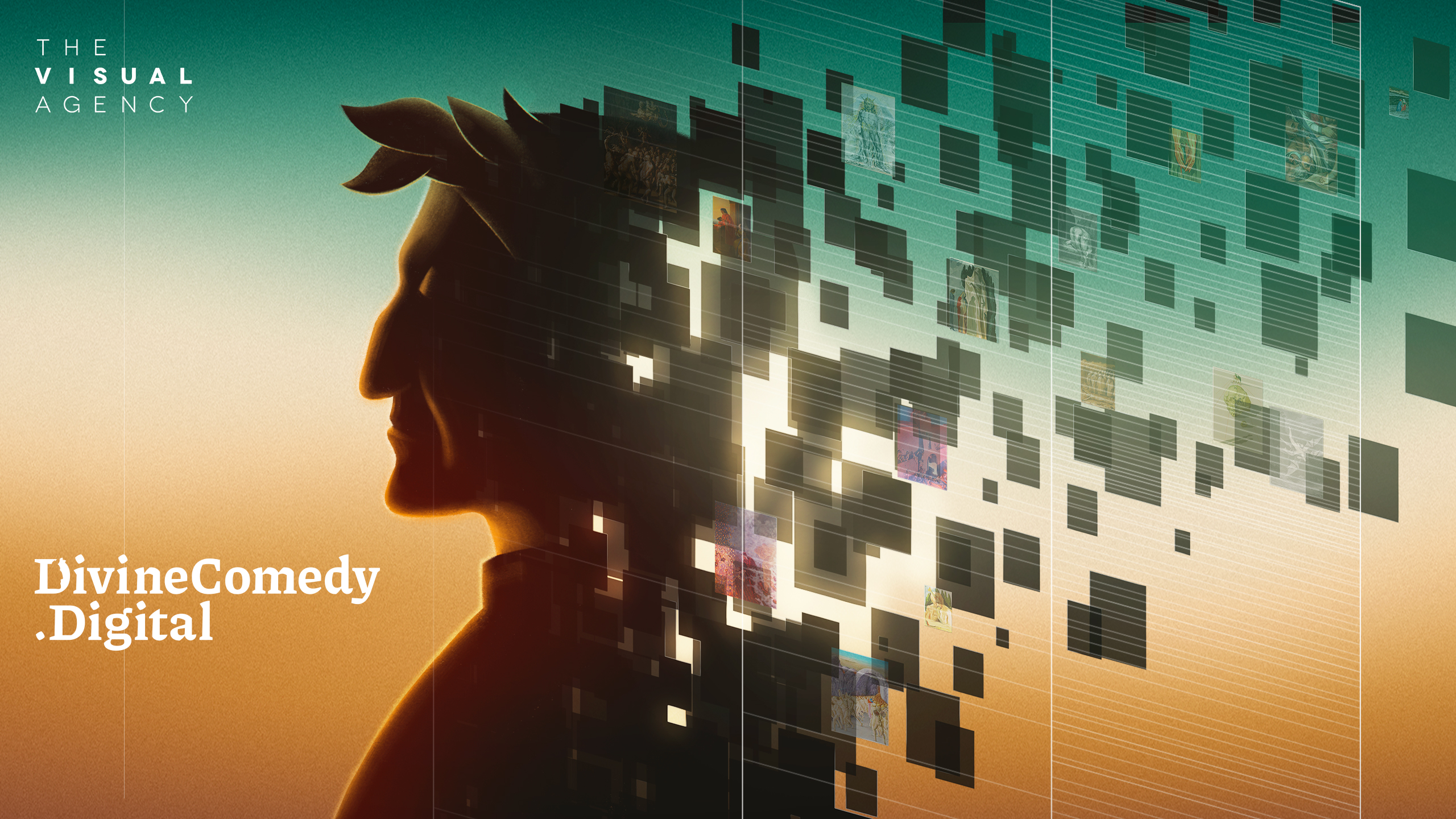
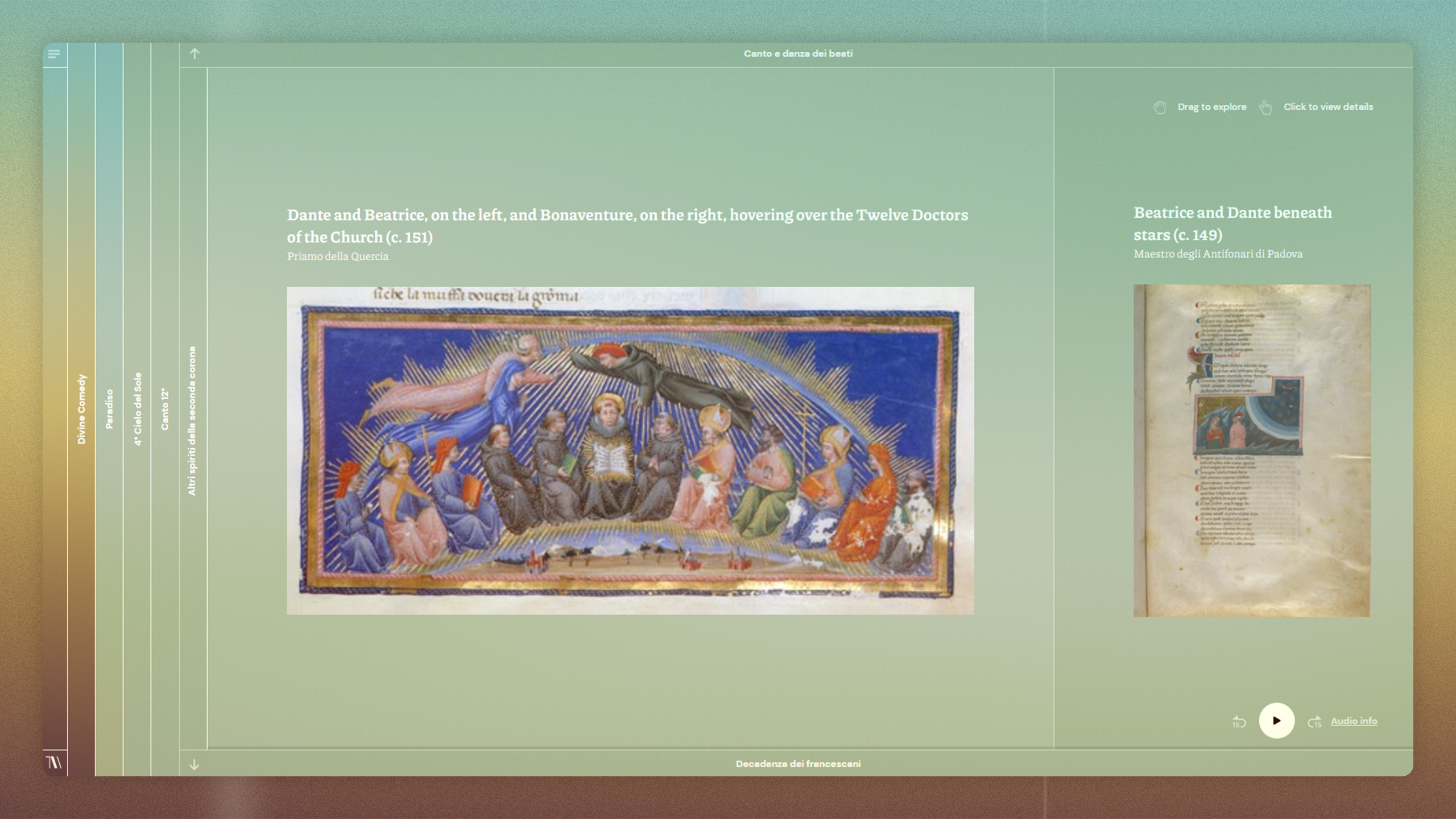
The number of artworks inspired by Dante’s Divine Comedy in the seven hundred years since the poet completed his epic, vernacular masterwork is so vast that referring to the poem inevitably means referring to its illustrations. These began appearing decades after the poet’s death, and they have not stopped appearing since. Indeed, it might be fair to say that the title Divine Comedy (simply called Comedy before 1555) names not only an epic poem but also its many constellations of artworks and interpretations, which would have filled a modest-sized set of Dante encyclopedias before the internet.
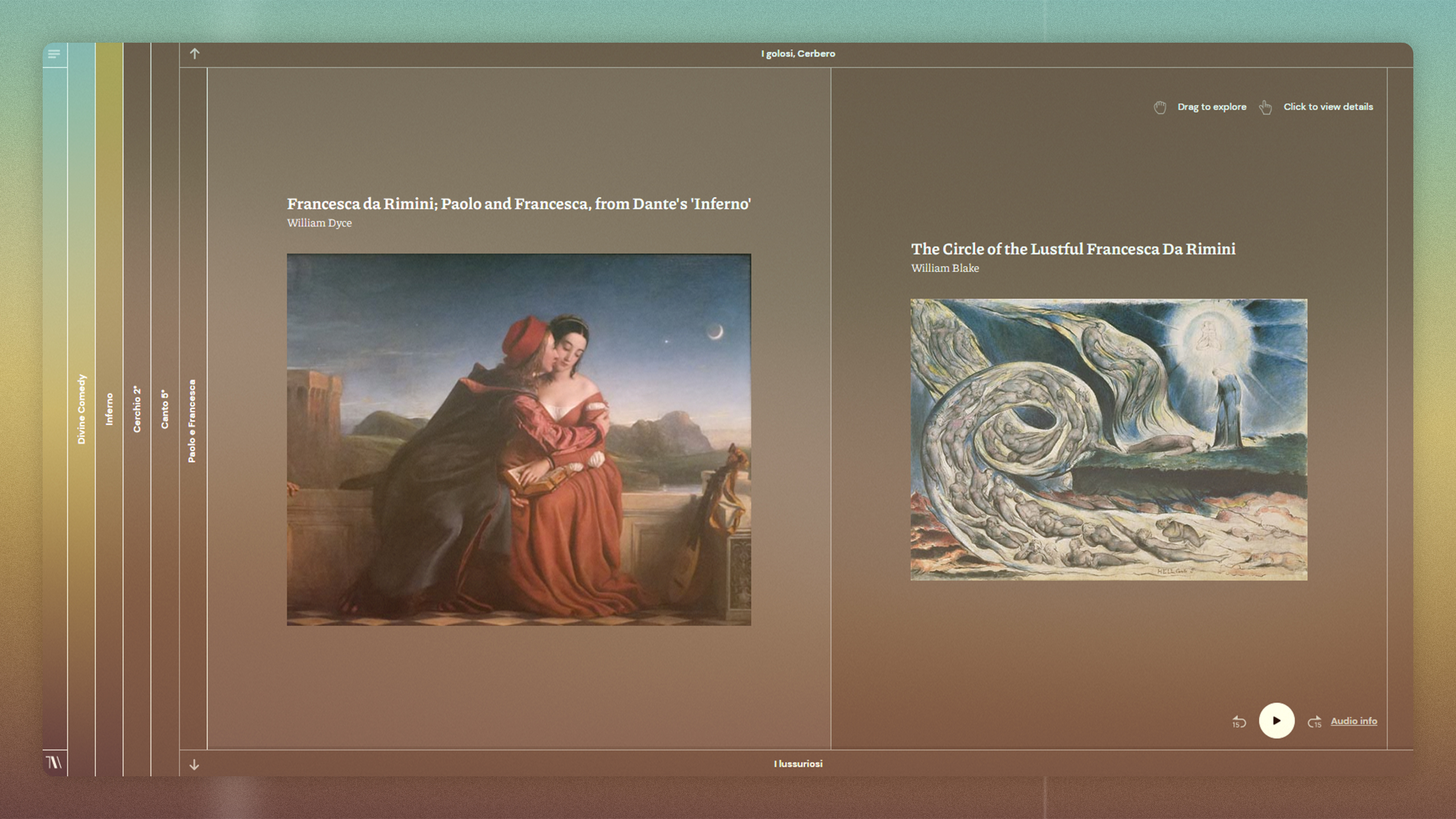
Luckily for art historians and Dante scholars working today, there is now Divine Comedy Digital, a beautifully designed database which brings these artworks — spread out all over the world — together in one virtual place.
The interface requires no special Dante knowledge to navigate, though it helps to be familiar with the poem and/or have a reference copy nearby when looking through the menus. Dividing neatly into the poem’s three books (or cantiche), the menu at the left further breaks down into circles (Inferno), terraces (Purgatorio), and Cantos (all three books).
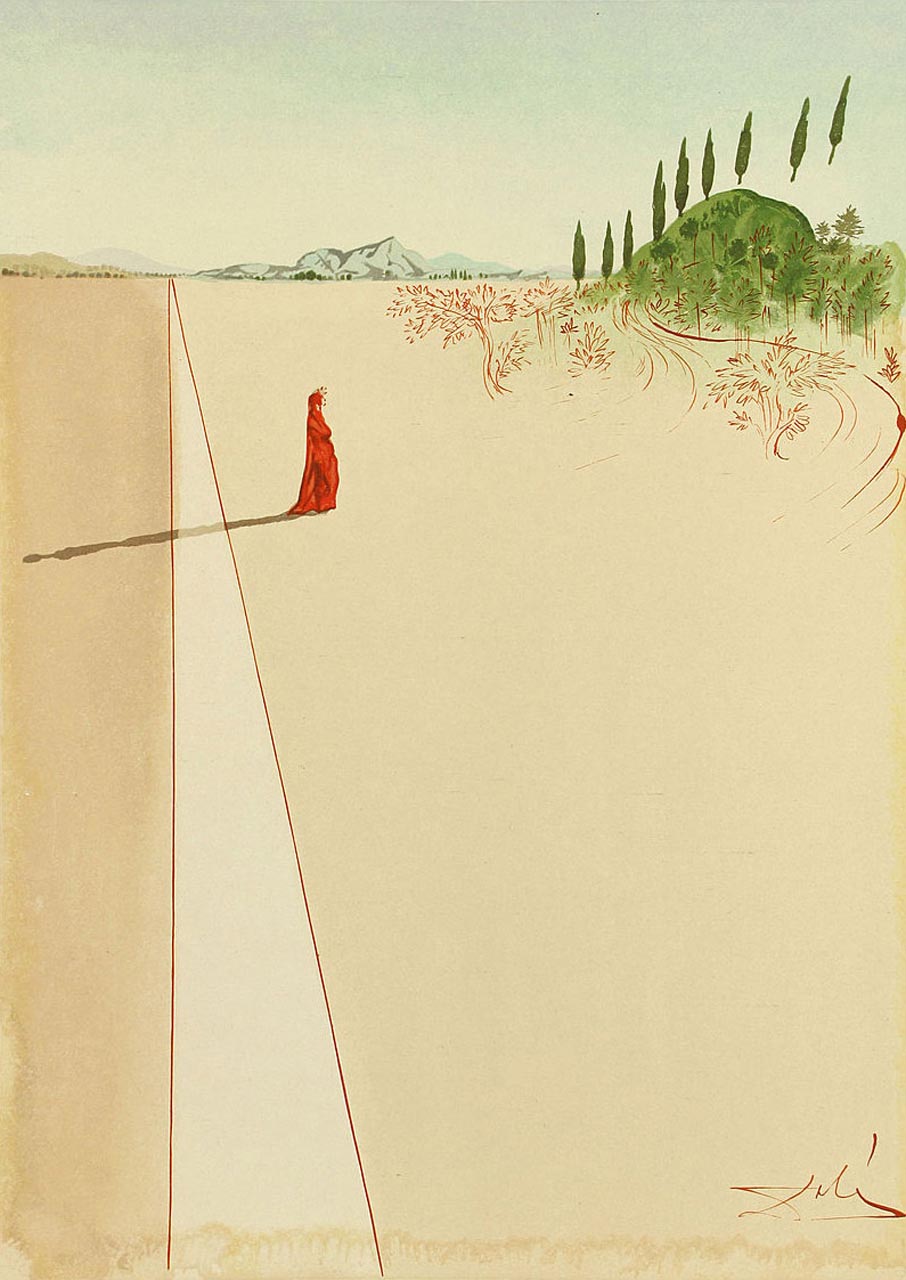
Toggling between options in a menu on the right allows visitors to see the number of illustrated verses in each Canto or the number of artworks. Within a matter of minutes, you’ll be discovering Dante illustrations you never knew existed, from Salvador Dali’s The Delightful Mount (1950, above) to Alessandro Vellutello’s Dante and St. Bernard, Mary and the Trinity (1544) and hundreds of others in the years in-between.

Calling itself a “slow surfing site,” Divine Comedy Digital contains a handy tutorial if you do get lost and allows users “not only to navigate through the collection, but also to suggest missing artworks.” So far, the 17th and 18th centuries are hugely underrepresented, though not for a lack of Dante-inspired artwork made in that two-hundred year period. The gaps mean there is much more Dante art to come.

Released in June of this year, the project is the work of The Visual Agency, “an information design agency specialized in data-visualization based in Milan and Dubai” and was created to celebrate the 700th anniversary of Dante’s death. As he continues to inspire artists for the next few hundred years, perhaps the work based on his epic poem will trend more digital than medieval, creating interpretations the poet never could have dreamt. Enter the Divine Comedy Digital project here.
You can also see some of the earliest illustrated editions of Dante’s Divine Comedy (1487–1568), courtesy of Columbia University, here.
Related Content:
A Free Course on Dante’s Divine Comedy from Yale University
Mœbius Illustrates Dante’s Paradiso
Hear Dante’s Inferno Read Aloud by Influential Poet & Translator John Ciardi (1954)
A Digital Archive of the Earliest Illustrated Editions of Dante’s Divine Comedy (1487–1568)
Josh Jones is a writer and musician based in Durham, NC. Follow him at @jdmagness.
Read More...Neil Young Plays “Hey, Hey, My, My” with Devo: Watch a Classic Scene from the Improvised Movie Human Highway (1980)
For Neil Young fans, the words “Human Highway” can mean one of three different things, two of which are so unlike the third, it’s as if they came from different artists. First, there’s “Human Highway,” the song, one of Young’s gentle acoustic rags, with Nicolette Larson’s soft vocal harmonies and lots of banjo and fiddle. It landed on 1978’s Comes a Time but debuted five years earlier, nearly becoming the title track for a CSNY album that never materialized, a legendary follow-up to Déjà Vu.
None of this has anything to do with Human Highway, the 1980 film directed by Neil Young (as “Bernard Shakey”) and Dean Stockwell, which tells the “story,” if it can be called, of a crooked diner owner in a small town next to a nuclear power plant staffed by the members of Devo as “nuclear garbagepersons.” The cast is cult film royalty: “Dennis Hopper is a psychotic cook named Crackers,” notes critic Steven Puchalski, “Sally Kirkland is a beleaguered waitress; [Stockwell] is the new owner, Young Otto (son of the late Old Otto); plus Neil Young and Russ Tamblyn are frighteningly convincing as two noodle-headed gas pump operators, Lionel and Fred.”
The film is set on the last day before a nuclear apocalypse, a slapstick take on the time’s nuclear anxiety and Young’s stance against nuclear power. His nerdy Lionel idolizes rock star Frankie Fontaine (also Young), then becomes him in a dream sequence full of “wooden Indians” — his backing band. He then jams out with Devo for ten minutes (top) one of the highlights of the film, a performance of “Hey, Hey, My, My” with Mark Mothersbaugh taking lead vocals as Devo character “Booji Boy” (pronounced “boogie boy”).
“By normal standards,” Puchalski writes, “the movie sucks, but it’s a Mutant Must-See for Rock-‘N’-Schlock Completists.” It could also be one of the most influential indie films of the eighties, argues Den of Geek’s Jim Knipfel, leaving its mark on everything from Alex Cox’s Repo Man to David Lynch’s Blue Velvet (in which Hopper and Stockwell play somewhat similar characters) and Twin Peaks (in which Russ Tamblyn appears), to Tim Burton’s Pee Wee Herman’s Big Adventure.
Or maybe Young “was simply cursed to be ten minutes ahead of his time,” given that hardly anyone saw Human Highway in 1982. Shot over four years, and mostly financed by Young himself, Human Highway saw a limited release in L.A. then disappeared until a 1996 VHS edit of the film brought it some renown and critical reappraisal. (Its cover quoted an agent at William Morris saying, “It’s so bad, it’s going to be huge.”) The film has since become a cult classic, warranting special screenings like a reunion in 2016 at L.A.‘s Regal Theater featuring Young, Tamblyn, Devo’s Gerald Casale, actress Charlotte Stewart, and Cameron Crowe. (See a trailer for the DVD director’s cut release just above.)
At one point during the Q&A, Young turned to Crowe and asked, “Do you think we could get this movie made today?”. The film was made under unique conditions: “no script, improvised dialogue and a daily routine that began with someone asking him ‘What’s the plan today, Neil?’ to which he always replied ‘The plan today is no plan!’ ” It could get made, if Neil wanted to finance it (and a younger cast could handle the amount of drugs that clearly went into making the film). Given the number of digital distribution channels and Young’s fame, it could also very likely find a wide audience.
But in 1982, releasing a self-financed film, even if you were Neil Young, proved much more challenging. And in the late seventies and early eighties, one of the few ways for innovative New Wave bands like Devo to get wider notice was to catch the ear of stars like Young, who discovered them on stage in 1977 and knew he had to get them on film — before “Whip It” and their first defining hits came out — and show the rest of us what we were missing.
Related Content:
The Mastermind of Devo, Mark Mothersbaugh, Presents His Personal Synthesizer Collection
When Neil Young & Rick “Super Freak” James Formed the 60’s Motown Band, The Mynah Birds
Josh Jones is a writer and musician based in Durham, NC. Follow him at @jdmagness
Read More...An Introduction to Japanese Kabuki Theatre, Featuring 20th-Century Masters of the Form (1964)
The English language has adopted kabuki as an adjective, applied to situations where exaggerated appearances and performances are everything. Business, politics, media: name any realm of modernity, and the myriad ways in which its affairs can turn kabuki will spring to mind. A highly stylized form of dance-drama originating in the seventeenth century, it continues to stand today as a pillar of classical Japanese culture — and indeed, according to UNESCO, one piece of the Intangible Cultural Heritage of Humanity. The worldwide regard for kabuki owes in part to self-promotional efforts on the part of Japan, whose Ministry of Foreign Affairs commissioned the half-hour introductory film above.
Produced in 1964, Kabuki: The Classic Theatre of Japan holds up as a representation of the art, as well as a view of some of the mid-20th century’s master practitioners. These actors include Jitsukawa Enjaku III, Nakamura Utaemon VI, and Ichikawa Danjūrō XI, whose stage names reflect their place in an unbroken professional lineage.
In fact, Ichikawa Danjūrō XI is a predecessor of Ichikawa Ebizō XI, previously featured here on Open Culture for his work in kabuki Star Wars adaptations. The generations shown here didn’t go in for such pop-cultural hybridization, but rather plays from the traditional kabuki repertoire like Shibaraku, Musume Dōjōji, and Sukeroku, scenes from all three of which appear in the film.
“Through elaborate costumes and vivid makeup, through beautifully stylized acting and exaggerated vocalization, and highlighted with picturesque settings and colorful music, the kabuki actors create dramatic effects of extraordinary intensity within a framework of pure entertainment,” explains the narrator. And as in the early performances of Shakespeare, all the roles are played by males, specialists known as onnagata. “Because the emphasis in kabuki is on artistic performance, not realism, the onnagata is considered more capable of expressing true femininity than is possible for an actress.” This may have struck Western viewers in the 1960s as an odd notion, but the sheer foreignness of kabuki — cultural, geographical, and temporal — must have been as captivating back then as it remains today, no matter how long we’ve been throwing its name around.
Related Content:
World Shakespeare Festival Presents 37 Plays by the Bard in 37 Languages: Watch Them Online
Based in Seoul, Colin Marshall writes and broadcasts on cities, language, and culture. His projects include the Substack newsletter Books on Cities, the book The Stateless City: a Walk through 21st-Century Los Angeles and the video series The City in Cinema. Follow him on Twitter at @colinmarshall or on Facebook.
Read More...How American Bandstand Changed American Culture: Revisit Scenes from the Iconic Music Show
In a Pontiac advertisement that aired just before the 1969 episode of American Bandstand above, the year’s models are touted as “breakaway cars” — vehicles for escape without rebellion. The ad shows a handful of getaways, all ending at the dealership, presided over by a bland salesman who smiles and nods his approval. It’s an apposite choice for the program that follows — a show which, for 37 years, gave American audiences safe teenage rebellion in the wholesome container of Dick Clark’s fictional 50s record shop.
As the episode opens, the camera pans around the bodies of teenage dancers, as if they were this year’s newest models, then lands on the smiling, square-jawed Clark, the seemingly ageless host who gave approval to the proceedings for the folks back home. What was he selling?
Viewers could consume the latest dance trends and pop hits in their living rooms, then journey to the local record shop — just like the one on set! The show’s reach was huge, and most every artist who made an appearance crossed over into mainstream success.
American Bandstand began its life in 1952 on a local ABC affiliate station in Philadelphia. Then it was called Bandstandand its hosts were radio personality Bob Horn and former ad salesman Lee Stewart, whom, it was thought, “could bring some of his clients on board as advertisers,” as Steve Cohen writes at the Cultural Critic. “Stewart had no charisma and eventually was dropped from the program.” Horn continued until 1956, when he was fired from the show after a drunk-driving arrest. The show’s wholesome image belied sordid beginnings.
Clark joined at the young age of 26 to replace Horn, the hard-drinking, chain-smoking 40-year-old. Establishing an easy rapport with the show’s young dancers, who came from the local West Philadelphia Neighborhood, Clark helped return Bandstand to respectability, then pushed for it to go national, which it did in 1957, “beaming images of clean-cut, average teenagers,” notes History.com, “dancing to the not-so-clean-cut Jerry Lee Lewis’ ‘Whole Lotta Shakin’ Goin’ On’ to 67 ABC affiliates across the nation.” (A grossly ironic musical choice.)
Renamed American Bandstand, the newly national program featured a number of new elements that became part of its trademark, including the high school gym-like bleachers and the famous segment in which teenage studio guests rated the newest records on a scale from 25 to 98 and offered such criticisms as “It’s got a good beat, and you can dance to it.” But the heart of American Bandstand always remained the sound of the day’s most popular music combined with the sight of the show’s unpolished teen “regulars” dancing and showing off the latest fashions in clothing and hairstyles.
Four years after becoming the show’s host, Clark became a millionaire at age 30. Hauled before Congress in 1960 to answer payola charges, he admitted to taking a few bribes, promised to divest, and skated away on charm while a business partner confessed and resigned. At the time, he described himself as “having an interest in 33 businesses,” Becky Krystal writes at The Washington Post, “ranging from music publishers to, as The New York Times reported, an operation that made and sold a stuffed kitten for sale on American Bandstand called the Platter-Puss.” His business model was decades ahead of the industry.
“A man with an unerring sense of what Americans wanted to hear and see,” Krystal writes (or a sense of who to ask), Clark “achieved his greatest renown for an ability to connect with the taste of the post-World War II baby-boom generation. By the show’s 30th anniversary, almost 600,000 teenagers and 10,000 performers had appeared on the program. Among those to make early national appearances included Buddy Holly, James Brown, Ike and Tina Turner, and Simon and Garfunkel. Dance crazes such as the Twist and the Watusi could be traced to the ‘Bandstand’ studio.”
American Bandstand didn’t only disseminate pop culture to the masses; it also has been credited with helping to integrate American culture with its integrated format. It’s a claim largely spread, his critics allege, by Clark himself. American Studies professor Matthew Delmont argues that, while the show sold an image of integration, allowing a few Black kids from the largely integrated West Philly neighborhood to appear, it also employed discriminatory tactics to exclude the majority of Black students who wanted to dance.
Clark may have bowed to the pressure of the times, but he was a consummate salesman who never lost a chance to make a buck. As Delmont says, he began touting the show’s history of integration when American Bandstand faced stiff competition in the 70s from upstart rival Soul Train,a show that taught a new, post-boomer, post-Civil Rights generation of kids how to dance, and whose smooth-voiced creator-host Don Cornelius made the square-jawed Clark look like a total square. See many more clips and edited episodes of American Bandstand from 1963–1970, before Soul Train considerably upped the ante for dance shows everywhere, on YouTube here.
Related Content:
Josh Jones is a writer and musician based in Durham, NC. Follow him at @jdmagness
Read More...Do We Outgrow the Music of Our Youth? Pretty Much Pop: A Culture Podcast #99
What long-term effects do songs that we’re exposed to early have on our adult tastes? As children we (hopefully) learn to love music, but then our critical faculties and peer pressure kick in, and many early influences become unacknowledged or transformed into guilty pleasures. Is the generation gap in musical taste really just due to how styles change over time (and we old folks just don’t get the new sound), or are there more fundamental reasons why it’s easier for younger people to absorb new music?
Today’s panel includes your host Mark Linsenmayer plus Erica Spyres, Brian Hirt, and The Hustle podcast host Jon Lamoreaux. They share their own experiences, songs from yesteryear that they have complicated feelings about now, and get into related topics like the activities of former pop stars and nostalgia in film soundtracks.
A few particular tracks that we mention are Go West’s “King of Wishful Thinking,” Jo Boxers’ “Just Got Lucky,” Jethro Tull’s “Songs from the Wood,” and The Cars’ “Magic.” Can a pretty Steve Howe intro redeem this Asia cheesefest?
A few articles we consulted included:
- “Why Old People Hate New Music” by Frank McAndrew
- “We Stop Discovering New Music at Age 30, a New Survey Suggests — Here Are the Scientific Reasons Why This Could Be” by Linsay Dodgson
- “Inside the Heads of People Who Don’t Like Music” by Divya Abhat
Follow Jon’s podcast @thehustlepod. To get an idea of the formats of The Hustle as compared to Mark’s Nakedly Examined Music, why not take a deep dive on Grand Funk Railroad’s amazing Mark Farner who appeared on both? …NEM, Hustle.
Hear more of this podcast at prettymuchpop.com. This episode includes bonus discussion that you can access by supporting the podcast at patreon.com/prettymuchpop. This podcast is part of the Partially Examined Life podcast network.
Pretty Much Pop: A Culture Podcast is the first podcast curated by Open Culture. Browse all Pretty Much Pop posts.
Read More...Andy Warhol’s Art Explained: What Makes His Iconic Campbell’s Soup Cans & Marilyn Monroe Diptych Art?
Pop Art looks out into the world. It doesn’t look like a painting of something, it looks like the thing itself. — Artist Roy Lichtenstein
By 2021, most of us accept that Andy Warhol’s Campbell’s Soup Cans are art, but there are some who are still not confident as to why.
No shame in that.
Art Historian Steven Zucker and the Khan Academy’s Sal Khan tackle the question head on in the below video, concluding that the work is not only a reflection of the time in which it was created, but that the enormity of its impact was made possible by that timing.
Forty-five years before Warhol escorted those lowly, instantly recognizable soup cans from the supermarket to the far loftier realm of museum and gallery, the art world was thrown into an uproar over Marcel Duchamp’s provocative readymade, Fountain, a prefabricated urinal submitted to the Society of Independent Artists inaugural exhibition as the work of the fictitious R. Mutt. The Tate Modern’s website summarizes its importance:
Fountain tested beliefs about art and the role of taste in the art world. Interviewed in 1964, Duchamp said he had chosen a urinal in part because he thought it had the least chance of being liked (although many at the time did find it aesthetically pleasing). He continued: ‘I was drawing people’s attention to the fact that art is a mirage. A mirage, exactly like an oasis appears in the desert. It is very beautiful until, of course, you are dying of thirst. But you don’t die in the field of art. The mirage is solid.’
Campbell’s soup cans possess a similar solidity.
The familiar label dates back to 1898 when a Campbell’s exec drew inspiration from Cornell University’s red and white football uniforms.
A full page magazine ad from 1934 introduces Cream of Mushroom and Noodle with Chicken (soon to become Chicken Noodle) by reminding readers to “Look for the Red-and-White Label.”
By 1962, Campbell’s had given consumers their pick of 32 flavors, and Warhol painted all 32 of them. Not the contents. Just those uniform cans.
Los Angeles’ Ferus Gallery sold five of them before gallerist Irving Blum realized that their impact was greatest when all 32 were displayed together, to echo how consumers were used to seeing the real thing.
Warhol had a personal connection to his subject matter, but it wasn’t like he set out to rep a lifelong favorite. Rather, he was following up on a friend’s suggestion to paint something everyone would would recognize, with or without passionate feelings. (He seemed to be without:)
I used to drink it. I used to have the same lunch every day, for 20 years, I guess, the same thing over and over again.
Warhol brought a successful commercial illustrator’s eye to his Campell’s Soup Cans, capitalizing on the public’s existing knowledge. The colors, the custom cursive logo over the sans serif flavor font, and the shape of the cans had couched themselves in the early-60s American consciousness.
As had industrialization as the overarching system by which most lives were ordered. The artist may not have offered overt comment on mass produced items, convenience foods, or brand loyalty. He just depended on the public to be so intimately acquainted with them, they had faded into the wallpaper of their daily lives.
Nor was the public overly accustomed to everyday objects reconceptualized as art. These days, we’re a bit blasé.
Warhol’s subject matter may have been prosaic, but his timing, Khan and Zucker tell us, could not have been better.
As Campbell’s is to soup, Marilyn Monroe is to celebrity — an enduring household name. Her sexy, youthful image is imprinted on fans born decades after her death.
The most universal Marilyn is the one from the Niagara publicity still, immortalized in acrylic and silkscreen in Warhol’s Marilyn Diptych. One of his most defining works, it was produced the same year as his soup cans (and Monroe’s suicide at the age of 36).
In considering this work for his ongoing series, Great Art Explained, gallerist James Payne delves into Warhol’s fascination with multiples, celebrity, religious iconography, machination, and death, noting that “both Warhol and Marilyn understood transformation”:
From early on in his career, Andy Warhol had an extraordinary ability of finding the sacred in the profane.… He was a product of the Eastern European immigrant experience who himself became an icon, a shy, gay, working class man who became the court painter of the 1970s, an artist who embraced consumerism, celebrity and the counterculture and changed modern art in the process.
Related Content:
Andy Warhol Demystified: Four Videos Explain His Groundbreaking Art and Its Cultural Impact
Take a Virtual Tour of the Andy Warhol Exhibition at the Tate Modern
Ayun Halliday is an author, theatermaker, and Chief Primatologist of the East Village Inky zine. Follow her @AyunHalliday
Read More...Support Us
We're hoping to rely on loyal readers, rather than erratic ads. Please click the Donate button and support Open Culture. You can use Paypal, Venmo, Patreon, even Crypto! We thank you!

About Us

Open Culture scours the web for the best educational media. We find the free courses and audio books you need, the language lessons & educational videos you want, and plenty of enlightenment in between.
Advertise With Us
FREE UPDATES!
GET OUR DAILY EMAIL
Get the best cultural and educational resources on the web curated for you in a daily email. We never spam. Unsubscribe at any time.
FOLLOW ON SOCIAL MEDIA
Open Culture editor Dan Colman scours the web for the best educational media. He finds the free courses and audio books you need, the language lessons & movies you want, and plenty of enlightenment in between.
Advertise With Us

