An Introduction to Nicolas Bourbaki, One of the Most Influential Mathematicians of All Time … Who Never Actually Lived
In 20th-century mathematics, the renowned name of Nicolas Bourbaki stands alone in its class — the class, that is, of renowned mathematical names that don’t actually belong to real people. Bourbaki refers not to a mathematician, but to mathematicians; a whole secret society of them, in fact, who made their name by collectively composing Elements of Mathematic. Not, mind you, Elements of Mathematics: “Bourbaki’s Elements of Mathematic — a series of textbooks and programmatic writings first appearing in 1939—pointedly omitted the ‘s’ from the end of ‘Mathematics,’ ” writes JSTOR Daily’s Michael Barany, “as a way of insisting on the fundamental unity and coherence of a dizzyingly variegated field.”
That’s merely the tip of Bourbaki’s iceberg of eccentricities. Formed in 1934 “by alumni of the École normale supérieure, a storied training ground for French academic and political elites,” this group of high-powered mathematical minds set about rectifying their country’s loss of nearly an entire generation of mathematicians in the First World War. (While Germany had kept its brightest students and scientists out of battle, the French commitment to égalité could permit no such favoritism.) It was the pressing need for revised and updated textbooks that spurred the members of Bourbaki to their collaboratively pseudonymous, individually anonymous work.
“Yet instead of writing textbooks,” explains Quanta’s Kevin Hartnett, “they ended up creating something completely novel: free-standing books that explained advanced mathematics without reference to any outside sources.” The most distinctive feature of this already unusual project “was the writing style: rigorous, formal and stripped to the logical studs. The books spelled out mathematical theorems from the ground up without skipping any steps — exhibiting an unusual degree of thoroughness among mathematicians.” Not that Bourbaki lacked playfulness: “In fanciful and pun-filled narratives shared among one another and alluded to in outward-facing writing,” adds Barany, “Bourbaki’s collaborators embedded him in an elaborate mathematical-political universe filled with the abstruse terminology and concepts of modern theories.”
You can get an animated introduction to Bourbaki, which survives even today as a still-prestigious and at least nominally secret mathematical society, in the TED-Ed lesson above. In the decades after the group’s founding, writes lesson author Pratik Aghor, “Bourrbaki’s publications became standard references, and the group’s members took their prank as seriously as their work.” Their commitment to the front was total: “they sent telegrams in Bourbaki’s name, announced his daughter’s wedding, and publicly insulted anyone who doubted his existence. In 1968, when they could no longer maintain the ruse, the group ended their joke the only way they could: they printed Bourbaki’s obituary, complete with mathematical puns.” And if you laugh at the mathematical pun with which Aghor ends the lesson, you may carry a bit of Bourbaki’s spirit within yourself as well.
Related Content:
Beautiful Equations: Documentary Explores the Beauty of Einstein & Newton’s Great Equations
The Mathematics Behind Origami, the Ancient Japanese Art of Paper Folding
The Unexpected Math Behind Van Gogh’s Starry Night
Can You Solve These Animated Brain Teasers from TED-Ed?
The Map of Mathematics: Animation Shows How All the Different Fields in Math Fit Together
Why the World’s Best Mathematicians Are Hoarding Japanese Chalk
Based in Seoul, Colin Marshall writes and broadcasts on cities, language, and culture. His projects include the Substack newsletter Books on Cities, the book The Stateless City: a Walk through 21st-Century Los Angeles and the video series The City in Cinema. Follow him on Twitter at @colinmarshall or on Facebook.
Read More...Hear Louis Armstrong’s Last Reel-to-Reel Tape, Made Hours Before His Death (1971)
50 years ago today Louis Armstrong made his final reel-to-reel tape. After concluding it with “April in Paris” from the “Ella and Louis” album he went to sleep and passed away. This video contains the final minute of “April in Paris” directly transferred from that last tape. pic.twitter.com/9zq9jWtiPj
&mdash Louis Armstrong (@ArmstrongHouse) July 5 2021
When Louis Armstrong first recorded “Hello, Dolly!”, in 1963, he “found the song trite and lifeless,” says his biographer Laurence Bergreen, a surprising fact since it became one of his signature tunes. “Armstrong had transformed the song, infusing it with irrepressible spirit and swing,” Marc Silver writes at NPR. He did so all the way to the end of his life, playing “Hello, Dolly!” after accepting an award at the National Press Club in one of his final performances on January 29, 1971. “He sang in a voice more gravelly than ever” and performed despite the fact that he “was under doctor’s orders not to break out his trumpet” after a heart attack that nearly felled the jazz giant. He died five months later on the morning of July 6th.
Armstrong spent July 5th, 1971, his final night, at home, relaxing and recording reel-to-reel tapes in his den at his home in Corona, Queens. Transferring his music to tape and making covers with his own collage art had been a decades-long hobby for Armstrong, a lifelong archivist and memoirist. “
It appears,” the Louis Armstrong House notes, “his [tape] numbering system got well into the 400s.” In 2009, Armstrong House Archivist Ricky Riccardi ran across an oddity, an unnumbered tape with no art on the cover. The only identifying information came from a note on the box in Armstrong’s wife’s Lucille’s handwriting, “Last Tape recorded by Pops. 7/5/71.”
As Riccardi explains in a post here (from a longer series on the last two years of Armstrong tapes), it would take five more years before he discovered the contents of the final Armstrong tape — an audio document of the LPs Satchmo listened to just hours before his death.
“Finally,” Riccardi writes, “around 11 a.m. on an early February day [in 2013], I was ready. I explained to my volunteer, Harvey Fisher, what was about to happen. I went into the stacks, grabbed the tape, sat at the tape deck and loaded the tape onto the hub. I hit ‘Play’ and held my breath as it started spinning.” What came out was “Listen to the Mockingbird” from Armstrong’s 1952 collaboration with Gordon Jenkins, Satchmo in Style.
“I felt tears in my eyes while dubbing it,” Riccardi writes. After recording this song, Armstrong flipped the record over, recorded the second side, then went on to record the entire 2‑LP set of Satchmo at Symphony Hall, “probably with fond memories of the musicians and friends on that album who were no longer living.” Finally, Armstrong put on his first, 1956 collaboration with Ella Fitzgerald, an album, writer and musician Tom Maxwell argues, that made a “cultural leap [in] the middle of that tumultuous century, that two black performers could be considered the best interpreters of white show tunes, and that the extemporaneous heart of jazz could elevate the whole to iconic status, desegregating American popular culture in just eleven songs.”
After the final song, “Louis left his den and headed down the hallway to his bedroom,” Riccardi writes, where, Lucille says, he “was feeling frisky and tried to initiate ‘the vonce.’ She declined, fearing for his health. He went to sleep. About 5:30 in the morning of July 6, Louis Armstrong passed away in his sleep…. Can you think of a better way to go out?” It was a peaceful end to a hard life lived in devotion to spreading his musical joy. You can hear a playlist compiled by Riccardi of most of the music from Armstrong’s 1969–1971 tapes above. It starts with “Hello Dolly!” and ends with the last song on Ella and Louis, and on Armstrong’s final reel-to-reel tape, the last song he ever heard: “April in Paris.”
Related Content:
Louis Armstrong Remembers How He Survived the 1918 Flu Epidemic in New Orleans
When Louis Armstrong Stopped a Civil War in The Congo (1960)
Josh Jones is a writer and musician based in Durham, NC. Follow him at @jdmagness.
Read More...Leon Theremin Advertises the First Commercial Production Run of His Revolutionary Electronic Instrument (1930)
“The theremin specifically, and Leon Theremin’s work in general is the biggest, fattest, most important cornerstone of the whole electronic music medium. That’s were it all began.” — Robert Moog
In the mid-twentieth century, the theremin — patented by its namesake inventor Leon Theremin (Lev Sergeyevich Termen) in 1928 — became something of a novelty, its sound associated with sci-fi and horror movies. This is unfortunate given its pedigree as the first electronic musical instrument, and the only musical instrument one plays without touching. Such facts alone were not enough to sell the theremin to its first potential players and listeners. The inventor and his protege Clara Rockmore realized they had proved the theremin was not only suitable for serious music but for the most beloved and well-known of compositions, a strategy not unlike the Moog synthesizer’s popularization on Wendy Carlos’ Switched on Bach.

Photo by Science Museum Group
© The Board of Trustees of the Science Museum, shared under Creative Commons Attribution NonCommercial-ShareAlike 4.0 License
For Theremin and Rockmore, demonstrating the new instrument meant more than making records. When he arrived in the United States in 1928, the inventor had just wrapped a long European tour. He showed off his new musical device in the U.S. at the New York Philharmonic. “At first, Theremin’s instruments were limited to just a few that the inventor himself personally made,” notes RCATheremin.
He then “trained a small group of musicians in the art of playing them.” The sound began to catch on with such popular musicians as crooner Rudy Vallée, “who developed such a fondness for the theremin,” writes Theremin player Charlie Draper, “that he commissioned his own custom instrument from Leon Theremin, and featured it in performances of his orchestra, The Connecticut Yankees.”

Photo by Science Museum Group
© The Board of Trustees of the Science Museum, shared under Creative Commons Attribution NonCommercial-ShareAlike 4.0 License
In the same year that Vallée and Charles Henderson released their popular song “Deep Night,” Theremin granted production rights to the instrument to RCA, and the company produced a limited test run of 500 machines. As RCATheremin points out, these were hardly accessible to the average person:
Factory-made RCA Theremins were first demonstrated in music stores in several major U.S. cities on October 14, 1929 and were marketed primarily in 1929 and 1930. Theremins were luxury items, priced at $175.00, not including vacuum tubes and RCA’s recommended Model 106 Electrodynamic Loudspeaker, which brought the total cost of buying a complete theremin outfit up to about $232.00. This translates to about $3,217 in today’s currency.
The prohibitive price of the RCA Theremin would doom the design when the stock market crashed later that year. Other factors contributed to its demise, such as a “significant miscalculation on the part of RCA,” who encouraged “the perception that the theremin was easy to play.” Advertising copy claimed it involved “nothing more complicated than waving one’s hands in the air!”
As masterful players, Theremin and Rockmore might have made it look easy, but as with any musical instrument, true skill on the therein requires talent and practice. To advertise the new commercial design by RCA, Theremin himself appeared in “the relatively new medium of sound film” in 1930, playing Henderson and Vallée’s “Deep Night” (top). Draper and pianist Paul Jackson recreate the moment just above, on a fully restored RCA theremin nicknamed “Electra.”
Only around 136 of the RCA theremins survive, some of them made by Theremin himself and others by different engineers. They are now among the rarest electric devices of any kind. See one of them, serial number 100023, further up, a resident of the National Science and Media Museum in Bradford, UK, and learn much more about the rare RCA Theremins here.
Related Content:
Wendy Carlos Demonstrates the Moog Synthesizer on the BBC (1970)
Josh Jones is a writer and musician based in Durham, NC. Follow him at @jdmagness.
Read More...Hear Bach’s Brandenburg Concertos Played on Original Baroque Instruments
“Subtle and brilliant at the same time, they are a microcosm of Baroque music, with an astonishingly vast sample of that era’s emotional universe.” — Ted Libbey
The portfolio, the demo, the head shot, the resume…. These are not materials made for general consumption, much less the praise and admiration of posterity. But not every applicant is Johann Sebastian Bach, who wrote his six Brandenburg concertos, in essence, “because, like pretty much everyone throughout history, Bach needed a job,” notes String Ovation. In 1721, he applied for a position with the Margrave of Brandenburg, younger brother of King Frederick Wilhelm I of Prussia, by sending the music: “It’s one of the few manuscripts that Bach wrote out himself, rather than give to a copyist…. At the time, Bach was the Kapellmeister in the small town of Cöthen. Working for His Royal Highness would have been a seriously upward move.”
He didn’t get the job. Indeed, it seems his application was ignored, and nearly lost several times throughout history. Now, Bach’s calling cards are some of the most virtuoso compositions of Baroque music we know. “Each concerto is a concerto grosso, a concerto that’s a continuous interplay of small groups of soloists and full orchestra…. The range of instruments with solos throughout the six concertos was designed to give opportunities to show the potential of nearly every instrument in the orchestra. Even the recorder got a solo.” The six together present themselves as an anthology of sorts, “a Baroque musical travelogue moving through ‘the courtly elegance of the French suite, the exuberance of the Italian solo concerto and the gravity of German counterpoint.’”
These pieces do not only demonstrate Bach’s compositional mastery; they also represent his “ultimate view,” as the Netherlands Bach Society points out, “of the most important large-scale instrumental genre of his day: the concerto.” In the third of these works, for example, he makes the “surprising” choice to compose for “three violins, three violas, three cellos and basso continuo. In other words, 3x3, which is a rational choice you would expect from a modernist like Pierre Boulez, rather than a Baroque composer like Bach.” In order to play these pieces the way Bach intended them to be heard, Ted Libbey writes at NPR, they must be played on the original instruments for which he composed, something a growing number of ensembles have been doing.
Voices of Music, one of the most prominent ensembles recovering the original sounds of Bach’s time, performs Concerto Number Three in G Major at the top and Concerto Number Six in B Flat just above, another surprising arrangement for the time. The final Brandenburg Concerto also upsets the musical order of things again: “Violins — usually the golden boys of the orchestra,” writes the Netherlands Bach Society, “are conspicuous by their absence! Instead, two violas play the leading role. As the highest parts, they ‘play first fiddle’ as soloists, supported by two viola da gambas, a cello, double bass and harpsichord.” The Margrave of Brandenburg, it seems had little time or interest, and never had these pieces performed by his ensemble, which may have lacked the skill and instrumentation. After hearing this music in its original glory, we can be grateful Bach’s handwritten resume survived the neglect.
Related Content:
Hear 10 of Bach’s Pieces Played on Original Baroque Instruments
Watch J.S. Bach’s “Air on the G String” Played on the Actual Instruments from His Time
Josh Jones is a writer and musician based in Durham, NC. Follow him at @jdmagness
Read More...Hiroshige, Master of Japanese Woodblock Prints, Creates a Guide to Making Shadow Puppets for Children (1842)
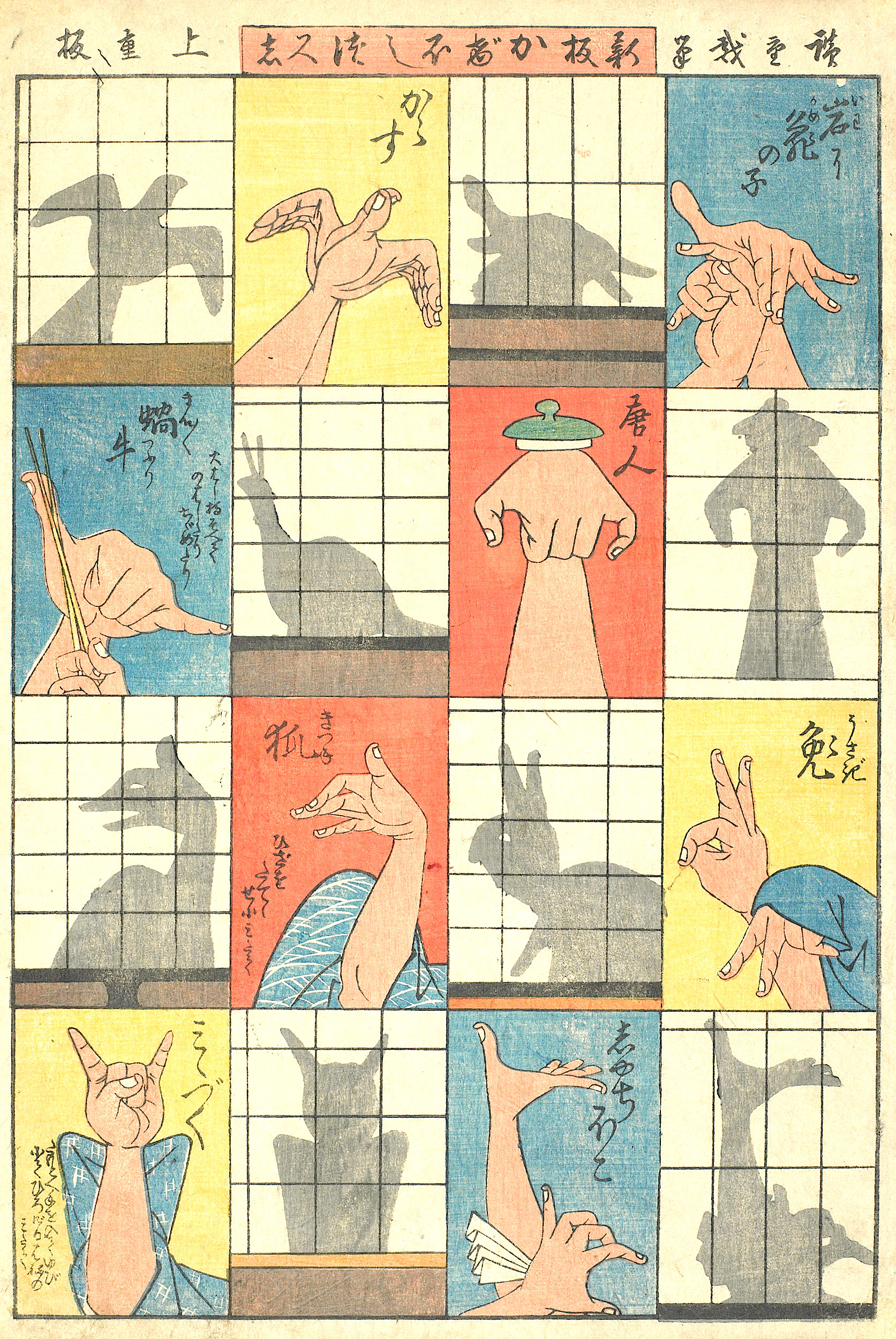
Even if the name Utagawa Hiroshige doesn’t ring a bell, “Hiroshige” by itself probably does. And on the off chance that you’ve never heard so much as his mononym, you’ve still almost certainly glimpsed one of his portrayals of Tokyo — or rather, one of his portrayals of Edo, as the Japanese capital, his hometown, was known during his lifetime. Hiroshige lived in the 19th century, the end of the classical period of ukiyo‑e, the art of woodblock-printed “pictures of the floating world.” In that time he became one of the form’s last masters, having cultivated not just a high level of artistic skill but a formidable productivity.
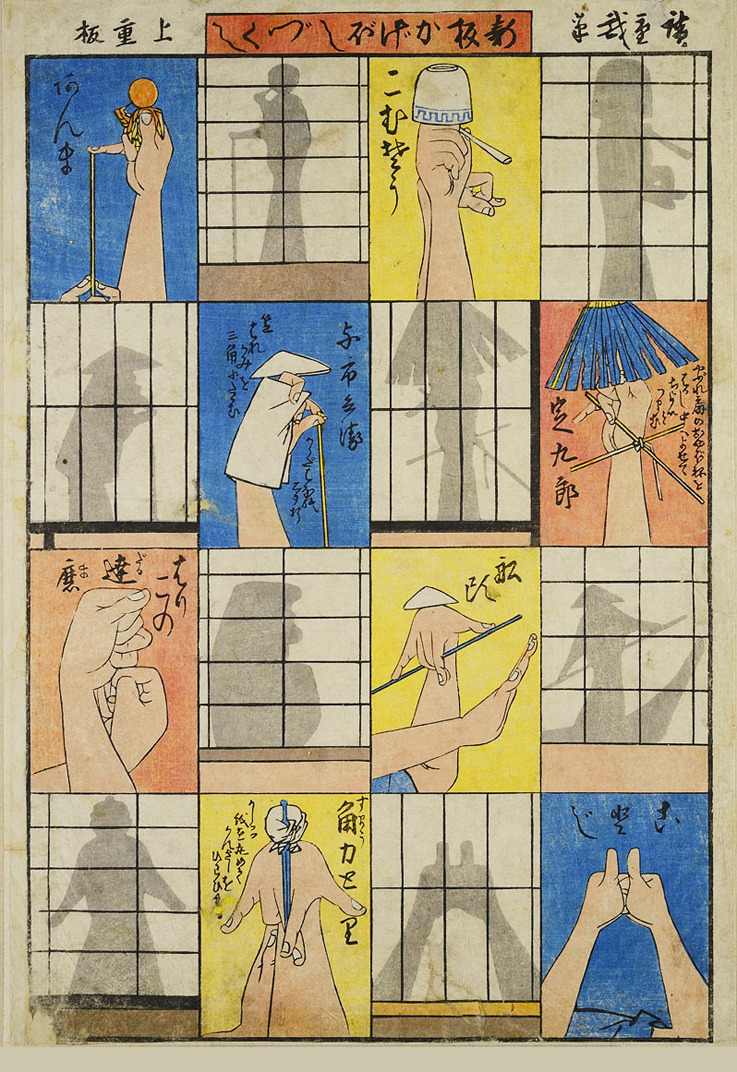
In total, Hiroshige produced more than 8,000 works. Some of those are accounted for by his well-known series of prints like The Fifty-three Stations of the Tōkaidō, The Sixty-nine Stations of the Kisokaidō, One Hundred Famous Views of Edo. But his mastery encompassed more than the urban and rural landscapes of his homeland, as evidenced by this much humbler project: a set of omocha‑e, or instructional pictures for children, explaining how to make shadow puppets.
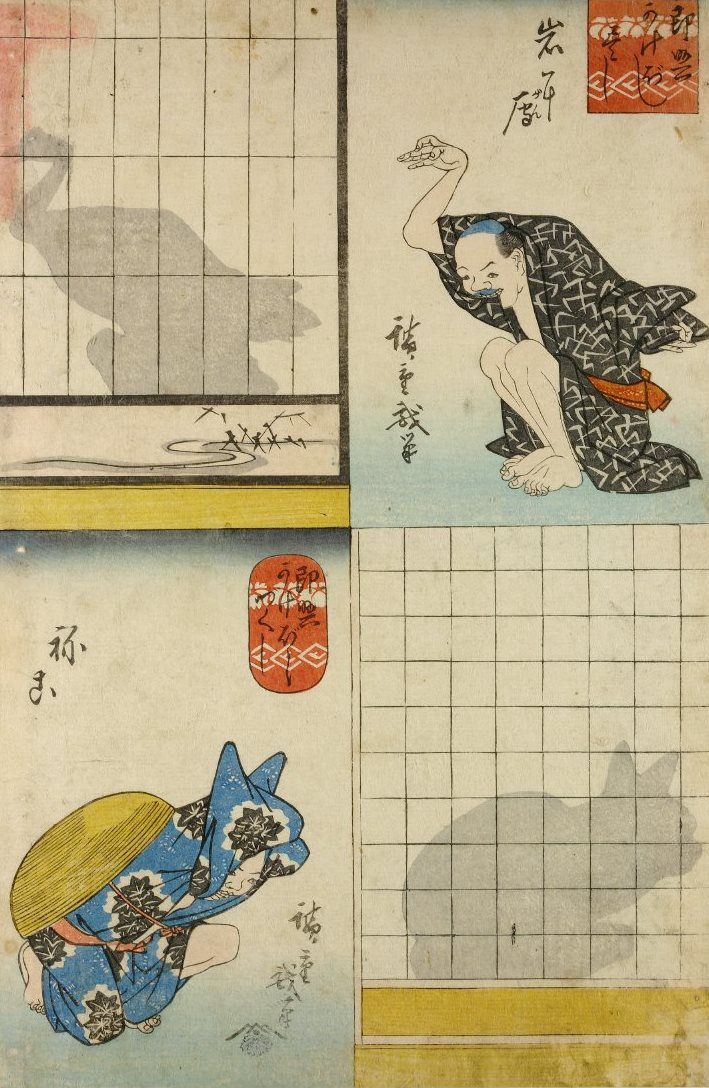
Hiroshige explains in clear and vivid images “how to twist your hands into a snail or rabbit or grasp a mat to mimic a bird perched on a branch,” writes Colossal’s Grace Ebert. “Appearing behind a translucent shoji screen, the clever figures range in difficulty from simple animals to sparring warriors and are complete with prop suggestions, written instructions for making the creatures move — ‘open your fingers within your sleeve to move the owl’s wings’ or ‘draw up your knee for the fox’s back’ — and guides for full-body contortions.” The difficulty curve does seem to rise rather sharply, beginning with puppets requiring little more than one’s hands and ending with full-body performances surely intended more for amusement than imitation.
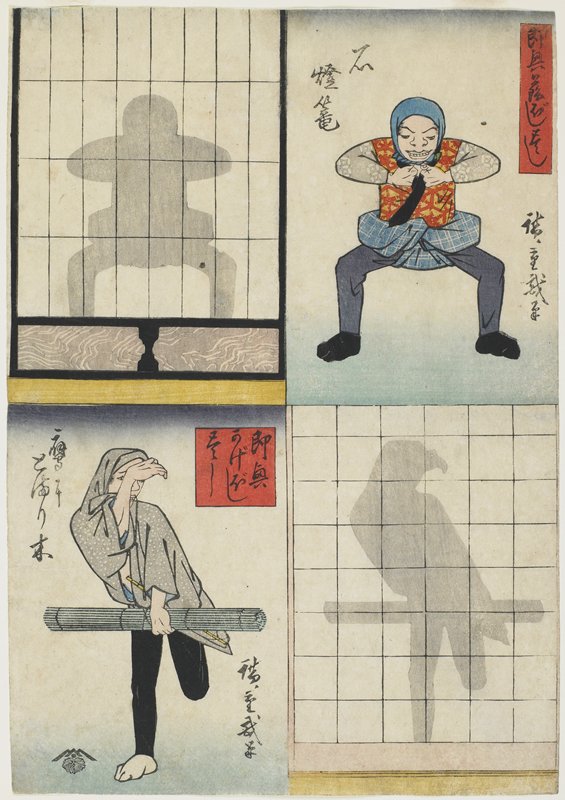
But then, kids take their fun wherever they find it, whether in 2021 or in 1842, when these images were originally published. Though it was a fairly late date in the life of Hiroshige, at that time modern Japan hadn’t even begun to emerge. The children who entertained themselves with his shadow puppets against the shoji screens of their homes would have come of age with the arrival of United States Commodore Matthew C. Perry’s “black ships,” which began the long-closed Japan’s process of re-opening itself to world trade — and set off a whirlwind of civilizational transformation that, well over a century and a half later, has yet to settle down.
Related Content:
Wagashi: Peruse a Digitized, Centuries-Old Catalogue of Traditional Japanese Candies
Jim Henson Teaches You How to Make Puppets in Vintage Primer From 1969
Based in Seoul, Colin Marshall writes and broadcasts on cities, language, and culture. His projects include the Substack newsletter Books on Cities, the book The Stateless City: a Walk through 21st-Century Los Angeles and the video series The City in Cinema. Follow him on Twitter at @colinmarshall or on Facebook.
Read More...The Intimacy of Frida Kahlo’s Self-Portraits: A Video Essay
“Culture has come to prize this quality in creative work: the ability to grab people quickly,” and “above pretty much anything else” at that. So says Evan Puschak, who should know: as the Nerdwriter, he runs a popular eponymous channel on Youtube, where everything depends on getting and holding the viewer’s increasingly fleeting attention. Even under such pressures, Puschak has managed to maintain one of the most thoughtful cultural channels around, previously featured here on Open Culture for its video essays on everything from the films of Jean-Luc Godard to the paintings of Edward Hopper to the music of Fleetwood Mac.
But it is Frida Kahlo whom the Nerdwriter credits as a master manipulator of audience attention. “Yes, there’s a sensationalistic obsession with the drama of her life, but that wouldn’t arouse nearly as much interest if it weren’t for the drama of her art — which is also sensational, but in the good way.”
The sensationalistic quality of Kahlo’s paintings owes to the “intimacy of the images” they depict, especially when they communicate “her vulnerability, her physical and emotional pain, but also her defiance and self-confidence, and the pride she so clearly has in her culture.” This comes through with special clarity in the self-portraits she created quite prolifically, and in so doing defined herself as well as the new 20th-century Mexican culture with which she came of age.
“I really, really hesitate to bring up the word selfie,” says Puschak, but “insomuch as her self-portraits are always simultaneously a recording and a performance of identity, they’re bound to be relatable to modern audiences.” In the first half of the 20th century during which Kahlo lived, painting was a relatively efficient way to produce images of oneself. Today, many of us do it dozens of times a day, at the touch of a button, marshaling few artistic resources in the process. But if selfies lack the impact of Kahlo’s self-portraits, it may owe to the ironic reason that the selfies look too good. Kahlo’s painting “has a bit of an amateurish quality to it, in its flattening of depth and skewed perspectives and anatomy.” But she used that style on purpose, paying homage to the folk art of her homeland and also making you feel as if “someone you know” painted these works. Puschak, who refers to her on a first-name basis, seemingly feels that way; but then, he’s far from the only Frida fan to do so.
Related Content:
A Brief Animated Introduction to the Life and Work of Frida Kahlo
What the Iconic Painting The Two Fridas Actually Tells Us About Frida Kahlo
Take a Virtual Tour of Frida Kahlo’s Blue House Free Online
Based in Seoul, Colin Marshall writes and broadcasts on cities, language, and culture. His projects include the Substack newsletter Books on Cities, the book The Stateless City: a Walk through 21st-Century Los Angeles and the video series The City in Cinema. Follow him on Twitter at @colinmarshall or on Facebook.
Read More...Storytelling and Race in Captain America — Pretty Much Pop: A Culture Podcast #98

What is it for a super-hero to represent America? Though the character created by Joe Simon and Jack Kirby in 1941 may have been a way to capitalize on WWII patriotism, it has since been used to ask questions about what it really means to be patriotic and how America’s ideals and its reality may conflict. We’re of course talking about race, a theme explored by Sam Wilson, formerly Cap’s side-kick, picking up the shield in the comics and now on TV (and in the forthcoming film).
Your Pretty Much Pop hosts Mark Linsenmayer, Erica, and Brian are joined by comic super-fan Anthony LeBlanc (returning from our ep. 56 on black nerds) to discuss the recent comic runs by Ta-Nehishi Coates and Nick Spencer and especially Truth: Red, White and Black, Marvel’s 2003 comics mini-series by Robert Morales and Kyle Baker that tells the story of American super-soldier experiments on unknowing black men (reminiscent of the real-life Tuskegee Syphilis Study). This was the source of the “first black Captain America” character Isaiah Bradley featured in The Falcon and the Winter Soldier Disney+ show, which we also discuss.
Here are a few articles that fed into our discussion:
- “The Power of a Skeptical Captain America” by Sophie Gilbert
- “‘The Falcon and the Winter Soldier’ Never Took Its Protagonist Seriously” by Justin Charity
- “‘The Falcon and the Winter Soldier’ Was Riddled With Contradictions” by Alison Herman
- “When Sam Wilson Became Captain America” by Brittany Matter
- “Why I’m Writing Captain America, and Why It Scares the Hell out of Me” by Ta-Nehishi Coates
- “My Secret History With Secret Empire: Looking Back At Nick Spencer’s Captain America” by Vishal Gullapalli
- “Secret Empire Creators Preview Captain America’s Assault on the Marvel Universe” by Christian Holub
- “Captain America Goes to War With Jordan Peterson” by Matthew Gault
- “Black Panther Writer Criticizes Marvel’s Treatment of Comic Creators” by Robert Wood
The final issue of Ta-Nehisi Coates’ Captain America is coming July 7.
We recommend the Captain America Comic Book Fans podcast for more information. Their recent interview with longtime editor Tom Brevoort was illuminating, and they spent eps. 33 and 34 walking through Truth: Red, White & Black.
Hear more of this podcast at prettymuchpop.com. This episode includes bonus discussion that you can access by supporting the podcast at patreon.com/prettymuchpop. This podcast is part of the Partially Examined Life podcast network.
Pretty Much Pop: A Culture Podcast is the first podcast curated by Open Culture. Browse all Pretty Much Pop posts.
Read More...Discover the 1820’s Color-Coded System for Memorizing Historical Events, Which Resembled Modern Art (1820)
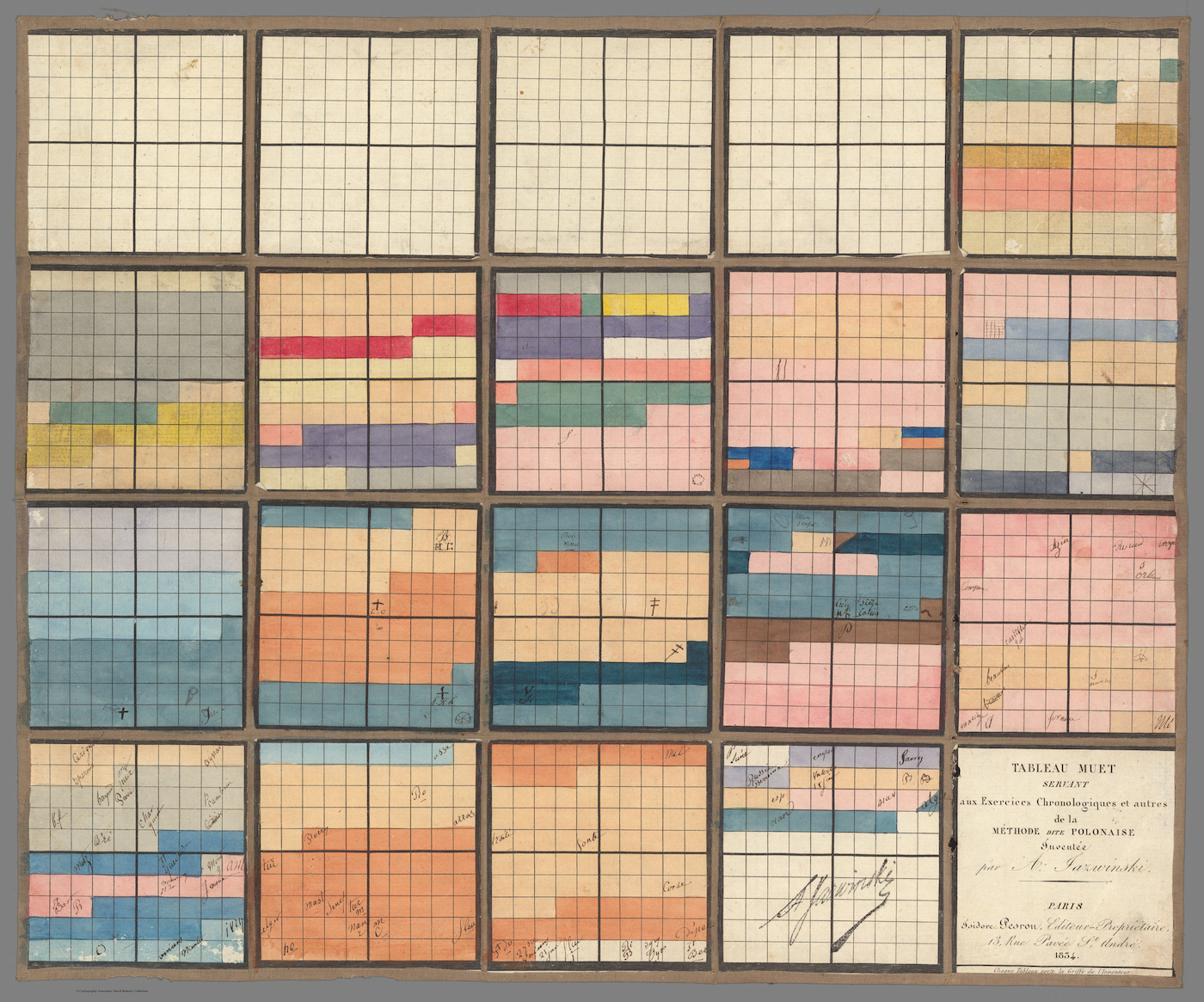
On first encountering Antoni Jażwiński’s “Polish System,” I couldn’t help but think of Incan Quipu, the system that used knotted cords to keep official records. Like Quipu, Jażwiński’s system of colored squares relies on an extreme shorthand to tell complex stories with mnemonic devices. But maybe that’s where the similarities end. Jażwiński’s invention (circa (1820) does not so much resemble other forms of communication as it does the abstract art of the following century.
“Jażwiński’s Méthode polonaise promises that the complexities of centuries can be refined into colors, lines, squares, and just a few marks,” writes Philippa Pitts at Sequitur. “Neatly arranged into a diagram that can be diligently committed to memory, the twists and turns of battles and revolutions are rendered as panes of pure gentle color, quietly plotted as coordinates in a matrix, subsumed back into the orderly progress of history.”
His attempts to impose order on life may have come to little in the end, but as an artifact of visual culture, the “Polish System” is sublime. Pitts goes on to write:
There is a wonderful resonance between Jażwiński’s chronographs and a wide range of artistic production, despite the anachronism of such comparisons. They recall Piet Mondrian’s early checkerboards and Robert Delaunay’s simultaneity. There is something reminiscent of process art here: They evoke the repetitive, cataloguing handwork of Hanne Darboven or Agnes Martin. There appears to be a common calm, comfort, catharsis, or salvation promised by the embrace of rule, order, and logic.
Jażwiński, a Polish educator, invented the system in the 1820s. It was “later brought to public attention in the 1830s and 1840s by General Józef Bem, a military engineer with a penchant for mnemonics,” notes the Public Domain Review. Such systems cropped up everywhere in 19th-century education, such as those pioneered by Emma Willard, the first woman mapmaker in the U.S. “Jażwiński’s contribution (and its later adaptations) proved one of the most popular.”
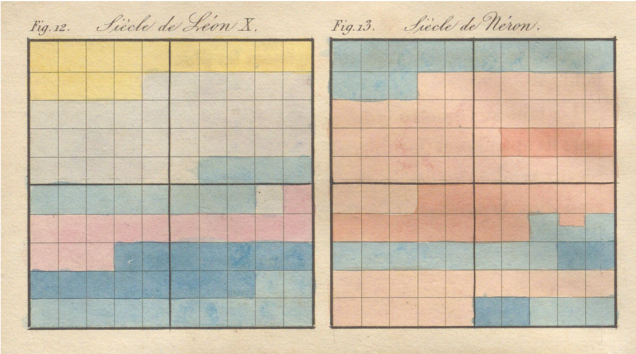
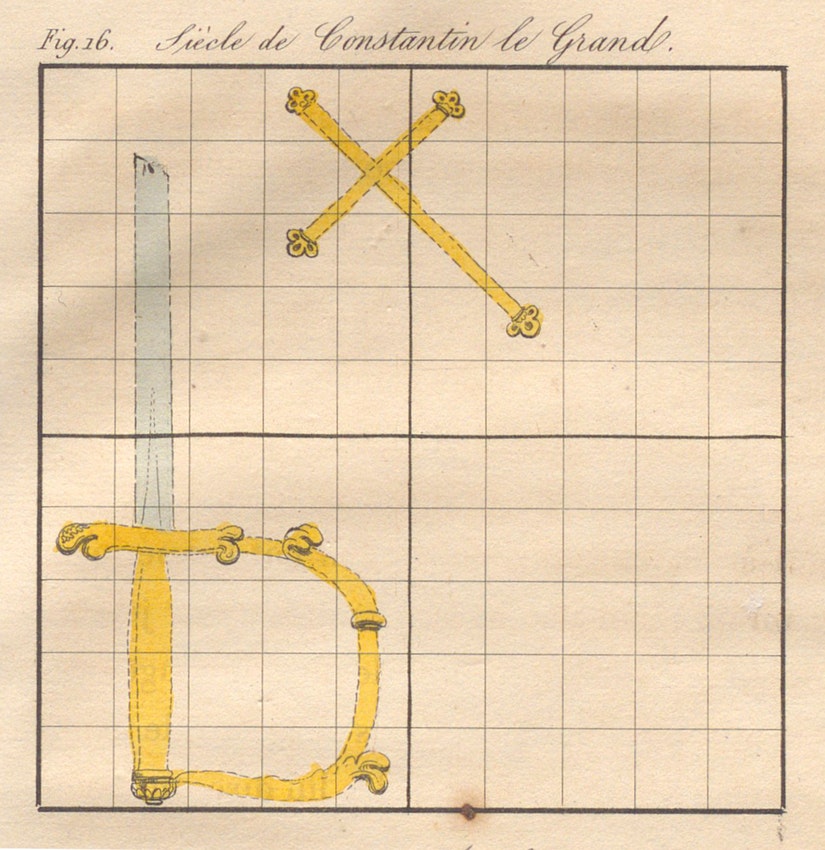
He explained his system with long paragraphs of text (which you can read here, in French), little of which students were likely to remember. What mattered was whether they could make sense of the color-coding and symbols placed inside the grid system, with each grid standing for an entire century — 100 years of human history reduced, for example, in the figure above, to one name, Constantine the Great, and two symbols, a sword and cross. This was an example of a “chronological constellation,” in which historical events take particular shapes, “sometimes it’s a chair,” Jażwiński wrote, “a sickle, a boat, a letter of the alphabet, etc.”
Even the names neatly printed above the grids are redundant, Pitts suggests. In such systems, called chronographs, “denotative text is of limited use. It is connotative visuality which further condenses the information: Flags, shields, and insignia can serve as shorthand for nations and dynasties, while looming storm clouds, bright sunbursts, and invocations of classical architecture add layers of associated meaning.” The view of history represented by such systems is quaint, at best; their oversimplifications erase more than they could ever communicate. But their visual appeal is undeniable as objects from a pre-Google past, when memorization was the only way to reliably store and access knowledge outside of books.
Related Content:
Josh Jones is a writer and musician based in Durham, NC. Follow him at @jdmagness
Read More...Haruki Murakami’s Daily Routine: Up at 4:00 a.m., 5–6 Hours of Writing, Then a 10K Run

Photo via Wikimedia Commons
Haruki Murakami has been famous as a novelist since the 1980s. But for a decade or two now, he’s become increasingly well known around the world as a novelist who runs. The English-speaking world’s awareness of Murakami’s roadwork habit goes back at least as far as 2004, when the Paris Review published an Art of Fiction interview with him. Asked by interviewer John Ray to describe the structure of his typical workday, Murakami replied as follows:
When I’m in writing mode for a novel, I get up at four a.m. and work for five to six hours. In the afternoon, I run for ten kilometers or swim for fifteen hundred meters (or do both), then I read a bit and listen to some music. I go to bed at nine p.m. I keep to this routine every day without variation. The repetition itself becomes the important thing; it’s a form of mesmerism. I mesmerize myself to reach a deeper state of mind. But to hold to such repetition for so long — six months to a year — requires a good amount of mental and physical strength. In that sense, writing a long novel is like survival training. Physical strength is as necessary as artistic sensitivity.
This stark physical departure from the popular notion of literary work drew attention. Truer to writerly stereotype was the Murakami of the early 1980s, when he turned pro as a novelist after closing the jazz bar he’d owned in Tokyo. “Once I was sitting at a desk writing all day I started putting on the pounds,” he remembers in The New Yorker. “I was also smoking too much — sixty cigarettes a day. My fingers were yellow, and my body reeked of smoke.” Aware that something had to change, Murakami performed an experiment on himself: “I decided to start running every day because I wanted to see what would happen. I think life is a kind of laboratory where you can try anything. And in the end I think it was good for me, because I became tough.”
Adherence to such a lifestyle, as Murakami tells it, has enabled him to write all his novels since, including hits like Norwegian Wood, The Wind-Up Bird Chronicle, and Kafka on the Shore. (On some level, it also reflects his protagonists’ tendency to make transformative leaps from one version of reality into another.) Its rigor has surely contributed to the discipline necessary for the rest of his output as well: translation into his native Japanese of works including The Great Gatsby, but also large quantities of first-person writing on his own interests and everyday life. Protective of his reputation in English, Murakami has allowed almost none of the latter to be published in this language.
But in light of the voracious consumption of self-improvement literature in the English-speaking world, and especially in America, translation of his memoir What I Talk About When I Talk About Running must have been an irresistible proposition. “I’ve never recommended running to others,” Murakami writes in The New Yorker piece, which is drawn from the book. “If someone has an interest in long-distance running, he’ll start running on his own. If he’s not interested in it, no amount of persuasion will make any difference.” For some, Murakami’s example has been enough: take the writer-vlogger Mel Torrefranca, who documented her attempt to follow his example for a week. For her, a week was enough; for Murakami, who’s been running-while-writing for nearly forty years now, there could be no other way.
Related Content:
Haruki Murakami Lists the Three Essential Qualities For All Serious Novelists (And Runners)
The Daily Habits of Famous Writers: Franz Kafka, Haruki Murakami, Stephen King & More
Haruki Murakami Translates The Great Gatsby, the Novel That Influenced Him Most
Haruki Murakami’s Passion for Jazz: Discover the Novelist’s Jazz Playlist, Jazz Essay & Jazz Bar
Read 12 Stories By Haruki Murakami Free Online
Based in Seoul, Colin Marshall writes and broadcasts on cities, language, and culture. His projects include the Substack newsletter Books on Cities, the book The Stateless City: a Walk through 21st-Century Los Angeles and the video series The City in Cinema. Follow him on Twitter at @colinmarshall or on Facebook.
Read More...Vincent Van Gogh’s “The Starry Night”: Why It’s a Great Painting in 15 Minutes
I had always wanted to see Van Gogh’s “The Starry Night” in person and many years ago I got a chance when I visited the Museum of Modern Art in New York. However, two dozen other people, who also wanted that chance, were there too, and my vision of Van Gogh’s masterpiece was one behind a phalanx of cell phones all trying to grab a “been there, done that” pic. Fortunately, the video above from the Great Art Explained YouTube channel takes you closer to the painting that an in-person viewing could without setting off an alarm. In 15 minutes, narrator/creator James Payne lays out the history, the creation, and the technique of “Starry Night” in great detail.
Some of the key takeaways from the video include:
1. A re-evaluation of asylums in the 19th century. While certainly many asylums for those with mental illness were despairing places, not so the small one in Saint-Rémy, in Provence. Though there were bars on the windows, Van Gogh’s views were of lush countryside and the small town nearby; views that would soon become the subject of his paintings. And the doctors realized that painting, and the freedom to work on his art, was the best thing for Van Gogh’s mental health. During his one-year stay at the asylum, he finished at least 150 paintings. “The Starry Night,” painted on June 18, 1889, was one of them.
But there were many masterpieces before that, including “Irises,” painted in the asylum’s walled garden before lunch one day; and many of the surrounding countryside once doctors decided he was safe to be let out alone.
2. The formative effect of Impressionism and Japanese ukiyo‑e on his work. From Monet and others, Van Gogh took the attention to natural light, the visible brushstrokes, and the pointillist coloring that would form new colors in the viewer’s eye. From the Japanese he took bold, bright colors and radical composition.
We can pinpoint the exact time and date of “Starry Night” and see what Van Gogh saw from his window (thanks to Griffith Park Observatory). And what we learn is…the man was an artist. He collaged the best bits of what he wanted us to see, from constellation and planets, to the village below (taken from a different viewpoint), to the cypress tree, which he brought forward in the composition. Van Gogh was taking a cue from Paul Gauguin, who encouraged him to use his imagination more, and finding the asylum led to a more active and more critical way of thinking about painting.
3. The “unappreciated-in-his-lifetime” myth. Yes, Van Gogh died too young. But no, he wasn’t an obscure artist. As Payne sends us off, he points out that Van Gogh was very much a part of the impressionist art scene, showed his paintings *and* sold them, and even had critics write about him. So, it might be better to call him a rising star, snuffed out too early. We can only wonder where he would have gone in his art, and what he would have created.
Related content:
In a Brilliant Light: Van Gogh in Arles–A Free Documentary
Ted Mills is a freelance writer on the arts who currently hosts the Notes from the Shed podcast and is the producer of KCRW’s Curious Coast. You can also follow him on Twitter at @tedmills, and/or watch his films here.
Read More...Support Us
We're hoping to rely on loyal readers, rather than erratic ads. Please click the Donate button and support Open Culture. You can use Paypal, Venmo, Patreon, even Crypto! We thank you!

About Us

Open Culture scours the web for the best educational media. We find the free courses and audio books you need, the language lessons & educational videos you want, and plenty of enlightenment in between.
Advertise With Us
FREE UPDATES!
GET OUR DAILY EMAIL
Get the best cultural and educational resources on the web curated for you in a daily email. We never spam. Unsubscribe at any time.
FOLLOW ON SOCIAL MEDIA
Open Culture editor Dan Colman scours the web for the best educational media. He finds the free courses and audio books you need, the language lessons & movies you want, and plenty of enlightenment in between.
Advertise With Us


